Astrological tarot timing turns a card into a stretch of the calendar. In the Golden Dawn system, each numbered Minor Arcana card from Two to Ten governs about ten days of the Sun's yearly path, each zodiac card of the Major Arcana points to its sign's month, and each planetary card points to that planet's cycle. The Nine of Pentacles, for example, belongs to Venus in Virgo, which the Sun crosses from about September 2 to 11.
What you get is a window to watch, not an appointment. Tarot cannot fix a date or promise that something will happen inside the window, and timing is the least reliable thing a spread does. Read that way, astrology gives a vague "soon" a shape you can plan around and check later. Simpler counting rules, such as suits standing for days, weeks or months, are covered in our guide to reading timing in tarot cards; this page stays with the zodiac.
At a glance, here is what each kind of card can point to:
- Two to Ten of each suit: one decan, roughly ten days of the year.
- The twelve zodiac trumps: one sign's month.
- The seven planetary trumps: a planet's cycle, from a lunar month to Saturn's years.
- Queens, Knights and Kings: about a month that straddles two signs.
- Aces and Pages: a quarter of the year, in one traditional scheme.
- The three elemental trumps: an element rather than a date.
Why the zodiac works as a tarot calendar
Western astrology divides the Sun's apparent path into twelve signs of 30 degrees, starting at the March equinox with 0° Aries. The Sun moves about a degree a day, so a sign lasts about a month, and each third of a sign, called a decan, lasts roughly ten days.
The Hermetic Order of the Golden Dawn, whose teaching document Book T shaped most modern tarot, gave one numbered Minor card to each of the 36 decans and a planet to each decan in the old Chaldean order (Saturn, Jupiter, Mars, Sun, Venus, Mercury, Moon), starting with Mars at the first decan of Aries. That is why Mars rules twice in a row where Pisces ends and Aries begins.
The suits follow the elements: Wands for fire signs, Pentacles for earth, Swords for air, Cups for water. Within each element, the cardinal sign that opens a season takes the Two, Three and Four, the fixed sign the Five, Six and Seven, and the mutable sign the Eight, Nine and Ten, so you can rebuild the whole list from memory.
All dates here are approximate. The Sun reaches each degree at a slightly different moment every year, and time zones and leap years shift a boundary by a day, so treat a day on the edge as belonging to both cards.
The 36 decan cards and their dates
Each line gives the card, its planet and sign, and the approximate dates the Sun spends there.
Aries, Taurus and Gemini: late March to late June
The year opens with the fire of Aries, the sign of first moves, so three Wands lead the list.
- Two of Wands — Mars in Aries — March 21–30
- Three of Wands — Sun in Aries — March 31–April 9
- Four of Wands — Venus in Aries — April 10–19
- Five of Pentacles — Mercury in Taurus — April 20–29
- Six of Pentacles — Moon in Taurus — April 30–May 10
- Seven of Pentacles — Saturn in Taurus — May 11–20
- Eight of Swords — Jupiter in Gemini — May 21–30
- Nine of Swords — Mars in Gemini — May 31–June 10
- Ten of Swords — Sun in Gemini — June 11–20
Cancer, Leo and Virgo: late June to late September
- Two of Cups — Venus in Cancer — June 21–July 1
- Three of Cups — Mercury in Cancer — July 2–11
- Four of Cups — Moon in Cancer — July 12–22
- Five of Wands — Saturn in Leo — July 23–August 1
- Six of Wands — Jupiter in Leo — August 2–11
- Seven of Wands — Mars in Leo — August 12–22
- Eight of Pentacles — Sun in Virgo — August 23–September 1
- Nine of Pentacles — Venus in Virgo — September 2–11
- Ten of Pentacles — Mercury in Virgo — September 12–22
Libra, Scorpio and Sagittarius: late September to late December
- Two of Swords — Moon in Libra — September 23–October 2
- Three of Swords — Saturn in Libra — October 3–12
- Four of Swords — Jupiter in Libra — October 13–22
- Five of Cups — Mars in Scorpio — October 23–November 1
- Six of Cups — Sun in Scorpio — November 2–11
- Seven of Cups — Venus in Scorpio — November 12–21
- Eight of Wands — Mercury in Sagittarius — November 22–December 1
- Nine of Wands — Moon in Sagittarius — December 2–11
- Ten of Wands — Saturn in Sagittarius — December 12–21
Capricorn, Aquarius and Pisces: late December to late March
- Two of Pentacles — Jupiter in Capricorn — December 22–30
- Three of Pentacles — Mars in Capricorn — December 31–January 9
- Four of Pentacles — Sun in Capricorn — January 10–19
- Five of Swords — Venus in Aquarius — January 20–29
- Six of Swords — Mercury in Aquarius — January 30–February 8
- Seven of Swords — Moon in Aquarius — February 9–18
- Eight of Cups — Saturn in Pisces — February 19–28
- Nine of Cups — Jupiter in Pisces — March 1–10
- Ten of Cups — Mars in Pisces — March 11–20
When a decan card lands in a timing position, read the nearest coming occurrence of its window unless your question set another horizon. Its meaning still colors those days: a Ten of Swords stretch feels nothing like a Six of Wands stretch.
Major Arcana: a sign's month or a planet's rhythm
In the Golden Dawn attributions most modern decks inherited, twelve trumps carry a zodiac sign and seven carry a planet. A zodiac trump in a timing position points to the month the Sun spends in its sign. A planetary trump is looser: it can point to its planet's next pass through part of your chart, or simply to the planet's pace.
The twelve zodiac trumps
- The Emperor: Aries, March 21–April 19
- The Hierophant: Taurus, April 20–May 20
- The Lovers: Gemini, May 21–June 20
- The Chariot: Cancer, June 21–July 22
- Strength: Leo, July 23–August 22
- The Hermit: Virgo, August 23–September 22
- Justice: Libra, September 23–October 22
- Death: Scorpio, October 23–November 21
- Temperance: Sagittarius, November 22–December 21
- The Devil: Capricorn, December 22–January 19
- The Star: Aquarius, January 20–February 18
- The Moon: Pisces, February 19–March 20
A zodiac trump and a decan card from the same sign narrow each other down: The Hermit beside the Nine of Pentacles puts the focus on Virgo season and, inside it, on early September.
The seven planetary trumps
Planets travel at very different speeds, and that speed is the most practical clue these cards offer.
- The Magician (Mercury): two to three weeks in a sign, longer around a retrograde; quick change.
- The High Priestess (Moon): the lunar month of about 29.5 days; many readers watch the next new or full moon.
- The Empress (Venus): about a month in a sign in most years, much longer in a retrograde year.
- The Tower (Mars): about six to eight weeks in a sign in most stretches; sudden in tone.
- Wheel of Fortune (Jupiter): about a year in each sign, a twelve-year round.
- The Sun (the Sun itself): the full year; often read as a birthday or an anniversary.
- The World (Saturn): about two and a half years in a sign; a long, slow timeline.
If you know your birth chart, you can also look up where the planet travels next in relation to your own placements. Our pages on Saturn in tarot and on the Moon in tarot show how those two planets read beyond timing.
The Fool, The Hanged Man and Judgement
The remaining trumps carry elements in the Golden Dawn scheme: air for The Fool, water for The Hanged Man and fire for Judgement. Modern astrologers often pair them with Uranus, Neptune and Pluto, which move too slowly to make a working calendar, so many readers treat these cards as "no fixed date": a leap you choose, a pause that runs its course, a moment of recognition.
Aces and court cards: wider windows
The Aces and the sixteen court cards sit outside the decan list. Book T still places them on the zodiac, but the spans are broader and the naming differs between decks, so decide which convention you follow before you draw.
Aces as the root of a season
In Book T each Ace is the root of its element and rules a quarter of the heavens centered on that element's fixed sign: the Ace of Wands from Cancer to Virgo, the Ace of Cups from Libra to Sagittarius, the Ace of Swords from Capricorn to Pisces, and the Ace of Pentacles from Aries to Gemini. As dates, that is about three months each, starting at a solstice or an equinox. Many modern readers instead treat an Ace as the opening of its suit's season, so the Ace of Wands becomes the first spark of spring. Pick one and keep it; our article on the four Aces covers what each means as a beginning.
Pages and Princesses
The Golden Dawn calls the Pages Princesses, and each shares her Ace's quarter. That makes the Page of Wands a June-to-September card, the Page of Cups September to December, the Page of Swords December to March and the Page of Pentacles March to June. In simpler systems a Page is a message with no fixed season, so Page timing varies more between readers than any other card's.
Queens, Knights and Kings
The other courts each rule from the 21st degree of one sign to the 20th degree of the next, so their months begin about ten days before a sign changes. Queens hold the cardinal signs. Golden Dawn Kings, usually matched with the mounted Knights of Waite-style decks, hold the mutable signs; Golden Dawn Princes, usually matched with Waite-style Kings, hold the fixed signs. Thoth names the ranks Knight, Queen, Prince and Princess, and some readers swap Kings and Knights, and with them their dates. For what each rank means as a person, see our overview of the court cards.
- Queen of Wands: late Pisces into Aries, March 11–April 9
- King of Pentacles: late Aries into Taurus, April 10–May 10
- Knight of Swords: late Taurus into Gemini, May 11–June 10
- Queen of Cups: late Gemini into Cancer, June 11–July 11
- King of Wands: late Cancer into Leo, July 12–August 11
- Knight of Pentacles: late Leo into Virgo, August 12–September 11
- Queen of Swords: late Virgo into Libra, September 12–October 12
- King of Cups: late Libra into Scorpio, October 13–November 11
- Knight of Wands: late Scorpio into Sagittarius, November 12–December 11
- Queen of Pentacles: late Sagittarius into Capricorn, December 12–January 9
- King of Swords: late Capricorn into Aquarius, January 10–February 8
- Knight of Cups: late Aquarius into Pisces, February 9–March 10
Five cards readers look up by name
Searches for a card's "time frame" cluster around a few cards. Here is how each reads, upright and reversed.
Nine of Pentacles: Venus in Virgo, early September
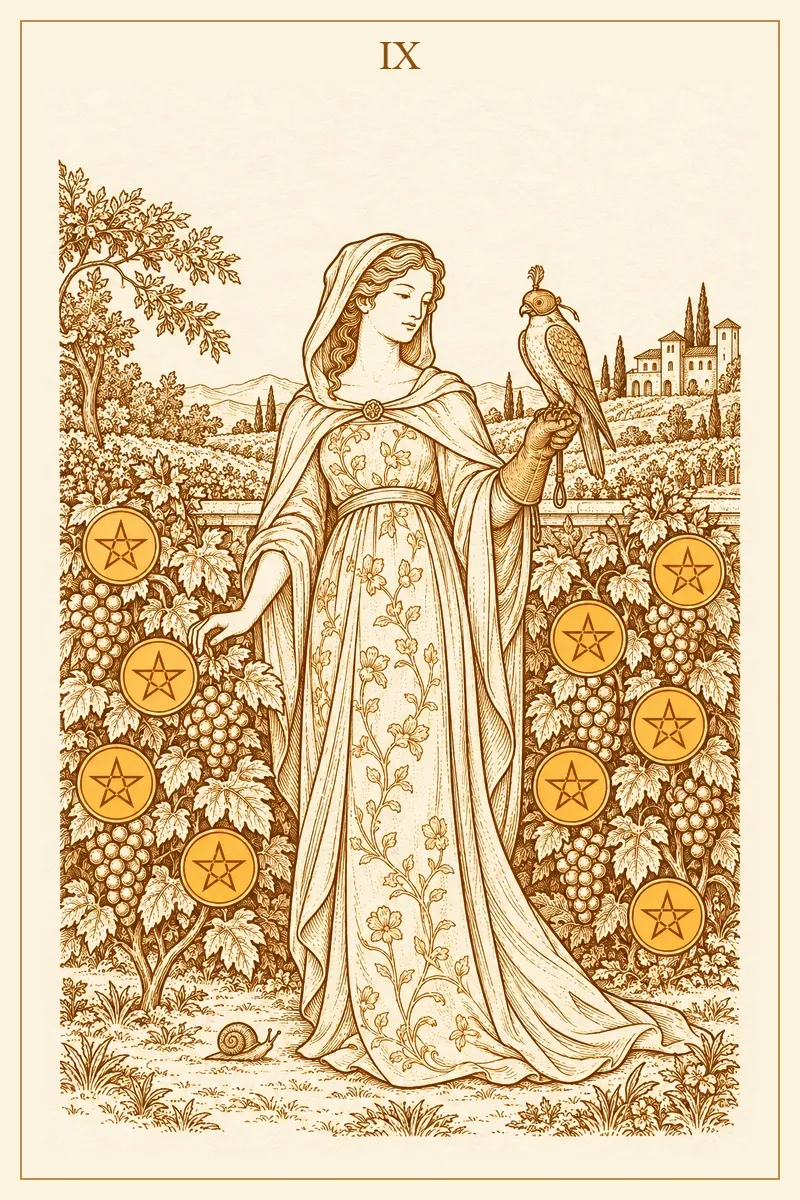
The Nine of Pentacles is the middle decan of Virgo, ruled by Venus, and the Golden Dawn calls it the Lord of Material Gain. Its window runs from about September 2 to 11. Venus brings pleasure and value, Virgo brings care and craft, and together they describe comfort earned through patient work: a figure standing alone in a ripe vineyard with a falcon on her gloved hand. Virgo's other cards are gathered in our Virgo tarot guide.
Upright in a timing position, it suggests early September as a likely stretch for something you have built to pay off: savings reaching a goal, a project you can finally enjoy, a home that starts to feel like yours. Reversed, many readers take it as a window that arrives with less ease than hoped, or as self-reliance that still needs work, which can push the event to the next Virgo season. In love it often points to feeling whole on your own first; in career and money it favors patient, independent progress over a windfall. The full Nine of Pentacles tarot meaning covers its other readings.
Ten of Pentacles: Mercury in Virgo, mid to late September
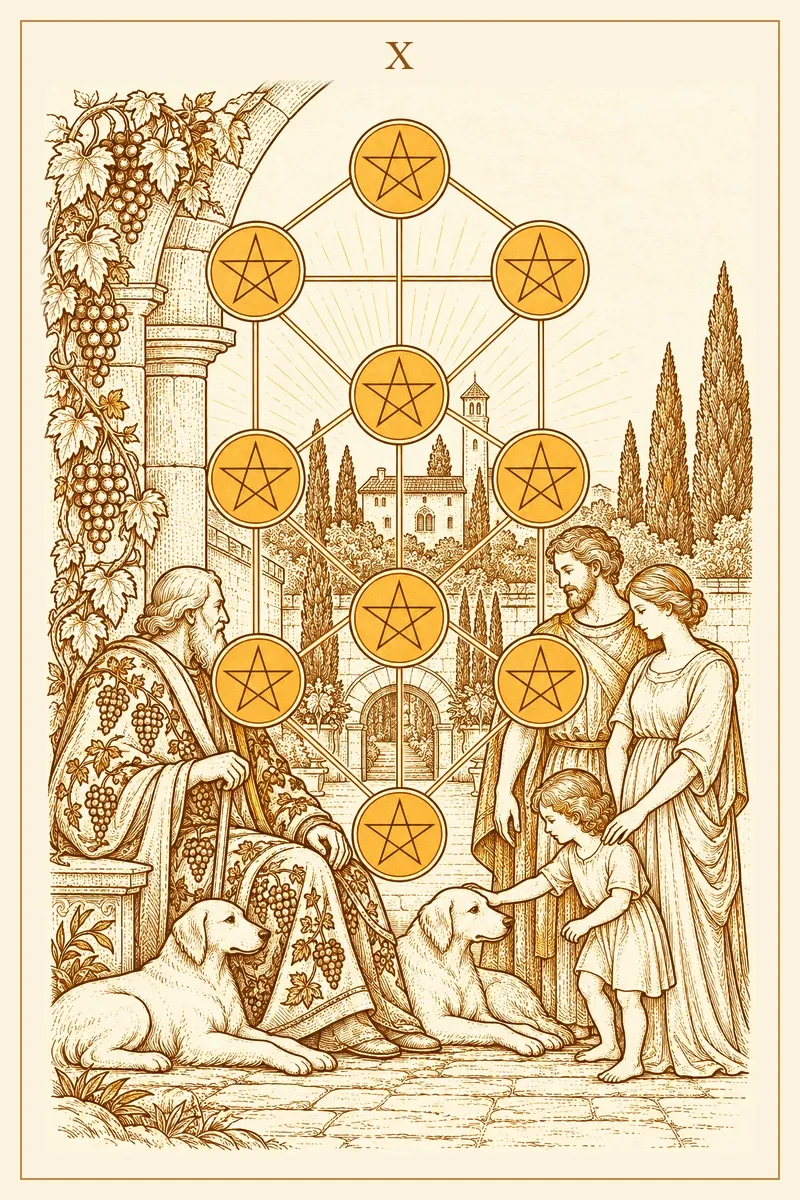
The Ten of Pentacles closes Virgo. Mercury rules this decan, and Book T titles the card Lord of Wealth. Its window runs from about September 12 to 22, just before the autumn equinox. Mercury handles contracts and conversations, and at the end of an earth sign it points to arrangements meant to last, which suits the card's picture of three generations and two dogs gathered beneath an archway.
Upright, a "10 of Pentacles timing" reading points to mid-to-late September for family, property, inheritance, long-term agreements or a workplace you plan to stay in. Reversed, it can describe a family or financial arrangement to sort out first, so the outcome looks more like a negotiation than a settled result. The Ten of Pentacles tarot meaning goes further into the card.
Four of Pentacles: Sun in Capricorn, mid-January
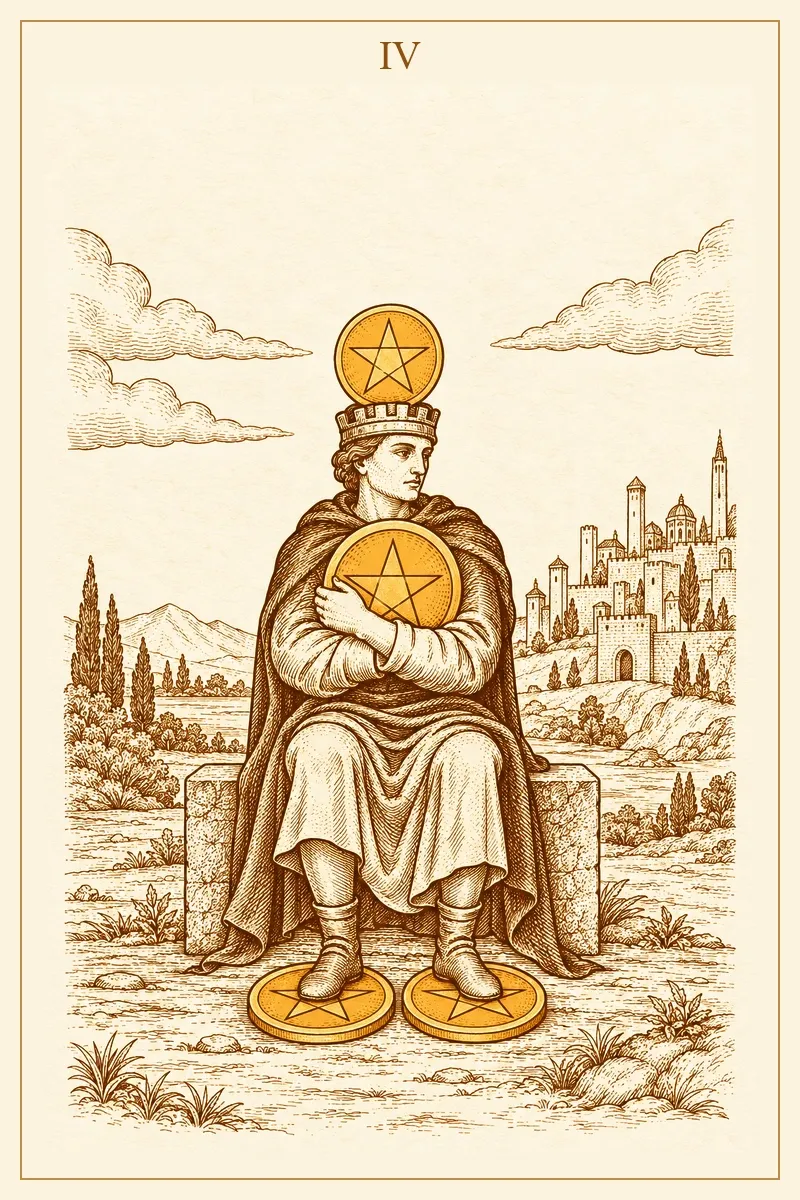
The Four of Pentacles is the last decan of Capricorn, ruled by the Sun, with the Golden Dawn title Lord of Earthly Power. Its window runs from about January 10 to 19. The Sun in a disciplined earth sign gives the card its tone of consolidation: a crowned figure holding one coin to his chest, another on his crown and two under his feet, with a city at his back.
Upright, "4 of Pentacles timing" usually points to mid-January for saving, budgeting or holding a position, and to things staying as they are until then. Reversed, it can show a grip loosening around that window: money starting to move, a rule relaxing, a fear of loss easing, or spending that runs ahead of planning. In love it can describe a protectiveness that needs to soften first. Capricorn's other cards are covered in our Capricorn tarot guide, and the Four of Pentacles tarot meaning explores the card in depth.
Page of Swords: a quarter of the year, not a decan
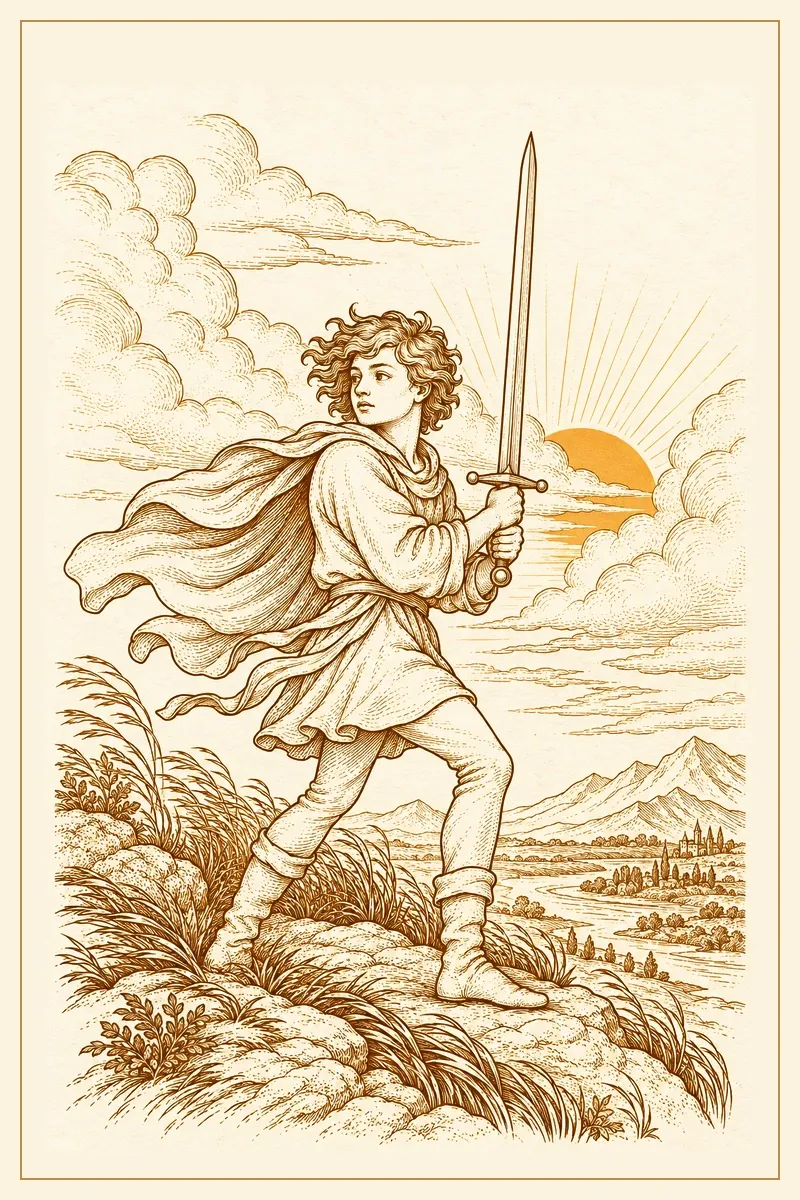
Pages carry no decan, so a "Page of Swords time frame" depends on your system. In Book T this Page is the Princess of the Rushing Winds, who shares the Ace of Swords' quarter from Capricorn through Pisces, about December 22 to March 20. The card shows a young figure on rough high ground, sword raised against a windy sky, ready to move.
Upright, it suggests news, questions and research arriving in that winter quarter, or a first step taken in thought before action. Reversed, it can mean information that comes late, gossip worth checking, or a plan that stalls until the facts are in. The Page of Swords tarot meaning explains the card's personality.
Wheel of Fortune: Jupiter and the turning year
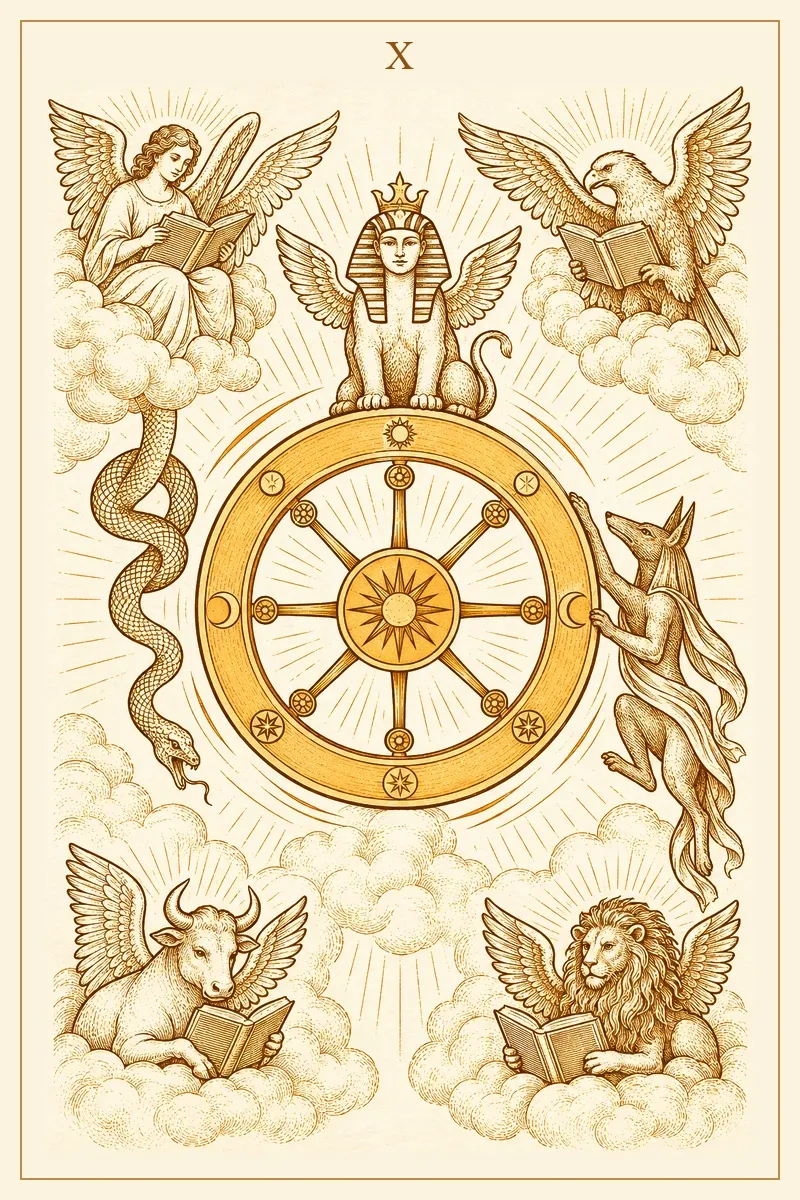
Wheel of Fortune is Jupiter's trump. Jupiter spends about a year in each sign, so in a timing position the Wheel tends to mean "within about a year" or "when the next cycle turns," not a particular week. Its picture fits: a great wheel with a sphinx at the top, a serpent and a jackal-headed figure at its sides, and four winged creatures reading in the corners.
Upright, it suggests a turn of circumstances, often outside your control, that opens the way within a year. Reversed, it can describe a loop that has to finish first, a delay, or a change you are resisting. Our guide to Jupiter in tarot covers the planet's themes, and the Wheel of Fortune tarot meaning covers the card.
The Sundial spread for timing questions
This five-card spread keeps the timing card in context. It grows out of a simple three-card spread of situation, timing and outcome, with two cards added to show what can move the window.
- Where the matter stands: current conditions and the season the question is in now.
- What has to ripen: the step or change that comes first.
- The timing card: read with the system above for a window.
- What could bring it forward: a help, an action or an opening.
- What could hold it back: a delay, a doubt or an obligation.
Before you shuffle, write down your horizon (say, "within twelve months") and your rules for courts, Pages and reversals. Read position 3 first, then see whether the other cards confirm, stretch or contradict its window.
A worked example: moving into a first place of your own
The question, asked in October: "When could I realistically move into a place of my own within the next year?" The Sundial spread gave these cards:
- Where the matter stands: Four of Pentacles, upright.
- What has to ripen: Page of Swords, upright.
- The timing card: Nine of Pentacles, upright.
- What could bring it forward: Wheel of Fortune, upright.
- What could hold it back: Ten of Pentacles, reversed.
The timing card points to about September 2 to 11. Because the question was asked in October, the nearest coming window is the following September, not a few weeks away. The Ten of Pentacles is the next decan of Virgo, so the two cards together make Virgo season the focus, with the reversed Ten showing how the window might stretch toward late September.
The Four of Pentacles describes careful saving, perhaps so careful that nothing moves, and its own window, mid-January, is a sensible point to review the budget. The Page of Swords belongs to the quarter from late December to March, so the research (neighborhoods, rents, lease terms, real monthly costs) is winter's work. The Wheel of Fortune suggests a change during the year, such as a lease renewal or a shift at work, that could open the way sooner. The reversed Ten of Pentacles names what could slow things: a family or shared money arrangement that needs a clear conversation first.
A grounded summary: research the numbers through winter, revisit the budget in January, watch for an unexpected chance, talk through family arrangements before summer, and aim for September.
Making the window useful
- Decide the system before you draw. Changing the rules after you see the cards turns the reading into guesswork.
- Set a horizon. "Within a year" tells you which occurrence of a window to read; without one, take the nearest window ahead.
- Look for agreement. Two cards from one sign narrow the window; cards from opposite ends of the year say the timing is still open.
- Keep your reversal rule steady. Read a reversed timing card as a delay, or as a window that passes quietly unless someone acts, but choose one.
- Write it down. Add the window to your calendar, note the reading in a tarot journal, and look back when the window closes to learn whether this system works for you.
Frequently asked questions
What is the Nine of Pentacles time frame?
In the Golden Dawn system the 9 of Pentacles is Venus in Virgo, so it points to about September 2 to 11, give or take a day depending on the year. Readers who prefer counting methods sometimes use nine weeks or nine months instead.
What is the Page of Swords time frame?
Pages have no decan of their own. Book T places the Page of Swords in the quarter from about December 22 to March 20, while other readers simply read it as "when the news arrives."
Can tarot give me an exact date?
No. Timing is the least dependable part of any reading, and no card can confirm that an event will happen, let alone on a set day. The astrological system narrows "someday" to a window of about ten days to a few months, which helps with planning and reflection, but other people's choices and changing circumstances can always move it.
Do the dates change in the Southern Hemisphere?
The dates stay the same, because the zodiac follows the Sun's position rather than the weather. Only the season names flip: the Cancer-to-Virgo quarter is winter in Sydney, so read the Ace and Page quarters by date.
What if the timing card is reversed?
The decan stays the same; the reversal changes how the window is likely to go. Common readings are a delay to the next occurrence of that window, an event that arrives in a quieter or partial form, or an inner block to attend to first.
Do I need to know astrology to use this method?
No. The lists on this page are enough to start, and the cardinal, fixed and mutable pattern makes them easy to learn. A birth chart adds depth to the planetary trumps but is optional.
Why do Golden Dawn, Thoth and Waite-style readings sometimes disagree?
The numbered cards follow the same decans in all three, since the Waite–Smith and Thoth decks both drew on the Golden Dawn attributions. The differences sit in the court cards, whose names and ranks changed between decks, and in the Aces and Pages, which many readers time by suit season.
A window to prepare for
A timing card is most useful as a reason to get ready, not a date to wait for. When a question with a "when" in it is on your mind, you can try the Sundial spread in a calm, unhurried reading of your own.