
Loading your view
The page is gathering the latest information.
The page is gathering the latest information.
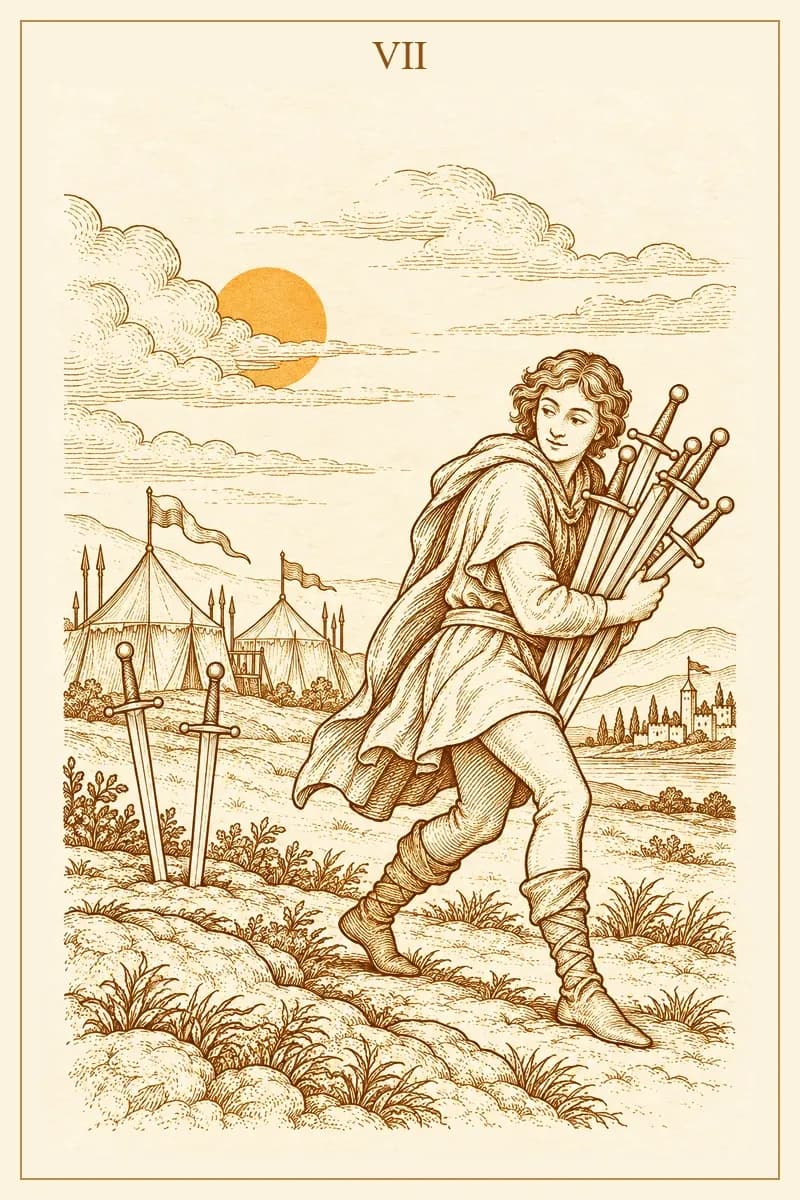
The card shown is VeilSoul's own engraved drawing of the 1909 Waite–Smith card. The scene and symbols described on this page follow the 1909 card, so a few details are drawn differently in our deck.
The Seven of Swords shows a figure tiptoeing away from a military camp, carrying five swords while two remain planted in the ground behind him. He glances back over his shoulder with a sly expression — the look of someone who believes he is getting away with something. The camp behind him is oblivious. This is the card of deception, cunning strategy, and the uncomfortable question of whether cleverness has crossed the line into dishonesty.
When the Seven of Swords appears upright, someone may not be entirely truthful — and that someone may be you. This card flags deception, half-truths, hidden agendas, and strategies that rely on secrecy rather than openness. It does not necessarily indicate malice; sometimes the Seven represents the pragmatic decision to withhold information for strategic advantage, to work independently rather than collaboratively, or to avoid a confrontation by maneuvering around it.
However, the card carries a warning: the figure left two swords behind. His plan is not as complete as he thinks. Whatever he is getting away with may well be discovered — deception is a short-term strategy with long-term consequences. The truth has a way of catching up.
The Seven of Swords can also represent the lone wolf approach — doing things your own way, operating outside conventional methods, and relying on cleverness rather than cooperation. In some contexts, this is admirable resourcefulness. In others, it is self-isolating behavior that cuts you off from the support you need.
The figure sneaks away carrying five swords, leaving two behind — a plan executed imperfectly, a theft that leaves evidence. Strategy and deception share the same blade here.
Deception becomes pathological — lying even when truth would serve better (excess) — or refusing all strategic thinking leaves you perpetually outmaneuvered by those who do (deficiency).
Detailed Interpretations
The Seven of Swords in love is a red flag for dishonesty, deception, or hidden agendas operating within a relationship — whether you are the one concealing something or your partner is the one whose behavior does not align with their words. This card can indicate infidelity, secret communication with an ex, financial deception within the partnership, or the subtler but equally damaging pattern of emotional dishonesty — presenting a false version of yourself, hiding your true feelings, or manipulating your partner's perception of reality to maintain control or avoid accountability.
When this card appears in a love reading, it demands honest self-examination. If you are the one being deceptive, the Seven warns that the scheme — whatever it is — will not succeed indefinitely. Deception requires constant maintenance, and the mental energy spent sustaining lies, managing contradictions, and anticipating exposure is energy that could be building something genuine instead. The figure in the card glances back over his shoulder because he knows, on some level, that what he is doing is unsustainable.
If you suspect your partner of dishonesty, the Seven of Swords takes your intuition seriously while cautioning against paranoia. There is a difference between genuine red flags and anxiety-driven suspicion, and this card asks you to examine the evidence clearly rather than either dismissing legitimate concerns or manufacturing accusations from insecurity. Trust your instincts, but verify them with honesty rather than surveillance — because a relationship that requires surveillance to maintain is already broken regardless of what the investigation reveals.
In love reversed, the Seven of Swords indicates that a hidden truth in a relationship is being revealed — an affair discovered through a careless text message, a lie exposed by contradicting evidence, a secret financial arrangement coming to light, or a pattern of deception that can no longer be maintained because the weight of accumulated dishonesty has become too heavy to carry. The figure has been caught, the swords are falling, and the reckoning that deception always eventually produces has arrived.
Alternatively, the reversed Seven can indicate a conscious decision to come clean — choosing to confess a secret, reveal an uncomfortable truth, or end a pattern of dishonesty before it is discovered by someone else. This is the harder but more dignified path, and while the confession may cause pain and damage trust, it also creates the possibility of genuine repair that discovery through exposure does not. A truth voluntarily offered carries different weight than a lie forcibly uncovered.
For some, this reversal marks the moment of recognizing your own self-deception in love — admitting that you have been lying to yourself about the health of your relationship, the character of your partner, or your own motives for staying in a situation that you know is not right. The most important honesty the reversed Seven demands is not with your partner but with yourself.
Professionally, the Seven of Swords represents workplace deception at various scales — someone taking shortcuts that compromise quality while presenting the appearance of diligence, stealing ideas and presenting them as original work, manipulating information in reports or presentations to create a misleading picture of performance, or operating with a hidden agenda that serves personal interests at the expense of the team or organization.
If you are the one employing these tactics, the Seven delivers a warning that is both practical and ethical. Practically, deception in professional environments tends to be discovered eventually — digital trails, inconsistencies in stories, colleagues who notice patterns. The career built on stolen credit, manipulated data, or strategic dishonesty is a house of cards that becomes increasingly precarious as the stakes grow higher and the scrutiny intensifies. Ethically, the Seven asks whether the professional identity you are constructing through deception is one you can sustain or be proud of, or whether you are building a reputation that would collapse the moment anyone looked closely at the foundation.
If you are on the receiving end of workplace deception — someone stealing your work, taking credit for your contributions, or undermining you through behind-the-scenes manipulation — the Seven counsels strategic awareness rather than naive trust or reactive confrontation. Document your work, maintain clear records of your contributions, communicate through channels that create paper trails, and be judicious about what information you share and with whom. Not everyone in your professional environment deserves the same level of trust, and the Seven of Swords reminds you that protecting your intellectual property and professional reputation requires ongoing vigilance.
Career-wise, the reversed Seven of Swords suggests that workplace dishonesty is being uncovered — stolen ideas traced back to their true originator, manipulative behavior documented and reported, fraudulent claims investigated, or a carefully constructed professional facade beginning to crack under scrutiny. The con is unraveling, and whoever built their career on deception is facing the consequences they always knew were possible but hoped would never arrive.
This reversal also appears when someone decides to become a whistleblower — exposing institutional dishonesty, reporting ethical violations, or refusing to participate in deceptive practices that they have been pressured to maintain. This is a courageous but often costly choice, and the reversed Seven acknowledges both the moral clarity it requires and the professional risk it entails.
For those who have been victims of workplace deception, the reversed Seven brings a measure of justice — the truth emerges, the stolen credit is attributed correctly, and the manipulator's reputation begins to reflect their actual behavior rather than the performance they constructed. However, justice in professional settings is rarely complete or swift, and the reversed Seven counsels patience with the process while maintaining the documentation and advocacy necessary to ensure that the truth ultimately prevails.
The Seven of Swords in health warns about the particular danger of self-deception regarding your wellness — ignoring warning signs your body is clearly sending, downplaying symptoms that deserve medical attention, telling yourself that an unhealthy habit is not really that serious, or maintaining the fiction that you are fine when the evidence suggests otherwise. The card holds a mirror up to the lies we tell ourselves about our own health, the bargains we strike with denial, and the creative rationalizations we construct to avoid the discomfort of honest assessment.
This card also addresses health-related deception in a more literal sense — withholding information from your doctor because you are embarrassed or afraid of the implications, minimizing your alcohol consumption or substance use when healthcare providers ask, or presenting a sanitized version of your lifestyle that prevents accurate diagnosis and appropriate treatment. Your body does not respond to the story you tell your doctor; it responds to the reality you live. The gap between the two is where preventable health problems grow undetected.
The Seven of Swords additionally warns against health shortcuts that promise dramatic results without genuine effort — supplements marketed as miracle cures, extreme diets that produce rapid but unsustainable weight loss, or wellness trends that substitute marketing language for scientific evidence. The figure in the card is stealing swords, not earning them. In health terms, this translates to seeking results through deception rather than discipline — and the body always knows the difference, even if the mind temporarily convinces itself otherwise.
Use this as a reflective prompt, not medical advice or a diagnosis. For health concerns, seek guidance from a qualified healthcare professional.
The Seven of Swords reversed often indicates that a deception is being exposed — secrets are coming to light, lies are unraveling, and the truth is catching up with whoever tried to evade it. If you have been dishonest, this reversal warns that discovery may be close.
Alternatively, the reversed Seven can signal a change of heart — the decision to come clean, to confess, or to stop operating through deception. You may be tired of the mental burden of maintaining lies and ready to face the consequences of honesty. This is a courageous and ultimately healing choice.
In some cases, the reversed Seven indicates that someone else's deception toward you is being revealed. Information you did not have before is now available. Trust what is being shown to you, even if it is uncomfortable.
The reversed Seven of Swords teaches that deception always has an expiration date — every lie requires another lie to support it, every cover story demands more mental energy to maintain, and the architecture of dishonesty grows increasingly fragile the larger and more complex it becomes. The mental energy spent sustaining deception would be infinitely better invested in building something real, because integrity compounds over time into trust, reputation, and genuine security, while deception compounds into anxiety, isolation, and the ever-present fear of exposure.
This reversal also teaches that the most dangerous form of deception is self-deception — the lies we tell ourselves to avoid confronting uncomfortable truths about our own behavior, motives, and character. External deception can sometimes be rationalized as strategy or survival; self-deception is always corrosive, because it prevents the honest self-assessment that genuine growth requires. The reversed Seven invites you to put down the stolen swords, stop looking over your shoulder, and discover that the life built on honesty — though less clever — is infinitely more sustainable and satisfying than the one built on schemes.
Check your motives today with ruthless honesty. Are you being fully transparent, or are you cutting corners, withholding information, or relying on cleverness where integrity would serve you better? The shortcut may save time in the moment, but the long-term cost of compromised trust always exceeds the short-term gain of successful deception. Choose one area where you have been less than fully honest — with yourself or with others — and correct it today. The swords you carry honestly are lighter than the ones you stole.
“I choose honesty over cleverness. My integrity is worth more than any advantage that deception could provide. I trust that truth, though sometimes costly, always serves me better than lies.”
The card shown is VeilSoul's own engraved drawing of the 1909 Waite–Smith card. The scene and symbols described on this page follow the 1909 card, so a few details are drawn differently in our deck.
The figure tiptoes away from the camp in broad daylight — the deception is brazen, relying on the distraction or complacency of others rather than actual concealment. His posture is exaggerated, almost theatrical — suggesting that his cleverness is not as subtle as he believes.
Five swords are carried while two remain behind — a critical detail. The plan is incomplete. Whatever is being stolen or concealed, something has been left behind that will eventually reveal the deception. The Seven of Swords never promises a clean getaway.
The military camp represents structure, rules, and collective order — the system from which the figure is stealing. The yellow sky suggests that this happens in the realm of intellect and ego rather than emotion. The Seven of Swords is about mental games, strategic maneuvering, and the risk of outsmarting yourself.
Sevens represent introspection, assessment, and the testing of one's approach. The Seven of Swords tests intellectual strategy itself — is your cleverness serving your highest good, or has it become a substitute for genuine integrity?
Keep or share this card reference
✦ From meaning to reflection ✦
Bring what this card stirred into a reading shaped around what you are facing now.
Read with this insight