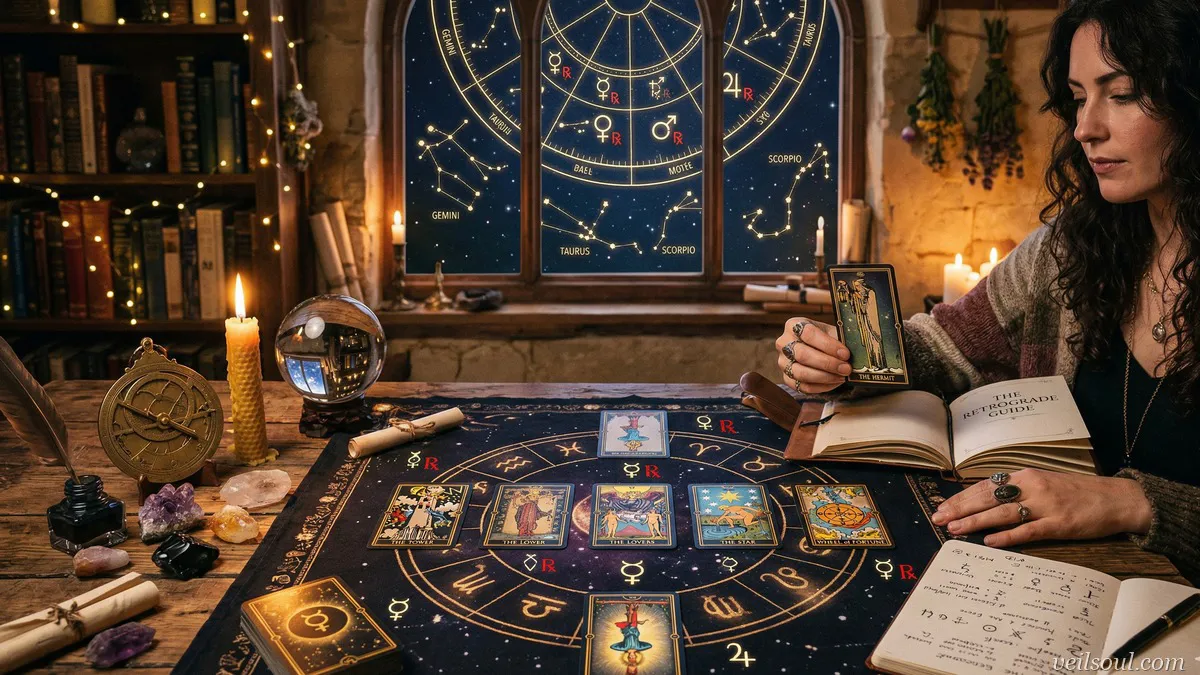
Reading tarot during Mercury retrograde works exactly as it does in any other week: the deck is the same, the shuffle is the same, and a card means what it has always meant. What changes is the kind of question worth asking. Retrograde periods, in astrology, are seasons for looking back, so the readings that pay off are the ones about unfinished conversations, half-made decisions and plans that deserve a second look. Tarot cannot confirm what another person is thinking, name a date or guarantee an outcome, in retrograde or out of it; what it can do, especially now, is show you where to turn your attention.
Below: the questions that work, how to treat reversed cards, how to re-read a spread from months ago, where to aim when Mercury, Venus, Mars or a slower planet is retrograde, a five-card spread, a worked example and the questions readers ask most.
At a glance, each retrograde has a focus and a card that carries its theme:
- Mercury retrograde: words, messages, plans and paperwork; The Magician.
- Venus retrograde: relationships, values, money and taste; The Empress.
- Mars retrograde: drive, effort, anger and timing; The Tower.
- Jupiter retrograde: beliefs, growth and luck; Wheel of Fortune.
- Saturn retrograde: duties, limits and long projects; The World.
- Uranus retrograde: freedom and change; The Fool.
- Neptune retrograde: dreams, faith and blurred lines; The Hanged Man.
- Pluto retrograde: power, control and deep change; Judgement.
What a retrograde is, and what it is not
A retrograde is an appearance, not an event in space. Every planet keeps moving forward along its orbit the whole time. Because Earth is also moving, there are stretches when our line of sight to another planet swings backward against the background stars, the way a slower car seems to drift backward when you pass it on the highway. For Mercury and Venus, which orbit inside Earth's path, this happens as they overtake us on the inside; for Mars and the planets beyond, it happens when Earth overtakes them. Then the line of sight straightens out and the planet appears to move forward, or "direct," again.
The rhythm is regular. Mercury turns retrograde about three times a year for roughly three weeks each time. Venus does it about every eighteen months, for around six weeks. Mars retrogrades about every two years, for two to two and a half months. Jupiter, Saturn, Uranus, Neptune and Pluto, being far away and slow, appear to move backward for four to six months every single year, which is why their retrogrades are rarely headline news: for the outer planets it is closer to the normal state of things.
Astrology reads these periods as a turn inward for whatever the planet stands for. That is an interpretive tradition, not a law of physics, and it is worth holding it lightly. Nothing in a retrograde breaks your phone, sabotages your contract or flips your cards upside down. What the tradition offers a tarot reader is a useful calendar: a few weeks a year with a built-in reason to pause, review and finish things.
Questions that suit a retrograde
The best retrograde questions look backward or sideways rather than straight ahead. A forecast question such as "will the job offer come through this month?" looks straight ahead and ignores the season's strength. Review questions use it. Try forms like these:
- Which conversation from the past month is still unfinished, and what is my part in finishing it?
- What did I decide too quickly, and what would I want to look at again before I commit further?
- Where am I pushing on a door that is not opening, and what would waiting cost me?
- What have I already been told, by a person or by my own experience, that I have not yet taken in?
- What small repair, apology or follow-up would make the next few weeks lighter?
Notice the shape: each one is about you, is open-ended, and points at something you can act on this week. Questions about other people's hidden intentions, exact dates or whether something is "meant to be" produce vague readings in any season, and during a retrograde they tend to pull you toward re-litigating the past instead of reviewing it.
Retrograde weeks are also a good time to shrink the spread. One card a day, or a three-card line, leaves room to sit with each image; a ten-card layout read in a hurry tends to produce the muddle people then blame on Mercury.
Reversed cards when a planet is retrograde
A common claim is that more cards come out reversed during a retrograde. A shuffled deck has no way of knowing what the sky is doing, so if you notice a run of reversals, the honest explanations are chance, how you shuffle, or the fact that you are looking for them. None of that makes the reversals meaningless. A reversed card still describes a theme that is blocked, delayed, turned inward or in need of a second look, which happens to be exactly the vocabulary astrology gives to a retrograde. The two ideas rhyme, and you can let them.
Three readings of a reversal fit the season especially well. The first is delay: the upright meaning is still on its way, but not on your preferred schedule. The second is interior: the card's energy is happening inside you rather than in the world, as when a reversed Knight of Wands is restlessness you have not acted on. The third is review: the card is pointing at a past version of itself, an earlier decision or relationship that is asking to be reconsidered.
Whether you read reversals at all is a settled choice you make before you shuffle, not something to switch on because a planet changed direction. If you are undecided, the guide to reading tarot reversals lays out the case for and against so you can pick a method and stick with it through the retrograde and beyond.
Re-reading a spread you laid months ago
If a retrograde is a season for going back over old ground, the most useful tarot practice it offers is re-reading a spread from your past. This needs a record, which is one of the quietest arguments for a tarot journal that tracks your readings: the date, the question, the cards in order, and what you thought they meant at the time.
Pick a reading from the previous cycle of the same planet: about four months back for Mercury, about a year and a half for Venus. Lay the same cards out again from the deck without shuffling. Read them as if you had just drawn them, then compare notes with your earlier self. Three things usually show up. One card you brushed past has become obvious in hindsight. One card you took as a prediction turns out to have described your own state of mind. And one card still has not landed, which is a good candidate for your next question.
Keep this to one or two old spreads per retrograde; re-reading everything you have ever drawn turns reflection into a search for proof. The point is to carry one unfinished thread into the present.
Where to point your questions, planet by planet
Each retrograde has a subject. Knowing it helps you aim your questions and recognize which cards are speaking to the season. The cards for Mercury through Saturn follow the Golden Dawn system that most modern decks use; the cards for Uranus, Neptune and Pluto are later attributions that many astrology-minded readers have adopted.
Mercury retrograde: The Magician and unfinished words
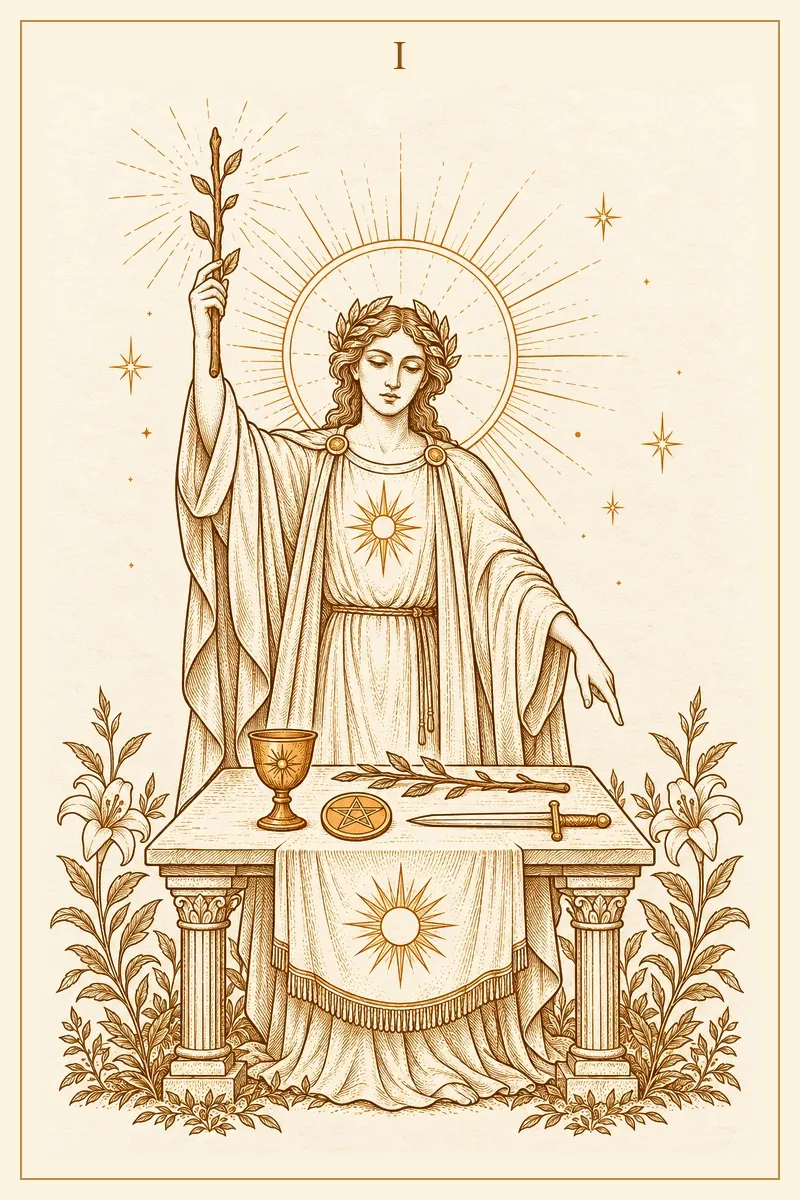
Mercury's card is The Magician, the figure who turns intention into speech and action, and the guide to Mercury in tarot covers the planet's full set of cards. During Mercury retrograde the subject is communication in the widest sense: messages you have sent and not sent, agreements that were never written down, travel plans, documents, and the gap between what you meant and what was heard. Questions to ask: which message am I avoiding, what did I agree to without reading, who deserves a clearer answer from me.
When The Magician appears upright in these weeks, read it as the capacity to say the thing plainly and to gather the tools you already have rather than acquiring new ones. Reversed, it is usually a conversation running on charm or speed instead of substance, or a skill you have stopped using; the fix is almost always to slow down and write the plain version. The Magician card meaning goes deeper into both positions.
Venus retrograde: The Empress and what you value
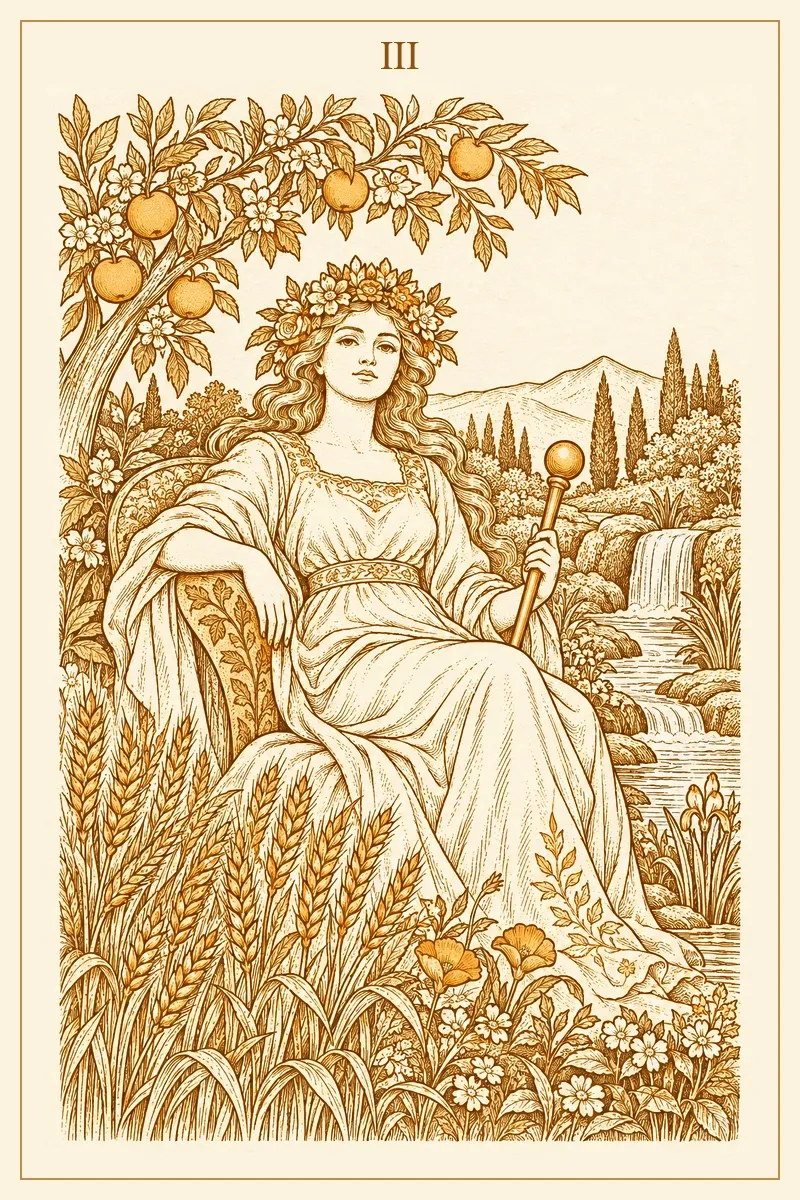
Venus retrograde, the rarer of the two inner-planet retrogrades at about eighteen months apart, brings up relationships, pleasure, money and taste, and its card is The Empress, the Major Arcana's image of abundance and care. The Venus in tarot guide lists the planet's minor cards; here, the retrograde question is about what you value and whether your life currently reflects it. People who reappear from the past are a well-known theme of these weeks, but the deeper work is usually with your own standards: what you settle for, what you overspend on, which old attachment is still shaping your choices.
Upright, The Empress during Venus retrograde asks whether you are nourished by what you have rather than always reaching for more. Reversed, she points to care that has become depletion, a creative project left unfed, or worth measured by someone else's attention. Love questions in this season go best when they are about your own patterns rather than another person's feelings, and big relationship decisions are better explored with the cards now and acted on once you have had time to sit with what you found. If The Empress keeps showing up, the Empress card meaning will help you hear what she is repeating.
Mars retrograde: The Tower and effort that stalls
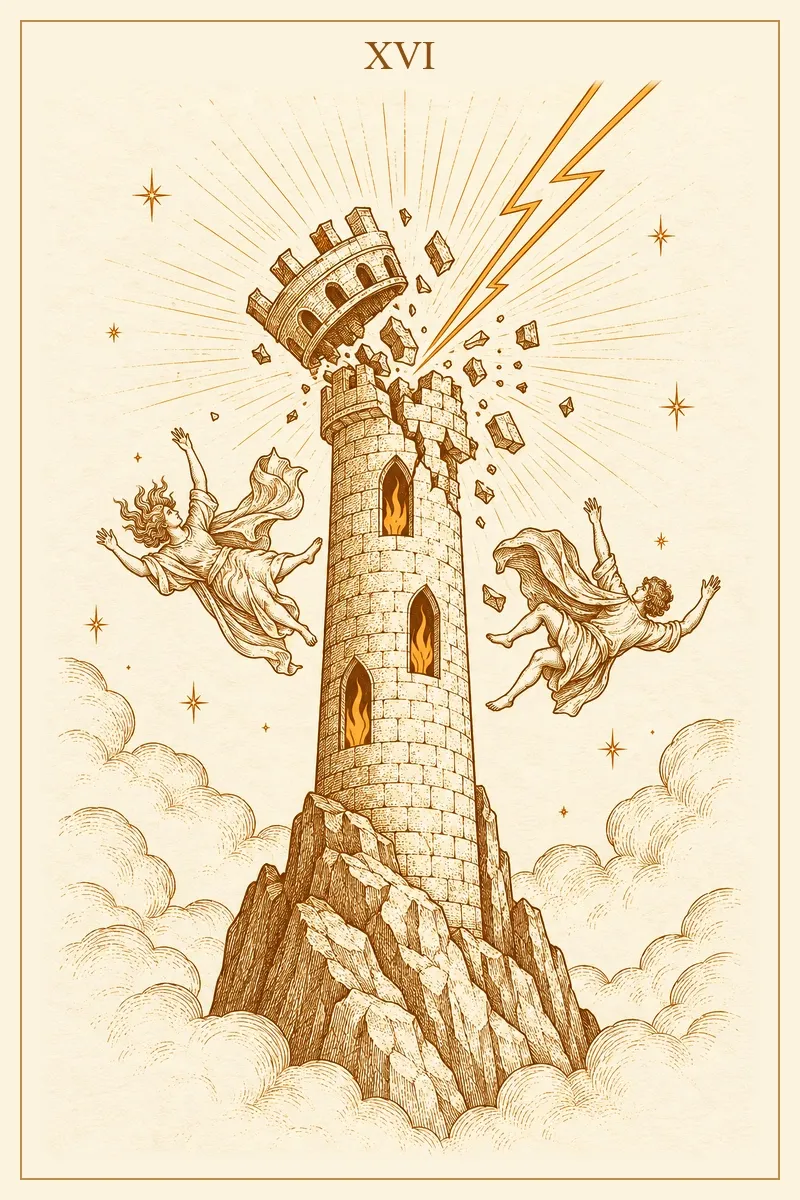
Mars rules effort, desire, anger and the will to begin, so a Mars retrograde, which comes around every two years or so and lasts two to two and a half months, is felt as a dip in momentum: projects that stall, motivation that drains, frustrations that surface because they no longer have an outlet. Its card is The Tower, which is less about disaster than about a structure that was already unstable finally giving way. Read as a retrograde card, The Tower asks what you have been forcing and what would happen if you stopped holding it up.
Upright in a Mars retrograde, The Tower names a sudden release of pressure that clears the ground: a resignation, an argument that finally happens, a plan that collapses so a better one can be built. Reversed, it points to a collapse you are postponing, or to a shock whose aftermath you are still living in. Either way the useful response is practical: where is my energy going, which fight is actually mine, and what can I let fall rather than carry. The Tower card meaning looks at how the card turns from threat into relief once you stop reading it as punishment.
The outer planets: long retrogrades, slow questions
Jupiter, Saturn, Uranus, Neptune and Pluto each appear to move backward for roughly four to six months every year, so you are rarely out of one of their retrogrades for long. Their themes are correspondingly slow, and they reward one deliberate reading at the start of the period rather than daily checking. Jupiter's card is Wheel of Fortune, and its retrograde is a time to ask which belief about your luck or growth is due for revision. Saturn's is The World, the card of completed work, and its retrograde suits questions about duties you took on without choosing them and long projects that need their scope redrawn. Uranus, with The Fool, asks which change you have been calling freedom and which you have been calling fear. Pluto, with Judgement, points at the power dynamics you are finally ready to name.
In practice, treat an outer-planet retrograde as background rather than foreground. Note the date it began, draw one card for the season under the relevant question, and return to that card at the end rather than drawing again every week.
The Hanged Man: Neptune's card and the shape of every retrograde
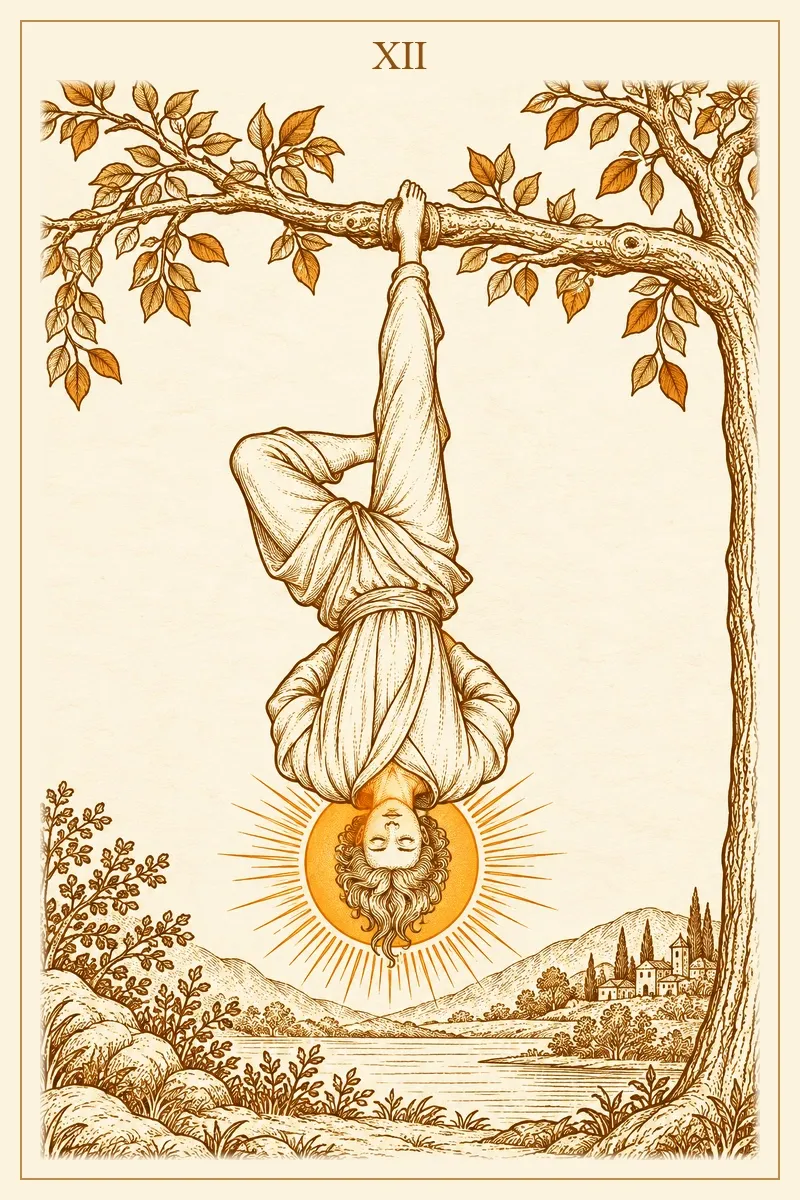
Neptune's card is The Hanged Man, and of all the planetary cards it is the one that best describes what a retrograde feels like from the inside: suspended, upside down, seeing the familiar from an angle you did not choose. Neptune's own retrograde, about five months a year, is a season for examining what you have idealized, the places where faith has become fog, and the escape you lean on when things are hard.
Upright, The Hanged Man in any retrograde reading says the pause is the point: nothing is wrong with you for not moving, and the view from here is the lesson. Reversed, it is a pause that has curdled into stalling, or a sacrifice nobody asked you to make. In the Second Look spread below, this card in the "what to pause" position is as clear as the deck gets. The Hanged Man card meaning has more on telling the two apart.
The Second Look spread: five positions for any retrograde
This spread works for any retrograde, whether it is Mercury's three weeks or Saturn's four months. Lay the five cards in a shallow arc from left to right, the way a planet appears to loop against the stars, and read the positions in order. Name the planet aloud or in your journal first, so the whole reading knows its subject.
- The return: what this retrograde is bringing back for a second look.
- What I missed: the detail, feeling or warning that passed me by the first time.
- What to pause: the action, decision or conversation that will go better after the planet turns direct.
- What to repair or finish: the loose end that is ready to be tied now.
- What to carry forward: the understanding to take with me when the planet moves on.
Read positions one and two together; they usually describe one situation from two angles. Positions three and four are a pair of opposites, and the contrast between them is where most of the advice lives. Position five is a summary, not a prediction; a reversed card there is something you will understand later, not a bad ending.
Worked example: a website that would not finish
A freelance designer has spent three weeks rebuilding her portfolio site during Mercury retrograde. Every evening she changes the wording, nothing feels done, and a client who asked to see it is still waiting. Her question for the Second Look spread: "What does this retrograde want me to revisit about the portfolio, and what should I actually do this week?"
- The return: Eight of Pentacles reversed.
- What I missed: Two of Swords.
- What to pause: Knight of Wands.
- What to repair or finish: Three of Pentacles.
- What to carry forward: The Star.
The reversed Eight of Pentacles in the return position names the problem precisely: craft that has become fiddling, polishing for its own sake, effort disconnected from the person it is for. It has come back for a second look because it was never resolved, only repeated. The Two of Swords as what she missed describes a decision she has been avoiding by editing: she has not chosen who the site is for, so every sentence tries to speak to everyone. The blindfold is self-chosen, and the detail she overlooked is that no amount of wording fixes an undecided audience.
The Knight of Wands in the pause position is the urge to launch a splashy relaunch announcement the moment the site is "ready." Paused, that impulse costs nothing; acted on now, it would ship an unfocused site to a wide audience. The Three of Pentacles as what to repair or finish is the move she can make this week: show the client the current version, ask for one round of specific feedback, and let the work be a collaboration rather than a solo performance. The Star as what to carry forward is calm and a longer view, the reminder that her reputation is built over years, not in one retrograde.
Her action list came out short. Decide on the audience in one sentence. Send the client the live draft with two questions. Stop editing the copy until the retrograde ends, then make one pass with fresh eyes. None of this was prediction; it came from five images set against five honest positions and a question about her own next step.
Journaling through the retrograde
Retrograde readings generate more hindsight than most, and hindsight evaporates quickly once the planet turns direct and life speeds up. A few lines a day is enough to keep it. Record the date, the planet that is retrograde, the card or cards, and one sentence on what you noticed. On the last day, read the entries in order and write a short closing note: what came back, what you finished, what you are still carrying.
Prompts that suit the season: What did I re-read, re-send or re-decide this week? Which card has appeared more than once since the retrograde began, and what have I done about it? What am I relieved not to have rushed? What would I tell the version of me who sat down with the cards on the first day? Writing these down also gives you the material for the next cycle's re-reading, which is how the practice compounds.
Frequently asked questions
Does Mercury retrograde make tarot readings less accurate?
No. The deck has no connection to Mercury's apparent motion, and a card means the same on any date. If your readings feel muddled during these weeks, the likelier causes are rushing, a question that is really a forecast in disguise, or a spread too large for the time you gave it. Smaller spreads and review-style questions usually clear it up.
Do more reversed cards appear during a retrograde?
Not in any way that a shuffle could produce. If you notice more, you are probably paying closer attention to them, which is fine. Read them as delay, interior work or a theme to revisit, the same way you would in any other month.
Should I avoid big decisions, or buying a new deck, during Mercury retrograde?
Make decisions on their merits, with the information you have, regardless of what the sky is doing. The retrograde is a useful nudge to read the fine print and double-check details, not a reason to freeze. A deck bought during a retrograde is as good as any other deck.
Can tarot tell me when a retrograde will stop affecting me?
Tarot cannot give dates or confirm outcomes, during a retrograde or at any other time, and it cannot tell you what someone else is thinking. The retrograde's end date is published in any ephemeris or astrology calendar; the cards are for deciding what to do between now and then.
Which tarot card represents retrograde?
There is no retrograde card, because the cards correspond to planets, signs and elements, not to the direction a planet appears to move. The Hanged Man comes closest in spirit, with its suspended, upside-down view. For a specific retrograde, use the planet's card from the list at the top of this guide.
Is it a bad time to start learning tarot?
It is a good one. Beginners benefit from exactly what the season encourages: one card a day, a short journal entry and a willingness to look twice. Treat the retrograde as permission to go slowly.
Should I cleanse my deck when the retrograde ends?
Only if that is part of your usual practice. A retrograde does not leave anything on the cards. If you like to mark transitions, a brief shuffle with a sentence about what you are leaving behind works as well as any ritual.
When the planet turns direct
The retrograde ends the way it began, quietly, with a planet that was never actually going backward appearing to move forward again. What you keep is whatever you took the time to review: a conversation finished, a decision looked at twice, a spread from months ago finally understood. If you would like to lay the Second Look spread while the season is still here, you can start a reading whenever you are ready and bring your own question to it.