
Loading your view
The page is gathering the latest information.
The page is gathering the latest information.
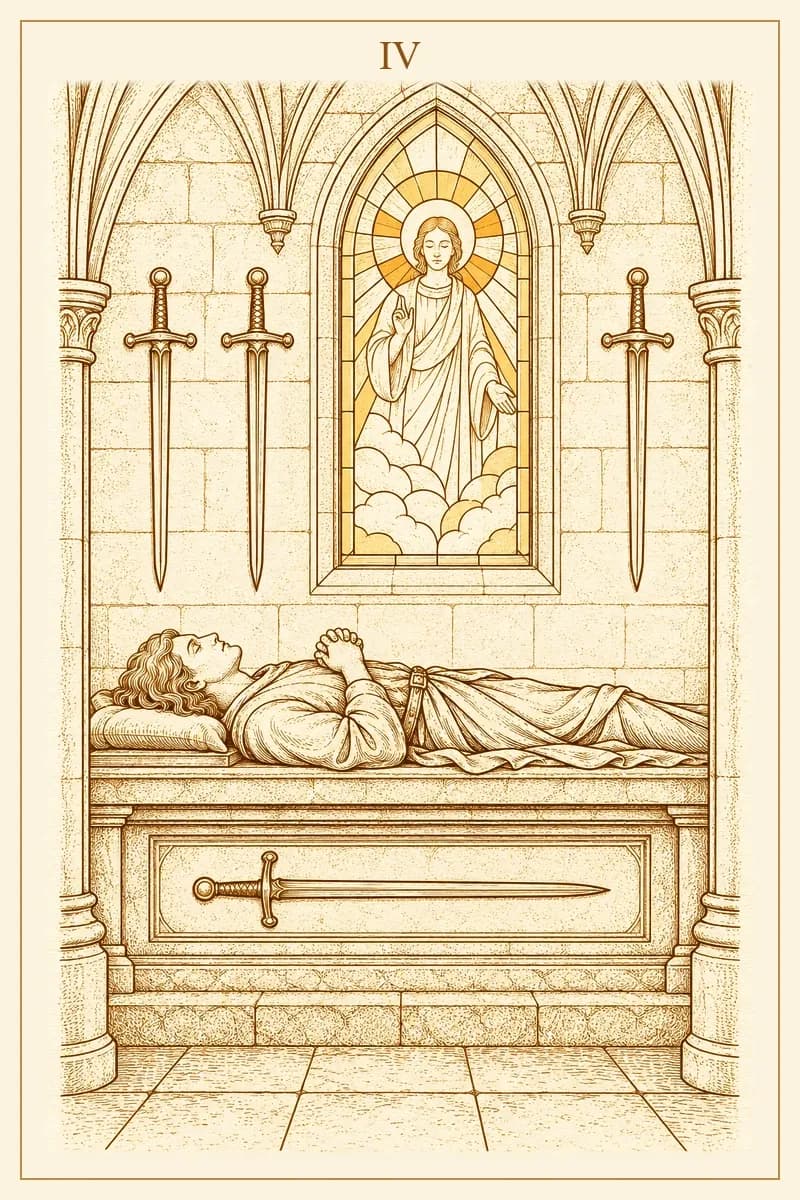
The card shown is VeilSoul's own engraved drawing of the 1909 Waite–Smith card. The scene and symbols described on this page follow the 1909 card, so a few details are drawn differently in our deck.
The Four of Swords depicts a knight lying in repose upon a tomb inside a church, hands clasped in prayer, three swords mounted on the wall above him and one beneath. A stained-glass window shows a figure offering blessing. This is not death — it is deliberate, sacred rest. The knight has laid down his swords and chosen stillness after battle. This card is the tarot's prescription for recovery.
When the Four of Swords appears upright, you need rest — not as a luxury, but as a necessity. Your mind has been overworked, overstimulated, or overwhelmed, and continuing to push forward without pause will lead to diminished returns or outright collapse. The card does not suggest laziness; it prescribes strategic withdrawal. The knight rests so that he may fight again. You must rest so that you may think clearly again.
The church setting emphasizes that this rest is sacred, not shameful. In a culture that glorifies constant productivity, the Four of Swords offers radical permission to stop. Meditation, solitude, sleep, therapy, a retreat from social obligations, a break from decision-making — whatever form your rest needs to take, this card validates it.
The single sword beneath the knight points toward the future — the next challenge that awaits after recovery. Rest is not permanent avoidance; it is preparation. The Four of Swords suggests that when you emerge from this period of stillness, you can return to the world with a clarity and strength that was impossible while you were exhausted.
The knight lies still — not dead but deliberately dormant, recovering strength the battlefield consumed. Three swords hang above while one rests beneath, the weapon he chose to keep closest.
Rest becomes either permanent avoidance — hiding in retreat to escape re-engagement (excess) — or a premature return to conflict before wounds have closed, reopening everything (deficiency).
Detailed Interpretations
The Four of Swords in love suggests that a relationship needs a period of deliberate quiet — not necessarily separation or a formal break, but a conscious pause from the intensity of conflict, emotional processing, or the relentless effort of trying to fix everything at once. If you and your partner have been arguing frequently, navigating a crisis, or grinding through difficult conversations that leave you both exhausted, this card prescribes rest before resolution. Some problems cannot be solved while both people are depleted — they require the clarity and patience that only genuine recuperation can restore.
This card often appears when one or both partners are emotionally burnt out from the demands of the relationship itself. The constant processing, the repeated conversations about the same unresolved issues, the emotional labor of trying to hold everything together has left no energy for the actual experience of loving each other. The Four of Swords suggests that stepping back temporarily — sleeping in separate rooms for a few nights, taking a weekend apart, or simply agreeing to a moratorium on heavy discussions — can do more for the relationship than another marathon conversation about what is wrong.
For singles, the Four of Swords indicates a period of voluntary romantic withdrawal that is healthy and necessary rather than avoidant. You are not hiding from love — you are recovering from whatever came before so that when you do engage again, you bring a rested, clear, and emotionally available version of yourself rather than the exhausted, guarded person that chronic dating fatigue creates. This pause is an act of self-respect, not defeat.
In love reversed, the Four of Swords suggests emerging from a period of romantic withdrawal — feeling rested enough to date again, to reconnect with a partner after a needed break, or to resume a difficult conversation that was wisely postponed until both people had the emotional resources to engage productively. The period of stillness has served its purpose, and energy is returning to the relational dimension of your life.
However, this reversal also carries a caution: are you truly rested, or are you simply impatient with the stillness? Returning to romantic engagement before genuine recovery is complete is like leaving the hospital before the wound has healed — the appearance of wellness masks continuing vulnerability. If you are emerging from heartbreak, burnout, or a period of emotional depletion, check honestly whether you are ready for intimacy or merely tired of being alone. The difference matters enormously for the quality of whatever connection you build next.
For couples, the reversed Four may indicate that one partner is ready to re-engage while the other still needs space — a timing mismatch that requires patience and honest communication rather than pressure or guilt.
Professionally, the Four of Swords delivers a strong and unambiguous signal to step back from work pressure and allow your mind genuine time to recover. Burnout is not a badge of honor or evidence of dedication — it is a warning sign that your current pace is unsustainable and that the quality of your work, your judgment, and your professional relationships are all deteriorating under the weight of exhaustion you may be too depleted to recognize.
If you have been pushing through fatigue, working weekends consistently, skipping meals and exercise to meet deadlines, or lying awake at night with your mind racing through tomorrow's task list, the Four of Swords does not suggest rest — it insists on it. The knight in the card is not lazy; he is a warrior who understands that the sword is useless in hands too tired to wield it effectively. Strategic withdrawal from the battlefield is not retreat — it is the prerequisite for returning to fight with clarity, creativity, and the kind of focused energy that exhaustion makes impossible.
This card also addresses the cultural pressure to perform constant productivity and the shame that many professionals feel when they acknowledge the need for rest. The Four of Swords reframes rest not as the absence of work but as the foundation upon which quality work becomes possible. The insight you need, the creative solution you have been chasing, the strategic clarity that has eluded you — these are far more likely to arrive during a period of genuine mental rest than during another sixteen-hour day of diminishing returns.
Career-wise, the reversed Four of Swords signals the end of a professional break or recovery period — you are recharged, your mental clarity has returned, and you are ready to re-engage with work, projects, and professional ambitions that were wisely set aside during a period when rest was the priority. The warrior rises from the tomb, picks up his sword, and returns to the field with renewed energy and sharper focus than exhaustion ever allowed.
If you have been postponing important career decisions, delaying a job search, or avoiding professional challenges while you recovered, the reversed Four says the time for rest is concluding and the time for action is beginning. The clarity you gained during the pause should now inform the decisions you make going forward — approach your work with the strategic intelligence that only a rested mind can provide.
However, this reversal also warns against the restlessness that can follow a period of enforced stillness — the urge to overcompensate for lost time by taking on too much too quickly, saying yes to every opportunity because the energy feels unlimited, or abandoning the healthy boundaries you established during your rest period the moment productivity feels possible again. Return to work gradually, sustainably, and with the lessons of your rest period integrated into how you structure your professional life going forward.
The Four of Swords is one of the strongest and most direct health cards in the entire tarot — a clear prescription for rest, recovery, and mental restoration that should not be negotiated with or rationalized away. If you have been ill, recovering from surgery, managing a chronic condition, or simply running on empty for too long, this card tells you unequivocally that healing requires stillness and that pushing through will cost you more than pausing ever could.
This card is particularly relevant for mental health. The mind, like the body, requires periods of genuine rest to consolidate learning, process emotions, repair neural pathways stressed by chronic anxiety or depression, and restore the cognitive resources that sustained mental effort depletes. The Four of Swords prescribes not just sleep — though adequate sleep is foundational — but contemplative rest: meditation, quiet time in nature, digital detox, or simply sitting in stillness without the compulsion to produce, perform, or respond to external demands.
The Four also addresses the specific health risks of ignoring the body's signals for rest. The immune system weakens under sustained stress, making you vulnerable to infections and inflammatory conditions. Cognitive function degrades — decision-making becomes impulsive, memory consolidation suffers, and creative problem-solving capacity diminishes significantly. The cardiovascular system operates under increased strain. The Four of Swords reminds you that the body is not a machine that can run indefinitely — it is a living system that requires cycles of effort and recovery to function optimally, and ignoring the recovery phase does not eliminate its necessity but merely delays and amplifies its eventual cost.
Use this as a reflective prompt, not medical advice or a diagnosis. For health concerns, seek guidance from a qualified healthcare professional.
The Four of Swords reversed indicates that the rest period is ending — you are ready to re-engage with the world. Energy is returning, mental clarity is improving, and the stillness that was necessary is now becoming restlessness. It is time to get up from the tomb and pick up your sword again.
Alternatively, this reversal can signal an inability to rest — insomnia, anxiety that prevents relaxation, or a refusal to take the break you desperately need. You may be pushing through exhaustion out of obligation, guilt, or the false belief that stopping is weakness.
The reversed Four may also indicate forced isolation — a recovery period that feels like imprisonment rather than healing. If rest has become stagnation, the card encourages you to re-enter the world gradually, even if you do not feel completely ready.
The reversed Four of Swords teaches that rest has a season, and knowing when to end it is as important as knowing when to begin. Perpetual retreat becomes avoidance, and the sanctuary that healed you can become the prison that holds you if you remain in it past the point of necessity. The lesson is to honor your need for recovery fully and without guilt — and then to honor your readiness to return to life with equal conviction.
This reversal also teaches that the quality of your re-engagement depends entirely on whether the rest was genuine. If you spent your recovery period scrolling through work emails, worrying about what you were missing, or feeling guilty about every moment of stillness, you did not actually rest — you merely stopped moving while your mind continued to sprint. True restoration requires the courage to be genuinely still, genuinely unavailable, and genuinely unproductive for long enough that your mind and body actually repair themselves rather than merely simulating the appearance of recovery.
Rest today — not because you have earned it through sufficient productivity, but because you need it and your body has been asking for it longer than you have been willing to listen. Turn off the notifications, close the laptop, put down the to-do list, and let your mind experience genuine stillness without the guilt of unfinished tasks hovering at the edges. Tomorrow's clarity, creativity, and courage depend entirely on today's willingness to be still. The sword is sharpened not by swinging it harder but by setting it down and tending the blade with care.
“I give myself permission to rest without guilt. Stillness is not weakness — it is the source of my clarity, strength, and renewal.”
The card shown is VeilSoul's own engraved drawing of the 1909 Waite–Smith card. The scene and symbols described on this page follow the 1909 card, so a few details are drawn differently in our deck.
The knight lies on a stone tomb in a church — a sacred space dedicated to contemplation and communion with the divine. His hands are clasped in prayer, indicating that this rest is intentional and spiritually purposeful, not accidental collapse. He has chosen stillness.
Three swords hang on the wall behind him — the battles, conflicts, and mental challenges he has temporarily set aside. The single sword beneath him lies ready at his side — the future engagement he is preparing for. This detail is crucial: the Four of Swords is not about giving up. It is about resting before the next round.
The stained-glass window shows a figure of compassion offering blessing, confirming divine support for the act of resting. The warm yellow light entering through the glass suggests that even in stillness, illumination continues. Wisdom arrives during rest in ways it cannot arrive during action.
Fours represent stability, structure, and foundation — the pause after the Three's creation. The Four of Swords is structured rest: deliberate, boundaried, and purposeful. It is not collapse; it is architecture of recovery.
Keep or share this card reference
✦ From meaning to reflection ✦
Bring what this card stirred into a reading shaped around what you are facing now.
Read with this insight