
Loading your view
The page is gathering the latest information.
The page is gathering the latest information.
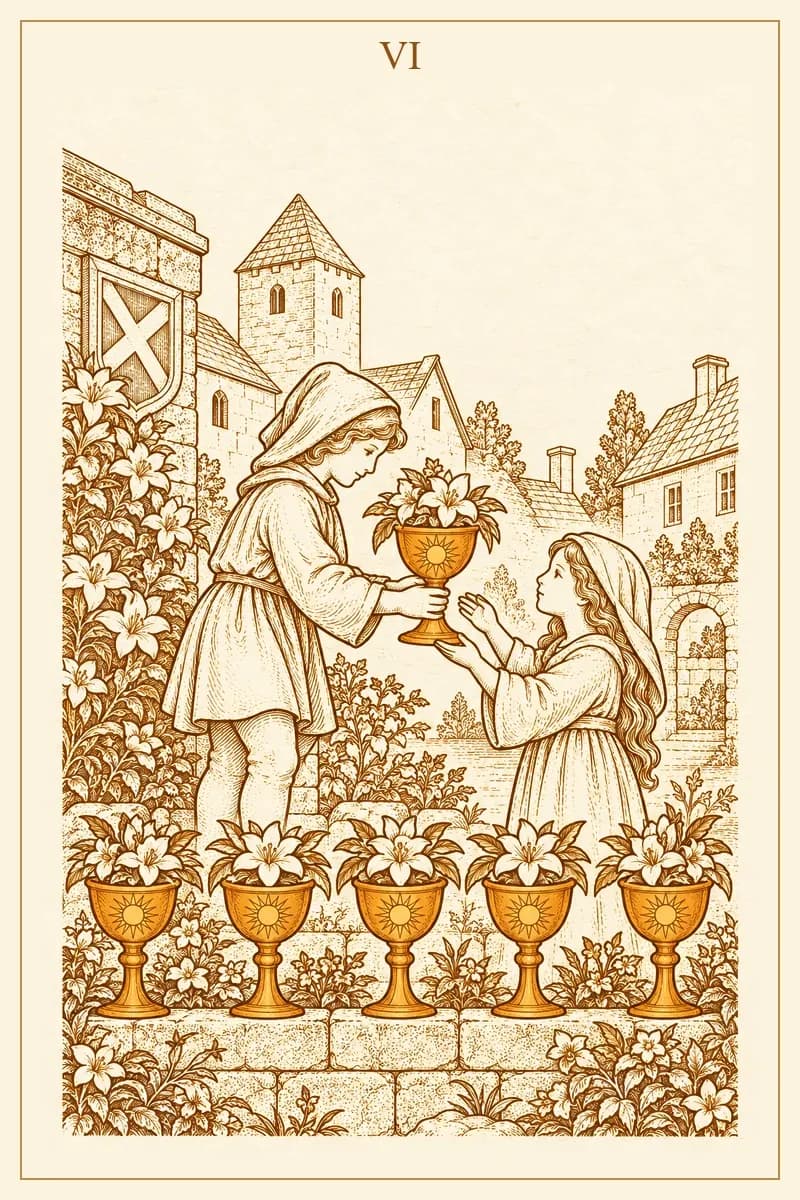
The card shown is VeilSoul's own engraved drawing of the 1909 Waite–Smith card. The scene and symbols described on this page follow the 1909 card, so a few details are drawn differently in our deck.
The Six of Cups is a tender scene of nostalgia and innocent generosity. In a garden setting, a young boy offers a golden cup filled with white flowers to a smaller girl — a gesture of pure, unselfish giving. Six cups surround them, each overflowing with blossoms. In the background, an older figure walks away, and buildings suggest a childhood home or village. The scene radiates warmth, safety, and the uncomplicated sweetness of early experience.
When the Six of Cups appears upright, the past is calling to you. Memories of childhood, former friendships, old homes, or simpler times are rising to the surface. This card may appear when you reconnect with someone from your past — an old friend, a childhood sweetheart, a family member you have not spoken to in years. It can also indicate the return to a place that holds deep emotional significance.
Beyond literal nostalgia, the Six of Cups represents the quality of innocence itself — the capacity to give without expectation, to trust without calculation, and to experience joy without self-consciousness. When this card appears, it asks you to reconnect with that childlike part of yourself that has been buried under adult cynicism and complexity.
The Six of Cups also carries a message about generosity and kindness. The boy gives the girl a cup of flowers not because he expects something in return, but because giving is its own reward. This card encourages random acts of kindness, charitable impulses, and the simple joy of making someone else smile.
A child offers a cup of flowers to a smaller child in an old garden — innocence giving to innocence. Memory is not the past revisited but the emotional foundation still shaping the present.
Nostalgia becomes a drug — the past so idealized the present cannot compete (excess), or childhood wounds stay unvisited, the garden locked and flowers withered behind the gate (deficiency).
Detailed Interpretations
The Six of Cups in love often signals the return of a past love or the rekindling of an old flame. An ex-partner may re-enter your life, or you may find yourself drawn to someone who reminds you of a childhood connection. Whether this reunion is wise depends on the surrounding cards and your own growth since the relationship ended. Nostalgia is a powerful intoxicant, and the Six of Cups asks you to distinguish between genuine recognition that a past love deserves a second chance and the seductive but misleading pull of memory that softens every edge and erases every reason the relationship ended in the first place. The person returning may have genuinely changed — or they may simply be the same person wrapped in the golden glow your memory has applied to them in their absence.
In an existing relationship, the Six of Cups encourages you to remember what first drew you together — the early dates, the first conversations, the moment you knew. Revisit those feelings. This card also favors creating new memories together that carry the same innocent joy: a picnic, a walk through a place that matters to you both, or sharing childhood stories you have never told. The Six of Cups in a committed partnership is a reminder that the foundation of your love exists beneath the layers of habit, routine, and accumulated small grievances — and that sometimes the most romantic thing you can do is remember who you were to each other before life got complicated, and let that memory refresh your commitment to who you are becoming together.
In love reversed, the Six of Cups may indicate nostalgia for a past relationship that is preventing engagement with present possibilities — idealization of what was, or of someone who is genuinely gone, that keeps the heart occupied with the past at the expense of what is actually available now.
This reversal can also indicate attempts to recreate a past relationship dynamic with a new person — projecting the template of a significant past connection onto someone who is not that person and who deserves to be encountered in their own right.
Alternatively, this card reversed may signal a reconnection with someone from the past that seems appealing on the surface but that would actually represent regression rather than genuine renewal. Nostalgia is a powerful feeling; it is not always accurate guidance.
Professionally, the Six of Cups may indicate reconnecting with a former colleague or employer, returning to a previous career path, or finding that a childhood passion holds the key to your next professional chapter. Sometimes the career that fulfills you most is the one you dreamed about before the world told you to be practical. The Six of Cups in career asks you to revisit those early dreams not with the cynicism of an adult who knows better but with the openness of someone willing to ask whether the dream was abandoned because it was truly impractical or simply because no one around you validated it at the time.
This card can also suggest mentorship — either receiving guidance from someone who has known you a long time, or offering your own experience to someone just starting out. The cycle of giving and receiving that the Six of Cups represents is a powerful force in professional development. The mentor who shaped your early career may have something new to teach you, or you may discover that teaching what you know to the next generation clarifies your own understanding in ways that solitary practice never could.
The Six of Cups also favors businesses and careers rooted in heritage, tradition, or nostalgia — antiques, restoration, genealogy, heritage tourism, traditional crafts, childhood education, or any field where the past is not merely preserved but actively brought into meaningful conversation with the present. If your professional path has felt disconnected from your personal history, this card suggests that reconnecting those threads may unlock both fulfillment and unexpected success.
Career-wise, the reversed Six of Cups suggests being stuck in professional nostalgia — longing for the way work used to be, romanticizing a past role or period that may not have been as idyllic as it now appears, or refusing to adapt to present professional realities because they do not match a preferred memory of how things once were.
This reversal may also indicate someone whose professional gifts were formed in childhood — the natural singer, the gifted writer, the born teacher — who has either failed to develop those gifts into adult professional form, or who is struggling with the gap between the uncomplicated joy of childhood expression and the complex demands of professional creative work.
The invitation is to bring the genuine gifts forward without trying to recreate the conditions of their origin.
The Six of Cups in health encourages you to return to wellness practices that worked for you in the past. A childhood activity — swimming, cycling, dancing, playing a sport — may hold the key to rekindling your physical vitality. Sometimes the body remembers joy through movement it learned long ago, and the exercise that feels least like exercise is often the one you discovered before fitness became an obligation and a source of guilt. The Six of Cups asks you to reconnect with the version of physical activity that made you feel alive rather than disciplined — the movement your body chose when it was free to choose, before anyone told you what counted as a real workout.
This card also speaks to the healing power of emotional connection with family and the comfort of familiar environments. If your health has suffered, returning to a place or community that feels like home may accelerate your recovery. The Six of Cups recognizes that healing is not purely biological — it happens in context, and the context of safety, belonging, and emotional warmth creates conditions in which the body can repair itself more effectively than it can in environments of stress and isolation. If you have been trying to heal while simultaneously managing loneliness, displacement, or disconnection from your roots, this card gently suggests that addressing the emotional environment may be as important as any medical intervention. Sometimes the medicine is not a prescription but a phone call to someone who remembers who you were before you got sick, and who can remind you that person still exists beneath the illness.
Use this as a reflective prompt, not medical advice or a diagnosis. For health concerns, seek guidance from a qualified healthcare professional.
The Six of Cups reversed suggests being stuck in the past, idealizing former times at the expense of the present, or clinging to childhood patterns that no longer serve you. Nostalgia, when excessive, becomes an escape from the challenges and responsibilities of adult life.
This reversal can also indicate childhood trauma or unresolved past experiences that are influencing your current behavior. Patterns established in early life — people-pleasing, fear of abandonment, difficulty trusting — may be surfacing and demanding attention.
In some readings, the reversed Six of Cups may simply suggest that a hoped-for reunion is unlikely, or that returning to the past is not the answer to your current situation. Sometimes you cannot go home again, and growth requires moving forward rather than looking back.
The reversed Six of Cups teaches the essential difference between honoring the past and being imprisoned by it — between drawing on the genuine gifts, memories, and formative experiences of earlier life and being unable to function in the present because it does not match the remembered version of before.
This card in reversal invites honest assessment of nostalgia: what are you actually longing for when you long for the past? Often it is not the specific circumstances but the feeling they contained — simplicity, safety, uncomplicated joy, a sense of belonging. That feeling can be sought and created in present circumstances; it does not require returning to conditions that are genuinely gone.
The deepest lesson: the past is a foundation, not a destination. Its gifts are meant to be carried forward, not returned to. The reversed Six asks you to identify what you are genuinely seeking — the feeling beneath the nostalgia — and to find it in the present rather than continuing to search for it in what cannot be recovered.
Let a positive memory or childhood joy inform something you do today — not as an escape into the past, but as a reminder of what genuinely delights and restores you. The Six of Cups at its best connects the simple pleasures of early life with the present moment. What did you love doing before ambition, obligation, and complexity made everything more complicated? Find one small version of that today.
“I honor my past with gratitude and carry its lessons forward. My childhood innocence still lives within me, informing my capacity for joy and generosity.”
The card shown is VeilSoul's own engraved drawing of the 1909 Waite–Smith card. The scene and symbols described on this page follow the 1909 card, so a few details are drawn differently in our deck.
The children in the card represent innocence, trust, and the pure emotional exchanges of early life — before social conditioning taught us to guard our hearts. The boy's offering of flowers in a golden cup symbolizes generous love that expects nothing in return.
The six cups filled with white flowers represent memories and emotional treasures from the past that still carry beauty and meaning. White flowers symbolize purity and sincerity — the emotions depicted here are uncorrupted by ulterior motives.
The background details — the older figure walking away, the sturdy buildings, the garden setting — suggest a safe, established environment connected to childhood or heritage. The departing figure may represent the adult self stepping back to allow the child self to emerge, or the passage of time that makes nostalgia bittersweet.
Six is the number of harmony, balance, and reciprocity. In the Cups suit, it represents emotional equilibrium restored through connection to the past — the sweetness of memory that heals present wounds and reminds us of our capacity for uncomplicated love.
Keep or share this card reference
✦ From meaning to reflection ✦
Bring what this card stirred into a reading shaped around what you are facing now.
Read with this insight