Loading your view
The page is gathering the latest information.
The page is gathering the latest information.
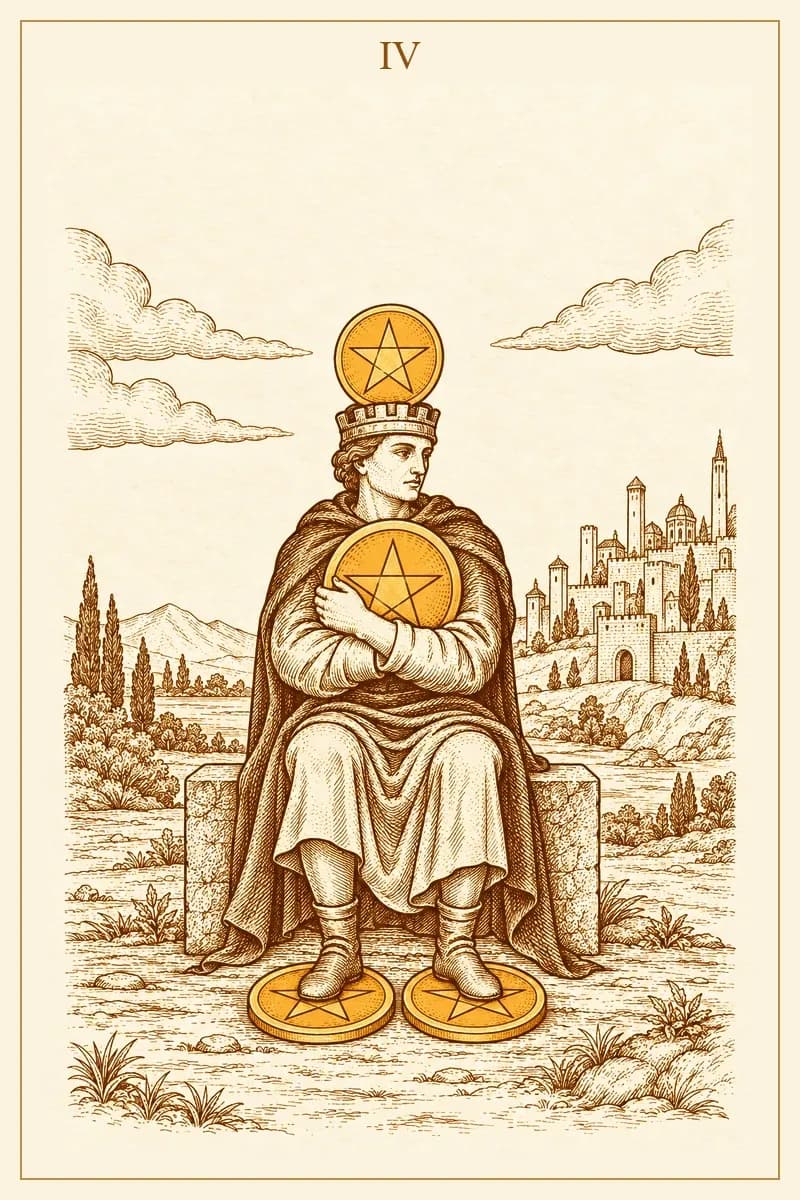
The card shown is VeilSoul's own engraved drawing of the 1909 Waite–Smith card. The scene and symbols described on this page follow the 1909 card, so a few details are drawn differently in our deck.
The Four of Pentacles presents a figure seated on a stone bench outside a city, clutching a golden pentacle tightly to his chest while balancing one on his head and resting his feet on two more. His posture is rigid, his grip unyielding — he holds his wealth close and seems unwilling to release even the smallest coin. Behind him, the city represents the community and opportunities he has turned his back on in order to protect what he has.
When the Four of Pentacles appears upright, the central question is one of control and attachment. You may be holding too tightly to money, possessions, routines, or relationships out of fear that letting go means losing everything. There is a difference between financial prudence and fearful hoarding, and this card asks you to examine which side of that line you are standing on.
However, the Four of Pentacles is not entirely negative. In certain contexts, it represents legitimate financial caution — saving for the future, protecting your assets, establishing boundaries around your resources. If you have been too generous or too careless with your money, this card may be advising you to tighten up, budget carefully, and ensure your financial foundation is secure before extending yourself.
The deeper message of the Four is about the relationship between security and freedom. The figure has achieved material stability, but at what cost? His rigid grip prevents him from participating in the life of the city behind him. Security that isolates you from connection, generosity, and growth is not true security — it is a gilded cage.
A figure clutches one pentacle to their chest, balances another on their head, and pins two beneath their feet — every limb locked in defense. Security has become a prison built from the inside.
The grip loosens into reckless spending that bleeds resources dry, or tightens further into paranoid isolation where even necessary exchanges feel like theft.
Detailed Interpretations
The Four of Pentacles in love reveals a relationship dynamic where possessiveness, jealousy, or emotional guardedness has taken root. One partner may be controlling — holding the other too tightly, monitoring their communications, fearing abandonment so deeply that they attempt to prevent it through restriction rather than trust. Love cannot grow in a closed fist; it needs open hands and the willingness to be vulnerable even when vulnerability feels dangerous.
This card often appears when emotional walls have been constructed so high that genuine intimacy cannot penetrate them. One or both partners may withhold affection, avoid difficult conversations, or refuse to share their innermost feelings because exposure feels like a loss of control. The irony is that the very behaviors meant to protect the relationship — jealousy disguised as caring, possessiveness framed as devotion — are the behaviors most likely to destroy it.
If you are single, the Four of Pentacles suggests that you are holding onto past heartbreak so tightly that you have closed yourself to new love entirely. Perhaps a previous betrayal taught you that opening your heart leads to pain, so you decided to never be that vulnerable again. The walls you built for protection have become a prison of your own making. This card asks whether your emotional boundaries are keeping you safe or keeping you alone — and whether the safety of isolation is worth the cost of missing genuine connection.
In love reversed, the Four of Pentacles signals a significant shift in relationship dynamics around control and attachment. In its most positive expression, this reversal indicates the genuine release of jealousy, possessiveness, and control issues — a breakthrough moment where one or both partners recognize that their grip was suffocating the relationship and consciously choose to trust instead. Walls come down, vulnerability replaces defensiveness, and the relationship breathes freely for perhaps the first time.
However, the reversed Four can also indicate a relationship falling apart precisely because the controlling dynamics became intolerable. One partner may finally refuse to accept possessive behavior, setting boundaries that the controlling partner experiences as abandonment. Alternatively, the person who was holding on too tightly may simply exhaust themselves — control requires enormous energy, and when that energy runs out, the relationship collapses not through resolution but through burnout. For singles, this reversal often marks the moment when old heartbreak finally loses its grip and you genuinely open to new possibilities.
Professionally, the Four of Pentacles indicates a conservative approach to business and career — protecting what you have accumulated rather than risking growth through investment, innovation, or change. This may be wise during genuinely uncertain times when preserving capital and maintaining stable employment is the responsible choice. However, it can also signal stagnation born from fear rather than strategy. Are you hoarding resources, knowledge, or opportunities because you have analyzed the risks, or because you are terrified of losing what you have built?
In financial terms, the Four frequently represents excessive saving at the expense of strategic investment, reluctance to spend money even when the expenditure would generate meaningful returns, or a scarcity mindset that convinces you there will never be enough regardless of how much you accumulate. A tight budget is responsible; a death grip on every penny is self-defeating and ultimately counterproductive to the wealth-building you claim to pursue.
For those in leadership positions, the Four of Pentacles warns against micromanagement — holding every decision, every piece of information, and every process so close to your chest that your team cannot function independently or develop their own capabilities. This control creates a bottleneck that limits organizational growth while simultaneously burning you out. The most effective leaders delegate authority, share information generously, and trust others to contribute their expertise. Your value as a leader comes from enabling others, not from being the sole gatekeeper of knowledge and decisions.
Career-wise, the reversed Four of Pentacles indicates a meaningful shift in your professional relationship with security and control. Positively, this can manifest as finally opening up to new business strategies after a period of excessive conservatism — investing in growth, sharing resources with colleagues, embracing calculated risks that your upright-Four caution previously prevented. You recognize that hoarding knowledge and opportunities served no one, least of all yourself, and you begin to operate with greater generosity and strategic vision.
In its challenging expression, the reversed Four warns of financial setbacks caused by the sudden loss of discipline — swinging from excessive tightness to reckless spending, making impulsive investments without due diligence, or abandoning budgets entirely in a reactive overcorrection. The pendulum swings from hoarding to hemorrhaging, and neither extreme serves your long-term interests. The key question is whether your letting go represents conscious growth or unconscious chaos. True financial maturity lies not in gripping or releasing but in holding resources with wisdom — knowing when to save, when to invest, and when to share.
The Four of Pentacles in health points to tension held chronically in the body — tight shoulders that creep toward your ears, a clenched jaw that aches by evening, lower back rigidity, or headaches born from the constant mental effort of trying to control everything around you. The body reflects the mind with remarkable faithfulness: when you cannot let go mentally, your muscles follow suit, bracing against perceived threats even during moments that should be restful.
Stress-related conditions frequently accompany this card — hypertension, digestive issues from a nervous system perpetually in fight-or-flight mode, insomnia caused by a racing mind cataloging everything that could go wrong, or immune system suppression from sustained cortisol elevation. The Four of Pentacles asks you to recognize that the need to control is itself a health risk, and that relaxation is not laziness but a medical necessity.
This card strongly encourages relaxation practices that teach the art of conscious releasing — massage therapy that works the tension from muscles you did not realize you were clenching, yoga that opens constricted postures, meditation that trains the mind to observe thoughts without gripping them, or breathing exercises that activate the parasympathetic nervous system. Physical health improves dramatically when you allow yourself to soften rather than perpetually brace against the world.
Use this as a reflective prompt, not medical advice or a diagnosis. For health concerns, seek guidance from a qualified healthcare professional.
The Four of Pentacles reversed can indicate one of two extremes: either releasing your grip on material attachments and embracing generosity, or losing financial control entirely through reckless spending or unexpected loss. Context determines which interpretation applies.
In its positive expression, the reversed Four signals liberation from possessiveness — finally letting go of money fears, sharing your resources, opening your heart, or releasing a relationship that you were holding onto out of fear rather than love. The cage door opens and you choose to walk out.
In its shadow expression, the reversed Four indicates financial instability, loss of savings, or a situation where you had control and lost it. Money flows out faster than it comes in, boundaries dissolve, and the security you built is threatened.
The reversed Four of Pentacles teaches that the journey from fear-based control to genuine security requires passing through the uncomfortable territory of uncertainty. True security was never about how tightly you gripped — it was about trusting yourself to handle whatever comes, whether abundance or loss. The lesson is that holding on too tightly to anything — money, people, status, routines — ultimately pushes it away through the suffocating pressure of your grip, while open-handed generosity creates the circulation and flow that sustains genuine abundance.
This reversal also teaches discernment between healthy releasing and reckless abandonment. Letting go of control does not mean abandoning all structure — it means finding the balance between rigidity and chaos, between hoarding and hemorrhaging. The mature expression of the Four reversed is someone who can hold their resources, relationships, and plans with a relaxed but attentive hand — present enough to be responsible, loose enough to allow growth and change.
Notice where you are gripping too tightly today — your money, your schedule, your plans, your opinions, the people around you. Choose one area where control has become a reflex rather than a choice, and consciously loosen that grip. You do not need to let go entirely — just soften enough to feel the difference. Observe what happens when you stop bracing and start breathing. Control is often the enemy of the very flow and opportunity you need most, and today is a good day to practice the art of holding gently.
“I hold my resources with an open hand. I trust that true security comes from wisdom and generosity, not from fearful control.”
The card shown is VeilSoul's own engraved drawing of the 1909 Waite–Smith card. The scene and symbols described on this page follow the 1909 card, so a few details are drawn differently in our deck.
The figure's posture tells the entire story: one pentacle pressed against his chest (guarding his heart and values), one balanced on his head (consuming his thoughts), and two beneath his feet (controlling his foundation and path). He has made material security his entire identity — every part of his being is engaged in holding on.
The stone bench represents stability that has become rigidity. He is seated, not moving — unlike the dancing figure of the Two of Pentacles, who embraced the flow of material life. The Four has stopped dancing and started hoarding.
The city behind him symbolizes community, trade, relationships, and shared prosperity — everything that requires openness and exchange. By turning his back on it, the figure has chosen isolation over participation, control over connection. The Rider-Waite-Smith imagery makes clear that the price of absolute security is absolute loneliness.
Four represents structure, stability, and foundation. In the Pentacles suit, it manifests as material security taken to its extreme — the point where healthy structure becomes rigid control. The Four asks whether your foundation supports you or imprisons you.
Keep or share this card reference
✦ From meaning to reflection ✦
Bring what this card stirred into a reading shaped around what you are facing now.
Read with this insight