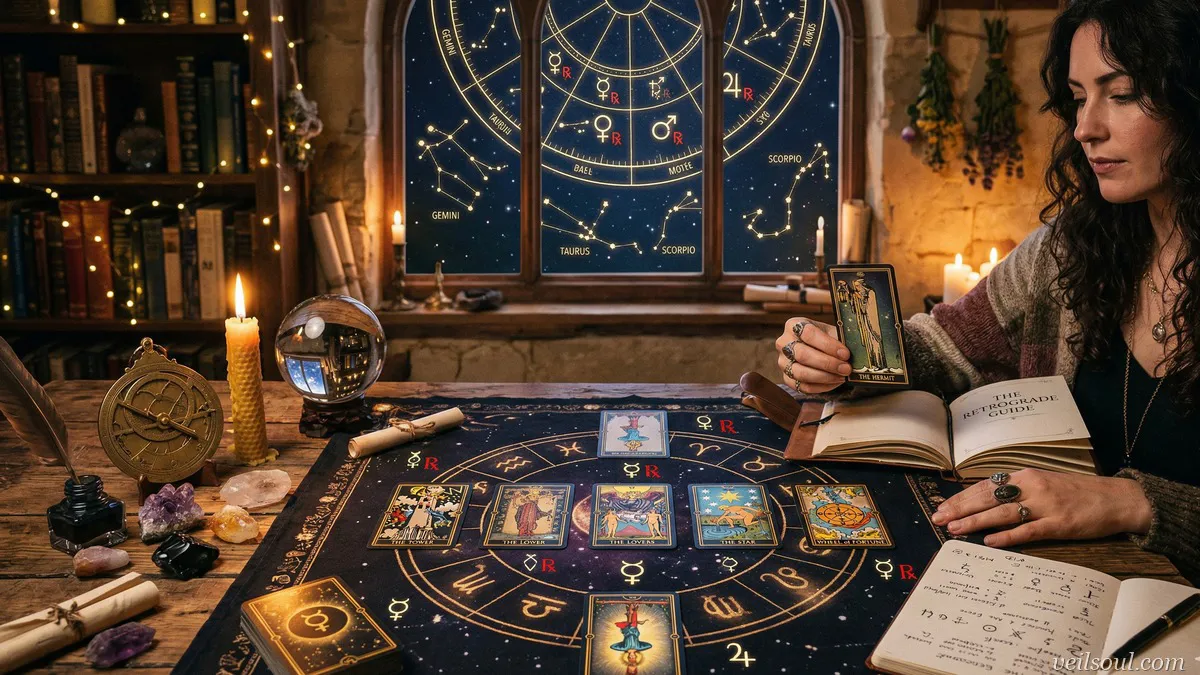
Neptune has no card of its own in the Golden Dawn system that most modern decks follow. The planet was discovered in 1846, and the correspondences set down in the Order's tarot manual, Book T, were built on the seven classical planets alone, so Neptune received no trump and no decans. Modern readers most often give it The Hanged Man (XII), which the Golden Dawn assigned to the element of Water, and many also read it through The Moon (XVIII), the card of Pisces, the sign modern astrology hands to Neptune.
Pisces brings three more cards with it: the Eight of Cups, the Nine of Cups and the Ten of Cups, the sign's decans. Book T gives those to Saturn, Jupiter and Mars, not to Neptune, yet they carry the same water and suit a question that feels hazy. All of these pairings are tools for reflection. A Neptune card cannot reveal what someone else secretly feels, confirm that you are being deceived, or tell you when a confusing period will clear; what it can do is help you sort what you know from what you are hoping or fearing.
At a glance, these are the cards this guide connects with Neptune, and why:
- The Hanged Man (XII): the usual modern Neptune card; in the Golden Dawn, Water and the Hebrew letter Mem. Surrender, suspension, a changed point of view.
- The Moon (XVIII): Pisces in the Golden Dawn, and Pisces is Neptune's modern sign. Dreams, half-light, uncertainty.
- Eight of Cups: Saturn in Pisces, first decan. Walking away from what no longer feeds you.
- Nine of Cups: Jupiter in Pisces, second decan. A wish met, and a check on whether it was really yours.
- Ten of Cups: Mars in Pisces, third decan. A shared ideal that someone has to keep tending.
- Seven of Cups: Venus in Scorpio, not a Pisces card at all, but the deck's clearest picture of Neptune's fog of illusion.
Discovered in 1846, left out of a seven-planet design
Neptune was the first planet found by mathematics rather than by sky-watching. Irregularities in the orbit of Uranus led Urbain Le Verrier in France to calculate where an unseen planet ought to be, and on September 23, 1846, Johann Galle at the Berlin Observatory found it within about a degree of that spot. It was named after the Roman god of the sea, and its astronomical symbol is his trident.
About four decades later, the Hermetic Order of the Golden Dawn drew up the tarot correspondences that most English-language decks still inherit. Book T works with a closed set of symbols: three elements, seven planets and twelve signs make twenty-two parts, one for each trump and each Hebrew letter. The planets in that set are the seven visible to the naked eye, from the Moon out to Saturn. Uranus and Neptune were known by then, but the scheme stood on the older astrology and kept no seat for them.
The Minor Arcana follow the same logic. Book T divides the zodiac into thirty-six decans of ten degrees, gives each one to a numbered card from Two to Ten, and assigns the rulers by cycling through the seven classical planets in their traditional order. No decan is left over for a planet the ancients never saw, so in the Golden Dawn system Neptune rules no Major Arcana card and no Minor Arcana card. Every link between Neptune and tarot that you meet today was added afterward by twentieth-century readers, which makes those links a choice you make rather than a rule you inherit.
Sea god, fog and compassion: what Neptune stands for
In modern astrology Neptune is the planet of dissolving edges. It is linked with dreams and imagination, music, film and poetry, spiritual longing, compassion, and the sense of belonging to something larger than yourself. The same quality has a shadow: confusion, wishful thinking, deception and self-deception, and the urge to escape into sleep, screens, substances or someone else's story. Astrologers usually read both faces together, because the gift of seeing past hard lines is also the risk of not seeing clearly at all.
Modern astrology makes Neptune the ruler of Pisces, the last sign of the zodiac, which traditional astrology gave to Jupiter. Neptune takes about 165 years to circle the Sun, so it spends around fourteen years in each sign. That slow pace is why its sign is read as a mood shared by a generation, and its contact with the sensitive points of a personal chart as a long, foggy season rather than a single event. When tarot readers call a card "Neptunian," they usually mean a boundary blurring, an ideal taking hold, a surrender that cannot be forced, or facts that are not yet visible.
The Hanged Man: the water trump readers now give to Neptune
In Book T, The Hanged Man is one of the three elemental trumps. It carries the Hebrew letter Mem, which means water, and its Golden Dawn title is the Spirit of the Mighty Waters. When later readers went looking for homes for the planets found since antiquity, the elemental trumps were the natural openings, since only those three cards had neither a sign nor a classical planet. Most modern sources settle on Uranus for The Fool (Air), Neptune for The Hanged Man (Water) and Pluto for Judgement (Fire), and our guide to Pluto in tarot follows the last of the three.
The fit rests on theme: water dissolves and carries, and the Hanged Man gives up his footing and lets himself be held. Treat the pairing as a modern convention rather than part of the Golden Dawn system, and it stays useful without claiming more history than it has. Our guide to the Water element in tarot follows that element through the rest of the deck.
The Hanged Man (XII): held still on purpose
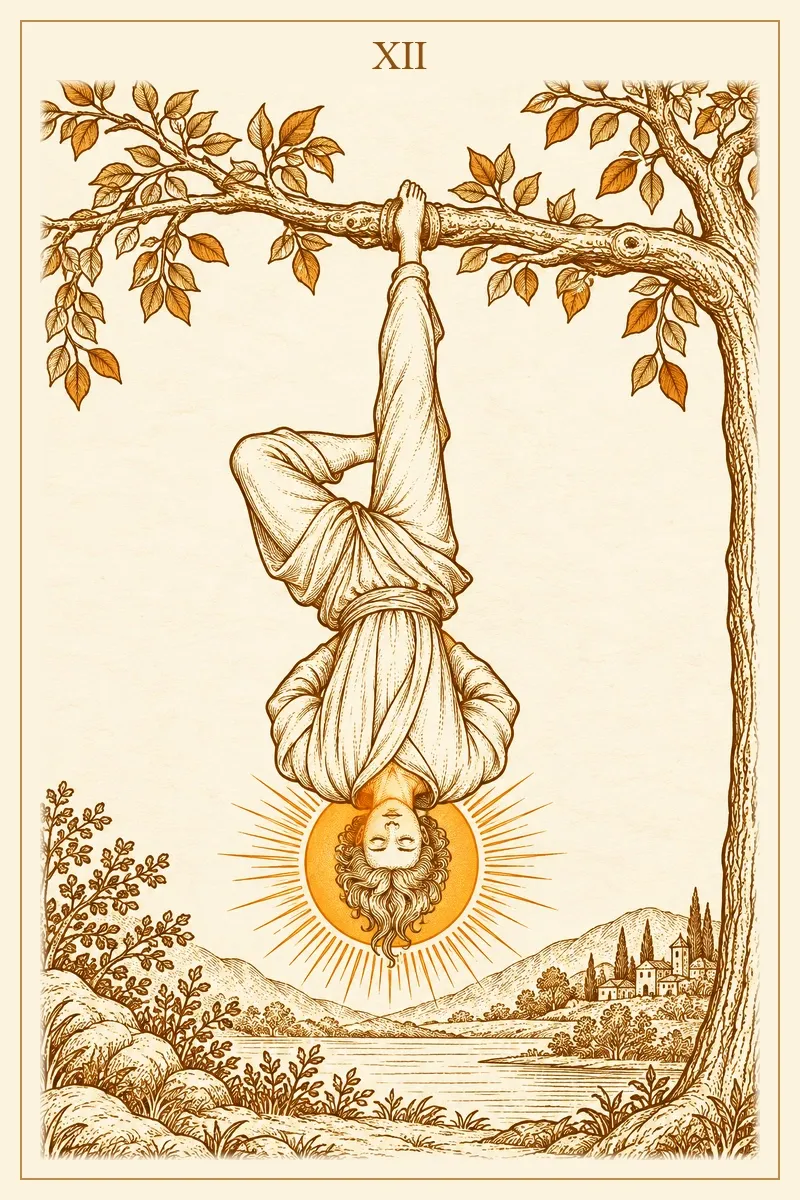
A young man hangs upside down by one foot from the leafy branch of a living tree, above a still lake with a village on its far shore. His free leg bends behind the other to make a cross, his hands are out of sight behind his back, and a ring of light surrounds his head. His eyes are closed and his face is calm. Nothing in the picture says he is trapped; he looks like someone who has stopped struggling and started noticing.
Upright, as a Neptune card, The Hanged Man describes a pause you cannot hurry: waiting for news, a project on hold, a feeling you have to live with before you can explain it. The advice is to stop pushing and look at the situation from the other way up. In love it can mean letting a relationship find its own pace instead of demanding a definition this week; at work, accepting a delay and using the time to rethink the plan.
Reversed, the pause has stopped serving you. It can point to martyrdom, giving and giving in the hope that sacrifice will eventually be rewarded, or to drifting, where waiting has quietly become avoidance. The reversed card asks one plain question: is this suspension still teaching you something, or is it time to come down? For the card's full range outside astrology, see The Hanged Man tarot meaning.
The Moon: the card of Neptune's modern sign
The second route from Neptune into the deck runs through Pisces. In the Golden Dawn system Pisces belongs to The Moon, the eighteenth trump, with the Hebrew letter Qoph and the title Ruler of Flux and Reflux. Neptune does not appear in that attribution; the card belongs to the sign, and readers reach it through Neptune's modern rulership. The older rulers have cards too: Jupiter, the traditional lord of Pisces, holds the Wheel of Fortune, and Venus, which traditional astrology exalts in Pisces, holds The Empress. Our Pisces tarot guide covers the sign's court cards and season in more depth.
The Moon (XVIII): walking by uncertain light
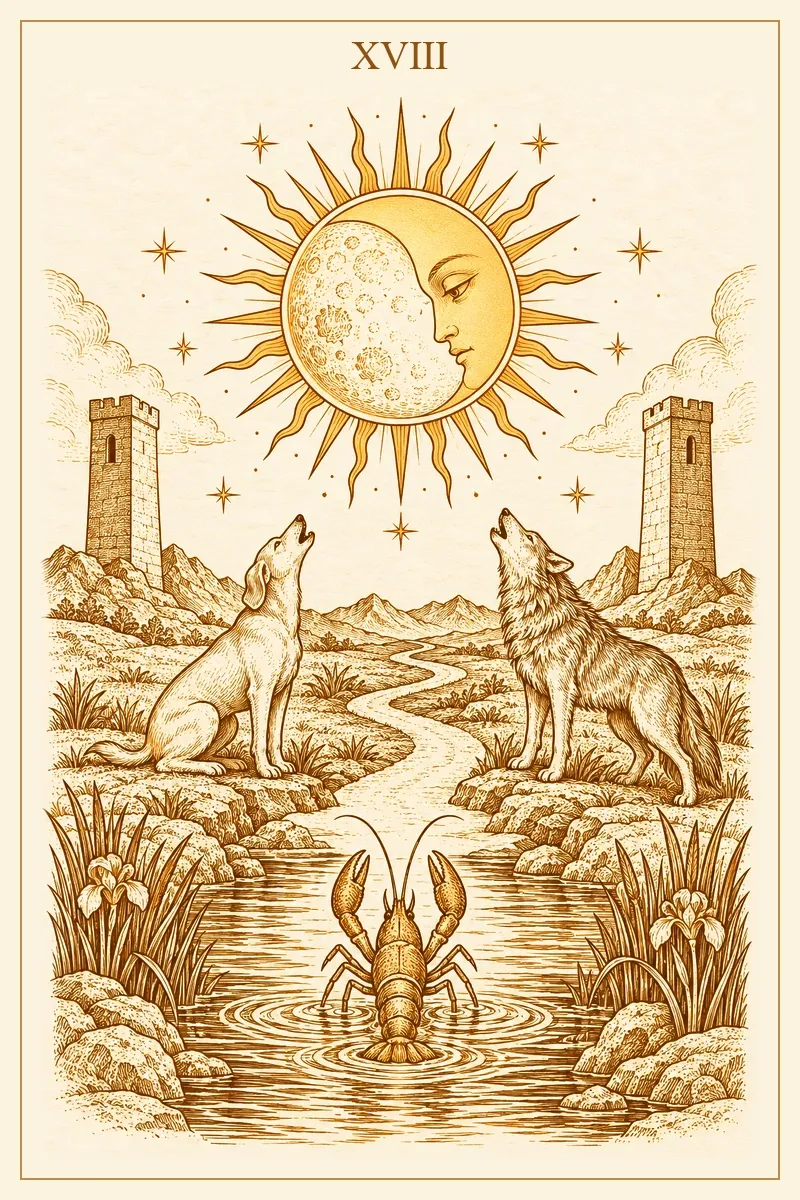
A full moon with a quiet crescent face sits inside a ring of long rays, with small stars around it. Below, a crayfish climbs out of a pool where a winding path begins; the path runs between a dog and a wolf howling up at the sky, then between two stone towers toward distant mountains. The light is strong enough to walk by and too weak to show the whole road.
Upright, The Moon is the most Neptunian picture in the deck: you are moving through something you cannot fully see. Dreams are vivid and intuition is loud, but so are worry and imagination, and from the inside they are hard to tell apart. Keep going, but do not build a decision on an impression you have not checked. In love it often marks a stage of reading signals and filling silences; at work, a plan made on half the information.
Reversed, the fog starts to lift, or you finally notice how much of the story you supplied yourself. A fear shrinks once it is said aloud, a misunderstanding gets cleared up, or a hunch you kept dismissing proves right. It can also warn that you are pushing an inconvenient intuition away. The full Moon tarot meaning goes through its symbols one by one.
Three Pisces cups ruled by classical planets
The last three numbered Cups cover Pisces, ten degrees each, and Book T gives every one of them a classical ruler: the Eight of Cups is Saturn in Pisces, the Nine of Cups is Jupiter in Pisces and the Ten of Cups is Mars in Pisces. Neptune rules none of them. What they share with Neptune is the sign's water, and each shows a different side of the Neptunian question of how far to trust a feeling: leaving on instinct, getting what you wished for, and living inside an ideal. The Sun passes through all three from about February 19 to March 20.
Eight of Cups, Saturn in Pisces: leaving what no longer nourishes
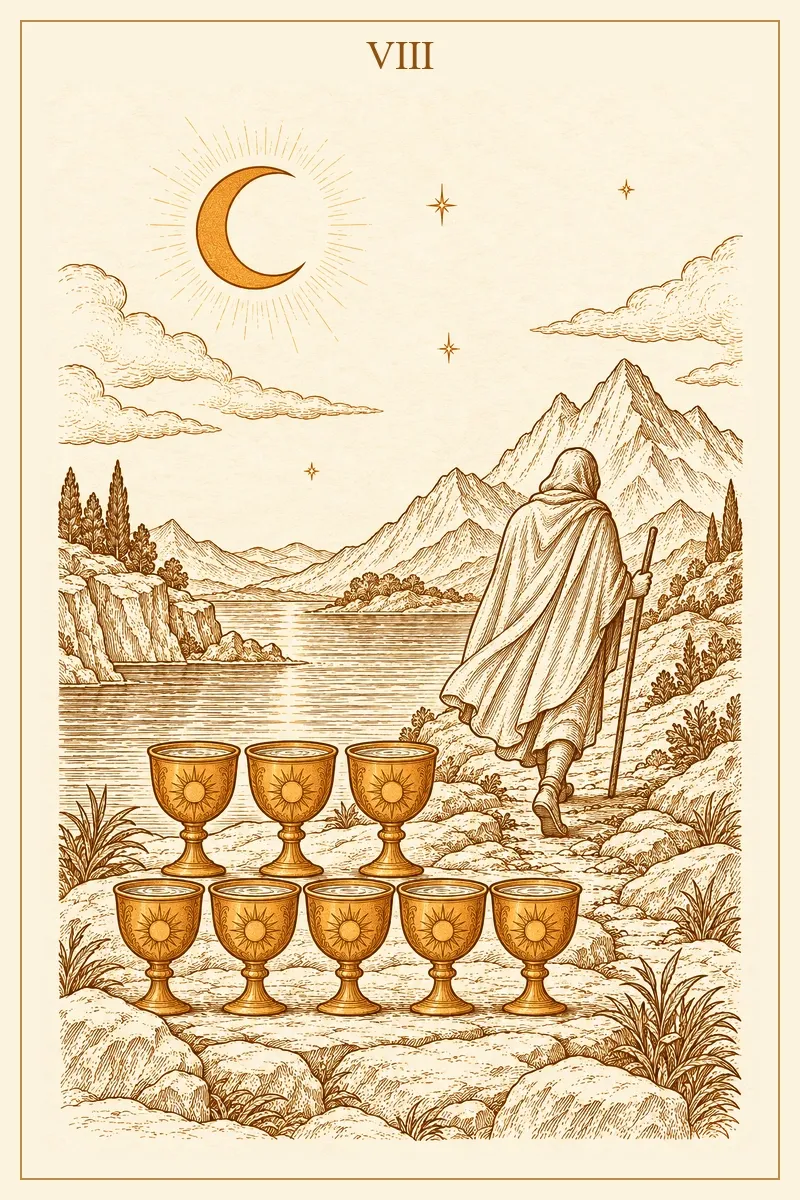
A hooded figure with a walking staff turns away from eight cups set in two rows, three above five, and heads past a lake toward the mountains under a crescent moon. Book T calls it the Lord of Abandoned Success: nothing here is broken, and the figure is leaving anyway.
The Neptune theme in this card is the slow dissolving of attachment. A job, a friendship or a way of living stops feeding you long before you can explain why, and one day leaving feels less like a decision than a recognition. Saturn's rule keeps the card honest: the departure has a cost and deserves a plan, not just a mood. Upright, it supports walking toward something that matters more, even without a map. Reversed, it shows a long hesitation at the edge, or a habit of leaving whenever life turns ordinary, which is Neptune's escapist side rather than its wisdom. The Eight of Cups meaning covers love and career readings for the card.
Nine of Cups, Jupiter in Pisces: the dream that comes true
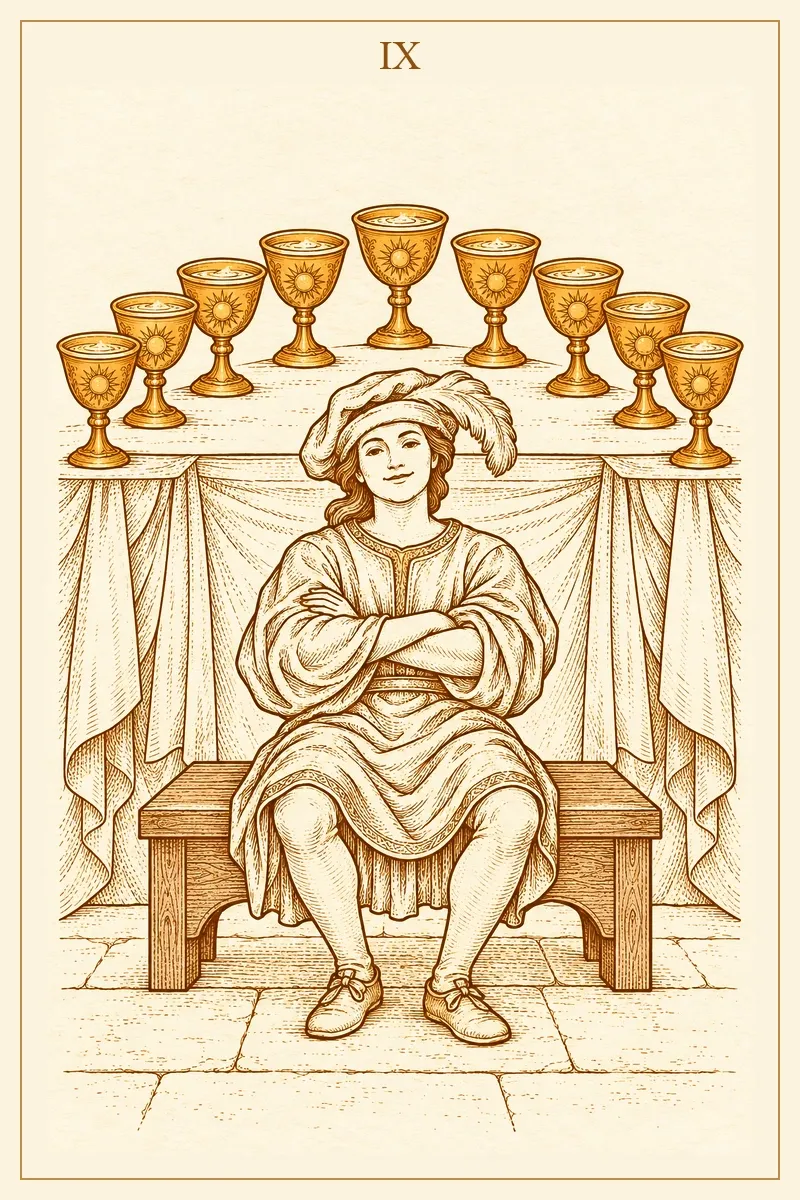
A young man in a feathered cap sits on a wooden bench with his arms folded and a satisfied smile, and behind him nine cups stand in a curved row on a draped table. Its Golden Dawn title is the Lord of Material Happiness, and its ruler, Jupiter, is also the traditional lord of Pisces, so the card sits comfortably in the sign.
Through a Neptune lens, the Nine of Cups is the moment a dream becomes ordinary life, which is both its pleasure and its test. Upright, it is genuine contentment and a wish you can name and work toward. Reversed, Neptune's fog returns: satisfaction that does not satisfy, a wish borrowed from someone else's picture of happiness, or indulgence used to soothe something you have not looked at yet. Ask whether the cups behind you hold what you actually wanted. More on the card is in the Nine of Cups meaning.
Ten of Cups, Mars in Pisces: living inside the ideal
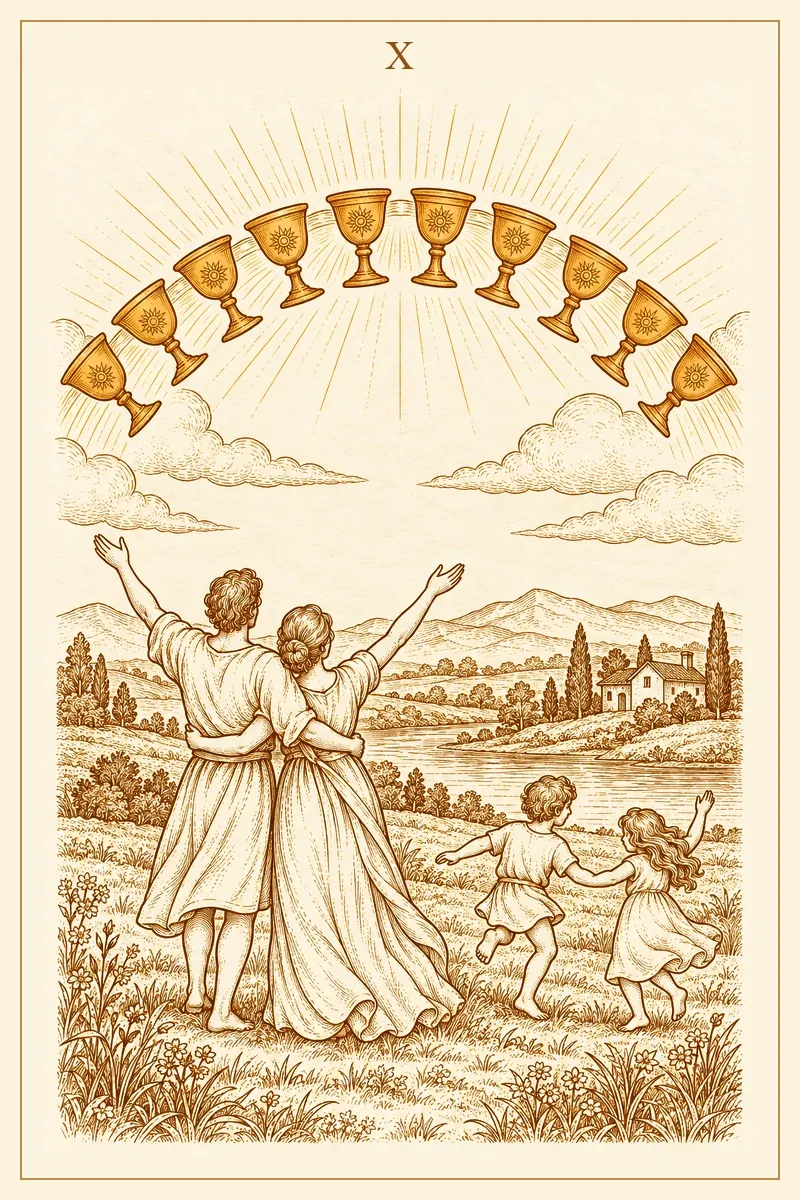
A couple stands with their arms around each other, each raising a free arm toward an arc of ten cups set in rays of light, while two children dance hand in hand beside them and a small house sits among trees beyond a river. Book T names it the Lord of Perfected Success.
This is Neptune's highest vision made visible: belonging without conditions, a love that feels larger than the people in it. Mars as its ruler is the useful surprise, a reminder that the picture has to be maintained by effort, apologies and small practical acts. Upright, it speaks of shared happiness and a home, chosen or inherited, where you are known. Reversed, the ideal and the reality have drifted apart: a family image kept up for show, or one person quietly holding the whole picture together. The Ten of Cups meaning covers its other contexts.
The Seven of Cups: the deck's picture of Neptune's fog
Some cards carry Neptune's mood without any astrological claim to it, and the clearest is the Seven of Cups. In Book T it belongs to Venus in Scorpio, a decan of a different water sign, under the title Lord of Illusionary Success, which is reason enough for many readers to bring it in. Treat it as a thematic match, not an attribution.
Seven of Cups: choosing among visions
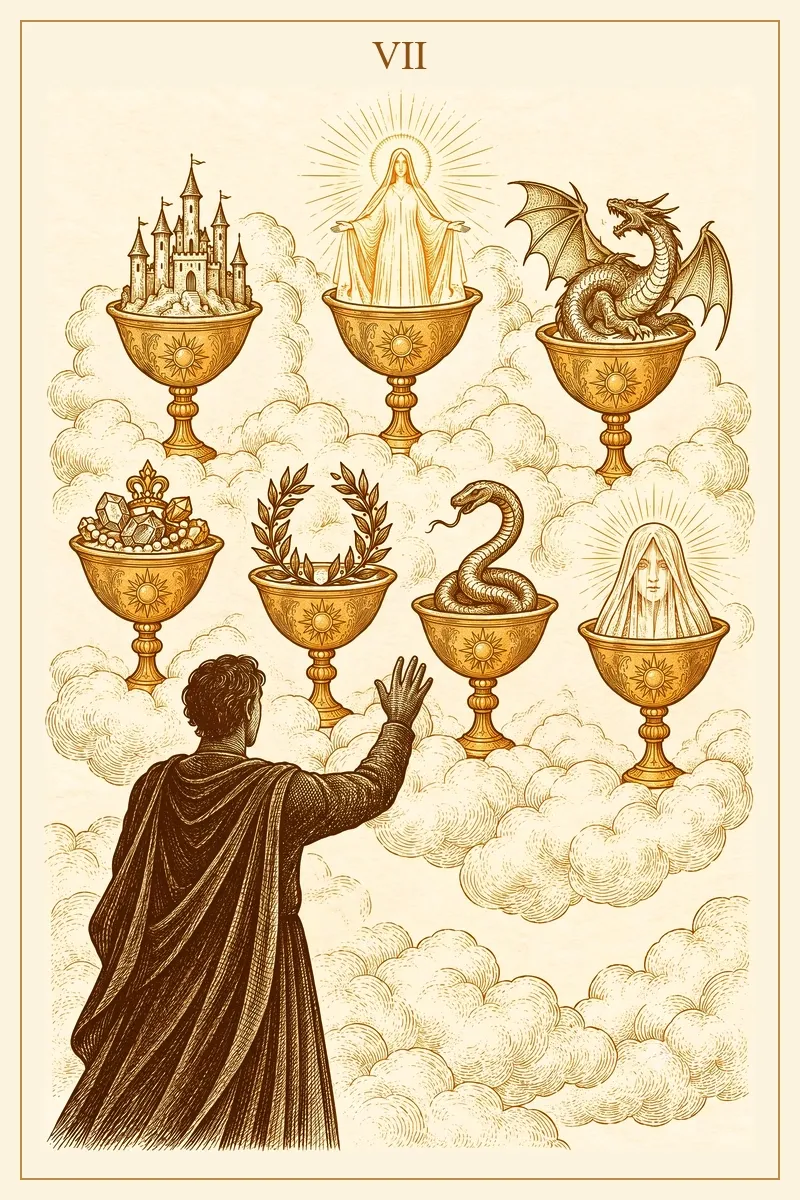
A cloaked figure, seen from behind, raises a hand toward seven cups floating in clouds. Each one holds a vision: a castle, a radiant robed figure, a winged dragon, a heap of jewels, a laurel wreath, a snake and a veiled head glowing with light. Some look like rewards and some like threats, and none of them can be held yet.
Upright, the card describes too many possibilities and too little ground: daydreams, a plan that only works in the imagination, or an offer whose appeal lives mostly in the telling. Neptune's lesson here is not to stop dreaming but to test one dream at a time. Reversed, it often marks clarity arriving, when the options narrow and you see which cup is real; sometimes it means the fantasies have become a hiding place. The Seven of Cups meaning covers the card in love and work.
Neptune themes in love, work, money and rest
When a reading turns on a blurred boundary, an ideal, a secret or a longing to get away, ask what Neptune would ask: what am I sensing, what am I assuming, and what would still be true in plain daylight?
Love and idealizing someone
Neptune in love is the pull to see a partner as the answer to everything, or to stay loyal to the person you hoped they were. The Moon or the Seven of Cups beside a court card can point to a relationship read mostly through imagination. The gentle question is what you know from their actions, not from your hopes or fears.
Work, money and vague terms
Neptune is kind to artists, caregivers and anyone whose work depends on empathy, and unkind to vague agreements. In a career question, these cards can encourage creative or service-minded work while asking you to get the hours, the pay and the expectations in writing. Money is where the fog costs most: treat a Neptune card in a money question as a prompt to read the small print and ask for numbers. It cannot tell you whether an investment is sound, and decisions with real stakes belong with a qualified financial advisor.
Rest, spirituality and escape
Neptune also governs the need to switch off: sleep, music, prayer, meditation, the sea. A reading full of Neptune cards may simply say you need real rest. If it points instead to escape that has become a pattern, take that seriously and talk to someone you trust, a counselor or a doctor. For the quieter skill of listening to your own impressions, our guide to building intuition for tarot offers simple practices.
The lighthouse spread: five cards for a hazy question
This spread is made for situations that feel unclear, when you suspect something is off, or that something wonderful is possible, and cannot tell which. Lay the first four cards in a row from left to right, then place the fifth above them as the lighthouse.
- What I sense: the impression or feeling I keep returning to.
- What I am hoping is true: the wish shaping how I see this.
- What I am afraid is true: the fear doing the same.
- What is actually in front of me: the facts I could show someone else.
- The lighthouse: one thing I can check or ask about in daylight.
Write a sentence for each card before you look anything up. Positions two and three are the core: once your hope and your fear sit side by side, the fourth card usually reads more plainly.
A worked reading: a dream job with vague terms
Here is an invented example. A friend invites you to leave your steady job and join the design studio she has just started. The idea thrills you, the details are thin, and you ask: "What do I need to see clearly before I decide about the studio?" The cards come out like this:
- What I sense: The Moon, upright.
- What I am hoping is true: Nine of Cups, upright.
- What I am afraid is true: Eight of Cups, reversed.
- What is actually in front of me: Two of Pentacles, upright.
- The lighthouse: Page of Pentacles, upright.
The Moon in the first position says the excitement is real but the picture is only half lit. You are sensing a great opportunity and some unease at the same time, and you do not yet know which is information and which is imagination. The Nine of Cups shows the hope plainly: work you love, with someone you like, and the satisfaction of having chosen it yourself.
The reversed Eight of Cups names the fear. You worry about leaving security behind, and perhaps also that this is one more exit dressed up as a calling. The Two of Pentacles in the fact position is very ordinary: right now you are juggling a full-time job and a dream, and both need care.
The Page of Pentacles as the lighthouse turns all of this into a task. Ask for the concrete details: a written description of the role, the pay, how long the studio's money will last, and what happens if things take longer than planned. The reading does not say yes or no; it shows that the decision is waiting on information you can get.
Frequently asked questions
What tarot card is Neptune?
There is no Neptune card in the Golden Dawn system. The most common modern pairing is The Hanged Man (XII), the trump of Water, and many readers also use The Moon (XVIII) because it is the card of Pisces, Neptune's modern sign. Both are modern conventions rather than historical attributions.
Why does Neptune have no card in Book T?
Book T matches the twenty-two trumps to three elements, seven classical planets and twelve signs. Neptune, found in 1846, was not part of that classical set, so it received neither a trump nor a decan.
Are the Eight, Nine and Ten of Cups Neptune's decans?
No. They are the Pisces decans, and Book T gives them to Saturn, Jupiter and Mars in that order. They connect to Neptune only through the sign Neptune rules in modern astrology.
Does a Neptune card mean someone is lying to me?
Not by itself. Neptune cards point to uncertainty, and that covers your own assumptions as much as anyone else's honesty. Treat The Moon or the Seven of Cups as a prompt to check facts and ask direct questions, not as proof of deception.
Can tarot tell me what a Neptune transit will bring?
No. Tarot cannot predict events, set dates or reveal another person's private intentions. It can help you name what a long, hazy period is asking of you and decide what to look at more closely, which is often the more useful answer.
Keeping one foot on the shore
Neptune came to tarot late and by borrowing, through the Water trump and the card of its modern sign, so hold it lightly and keep your sources clear. Its cards invite you to dream and to trust what you sense, and then to step back onto dry land and check.
When a question feels blurry, try a reading with the lighthouse positions and see which part of the picture comes into focus.