Security you are gripping too hard sits at the core of the Four of Pentacles. Upright, this tarot card means saving, protecting and controlling what you have built, which can be sound planning or a fear of loss that keeps you from moving. Reversed, the grip is changing: you either loosen it and let money, affection or effort flow again, or you clutch harder as pressure rises. On timing, the 4 of Pentacles describes a holding pattern rather than sudden news: things tend to stay as they are until someone opens their hands, and the decan tradition places the card in mid-January.
No card can tell you what another person will decide, hand you a date, or confirm how a financial choice will turn out. What the Four does well is show where you are holding on, why, and what that hold costs you, so treat it as a mirror for your own choices.
The short version, before the detail:
- Upright: security, saving, firm limits, control, fear of loss.
- Reversed: letting go and generosity, an overspending swing, or a tighter grip kept out of sight.
- Love: loyalty and steadiness, or possessiveness and a guarded heart.
- Work and money: strong reserves that may be too tight; a safe job kept out of fear.
- Timing: slow; a pause that lasts until something is released; mid-January in the decan system.
- Yes or no: usually no, or "not while you hold on this hard."
Crown, chest and boots: where the four coins sit
A young king on a block of stone
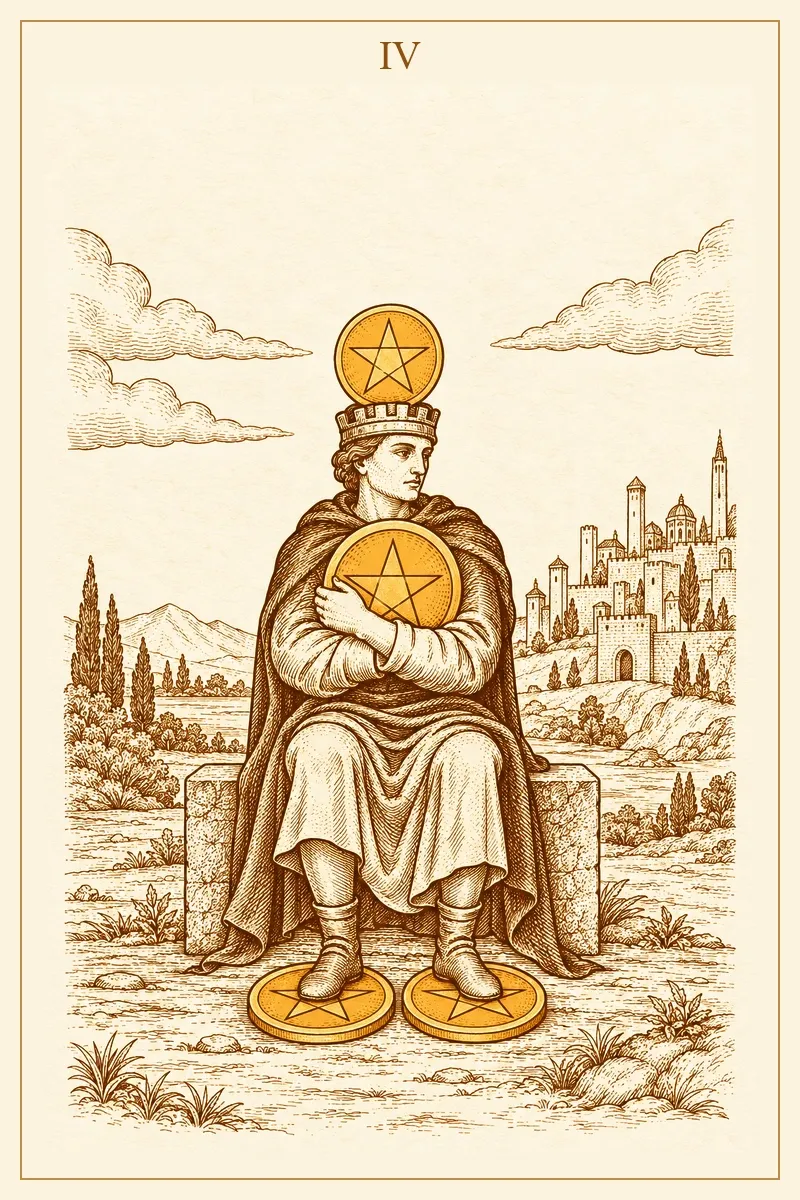
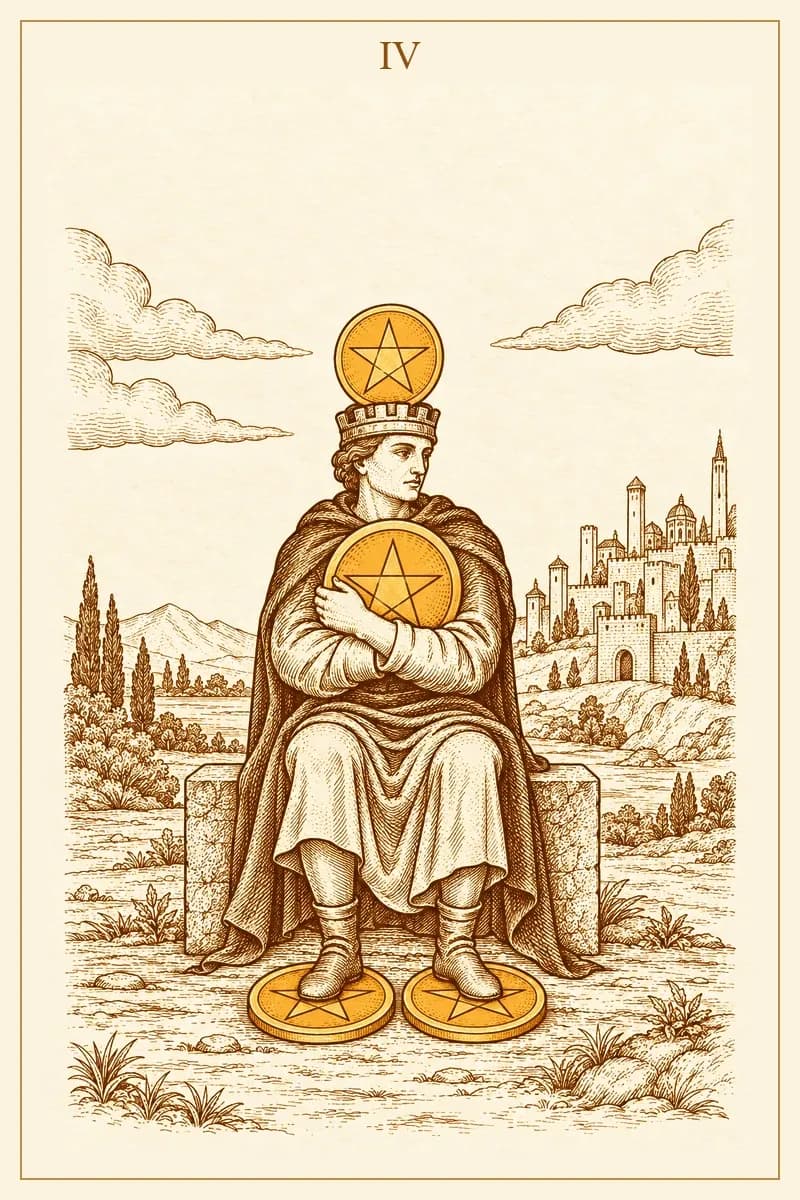
On the Veil Soul card, a young man in a crenellated crown sits on a plain block of cut stone in open, rocky ground. A heavy cloak falls from his shoulders and pools on the earth around the block. He has wrapped both arms around one coin and pressed it flat against his chest, fingers spread over the rim so it cannot slip. A second coin balances on top of his crown. The last two lie under his boots, one beneath each foot, so that even standing up would mean letting something go.
Each coin is pinned by a different part of him: thought at the top, feeling at the heart, footing below. Nothing has been stolen and nothing is wasted, yet he cannot reach for anything new, shake a hand or walk anywhere without loosening a hold. His posture reads less as greed than as bracing, the stance of someone who expects to lose something.
The town over his shoulder
Behind him on the right rises a walled town: towers of different heights, a domed roof, battlements and an arched gate. He sits outside it with the gate at his back. On the left the land opens out to tall cypresses and soft mountains. The town is where trade and company happen, and he keeps to the outside of its walls. Fours are numbers of structure, and in the earth suit this one marks a foundation that has set; the image asks whether he is guarding his wealth from the town, or guarding himself from everything the town would ask of him.
Upright: the line between keeping safe and keeping still
Upright, the Four is neither lucky nor unlucky; the reading turns on which side of a thin line you stand.
Healthy holding: savings, limits and a finished foundation
At its best, the card confirms that you have built something worth protecting: an emergency fund, a home, a steady income, energy you no longer hand to anyone who asks. Saving instead of spending, turning down a loan you cannot afford and guarding your rest are all Four of Pentacles skills. Three signs you are on the healthy side: you know what the reserve is for, you can name the amount that would count as enough, and you still spend on the people and things that matter to you.
Over-holding: control, scarcity and a life on pause
The shadow side looks the same from outside. The savings grow but never feel sufficient, a partner's independence feels like a threat, and even welcome change is refused because it would loosen something. The figure on the card is not poor; he is afraid of becoming poor, and that fear writes the rules. It often grows out of a real memory, such as a lean year or a layoff, and the card does not call it foolish. It asks whether the fear still fits today, or whether it is guarding against a winter that has already passed.
Telling the two apart in a spread
Look at the neighbors and the position. Beside steady cards such as the King of Pentacles or the Ten of Pentacles, the Four leans toward wise stewardship. Beside cards of fear or restriction, such as the Eight of Swords or The Devil, it leans toward a grip that has become a cage. In an advice position it usually means hold your ground; in a challenge position, ease off.
Reversed Four of Pentacles: three ways the fingers open
A reversed Four of Pentacles means the grip is shifting. Test each of these three readings against your situation.
A release you chose
The kindest reading: you are ready to let go. You spend part of the savings on a course postponed for years, you stop checking a partner's phone, you hand a project to a colleague and let them run it their own way. Generosity comes back, often with a relief people did not expect, because holding was heavier than they realized.
A swing to the other extreme
Sometimes the coins scatter instead. After a long stretch of strict saving, money goes out in a rush: impulse purchases, a loan to someone unlikely to repay it, a gamble meant to make up for lost time. The aim is not to stop holding anything but to hold with an open hand, deciding in advance what can go and what stays.
A grip that tightens out of sight
Under pressure from a debt, a shrinking income or a partner who seems to be drifting, the hold can tighten and go private. Money gets hidden, accounts are checked again and again, and control turns into rules for other people. If this fits, the card asks for honesty before generosity: tell someone you trust what you are afraid of losing.
4 of Pentacles timing: how long the holding lasts
People who ask about timing with this card usually mean "how long will this stay stuck?" or "when will money start moving again?" The methods below give rough windows for a check-in; they disagree, so choose one and stick with it.
Sun in the last decan of Capricorn: mid-January
The Golden Dawn titled this card the Lord of Earthly Power and assigned it the Sun in the final ten degrees of Capricorn. The Sun crosses that stretch from about January 10 to January 19, give or take a day depending on the year. Decan readers take an upright Four as pointing toward that window, a natural moment to review a budget or decide whether a long-held position is still worth keeping. The post on Capricorn in tarot follows this sign of structure and patient effort through its other cards, and the overview of tarot timing with astrology lists every card's window side by side.
Suit and number: four weeks, four months or a season
A simpler convention treats Pentacles as the slowest suit, measured in months or seasons rather than days, and some readers then count the number: four weeks for a small matter, four months for a larger one. Others link the earth suit with winter. Either way, this is not a card of sudden news. Whatever you are waiting on is likely to move at the pace of paperwork, savings and trust.
Nothing moves until something is released
The most useful timing clue is in the picture itself. The figure cannot stand without lifting his feet off two coins. In the same way, a Four of Pentacles situation tends to stay frozen until someone lets go of something: a condition, a sum, a title, an old resentment. Ask "when will this change?" and the card's honest answer is often "when the grip loosens," which may depend on you more than on the calendar.
Reversed timing and the cards beside it
Reversed, the Four often shows a hold that is already slipping, so movement can arrive sooner, sometimes all at once. Quick cards nearby, like the Eight of Wands or The Chariot, pull the window closer; patient ones, like the Seven of Pentacles or the Four of Swords, stretch it further. When a date is what you really want, swap the question for "What am I holding that keeps this from moving?" The Four answers that one clearly.
Possessive, guarded or simply loyal? The Four in love
In love, the card asks how safety is kept: through trust, or through control.
If you are single
Upright for someone single, the Four often points to a guarded heart: wanting a partner while keeping everyone at arm's length, or holding an old relationship in memory so firmly that nobody new can measure up. The card does not ask you to tear down every wall, only to notice which walls still protect you and which just keep the door shut.
If you are in a relationship
For a couple, the healthy side is loyalty: a partner who stays, protects the home and saves for a shared future. The shadow side is possessiveness, jealousy, keeping score with money or affection, or clinging to a fixed picture of how the relationship must look. Ask whether the closeness is chosen by both people or held in place by one.
Reversed in love
Reversed, walls can come down: someone finally says what they feel or stops monitoring the other person. A controlling pattern breaking can feel unsteady at first, even when the change is healthy. Less often, possessiveness is growing worse under stress. If a relationship ever feels unsafe, reach out to a trusted person or a support service rather than waiting for a card to change.
What the Four says about how someone feels
Drawn for another person's feelings, the Four usually describes someone who cares and is being careful, holding back out of fear of loss rather than lack of interest. What they do over time, and a direct conversation, will tell you more than any one card.
Savings, salaries and the job that feels too safe to leave
Saving and spending
Financially, the upright Four means saving, budgeting and protecting reserves, which is often exactly right after a hard stretch. The warning comes when money stops serving your life and starts replacing it: never touching an emergency fund even during an emergency, or feeling anxious every time money leaves the account. Security exists to buy some freedom. When it no longer does, the card wants you to notice.
At work
In career readings, the card often shows someone staying in a job because it is safe, not because it fits. It can also describe territorial behavior: hoarding information, refusing to delegate, making sure no one else can do your role. Holding your position may still be wise when the market feels uncertain; the question is whether you stay by choice or out of fear.
Reversed in money and work
Reversed, you may be ready to leave a secure but stale role, invest in your own training, or share credit and responsibility. It can also mean control is slipping because of outside changes, such as a reorganization or unexpected costs. For debt, investments or contracts, a qualified professional is the right next step; the card can show your feelings about the choice, not make it for you.
The body, the breath and an inner sense of safety
Holding on shows up physically: a clenched jaw, raised shoulders, shallow breathing, sleep that comes slowly when money is on your mind. Upright, the Four can be a nudge to give your body the same care you give your savings; any symptom that worries you belongs with a doctor. Spiritually, it asks what your security really rests on: take away the job and the account, and your skills and relationships remain. Reversed, the Four often marks that quiet shift: safety starts to feel like something inside you rather than something you must guard.
A yes-or-no question meets a closed fist
As a yes-or-no card, the upright Four of Pentacles usually says no, or more precisely "not while you hold on this hard." It leans against risk, large spending and sudden change. It can be a yes when the question is about keeping something: "Should I hold on to my savings for now?" or "Should I keep this boundary?" Reversed, it leans toward a cautious yes for questions about letting go, opening up or moving on.
After the workshop, before the cold: the Four between the Three, Five and Six
The Four comes after building and before hardship, and the cards on either side explain why the grip matters so much.
Three of Pentacles: the work that made the coins
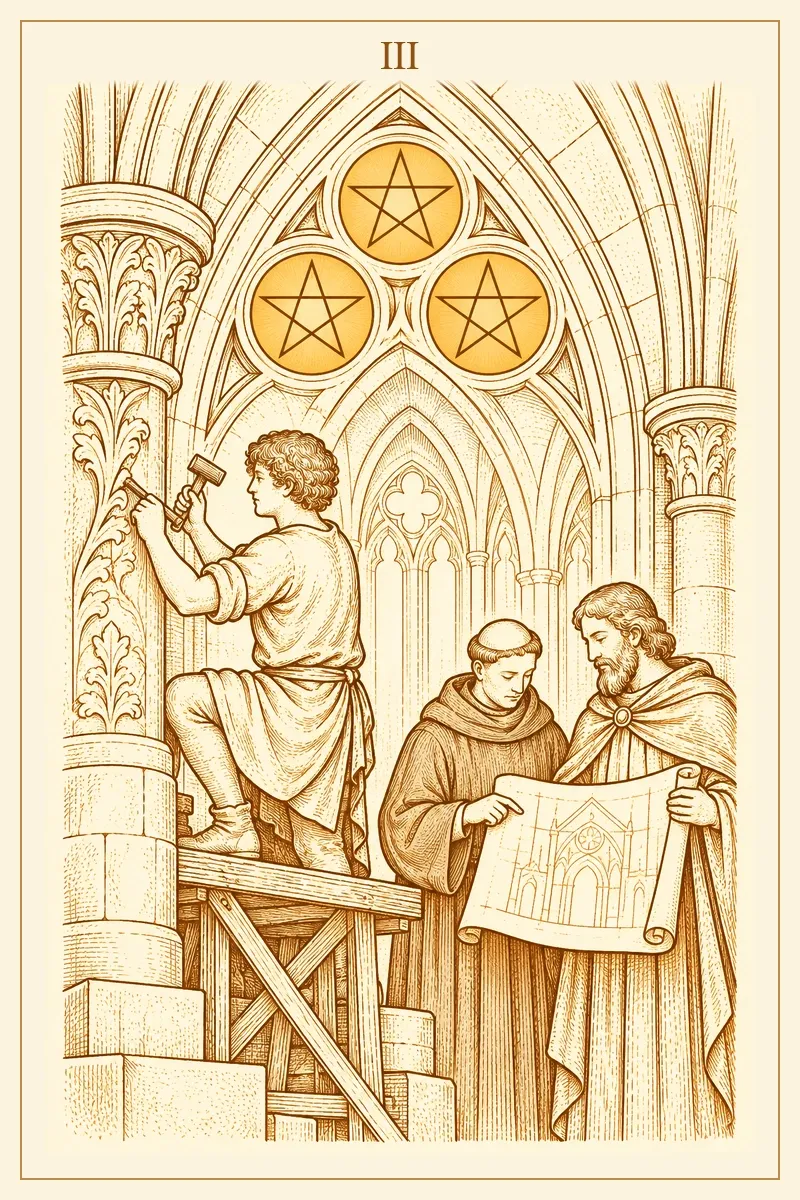
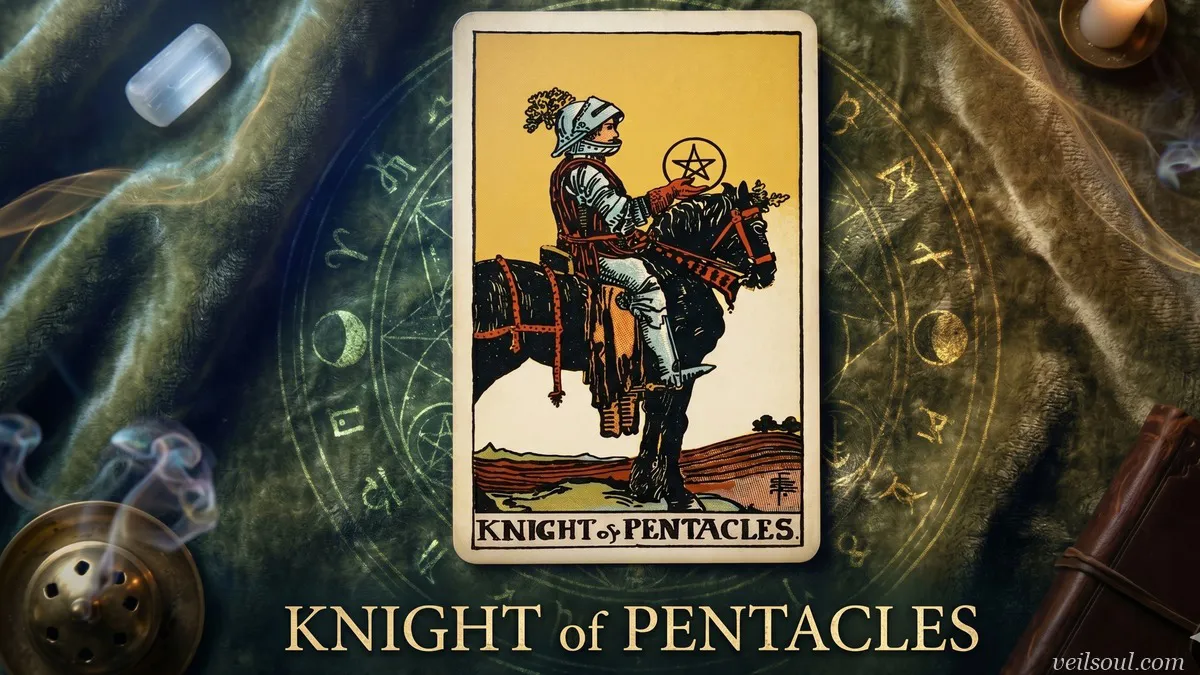
The Three of Pentacles is skilled people building something together and being recognized for it. The Four takes the result of that shared work and keeps it for one person. When both appear, ask whether something built as a team is now guarded by one member. As the Three of Pentacles meaning shows, that card thrives on exchange, which is exactly what the Four shuts out.
Five of Pentacles: the winter the Four is afraid of
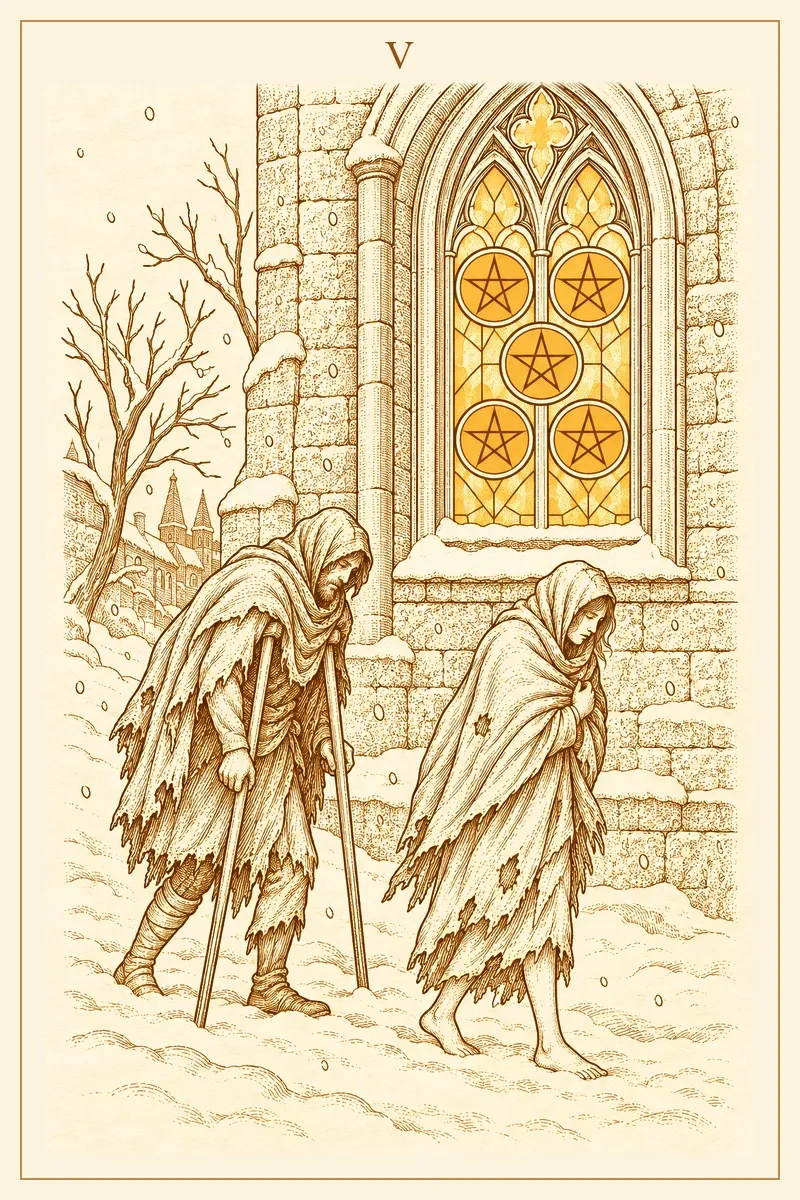
The Five of Pentacles is a card of hardship and of feeling left out in the cold. It is the loss the Four is trying to prevent, and side by side the two point to an old fear shaping present choices: a real shortfall, or a dread of one strong enough to create the isolation it predicts. The Five of Pentacles guide also looks at where help comes from, the part the Four tends to forget.
Six of Pentacles: what an open hand looks like
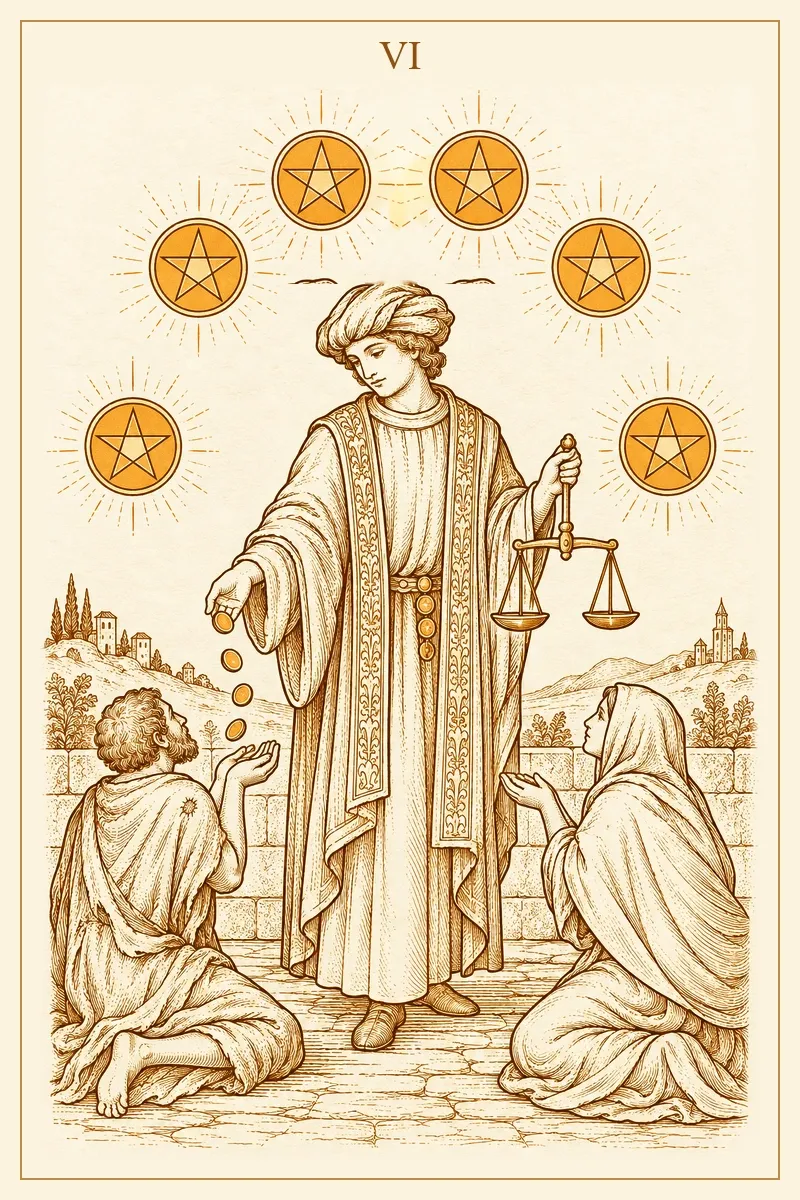
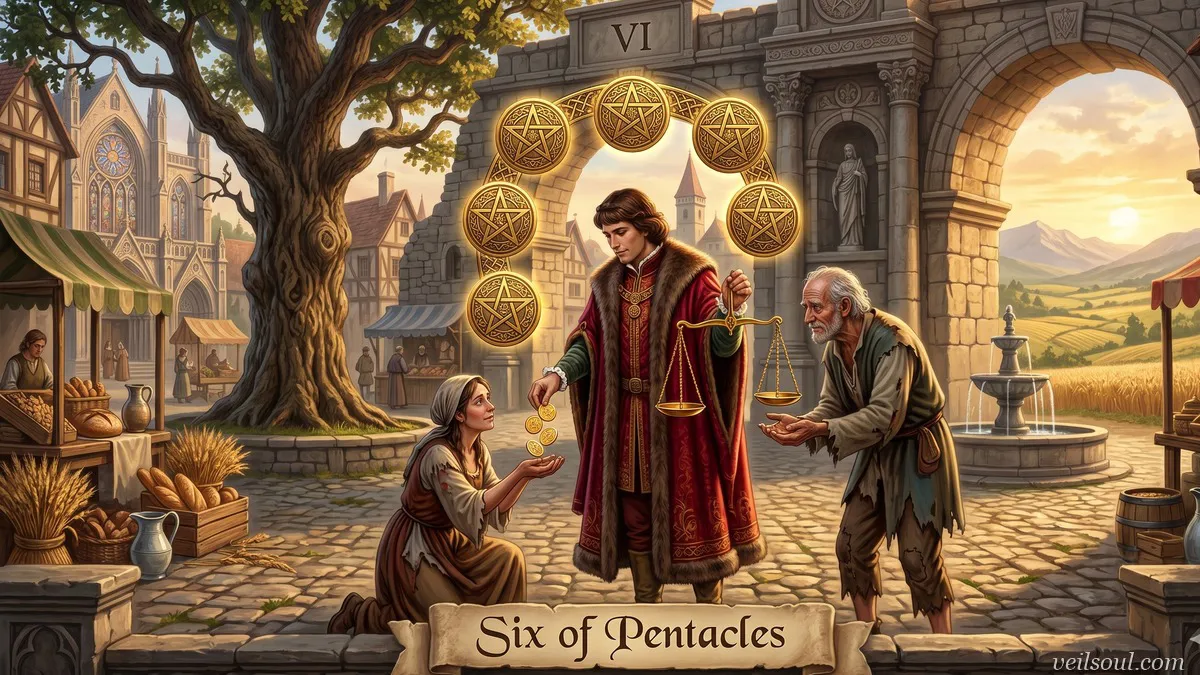
The Six of Pentacles answers the Four: resources given and received in measure. Where the Four pins every coin in place, the Six lets some go and stays steady. Together they describe the move from hoarding to generosity, and the Six of Pentacles meaning covers both sides of that exchange, including help that comes with strings attached.
Cards that loosen or lock the grip
- With The Devil: security has hardened into a chain, such as a debt or a habit kept out of fear. Both cards belong to Capricorn, and the Devil tarot meaning explores how chains like these come loose.
- With Death: a release you did not choose. Something you held is ending, and the Death card meaning explains why that ending is a transition rather than a punishment.
- With The Star: hope after letting go, when giving and receiving feel safe again. The Star card's meaning fills in that recovery.
- With The Fool: an invitation to step off the stone block and ask how much you truly need to carry into what comes next.
- With The Emperor: structure that protects or rules that confine; ask who the rules serve.
The Open Hand spread: five positions for what you are guarding
Use this layout when the Four turns up, or whenever you cannot seem to let go of money, a role or a person. Shuffle with the question "What am I holding, and what would loosening it change?" and lay the cards in a row.
- The coin on the crown: the belief or worry that keeps your mind on this.
- The coin at the heart: what you are emotionally attached to, and why.
- The coins underfoot: the practical foundation you are standing on.
- The town: what you are missing while you hold on.
- The open hand: one thing you could loosen safely, and how.
Read the first two cards together: they often reveal whether the grip comes from present facts or from an older fear. Treat the fifth card as advice, not a forecast.
A worked reading: savings that never feel like enough
The question
Imagine someone who has saved steadily for six years since a long spell without work. A part-time design course would cost about a fifth of those savings, and they have postponed enrolling three times. They lay out the Open Hand spread with its usual question.
The five cards
- Crown: the Five of Pentacles. The worry at the top is the memory of that lean year.
- Heart: the Nine of Pentacles. The savings have become proof of self-reliance; spending any of it feels like giving up independence.
- Underfoot: the King of Pentacles. The foundation is sturdy: a stable job, good habits, no debt.
- Town: the Eight of Pentacles. What is being missed is a skill, and a direction of work they have wanted to test.
- Open hand: the Two of Pentacles. Balance, not all or nothing.
What the reading suggests
The first two cards show a grip that comes from an old fear and from pride in independence rather than from today's figures, and the third confirms the ground underneath is solid. The fourth names the cost of waiting. The Two points to a middle path: set a floor the fund will never drop below, pay for the course in installments, and review after the first term. The spread does not promise the course will pay off; it shows that a memory, more than the present, is making the decision.
Loosening one finger at a time: steps for the week after
- Write down what you are protecting, and a number or condition that would count as enough.
- Choose one small, reversible release: a modest purchase you keep postponing, one task delegated, one worry shared.
- Keep one limit on purpose, so loosening does not turn into the spending swing the reversed card warns about.
- Check in again in four weeks, in step with the card's slow clock, and note what has changed.
Frequently asked questions
Is the Four of Pentacles a good or a bad card?
Neither. Security can be wise or fearful, and the Four can affirm healthy saving or warn that control has taken over. The question and the nearby cards tell you which.
What does the Four of Pentacles mean reversed?
Usually that the grip is changing: a welcome release, a swing into overspending after long restriction, or a hold that tightens privately under pressure.
What does the 4 of Pentacles say about timing?
That things move slowly: mid-January for decan readers, months or a season for suit readers. Its most practical message is that the situation tends to stay put until something is let go.
Does the Four of Pentacles mean someone is possessive?
It can, especially in a relationship spread, but it equally describes loyalty and care. Look at real behavior: whether closeness is freely chosen, and whether both people keep their own money, friends and time.
Can the Four of Pentacles tell me whether to spend my savings?
No. Tarot cannot see your finances, guarantee how a decision will turn out or speak for anyone else's choices. It can show whether fear or clear thinking is steering you, which is worth knowing before you sit down with the numbers or with someone qualified to advise on them.
How is the Four of Pentacles different from the Four of Swords?
Both describe stillness. The Four of Swords is rest you need, a pause to recover. The Four of Pentacles is a hold you keep, stillness that comes from not wanting to let anything go. One restores energy; the other can quietly drain it.
Keep the coins, open the hand
Holding something precious is not the problem; holding it so tightly that you cannot move is. If part of your life feels pinned in place, bring the question to a Veil Soul reading and see which coin you are ready to lift first.