
Loading your view
The page is gathering the latest information.
The page is gathering the latest information.
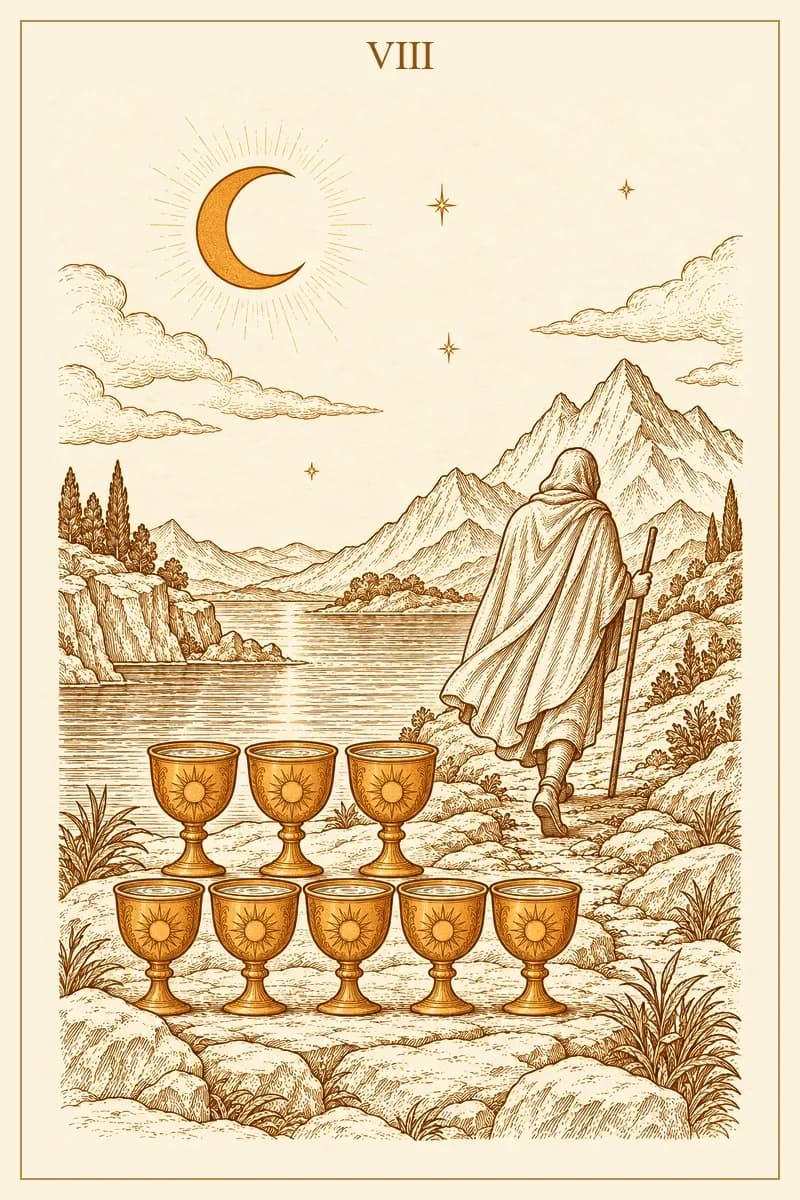
The card shown is VeilSoul's own engraved drawing of the 1909 Waite–Smith card. The scene and symbols described on this page follow the 1909 card, so a few details are drawn differently in our deck.
The Eight of Cups is one of the tarot's most poignant images. A cloaked figure walks away from eight neatly stacked cups, heading toward mountainous terrain under a crescent moon. The cups are arranged carefully — five on the bottom row, three on top — but there is a gap in the top row where a ninth cup should be. Something is missing, and the figure has chosen to leave what they have built in search of what is absent.
When the Eight of Cups appears upright, you are being called to walk away from a situation that no longer fulfills you — even though it may look perfectly fine from the outside. This is not the Five of Cups' grief over what was lost; this is the conscious, courageous choice to leave something that is not enough. The cups are not spilled — they are simply not complete.
This card represents the moment when you realize that success without meaning is empty, that a relationship without depth is lonely, or that comfort without growth is stagnation. The Eight of Cups honors the courage it takes to leave the known for the unknown, to walk away from what works on paper because your soul knows something is missing.
The journey in this card is solitary and takes place at night — under moonlight, guided by intuition rather than logic. This is not a decision you can explain to others with a neat list of reasons. It is a deep inner knowing that it is time to move on, even if the destination is unclear.
Eight cups stand stacked but the figure walks away under an eclipsed moon — fullness without meaning is its own drought. Departure here is not failure; it is fidelity to a deeper thirst.
Fear of the unknown keeps you among cups that no longer nourish (deficiency of courage), or restless wandering from situation to situation, abandoning before depth can form (excess departure).
Detailed Interpretations
The Eight of Cups in love can point toward leaving a relationship that looks good on the surface but does not meet your emotional or spiritual needs. This is one of the hardest decisions in love — walking away not because the other person is terrible, but because the relationship is not enough. You deserve more than "fine." The Eight of Cups acknowledges that leaving something that is merely adequate requires a different kind of courage than leaving something that is actively harmful — there is no dramatic justification, no clear villain, no obvious breaking point that makes the decision easy to explain to friends and family. There is only the quiet, persistent knowledge that something essential is missing, and the growing certainty that staying will mean spending the rest of your life wondering what would have happened if you had been brave enough to go.
If single, this card may indicate that you are releasing an attachment to a past love or to a romantic ideal that has kept you from being available to genuine connection. The Eight of Cups clears the emotional slate so something more authentic can arrive. This is the moment when you stop texting the ex, delete the saved messages, and accept that the chapter is truly closed — not because you have stopped caring, but because you have finally understood that caring about someone and being right for each other are not the same thing, and that holding on to a love that has already ended is the surest way to miss the love that is trying to begin.
In love reversed, the Eight of Cups suggests difficulty leaving a situation that has genuinely run its course — staying out of fear of the unknown, guilt about the impact of leaving, or the seductive familiarity of even an unfulfilling connection compared with the uncertainty of what lies beyond it.
This reversal may also indicate the return from a period of emotional withdrawal — someone who left a relationship or retreated from love coming back with renewed perspective, or the decision that what was abandoned in the search for something more meaningful is actually worth returning to and genuinely rebuilding.
For those aware of needing to leave something but unable to make the move, the reversed Eight asks directly: what specifically is keeping you here? Naming the actual obstacle — fear, guilt, financial dependency, genuine ambivalence — is the first honest step toward working with it.
Professionally, the Eight of Cups represents leaving a career, role, or company that no longer aligns with your deeper purpose. You may have achieved conventional success — the salary, the title, the stability — but something essential is missing. The work does not feel meaningful. The environment does not support your growth. The cup is almost full, but not quite. The Eight of Cups professional departure is not the dramatic exit of someone who has been fired or mistreated — it is the quiet resignation of someone who has simply outgrown the container, who looks at the eight stacked cups of their accomplishments and realizes that none of them hold the thing they were actually searching for.
This card validates the courage to quit a job, change careers, or step away from a professional path that society tells you should make you happy but does not. The mountains ahead are steep, and the journey will be challenging — but staying in something that drains your spirit is more costly in the long run. The Eight of Cups does not promise that what comes next will be easier — it suggests that what comes next can be more authentically yours, and that the discomfort of starting over is often temporary.
The Eight of Cups also supports sabbaticals, extended leave, and periods of professional reinvention. Sometimes you need to walk away from the table entirely in order to understand what you actually want to build, and the Eight gives you permission to take that walk without apologizing for the fact that what you had was not bad enough to justify leaving by anyone's standards but your own.
Career-wise, the reversed Eight of Cups suggests either the difficulty of leaving a professional situation that no longer serves you, or the return to a professional path after a period of seeking something different and finding the search inconclusive.
The first pattern is more common: staying in a role, company, or professional direction out of inertia, security, or the fear that the dissatisfaction is personal rather than circumstantial — that moving would only transport the problem rather than solve it.
The second pattern represents valuable learning: the person who left in search of something more meaningful and discovered, through that searching, either what they were actually seeking or a genuine appreciation for what they had left behind. Both outcomes are instructive.
The Eight of Cups in health suggests that a current health approach, treatment, or practitioner is not giving you what you need. It may be time to seek a second opinion, try a different therapeutic modality, or fundamentally change your approach to wellness. The Eight of Cups in health is the patient who has followed the protocol faithfully for months, done everything they were told, and still does not feel better — not because the treatment is wrong for everyone, but because it is wrong for them. This card gives you permission to trust your own body's feedback over the authority of anyone who has not lived inside it.
This card also speaks to the health consequences of staying in situations that drain you emotionally. Sometimes the most important health decision is not about diet or exercise — it is about leaving the environment or relationship that is making you sick. The correlation between chronic emotional distress and physical illness is not metaphorical — it is measurable, documented, and increasingly acknowledged by medical professionals who have seen patients whose mysterious symptoms resolved not through medication but through the removal of the chronic stressor that was generating them. The Eight of Cups asks whether your health problems might be your body's way of telling you what your mind has been refusing to accept: that something in your life needs to be walked away from before your body can begin to heal. The figure walks toward the mountains under a moonlit sky — the path is uncertain and the destination unclear, but the leaving itself is the medicine.
Use this as a reflective prompt, not medical advice or a diagnosis. For health concerns, seek guidance from a qualified healthcare professional.
The Eight of Cups reversed can indicate fear of change — knowing that you need to leave but being unable to take the first step. The cups behind you are not enough, but the mountains ahead are terrifying. You may be staying in an unfulfilling situation out of fear, habit, or a sense of obligation.
Alternatively, this reversal can signal a return — coming back to something you previously walked away from with new perspective and renewed commitment. Sometimes the journey away teaches you the value of what you left.
In some cases, the reversed Eight of Cups suggests aimless wandering — leaving situations without a clear sense of what you are seeking, moving from one unfulfilling situation to another without addressing the underlying pattern.
The reversed Eight of Cups teaches the difference between running away from difficulty and consciously walking away from what has genuinely been outgrown — between avoidance and evolution, between the restless search that never arrives anywhere and the deliberate departure that is genuinely heading somewhere specific.
This card also addresses the wisdom of timing: the Eight of Cups asks us to leave at the right moment — after genuine effort has been made, after the situation has been honestly assessed, after grief has been genuinely acknowledged rather than bypassed. The reversed card suggests that either the timing is not yet right, or that the departure that was made prematurely is asking to be reconsidered.
The deepest lesson: not all that is left behind is truly finished with — and not all that is endured builds genuine strength. Wisdom requires the ability to distinguish between these, which means sitting with the discomfort of genuine uncertainty rather than defaulting to either compulsive departure or compulsive endurance.
Honestly assess one situation in your life today — a relationship, a role, a habit — and ask yourself the Eight of Cups' essential question: is this genuinely worth continuing to invest in, or is the effort of maintaining it consuming resources that belong elsewhere? You do not have to decide or act today. But you do owe yourself the honest question, and the space to sit with whatever answer surfaces without immediately defending against it.
“I have the courage to leave what does not serve my soul, even when the path ahead is unclear. I trust my inner knowing and walk toward wholeness.”
The card shown is VeilSoul's own engraved drawing of the 1909 Waite–Smith card. The scene and symbols described on this page follow the 1909 card, so a few details are drawn differently in our deck.
The eight cups arranged in two rows with a deliberate gap symbolize achievement that is almost but not quite complete — a life that looks full but feels empty. The missing cup is the key to the entire card: it represents whatever is absent from the figure's emotional life despite outward success.
The figure walks toward the mountains — a symbol of spiritual ascent, challenge, and higher perspective. The journey is uphill and uncertain, but it leads to elevation. The crescent moon overhead illuminates the path with intuitive rather than rational light — this departure is guided by feeling, not calculation.
The red cloak and boots suggest that this walking away is an act of will and passion, not defeat. The figure is not fleeing — they are choosing. The river in some versions of this card represents the emotional threshold being crossed — leaving the familiar emotional landscape for unknown emotional territory.
Eight is the number of movement, power, and regeneration. In the Cups suit, it represents the emotional strength required to walk away from the familiar — the recognition that some things must be left behind for deeper fulfillment to be found.
Keep or share this card reference
✦ From meaning to reflection ✦
Bring what this card stirred into a reading shaped around what you are facing now.
Read with this insight