
Loading your view
The page is gathering the latest information.
The page is gathering the latest information.
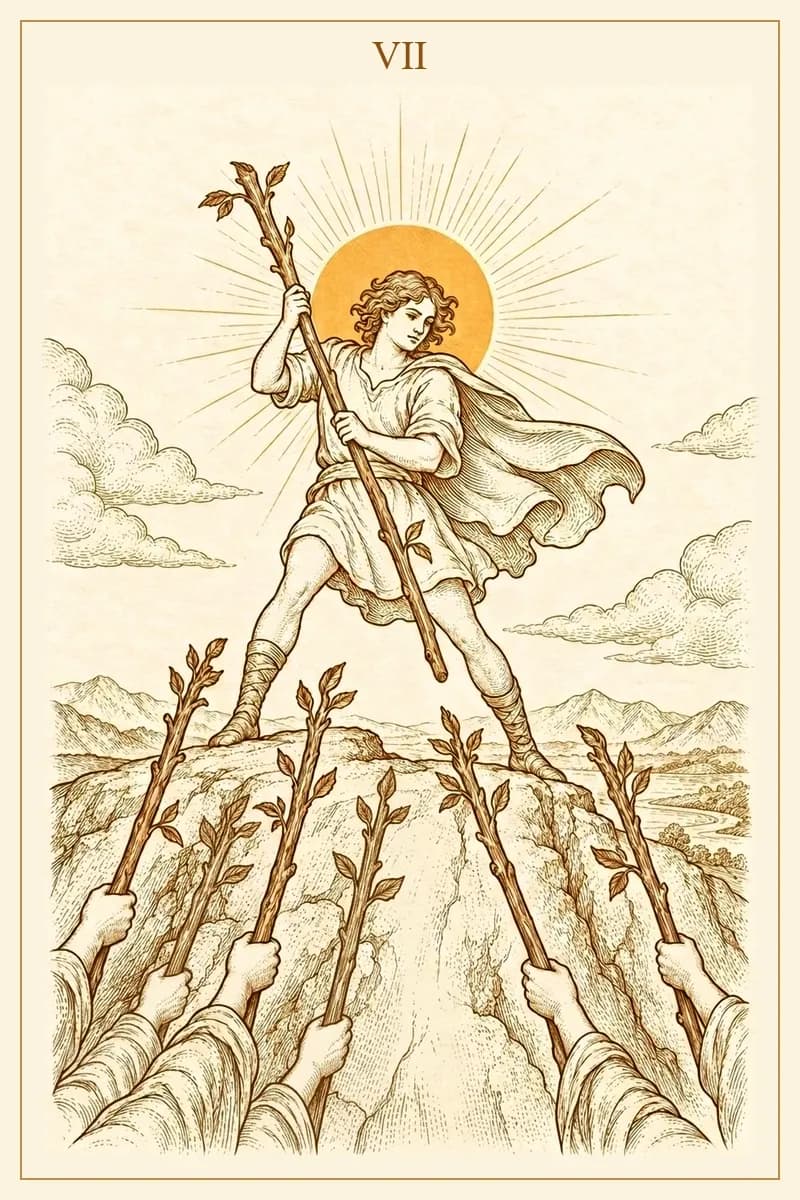
The card shown is VeilSoul's own engraved drawing of the 1909 Waite–Smith card. The scene and symbols described on this page follow the 1909 card, so a few details are drawn differently in our deck.
The Seven of Wands shows a figure standing on an elevated position, holding one wand defensively against six wands raised from below. This is the card of the defender — the person who has achieved something worth envying and must now hold their ground against competition, criticism, or the attempts of others to claim what they have worked to build.
When the Seven of Wands appears, you are likely experiencing a period of challenge to your position, your ideas, or your identity. This challenge may come from colleagues competing for the same space, critics questioning the validity of your work, or the cumulative pressure of multiple demands converging on your limited energy. The card confirms that you have the higher ground — you are defending from a position of genuine strength — but maintaining it requires sustained effort.
The Seven of Wands is not a card of aggression but of principled defense. There is an important difference: you are not seeking to expand or dominate, but to protect what has legitimately been earned. Stand firm in your values, your work, and your approach — even when others challenge you to abandon them.
This card also carries a subtle warning about defensive paranoia: not every wand raised in your direction is an attack. Some are questions, some are curiosity, some are the natural friction of a competitive environment. Discernment — knowing which challenges require firm engagement and which require only confident non-reaction — is the Seven of Wands' deeper wisdom.
You hold high ground and six challengers want it. Defense here is not fear — it is the proof that what you built was worth attacking.
You fight every challenger on principle, exhausting yourself over territory that no longer matters (excess), or you abandon your position at the first sign of opposition (deficiency).
Detailed Interpretations
In love, the Seven of Wands often appears when a relationship is being challenged by external pressures — disapproving family members, competitive rivals for a partner's attention, or circumstances that are testing the stability and commitment of the bond. You may feel the need to defend this relationship against forces that would see it diminished or ended.
For singles, this card can indicate being in a competitive dating environment where you must assert your worth and hold your standards even when others are not meeting them. Do not lower your bar simply because the current environment makes it feel necessary.
In an established relationship, the Seven asks: are you defending the relationship itself, or are you defending your ego within the relationship? There is a meaningful difference — one strengthens the partnership, the other can erode it. Stand your ground on what genuinely matters, but be honest about whether the hill you are defending is worth the battle. The strongest relationships are not the ones that never face opposition — they are the ones where both partners choose each other again, deliberately, even when it would be easier not to.
In love reversed, the Seven of Wands suggests defensive patterns that are damaging rather than protective — walls built so high that genuine intimacy cannot enter, or a constant state of combat readiness that keeps both partners perpetually on edge.
This reversal may also indicate choosing your battles poorly: fighting hard over issues that do not ultimately matter while allowing genuinely important dynamics to remain unaddressed. Examine where you are putting your defensive energy, and whether the battles you are fighting are for the relationship or for your ego's comfort.
In career, the Seven of Wands represents holding your professional position against competitive pressure, criticism, or the challenges that naturally arise when you have achieved something worth noticing. This is not the time to abandon your approach or second-guess your direction — you may well be on the right path, and the challenges you face are evidence of your position's value, not its weakness.
For those in leadership, this card asks you to hold firm on decisions you believe in, even when they are unpopular. True leadership sometimes means standing alone on the hill while others disagree below.
This card also appears when your creative or professional identity is being questioned — when someone challenges your expertise, your approach, or your right to occupy the space you have built. Respond from a position of genuine confidence: you do not need to prove yourself to those who have not done the work of understanding your contribution.
Career-wise, the reversed Seven of Wands may indicate feeling overwhelmed by competition or criticism, to the point where you are considering abandoning a position that is actually worth holding. The pressure is real, but the impulse to retreat may be premature — assess whether the challenges you face are genuinely threatening your position or simply making it temporarily uncomfortable.
This reversal can also point to a defensive stance that has become exhausting and counterproductive: spending so much energy protecting your position that you have none left for actual growth or creative work. Sometimes the wisest move is a strategic step back — not retreat, but repositioning.
The Seven of Wands in health represents the resilience required to maintain health commitments under pressure — when life becomes demanding, when others undermine your efforts, or when temptation and circumstances conspire to make your health practices feel unsustainable.
This is the card of holding your ground: keeping the workout appointment when you are tired, maintaining the dietary commitment when social pressure makes it inconvenient, or continuing a mental health practice even when its benefits are not yet visible. Your body is worth defending against the forces that would erode its care.
If you are managing a health condition, the Seven of Wands may indicate the need to advocate firmly for yourself within medical systems — insisting on answers, seeking second opinions, or standing by your understanding of your own body when it conflicts with a generalized recommendation.
Use this as a reflective prompt, not medical advice or a diagnosis. For health concerns, seek guidance from a qualified healthcare professional.
The Seven of Wands reversed suggests that the defensive position has either collapsed or been voluntarily abandoned. The figure who was holding the high ground has either been overwhelmed by the sheer number of challengers, has stepped aside strategically, or has given up from exhaustion when the position was still worth holding.
This reversal commonly indicates feeling overwhelmed, outmatched, or exhausted in the face of sustained challenge. The wands coming from below have become too many to hold off individually, and the effort of constant defense has depleted the reserves that once made the position tenable.
Alternatively, the reversed Seven may represent the wisdom of choosing which hills are worth dying on — and recognizing that this particular one is not. Not every position is worth infinite defense. Sometimes stepping aside allows you to redirect your energy toward ground that can actually be held and that is more worth holding.
The reversed Seven of Wands teaches the wisdom of knowing when to stand and when to step aside — and recognizing that not every challenge to your position is an attack that must be repelled. Some challenges are invitations to evolve; some competitors are mirrors showing you where growth is needed; some criticism, despite its sting, contains useful information.
This card also addresses the exhaustion of constant defensiveness. When everything feels like a threat, the world becomes an exhausting place, and the creative energy that was meant to build something is entirely consumed by the effort of protection. The reversal asks: what would you create if you spent even half of your defensive energy on forward movement instead?
The deepest lesson: confidence does not require defense. When you are genuinely secure in your value, the wands raised from below simply do not require response.
Today, identify the one position — an idea, a project, a boundary, a value — that is most worth defending right now, and bring your full energy there. Let the minor provocations pass without engaging. The Seven of Wands teaches economy of defense: not every challenge requires a response, but the ones that do deserve your full, unhesitating presence.
“I stand my ground with conviction. The challenges I face prove the value of the position I hold.”
The card shown is VeilSoul's own engraved drawing of the 1909 Waite–Smith card. The scene and symbols described on this page follow the 1909 card, so a few details are drawn differently in our deck.
A figure stands on elevated ground — higher than those challenging from below — holding a wand defensively against six wands thrust upward from the lower position. The stance is not aggressive but resolute: this person is not attacking, they are holding their ground. Notably, the figure appears to be wearing mismatched footwear, suggesting they were caught off-guard, that this challenge arrived without warning and required immediate response.
The elevated position is the card's essential message: you are defending from the high ground, which means you have already achieved something worth defending. The challengers below are not necessarily enemies — they may be competitors, critics, or simply others who want what you have built and are willing to contest your right to it.
The single wand held against six is an important detail: the defender is outnumbered but not outpositioned. Quality of position matters more than quantity of challengers in this image. One person holding the high ground can hold it against many, provided they maintain their footing and their conviction.
Seven is the number of assessment, challenge, and inner strength. In the Wands suit, it represents the test of courage that follows success — defending what you have built against those who would take it.
Keep or share this card reference
✦ From meaning to reflection ✦
Bring what this card stirred into a reading shaped around what you are facing now.
Read with this insight