Each Ace in tarot is the first card of its suit and stands for a beginning in that suit's part of life: the Ace of Wands is a spark of drive, the Ace of Cups a new feeling, the Ace of Swords a clear thought, and the Ace of Pentacles a tangible opportunity. An Ace shows something being offered, not something already built, so its message is "this can start now" rather than "this is done." When multiple Aces appear in one tarot reading, several beginnings are open at the same time, and the useful question becomes which one to feed first.
No Ace can tell you whether a job will come through, what another person intends, or on which date something will begin. What the four Aces can do is show you where fresh energy is gathering in your life, so you can decide what to do with it while it is still new.
The Aces at a glance:
- Ace of Wands (fire): drive, desire and an idea asking for a first move.
- Ace of Cups (water): a feeling offered, such as love, tenderness, forgiveness or creative warmth.
- Ace of Swords (air): a truth seen plainly, a decision coming into focus.
- Ace of Pentacles (earth): something you can hold: an offer, income, a home, a healthier routine.
- Any Ace reversed: the beginning is still there but delayed, held back or spilling in the wrong direction.
- Two or more Aces: several doors open at once; choose an order rather than rushing through all of them.
Why an Ace stands apart from the rest of the Minor Arcana
The Minor Arcana has four suits of fourteen cards, and the forty numbered cards run from Ace to Ten. If you are still sorting the two halves of the deck, the split is laid out in Major Arcana vs Minor Arcana. Inside that numbered run, the Ace is the number one: the element before anything has happened to it. The Two adds a choice or a partner, the Three a first result, and so on until the Ten closes the cycle. Reading the Ace as the opening line of that ten-step story makes the rest of the suit easier to follow, and the stage-by-stage logic is covered in number symbolism in the Minor Arcana.
The Hermetic Order of the Golden Dawn, the late nineteenth-century English occult society, gave each Ace a formal title. The Ace of Wands is the Root of the Powers of Fire, the Ace of Cups the Root of the Powers of Water, the Ace of Swords the Root of the Powers of Air, and the Ace of Pentacles the Root of the Powers of Earth. "Root" is the right word: an Ace is where the element starts, still underground, before it has a shape.
The same system places all four Aces on Kether, the first sphere of the Kabbalistic Tree of Life, whose name means "crown." Kether stands for pure potential, the point just before anything becomes a definite thing. That is why the Aces are not given a decan of the zodiac the way the Twos through Tens are: they are treated as the element itself rather than as one season or situation inside it. In practice this gives you a reading rule. An Ace describes an impulse or an opening, not a finished event, and how far it grows depends on what happens next.
The pictures carry the same idea. In the cards shown on this page, every Ace has a hand reaching out of a bank of cloud at the left edge, holding the suit's emblem in front of a burst of light. Nobody in the scene has earned anything yet. The emblem is simply being held out, and the landscape below waits for someone to step into it.
The four Aces and what each one offers
Ace of Wands: a living branch and the urge to begin
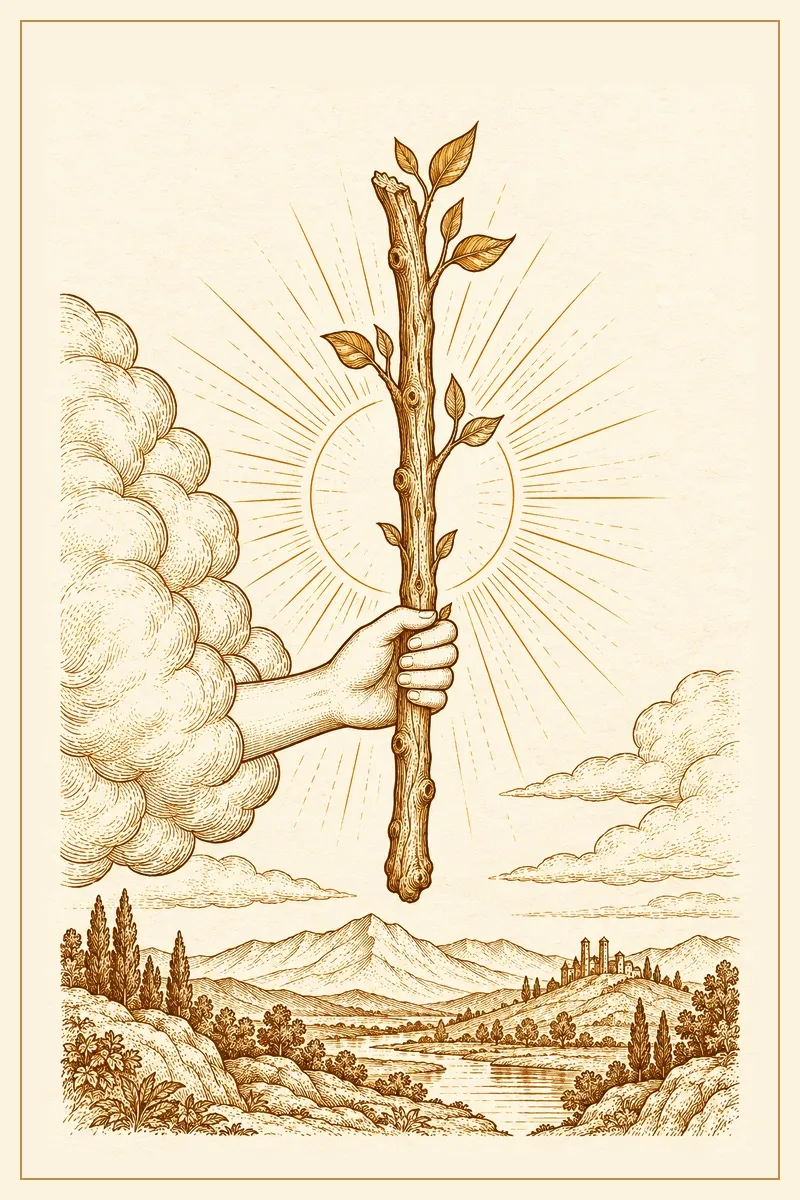
A hand grips a rough, knotted branch that is still growing: fresh leaves sprout along its length, and a ring of light like a rising sun stands behind it. Far below, a river winds through a valley lined with dark cypresses, and a small town with towers sits on a hilltop to the right. The branch is living wood, which is the whole point of fire in tarot: energy that can catch and spread.
Upright, the Ace of Wands is drive arriving before the plan does. It can be an idea you keep coming back to, a sudden appetite for a project, or the nerve to apply, pitch, travel or ask someone out. At work it favors starting something with your own hands; in love it describes attraction with real heat in it; with money it points to the energy behind a venture rather than the cash itself. The card works best when you give the spark a job quickly, because fire left without fuel burns down.
Reversed, the branch is damp. The wish to start is there, but the energy is scattered over too many ideas, held back by fear of looking foolish, or spent on false starts. Sometimes it is simple tiredness that needs rest before any launch.
The question it asks: what would you start this week if nobody were watching? The longer Ace of Wands tarot meaning covers its yes-or-no answer, its career angle and the cards that change its message.
Ace of Cups: five streams and a descending dove
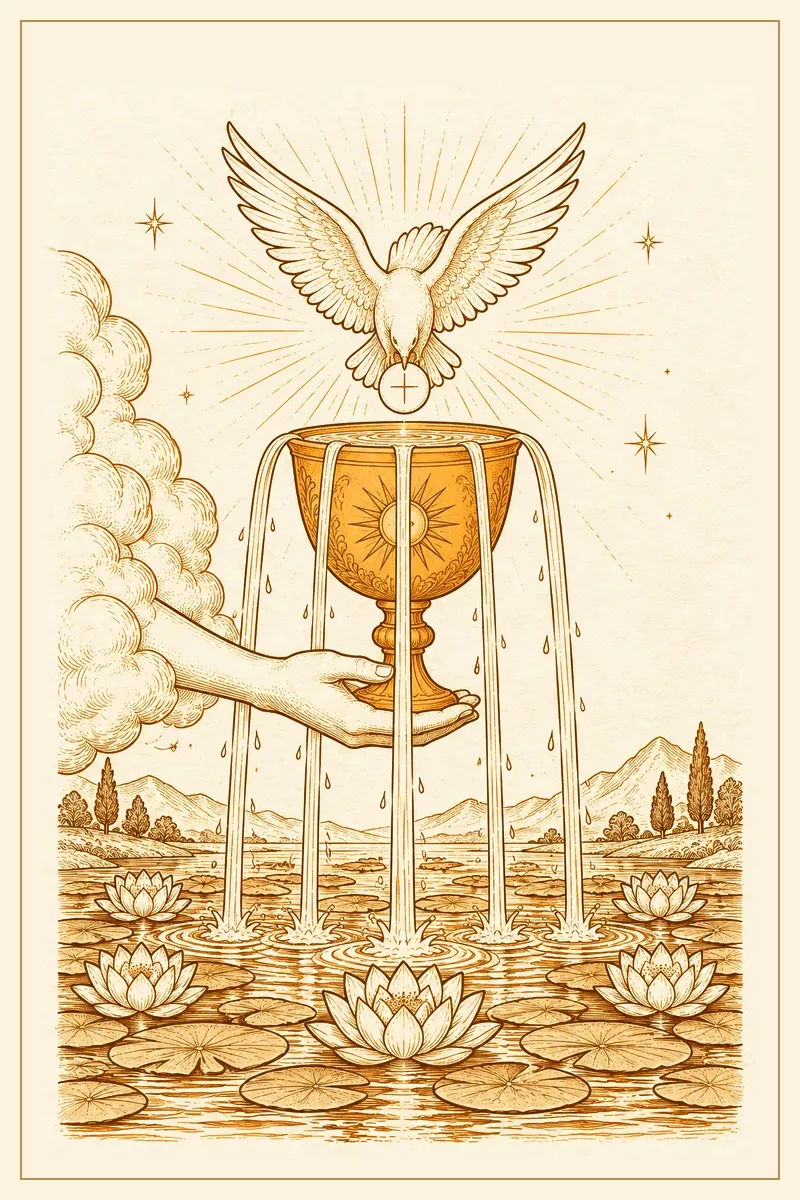
A hand rests open under a golden chalice engraved with a sun. Five streams of water arc over its rim and fall into a still pond covered with water lilies, while a dove dives toward the cup from above, holding a round wafer marked with a cross. Stars hang in the pale sky, and low hills and cypresses line the far shore. The cup is so full that it cannot keep what it is given; it has to share it.
Upright, the Ace of Cups is a feeling being offered: new love or warmth returning to an old bond, compassion, forgiveness, a creative mood that comes from the heart, or a quiet spiritual moment. In a love reading it describes emotional openness more than a guaranteed romance. At work it can mean caring about what you do again. Its gift is receptivity: the cup has to stand upright to be filled.
Reversed, the cup is tipped or covered. Feelings may be bottled up, poured out to everyone except yourself, or kept back because a past hurt still stings. It can also describe a mood so full that it spills into overwhelm.
The question it asks: what feeling are you ready to let yourself have? For its love, spiritual and reversed sides in more depth, see the Ace of Cups tarot meaning.
Ace of Swords: a blade through a laurel wreath
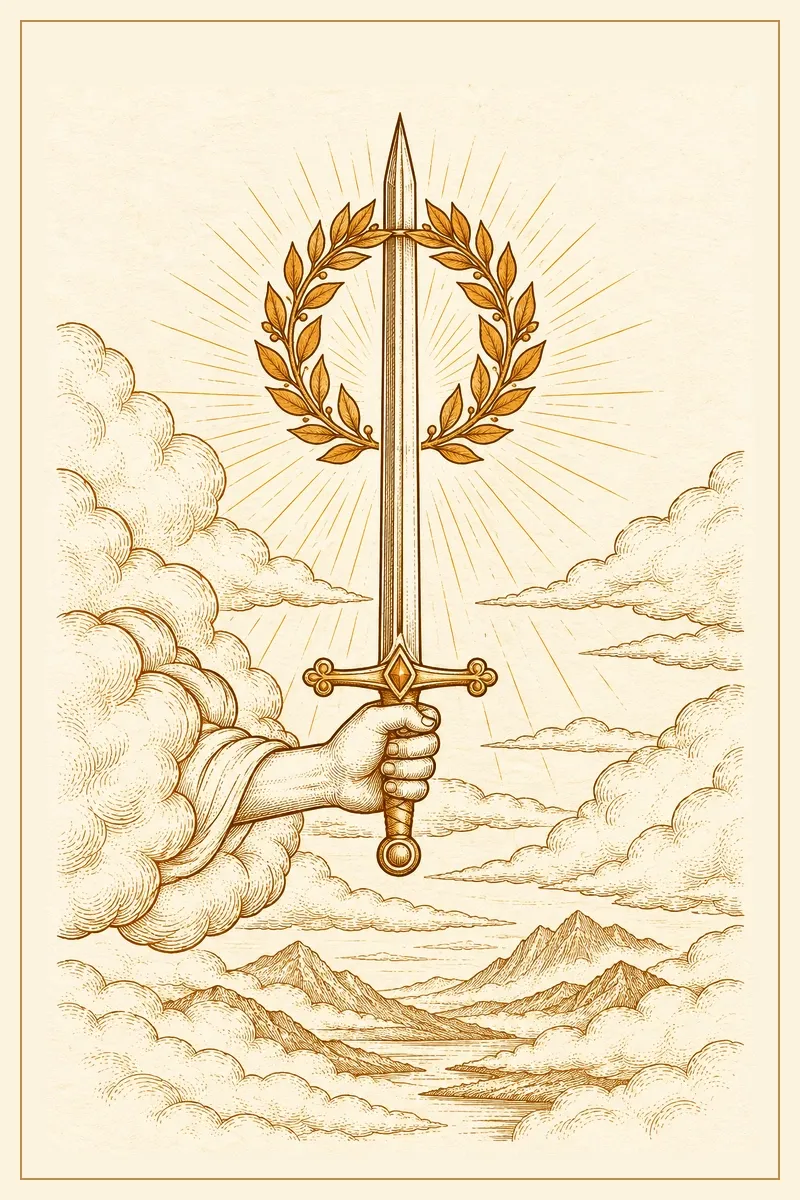
A sleeved arm reaches out of the clouds and holds a straight sword point upward. Near the tip, a laurel wreath circles the blade, glowing gold against rays of light, and far below, sharp mountain peaks and a thin river show through drifting cloud. Laurel is the old crown of victory, so the image reads as a mind that has won its way through to clarity: the thought rises above the fog.
Upright, the Ace of Swords is a breakthrough in understanding. A confusing situation suddenly makes sense, a truth becomes plain enough to say, or a decision that has circled for weeks finally lands. At work it favors a clear proposal, a frank negotiation or a new method; in relationships it asks for an honest conversation; with money it suggests reading the terms before you sign. Its gift is precision, and precision can sting.
Reversed, the edge is dull or swinging wildly. That can look like confusion and overthinking, a truth you are avoiding, or words used so sharply that they wound rather than clarify. Gather the facts first, then say the important thing once and calmly.
The question it asks: what do you already know but have not yet said? The Ace of Swords tarot meaning follows the card through love, career and health questions.
Ace of Pentacles: a coin above a garden gate
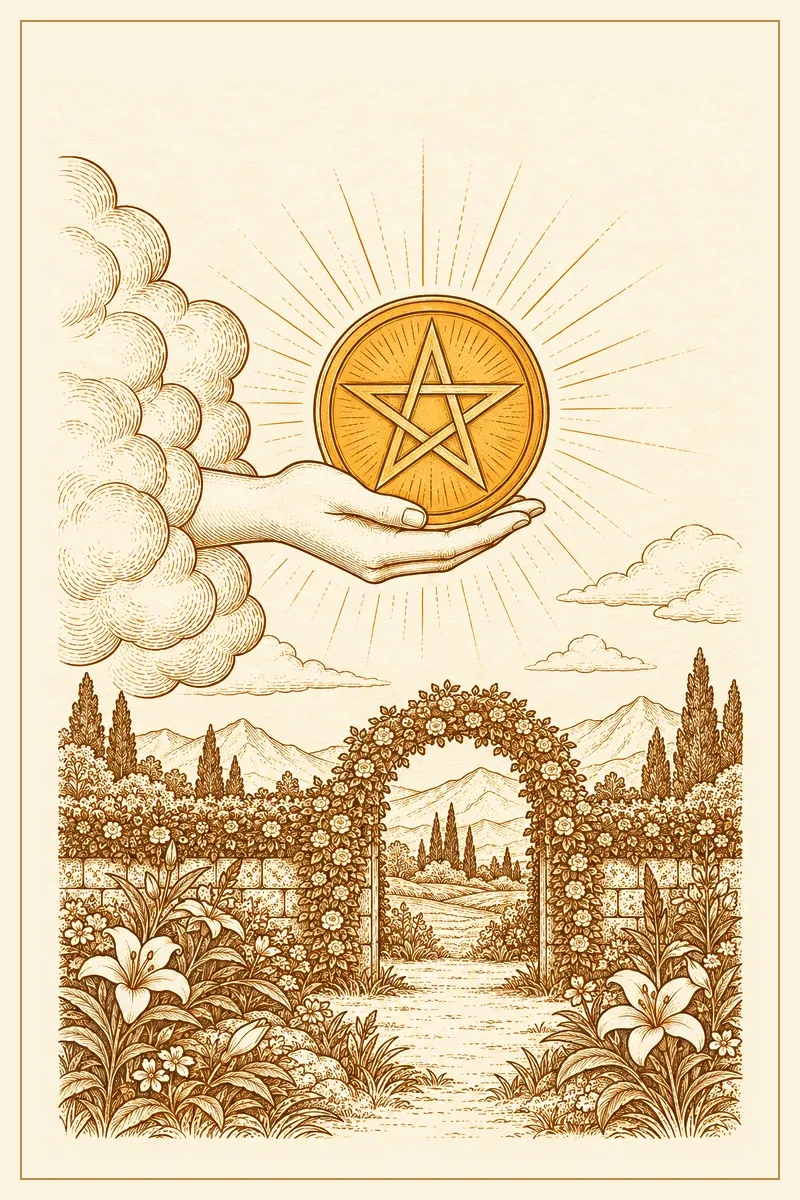
An open palm reaches from a cloud and offers a large golden coin with a five-pointed star at its center. Below lies a walled garden: lilies in the foreground, a stone wall, and an archway covered in flowers. Through the arch a path runs out toward fields, cypresses and distant mountains. The coin is the seed, the garden is what tending it can produce, and the gate shows that the way into the wider world starts from that cared-for ground.
Upright, the Ace of Pentacles is an opening you can touch: a job offer, a first client, a raise, a lease, a savings plan, a new routine for your body. In love it describes care shown through time and effort, such as shared plans or a home. It is the slowest and steadiest of the four Aces and grows only if it is planted and looked after, so it rewards a small, practical first step.
Reversed, the coin stays in the cloud. An offer may be delayed, smaller than hoped, or not yet backed by a budget or a plan. It can also warn against spending the seed before it has had a chance to grow.
The question it asks: what could you put in the ground this month, however small? There is more on offers, money and the body in the Ace of Pentacles tarot meaning.
Three shapes a reversed Ace can take
Reading reversals is optional, and the guide to tarot reversals explains how to choose an approach that suits you. If you do read them, a reversed Ace can take one of three shapes:
- Not yet: the beginning is real but early. The offer, the feeling or the idea needs more time before it can carry weight.
- Held back: something inside you is blocking it, such as doubt, an old hurt, or a habit of waiting for permission.
- Overflowing: the element is present in excess. Too many ideas, feelings, opinions or purchases, with no channel to carry them.
To tell which shape you are looking at, check the cards beside it. A reversed Ace next to slow, steady cards such as the Fours leans toward "not yet." Next to cards of worry or withdrawal, it leans toward "held back." Surrounded by several cards of its own suit, it leans toward "overflowing." Whatever the shape, a reversed Ace is not a closed door. It is a seed that still needs light, water or a smaller pot.
Two, three or four Aces in the same spread
When several Aces turn up together, read them as a cluster before you read them one by one. Several beginnings are being offered at once, and beginnings cost energy. The reading is less about luck and more about priority: which opening to feed now, which to schedule for later, and which to let pass.
Two Aces: reading the pair
Two Aces describe two fresh starts that can either help or crowd each other. The pair tells you how the two elements meet:
- Wands and Cups: desire and feeling arrive together, as when you fall for a person or a project all at once. Check that the excitement has somewhere steady to land.
- Wands and Swords: drive meets a sharp idea. A plan is ready to start; the risk is moving faster than the facts.
- Wands and Pentacles: a spark with resources behind it, such as a side project that could earn or a skill that could become paid work.
- Cups and Swords: heart and head both have something new to say. An honest conversation about a feeling is ready to happen.
- Cups and Pentacles: a feeling taking physical form: moving in together, setting up a home, or work you love that also pays.
- Swords and Pentacles: a clear decision with practical results, such as signing, budgeting or starting a routine you have thought through.
If one of the pair is reversed, read it as the beginning that needs more time, and the upright Ace as the door that is open today.
Three Aces: notice the missing suit
Three Aces suggest fresh energy moving through most of your life at once. Here the absent suit can say as much as the three present. Without the Ace of Cups, your days may fill with projects and plans that do not yet feed your heart. Without the Ace of Swords, there is plenty of momentum but little planning. Without the Ace of Wands, the openings are sensible but may lack excitement. Without the Ace of Pentacles, ideas and feelings run ahead of money, time and the body. Ask what the missing element would add.
All four Aces together
Four Aces in one spread describe a full reset: fire, water, air and earth all starting over together. That can feel thrilling or exhausting. Treat it as a menu rather than a to-do list. Each beginning needs its own first step, and saying yes to all four in the same month spreads any energy thin. Write each Ace's opening as one sentence, put the four in order, and start with the one that makes the others easier.
Aces beside the Major Arcana and the Tens
An Ace beside a Major Arcana card takes on that card's weight: the Major names the larger chapter, and the Ace shows where it begins in daily life. An Ace next to The Magician, the trump numbered one, doubles the beginning, with tools and skill on one side and a fresh supply of the element on the other. An Ace beside the Ten of its own suit links an ending to a new start. The Ten of Wands next to the Ace of Wands, for example, can read as a heavy load being put down so that a lighter, more freely chosen project can begin.
Reading an Ace by its place in the spread
- Past: a beginning that has already happened and is still unfolding. Ask whether you have kept tending it.
- Present: the opening is available now; this is where the card speaks most directly.
- Obstacle or challenge: a new start pulling focus from the matter at hand, or a beginning you keep refusing.
- Advice: start, accept, say yes to the first step. The card is a nudge to act.
- Outcome: the result is itself a beginning. The situation leads into a fresh cycle rather than a final answer.
- Feelings or another person's position: new or renewed interest, colored by the suit: excitement with Wands, tenderness with Cups, frank curiosity with Swords, steady intent with Pentacles.
Timing is a natural question with Aces, because beginnings feel urgent. If you use a timing convention, such as matching each suit to a season, decide on it before you shuffle and keep it the same from reading to reading, so you can see over time whether it helps. For letting positions do the work in a small layout, three-card spread mastery walks through the method.
The Four Roots spread for a fresh start
This layout uses the Aces on purpose. It suits moments when you feel ready for something new but cannot tell which part of life it belongs to.
- Take the four Aces out of the deck, shuffle them face down, and pick one without looking. Read it upright.
- Shuffle the remaining seventy-four cards with your question in mind.
- Lay three cards in a row below the chosen Ace.
The positions:
- 1. The root (the chosen Ace): the area of life where a beginning is gathering: drive, feeling, thought or material things.
- 2. The soil: what already supports this beginning, such as a skill, a person, free time or savings.
- 3. The stones: what could crowd it out or slow it down.
- 4. The first shoot: a small action that would show the beginning is real.
Keep the question open, for example "Where is something new ready to start for me?" rather than "Will I get the job?" If the fourth card is unclear, write down one thing you could do within a week that matches its picture, and treat that as your answer.
A worked example with three Aces
This reading is invented to show the method. The question: "I've been offered a part-time teaching job while I'm finishing my own illustration project. Where should my energy go this season?" The reader used a three-card spread with the positions What is opening, What is in the way and What to do.
- What is opening: Ace of Pentacles, upright.
- What is in the way: Ace of Wands, reversed.
- What to do: Ace of Swords, upright.
Three Aces in three cards say that this season is crowded with beginnings, and the first task is to sort them. The Ace of Pentacles in the opening position describes the teaching offer as real and solid: steady income, a schedule, ground to stand on. It does not say the job is the right choice, only that it is concrete.
The Ace of Wands reversed in the obstacle position is the illustration project. The creative fire has not gone out, but it is damp: started and restarted, squeezed into leftover hours, and weighed down by the feeling that it should be finished by now. The card suggests that the project suffers less from a lack of talent than from a lack of protected time.
The Ace of Swords as advice asks for a clear decision instead of drifting into both. The querent might write the terms of the teaching job next to a realistic schedule for the project, then decide what share of each week each one gets. The laurel on the blade hints that a clear choice, even a modest one, will feel like a small victory after months of fog.
The missing suit is Cups. That gap invites one more question: does either path feel nourishing, or have both turned into duties? A good next step is to spend one hour on the illustration project this week purely for enjoyment, and notice how it feels before signing anything.
What to do in the days after an Ace appears
An Ace opens a door; walking through it is your part. These steps help turn the reading into something you can see in your week:
- Name the beginning in one sentence: use your own words ("I want to start teaching in the evenings"), not the card's keywords.
- Pick a first step you can take this week: one email, one sketch, one conversation, one first deposit.
- Protect the seedling: give the idea or feeling a set hour, a folder of its own, or a quiet walk.
- Watch what follows: in later readings, notice whether the Two or Three of the same suit turns up, which can be read as the beginning moving into choice and growth.
- Let some openings pass: not every Ace needs a yes. Choosing one beginning well bears more fruit than starting four halfway.
Frequently asked questions
Is an Ace a yes in a yes-or-no reading?
An upright Ace leans toward yes, because it describes something starting. Reversed, it leans toward "not yet" or "not like this." The rest of the spread matters more than any single card, and an Ace answers best when the question is about something you can begin yourself.
Can an Ace predict a new relationship or a new job?
Tarot cannot confirm an outcome, a date or what another person feels. An Ace shows openness and opportunity; whether a relationship or a job follows depends on choices, timing and other people. Use the card to look at how ready you are, not as a guarantee.
What does it mean when the same Ace keeps appearing?
When one Ace returns reading after reading, a particular beginning is asking for your attention. Ask yourself whether there is a first step you keep postponing. Noting the date and the card each time helps you see what that Ace has been tied to.
How is an Ace different from The Magician?
Both carry the number one, but they play different roles. The Magician is a figure who uses all four tools with skill and intention. An Ace is one element, still unshaped, being handed to you. If The Magician is the maker, the Ace is the raw material.
How do I read Aces if I don't use reversals?
Without reversals, read the "not yet" or "held back" side from position and neighbors. An Ace in the obstacle position, or one surrounded by heavy cards, can say that the beginning will take more effort even while it lies upright.
Before you pick up the deck again
The next time an Ace turns up, look at what the hand is holding out and name it in one sentence before you reach for any book. When you have a question about a new start of your own, you can begin a reading on Veil Soul and see which suit answers first.