Loading your view
The page is gathering the latest information.
The page is gathering the latest information.
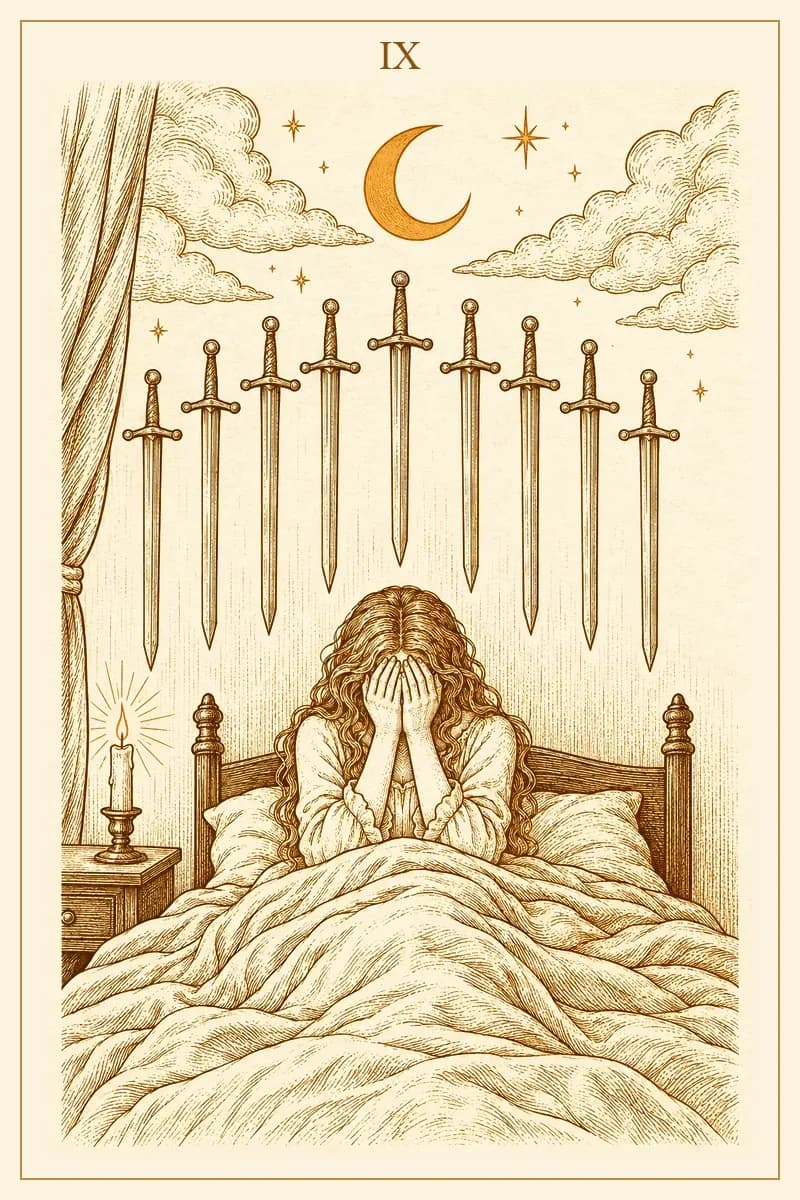
The card shown is VeilSoul's own engraved drawing of the 1909 Waite–Smith card. The scene and symbols described on this page follow the 1909 card, so a few details are drawn differently in our deck.
The Nine of Swords shows a figure sitting upright in bed in the middle of the night, face buried in hands, nine swords hanging on the dark wall behind. This is the card of anxiety at its most acute — the 3 AM awakening, the racing thoughts, the dread that feels like it will never end. The room is dark. The figure is alone. The mind has become its own worst enemy.
When the Nine of Swords appears upright, you are experiencing intense anxiety, guilt, worry, or mental anguish that may be disproportionate to the actual situation. This is not to minimize your suffering — the pain is absolutely real. But the Nine of Swords specifically represents the mind's tendency to catastrophize, to replay worst-case scenarios, and to turn manageable problems into existential crises through relentless overthinking.
The nine swords on the wall are the thoughts that torment you — each one a worry, a regret, a fear, a self-criticism. They hang in orderly rows, suggesting that the anxiety has become systematic, habitual, a nightly ritual of suffering that feels impossible to break. The figure does not look at the swords; the torment is internal, projected onto the darkness of the room.
The Nine of Swords carries an important truth: much of what you are afraid of has not happened yet. The card depicts suffering caused by anticipation of disaster rather than disaster itself. The fear of the thing is often worse than the thing. This does not make the fear less painful, but it does mean that the solution lies in changing your relationship with your own thoughts rather than waiting for external circumstances to change.
The figure wakes at 3 AM with nine swords mounted on the wall of their own mind. The suffering is real but internal — anxiety manufactures futures that may never arrive.
Anxiety deepens to despair where mental swords multiply faster than dawn dispels them (excess), or gets performatively dismissed — insisting all is fine while nightmares continue (deficiency).
Detailed Interpretations
The Nine of Swords in love reveals anxiety, insecurity, or obsessive worry consuming a relationship from the inside — the kind of relentless mental anguish that keeps you awake at night replaying conversations, imagining worst-case scenarios, convinced that your partner is losing interest, preparing for an abandonment that may exist only in the catastrophic theater of your anxious mind. This card does not necessarily mean the relationship is in trouble; it means your perception of the relationship is being distorted by fear, and the suffering that distortion creates is genuine regardless of whether the threat is real.
When this card appears, it often indicates that anxiety has become the dominant experience of the relationship rather than love, trust, or connection. You may be monitoring your partner's behavior for signs of betrayal, interpreting neutral actions as evidence of problems, or withholding your genuine feelings because vulnerability feels too dangerous when your nervous system is perpetually activated. The tragedy of the Nine is that the anxiety itself often creates the very distance and disconnection it fears — your partner feels your suspicion and pulls away, which you then interpret as confirmation that your worst fears were justified all along.
For singles, the Nine of Swords may indicate that past romantic trauma has left you in a state of hypervigilance that makes new connection feel terrifying rather than exciting. Every potential partner triggers the alarm system calibrated by previous betrayal or heartbreak, and the prospect of opening your heart again produces not anticipation but dread. This card gently acknowledges that the pain is real while pointing out that the swords on the wall are memories, not prophecies — the past informs but does not dictate the future.
In love reversed, the Nine of Swords indicates that relationship anxiety is beginning to subside — not vanishing instantly but gradually loosening its grip as you find effective ways to manage the fear. Communication with your partner is helping, therapy is providing tools for distinguishing between genuine concerns and anxiety-driven catastrophizing, or you are simply learning through experience that the worst-case scenarios your mind constructed at three in the morning are not reliable predictions of reality.
This reversal marks the transition from acute suffering to active recovery. The nightmares are fading, the obsessive mental loops are becoming shorter and less frequent, and you are beginning to trust — cautiously, imperfectly, but genuinely — that your relationship can survive the honesty of your actual feelings rather than requiring the exhausting performance of constant reassurance-seeking and vigilance.
For those who have been isolated by relationship anxiety, the reversed Nine often marks the moment of reaching out — telling your partner what you have been experiencing internally, confiding in a friend, or booking the therapy appointment you have been postponing. The act of speaking the fear aloud is itself therapeutic, because anxiety thrives in secrecy and isolation and weakens significantly when exposed to the perspective and compassion of another human being.
Professionally, the Nine of Swords represents work-related anxiety at its most consuming — the dread that builds on Sunday evening and intensifies through the week, the obsessive replaying of professional mistakes that keeps your mind churning when your body desperately needs sleep, the fear of being exposed as incompetent, the conviction that the next performance review will end your career, or the paralysis of knowing you need to make a major professional decision while every option feels equally terrifying.
This card often appears for high-achievers whose external success masks intense internal anxiety — people who perform brilliantly under pressure but collapse in private, whose perfectionism drives outstanding work but also drives devastating self-criticism, who lie awake at night cataloging every error and insufficiency while colleagues and managers see only competence and dedication. The Nine of Swords reveals the hidden cost of professional performance sustained by anxiety rather than confidence.
The card also addresses the very real phenomenon of workplace-induced mental health crises — burnout that has progressed beyond exhaustion into genuine despair, toxic work environments that have eroded your sense of professional worth, or career setbacks that trigger disproportionate psychological responses because your identity and your job title have become dangerously synonymous. The Nine does not minimize this suffering — it depicts it with unflinching honesty. But it also gently suggests that the nine swords hanging on the wall, while terrifying in the dark, may look very different in the morning light, and that the catastrophic narrative running through your sleepless mind is almost certainly more extreme than the reality it claims to describe.
Career-wise, the reversed Nine of Swords suggests that professional anxiety is becoming more manageable — through therapeutic support that provides perspective, through the gradual realization that the feared catastrophe was far less likely than your anxious mind insisted, or through practical changes in your work situation that have reduced the sources of stress. The Sunday night dread is softening, the obsessive error-cataloging is losing its compulsive intensity, and you are beginning to separate your professional worth from the distorted assessment that anxiety produces.
This reversal also appears when someone takes concrete action to address workplace anxiety rather than simply enduring it — negotiating a reduced workload, setting boundaries around after-hours communication, addressing a conflict with a colleague that has been generating disproportionate stress, or making the difficult decision to leave a position that was systematically destroying their mental health. The reversed Nine honors the courage required to acknowledge professional suffering and to prioritize psychological wellbeing over the appearance of toughness.
However, this reversal carries a caution: the easing of acute anxiety does not mean the underlying causes have been resolved. If the relief comes from avoidance rather than genuine coping, the swords will return to the wall. Sustainable recovery requires not just symptom management but honest engagement with the thought patterns, work habits, and professional situations that created the crisis in the first place.
The Nine of Swords is one of the most significant mental health cards in the entire tarot. It directly and unflinchingly depicts anxiety, insomnia, and the kind of psychological suffering that feels unbearable in the darkness of a sleepless night — the racing thoughts, the crushing weight on the chest, the inability to stop the mind from manufacturing worst-case scenarios with industrial efficiency. If you are experiencing this level of mental anguish, this card acknowledges your suffering completely and without judgment.
The physical health implications of chronic anxiety and insomnia are severe and well-documented. Sustained sleep deprivation impairs immune function, cognitive performance, emotional regulation, and cardiovascular health. Chronic anxiety elevates cortisol to levels that promote inflammation, disrupt digestion, accelerate aging, and create conditions favorable to a wide range of serious illnesses. The Nine of Swords is not just a mental health card — it is a whole-body health warning that the mind-body system is under unsustainable stress and that intervention is necessary.
This card strongly encourages seeking professional help if you have not already done so. Therapy, medication, mindfulness practices, sleep hygiene protocols, crisis hotlines — these are not signs of weakness but tools designed specifically for the kind of suffering the Nine depicts. The figure in the card is alone in the dark, but they do not have to be. The most important message of the Nine of Swords is that the isolation of anxiety is itself an illusion — help exists, recovery is possible, and the swords on the wall lose their power the moment you speak about them to someone who can help you carry the weight.
Use this as a reflective prompt, not medical advice or a diagnosis. For health concerns, seek guidance from a qualified healthcare professional.
The Nine of Swords reversed signals that the worst of the anxiety is beginning to lift. The nightmares are fading. The catastrophic thinking is loosening its grip. You may be seeking help — therapy, medication, meditation, or simply reaching out to someone who understands. The decision to address the suffering rather than endure it alone is the turning point this reversal represents.
Alternatively, the reversed Nine can indicate that anxiety has been internalized so deeply that it has become invisible to others — you are suffering in silence, presenting a calm exterior while falling apart inside. The reversal urges you to speak up, to let someone in, to stop carrying this burden alone.
In some cases, the reversed Nine represents the aftermath of an anxiety crisis — the exhausted relief that comes when the panic subsides, the shaky but real return to a calmer mental state.
The reversed Nine of Swords teaches that asking for help is not weakness — it is the single bravest act available to someone in the middle of acute mental suffering. The lesson is that you do not have to face the dark alone, that anxiety lies when it tells you no one would understand, and that the isolation your suffering creates is itself a symptom rather than a necessary condition. Speaking your fear to another person — a therapist, a friend, a partner, a crisis counselor — does not make you vulnerable; it makes you human, and it breaks the suffocating cycle of rumination that thrives only in silence and solitude.
This reversal also teaches the crucial distinction between the feeling of danger and the reality of danger. Anxiety is a survival mechanism that has lost its calibration — an alarm system firing at maximum volume in response to threats that are imagined, exaggerated, or already past. The reversed Nine reminds you that your feelings, while real and valid as experiences, are not reliable assessments of reality. The swords on the wall are real, but their arrangement — their significance, their threat level, their permanence — is a story your mind constructed in the dark. In the light, with help, the story can be revised.
If anxiety wakes you tonight or shadows your day today, remember this: the fears that feel most real and most overwhelming at three in the morning are almost never as real or as overwhelming by morning light. Write them down if it helps — transfer the spinning thoughts from your mind onto paper where they become smaller, more concrete, and more manageable. Breathe deliberately and slowly. And if the weight is too heavy to carry alone, reach out to someone — not tomorrow, not when you feel stronger, but now. You are stronger than your worst thoughts, and this darkness, like every darkness before it, is temporary.
“My fears are not facts. The darkness of this hour is temporary, and dawn is coming. I choose to reach out, to speak up, and to trust that this anxiety will pass.”
The card shown is VeilSoul's own engraved drawing of the 1909 Waite–Smith card. The scene and symbols described on this page follow the 1909 card, so a few details are drawn differently in our deck.
The figure sits upright in bed — the body has bolted awake from sleep, driven by anxiety so powerful it overrides the body's need for rest. The face buried in hands indicates shame or despair — this is not a productive midnight brainstorm but a tormented vigil.
Nine swords hang in ordered ranks above the figure — ordered, systematic, relentless. They represent the repetitive, cyclical nature of anxious thoughts. The same worries, the same fears, the same regrets, night after night. The quilt covering the figure is decorated with roses and astrological symbols — beauty and meaning exist, but the figure cannot see them because of the darkness and the despair.
The black background is absolute — no window, no light, no exit visible. This captures the subjective experience of severe anxiety: the feeling that the darkness is total, that there is no relief, that the suffering will never end. And yet — it is night. Night always ends. The Nine of Swords depicts the darkest hour, which is also the hour closest to dawn.
Nines represent culmination, near-completion, and the final test before the cycle ends. The Nine of Swords is the culmination of mental suffering — the peak of anxiety before the mind either breaks through to wisdom or collapses into the Ten's complete overwhelm.
Keep or share this card reference
✦ From meaning to reflection ✦
Bring what this card stirred into a reading shaped around what you are facing now.
Read with this insight