
Loading your view
The page is gathering the latest information.
The page is gathering the latest information.
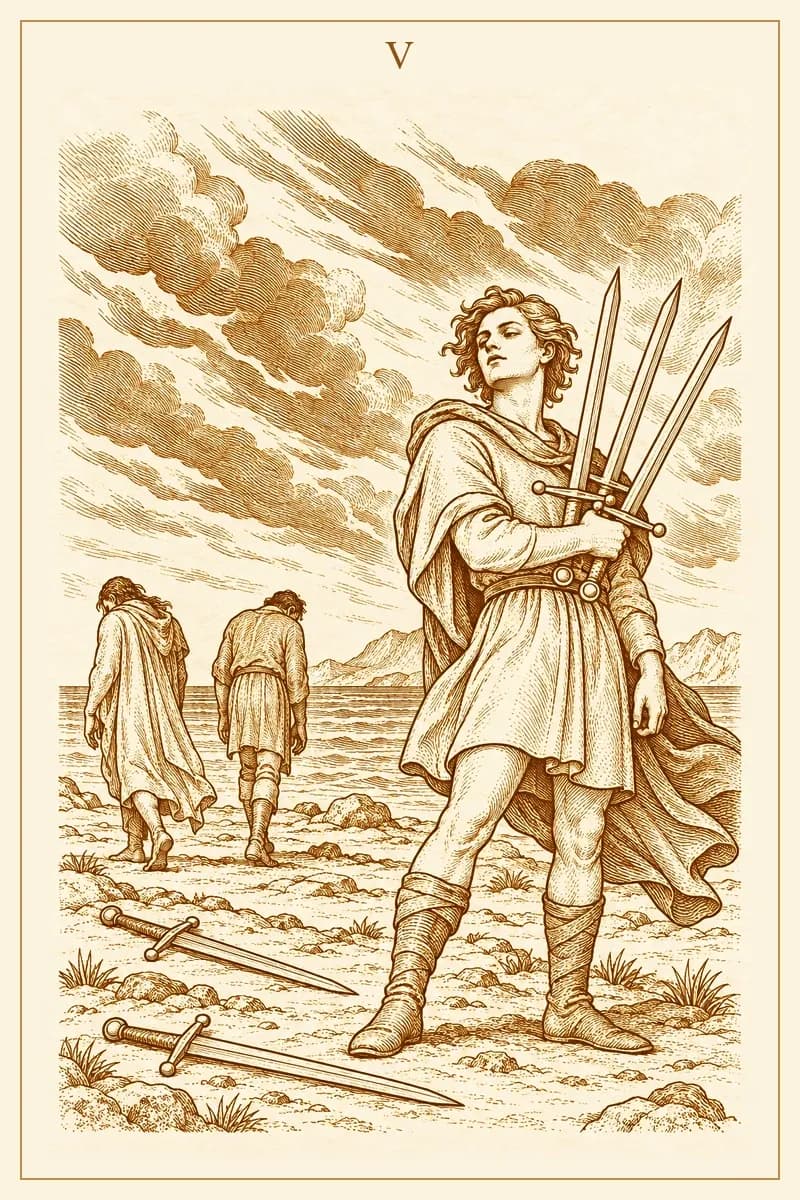
The card shown is VeilSoul's own engraved drawing of the 1909 Waite–Smith card. The scene and symbols described on this page follow the 1909 card, so a few details are drawn differently in our deck.
The Five of Swords shows a figure in the foreground holding three swords with a smug expression, while two defeated figures walk away in the background, shoulders slumped in humiliation. The sky is turbulent, streaked with stormy clouds. Someone has won — but at what cost? This is the card of victory that tastes like ashes, conflict that leaves everyone damaged, and the uncomfortable question: was winning worth what it destroyed?
When the Five of Swords appears upright, a conflict in your life has reached a point where someone must lose. This may be an argument, a power struggle, a competitive situation, or a battle of wills. The card warns that winning this fight may cost you something more valuable than what you gain — a relationship, your reputation, your integrity, or your peace of mind.
The figure holding the swords has won the battle but lost the war. The two people walking away are not just defeated — they are leaving. When you fight to win at all costs, you often end up winning an empty room. The Five of Swords asks: is this victory worth the isolation that comes with it?
Alternatively, you may be one of the figures walking away — the one who lost the argument, the one who was bullied, outmaneuvered, or overpowered. In this case, the Five of Swords validates your decision to withdraw. Not every battle is worth fighting. Sometimes the wisest move is to pick up your remaining dignity and walk away from a fight you cannot win without becoming someone you do not want to be.
The victor holds three stolen swords while two defeated figures retreat into grey sky. The battle was won but the cost — isolation, broken trust — exceeds every gain.
Hollow victory escalates into compulsive domination where every interaction becomes contest (excess), or collapses into chronic surrender, yielding swords before the fight begins (deficiency).
Detailed Interpretations
The Five of Swords in love reveals a relationship marred by destructive conflict, corrosive power imbalance, or the toxic pattern of fighting to win rather than fighting to understand. If every disagreement becomes a battle where one partner must dominate and the other must submit, where points are scored and humiliations are cataloged for future ammunition, this card confirms that the relationship has crossed the line from healthy conflict into something genuinely harmful.
This card often appears when one partner consistently uses superior verbal skill, emotional manipulation, or psychological aggression to win arguments — leaving the other feeling defeated, diminished, and increasingly unwilling to express their genuine feelings because vulnerability has become dangerous rather than intimate. The smug figure collecting swords in the foreground does not care about resolution; they care about domination, and the two retreating figures represent the trust, safety, and emotional openness that have been driven out of the relationship by this pattern.
For singles, the Five of Swords may indicate that you are approaching dating as a competitive arena rather than a collaborative exploration — guarding yourself so aggressively that potential partners experience your defenses as hostility, or choosing people you can dominate rather than people who challenge you to grow. This card asks a difficult question: in your romantic history, are you more often the figure holding the collected swords or the one walking away defeated? And whichever role you tend to play, what would it take to stop participating in the game entirely and seek relationships built on mutual respect rather than power dynamics?
In love reversed, the Five of Swords indicates a genuine desire for reconciliation after a period of destructive conflict. One or both partners are ready to stop fighting, put down the weapons of blame and criticism, and begin the difficult work of rebuilding trust that aggressive behavior has damaged. Pride is softening, the smug satisfaction of winning arguments is giving way to the sober recognition that winning at your partner's expense means losing the relationship, and honest conversation is replacing the verbal combat that had become the default mode of engagement.
This reversal can also indicate walking away from a relationship that was defined by toxic conflict — not reconciling but releasing. You have decided that this particular battle is not worth fighting anymore, that the pattern of attack and defense has become too deeply entrenched to change, and that the healthiest choice is to collect whatever dignity remains and leave the battlefield entirely. This is not defeat — it is the wisdom of knowing when further engagement will only deepen the wounds rather than heal them.
For some, the reversed Five marks the moment of genuine apology — acknowledging not just that you were wrong in a specific argument but that your entire approach to conflict within the relationship has been harmful, and committing to change the pattern rather than merely winning the next round more gracefully.
Professionally, the Five of Swords represents workplace conflict at its most damaging — office politics that have turned genuinely toxic, competitive situations where ethical lines are being deliberately crossed, or environments where winning has become more important than producing quality work or maintaining professional integrity. Someone may be taking credit for others' contributions, sabotaging colleagues to advance their own position, spreading rumors to undermine a competitor, or using institutional power to bully those who lack the authority to fight back.
If you are the one engaging in these behaviors — rationalizing cutthroat tactics as necessary for survival, telling yourself that business is business while relationships burn around you — the Five of Swords delivers a sharp warning: the victory you are pursuing is hollow. The swords you collect from defeated opponents may look like trophies, but they are actually evidence of bridges burned, trust destroyed, and a professional reputation that is being built on fear rather than respect. People remember how you made them feel, and the colleagues you humiliate today will be the hiring managers, clients, and industry peers you need tomorrow.
If you are on the receiving end of workplace aggression, the Five of Swords asks you to evaluate honestly whether this is a battle worth fighting. Not every workplace conflict deserves your energy, and some environments are simply too toxic to reform from within. Walking away from a fight is not weakness — sometimes it is the most strategic decision available, preserving your energy, your integrity, and your mental health for battles that are actually winnable and worth winning.
Career-wise, the reversed Five of Swords suggests the resolution of a workplace conflict — whether through formal mediation, a genuine apology that restores damaged trust, mutual agreement to stop the hostilities and move forward professionally, or the strategic decision to disengage from a toxic situation entirely. The competitive aggression that characterized the upright Five is fading, replaced by a recognition that professional relationships built on mutual respect produce better outcomes for everyone than zero-sum power games.
This reversal also appears when someone who has been engaging in cutthroat professional behavior experiences a moment of reckoning — recognizing the damage their tactics have caused, feeling the emptiness of victories achieved through manipulation or intimidation, and choosing to rebuild their professional reputation on a foundation of integrity rather than fear. The collected swords are returned, the smug expression softens into genuine remorse, and the hard work of earning back trust begins.
However, the reversed Five can also indicate the aftermath of a conflict where you were on the losing side — processing the humiliation of a public professional defeat, a failed power play, or a competitive situation where you were outmaneuvered. The lesson in these cases is not to seek revenge but to learn from the experience, rebuild quietly, and ensure that your next professional engagement is grounded in competence and collaboration rather than the combative approach that led to the original defeat.
The Five of Swords in health draws a direct connection between chronic interpersonal conflict and physical deterioration. Sustained conflict — whether at work, in relationships, within families, or in any environment where you are constantly bracing for the next attack — creates a state of perpetual stress that the body was never designed to maintain. Cortisol levels remain chronically elevated, suppressing immune function, disrupting sleep architecture, increasing blood pressure, promoting inflammatory responses, and creating the conditions for a cascade of stress-related illnesses that range from frequent colds to cardiovascular disease.
This card also addresses the specific health impact of toxic victories — the physical cost of maintaining aggressive, dominant, or combative postures over time. The person who wins every argument but remains perpetually tense, whose jaw is clenched, whose shoulders never fully relax, whose mind is always scanning for the next threat or rehearsing the next verbal assault, is paying for those victories with their body. Dominance is physiologically expensive, and the Five of Swords suggests that the health costs of your conflicts may be far higher than you have been willing to acknowledge.
The prescription is not to suppress conflict — suppressed anger carries its own serious health consequences — but to examine honestly whether the conflicts consuming your energy are worth their physical price. Some battles protect things that matter; others are fought purely from ego, habit, or the inability to let perceived slights pass without retaliation. Your body does not distinguish between the two, and it charges the same toll for both.
Use this as a reflective prompt, not medical advice or a diagnosis. For health concerns, seek guidance from a qualified healthcare professional.
The Five of Swords reversed signals the desire to end a conflict — to put down the swords and seek reconciliation. You may be ready to apologize, to forgive, or to walk away from a fight that has cost too much already. The reversed Five favors peace over pride.
Alternatively, this reversal can indicate lingering resentment from a past conflict — a wound that never properly healed because neither party was willing to address it honestly. Old grudges resurface. The reversed Five asks whether it is finally time to release the anger.
In some cases, the reversed Five indicates that a bully or adversary is backing down — the power dynamic is shifting in your favor, and the conflict may resolve without further confrontation.
The reversed Five of Swords teaches that true strength is not measured by how many fights you win but by how many unnecessary fights you have the wisdom to walk away from. The lesson is that pride is a catastrophically poor compass — it points consistently toward victory and away from peace, toward dominance and away from connection, toward being right and away from being happy. Every conflict has a cost, and the reversed Five asks you to become honest about whether the victories you have pursued were worth the relationships, the trust, and the peace of mind they consumed.
This reversal also teaches the profound difference between resolution and surrender. Walking away from a toxic conflict is not losing — it is choosing to invest your limited energy in things that actually matter rather than in battles that leave everyone diminished. The most powerful move on the Five of Swords chessboard is often the one that no one expects: putting down the sword entirely, extending an open hand, and choosing peace over the hollow satisfaction of another win.
Before engaging in today's conflicts, pause and ask yourself honestly: is winning this argument worth what it will cost? Not every disagreement requires a battle, and not every battle requires a victor. Some of the most powerful choices you can make today involve walking away from provocations that your ego insists you must answer, choosing silence when a cutting response is on the tip of your tongue, or simply deciding that peace matters more to you than being right. The swords you choose not to pick up today are the relationships you preserve for tomorrow.
“I choose peace over pride. I release the need to win every argument, and I measure success by the quality of my relationships, not the number of my victories.”
The card shown is VeilSoul's own engraved drawing of the 1909 Waite–Smith card. The scene and symbols described on this page follow the 1909 card, so a few details are drawn differently in our deck.
The central figure holds three swords — two collected from the defeated opponents and one of his own. His expression is smug, almost sneering, revealing that this victory was about dominance rather than justice. The defeated figures walk toward the sea — retreating into the emotional realm, their backs turned in shame and sorrow.
The turbulent sky — churning grey and yellow clouds — indicates that no one has truly won. The atmosphere is poisoned by the conflict itself. Even the victor stands alone in a landscape drained of warmth.
The sea in the background is choppy and unsettled, mirroring the emotional turmoil that this type of conflict creates. The Five of Swords is a study in the difference between winning and succeeding — the figure has won the swords but lost his companions, and swords without allies are just sharp metal gathering dust.
Fives represent disruption, conflict, and the instability that forces growth. The Five of Swords is intellectual conflict at its most destructive — arguments that wound, competitions that isolate, and victories that cost more than they are worth.
Keep or share this card reference
✦ From meaning to reflection ✦
Bring what this card stirred into a reading shaped around what you are facing now.
Read with this insight