
Loading your view
The page is gathering the latest information.
The page is gathering the latest information.
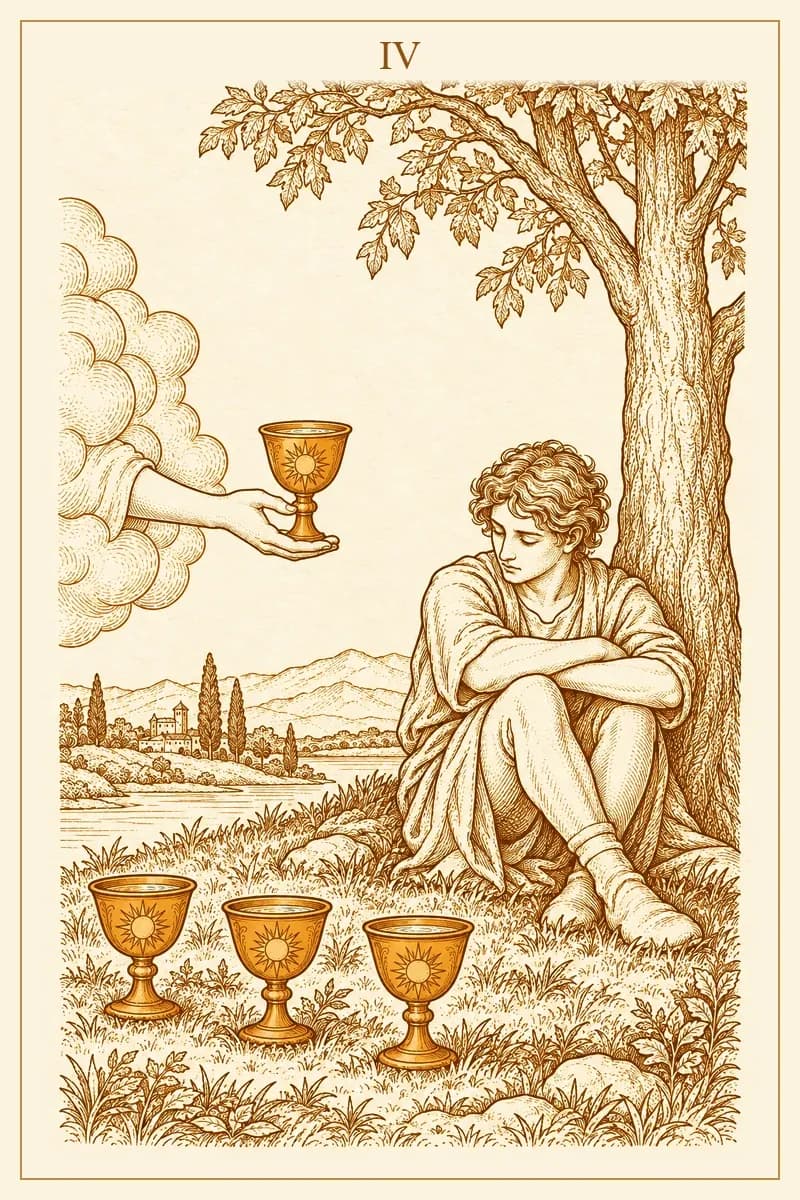
The card shown is VeilSoul's own engraved drawing of the 1909 Waite–Smith card. The scene and symbols described on this page follow the 1909 card, so a few details are drawn differently in our deck.
The Four of Cups depicts a young man sitting beneath a tree with his arms crossed and his eyes downcast, staring at three cups arranged on the ground before him. A fourth cup is being offered by a mysterious hand emerging from a cloud — but the figure does not see it, or chooses not to look. He is so absorbed in contemplating what he already has (or what he lacks) that he is blind to the new opportunity being presented.
When the Four of Cups appears upright, you are in a period of emotional withdrawal, dissatisfaction, or apathy. The world is offering you something — a new relationship, a creative opportunity, an invitation, a change of perspective — but you cannot see its value because you are too focused on what you feel is missing. The three cups on the ground represent what you already have, and yet none of them seem enough.
This card is not necessarily negative. Sometimes the Four of Cups reflects a necessary period of introspection and emotional recalibration. Before you can appreciate what is being offered, you may need time to sit with your feelings, to understand what you truly want, and to process disappointment or disillusionment. Meditation and solitude can be healing.
However, the Four of Cups warns against prolonged withdrawal that becomes self-indulgent brooding. There is a difference between contemplation that leads to clarity and sulking that leads to stagnation. At some point, you must open your eyes and see the cup that is being offered — because it will not wait forever.
Three cups sit before him, a fourth extends from the cloud, yet he stares at none. Emotional saturation has made offerings invisible — the paralysis of a heart that forgot how to want.
Emerging from apathy into renewed desire (healthy), or sinking deeper into withdrawal where the cloud's offering threatens the numbness you've grown comfortable in (excess).
Detailed Interpretations
The Four of Cups in love suggests emotional dissatisfaction or taking a relationship for granted. If single, you may be turning down perfectly good romantic opportunities because you are fixated on an idealized version of love that does not exist, or because you are still mourning a past connection. The person sitting under the tree with arms crossed is you — so absorbed in what you have lost or what you think you deserve that you cannot see what is actually being offered. Someone may be showing you genuine interest right now, and you are dismissing them because they do not match the fantasy you have constructed from past heartbreak and romantic films. The Four of Cups asks you to examine whether your standards are truly standards or whether they are walls built from disappointment and disguised as selectiveness.
In a relationship, this card indicates a period of emotional distance or boredom. One or both partners may feel unappreciated or disconnected. The remedy is not to seek excitement outside the relationship but to look at what you already have with fresh eyes. The fourth cup — the renewed perspective — is right there if you are willing to see it. Relationships go through seasons, and the Four of Cups often appears during the winter — the stretch where passion has cooled, routines have calcified, and both partners have stopped doing the small things that once made the other feel cherished. This is not the end; it is an invitation to fall in love again with someone you already know, which requires more courage and imagination than falling in love with a stranger ever did.
In love reversed, the Four of Cups suggests emerging from a period of emotional withdrawal or apathy — a reconnection with desire, a willingness to re-engage with love after a period of deliberate emotional distance, or the recognition that the contemplative period has served its purpose and something new is ready to be reached for.
Alternatively, this reversal may indicate the opposite movement: retreating deeper into emotional withdrawal when connection and engagement are actually available and appropriate. The cup being offered from the cloud is genuinely worth receiving — and the reversed Four asks whether fear, boredom, or habitual avoidance is preventing you from reaching for it.
For those in existing relationships, this reversal invites re-engagement: coming back from wherever you went during the contemplative phase and bringing genuine presence back to the partnership.
Professionally, the Four of Cups suggests career dissatisfaction or a failure to recognize opportunities that are being presented to you. You may be so disillusioned with your current role that you cannot see the potential in a new offer, a training opportunity, or a lateral move that could reignite your passion. The Four of Cups professional is the person who has become so accustomed to being disappointed by work that they pre-reject everything — the promotion they assume will be more stress for marginal pay, the project they dismiss as beneath their abilities, the networking event they skip because they have decided in advance that nothing good will come of it.
This card asks you to examine whether your dissatisfaction is based on genuine misalignment or merely on temporary fatigue and restlessness. Sometimes the grass looks greener elsewhere simply because you have stopped watering your own garden. Before you quit, before you disengage, before you write off your current situation as hopeless — have you actually tried to change it from the inside? Have you had the conversation with your manager, submitted the proposal, volunteered for the interesting project, or asked for the flexibility you need?
If you have been offered something new and are hesitating, the Four of Cups urges you to at least consider it before rejecting it. The cloud-hand will not extend the cup forever. Opportunity does not wait for you to finish being disillusioned, and the window between being offered something valuable and having that offer withdrawn is often narrower than your brooding timeline assumes.
Career-wise, the reversed Four of Cups suggests either the end of a period of professional stagnation — motivation returning, engagement with work renewing, or a new opportunity suddenly visible after a period when everything felt gray and uninspiring — or a deeper retreat into professional disengagement when the circumstances actually call for re-engagement.
This reversal also appears when someone has been so focused on what they do not have professionally — the role they were passed over for, the recognition not received, the opportunity that went to someone else — that they have remained blind to genuine possibilities that were available all along.
The invitation is to look up from the current posture of dissatisfaction and notice what is actually present and available, rather than continuing to mourn what is absent.
The Four of Cups in health may indicate emotional fatigue or a mental health dip that manifests as apathy toward self-care. You know what you should be doing for your health, but you cannot summon the motivation. The gym membership goes unused. The meditation app collects dust. The vegetables rot in the refrigerator while you order delivery for the third consecutive night. This is not laziness — it is the specific paralysis that comes from emotional depletion, from a system that has been running on fumes for so long that even beneficial activities feel like demands rather than gifts.
Rather than forcing yourself into action, honor the need for rest and reflection — but set a limit. Use this period to reassess your health goals with honesty. What do you actually want? What would make wellness feel exciting rather than obligatory? The fourth cup holds a new approach, if you are willing to look. Perhaps the reason your health routine collapsed is that it was built on obligation rather than enjoyment — on what you were told you should do rather than what actually makes your body feel alive and your mind feel clear. The Four of Cups in health is an invitation to redesign your wellness from the ground up, starting not with what is optimal according to some external authority but with what genuinely brings you energy, pleasure, and the desire to continue. A sustainable health practice is one you look forward to, not one you endure, and this card asks you to find that version before your apathy hardens into something more difficult to reverse.
Use this as a reflective prompt, not medical advice or a diagnosis. For health concerns, seek guidance from a qualified healthcare professional.
The Four of Cups reversed often signals a positive shift — emerging from a period of apathy, finally seeing what has been offered, and choosing to engage with life again. The fog of discontent lifts, and you recognize the opportunities you have been overlooking. Motivation returns.
Alternatively, this reversal can indicate deepening withdrawal — pulling further away from people, opportunities, and experiences. Depression, burnout, or prolonged grief may be preventing you from engaging with even the most basic aspects of daily life.
The reversed Four of Cups can also suggest that you have done the inner work, completed the contemplation, and are now ready to act. The period of retreat is over — it is time to uncross your arms and reach for the cup.
The reversed Four of Cups teaches the skill of recognizing genuine opportunity when it arrives — distinguishing it from the distractions and false offers that deserve to be declined, but also from the genuinely good things that are available right now and deserve a wholehearted yes.
This card also addresses the spiritual exhaustion that can result from chronic dissatisfaction — the state of being so habitually focused on what is missing, what is not enough, or what should be different that the actual present, with its real gifts and real possibilities, becomes completely invisible.
The deepest lesson: there is a point at which contemplative withdrawal becomes avoidance, at which necessary discernment becomes paralysis, at which healthy reflection becomes resistance to life. The reversed Four asks you to notice if that line has been crossed — and if so, to make the deliberate movement back toward engagement, presence, and the risk of genuine participation.
Look up today. The Four of Cups often shows someone so absorbed in contemplation or dissatisfaction that they miss what is being offered right in front of them. The reversed card asks you to shift posture — literally or figuratively — and notice one genuine possibility, connection, or source of beauty that is available to you right now that your current focus has been obscuring. Reach for it.
“I open my eyes to the blessings that surround me. I release dissatisfaction and choose to see the gifts that life is offering me right now.”
The card shown is VeilSoul's own engraved drawing of the 1909 Waite–Smith card. The scene and symbols described on this page follow the 1909 card, so a few details are drawn differently in our deck.
The seated figure represents the contemplative self — withdrawn from action and absorbed in inner experience. His crossed arms signal a closed posture, a refusal to engage. The tree behind him symbolizes stability and shade (comfort), but also the risk of becoming too rooted in one emotional state.
The three cups on the ground represent past emotional experiences — gifts already received that no longer satisfy. The fourth cup offered by the divine hand is the new opportunity, the fresh perspective, the unexplored possibility. The hand from the cloud signifies that this offering comes from a higher source — intuition, grace, or the universe itself.
The key tension in this card is between the figure's inner world and the external offering. He is not in danger — he is in stasis. The card asks whether this stillness is sacred contemplation or stubborn refusal to grow.
Four is the number of stability, structure, and foundation — but also stagnation. In the Cups suit, it represents emotions that have become static, a heart that has settled into a fixed pattern. The challenge is to use stability as a platform for growth rather than a cage.
Keep or share this card reference
✦ From meaning to reflection ✦
Bring what this card stirred into a reading shaped around what you are facing now.
Read with this insight