The planet Moon's card in tarot is The High Priestess (II), not the card called The Moon (XVIII). In the Golden Dawn correspondences that many English-language decks inherited, the seated priestess between two pillars carries the Moon itself, while The Moon card belongs to the zodiac sign Pisces. The Moon also reaches The Chariot through Cancer, the sign it rules, The Hierophant through Taurus, the sign where it is exalted, and five numbered cards of the Minor Arcana through the decans.
That map was drawn by one Victorian magical order, the Hermetic Order of the Golden Dawn, and it is a lens rather than a rule; plenty of skilled readers never use astrology at all. No lunar card can tell you what someone else feels, when a full moon will bring news or how a situation will turn out. What these cards do well is help you notice the part of you that reacts before you think: moods, habits, the need for care and the quiet knowing underneath a decision.
Here are the eight cards the Golden Dawn ties to the Moon, with the role each plays:
- The High Priestess (II): the Moon itself; inner knowing, patience and what is not yet said.
- The Chariot (VII): Cancer, the Moon's own sign; feeling given a shell and a direction.
- The Hierophant (V): Taurus, the Moon's exaltation; comfort found in ritual, habit and shared tradition.
- Two of Swords: Moon in Libra; a truce kept by not looking.
- Six of Pentacles: Moon in Taurus; care that flows as giving and receiving.
- Four of Cups: Moon in Cancer; a full heart that has gone flat.
- Nine of Wands: Moon in Sagittarius; strength drawn from memory and instinct.
- Seven of Swords: Moon in Aquarius; effort that comes and goes, and plans kept private.
The High Priestess or The Moon card: which one is the planet?
The mix-up is understandable: one card is literally named after the Moon. The Golden Dawn, however, assigned the trumps through the Hebrew alphabet rather than through card titles. Its twenty-two letters fall into three groups: three "mother" letters for the elements, seven "double" letters for the seven classical planets and twelve "simple" letters for the signs of the zodiac.
The High Priestess received Gimel, a double letter, and with it the Moon. On the Golden Dawn Tree of Life her path runs from the crown at the top of the tree straight down to its heart, crossing the gulf the order called the Abyss, which is why she is read as knowledge that arrives whole rather than being worked out step by step. The order's manual, Book T, titles her Priestess of the Silver Star.
The Moon (XVIII) received Qoph, a simple letter, and with it Pisces. Its moon face, howling animals and creature crawling out of the water describe the dreamy, boundary-dissolving side of that water sign. If that card is what drew you here, the Moon tarot card meaning covers it in full, and the Pisces and tarot guide explains its sign. This post stays with the Moon as a body in the sky.
The Moon as a luminary: what it governs
Astrology calls the Sun and the Moon the two luminaries, the lights of day and night. The Sun stands for the self you are growing into; the Moon stands for the self you fall back on when you are tired, frightened or at home with the door closed. It describes instinct, emotional reflexes, habits, memory, the body's rhythms, the way you were cared for and the way you now care for others.
The Moon is also the fastest-moving body in the traditional sky. It passes through each sign in about two and a half days and completes its phases in about twenty-nine and a half. That speed is the key to reading it in tarot: lunar themes ebb and return, like a mood that lifts by evening or a worry that comes back every Sunday night. Traditional astrology gives the Moon its home in Cancer and its exaltation, the sign where it works at its best, in Taurus, which is why The Chariot and The Hierophant belong in its company.
The High Priestess: the Moon's own trump
Every other lunar card shows the Moon working through a sign. The High Priestess is the planet with nothing added, so she is the place to start.
The High Priestess (II): knowing that waits
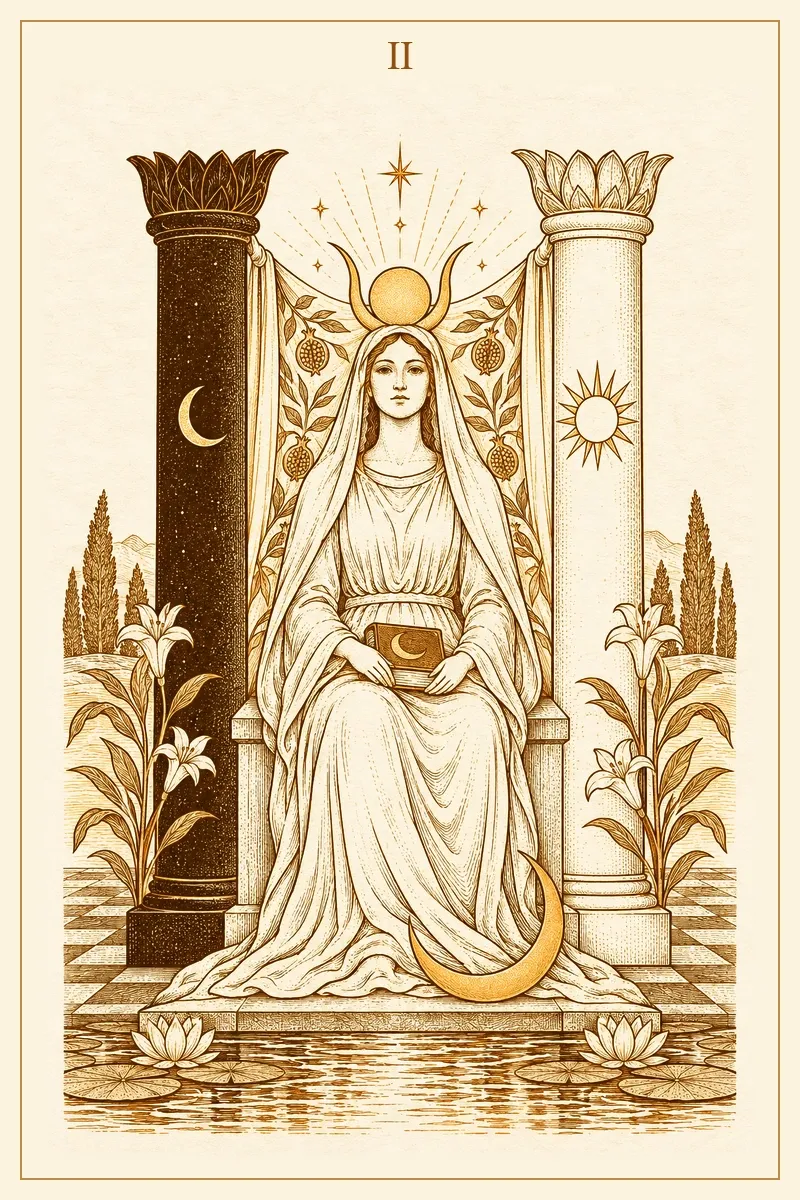
She sits between a dark pillar marked with a crescent and a pale pillar marked with a sun. A crown of a disc between two horns rests on her head, a veil patterned with pomegranates hangs behind her, a book with a crescent on its cover lies in her lap and a large crescent curves at her feet, just above still water with lily pads.
Upright, The High Priestess asks you to pause and listen to what you already sense: patience, discretion and a hunch you cannot yet prove. In love she can describe attraction that has not been spoken, or a need to understand your own feelings before explaining them to anyone. At work she suits research, listening rather than talking, and keeping a project quiet until it is ready.
Reversed, the lunar quiet turns into static. You may be ignoring a clear inner signal, collecting other people's opinions to drown it out, or keeping a secret that now costs more than it protects. Sometimes the reversal points outward, to missing information. For her love, career and yes-or-no readings, see the full High Priestess tarot meaning.
Home and exaltation: The Chariot and The Hierophant
Two more trumps carry the Moon indirectly: The Chariot through Cancer, the sign the Moon rules, and The Hierophant through Taurus, the sign where it is exalted. Neither looks lunar at first glance, which is part of what they teach.
The Chariot (VII): the Moon through Cancer
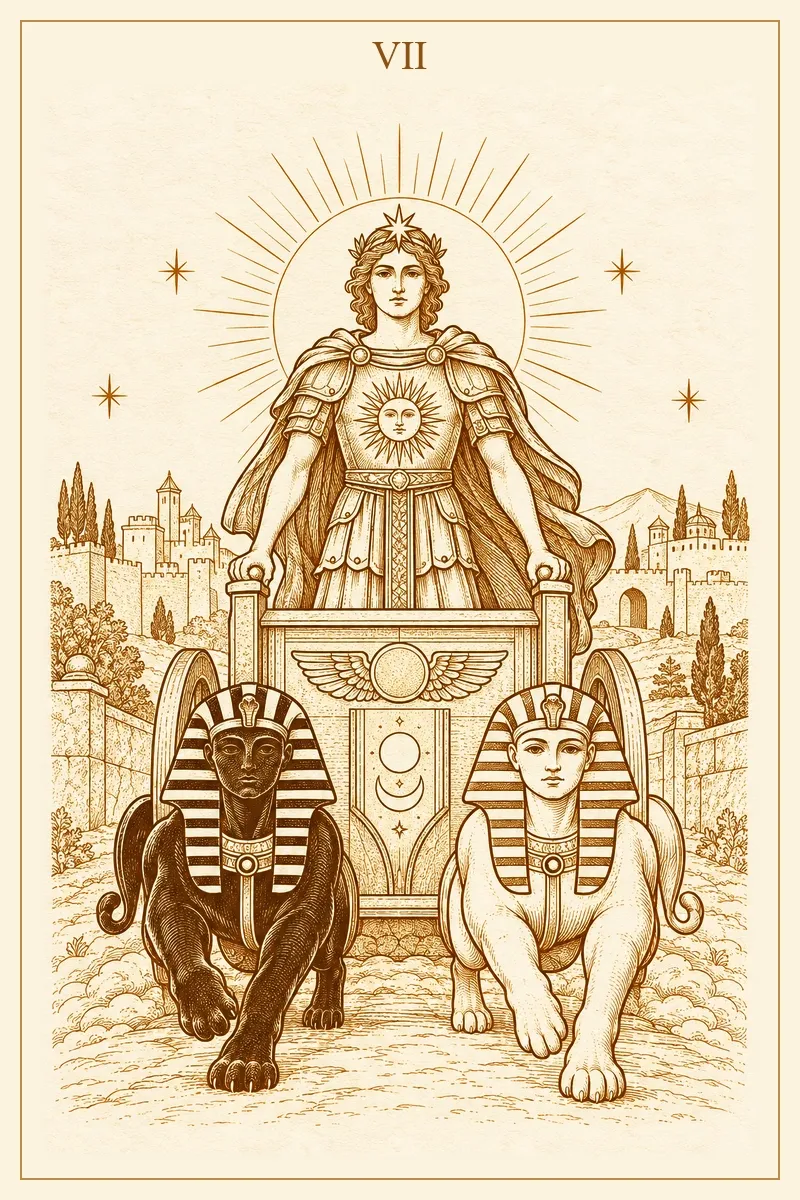
A charioteer in a star-topped laurel wreath stands in armor with a radiant sun on his breastplate, a walled city behind him. A small crescent marks the front of his chariot, and two sphinxes, one dark and one pale, lie before it with no reins in sight. The Golden Dawn gave this card the letter Cheth, usually translated as a fence or enclosure: a fitting image for Cancer, the crab that carries its home on its back.
Seen through the Moon, The Chariot is emotion with armor on: the drive to protect what you love without letting every feeling steer. Upright, it supports determination and the steadiness to keep two pulling forces in line. Reversed, the shell becomes a wall: forcing a result, defensiveness that looks like strength, or moving fast so you never have to feel. The Chariot tarot meaning explores its victory themes, and the Cancer and tarot guide shows the rest of the Moon's sign in the deck.
The Hierophant (V): the Moon exalted in Taurus
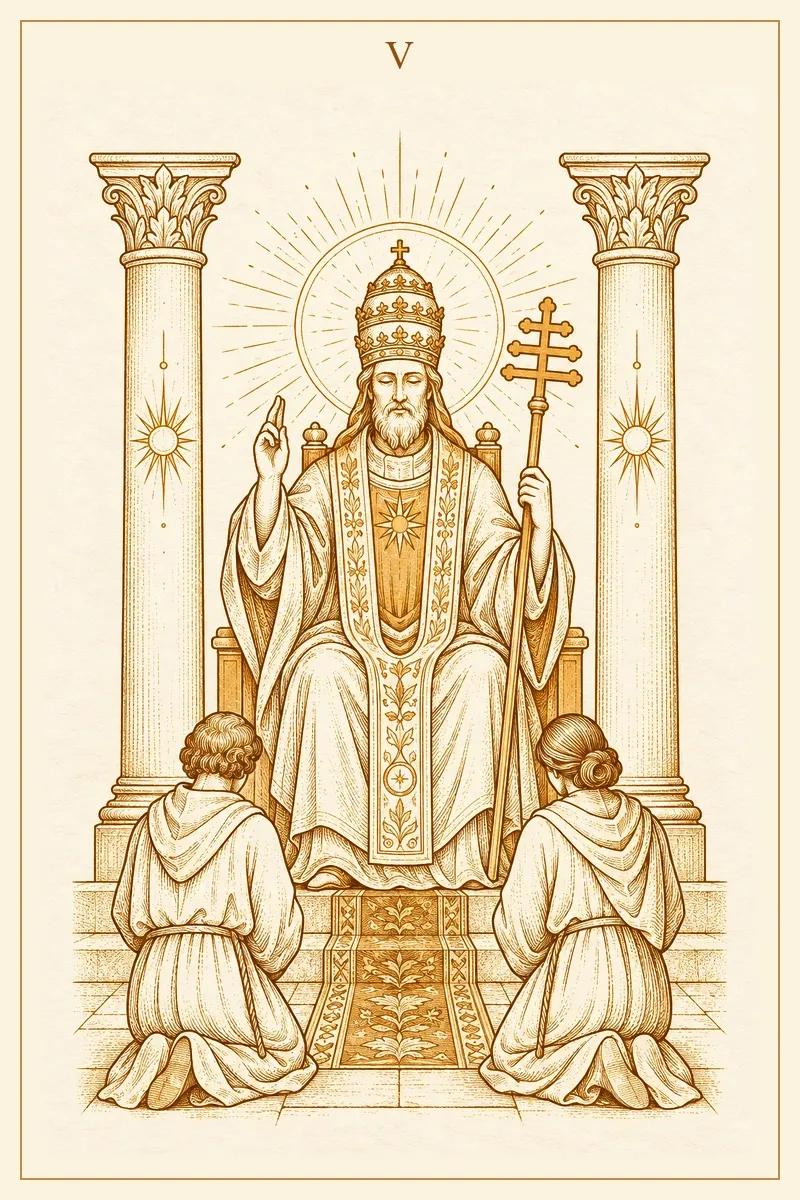
A teacher in a triple crown sits between two columns, one hand raised in blessing and the other holding a triple cross, while two figures kneel at his feet. Taurus is ruled by Venus, so the Moon is an honored guest here rather than the owner. Astrologers say it is exalted in Taurus because feeling settles in this slow, sensory sign: moods find a rhythm, and comfort comes from things done the same way each time.
That is The Hierophant's lunar side: rituals, family customs, a practice you return to. Upright, the card supports learning within a tradition and making a commitment official. Reversed, the comfort turns into a rut, or a rule you follow only because your family always did. Read more in the Hierophant tarot meaning and the Taurus and tarot guide.
The five lunar decans in the Minor Arcana
The Golden Dawn split each sign into three ten-degree decans and gave one to each numbered card from two to ten. To find a decan's ruler, start with Mars at the first decan of Aries and repeat the classical planets in descending order, Saturn, Jupiter, Mars, Sun, Venus, Mercury, Moon, around the zodiac. Thirty-six decans shared by seven planets means five for each and a sixth for Mars, which opens and closes the wheel, as the Mars in tarot guide explains.
Counted through, the Moon lands on the first decan of Libra, the second of Taurus, the third of Cancer, the second of Sagittarius and the third of Aquarius. The dates below are approximate Sun dates that shift slightly each year; use them for themed reflection, not as forecasts.
Two of Swords: Moon in Libra
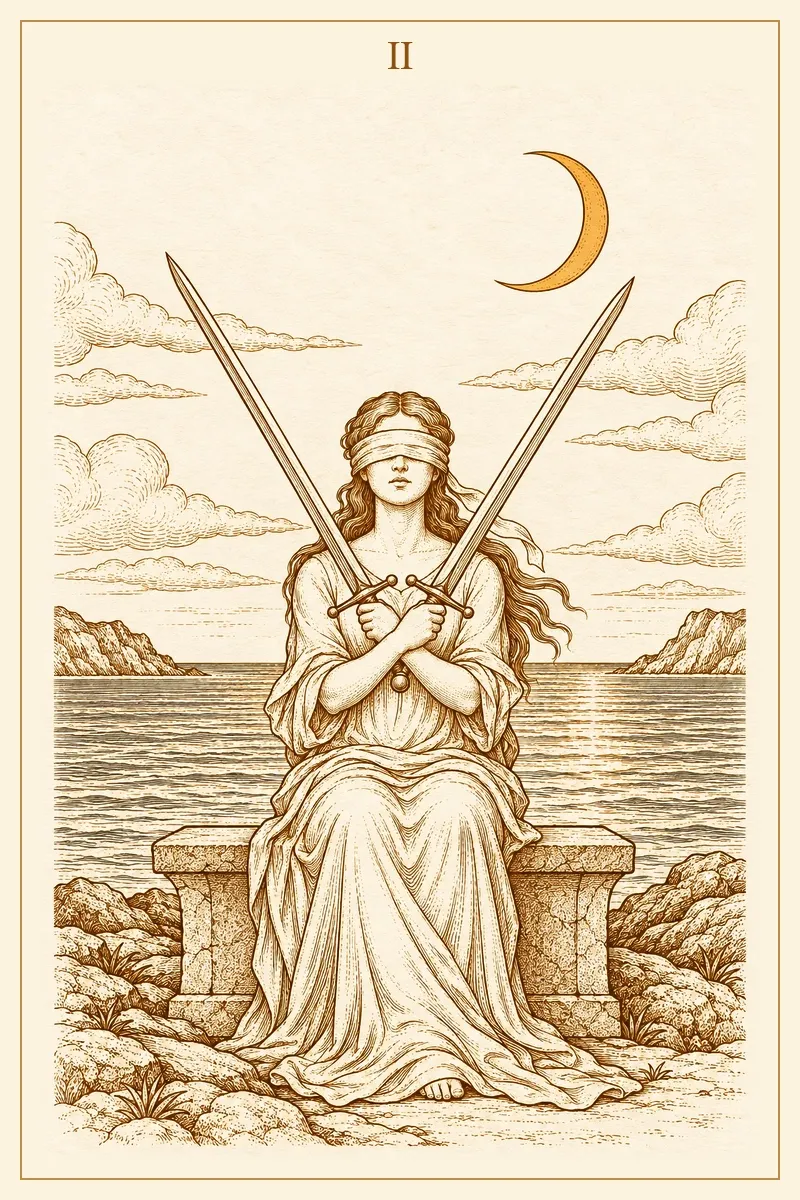
A blindfolded woman sits on a stone bench by the sea, two long swords crossed over her chest, a thin crescent moon high in the upper right of the sky. The Golden Dawn title is Lord of Peace Restored, and the decan opens Libra, roughly September 23 to October 2. The Moon wants comfort and Libra wants harmony, so together they keep the peace by refusing to look: the water behind her is calm because nothing has been decided yet.
Upright, the card describes a stalemate or a truce that lasts only while both sides avoid the real subject. Its lunar question: what do you already feel about this choice? Reversed, the blindfold slips: hidden facts surface, or you admit which way you are leaning. The Two of Swords tarot meaning follows it into love and work.
Six of Pentacles: Moon in Taurus
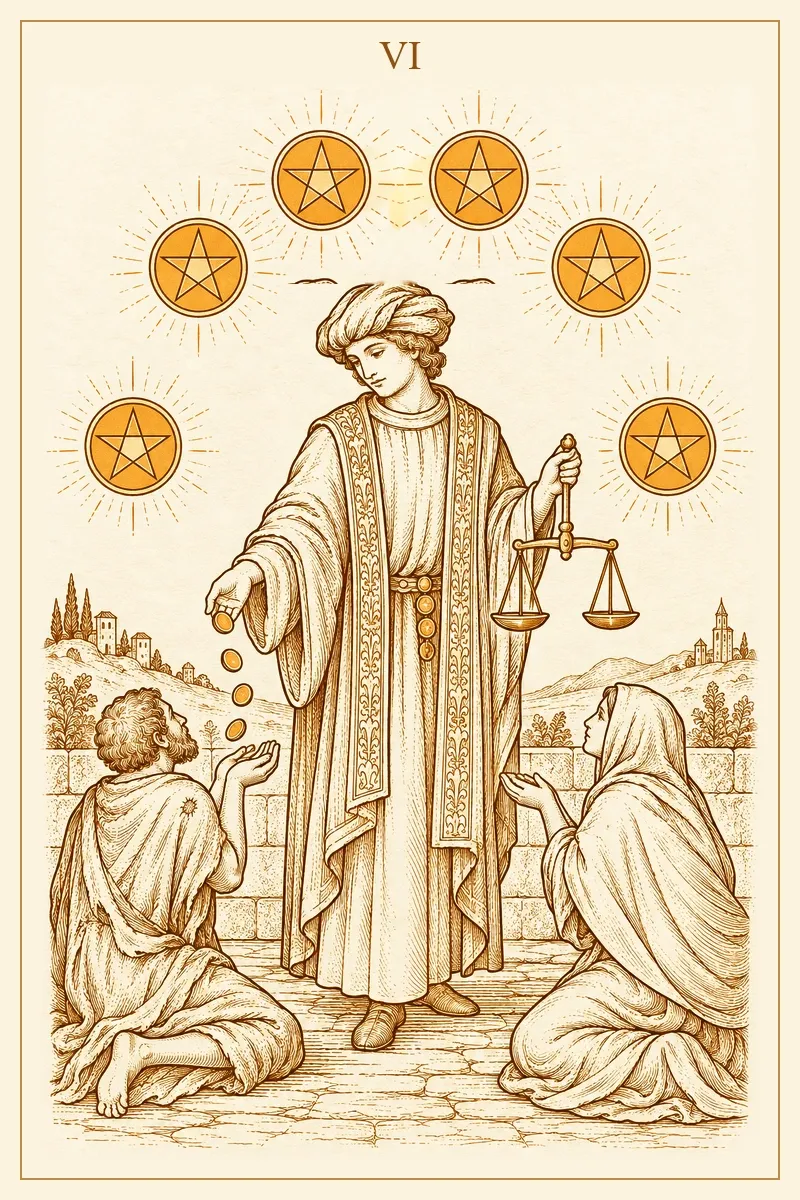
A merchant in a turban holds a balanced scale in one hand and lets coins fall from the other toward a kneeling figure, while a second figure kneels on his other side and six pentacles arc overhead. This is Lord of Material Success, the middle decan of Taurus, around April 30 to May 10. Here, in the sign of its exaltation, lunar care becomes practical: feeding people, lending, sharing what you have, being looked after.
Upright, the card points to generosity, fair exchange and help that arrives when needed; its lunar lesson is that care is a flow, not a ledger. Reversed, the flow tips: gifts with strings attached, one person always giving, or pride that refuses support. The full Six of Pentacles tarot meaning covers its money and relationship readings.
Four of Cups: Moon in Cancer
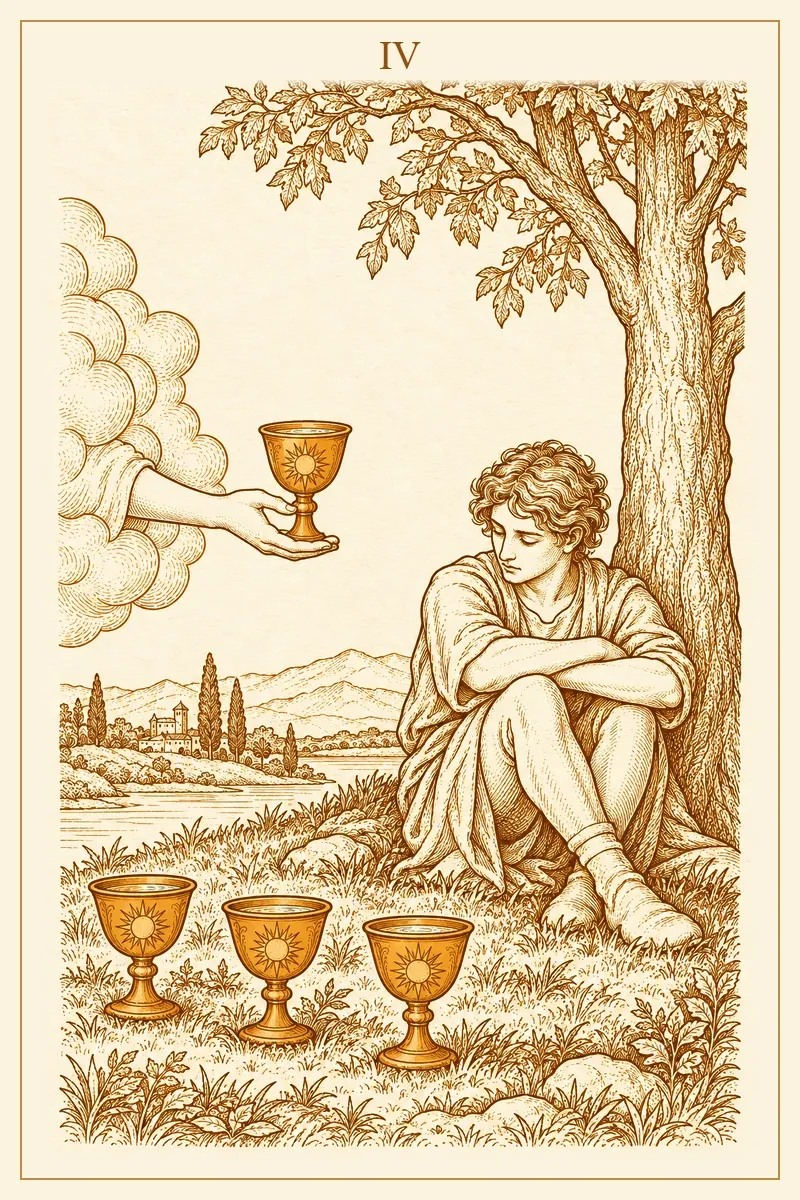
A young man sits under a tree with his arms folded, three cups on the grass before him, while a hand reaches out of a cloud to offer a fourth. The Golden Dawn calls it Lord of Blended Pleasure, and the decan closes Cancer, around July 12 to 22. The Moon is in its own sign, so feeling is at its fullest, and that fullness is the trouble: the heart is saturated, pleasure is mixed with flatness, and a new offer barely registers.
Upright, the Four of Cups describes apathy, withdrawal and the sense that something is missing even when much has been given; it can be healthy rest or a mood hardened into habit. Reversed, attention returns: you notice the offered cup or accept an invitation. Read the Four of Cups tarot meaning for more.
Nine of Wands: Moon in Sagittarius
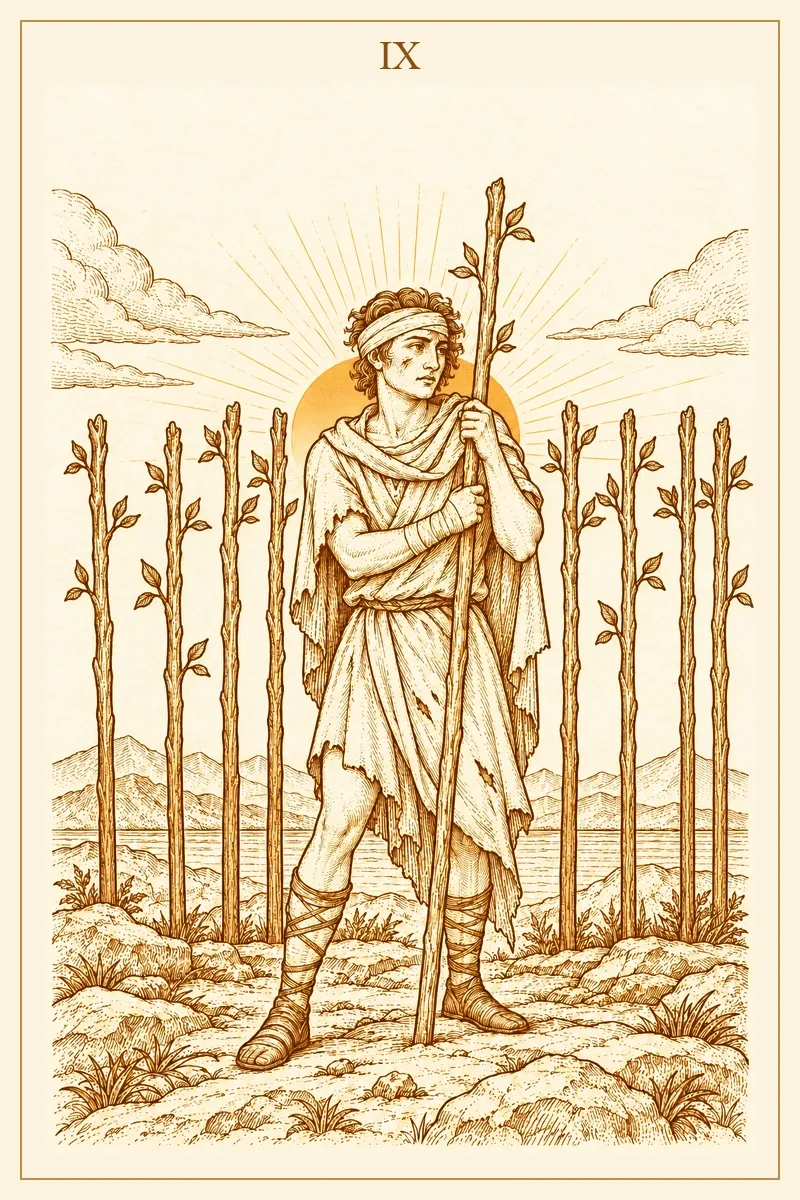
A man with a bandaged head grips a staff and glances warily to one side, eight more staffs planted behind him like a fence, a pale sun rising at his back. The Golden Dawn names it Lord of Great Strength, and the decan sits in the middle of Sagittarius, around December 2 to 11. The card carries the Moon twice: every Nine also belongs to Yesod, the sphere the Golden Dawn assigned to the Moon on its Tree of Life.
The lunar side of this card is memory: his guard comes from having been hurt before. Upright, the Nine of Wands supports persistence and one last steady effort. Reversed, the guard either drops from exhaustion or hardens into suspicion. Ask which old wound is still setting the fence line. The Nine of Wands tarot meaning goes further.
Seven of Swords: Moon in Aquarius
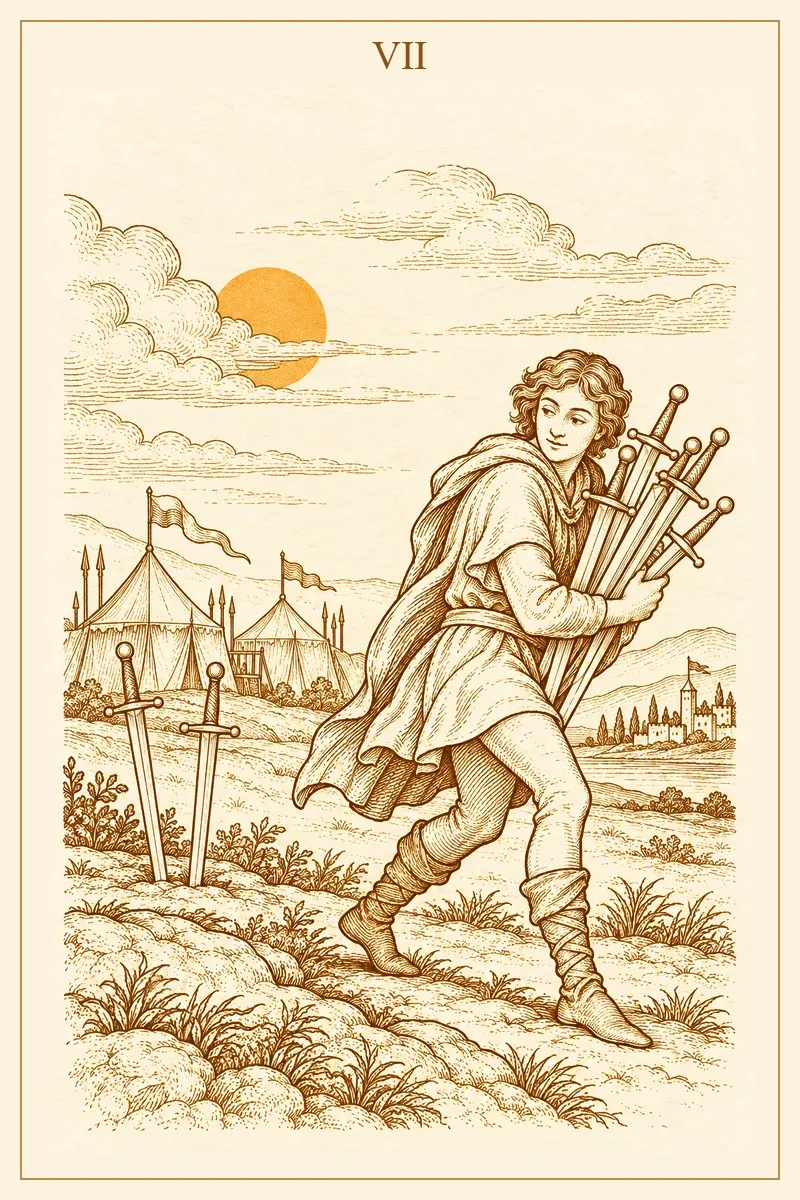
A young man hurries away from a camp of tents with five swords bundled in his arms, two more left standing in the ground, glancing back as he goes. The Golden Dawn title is Lord of Unstable Effort, and the decan closes Aquarius, around February 9 to 18. The changeable Moon in a cool, independent air sign gives effort that comes in bursts and plans kept to oneself.
Upright, the card can mean strategy, going it alone or taking more than your share, and sometimes evasion. Its lunar question is whether you are hiding real feelings behind cleverness. Reversed, the secret surfaces: a confession, or relief at no longer pretending. See the Seven of Swords tarot meaning for trust and relationship readings.
Cards that look lunar but answer to other rulers
The Moon card is the clearest case. Its image, a moon face set inside a rayed disc above a winding road, a dog and a wolf, two towers and a crayfish rising from a pool, is full of night, but in the Golden Dawn order it is the card of Pisces, a sign ruled by Jupiter. The difference from the planet's card is direction: The High Priestess holds knowledge calmly, while The Moon card walks through uncertainty, learning to tell a real danger from an imagined one.
The Eight of Cups raises the same question. Its picture shows a crescent moon above the figure walking away from his cups, and some lists call it Moon in Pisces. Count the decans and it falls to Saturn: the first decan of Pisces, Lord of Abandoned Success. Its departure is Saturn's work of releasing what no longer holds, which the Eight of Cups tarot meaning and the Saturn in tarot guide both develop. The suit of Cups as a whole shares the Moon's watery mood, but that is an elemental pattern rather than a planetary one.
Reading the lunar cards in love, work and daily rhythm
When two or more of the Moon's cards land in one spread, the question is usually less about what will happen and more about how you are responding: what you feel, what you repeat and what you need.
Love, family and home
The Moon governs closeness and care, so its cards often describe the emotional climate of a relationship. The High Priestess can point to feelings not yet spoken, the Six of Pentacles to who gives and who receives, The Chariot to the urge to protect a household. In family questions, the Four of Cups may show someone who has withdrawn rather than stopped caring. Use these cards to understand your own reactions.
Work and money
At work the Moon is about rhythm and morale more than ambition. The Nine of Wands describes a tired team holding the line; the Seven of Swords asks whether information is shared openly; The Hierophant favors established procedures and mentors. The Six of Pentacles can concern pay, loans or support, but money decisions deserve real figures and, where needed, professional advice.
Moods, habits and rest
Because the Moon changes quickly, lunar cards mirror patterns well: the same argument every month, energy that dips on the same weekday, a habit you reach for when anxious. Too much Moon looks like being ruled by moods or caring for everyone except yourself; too little looks like dismissing every hunch you cannot justify. Track a feeling for one cycle before deciding what it means. The cards are not a diagnosis, and persistent low mood or sleep trouble belong with a doctor or counselor.
Using the Moon's phases as a reading rhythm
You do not need a full moon to read these cards, but the phases make a natural calendar for reflection: set an intention near the new moon, check in at the first quarter, review at the full moon and clear away what is finished as the light wanes. The new moon intention-setting guide and the full moon tarot spread offer rituals for both ends of the month. Treat the cycle as a rhythm for paying attention, not a timer.
A five-card lunar intuition spread
This spread works with the Moon's two sides, the face that shows and the face that stays dark. Lay the cards in a crescent, left to right, and read the first and second together before going on.
- The lit face: what I show other people about this situation.
- The dark face: what the quieter part of me already knows.
- The feeling I avoid: the emotion I keep stepping around.
- What needs tending: where care, rest or support is missing.
- The intuitive step: one small action that honors what I feel.
If the second position is hard to read, the guide to building tarot intuition offers exercises for trusting first impressions without discarding a card's meaning.
Worked example: carrying a family after moving home
Imagine someone who moved back to their hometown a year ago and has quietly become the person everyone relies on. They ask, "What am I not letting myself feel about this?" Home, family and care are lunar themes, so they choose this spread and draw:
- The lit face: Nine of Wands.
- The dark face: The High Priestess.
- The feeling I avoid: Four of Cups.
- What needs tending: Six of Pentacles, reversed.
- The intuitive step: The Chariot.
The Nine of Wands as the lit face fits a person who looks capable and a little worn, always on guard for the next request. The High Priestess in the dark face says they already know something they have not said aloud, perhaps that this arrangement was never meant to be permanent.
The Four of Cups names the avoided feeling: not anger but flatness, a disappointment that home did not feel the way they hoped, and a habit of overlooking the help that is offered. The reversed Six of Pentacles shows where care is missing: the giving runs one way, and they have stopped receiving.
The Chariot as the step does not tell them to leave. It suggests taking the reins on purpose, perhaps by proposing a shared schedule at the next family dinner. The reading gives the asker words for what they need.
Frequently asked questions
Which tarot card represents the planet Moon?
The High Priestess (II). In the Golden Dawn system she carries the Moon itself; The Chariot carries it through Cancer, The Hierophant through its exaltation in Taurus, and the Two of Swords, Six of Pentacles, Four of Cups, Nine of Wands and Seven of Swords are its five decan cards.
Is The Moon card (XVIII) the Moon's card?
Not in the Golden Dawn order, where The Moon card belongs to Pisces and the planet goes to The High Priestess through the letter Gimel. The two share an interest in what is hidden, so some readers treat them as relatives.
Is the Eight of Cups a Moon card?
The moon in its picture makes it look like one, but its decan is the first of Pisces, which the Chaldean order gives to Saturn. Read it as a card of leaving what has stopped nourishing you, with Saturn's patience rather than the Moon's changeability.
Can lunar cards or moon phases tell me when something will happen?
No. Tarot cannot confirm a date, an outcome or another person's thoughts, and neither can a phase of the Moon. Decan dates and phases work as a rhythm for reflection; for timing, look at the practical steps the cards suggest.
Do I need to know my Moon sign to use these cards?
No. Every card above has a full meaning on its own. If you know your Moon sign, you may enjoy noticing which lunar cards feel personal, but the correspondences are an extra layer, not a requirement.
Reading by reflected light
The Moon makes no light of its own; it returns the Sun's light to us in changing shapes. Its tarot cards work the same way, reflecting your feelings back so you can see them: The High Priestess with her quiet certainty, The Chariot and The Hierophant with their shell and their ritual, and five minor cards that show feeling at work in conflict, generosity, saturation, resilience and secrecy. For the other half of the luminary pair, read the Sun in tarot guide, or continue with Mercury in tarot.
When something feels unsettled and you cannot yet say why, you might start a reading and ask only what the quieter part of you already knows.