
Loading your view
The page is gathering the latest information.
The page is gathering the latest information.
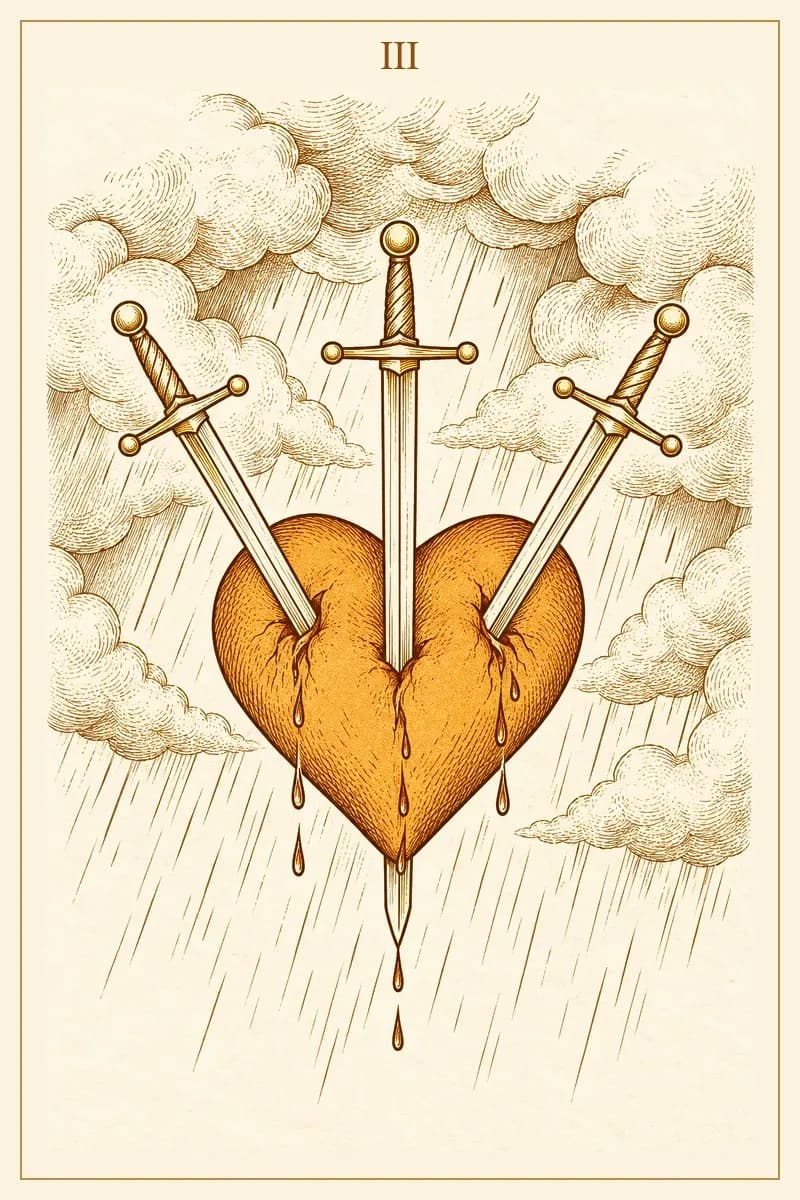
The card shown is VeilSoul's own engraved drawing of the 1909 Waite–Smith card. The scene and symbols described on this page follow the 1909 card, so a few details are drawn differently in our deck.
The Three of Swords is among the most visceral images in the Rider-Waite-Smith deck: three swords pierce a bright red heart against a background of grey rain clouds. There is no figure, no landscape, no narrative — just the raw reality of emotional pain. This card does not soften its message. Something has wounded you, and the wound is real.
When the Three of Swords appears upright, heartbreak, grief, or a painful truth has entered your life. This may be a romantic betrayal, the loss of someone important, a hurtful revelation, or the sharp pain of disappointment when reality fails to match your hopes. The swords represent the thoughts and words that have caused this pain — a cruel comment, a devastating truth, a realization that changes everything.
However, the Three of Swords carries a paradox that is essential to understand: the pain it depicts is also a form of healing. The swords are piercing the heart to release what has been trapped inside — grief that needs to be felt, tears that need to fall, truths that need to be acknowledged. Suppressed pain festers; expressed pain eventually heals. This card gives you permission to feel the full weight of your sorrow.
The rain in the background is weather: real and heavy, and, like all weather, it passes. The Three of Swords does not announce permanent damage — it announces a necessary passage through pain that, if fully experienced, leads to genuine emotional clarity on the other side.
Three blades pierce the heart simultaneously — betrayal, loss, and the truth that made both visible. The rain falls because grief must be witnessed, not hidden.
Pain either calcifies into identity — wearing heartbreak as armor (excess) — or gets buried alive beneath forced optimism where it festers unprocessed (deficiency).
Detailed Interpretations
The Three of Swords in love is one of the most feared cards in romantic readings — and for deeply understandable reasons. It represents heartbreak in its most direct and undeniable form: betrayal discovered through evidence that cannot be explained away, separation that tears apart a life you built together, the devastating discovery that the person you trusted most has been dishonest about something fundamental, or the slow and agonizing realization that a relationship you poured your heart into is irreparably broken despite every effort to save it.
This card does not soften its message. The three swords are already embedded in the heart — this is not a warning about potential pain but an acknowledgment of pain that is already present and demanding to be felt. Whether the heartbreak comes from infidelity, a painful breakup, the end of a marriage, the betrayal of trust in a way that cannot be undone, or simply the grief of loving someone who cannot or will not love you back in the way you need, the Three of Swords validates the full weight of that suffering without minimizing it.
However, even in its most painful expression, this card carries a thread of eventual healing. The rain in the background will pass. The swords can be removed. The heart, though scarred, is capable of mending — but only if you allow yourself to feel the grief fully rather than suppressing it behind a brave face or rushing into a rebound relationship to avoid the emptiness. The Three of Swords insists that heartbreak must be honored with honest tears before genuine healing can begin.
In love reversed, the Three of Swords indicates the gradual process of healing from heartbreak — slowly releasing the acute pain of betrayal or loss and beginning to reconstruct a sense of self that does not revolve around the wound. You are learning to love again, or at least to believe that love is possible again, but the scars are still tender and the trust that was broken has not yet been fully rebuilt.
This reversal often marks the transition from active grief to quiet recovery — the morning you wake up and realize the first thought in your mind was not about the person who hurt you, the evening you laugh genuinely for the first time in weeks, the moment you notice beauty in the world again after a period when everything seemed grey. These small milestones of healing are the reversed Three's gift, and they deserve to be noticed and honored even when the overall recovery feels painfully slow.
However, the reversed Three can also indicate someone who is clinging to heartbreak long past the point where grief has served its purpose — replaying the betrayal obsessively, refusing to forgive not because forgiveness has not been earned but because the identity of victim has become more comfortable than the vulnerability of moving forward. If this resonates, the card gently suggests that holding onto pain is not loyalty to your suffering — it is resistance to your healing.
Professionally, the Three of Swords represents a painful career setback that cuts deep — a project failure that was publicly visible, a layoff that blindsided you after years of loyal service, a partnership dissolution that turned acrimonious, or the devastating realization that a professional path you invested in deeply and sacrificed significantly for is not going to deliver the future you envisioned. The pain is real, and this card does not pretend otherwise.
This card also addresses the particular grief of professional betrayal — a colleague who took credit for your work, a business partner who acted in bad faith, a mentor whose guidance turned out to serve their interests rather than yours, or a company that promised growth and stability but delivered neither. Workplace betrayals carry a unique sting because they violate the professional trust that makes collaboration possible, and their damage extends beyond the immediate incident to affect your willingness to trust future colleagues and employers.
The Three of Swords in career readings carries the same essential message as in love: the pain must be acknowledged before it can be processed and eventually transcended. Suppressing professional grief — pretending the layoff does not hurt, acting unfazed by the betrayal, immediately pivoting to the next opportunity without processing the loss — may look resilient from the outside but creates unresolved emotional weight that will affect your judgment, your confidence, and your ability to engage fully with future professional relationships. Feel the disappointment. Name what was lost. Then, when the grief has been honestly honored, begin building again with the hard-won wisdom that only genuine setback can provide.
Career-wise, the reversed Three of Swords suggests recovery from a professional disappointment that initially felt devastating. The acute shock is fading, the emotional wound is beginning to close, and you are starting to see what can be learned from the setback rather than being consumed entirely by its pain. The swords are being slowly withdrawn from the heart of your professional confidence.
This reversal often brings unexpected gifts of perspective — the layoff that seemed catastrophic at the time freed you from a role that was slowly diminishing you. The partnership dissolution that felt like failure removed you from a dynamic that was toxic. The project failure that humiliated you taught lessons about preparation, collaboration, and risk management that will prevent far larger failures in the future. The reversed Three does not claim that the pain was worth it — that is for you to decide — but it does suggest that wisdom extracted from suffering has a value that comfort alone could never produce.
However, beware of premature closure — declaring yourself healed before the grief has been fully processed, rushing back into professional intensity as a way of avoiding the emotional work that genuine recovery requires, or using busyness as a bandage over a wound that still needs air and attention to heal properly.
The Three of Swords in health draws a direct and unflinching line between emotional pain and physical symptoms. Grief, heartbreak, betrayal, and chronic stress do not stay politely contained in the mind — they manifest with remarkable force as chest tightness that mimics cardiac distress, immune system suppression that leaves you vulnerable to every passing illness, digestive disruption from a nervous system locked in fight-or-flight, insomnia driven by a mind replaying painful memories on an endless loop, or the bone-deep exhaustion that accompanies prolonged emotional suffering.
This card is particularly associated with cardiac health — the symbolic heart pierced by swords translating into literal cardiovascular stress. Research consistently demonstrates that acute grief and emotional trauma significantly elevate the risk of heart-related events, a phenomenon sometimes called broken heart syndrome. If you are experiencing intense emotional pain, monitoring your physical health is not an overreaction — it is a medically informed precaution.
The Three of Swords also addresses the health impact of suppressed grief. Tears that are not cried, anger that is not expressed, and sadness that is not acknowledged do not simply disappear — they are converted into physical tension, chronic pain, autoimmune responses, and the kind of low-grade inflammation that accumulates silently until it produces serious health consequences. This card counsels that allowing yourself to grieve openly and fully is not indulgence — it is one of the most important things you can do for your physical health during a period of emotional crisis.
Use this as a reflective prompt, not medical advice or a diagnosis. For health concerns, seek guidance from a qualified healthcare professional.
The Three of Swords reversed signals the beginning of recovery from heartbreak or grief. The worst of the pain is behind you, and you are slowly pulling the swords from your heart. Healing is underway, though it may not feel complete yet. The reversed position suggests that you are choosing to release the pain rather than continuing to carry it.
Alternatively, this reversal can indicate that you are holding onto grief longer than necessary — replaying painful memories, refusing to forgive, or identifying so strongly with your wound that it has become part of your identity. The swords are ready to be removed, but you keep pushing them back in.
The reversed Three may also point to suppressed grief — pain that you have never fully allowed yourself to feel. Unexpressed sorrow does not disappear; it goes underground and affects your life in subtle, destructive ways. The card encourages you to finally let the tears fall.
The reversed Three of Swords teaches that healing is not the absence of pain but the willingness to move through it with honesty and patience rather than around it with avoidance and distraction. Grief that is fully felt — not performed, not suppressed, not intellectualized, but genuinely experienced in the body and the heart — transforms over time into a wisdom and emotional depth that suffering denied can never produce.
This reversal also teaches the essential difference between healing and forgetting. You do not need to forget what happened to move forward; you need to integrate it — to carry the scar as evidence of survival rather than as a wound that reopens every time you encounter something that reminds you of the original pain. The reversed Three suggests that the heart can mend, that love can return, and that the person who emerges from genuine heartbreak is not weaker but more compassionate, more honest, and more capable of the kind of love that only someone who has truly suffered can offer.
If something hurts today, let it hurt. Do not rush past the pain, do not explain it away with logic, do not distract yourself into numbness. Feel it, name it, sit with it long enough to understand what it is teaching you. Grief processed honestly is grief that heals. Pain that is acknowledged loses its power to control you from the shadows. Today is not about being strong — it is about being honest with yourself about what you feel, and trusting that the heart knows how to mend itself when given the respect of genuine attention.
“I allow myself to feel this pain fully, knowing that honest grief is the doorway to genuine healing. My heart will mend, and I will be wiser for having felt this deeply.”
The card shown is VeilSoul's own engraved drawing of the 1909 Waite–Smith card. The scene and symbols described on this page follow the 1909 card, so a few details are drawn differently in our deck.
The image is starkly simple: three swords pierce a floating red heart against a grey sky filled with rain. The heart is not held by anyone — it floats in universal space, suggesting that this pain is a fundamental human experience rather than a personal failure. Everyone who has ever loved has known this card.
The three swords enter the heart at precise angles, suggesting that the pain comes from multiple directions — perhaps three specific causes, three painful truths, or the intersection of thought, word, and action that created the wound. The number three in tarot represents creation through conflict — something new emerges from the collision of opposing forces.
The rain falls steadily but not violently — this is deep, cleansing grief rather than sudden trauma. The grey clouds are heavy but not permanent. Behind them, the sky continues to exist. The Three of Swords suggests that the rain will stop, but only after it has done its necessary work of washing away what can no longer be carried.
Threes represent creation, expression, and the first result of combining forces. The Three of Swords is the painful truth that emerges when intellect meets emotion — the heart pierced by understanding. Creation through conflict: something new is born from this pain.
Keep or share this card reference
✦ From meaning to reflection ✦
Bring what this card stirred into a reading shaped around what you are facing now.
Read with this insight