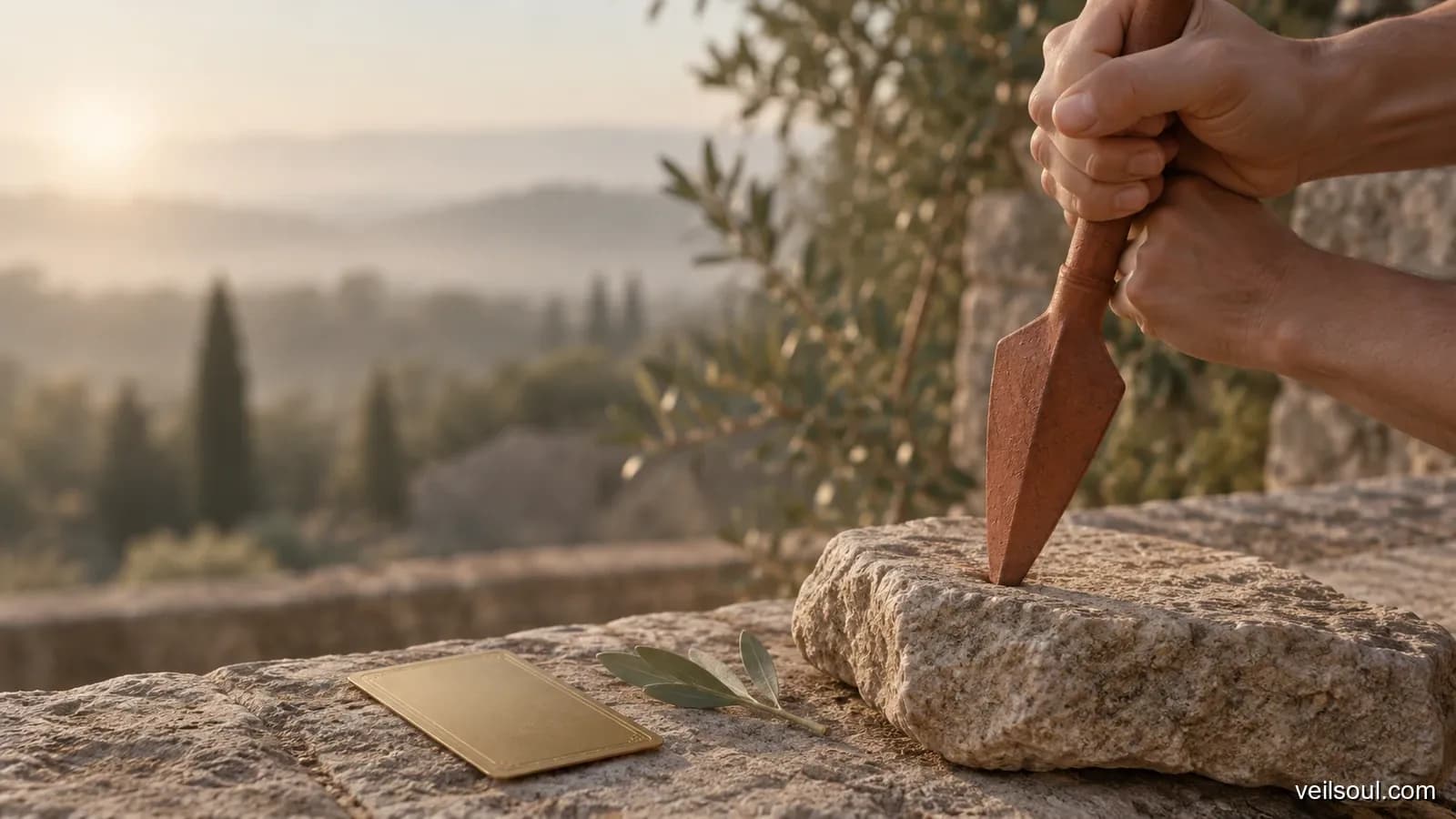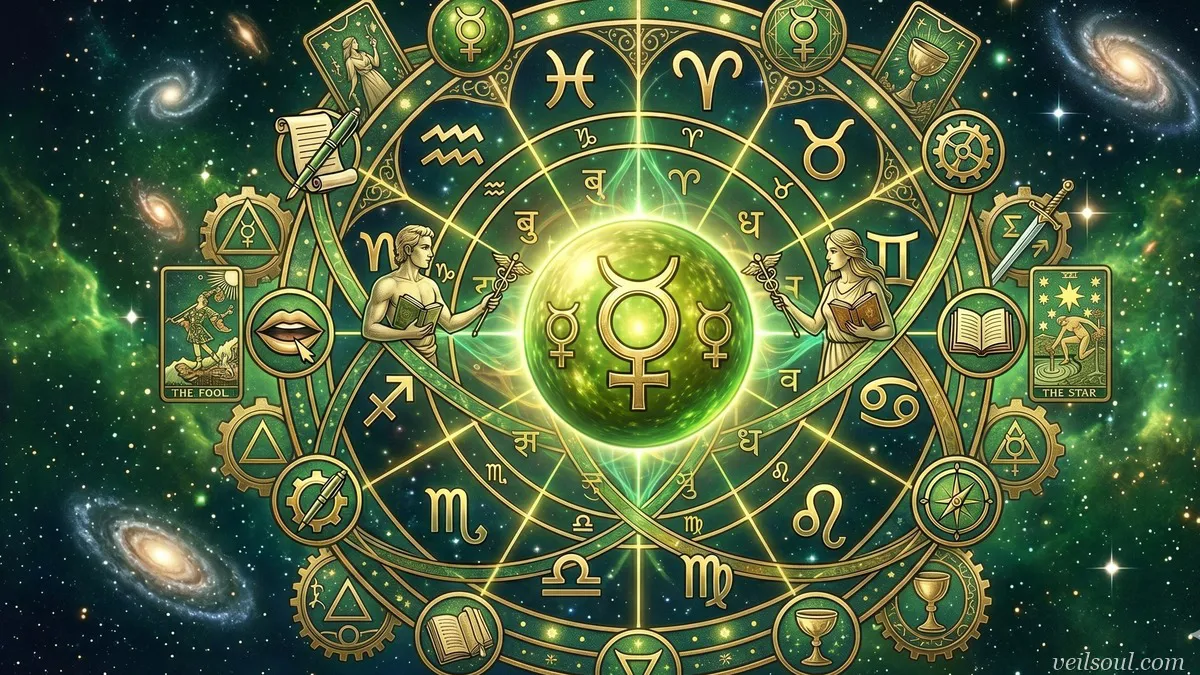
Saturn's tarot card is The World (XXI). In the Golden Dawn system, which shapes most modern decks, the last card of the Major Arcana belongs to the slowest of the classical planets, so Saturn in tarot reads as the completion that only time and steady work can bring. Saturn also reaches The Devil and The Star through Capricorn and Aquarius, the two signs it rules, Justice through Libra, where it is exalted, and five minor cards through the decans.
These links describe a style of energy, not a forecast. A Saturn card can help you look at a commitment, a burden or a slow project with clearer eyes, but it cannot tell you what another person is thinking, set a date or guarantee how something will end. What it can do is ask a useful Saturn question: what are you building, and what does it honestly need from you?
The Saturn cards at a glance:
- The World (XXI): Saturn itself; a cycle finished and whole.
- The Devil (XV): Saturn through Capricorn; ambition, attachment and the weight of habit.
- The Star (XVII): Saturn through Aquarius; patient hope and a long view.
- Justice (XI): Saturn exalted in Libra; fair limits and accountability.
- Seven of Pentacles: Saturn in Taurus; waiting for slow growth.
- Five of Wands: Saturn in Leo; friction that tests your effort.
- Three of Swords: Saturn in Libra; a painful truth about a bond.
- Ten of Wands: Saturn in Sagittarius; a load carried too long.
- Eight of Cups: Saturn in Pisces; leaving what no longer fills you.
The slow planet and the shape of things
In traditional astrology Saturn is the outermost planet visible to the naked eye, and it takes about twenty-nine and a half years to travel once around the zodiac. That pace shaped its meaning. Saturn stands for time, limits, structure, responsibility, endurance and the kind of maturity that grows from repetition rather than inspiration. Where Jupiter widens things, Saturn gives them edges.
Older texts call Saturn the greater malefic, and it is easy to read that as "the bad planet." A gentler and more useful view is that Saturn is the planet of form. A form has walls, and a wall keeps the cold out as well as keeping you in. A deadline, a budget, a promise and a daily practice are all Saturn structures. They feel restrictive on a bad day and protective on a good one.
When you meet Saturn in tarot, then, expect cards that talk about effort over time, about what a commitment costs, and about the relief of finishing. Saturn's cards rarely say no for the sake of it; they usually say not this way, or not yet, or not without a plan.
The World: why the final card belongs to Saturn
It can seem strange that a card of joy and arrival is assigned to the planet of restriction. The pairing makes sense once you see The World as the end of a long apprenticeship. Every Major Arcana card before it is a lesson; The World is the moment the lessons have been absorbed and the work holds its own shape. That is Saturn's reward: not freedom from structure, but ease inside it.
The Golden Dawn gives The World a second attribution as well, the element of Earth. Its table rests on the twenty-two Hebrew letters, and only three of them were assigned to elements: Air, Water and Fire. Earth was added to the last letter, Tav, which already belonged to Saturn and to The World. The most solid element and the most patient planet share the card that closes the Major Arcana.
The World (XXI): the finished circle
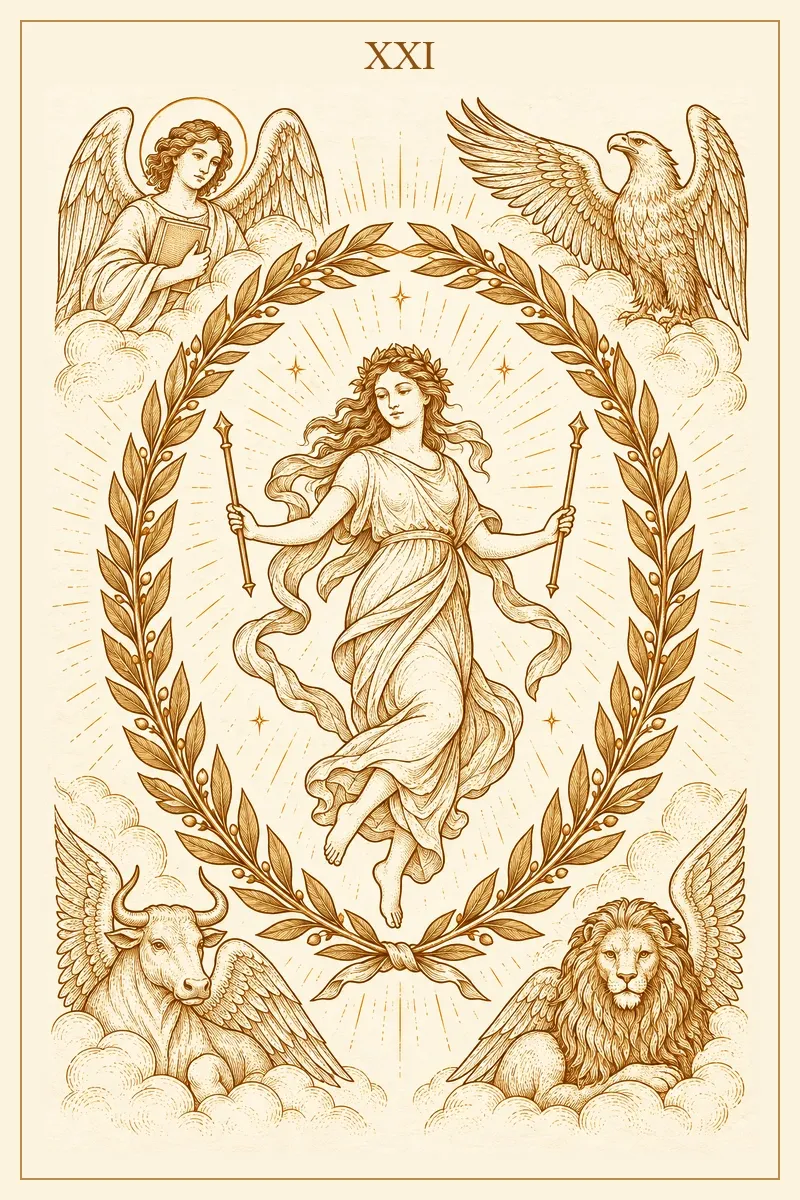
In the Veil Soul deck, a woman crowned with laurel floats inside an oval wreath of laurel leaves, a short wand in each hand and a long ribbon trailing around her. In the four corners rest an angel holding a book, an eagle, a winged bull and a winged lion, each on a bank of cloud. The wreath is tied at the bottom with a ribbon. Nothing in the picture is unfinished: the circle is closed and every corner is filled.
Read as a Saturn card, the image is a portrait of disciplined freedom. The dancer moves lightly because the frame around her is secure. For a deeper look at the card on its own, see our full guide to The World's meaning.
Upright, The World describes a finished cycle: a degree completed, a long project delivered, a relationship that has reached a mature, settled form. In love it suggests a bond that has found its own structure, whatever shape that takes for the two people involved.
Reversed, the card usually describes a cycle that is almost complete but not yet closed. Something remains: a final exam, a last conversation, paperwork you keep postponing. Saturn's voice here is practical rather than harsh. Finish the last ten percent, or decide consciously that you are leaving it unfinished. Either choice is better than hovering at the threshold for months.
The World also leads straight back to The Fool, card zero. Saturn, the planet of cycles, reminds you that completion is a doorway; what you have mastered becomes the ground for the next beginning.
Three more Major Arcana cards through Saturn's signs
A planet in tarot reaches beyond its own card through the signs it rules and the sign where it is exalted. Saturn traditionally rules Capricorn and Aquarius and is exalted in Libra, so three more Major Arcana cards carry a Saturn tone.
The Devil (XV), through Capricorn. A horned figure with bat wings sits on a dark stone throne marked with a crescent moon, and two robed people stand beside it, each holding the chain that hangs from a collar at the neck. Capricorn is Saturn's earthy, ambitious sign, and The Devil shows the shadow side of that ambition: work that becomes a cage, a habit that hardens into a rule you no longer chose. The chains are loose enough to lift off, which is the card's quiet point. Our Capricorn and tarot guide follows this connection further.
The Star (XVII), through Aquarius. A kneeling woman pours water from two jugs under a large eight-pointed star, one stream into a pool and the other into a brook running across the land. Aquarius is Saturn's airy sign, the one that builds structures for a group and thinks in long time spans. The Star gives Saturn its most hopeful face: steady renewal after a hard stretch, and faith kept up through small daily acts rather than a single leap. Our Aquarius tarot guide explores the sign in more depth.
Justice (XI), Saturn exalted in Libra. A crowned woman sits between two stone columns with a raised sword in one hand and balanced scales in the other. Saturn is said to work at its best in Libra because fairness needs firm rules and consistent consequences. Justice shows that strength: an agreement honored, a decision weighed carefully, responsibility accepted without drama. You can read more about the sign itself in our Libra tarot guide.
Five decans where Saturn sets the pace
The numbered minor cards from two to ten are tied to the decans, the thirty-six ten-degree slices of the zodiac. Each decan pairs a planet with a sign, and Saturn holds five of them. Together they show Saturn in five moods: waiting, competing, grieving, carrying and leaving.
Seven of Pentacles: Saturn in Taurus
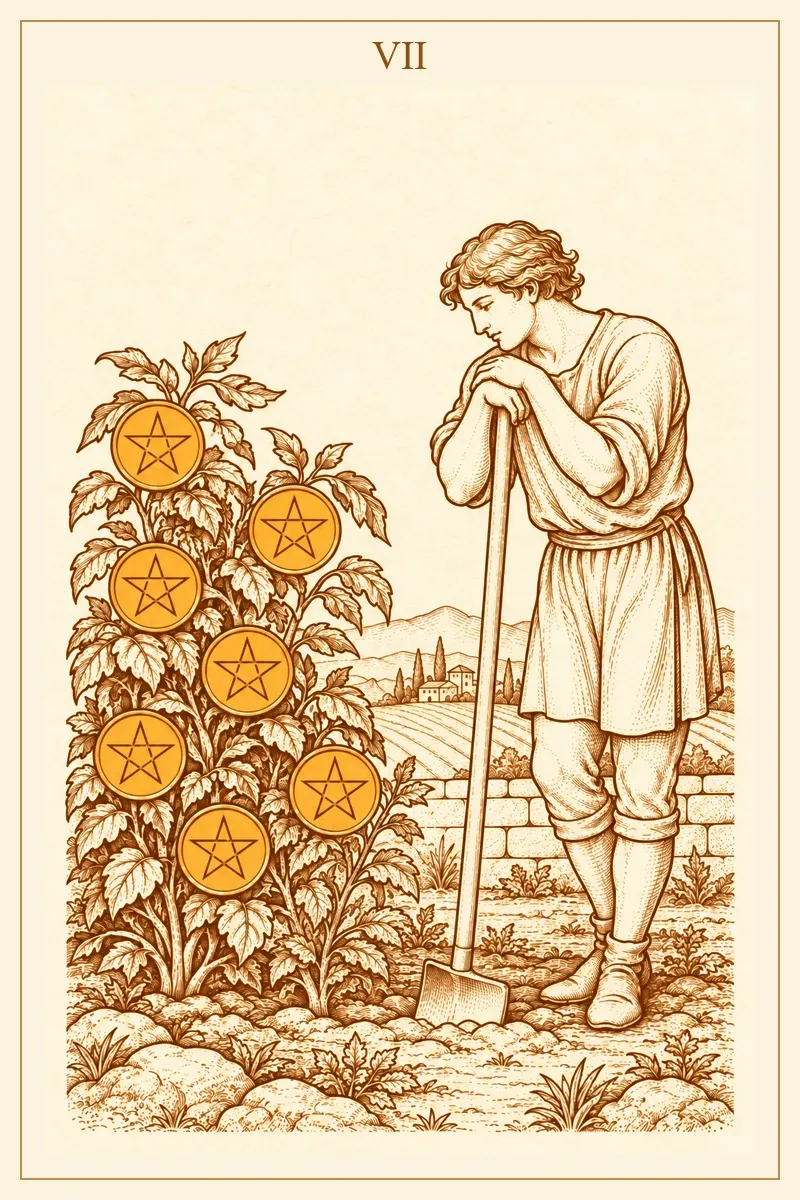
A young gardener leans on a long spade, chin resting on his folded hands, and looks at a leafy plant hung with seven gold pentacles. A low stone wall and open fields stretch behind him. Taurus is a sign of slow, physical growth, and Saturn in Taurus is the long middle of any effort: the plant is real, but the harvest is not ready, and pulling at the leaves will not speed it up.
Upright, the card asks you to review rather than abandon. Look at what has grown, what has not, and whether your effort is going to the right place. In money questions it can describe savings, or an investment of time, that compounds slowly. Reversed, it often points to impatience, or to the opposite problem: tending something for years without asking whether it can still bear fruit. The Seven of Pentacles meaning guide covers its other readings.
Five of Wands: Saturn in Leo
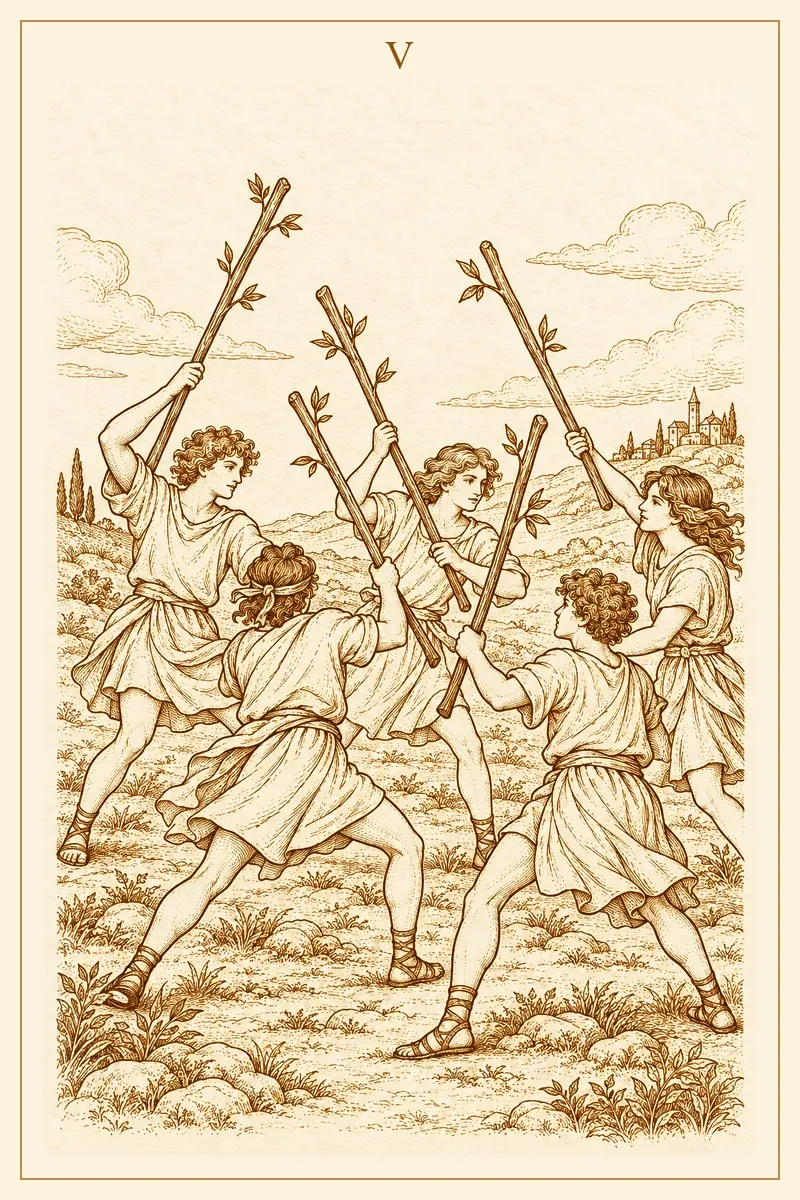
Five young people in short tunics raise leafy staffs on a scrubby hillside, a small town on the hill behind them. No one is hurt; the scene looks closer to a rough practice than a battle. Leo wants to shine, and Saturn in Leo puts that wish under pressure: competition, clashing plans, a room full of people who all want the lead.
Upright, the Five of Wands asks whether the friction is useful. Saturn's advice is structure: agree on rules, roles or turn-taking so the energy goes into the work instead of the argument. Reversed, the card can describe a conflict being avoided, or a group finally settling on a way to cooperate. More detail is in the Five of Wands guide.
Three of Swords: Saturn in Libra
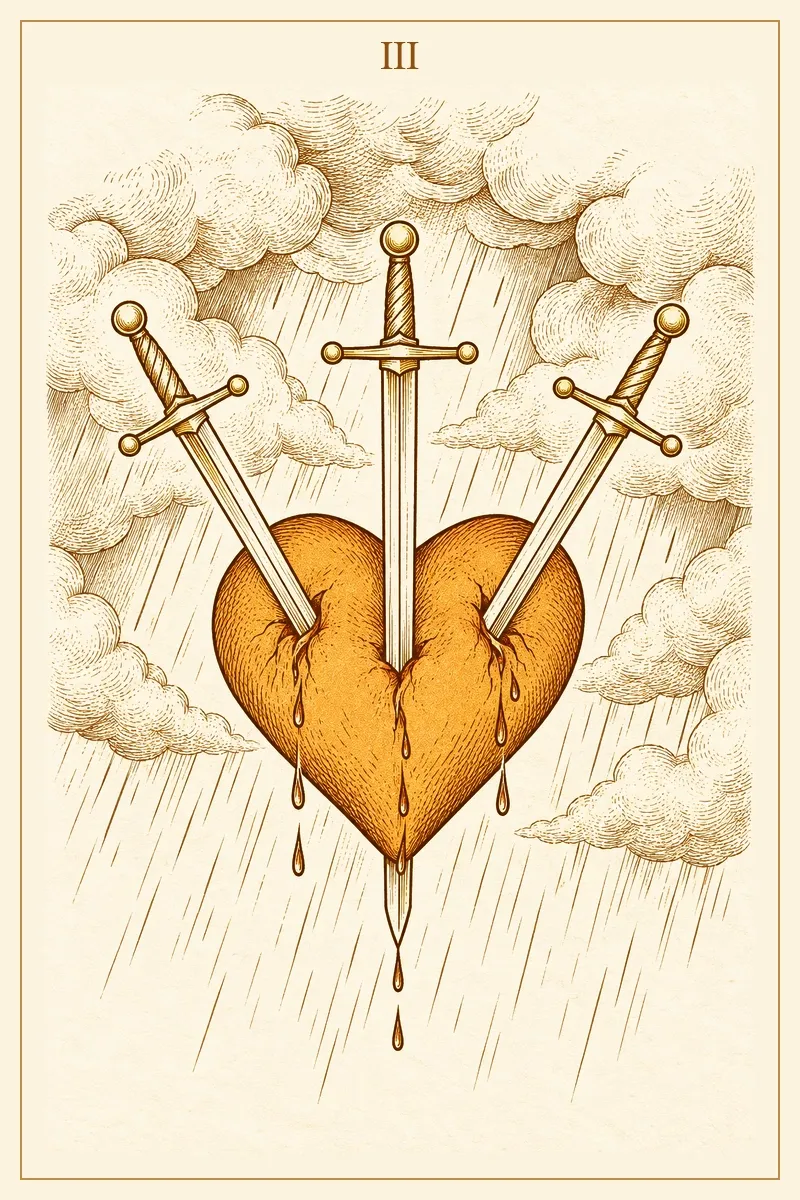
Three upright swords pierce a large heart under heavy clouds and slanting rain, and drops fall from the wounds. Because Saturn is exalted in Libra, this decan carries Saturn at full strength inside a sign about partnership, so its lesson concerns the truth inside a relationship.
Upright, the Three of Swords names grief, disappointment or a hard fact that can no longer be ignored. Saturn does not make the pain worse; it makes it clear. Reversed, it can describe healing that has begun, or sorrow that has been pushed down and wants a slower, kinder hearing. Be gentle with yourself here, and if grief is heavy, talking with someone you trust or a counselor will help more than another draw. Our Three of Swords meaning guide goes deeper.
Ten of Wands: Saturn in Sagittarius
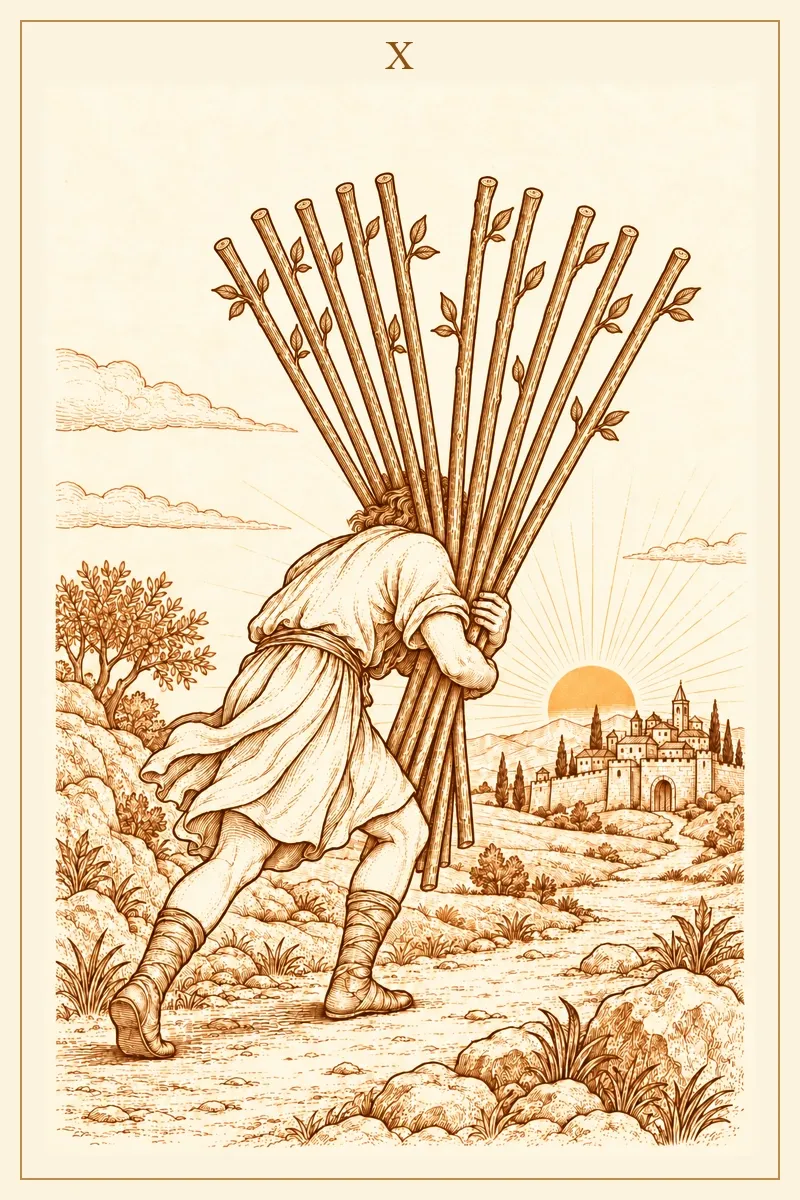
A man bent forward carries ten long staffs in his arms, his head bowed into the bundle, and walks a dusty path toward a walled town with the sun low on the horizon. Sagittarius is the sign of wide horizons and big plans, and Saturn in Sagittarius shows what happens when every plan becomes a duty you carry alone.
Upright, this is the card of overcommitment. The goal is close, which is why the load feels bearable, but the way it is held cannot last. Saturn asks you to count the wands: which tasks are truly yours, which can be delegated, and which can be dropped. Reversed, it can mean you are finally putting some of the weight down, or that the strain has reached a limit and something will have to change. The Ten of Wands guide looks at both.
Eight of Cups: Saturn in Pisces
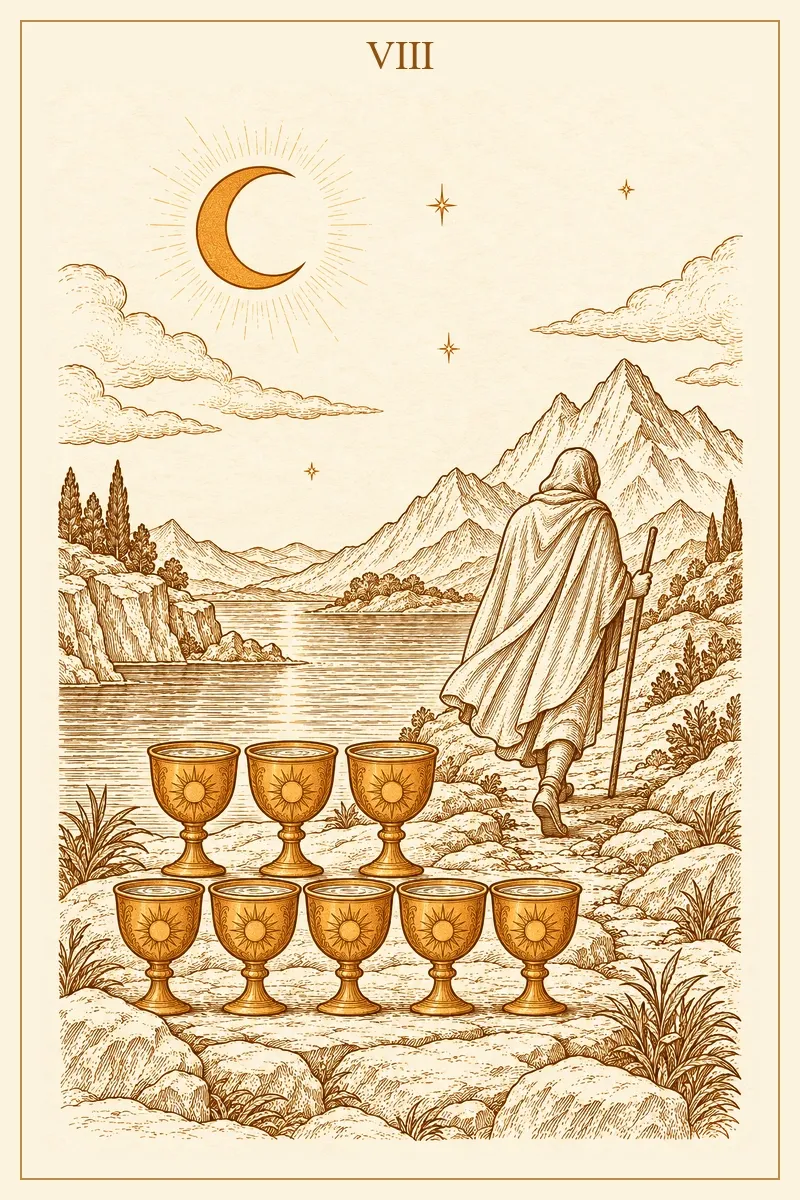
Eight gold cups stand in two rows on rocky ground by a still lake, three above and five below, while a hooded figure with a walking staff heads toward the mountains under a crescent moon. Pisces dissolves boundaries, and Saturn in Pisces is the discipline of drawing one anyway: the decision to leave something that looks fine on the surface but no longer nourishes you.
Upright, the Eight of Cups describes a mature departure. Nothing has broken; you simply know these cups are not what you are looking for anymore, and Saturn gives the walk its steadiness. Reversed, the card may show hesitation at the edge of leaving, or a return to something you walked away from too quickly. Ask whether staying is a choice or a habit. The Eight of Cups meaning guide has more.
Saturn's cards in love, work and money
Saturn cards change tone with the question. A few patterns help when several of them land in one spread.
Love and commitment. Saturn cards in a relationship reading are about structure and honesty, not passion. The World can mark a relationship reaching a stable form; Justice can ask for a fairer division of effort; the Three of Swords can point to a truth both people already sense. A Saturn-heavy love spread is rarely a sign that a bond is doomed. It usually asks what agreement the relationship needs now.
Work and long projects. This is where Saturn feels most at home. The Seven of Pentacles and the Ten of Wands often appear around long qualifications, building a business or holding a demanding role. Read them together as a question about pacing: are you investing steadily, or trying to carry everything at once?
Money and resources. Saturn favors slow, plain, reliable choices: budgets, steady saving, paying down what you owe. A Saturn card in a money question is not financial advice, and it cannot tell you whether a specific purchase or investment will pay off. It can help you notice whether you are being patient or merely avoiding a decision.
When Saturn feels heavy. Every Saturn card has a version that tips into too much: rigidity, perfectionism, carrying duties out of fear rather than choice. If a reading leaves you feeling smaller, look for the release: The Devil's chains are loose, the Ten of Wands can be set down, and the Eight of Cups shows that walking away is itself a disciplined act.
The Saturn return, read as a symbol
Because Saturn takes about twenty-nine and a half years to circle the zodiac, it comes back to the place it held at your birth around ages 29 to 30, and again around 58 to 59. Astrologers call this the Saturn return. Many people connect these years with taking stock of work, relationships, home and what they want the next stretch of life to rest on.
Nothing about these ages is fixed or fated. As a symbol, though, the return gives a reflective frame. Around the first return, the question is often "Which structures did I inherit, and which do I actually choose?" Around the second, it may be "What have I built, and what do I want to hand on or let go?"
The Saturn ledger: a six-card spread for long work
This spread suits any project or commitment that takes months or years: a course of study, a long relationship, a career change, a home, a creative work. Lay the cards in two rows of three, the foundation row below and the roof row above.
- The foundation: what this commitment rests on right now.
- The load: what I am carrying that makes it heavier than it needs to be.
- What is ripening: the slow growth I may not be giving enough credit.
- The boundary: the limit that would protect this work.
- What I can set down: a duty, habit or expectation I can release.
- The next check-in: what to look at when I review this again in a season.
Cards one to three form the bottom row and four to six the top row, so each pair lines up in a column: the foundation under the boundary that protects it, the load under what you can drop, and the slow growth under the next review. Read the bottom row first, then the columns.
Example reading: a qualification that is taking too long
Imagine someone two years into a part-time professional qualification that was meant to take eighteen months. They work full time, the exams keep slipping, and they are tired. Their question is: "How can I finish this without burning out?"
They lay out the Saturn ledger and draw:
- The foundation: Seven of Pentacles.
- The load: Ten of Wands.
- What is ripening: The Star.
- The boundary: Justice.
- What I can set down: Five of Wands, reversed.
- The next check-in: The World, reversed.
The foundation is the Seven of Pentacles: real growth, slower than hoped. The reader notices that two years of study have already produced skills they use at work, even though the certificate is not finished. The Ten of Wands in the load position is plain: they are carrying the study, a full-time job and a volunteer role they took on the same year. The Star in the ripening position suggests the hope behind the qualification is still alive; they want this work, and that matters.
Justice as the boundary suggests a fair, firm rule: two evenings a week protected for study, and no new commitments until the next exam. The reversed Five of Wands above the load points to a study group that has turned into a weekly argument about scheduling, so the reader decides to stop attending and study alone at a fixed time. The World reversed in the check-in position reads as "almost there, not yet closed." In three months they will ask one question: which modules remain, and is the end date realistic?
The reading leaves them with a clearer plan, one thing to put down and a date to look again.
Saturn beside the other planets
Saturn makes most sense next to its neighbors. Jupiter, the planet of growth and generosity, opens doors; Saturn decides what you can actually hold once you walk through. Our guide to Jupiter in tarot covers the expanding side of that pair.
The faster personal planets show a different contrast. Mercury in tarot is about messages and quick thinking, and Venus in tarot is about what you value and enjoy; Saturn asks how long those things will last and what they require of you. Beyond Saturn lie the outer planets found by telescope, and Uranus in tarot describes the sudden break that Saturn's steady structures sometimes need.
Frequently asked questions
Which tarot card is Saturn?
The World (XXI) is Saturn's card in the Golden Dawn system. Saturn also connects to The Devil and The Star through the signs it rules, to Justice through its exaltation in Libra, and to five minor cards through the decans: the Seven of Pentacles, Five of Wands, Three of Swords, Ten of Wands and Eight of Cups.
Is The Devil a Saturn card?
Only indirectly. The Devil is Capricorn's card, and because Saturn rules Capricorn it carries a Saturn flavor of ambition, duty and attachment. Saturn's own card is The World, so read The Devil as Saturn's influence through a sign rather than the planet itself.
Is Saturn a bad sign in a tarot reading?
No. Saturn cards can feel serious because they talk about effort, limits and time, but they also bring completion, maturity and steadiness. A reading full of Saturn cards usually asks for patience and a plan rather than predicting a loss.
Can Saturn cards tell me when something will happen?
Tarot cannot set a date, confirm someone else's intentions or guarantee an outcome, and Saturn cards are no exception. They can suggest that something will take longer than you hoped or that a cycle is near its end. If timing is your real question, our guide to reading timing in tarot explains what the cards can and cannot do.
Does tarot predict what my Saturn return will bring?
No. The Saturn return is a symbolic checkpoint around ages 29 to 30 and 58 to 59, not a fixed event. Tarot can help you reflect on the structures in your life during those years, but it does not forecast them.
Letting time do its part
Saturn's cards do not appear to slow you down for no reason. They show the shape of the work, the weight you are carrying and the moment it is finally done. When one turns up, ask what structure would help, what you can set down and what simply needs more time.
When you are ready to look at a long project of your own, start a quiet reading and let the cards show where the work stands today.