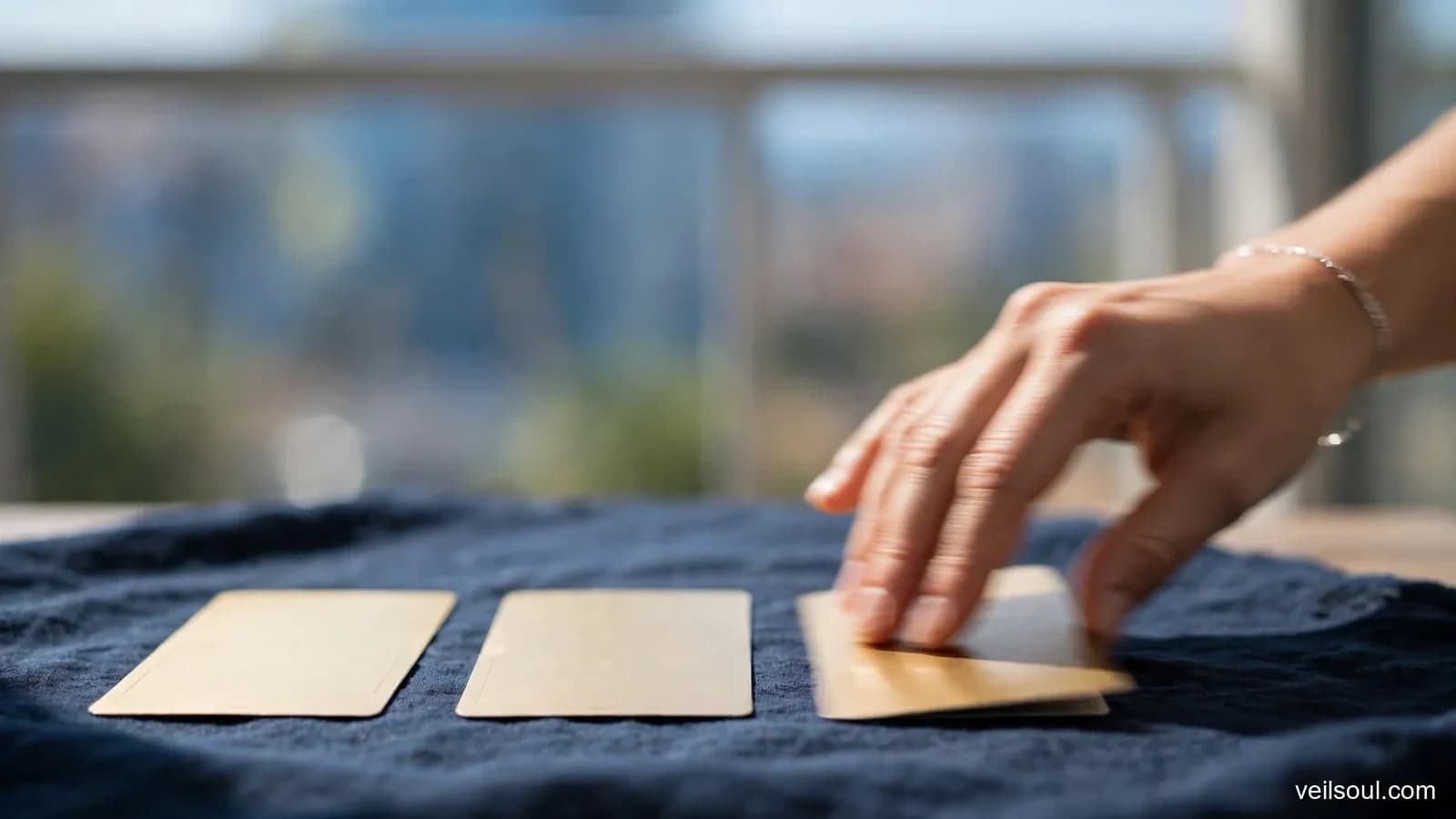
Lay three cards in a row and give each one a tense: the left card is the past that shaped your question, the middle card is the present as it stands, and the right card is the future the current pattern is moving toward. That is the whole past present future tarot spread. Its strength comes from reading the three as one story with a beginning, a turn and a likely next chapter, so the future card describes a direction you can still steer rather than a verdict.
Tarot can help you see a situation more clearly, but it cannot set a date, guarantee an outcome, or report what another person privately thinks. Treat a reading as a structured conversation with yourself, and let your own choices carry the weight.
The same three slots can hold far more than time. Change the labels and the row becomes a decision tool, a relationship check or a plan for tomorrow; nine such sets follow the past, present and future layout below, along with a worked reading.
Ten ways to name the three positions, at a glance:
- Past, Present, Future: how a situation got here and where it is heading.
- Situation, Action, Outcome: what is true, what to do, where that step may lead.
- Mind, Body, Spirit: a whole-person check-in.
- You, Them, the Connection: two perspectives and the space between them.
- Keep, Release, Welcome: sorting what to carry into a new chapter.
- Strength, Challenge, Advice: a problem and a way through it.
- Option A, Option B, What You Overlooked: two paths and the factor you missed.
- Known, Hidden, Integration: what you see, what sits beneath it, how to hold both.
- Morning, Afternoon, Evening: a single day divided into three themes.
- Your own three: positions written for one specific question.
Setting up a past, present and future reading
The layout takes a minute to learn; the preparation is what makes it useful. A tarot reading about past, present and future works best when the question names something you can act on and a time window for the future card.
- Write the question in one sentence. "What do I need to understand about where my savings habits are heading?" gives the cards something to answer. "Will I be rich?" does not.
- Set a horizon. Add a window such as "over the next three months." Without one, the future card might describe next week or next year, and you cannot tell which.
- Shuffle and lay three cards left to right. Past on the left, present in the middle, future on the right, turned over one at a time.
- Read twice. First give each card one sentence in its position, then read the row as a single line of story.
- Finish on paper. Write a one-sentence summary and one action you will take before the window closes.
What the past card is asking
The left position is not a summary of your whole life. It points to the cause or pattern that still feeds the question: a decision from last spring, a habit picked up after a move, a hope you quietly set aside. If the card seems to match nothing, widen the lens toward a family pattern or a conversation that ended badly instead of forcing it onto last week's events.
What the present card is asking
The middle card is the hinge of the spread. It describes the situation as it stands, which is not always how it feels from inside. A calm card here when you feel frantic can mean the problem is smaller than your worry about it; an unsettled card when you feel fine can point to something you have stopped noticing.
What the future card is asking
Read the right-hand card with the words "if nothing changes" in front of it. Because the present is the part you can still influence, the future card works best as feedback: does this direction suit you? If it does not, the middle card shows where to push. To stay with this one layout for a while, the past, present and future deep dive spends a whole guide on the moves between these three positions.
Nine more ways to name the three positions
Each set below keeps the row of three and changes the question each slot asks. Pick the set before you shuffle; switching labels after the cards are down turns the reading into a search for the answer you were hoping for.
Situation, Action, Outcome
Card one describes the situation as it truly is, which may differ from your account of it. Card two suggests an action worth taking, and card three shows where that action may lead. Use it for practical conflicts, such as "How should I handle the tension with my colleague over our shared project?" If the outcome looks bleak, reread the action card first; it may be asking for the step you planned to skip.
Mind, Body, Spirit
Card one reflects your thoughts and mental load, card two your energy and material circumstances, and card three your sense of meaning. Reach for it when something feels off and you cannot say what: "Where does my attention need to go this month?" When one card clashes with the other two, start there. The body position is a prompt for reflection, not a health assessment; any physical concern belongs with a doctor.
You, Them, the Connection
Card one is your stance and feelings, card two the other person's stance as you perceive it, and card three the dynamic between you. It works for romance, friendship, family or a work partnership: "What is happening between my sister and me since the move?" The middle card shows your perception of the other person. That is useful information about you, but it is not proof of their feelings, so check it against what they actually say and do.
Keep, Release, Welcome
Card one names what is serving you, card two what has run its course, and card three what you could make room for. Thresholds suit it: the turn of the year, a birthday, a move, the last week of a job. A difficult card in the release slot is easier to welcome than it looks, because it names the weight you are ready to put down.
Strength, Challenge, Advice
Card one is a resource you already have, card two the obstacle in front of you, and card three a way forward. It suits problems you feel stuck in, for example "What helps me finish the first draft of my thesis?" Read the advice card as a bridge between the first two: how does your strength meet the obstacle? This is also the set used in the practice exercise further down.
Option A, Option B, What You Overlooked
Card one shows the energy of the first choice, card two the second, and card three a factor you have not weighed yet. Assign each option to a position out loud before you shuffle, so you cannot swap them once you see the cards. Try it on "Do I sign up for the evening course or keep my weekends free?" The third card can matter more than the first two, because it may show that the real question is neither option.
Known, Hidden, Integration
Card one shows what you are aware of, card two what is working below that awareness, and card three how to hold both at once. It fits the slower reflection described in the guide to tarot for self-discovery, and questions like "Why do I keep saying yes to projects I resent?" The hidden card may feel uncomfortable to look at; treat that discomfort as information, not as a judgment of you.
Morning, Afternoon, Evening
Each card gives a theme for one part of a day, which makes this set a fuller version of the one-card daily draw for busy days. Ask "What should I keep in mind across tomorrow?" the night before, and treat the cards as themes rather than forecasts: a Five of Wands in the afternoon slot is a reminder to stay patient in a crowded meeting, not a promise of an argument.
Writing your own three positions
Any three questions can become a spread: Head, Heart, Gut; Fear, Truth, Courage; What I think, What I feel, What I know. Three rules keep a homemade set readable. Each position asks something the other two do not, the order makes sense from left to right, and each answer can lead to an action, even a small one. Write the labels down before you shuffle and keep the ones that work.
Matching the position set to your question
The fastest way to choose is to listen to the shape of the question you are asking. Each shape below points to one or two sets.
- "How did this happen, and where is it going?" Past, Present, Future.
- "What should I do?" Situation, Action, Outcome, or Strength, Challenge, Advice.
- "Which one?" Option A, Option B, What You Overlooked.
- "What is going on between us?" You, Them, the Connection.
- "Why do I feel off?" Mind, Body, Spirit, or Known, Hidden, Integration.
- "What changes now?" Keep, Release, Welcome.
If your question fits none of these, it may be two questions sharing one sentence; split it into two short readings. Yes-or-no questions also sit awkwardly in three positions. "Will he text me back?" becomes far more readable as "What do I need to understand about the silence since our last date?", which a past, present and future row can answer from your side of the story.
A worked reading: the friend who stopped calling
Here is a hypothetical reading that shows the format in motion. Dana and Leah shared an apartment for four years; since Leah moved across the country for work, their messages have slowed to birthdays. Dana asks: "What do I need to understand about my friendship with Leah, and where is it heading over the next three months?" She uses the past, present and future set, reads reversals, and draws three cards, all upright.
Past: Three of Cups
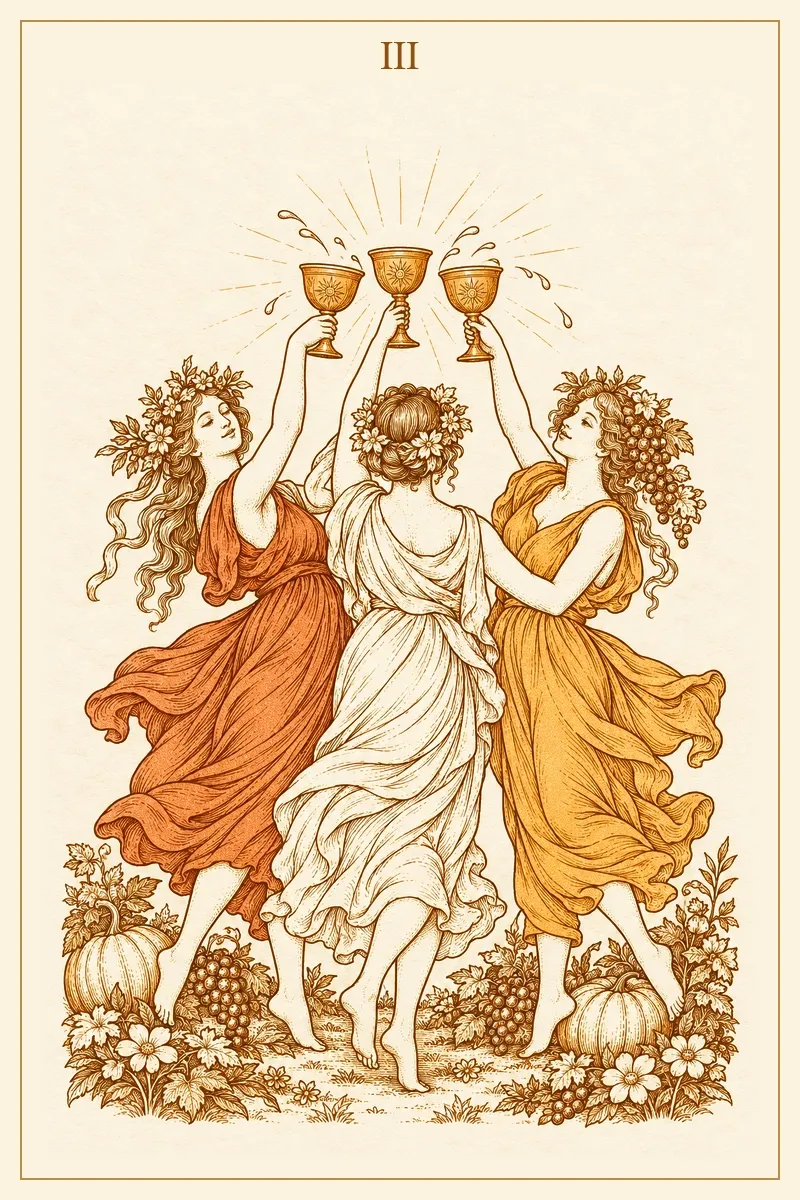
The Three of Cups is a card of shared celebration, easy company and friendship that feels like home. In the past slot it names what the bond was built on: crowded kitchen dinners and nights that ran late. The friendship was real and joyful, and a quiet stretch does not erase that history. The full Three of Cups tarot meaning also covers how the card reads in love and work questions.
Had it appeared reversed, it would have suggested a past where the group mattered more than the pair, or where fun covered things that were never said. The silence might then be older than the move, and Dana's first question would be what the two of them never talked about.
Present: The Hermit
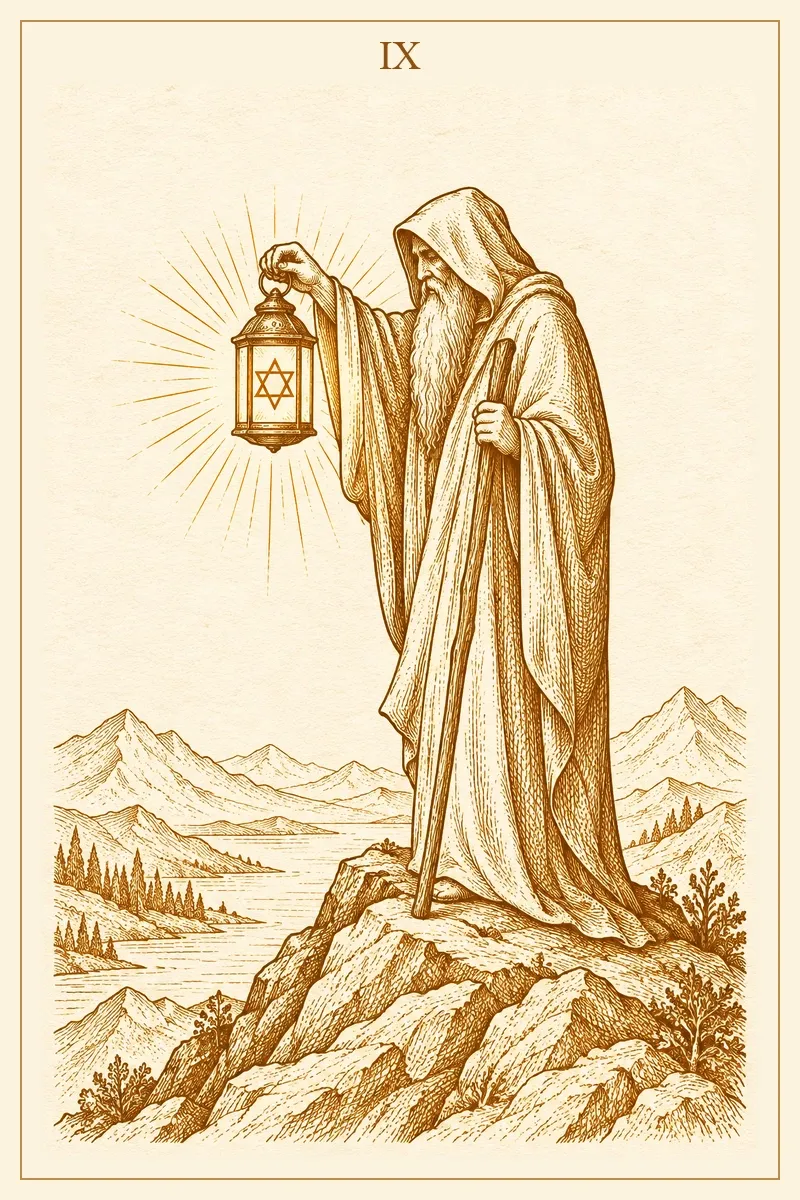
The Hermit stands for withdrawal, solitude and attention turned inward. In the middle slot it describes the friendship honestly: someone has stepped back. It might be Leah, settling into a new city and a demanding job. It might also be Dana, who stopped reaching out first because part of her was waiting to be missed. The Hermit is not rejection but a retreat for reflection, and the question it raises is "Who is the Hermit here?" The guide to The Hermit tarot meaning goes deeper into the card's quieter side.
Reversed, The Hermit would point to solitude that has turned from restful to lonely, or to avoidance that has hardened into a habit, and the reading would ask Dana to look at her own loneliness directly.
Future: Page of Cups
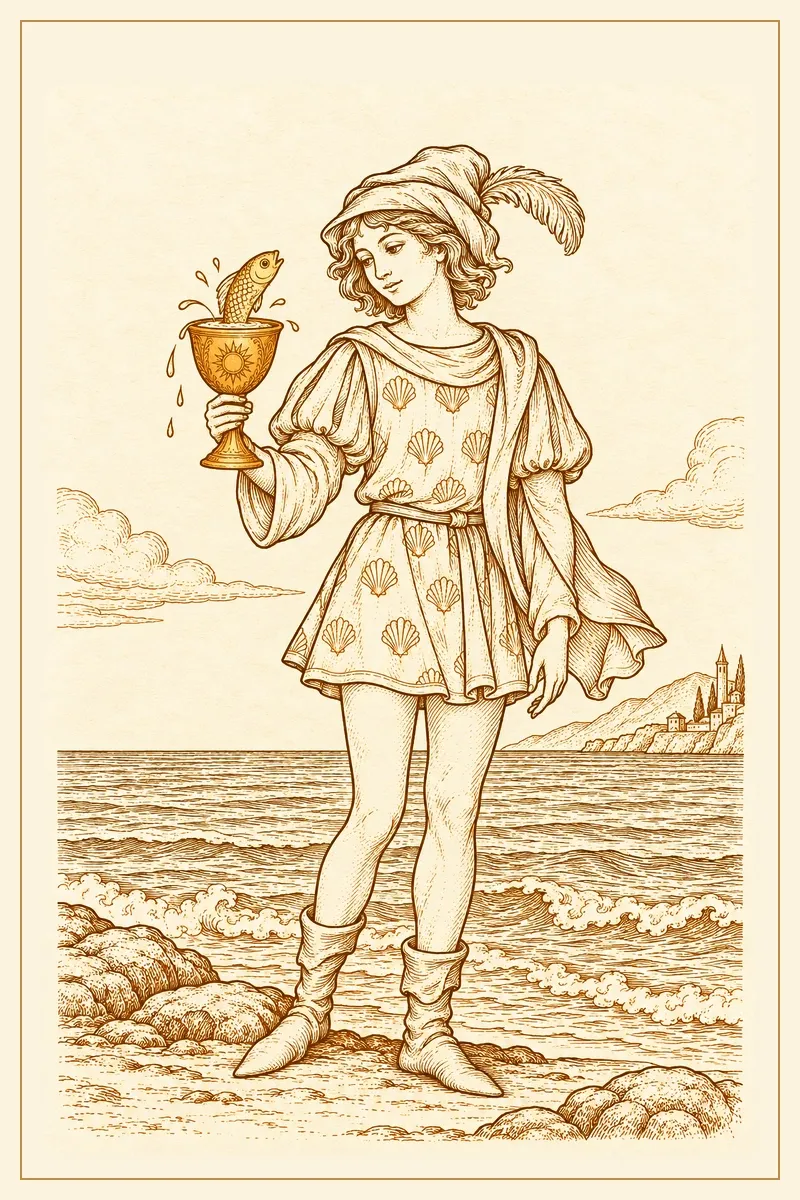
The Page of Cups brings a gentle, slightly playful emotional message: a first step in feeling, an invitation, a surprise that softens the mood. In the future slot it suggests that the next chapter starts small, with a light message or a shared memory. It does not promise that Leah will answer warmly; it shows where the pattern can go once someone offers a small opening. The Page of Cups tarot meaning explores its creative and romantic readings as well.
Reversed, the Page would describe a message held back or feelings expressed sideways, such as a "like" on a post instead of a real word, and the reading would warn against waiting for the other person to guess.
Reading the row as one sentence
Left to right, the row runs from shared joy, through a retreat, to a tentative invitation. The Hermit is the hinge: the friendship has not ended, it has gone inward. Dana writes her summary in one line: "The friendship was real, it has gone quiet rather than cold, and a small, light message is the way back in." Her action for the week is to send Leah a photo from their old apartment with no request for a long call attached. The cards did not tell her what Leah feels; they helped her stop waiting for a sign and take the step that was hers to take.
A different set would have changed the reading. You, Them, the Connection would have tempted Dana to spend it guessing at Leah's private feelings. Past, Present, Future kept the focus on the pattern and on the part she could change.
How the three cards talk to each other
Three cards are few enough to hold in your head at once, which makes this format a good place to practice reading connections. The fuller method is laid out in the guide on how to connect tarot cards; these are the moves that matter in a row of three.
Start from the middle. In every position set, card two links card one to card three. Ask how the first becomes the second and how the second turns into the third. If you cannot find a link, name the gap; a missing step can be the message.
Compare the ends. Put card one beside card three and name what changed. The same suit or number at both ends can mean the story is circling back to where it started. Very different cards suggest a real shift, and the middle card explains the turn.
Weigh the Major Arcana. A Major Arcana card between two Minor cards carries extra weight and sets the theme for the others. Three Majors in a row point to a larger chapter of life rather than the events of one week.
Notice the suits. Two cards of one suit show where the energy pools, whether in feeling (Cups), thought (Swords), drive (Wands) or work and money (Pentacles).
Follow the gaze. When figures on the cards face toward or away from each other, treat that as part of the story: a figure turned away from the future card may be reluctant to move on.
When a hard card lands in the future position
A card like The Tower, the Ten of Swords or the Three of Swords in the third slot can feel like a sentence passed on you. Read it with the same words as any other future card: "if nothing changes." It describes where the current pattern is pointing, and the present card shows what you could change.
Each of these cards also has a constructive reading. The Tower can name a structure that was already unsound, so its fall clears space for something sturdier. The Ten of Swords marks an ending that has run its full course, which means the hardest part may be closer to finished than you think. The Three of Swords names a painful truth, and a truth that is named can be spoken, grieved and worked through.
If you want guidance after a hard future card, add one card below the row labeled "what helps," and stop there. Redrawing the whole spread in search of a kinder future only teaches you to distrust the first answer.
Habits that flatten a three-card reading
A row of three is forgiving, but a few habits drain the meaning out of it:
- Reading three separate fortunes. Each card gets its sentence, then the cards must be read together. The conversation between them is the reading.
- Losing the question. A card's general meaning can differ from what it means in the context of what you asked. Read the question again before you read the row.
- Pulling clarifiers whenever the row feels unclear. Extra cards add noise faster than they add clarity. If you allow a clarifier, allow one, and decide its label first.
- Relabeling after the fact. Choosing the position set after you see the cards makes the reading say whatever you wanted.
- Treating reversals as compulsory. Reading every card upright is a valid choice, and the guide to tarot reversals explains how to decide whether to add that layer.
Practicing the format, then growing past it
This short exercise trains the move from card-by-card reading to a whole interpretation:
- Shuffle and draw three cards for Strength, Challenge, Advice.
- Write one sentence for each card in its position.
- Write one paragraph that tells the story of all three: how your strength meets the challenge, and how the advice serves both.
- Distill the whole reading into one sentence. That sentence is the core message.
For a week, use a different position set each day and keep only the one-sentence summaries; on the eighth day, read them together to see which sets suit the way you think.
When three cards feel natural, there are several ways to grow. Add a fourth card under any set as an "underlying influence" or "advice" card. Lay two rows of three, such as past, present and future for you on top and for the situation underneath, and read the columns as well as the rows. Or move on to the layouts in five simple tarot spreads for beginners. Larger spreads are built from the same relationships you practice here, so there is no need to hurry toward complexity.
Frequently asked questions
Is the future card in a past present future spread fixed?
No. The future card shows where the situation is heading if the current pattern holds, and the present card shows where that pattern can change. Tarot cannot confirm a date, guarantee an outcome or tell you what another person is thinking. It can help you notice what you already sense and decide what to do with it.
How far ahead does the future card look?
As far as the window you set before shuffling. A question framed as "over the next three months" gives the card a clear horizon. Without a window, read the card as the next stage of the story rather than a specific moment on the calendar.
What if the past card matches nothing I remember?
The card may describe an older pattern, an influence from family or work, or a feeling you set aside rather than an event. If it still fits nothing, note it in your journal and look again in a week, once the situation has moved.
Can I do a three-card reading about another person?
You can read your side of a relationship with You, Them, the Connection, as long as you remember that the middle card reflects your perception of the other person, not their private thoughts. If you are reading for someone else, ask for their consent and let them choose the question.
Can I ask the same question again if I do not like the answer?
You can, but the second reading will tell you less than the first. Ask a different question built on the first reading instead, such as "What helps me with what the future card describes?", and return to the original question once something in the situation has changed.
Is a three-card spread enough for a big decision?
It is a good place to start. Option A, Option B, What You Overlooked can bring hidden factors to the surface, and Situation, Action, Outcome can clarify a next step. Weigh what the cards raise alongside practical facts and honest conversations.
Three cards, one honest next step
Past, present and future is the place to start, and the other nine sets are there when your question needs a different shape. Whichever you choose, the reading is finished when you can say it in one sentence and name one thing you will do.
When you have a question ready, start a reading with Veil Soul, lay your three cards, and write down the sentence they leave you with.