
Loading your view
The page is gathering the latest information.
The page is gathering the latest information.
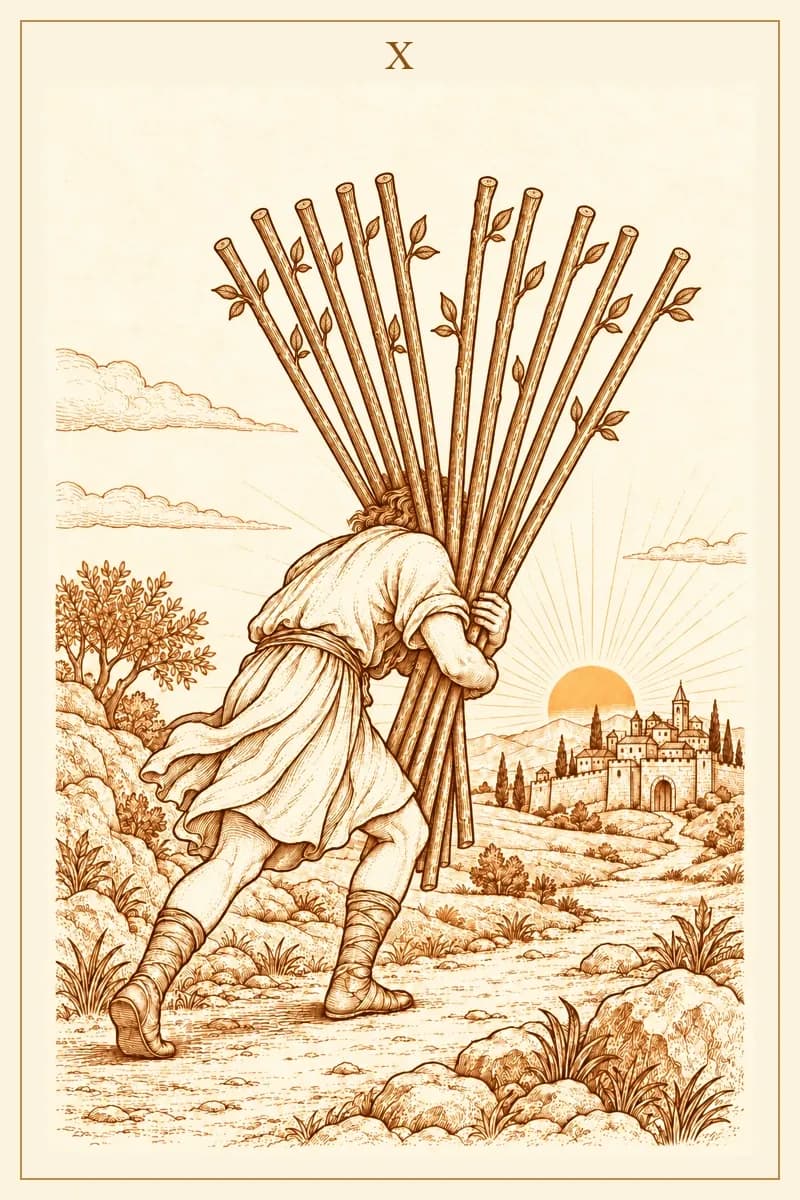
The card shown is VeilSoul's own engraved drawing of the 1909 Waite–Smith card. The scene and symbols described on this page follow the 1909 card, so a few details are drawn differently in our deck.
The Ten of Wands shows a figure carrying ten heavy wands toward a distant town, bent under their weight but still moving forward. He cannot see the path ahead because the wands obscure his vision. The load is clearly too much for one person — yet he carries it all himself, unwilling or unable to set any of it down.
When the Ten of Wands appears upright, you are carrying more than your share. Responsibilities have piled up. Commitments have multiplied. What started as an exciting creative venture has become a heavy burden of obligation. You are exhausted, overwhelmed, and possibly resentful — but you keep going because you feel you must.
This card is both a mirror and a warning. The mirror shows you what you already know: you are overloaded. The warning is that this pace is not sustainable. Something needs to be put down, delegated, or released before the weight breaks you.
The town in the distance represents the goal — and it is close. You can finish this. But the question the Ten asks is not whether you can carry the load. It is whether you should. Success that costs you your health, your joy, or your relationships is not success — it is just suffering with a trophy at the end.
You carry every wand you ever picked up, and the weight obscures your view of where you are going. Ambition without delegation becomes its own form of self-harm.
You add responsibilities compulsively because indispensability feels safer than replaceability (excess), or you drop every burden at once, mistaking total abandonment for release (deficiency).
Detailed Interpretations
In love, the Ten of Wands often represents the weight that accumulates in a relationship when both partners have been carrying unspoken resentments, unaddressed needs, or the cumulative burden of life's demands without adequate support from each other. The relationship still exists — the figure still walks — but the joy has been obscured by the weight of what has been left unaddressed.
For singles, this card may indicate that you are entering the dating world carrying a heavy load from past relationships — unprocessed grief, lingering bitterness, or expectations shaped by prior hurt that make genuine new openings difficult to perceive clearly.
The Ten of Wands in love invites you to examine what you are carrying in this relationship or toward love in general — and to begin the courageous work of setting some of it down. Not every burden must be carried to the end. Some can be delegated; some can be released; some simply need to be acknowledged before they lose their crushing weight.
In love reversed, the Ten of Wands may indicate that a relationship's burdens are finally being acknowledged and addressed — either through honest conversation that leads to better distribution of responsibility, or through the painful recognition that the weight has become genuinely untenable.
Alternatively, this reversal may suggest refusing to continue carrying the emotional load for a partner who is not doing their share. Learning to require reciprocity in a relationship — rather than quietly resenting its absence — is a form of self-respect that this card supports.
In career, the Ten of Wands is the card of the person who has taken on too much — the project leader managing five deliverables simultaneously, the entrepreneur wearing every hat in their business, the employee who cannot say no and has accumulated a workload that is no longer sustainable. The ambition that got you here was valid. The load has simply exceeded what one person can carry effectively.
This card does not suggest failure — it suggests rebalancing. What can be delegated? What can be deferred? What has accumulated through inertia rather than genuine necessity? The Ten of Wands invites honest assessment of your current responsibilities and the courage to redistribute what does not actually need to be yours alone.
For those approaching a significant completion — a long project nearing its end, a difficult assignment almost finished — this card confirms that the final stretch is within sight. The burden is real; so is the destination.
Career-wise, the reversed Ten of Wands suggests that an unsustainable workload is either being addressed — through delegation, priority-setting, or organizational support — or has finally reached a point of forced reckoning. The situation cannot continue as it has been.
This reversal is also a prompt to examine what you have been carrying that was never truly yours to carry: responsibilities inherited by default rather than chosen, expectations absorbed from others rather than genuinely your own. Setting these down is not failure — it is reclaiming your capacity for the work that actually aligns with your strengths and purposes.
The Ten of Wands in health is a clear signal of physical and mental burnout — the body and mind carrying more than they can sustainably manage. Stress-related symptoms are likely present: chronic fatigue, tension, sleep disruption, or the lowered immune function that accompanies prolonged over-extension. The card is not an indictment but an invitation: put some of it down.
For those who pride themselves on strength and endurance, this card brings an important message: the ability to continue carrying heavy loads is not the same as the wisdom to know when to set them down. True strength includes knowing your limits — and respecting them before they become crises.
This card strongly supports delegation, boundary-setting, and the prioritization of recovery as a legitimate and necessary component of sustained high performance — not a sign of weakness, but of intelligent self-management.
Use this as a reflective prompt, not medical advice or a diagnosis. For health concerns, seek guidance from a qualified healthcare professional.
The Ten of Wands reversed signals that a burden is finally being released — deliberately, by choice, or by the circumstances that force a reckoning with how unsustainable the current load has become. Whether this release comes as welcome relief or difficult reckoning depends on how long the situation was allowed to continue past its sustainable point.
This reversal may also indicate a refusal to accept further burdens — learning to say no before the pile reaches its breaking point. This is genuine wisdom, not avoidance. The reversed Ten honors the maturity of recognizing your limits before they become crises.
Alternatively, this card reversed can signal the disorienting experience of losing responsibilities that once defined you — retirement, a project ending, a role changing. When the wands are no longer there to carry, who are you?
The reversed Ten of Wands teaches the liberating truth that not everything that can be carried must be carried — and that the willingness to release burdens is as much a form of wisdom and courage as the willingness to take them on in the first place.
This card also challenges the identity that forms around being the person who carries everything: the reliable one, the strong one, the one others can always count on to handle what no one else will. This identity, while arising from genuine capacity and care, can become its own kind of burden — a self-concept that no longer serves you but that you cannot imagine releasing because it has become so central to who you understand yourself to be.
The deepest lesson of the reversed Ten: delegation is not failure. Asking for help is not weakness. The load you refuse to share may be the very thing preventing you from doing the work that most needs your particular gifts.
Today, identify one thing you have been carrying that does not actually need to be yours alone — and take a concrete step toward sharing, delegating, or releasing it. The Ten of Wands teaches that putting something down is not giving up; it is freeing your hands for what genuinely requires your particular attention and strength. What would become possible if you were carrying less?
“I carry only what is mine to carry. I delegate with trust, release what no longer serves me, and move toward my goal unburdened.”
The card shown is VeilSoul's own engraved drawing of the 1909 Waite–Smith card. The scene and symbols described on this page follow the 1909 card, so a few details are drawn differently in our deck.
A single figure walks bent under the weight of ten wands — all of them clutched tightly against the body, obstructing the figure's view forward. The destination is visible in the background: a small town, safety, arrival. But the figure cannot see it clearly because the burden obscures the view.
The bent posture is the card's central message: the load is real and genuinely heavy. This is not a figure who is complaining unnecessarily — the wands are objectively a lot to carry. But the town in the background confirms that the destination is close. The question is not whether to finish but whether to carry all of this particular load all the way to the end, or to set some of it down and arrive more freely.
The fact that the figure grasps all ten wands tightly — nothing delegated, nothing set aside — speaks to the psychological dimension of this card: the difficulty of letting go, of trusting others to carry portions of the weight, of believing that not everything requires personal management to reach a good outcome.
Ten is the number of completion and culmination. In the Wands suit, it represents the full weight of creative and professional responsibility — the final burden before a cycle ends and a new one begins.
Keep or share this card reference
✦ From meaning to reflection ✦
Bring what this card stirred into a reading shaped around what you are facing now.
Read with this insight