The Wheel of Fortune (X) is Jupiter's card in tarot. In the Golden Dawn correspondences that most English-language decks still follow, the turning Wheel of Fortune belongs to the planet astrologers call the great benefic: the planet of growth, generosity, faith and good timing. Jupiter also rules Sagittarius and Pisces, which ties it to Temperance and The Moon; it is exalted in Cancer, the sign of The Chariot; and it rules five numbered minor cards through the decans.
That map comes from one tradition, not from the sky itself, and many fine readers never use astrology at all. A Jupiter card also cannot promise a lucky break, name the month an offer will arrive or tell you what someone else has already decided. What it can do is show where you have room to grow, and where "more" has quietly turned into "too much."
Here are the nine cards and the part of Jupiter each one carries:
- Wheel of Fortune (X): Jupiter itself; cycles, turning points and luck that rewards taking part.
- Temperance (XIV): Sagittarius, a Jupiter-ruled sign; patience and a far-off aim.
- The Moon (XVIII): Pisces, a Jupiter-ruled sign; faith on uncertain ground.
- The Chariot (VII): Cancer, where Jupiter is exalted; progress that protects what it carries.
- Nine of Cups: Jupiter in Pisces; contentment and a wish that has been met.
- Six of Wands: Jupiter in Leo; public success and well-earned praise.
- Four of Swords: Jupiter in Libra; rest that gives you back your strength.
- Eight of Swords: Jupiter in Gemini; too many thoughts, and an exit closer than it looks.
- Two of Pentacles: Jupiter in Capricorn; juggling and staying light on your feet.
The great benefic: what Jupiter stands for
Jupiter is the largest planet in the solar system, and traditional astrologers called it the greater benefic, the planet thought to enlarge and help, with Venus as the lesser benefic beside it. Its themes are expansion, generosity, optimism, faith and meaning, along with teachers, higher learning, long journeys, ethics and hospitality. In Roman myth Jupiter was the king of the gods, the sky father who kept oaths and protected guests.
Jupiter's shadow is excess. The impulse that opens doors can also overpromise, overspend or overcommit, and it can turn generosity into rescuing people who did not ask. When you meet Jupiter in a reading, ask two questions together: where is there room to grow, and what would growth of a sensible size look like?
The Wheel of Fortune, Jupiter's own card
If you remember only one Jupiter card, make it this one.
Wheel of Fortune (X): luck as a cycle
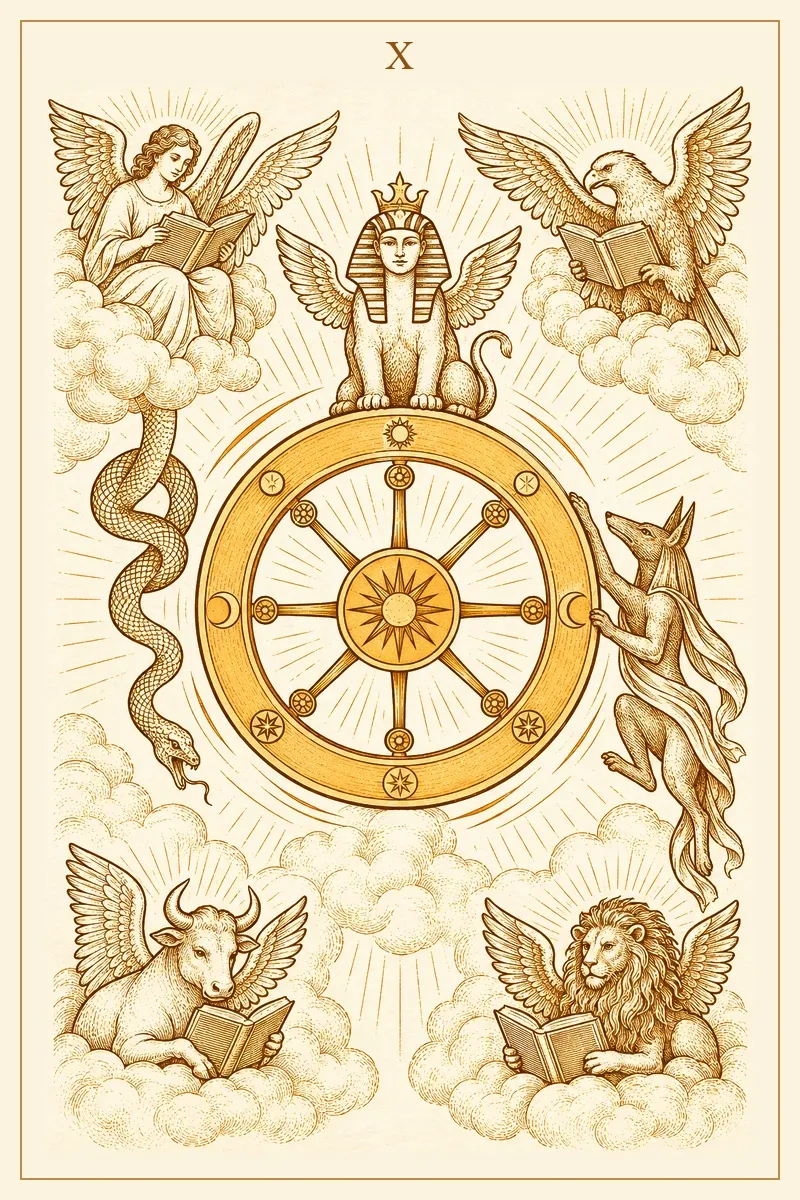
A great golden wheel fills the center of the card, with a sun at its hub. A crowned sphinx sits calmly on top, a serpent winds down one side and a jackal-headed figure climbs the other. In the four corners, an angel, an eagle, a bull and a lion, all winged, rest on clouds and read open books. The scene is busy, yet the sphinx does not move, and that stillness at the top of a turning world is the Jupiter lesson in a single image.
The old meaning of fortune was not a jackpot but a person's share of what life hands out, and Jupiter was the planet said to enlarge that share. The Wheel shows the share always moving. The four readers add Jupiter's love of learning: they study while the wheel turns, as if understanding the pattern is how you ride it well.
Upright, the Wheel points to a turning point: a stuck situation starts to move, a new chapter opens, or you find yourself in the right place at the right moment. A good turn tends to favor people who are already in motion, so apply, accept the invitation or send the message you have been holding. For the card in every position, see the full Wheel of Fortune tarot meaning.
Reversed, it often describes a cycle repeating, resistance to a change that has already begun, or a setback that feels personal. It is not a curse. Ask which part of the pattern is yours to change and which part you can only ride out. In love, it can be the same argument coming around again; in work, a reorganization you did not choose; with money, income that rises and falls, so a buffer for lean months matters more than a forecast.
Where Jupiter feels at home: three generous minor cards
The decan system splits each sign into three slices of ten degrees, and the seven classical planets take turns ruling them in an old fixed sequence. Jupiter's turns land on five numbered cards. Three fall in signs where Jupiter is said to work comfortably, Pisces (its own sign), Leo and Libra, and they show its generous face. The dates are approximate Sun dates, useful for themed reflection rather than prediction.
Nine of Cups: Jupiter in Pisces
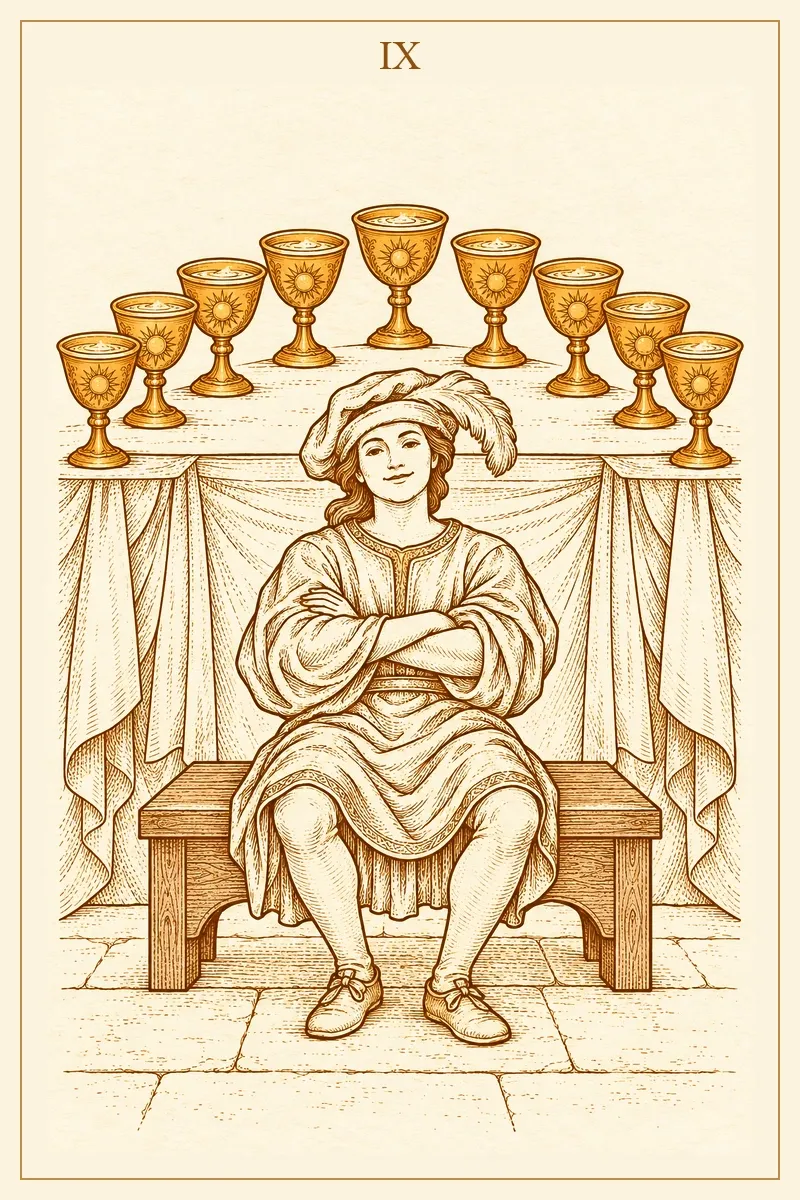
A smiling figure in a feathered cap sits on a wooden bench with arms folded, and behind him nine gold cups stand in an arch along a draped table. The decan covers the middle of Pisces, around March 1 to 10, and the Golden Dawn titled it the Lord of Material Happiness. Readers know it as the wish card. In Pisces, Jupiter's abundance is felt rather than counted: the satisfaction of having enough and noticing it.
Upright, the Nine of Cups describes contentment, a hope fulfilled and comfort you have earned; in love, ease, and with money, a season when needs are met. Reversed, Jupiter's shadow slips in: wanting more than you can enjoy, a wish that came true and still feels hollow, or indulgence used to fill an empty evening. The Nine of Cups tarot meaning covers its other contexts.
Six of Wands: Jupiter in Leo
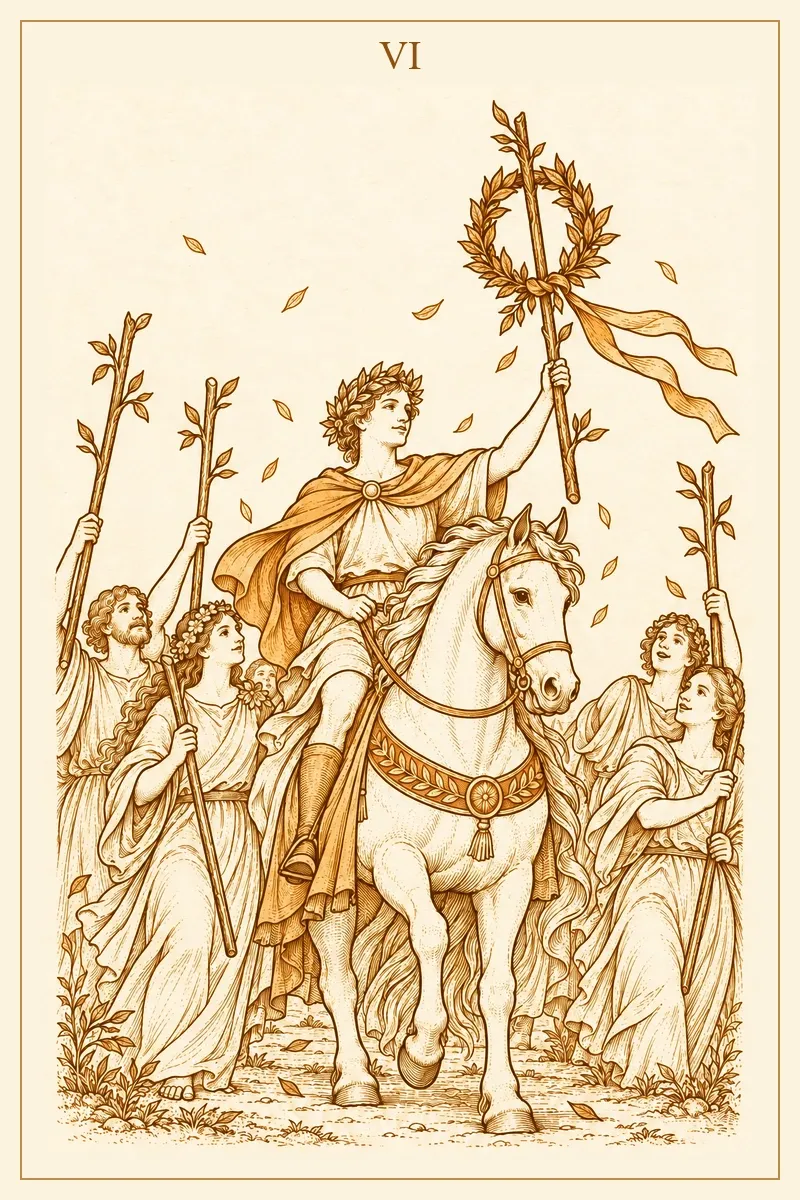
A rider crowned with laurel sits on a white horse and lifts a staff topped with a laurel wreath and a ribbon, while people carrying leafy staffs walk beside him and leaves drift through the air. The decan sits in the middle of Leo, around August 2 to 11, and its Golden Dawn title is the Lord of Victory. Leo loves to be seen and Jupiter enlarges whatever it touches, so this is success that others notice and celebrate.
Upright, the card brings recognition: a promotion, a project praised or the quiet confidence of knowing you did well. Reversed, it can describe applause that does not come, fear of being visible or pride that pushes people away. In a career reading it often asks whether you have told anyone what you achieved. The Six of Wands tarot meaning explores its work themes further.
Four of Swords: Jupiter in Libra
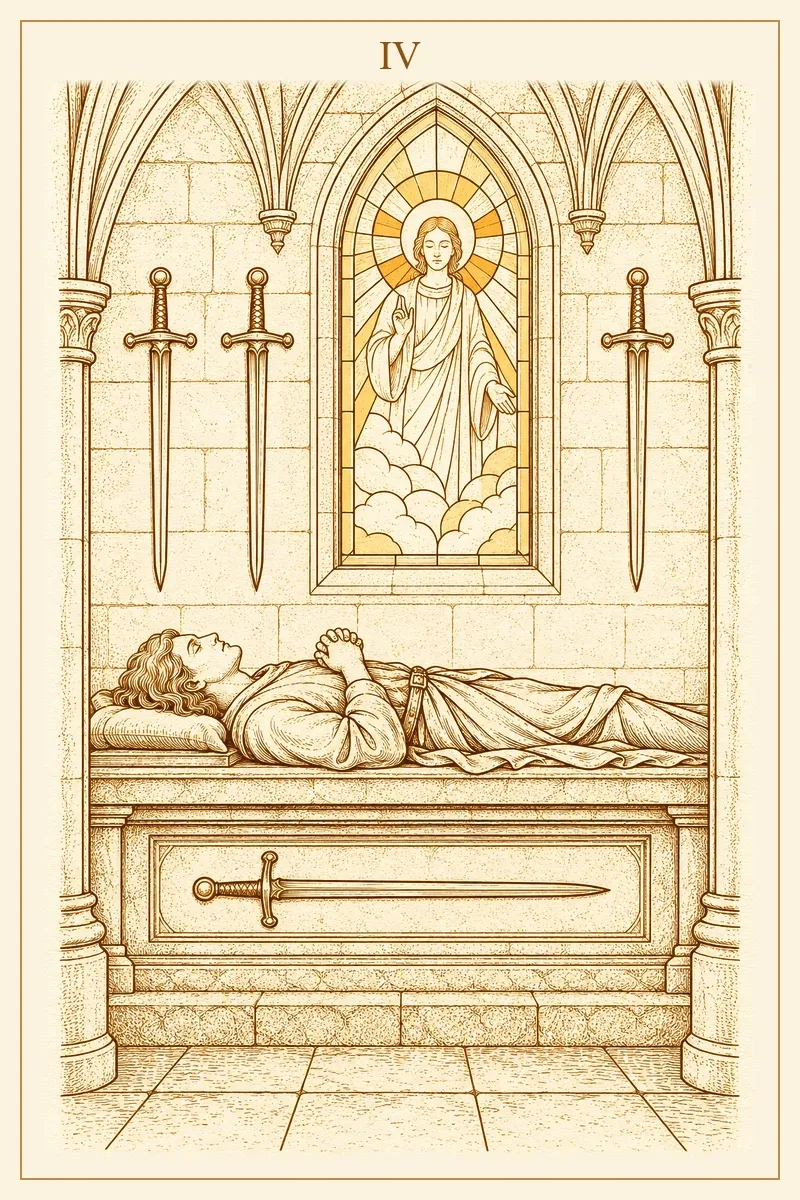
A figure lies with folded hands on a stone bench in a vaulted chapel. Three swords hang on the wall, a fourth is carved along the bench, and a stained-glass window above shows a figure raising a hand in blessing. The decan closes Libra, around October 13 to 22, and the Golden Dawn named it the Lord of Rest from Strife. It is the least obvious Jupiter card and one of the most useful: here the planet's generosity is aimed at you, as time to recover.
Upright, it suggests rest, retreat or a pause before a decision. Reversed, it can point to restlessness, returning to the fray too early or rest that has turned into avoidance. Where health is involved, take the card as a nudge to look after yourself and seek proper care, not as advice about treatment. The Four of Swords tarot meaning has more on its recovery themes.
Where Jupiter is squeezed: two cards under pressure
Traditional astrology also names signs where a planet struggles. Jupiter is in detriment in Gemini, opposite its own Sagittarius, and in fall in Capricorn, opposite Cancer. The idea is symbolic: a planet of the big picture placed in a sign of details, or of limits. The resulting cards are not bad cards; they show growth finding a narrower way through.
Eight of Swords: Jupiter in Gemini
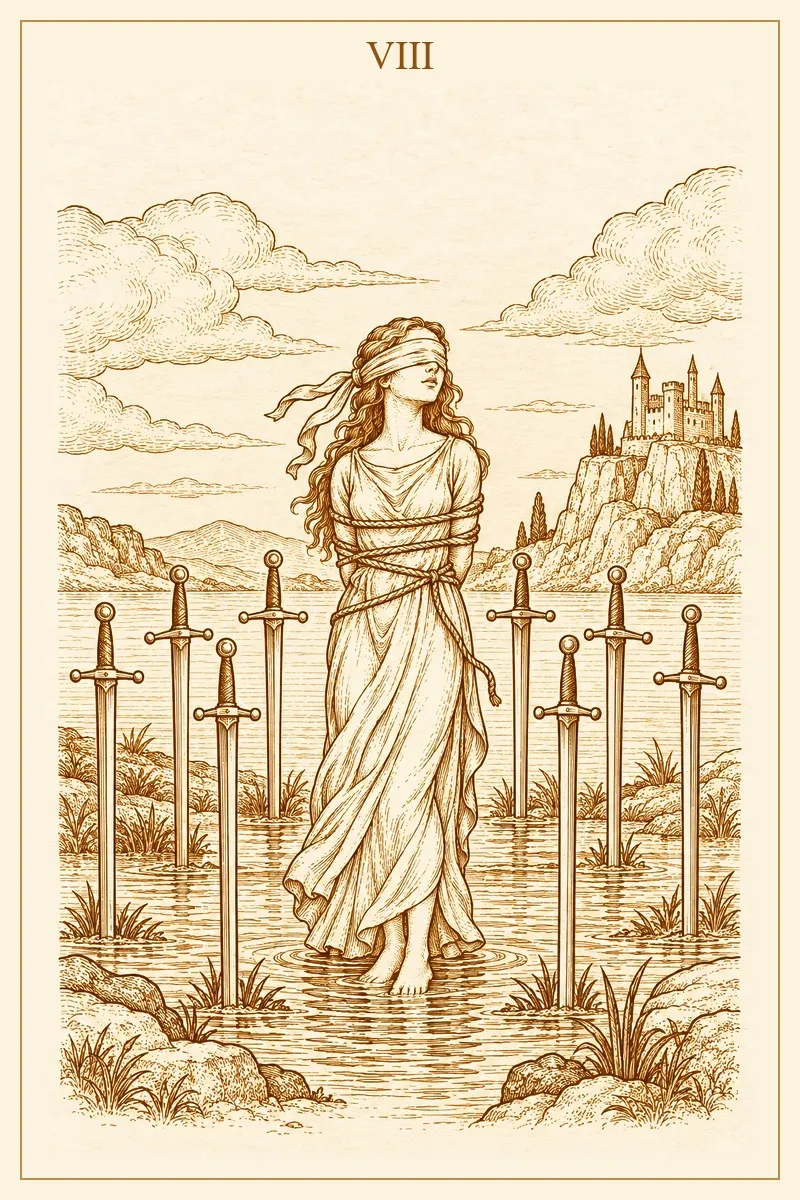
A blindfolded woman stands barefoot in shallow water, loosely tied with rope, with eight swords planted upright around her. A castle sits on a cliff behind, and the space in front of her is open. The decan opens Gemini, around May 21 to 31, and the Golden Dawn called it the Lord of Shortened Force. Jupiter wants to see every possibility and Gemini supplies endless thoughts, so the mind fills with options and what-ifs until it cannot take a step.
Upright, the card describes feeling trapped, overthinking or a belief that keeps you small. Reversed, the knots loosen: you take off the blindfold, ask for help or notice the open path. Because Gemini is Mercury's sign, some readers treat this as a Mercury card in spirit, and the Mercury in tarot guide explains why the decan ruler is still Jupiter. The Eight of Swords tarot meaning covers it in love and work.
Two of Pentacles: Jupiter in Capricorn
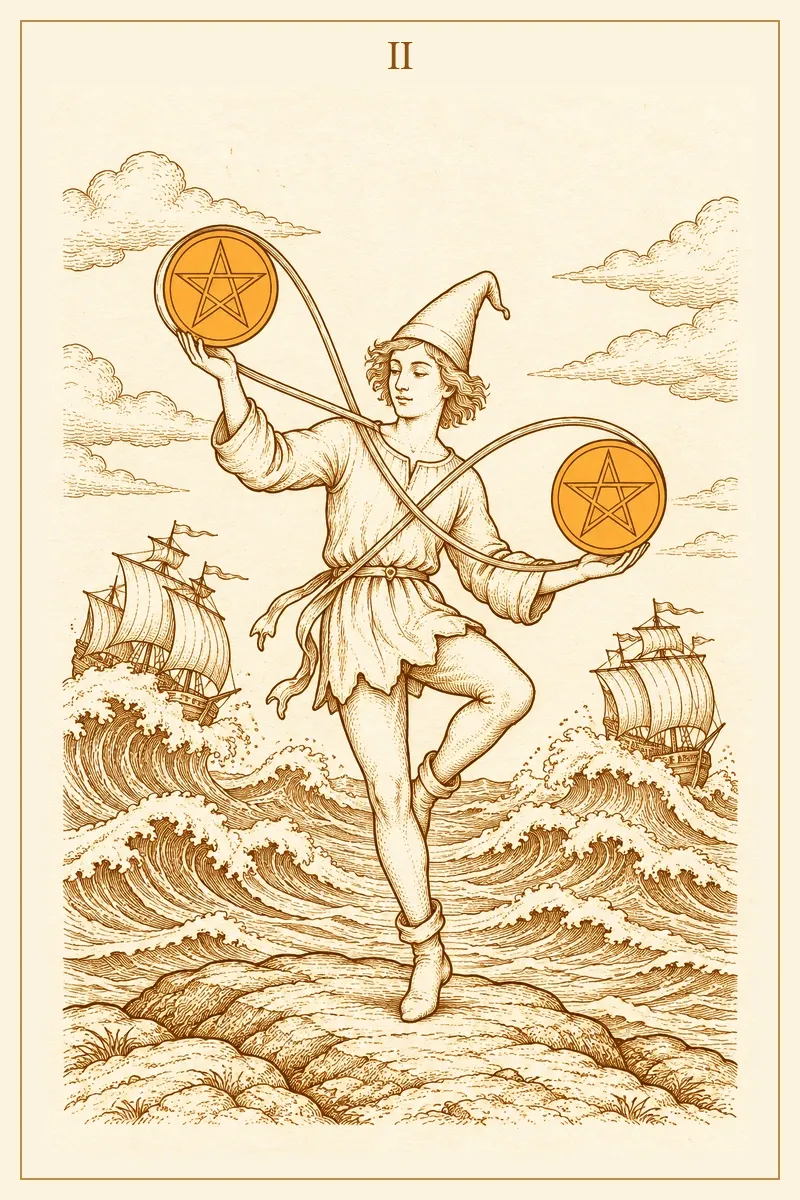
A young person in a pointed cap balances on one foot on a rocky shore, holding two coins joined by a looping band that makes a figure eight, while two ships ride high waves behind. The decan opens Capricorn, around December 22 to 30, and the Golden Dawn titled it the Lord of Harmonious Change. Capricorn is the sign of limits, so Jupiter's wish for more meets a fixed budget of time and money, and growth turns into skillful adaptation.
Upright, the card describes juggling with some grace: two jobs, a move and a deadline, cash flow that needs watching. Reversed, one ball is about to drop through overcommitment or a schedule with no slack, and the answer is usually to choose what to put down. For decisions about debt or investments, use the card to sort your questions and take them to a qualified adviser. Read more in the Two of Pentacles tarot meaning.
Jupiter's signs: Temperance, The Moon and The Chariot
Jupiter's two signs show its two moods. Sagittarius looks outward, toward travel, study and a meaning worth aiming at; Pisces looks inward, toward faith, compassion and what cannot be measured. Cancer, where Jupiter is exalted, or especially honored, belongs to The Chariot, whose crowned driver stands behind a dark sphinx and a light one: growth in protective form, a forward push that carries its people safely. Upright, The Chariot is progress with a clear direction; reversed, effort that has lost its steering.
Temperance (XIV): Jupiter through Sagittarius
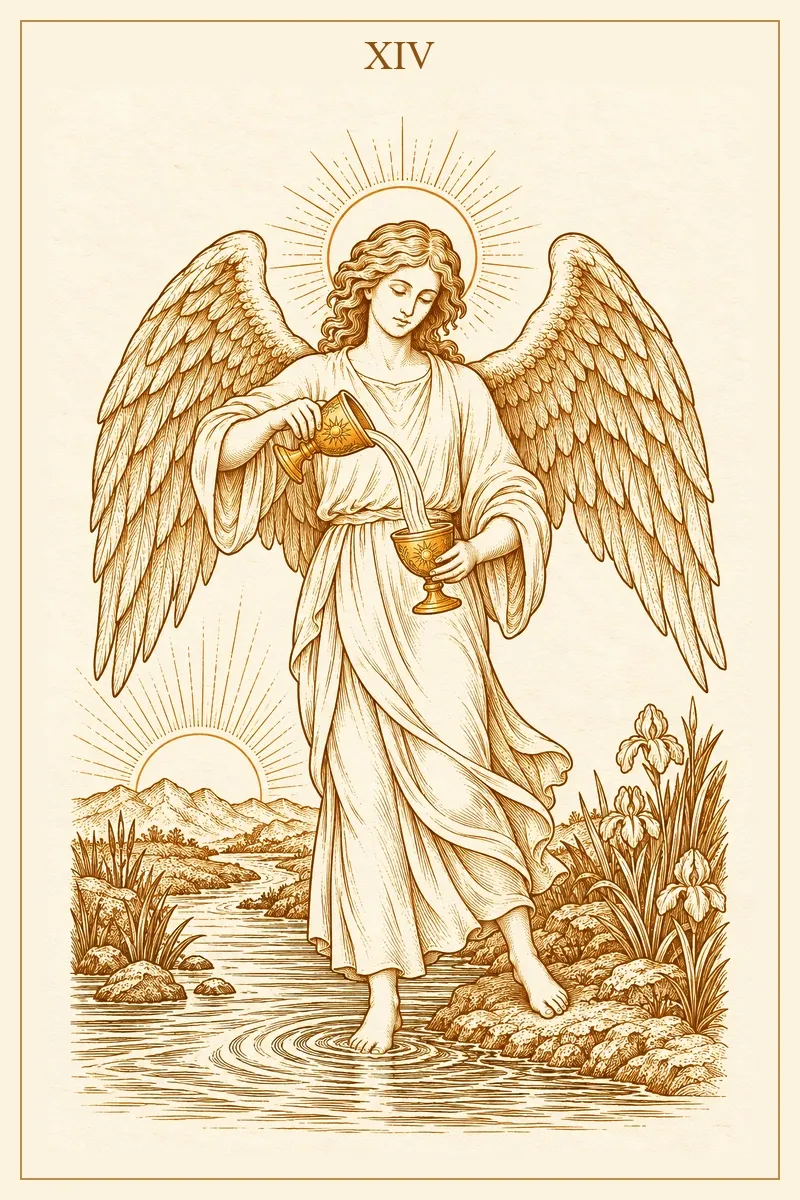
A winged figure with a halo of light stands with one foot in a stream and one on the bank, pouring water from one gold cup into another, while a path leads toward mountains and a rising sun. Sagittarius is the archer aiming far, and Temperance shows what such an aim requires: patience, the right mixture and a steady pace. The Temperance tarot meaning describes the card in full, and the Sagittarius and tarot guide shows the rest of the sign's cards.
Upright, Temperance supports moderation, blending two parts of your life and a plan measured in seasons rather than days. Reversed, it shows Jupiter's excess again: too much at once, a pace you cannot keep or impatience with a process that cannot be hurried.
The Moon (XVIII): Jupiter through Pisces
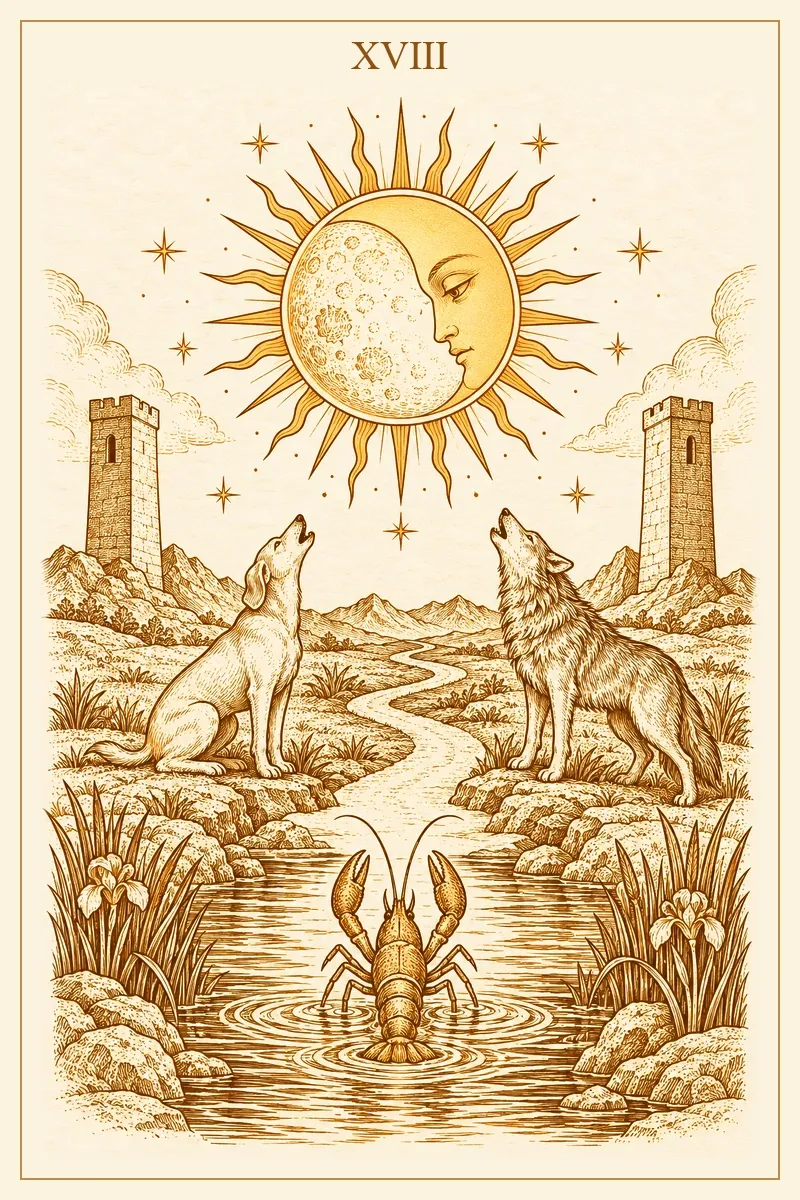
A moon with a sleeping profile glows inside a ring of rays between two stone towers. A dog and a wolf howl up at it, a crayfish climbs out of a still pool, and a winding path runs off between the hills. Pisces is the sign of the unseen and The Moon is the card of not knowing yet, so Jupiter's gift here is faith: the willingness to keep walking when the path is only half visible. See The Moon tarot meaning and the Pisces and tarot guide, which also returns to the Nine of Cups.
Upright, The Moon describes uncertainty, vivid dreams and fears that grow larger in the dark. Reversed, a fear may finally have a name, or confusion may be deepening into self-deception. Either way, separate what you know from what you imagine before acting.
Is Jupiter lucky? Reading growth without overreaching
People often meet Jupiter while searching for lucky cards, and the Wheel, the Six of Wands and the Nine of Cups all appear on most lists of fortunate draws, as the guide to tarot cards that mean good luck shows. Jupiter's idea of luck is broader than a windfall, though: it is the sense that a door is open and you are ready to walk through. When two or three Jupiter cards appear together, the reading is usually about size, meaning how much room you have and how much you are trying to fill.
In love, the Wheel can mark a new chapter, the Nine of Cups contentment and Temperance the patience two lives need to blend; the shadow is a grand gesture in place of steady care. In work, the Six of Wands brings recognition and the Two of Pentacles a full plate handled well, and when Jupiter arrives with an offer of more, the Four of Swords asks what it would cost your rest. With money, Jupiter means enough rather than guaranteed gain, so treat a money reading as reflection and check real numbers with the right professional.
Reversed Jupiter cards most often point to excess: spending to feel abundant, saying yes to everything, trusting things will work out without a plan. The remedy is not to shrink. It is to choose one area for growth and give it your full attention.
Timing with Jupiter: chapters, not dates
Jupiter takes about twelve years to travel through the zodiac, spending roughly a year in each sign, so astrologers read it as a planet of chapters. Its return to its birth position, around ages twelve, twenty-four and thirty-six, is called a Jupiter return, and some people use those years to ask what they want to grow into next. Jupiter also appears to move backward for about four months each year, a traditional time to review growth plans rather than launch them. If you enjoy seasonal readings, the decan dates give each Jupiter card a theme:
- Nine of Cups: about March 1 to 10, a time to notice what is already enough.
- Eight of Swords: about May 21 to 31, a time to question one belief that keeps you stuck.
- Six of Wands: about August 2 to 11, a time to acknowledge what you achieved.
- Four of Swords: about October 13 to 22, a time to rest before the year's last push.
- Two of Pentacles: about December 22 to 30, a time to rebalance commitments for the new year.
An open-door spread, with a sample reading
This four-card spread suits any moment when something larger is on offer: a new role, a move, a course of study, a relationship taking a bigger step. Lay the cards in a row from left to right.
- The open door: where growth is genuinely available to me now.
- What I carry through it: the strength or resource I already bring.
- The right size: how big this step should be, and where it would tip into too much.
- The guide: a practice, person or principle that can steady me.
Read the first and third cards together before anything else; the difference between the door and the right size is where most Jupiter readings find their real advice.
Sample reading: an offer to study abroad
Suppose someone asks, "I've been offered a place on a six-month course abroad. How can I make the most of it without overstretching myself?" Higher learning and long journeys are both Jupiter themes. They draw:
- The open door: Wheel of Fortune, upright.
- What I carry through it: Two of Pentacles, upright.
- The right size: Nine of Cups, reversed.
- The guide: Temperance, upright.
The Wheel at the door says this feels like a genuine turning point. It does not say the course will go well; it says the chance is real and that taking part is how a turning point becomes a new chapter. The Two of Pentacles shows what they bring: adaptability, perhaps from years of balancing part-time work with study, and a reminder to build flexibility into the budget.
The Nine of Cups reversed in the right-size position is the warning. The risk is trying to have everything at once, every trip, every class, every invitation, until nothing satisfies, or hoping the course will fix things it cannot fix. Temperance as the guide suggests a steady pace: study balanced with rest, adventure with routine. Practical steps could be a monthly budget with a small buffer, two clear priorities and a halfway check-in with a mentor. The reading offers a plan for using the opportunity well, not a promise about how it ends.
Jupiter and Saturn: the open hand and the steady one
In astrology Jupiter and Saturn are a classic pair. Jupiter expands and says yes; Saturn sets limits and asks what will last. In the same Golden Dawn system, Saturn's card is The World, the card of completion, and a reading that mixes the two often describes a healthy tension: an opportunity that needs structure, or a commitment that needs some optimism. The Saturn in tarot guide covers the other half of the pair.
Jupiter also sits naturally beside Venus, the other benefic. Venus enjoys what is close at hand, while Jupiter widens the view toward meaning; the Venus in tarot guide shows which cards carry that gentler planet.
Frequently asked questions
What is the Jupiter tarot card?
The Wheel of Fortune (X). Temperance and The Moon carry Jupiter through Sagittarius and Pisces, the signs it rules, The Chariot carries it through Cancer, where it is exalted, and the Eight of Swords, Six of Wands, Four of Swords, Two of Pentacles and Nine of Cups are its five decan cards.
Is the Wheel of Fortune always a lucky card?
Not always. It is a card of change and timing. Upright, the change often feels welcome; reversed, it may feel like a setback or a pattern repeating. In both cases it asks how you can work with the cycle rather than against it.
Why is the Eight of Swords a Jupiter card when it looks so restrictive?
Because its decan is Jupiter in Gemini, a sign where Jupiter is said to be in detriment. The planet's urge to see every possibility meets Gemini's busy mind, and too many options can feel like none. The open path in front of the figure is the Jupiter part: the way out is usually wider than it seems.
Can a Jupiter card tell me when good fortune will come?
No. No reading can confirm a date, an outcome or what someone else is thinking. The decan dates and the twelve-year cycle give you seasons for reflection, not a timetable. A Jupiter card is better used to decide what to do with the opportunities you can already see.
Does every tarot tradition link Jupiter to the Wheel of Fortune?
No. The pairing comes from the Golden Dawn, whose correspondences shaped most modern English-language decks, and some older continental systems assign the planets differently. If your deck's guidebook uses another scheme, it is working from a different map, not making a mistake. Every card also keeps its full meaning without any astrology.
Making room to grow
Jupiter in tarot is less about luck falling from the sky than about room: room to learn, to be recognized, to rest and to trust what you cannot yet see. When an offer arrives, picture the Wheel turning and ask whether the step in front of you is the right size.
When there is a bigger step on your mind, you can start a reading and ask one quiet question: where do I have room to grow right now?