
Loading your view
The page is gathering the latest information.
The page is gathering the latest information.
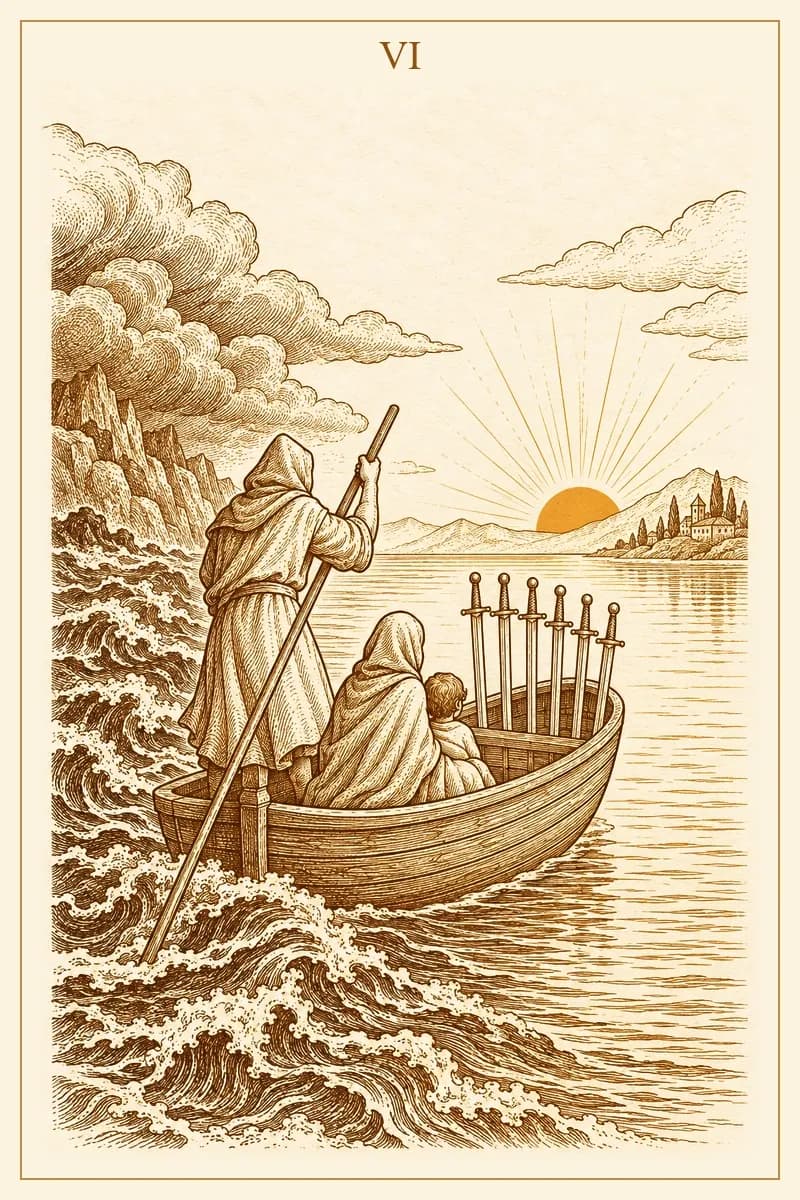
The card shown is VeilSoul's own engraved drawing of the 1909 Waite–Smith card. The scene and symbols described on this page follow the 1909 card, so a few details are drawn differently in our deck.
The Six of Swords shows a hooded figure and a small child being ferried across a body of water by a boatman. Six swords stand upright in the bow of the boat. The water on the left is choppy and turbulent; the water on the right — where the boat is heading — is calm and smooth. This is a card of passage: leaving difficulty behind and moving toward something quieter, if not yet joyful.
When the Six of Swords appears upright, you are in transition — moving away from a painful situation, a toxic relationship, a failed venture, or a period of mental anguish toward calmer ground. This is not a triumphant departure. The figures in the boat do not look happy. They are cloaked, heads bowed, carrying their swords with them. The baggage comes along — but the destination is better than where they started.
This card acknowledges that healing is not instant. The journey across the water takes time, and there is a quiet sadness to the crossing. You are grieving what you are leaving behind even as you know that leaving is necessary. The Six of Swords validates this complex emotional state: it is possible to be relieved and sad at the same time, to move forward while looking back.
The boatman represents guidance — whether from a therapist, a friend, a mentor, or your own hard-won wisdom. You are not making this crossing alone. Someone or something is helping you navigate from rough waters to calm ones. Trust the process. The other shore is real, and you are already on your way.
The boat moves toward calmer water, carrying grief and wisdom both. Transition is not escape — the six swords travel with you, scars you carry forward into whatever comes next.
The crossing stalls — either endlessly circling familiar pain instead of leaving shore (excess), or rushing to a new destination without processing what made the old one unbearable (deficiency).
Detailed Interpretations
The Six of Swords in love often appears during or after a breakup — the quiet, bittersweet period when you know with sober certainty that the relationship is over and you are beginning the slow, unglamorous journey of moving on. The love may have been real, the memories may still carry warmth, but something fundamental has broken and you have made the difficult decision that staying would cause more harm than leaving. This is not the dramatic exit of the Five — it is the subdued, dignified departure of someone who has grieved enough to know that the only remaining act of self-respect is to board the boat and cross to calmer waters.
This card captures the emotional texture of transitions that are necessary but not triumphant. There is no celebration in this departure, no vindication, no clean break that allows you to walk away unburdened. The six swords standing in the bow represent the baggage you carry with you — the memories, the lessons, the unhealed wounds that will accompany you to the other shore. The Six does not promise that you will arrive healed; it promises that you will arrive somewhere with the space and stillness necessary for healing to begin.
For singles, the Six of Swords may indicate moving on from a prolonged period of romantic grief, relocating to a new city where fresh connections become possible, or the gradual emotional transition from identifying as someone's former partner to rediscovering yourself as an independent individual. The journey is lonely — the figure in the boat is hooded, withdrawn, facing forward with quiet resignation — but it leads somewhere gentler than where you have been.
In love reversed, the Six of Swords suggests difficulty letting go of a past relationship — returning to a toxic partner because the familiarity of dysfunction feels safer than the uncertainty of starting over, or a healing transition that has stalled because you keep looking back at the turbulent shore you were supposed to be leaving behind. The boat has stopped moving, anchored by nostalgia, fear, or the unfinished emotional business that prevents genuine forward movement.
This reversal also indicates situations where someone attempts to leave a harmful relationship but is pulled back — by financial dependence, by children, by the partner's promises to change, or by the deeply ingrained belief that being in a painful relationship is better than being alone. The reversed Six validates how difficult it is to leave and acknowledges that the journey to calmer waters sometimes requires multiple attempts before you successfully complete the crossing.
For some, the reversed Six marks the painful realization that you have been running from relationship to relationship without ever completing the healing journey — boarding new boats before the crossing is finished, using new partners as distractions from the grief you have not yet processed. Until you allow yourself to complete the passage — to sit with the sadness, carry the swords honestly, and arrive at the far shore before seeking the next connection — the pattern will repeat.
Professionally, the Six of Swords represents leaving a difficult work situation behind and transitioning toward something calmer and more sustainable — quitting a toxic job that was eroding your health and confidence, transitioning out of a failing business before it consumes the last of your resources, relocating to a new city for a fresh professional start, or moving away from a career path that once held promise but has become a source of chronic frustration and diminishing returns.
This card does not promise that the transition will be easy or that the destination will be immediately better. What it promises is movement — the end of stagnation in a situation you have already recognized as untenable. The journey may involve a period of reduced income, professional uncertainty, or the discomfort of starting over in an unfamiliar environment. But the Six of Swords assures you that the turbulent waters are behind you and that each day of forward movement brings you closer to professional circumstances that allow you to work with dignity, clarity, and genuine purpose.
The Six also speaks to career transitions that are driven by necessity rather than ambition — layoffs, industry disruptions, or economic conditions that force you to leave a position you would have preferred to keep. In these cases, the card offers comfort: the forced departure, though painful and unwanted, may be carrying you toward opportunities that would never have been visible from where you were standing. The boatman steers toward calmer waters not because you asked for the journey but because remaining on the turbulent shore was no longer viable.
Career-wise, the reversed Six of Swords indicates a career transition hitting significant obstacles — a planned move falling through at the last moment, a new role failing to meet the expectations that motivated the change, the inability to leave a toxic work situation despite knowing you need to, or a professional relocation that has created more problems than it solved. The journey to calmer professional waters has been disrupted, delayed, or reversed entirely.
This reversal also appears when someone keeps returning to the same type of dysfunctional work environment — leaving one toxic job only to accept another with identical problems, because the patterns they carry with them recreate the same dynamics regardless of the external setting. The reversed Six asks whether the turbulence is in the water or in the boat — whether the professional difficulties you keep encountering are situational or whether something in your own approach to work is consistently generating the conflict and dissatisfaction you are trying to escape.
Additionally, the reversed Six can signal resistance to a career change that you know intellectually is necessary but cannot bring yourself to execute emotionally. The familiar misery of your current position feels more manageable than the terrifying uncertainty of the crossing, so you remain anchored to a shore you have already outgrown, watching the boats depart without you.
The Six of Swords in health represents a gradual, steady recovery — the transition from acute illness, crisis, or mental health emergency toward stability and the slow return of wellbeing. Healing is happening, but it is a journey rather than a destination, and the Six asks you to honor the pace of that journey rather than demanding that recovery conform to your impatient timeline. The waters are becoming calmer, but you are still in the boat — still in transit between the shore of illness and the shore of health.
This card frequently appears during recovery from surgery, during the stabilization phase of a mental health treatment plan, during rehabilitation from injury or addiction, or during the slow emotional recovery that follows a health scare. The message is consistent: you are moving in the right direction, the worst is behind you, but full recovery requires the patience to continue the crossing without trying to leap from the boat before it reaches the far shore.
The Six of Swords also addresses the mental health dimension of physical transitions — the psychological adjustment required when chronic illness, disability, or a significant health event forces you to move from the life you had to a different kind of life. This transition carries genuine grief for what was lost alongside cautious hope for what lies ahead. The card validates both emotions and encourages you to let the boat carry you forward at its own pace, trusting that the calmer waters ahead will eventually become the new ground beneath your feet.
Use this as a reflective prompt, not medical advice or a diagnosis. For health concerns, seek guidance from a qualified healthcare professional.
The Six of Swords reversed indicates resistance to a necessary transition — clinging to a painful situation because leaving feels too frightening, or attempting to return to a place you have already outgrown. The boat is stalled, circling back, or refusing to launch.
Alternatively, this reversal can signal a transition that is not going smoothly — unexpected obstacles during relocation, a recovery setback, or the realization that the destination you were heading toward is not what you expected. The journey has been disrupted.
The reversed Six may also indicate that you are carrying too much baggage into your new chapter — unresolved grief, unprocessed anger, or unhealthy patterns that are being transported rather than released. The swords in the boat are weighing it down.
The reversed Six of Swords teaches that moving forward requires actually letting go — not just physically departing from a situation but emotionally releasing the attachment to what you are leaving behind. You cannot row toward calmer waters while simultaneously reaching back for the turbulent shore. The boat moves forward only when you commit to the crossing completely, accepting that the place you are leaving — however painful, however familiar — is no longer where you belong.
This reversal also teaches that some transitions must be attempted more than once before they succeed, and that returning to a harmful situation after a failed attempt to leave is not permanent failure — it is a stage in the process of building enough strength, clarity, and practical resources to complete the journey successfully. Each attempt teaches something, each return reveals what still needs to be addressed, and eventually the crossing is completed not through dramatic escape but through the quiet accumulation of enough resolve to finally let the shore recede behind you.
If something in your life needs to be left behind — a habit, a relationship, a job, a mindset, a version of yourself that no longer fits — begin the journey today. It will not feel triumphant or exciting. It will feel quiet, bittersweet, and perhaps lonely. You will carry baggage and you will look back more than you want to. But the calmer waters are real, they are reachable, and every stroke of the oar brings you closer. You do not need to arrive today — you only need to get in the boat and start moving forward.
“I release what is behind me and move toward calmer waters. The journey is quiet and bittersweet, but every stroke of the oar brings me closer to peace.”
The card shown is VeilSoul's own engraved drawing of the 1909 Waite–Smith card. The scene and symbols described on this page follow the 1909 card, so a few details are drawn differently in our deck.
The boat carries its passengers from turbulent water (left) to calm water (right) — a visual representation of transition from difficulty to peace. The hooded figure and child suggest a parent protecting a vulnerable one during a difficult passage, or the adult self caring for the inner child through trauma.
The six swords stand upright in the bow — the problems, memories, and lessons being carried forward. They are not discarded; they travel with you. This is realistic rather than idealistic: you do not leave your past behind entirely. You carry its lessons into the new chapter.
The boatman poles the vessel forward with quiet determination. He represents the guide, the helper, the therapeutic presence that makes the crossing possible. The sky is grey but clearing — difficult weather is passing. The distant shore is visible, confirming that the destination exists even if it has not yet been reached.
Sixes represent harmony, resolution, and the first restoration of balance after the Five's disruption. The Six of Swords is the intellectual journey toward peace — leaving conflict behind through wisdom, acceptance, and the courage to move on.
Keep or share this card reference
✦ From meaning to reflection ✦
Bring what this card stirred into a reading shaped around what you are facing now.
Read with this insight