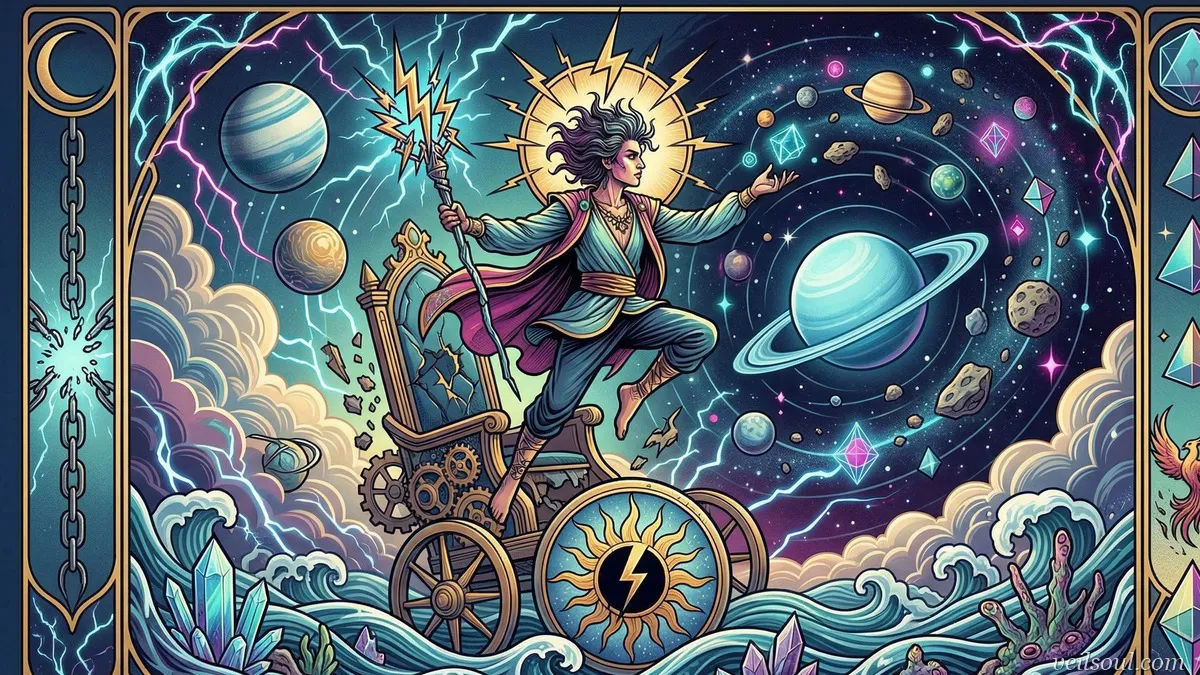
Full moon tarot practices are short, repeatable readings done on or near the night the moon is fully lit, when a month's effort, feelings and loose ends are easier to see. Five of them cover most needs, from five minutes to an evening: a one-card check-in, a three-card harvest reading that looks back to the new moon, a light and shadow spread, a quick release with paper, and a log that carries one question from full moon to full moon. Pick one, give it your full attention and write down what you see.
None of this requires believing that the moon changes your cards. The full moon is simply a date that comes around about once a month and invites a pause. Tarot cannot tell you how a situation will end, what someone else is thinking or when something will happen; it can put a picture beside a feeling you have half-noticed, so you can name it and decide what to do.
Here is what each practice is for:
- One-card check-in (5 minutes): one question about what the past two weeks have brought into view.
- Harvest reading (15 minutes): three cards for what you planted, what grew and what you are gathering now.
- Light and shadow spread (25 minutes): four cards for a strength you can own and a habit you are ready to face.
- Two-card paper release (20 minutes): one card names what to put down, a second shows life without it.
- Full moon log (10 minutes a month): the same question every full moon, so patterns show up over a year.
- Sign axis lens (optional): two Major Arcana cards that frame the month's full moon if you follow astrology.
Why the full moon works as a checkpoint
At the full moon, the Sun and the Moon sit on opposite sides of the Earth, and the face of the moon turned toward us is fully lit. Astrologers read that opposition as tension and balance between two parts of life. Readers who follow the lunar cycle treat it as the high point of the month: the new moon is for starting, the full moon for seeing how far things have come. For the symbolism of the lunar body itself, the Moon in tarot and astrology goes into depth.
That makes the night good for three kinds of reading. Review asks what a project, habit or relationship has actually produced, not what you hoped it would. Honesty follows from the light: brighter light means sharper shadows, so it is a natural night to look at something you have been stepping around. The turn comes afterward, as the lit part shrinks over the next two weeks and you simplify, finish and let go. Read slowly, too: a card that seems huge at ten at night often looks ordinary by morning, which is why each practice below ends with a written note.
Choosing the night and getting ready
A window of three nights
You do not need the exact minute of the full moon. The moon looks round to the eye for about three nights, so the evening before, the night itself and the evening after all work; choose the one that gives you quiet time. Decide on the practice in advance and write your question at the top of a fresh page, so you do not keep drawing just because the night feels special.
Resting the deck by the window
Some readers leave their deck on a windowsill under the full moon for an hour or overnight, to mark a fresh start for the cards. If that feels meaningful, do it, and bring the cards in before damp or strong morning sun can warp them. Other methods, from knocking on the deck to sorting it by suit, are covered in how to cleanse a tarot deck.
Settling before the first card
Sit where no one will interrupt you, leave your phone in another room and breathe slowly, letting each out-breath run longer than the in-breath. Read your question aloud once, then shuffle until your hands feel steady. If the subject is painful, add a line under the question saying what you will do afterward to look after yourself: a walk, a call to a friend, an early night.
Five full moon tarot practices, short to long
Each practice stands alone. You might keep the check-in every month and add a longer spread only when something big is happening.
The one-card check-in
Ask "What have the past two weeks brought into view?" and draw one card. Look at it for a full minute before thinking about its meaning, and notice what your eye goes to first: a figure, a color, an object. Then write three lines: what the card shows, what in your life it reminds you of, and one small thing you will do differently before the new moon.
The harvest reading (three cards)
This spread reviews the whole cycle. If you set an intention two weeks ago, the full moon is when you go back to it; a new moon tarot ritual is the planting half of the same rhythm. Lay three cards from left to right:
- What I planted: the intention, effort or decision you began with, as it looks now.
- What grew: what developed, including what you did not plan.
- What I am harvesting: what the cycle has given you, visible or not.
Read the three as one sentence. The middle card often matters most because it shows the surprise, and a hard third card may mean the harvest is a lesson rather than a result, which still counts. Mastering the three-card spread offers more ways to read a line of three.
The light and shadow spread (four cards)
The full moon makes the brightest light of the month and the clearest shadows, and this spread uses both. Lay two cards in a top row and two below:
- My light: a strength or truth I am ready to own out loud.
- My shadow: a fear, habit or denial I am ready to look at.
- How the light helps: where owning that strength can take me next.
- How to work with the shadow: a kinder, practical way to meet it rather than fight it.
Stay with the top row before moving on, since it is tempting to rush past your own strengths to reach the problem. Describe the shadow card as you would a friend's habit, without judgment, and let the fourth card suggest one realistic step rather than a personality overhaul.
The two-card paper release
This is the shortest release practice, and it works best when you already sense what you want to put down.
- Draw one card for "What am I ready to release?"
- Look at it until it says something in plain words, and write that on a small slip of paper. Be specific: "checking his profile every night" is easier to release than "the past."
- Draw a second card for "What does my life look like without it?"
- Tear the slip into small pieces while you look at the second card, or burn it in a sink or fireproof bowl if you can do so safely.
- Write both cards in your notebook with the date.
When there is more than one thing to let go of, the six positions of the full moon tarot spread give the release more room. For letting go that takes months rather than one night, tarot for letting go is a gentler companion.
The full moon log
Pick one question you care about for the year, such as "What is my body asking for?" or "Where is my work heading?", and ask it at every full moon. Draw one or two cards, note the date and the full moon's sign if you track it, and write two sentences. After three or four months, read the log back. You may find a suit that keeps returning, a card that appears whenever the month is busy, or a slow drift from Swords toward Cups. That pattern is the real reward of a full moon practice, and it only shows up on paper; keeping a tarot journal offers page layouts if you want more structure.
Reading the full moon across its sign axis
Because the Sun and the Moon face each other, every full moon sits on an axis between two opposite signs: an astrology calendar names the moon's sign, and the Sun is in the sign directly across from it. In the Golden Dawn system each sign has a Major Arcana card, so each axis gives you a pair to lay face-up beside your practice. The card of the moon's sign speaks to the private, feeling side of the month; the card of the Sun's sign to the outward side.
- Aries and Libra, The Emperor and Justice: what I want for myself and what is fair to the people beside me.
- Taurus and Scorpio, The Hierophant and Death: what I hold on to, and what I share or let end.
- Gemini and Sagittarius, The Lovers and Temperance: everyday choices, and the larger beliefs that steer them.
- Cancer and Capricorn, The Chariot and The Devil: home and feeling, against ambition and duties that start to bind.
- Leo and Aquarius, Strength and The Star: my own warmth and courage, and the group and the long hope.
- Virgo and Pisces, The Hermit and The Moon: order and routine, and imagination, rest and what will not be pinned down.
A pair is a lens, not a forecast. On a full moon across Cancer and Capricorn, for instance, you might ask whether your shadow card lives at home or at work. The Devil and Death look dark out of context, but here they simply name attachment and endings, which any honest review touches. The Moon card, with its two towers and a path running between them, looks a great deal like a full moon night, and The Moon tarot meaning explains its symbols if it keeps appearing.
Five cards with a full moon feel
Any card can turn up under a full moon, but these five carry the night's themes so clearly that they are worth knowing well: visibility, completion, taking stock, emotional overload and the turn toward a quieter stretch.
The Sun: the whole picture in daylight
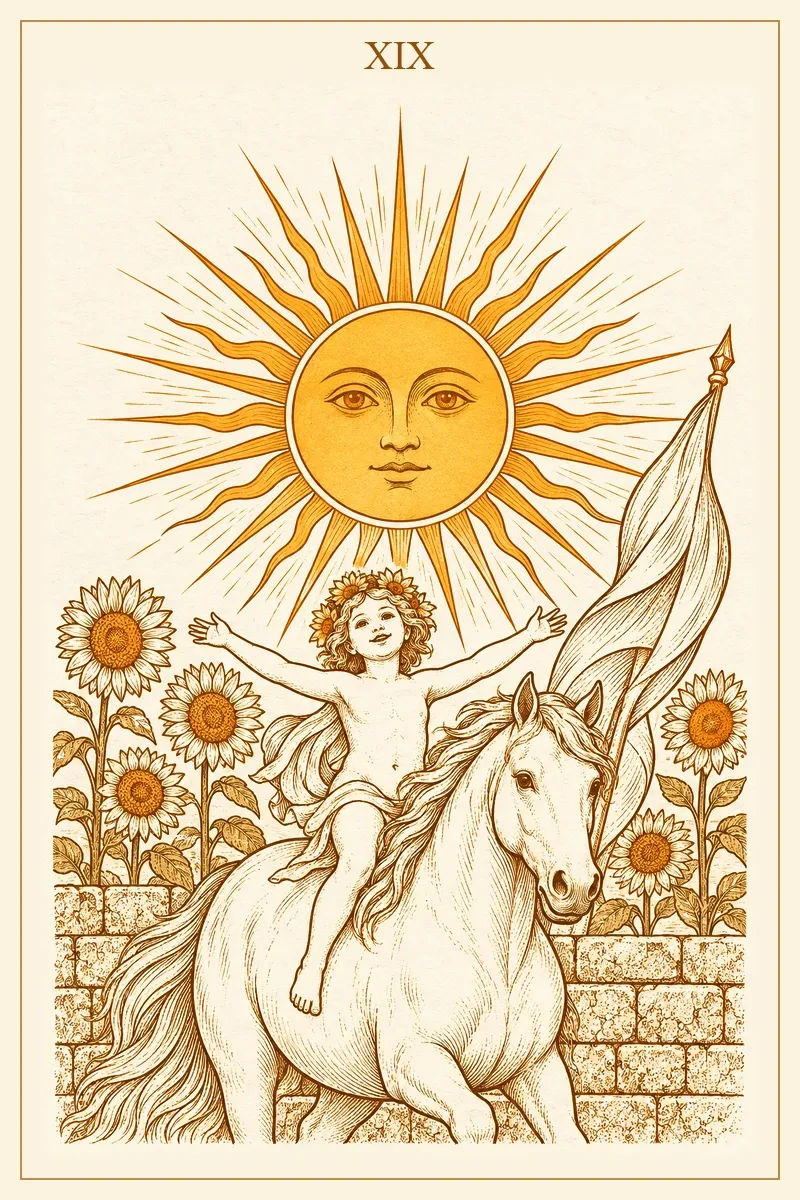
The Sun is the card of full visibility. Upright, something is going well and can be seen for what it is: warmth in a relationship, progress at work, energy returning after a tired season. In the light position it often names a plain, cheerful strength you tend to dismiss.
Reversed, the light is there but dimmed: success that feels smaller than it is, joy held back, a little overconfidence. As the harvest card it usually means the result is real but you have not yet let yourself see it. In love it can describe a good relationship that needs more play; with money, gains that are steady rather than dramatic. The Sun tarot meaning gathers the full range of readings.
Judgement: a call you can finally hear
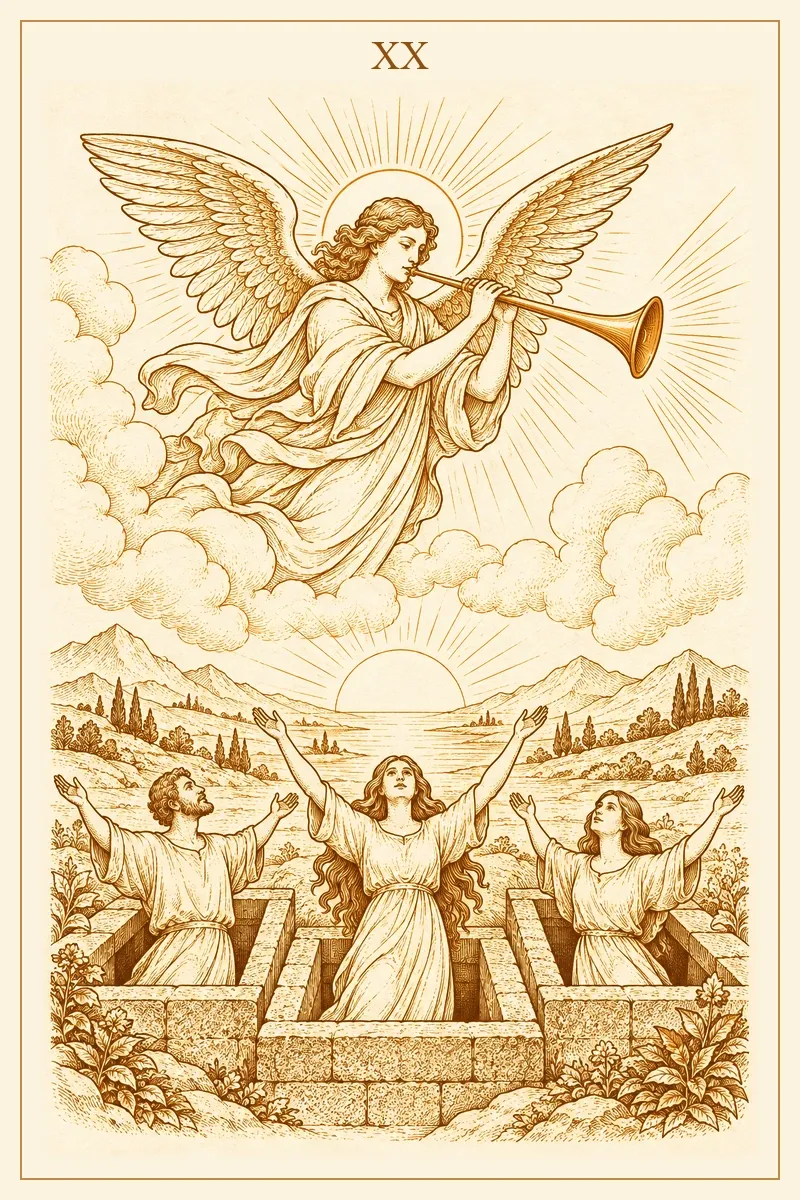
Judgement shows a trumpet call and figures rising to answer it. Upright, it is honest reckoning without blame: you see the past weeks clearly, own your part and feel drawn toward a step that has been waiting.
Reversed, the call is muffled: harsh self-judgment, replaying an old mistake, or putting off a decision you already know you need to make. As a shadow card, the gentlest reading is that you are harder on yourself than the situation calls for. At work it can mark an evaluation or a career rethink; in love, a frank talk about what each of you wants. The angel and the rising figures are unpacked in the Judgement tarot meaning.
The World: a cycle that closes whole
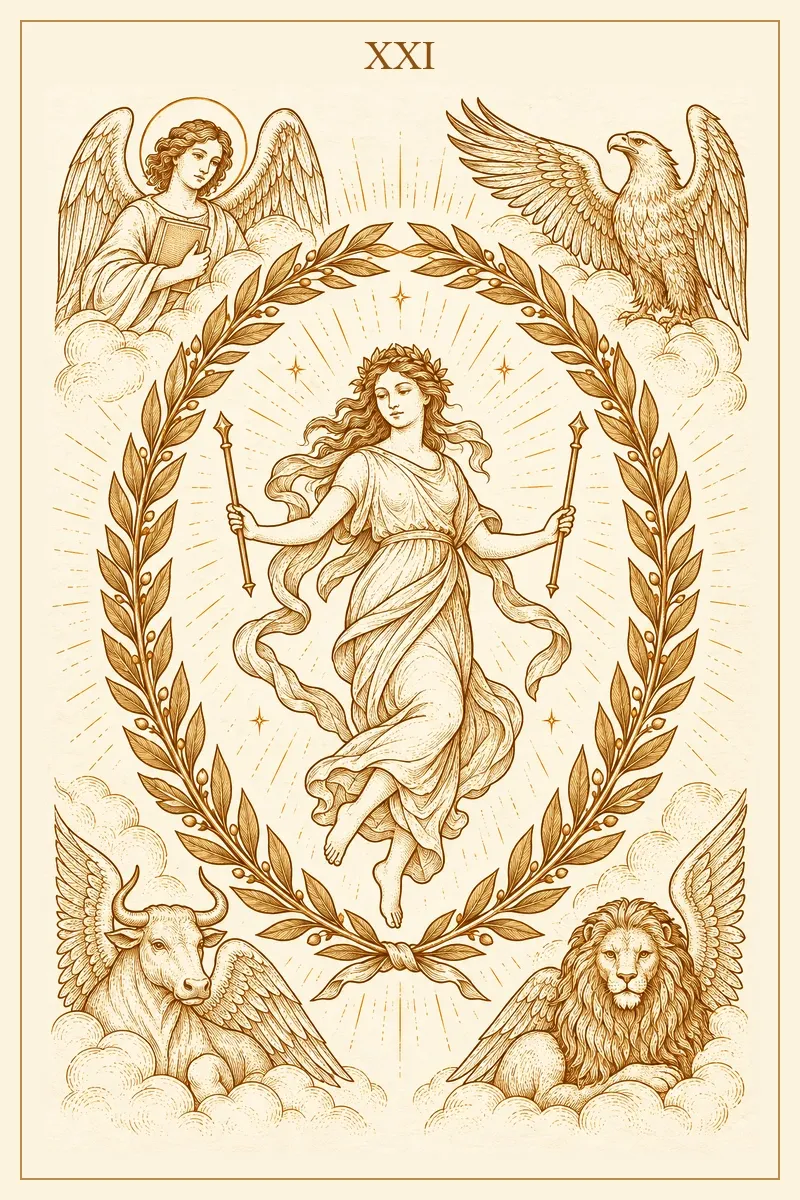
The World, the last card of the Major Arcana, shows a dancer inside a wreath and matches the full moon's sense of fullness. Upright, a chapter has come full circle: a course finished, a move settled, a hard year understood. As the harvest card it asks you to mark the ending before rushing into something new.
Reversed, it points to loose ends: an unsent email, a last conversation, a box still taped shut. Drawn as the first card of the paper release, it may simply say to finish one small thing, which is its own kind of letting go; in career readings, to close one project before the next begins. The World tarot meaning describes the wreath and the four figures in its corners.
Seven of Cups: a bright sky full of options
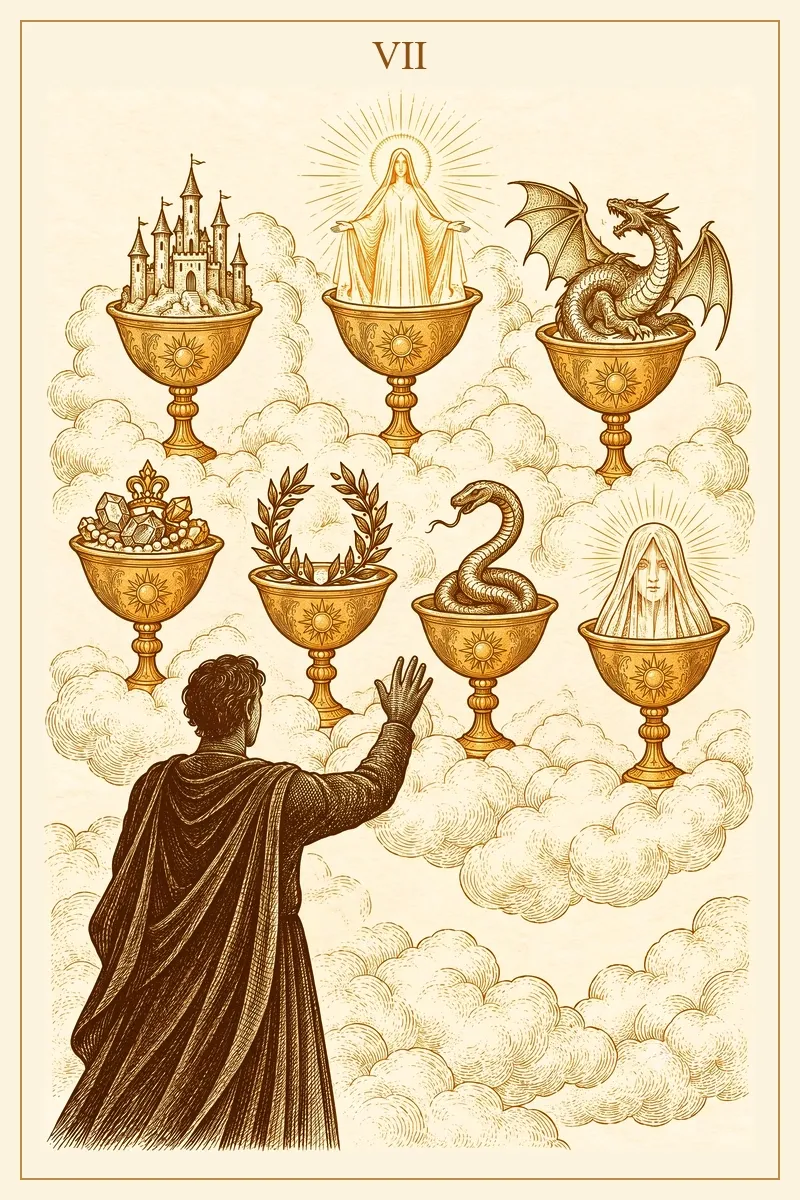
The Seven of Cups shows seven cups floating in clouds, each holding a different vision. Upright, it means too many options, wishful thinking or a fog of daydreams. On an emotional full moon night it is a fair caution: this may not be the evening for a big decision. Write the options down and test one in daylight.
Reversed, it often marks clarity returning as one cup stands out, though it can also mean retreating further into fantasy to avoid a choice, so check which feels true. In love it may point to idealizing someone; with money, to an offer that sounds too good. Each cup is examined in turn in the Seven of Cups tarot card meaning.
Six of Swords: crossing into the waning weeks
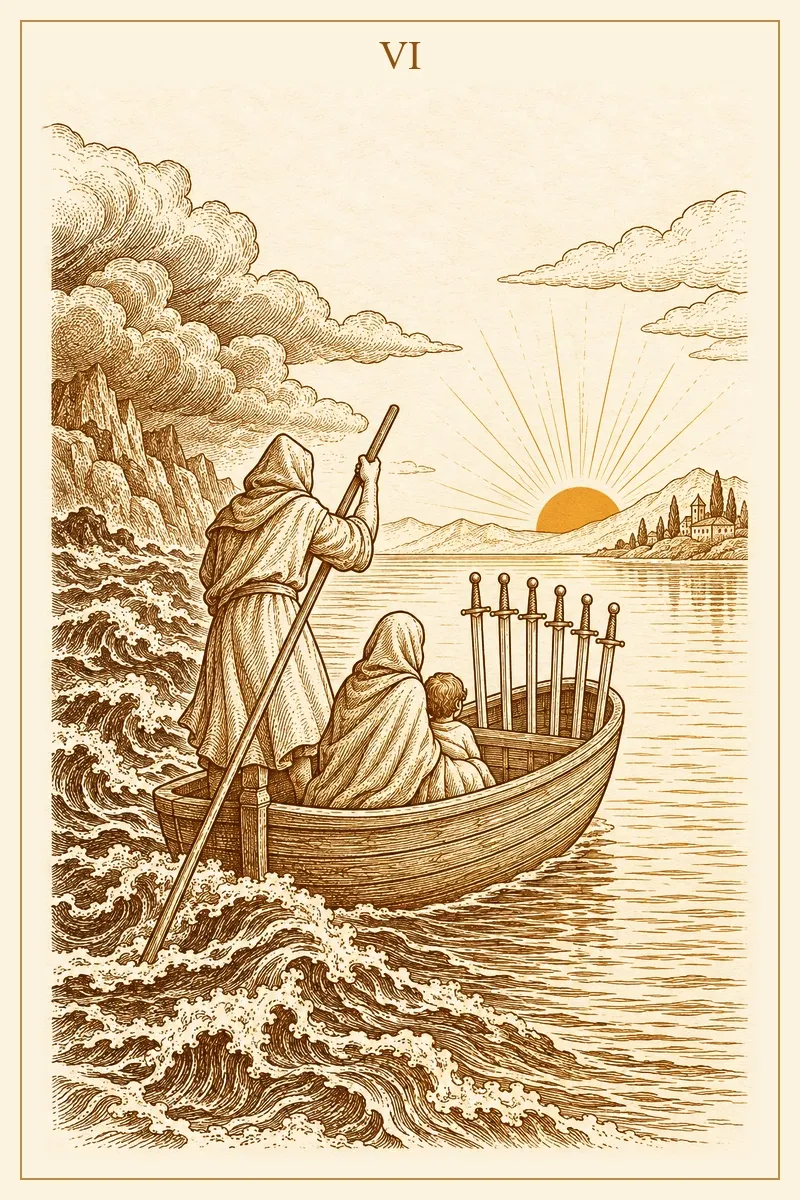
The Six of Swords shows a boat crossing from rough water toward a calmer shore. Upright, it is a transition already under way, carrying only what you need, which makes it a good guide card for the two waning weeks: move steadily and let someone else take the pole for a stretch.
Reversed, the boat is stuck or keeps turning back. You may be resisting a change you have already chosen, or carrying a weight that does not belong aboard; as the second card of the paper release, it asks what still ties you to the shore. At work it can mean a move that needs more preparation; in love, a recovery that takes longer than you would like. The crossing is explored further in the Six of Swords tarot card meaning.
A worked example: six weeks into a new job
This is an illustrative reading, not a real person's. Someone six weeks into a new job reads on a full moon across Cancer and Capricorn and asks the harvest question: "What have these six weeks actually produced?"
- What I planted: Page of Pentacles
- What grew: Seven of Cups
- What I am harvesting: The Sun, reversed
The Page of Pentacles is the seed: the decision to be a beginner again and learn the work properly. The Seven of Cups shows what grew beside it, which was not more skill but a cloud of imagined futures: a promotion, another team, a project the manager mentioned once. The reversed Sun says the real result, a great deal learned, is barely felt, because the present keeps being measured against those daydreams. The axis cards fit the picture. The Chariot, for the moon in Cancer, is a private drive to feel secure; The Devil, for the Sun in Capricorn, is the pull of ambition and long hours. Together they hint that the daydreams are partly a way to feel safe in an unfamiliar role.
For the paper release, the reader skips the first draw, treats the Seven of Cups as the thing to release and writes: "planning my next role before I have learned this one." The card for life without it is the Eight of Pentacles, a craftsperson absorbed in steady work. The log note reads: "Enjoy the learning; ask about growth paths in three months." The next full moon will show whether that holds.
Full moon questions for love, work and money
Any practice above can take a focused question. These work well because they ask about what has already happened, where a full moon reading is strongest, rather than about what someone else will do.
- Love: "What has this relationship shown me this month?" "What do I give that I would like returned?" "What am I pretending not to know?" If you are single: "What did the people I met teach me about what I want?"
- Work: "What did my effort produce, and what did it cost?" "Which task have I outgrown?" "What would finishing look like for this project?"
- Money: "Does where my money went match what I value?" "Which money worry is a fact and which is a fear?" "What is one sensible step for the waning weeks?"
Keep money and health questions reflective. A card can show your habits around spending or rest; it cannot replace a budget, an accountant or a doctor, and a full moon does not make it more reliable on those subjects.
When the full moon feels like too much
Some full moons stir up grief, anger or anxiety, and a spread full of hard cards can deepen it. A few gentle rules help:
- Shorten the practice. Switch to the one-card check-in and ask about support: "What would help me tonight?"
- Read a hard card as weather. The Tower, the Ten of Swords or the Nine of Swords describe a moment, not a verdict. Ask what the card invites you to do.
- Stop at one useful thought. Drawing more cards for a better answer usually muddies the first one.
- Close the session. Put the deck away, turn on the lights, drink some water and do what you wrote under your question.
If a reading keeps pulling you back to a painful subject night after night, talk with someone you trust or a counselor rather than drawing more cards.
Keeping the practice between full moons
The weeks around the full moon decide whether the practice becomes part of your life or stays a pleasant evening.
- The day after: reread last night's note in daylight and underline the one sentence that still feels true.
- The last quarter, about a week later: check whether you did the small thing you wrote down. If not, make it smaller.
- The new moon: carry what you learned into a fresh intention; new moon intention setting with tarot shows how to word one so you can check it at the next full moon.
- Every three months: read the log from the start and note any pattern.
Some months you will skip the practice entirely, and that is fine. A practice that survives a few gaps is sturdier than one that depends on never missing a night.
Frequently asked questions
Are tarot readings more accurate at the full moon?
There is no reliable evidence that the moon changes which cards come up or how accurate a reading is. What changes is you: the date gives you a reason to slow down, and a slower, more honest reading is usually a more useful one. Tarot still cannot tell you a date, an outcome or another person's private thoughts, on a full moon or any other night.
Can I do these practices if I cannot see the moon?
Yes. Clouds, city lights or a north-facing window make no difference, because you are working with the timing and your question. If you like, picture the moon for a moment before you shuffle.
Do I need to know astrology?
No. The sign axis is an optional lens for people who already follow astrology; the check-in, harvest reading, light and shadow spread, release and log all work without it.
What if a full moon falls during a retrograde or an eclipse?
Some readers treat these as extra-intense nights and keep the practice gentle, with fewer cards and more writing; reading tarot during retrogrades has ideas for reviewing rather than starting things in those periods.
Can I do a full moon practice with friends?
Yes. Choose one practice, let each person ask their own question, and agree that nobody interprets anyone else's cards unless invited. Reading for others is a skill of its own, and reading tarot for others covers the basics, from asking consent to phrasing hard cards kindly.
Which practice should I start with?
The one-card check-in. Do it for three full moons in a row and keep the notes; if you want more, add the harvest reading at the next one. A small practice you keep is worth more than an elaborate one you try once.
One card under a bright sky
Tonight or at the next full moon, find a quiet corner, ask what the past two weeks have brought into view, and draw a single card. Write three lines and leave it there. If you would like a guided spread to begin with, you can start a reading on Veil Soul whenever you are ready.