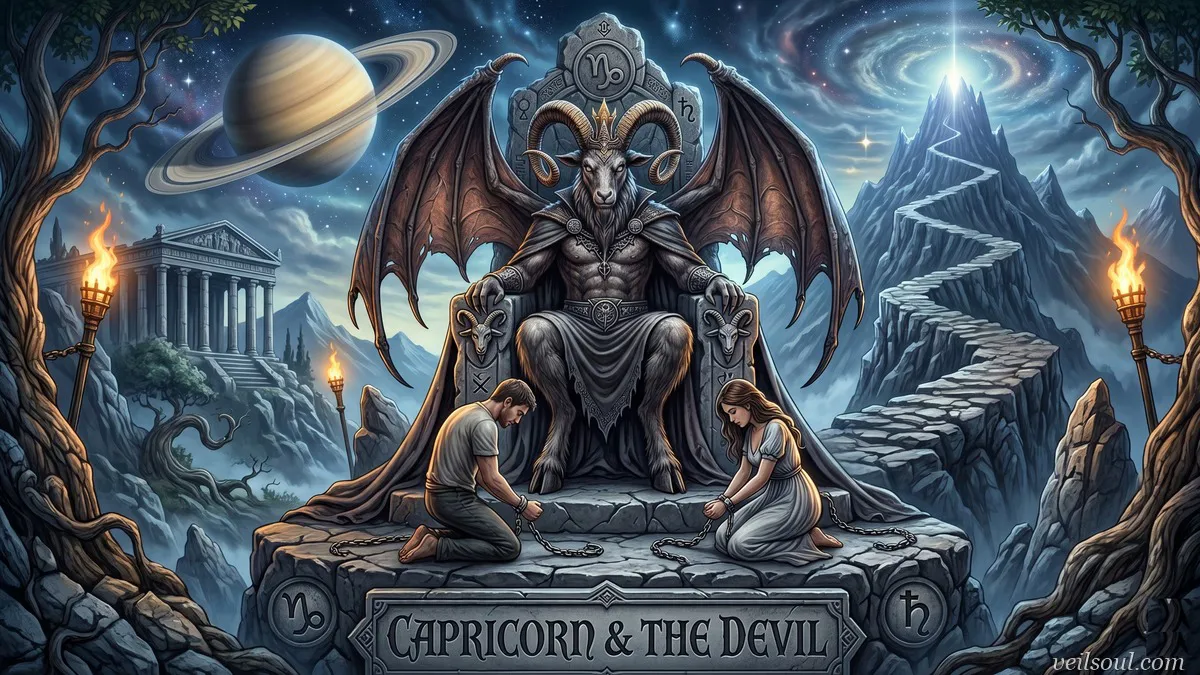
The Capricorn tarot card is The Devil, card XV of the Major Arcana, but one trump is only the front of the set. Saturn, its ruling planet, brings The World in behind it; the three Capricorn decans run across the Two, Three and Four of Pentacles; and two court cards divide the goat's degrees between them.
Used well, these cards separate the structure you built on purpose from the one you simply ended up inside. They cannot name the day a promotion lands, report what someone in authority privately thinks of you, or promise that a plan will hold. A reading sorts out the question; it does not settle the outcome.
Capricorn covers roughly December 22 to January 19: cardinal earth, ruled by Saturn, with ambition, discipline, structure and mastery as its working themes. Seven cards answer to it.
- The Devil (XV): the trump Capricorn is given: appetite, bargains, the chain that was never locked.
- The World (XXI): the card of Saturn, which rules the sign: limits, completion, a finished shape.
- Two of Pentacles: first decan, Jupiter in Capricorn, about December 22 to 30, weights kept in motion.
- Three of Pentacles: second decan, Mars in Capricorn, about December 31 to January 9, skilled work in a larger plan.
- Four of Pentacles: third decan, the Sun in Capricorn, about January 10 to 19, holding what you built.
- Queen of Pentacles: the court card over the first twenty degrees of the sign.
- King of Swords: the court card on the last ten degrees, which runs on into Aquarius.
What a goat is doing on the fifteenth trump
Capricorn is cardinal earth: the sign that starts things in the material world and still expects to be holding them in twenty years. The pairing comes from the Golden Dawn, whose correspondence tables shaped the best-known twentieth-century decks and, through them, many decks sold today. That table gives card XV to Capricorn together with the Hebrew letter Ayin, whose name means eye.
An eye looks at a thing and then wants it, and that is the hinge of the pairing. Capricorn can want something steadily for fifteen years without once letting go, and The Devil is that same capacity seen from underneath: desire turned into an arrangement that keeps running long after the reason for it has gone. Look at the picture rather than the title. The two figures beside the throne wear loose chain collars, and the end of each chain is held in that figure's own hand.
The Devil (XV): appetite, the bargain, and the loose chain
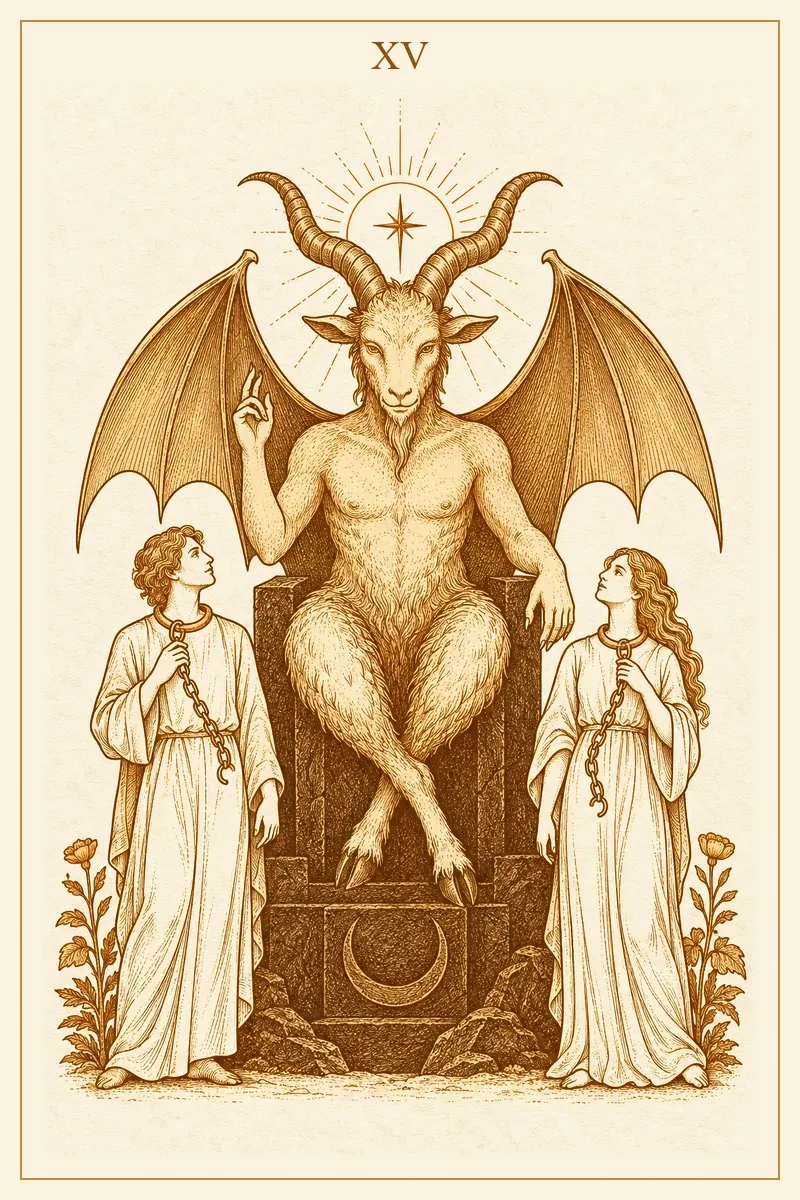
Upright, The Devil describes a binding arrangement you are getting something real out of: the salary that covers the mortgage and takes your evenings, the loan that bought the van, the relationship that works on paper and has not been honest in months. It is a card about trade, not about evil, and it carries the warmer end of appetite too.
Reversed, the chain is being handled. Someone has taken hold of the loop to work out how far it reaches: a resignation drafted, not sent, a subscription finally canceled, a conversation rehearsed in the car. It can also run into denial, where the arrangement is defended with unusual energy because looking straight at it would cost too much. Its range in love and money questions is set out in the meaning of The Devil.
Saturn's own trump is the last card in the deck
Planets hold their own trumps in the same tables. Capricorn's ruler is Saturn, and Saturn is given The World, card XXI, which surprises people more than the first pairing, because Saturn arrives in most horoscope columns as the planet of restriction.
Saturn is really the principle of edge: it makes something real by giving it a boundary, whether a deadline, a budget, a body or a border on a map. The World is what that looks like once the outline has been accepted rather than fought. So Saturn appears twice in a Capricorn reading: as the arrangement that holds you, and as the thing that finally has a shape. Its wider range across the deck is covered in Saturn in tarot.
The World (XXI): the end of the climb
Upright, The World marks a cycle that has genuinely closed: the degree awarded, the house signed for, the long project shipped. Its quiet insistence is that you let it be finished, and Capricorn's standard failure is to treat a finished project as a new baseline and start climbing again.
Reversed, something is close to done and is not being allowed to land. A dissertation at ninety percent. A move with three boxes still taped shut. A goodbye postponed because the ending would make the loss official. Reversed, this card is rarely about failure; it is about the last tenth of the work, the part nobody applauds. Its full range is laid out in the meaning of The World.
From the solstice to mid-January: the three decan cards
The goat's thirty degrees break into three ten-degree decans, and each one is given a numbered minor card plus a sub-ruling planet that colors it. Capricorn's three fall on the Two, Three and Four of Pentacles, the suit of work, money and everything that needs maintaining once it exists. The dates move by about a day from year to year.
Two of Pentacles: Jupiter in Capricorn, about December 22 to 30
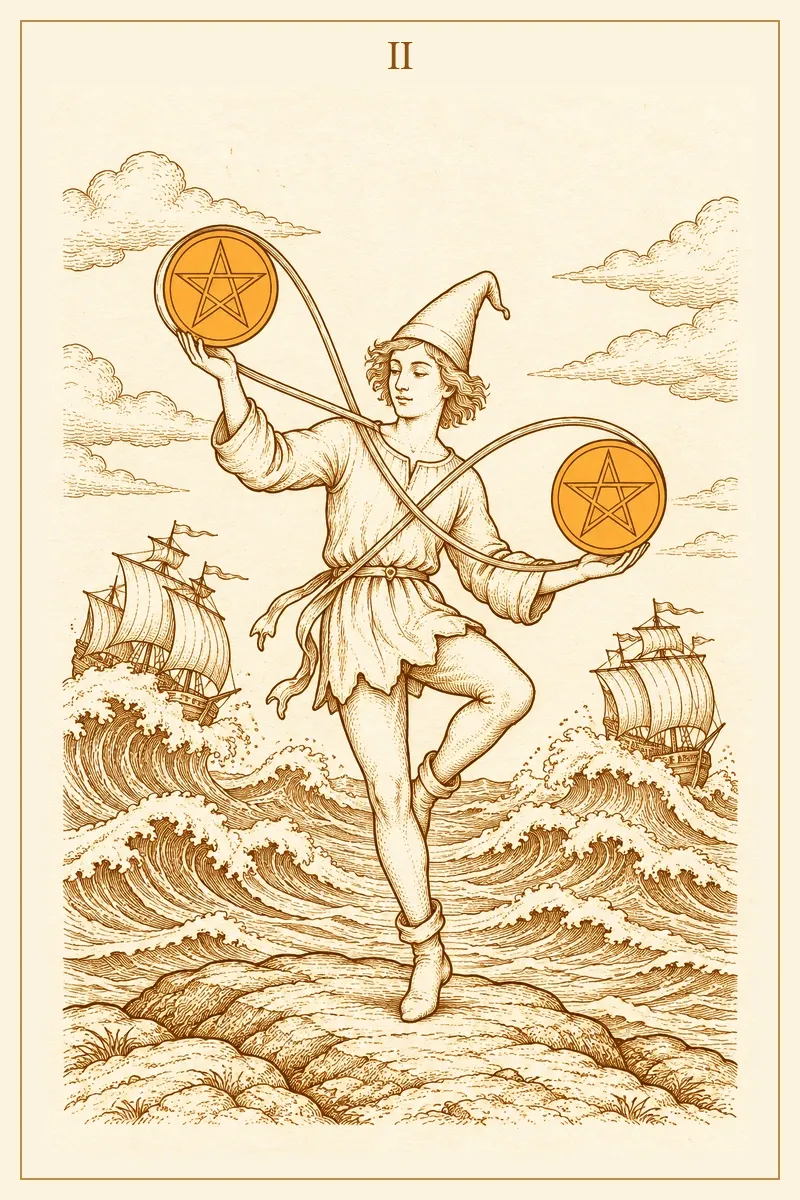
The first decan opens on the winter solstice under Jupiter, expansion dropped into the most structured sign in the zodiac. On the Two of Pentacles a figure keeps two coins moving inside a looping band while ships ride behind; older books call it the Lord of Harmonious Change.
Upright, this is competent juggling. Two jobs, a job and a course, the holiday and January's invoices. Nothing is dropping. The card is not asking you to simplify, only to notice that the balance is being actively held.
Reversed, the rhythm has gone: one obligation is eating the others, or a plate has already broken and is being pretended about. It appears when someone has taken on a new commitment without putting anything down, the characteristic Capricorn mistake with Jupiter's blessing on it. A fuller account sits in the Two of Pentacles meaning.
Three of Pentacles: Mars in Capricorn, about December 31 to January 9
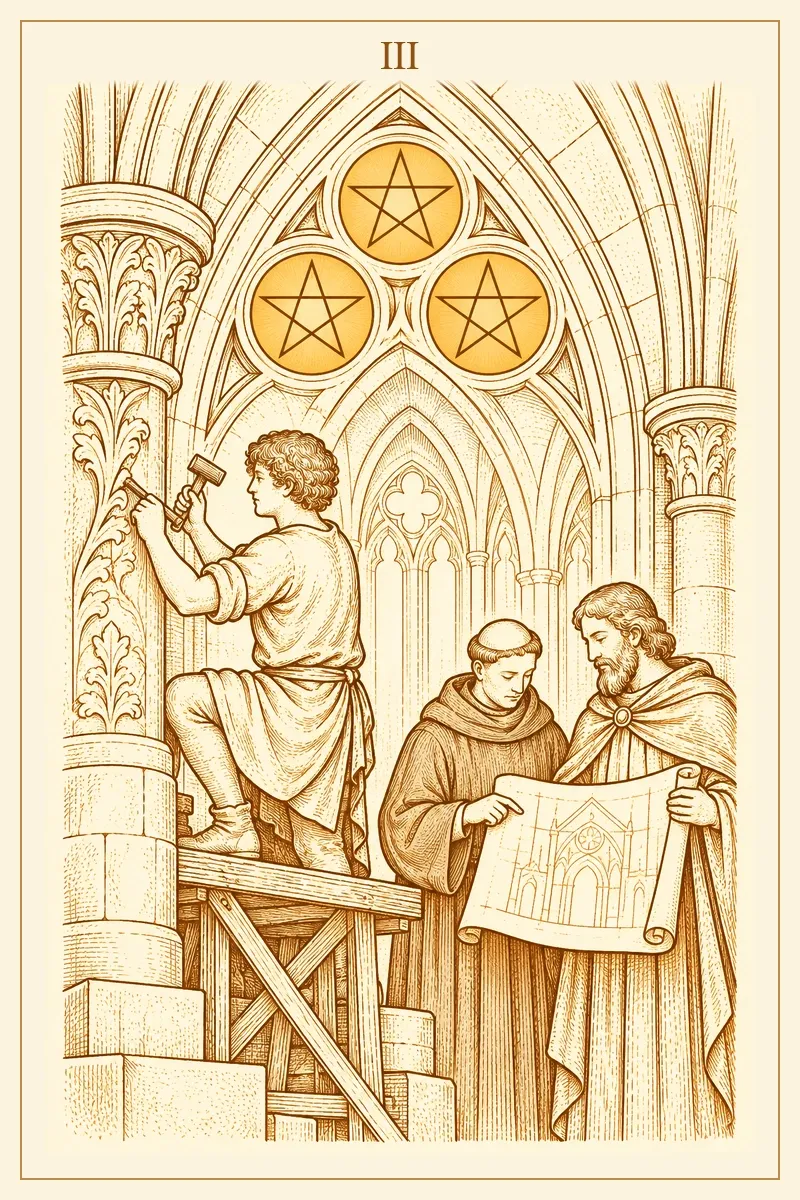
The second decan runs under Mars, which astrology places at its strongest in Capricorn: raw drive given a purpose and a schedule. On the Three of Pentacles a mason carves a cathedral pillar while a monk and a patron stand below with the plans. Older tables call it the Lord of Material Works.
Upright, it is skilled labor that has been seen. Your part of the job is recognized as yours, you are consulted rather than instructed, and the work is good enough that people have stopped checking it. In a career spread it is often the moment just before a title catches up with what you already do.
Reversed, one leg of the tripod is missing: the plans keep changing over the head of whoever holds the chisel, or the craft is excellent and nobody above has looked at it. That is a coordination problem rather than a competence problem. Its love, work and money readings are gathered in the Three of Pentacles meaning.
Four of Pentacles: the Sun in Capricorn, about January 10 to 19
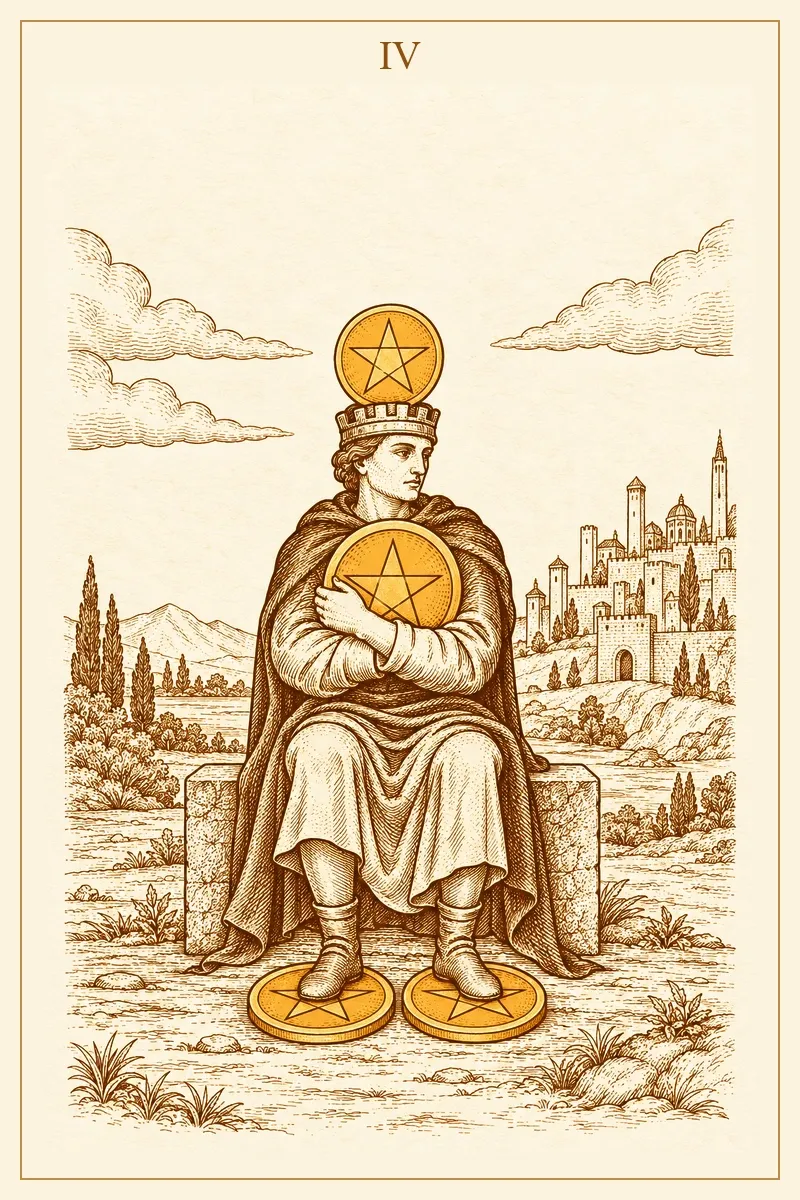
The third decan belongs to the Sun. On the Four of Pentacles a seated figure holds a coin clamped against the chest, one on the crown and two underfoot. Older books name it the Lord of Earthly Power, and it closes the Capricorn arc: you built it, and now you decide how tightly to hold it.
Upright, the card is not a scolding; sometimes a grip is correct. If the money is thin or the job is new, holding on is good sense. The question it asks is narrow: is this grip a strategy with an end date, or has it become the way you live?
Reversed, the hand is opening, in one direction or the other. Generosity returning, a budget loosened, a boundary that stopped protecting anything. Or control slipping before you were ready, which usually sits beside an unsettled card. Both faces are covered in the Four of Pentacles meaning.
Queen of Disks, Prince of Swords, and what your deck calls them
The court cards cause more disagreement than the rest of the table put together, and nearly all of it is about names. The older degree table uses King, Queen, Prince and Princess, with the King drawn as a mounted figure. Most modern decks print Page, Knight, Queen and King, where the Knight is the one on horseback. So the older King is the modern Knight, and the older Prince is the modern King for most readers.
In that table, Capricorn's degrees are shared by two courts and neither fits the sign neatly. The Queen of Disks covers the last ten degrees of Sagittarius and the first twenty of Capricorn; the Prince of Swords covers the last ten of Capricorn and the first twenty of Aquarius. In a modern deck that is the Queen of Pentacles across two thirds of the sign and the King of Swords across the final third. Readers who match rank to temperament instead choose the King of Pentacles, which the degree table puts on the Aries and Taurus border.
Queen of Pentacles: the first twenty degrees of the goat
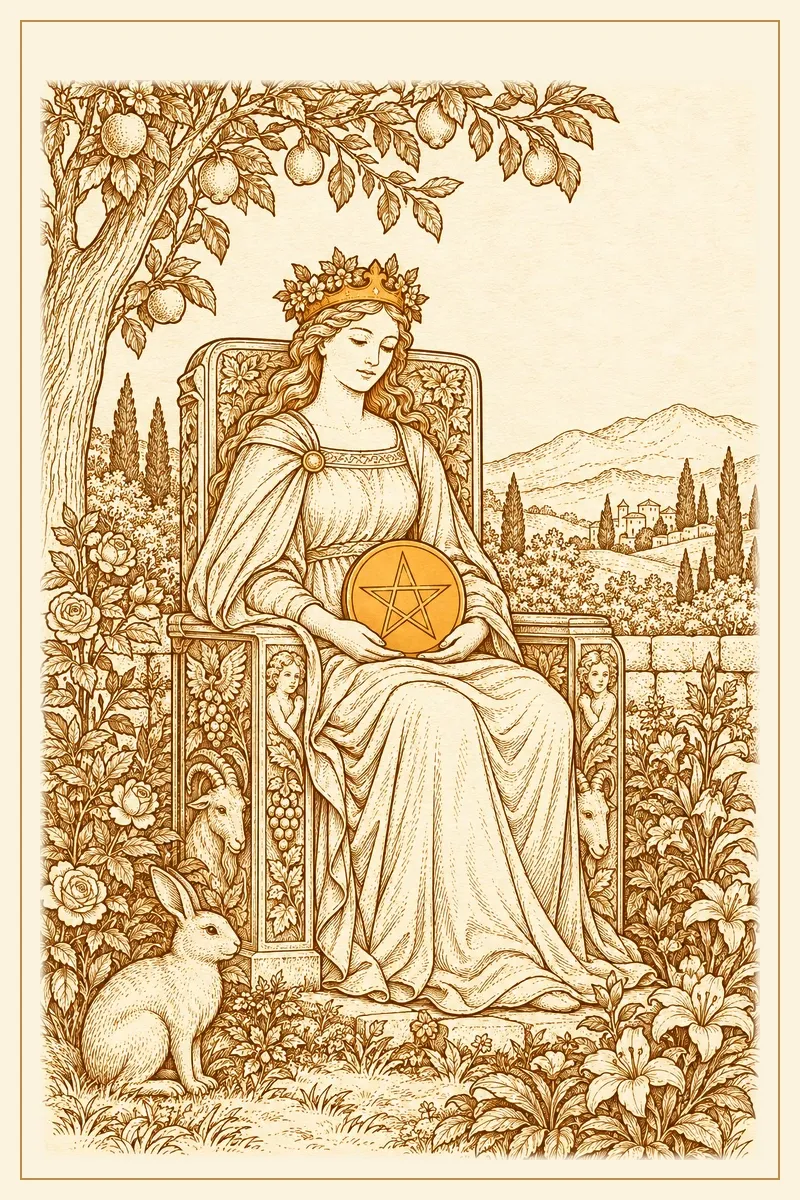
The Queen of Pentacles sits in a worked garden with a coin in both hands and a rabbit at her feet, and she is the most practical competence in the deck. Not wealth, competence. She knows what the house costs to run, and turns care into something you can eat or live in.
Upright, read her as a situation that is being well held, or as a person who provides steadily and says little about it. In a love question she is the partner who shows up with soup and a fixed shelf rather than a speech, and the honest follow-up is whether that has been received as love or just quietly used.
Reversed, the providing has gone out of balance. Everything runs because she runs it, nobody has thanked her in a year, and the care has curdled into martyrdom or control. She can also point at provision as leverage. More on both faces is in the Queen of Pentacles meaning.
King of Swords: the last ten degrees, where Capricorn meets Aquarius
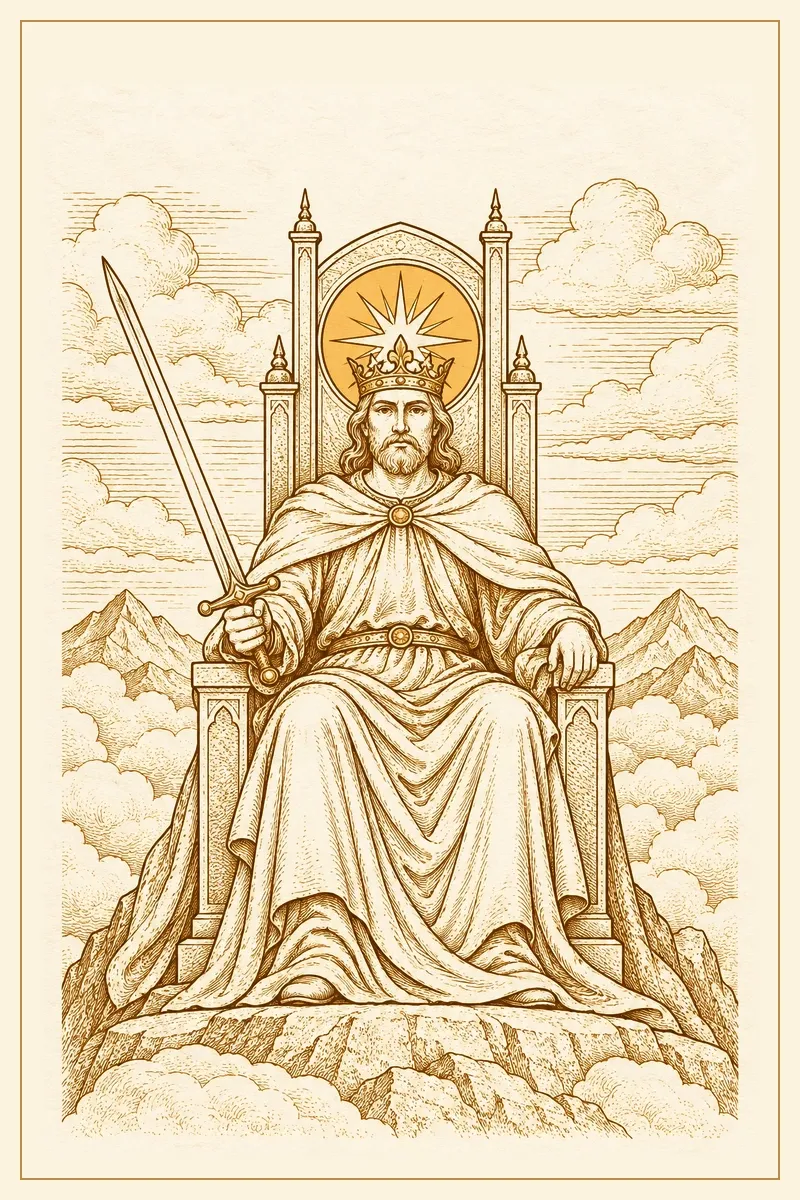
The final ten degrees hand over to air, and the King of Swords who rules there is cool, articulate and unsentimental. He is judgment, a boundary stated in words rather than held in the body, and he arrives when a situation has stopped being about effort and started being about a decision somebody has to make and defend.
Upright, he is the counselor you want in the room: facts first, feelings acknowledged and not used as evidence, a clear line drawn and kept. He is also the part of late Capricorn that steps back from a structure it built to ask whether that structure is fair.
Reversed, clarity has hardened into coldness, or authority is being used without a mandate: the manager who calls an opinion a policy, or the inner voice that cross-examines you over a decision made years ago with worse information. His fuller range is covered in the King of Swords meaning.
Near misses: The Emperor, The Hermit and the Ten of Pentacles
- The Emperor: the throne, the rule, the long reign. It reads as pure Capricorn authority and belongs to Aries. The Emperor sets the order; Capricorn maintains it afterward.
- The Hermit: an older figure alone on high ground with a lantern. The mountain causes the confusion, because Capricorn owns mountains everywhere else. The card is Virgo's.
- Ten of Pentacles: legacy, family money, the house that outlasts you. It feels like the end of the Capricorn story, and it is the third decan of Virgo.
What changes when a Capricorn card answers a love or career question
A correspondence is only worth knowing if it changes the question you ask next. These cards push a reading toward structure, cost and time.
Love: the person who shows up rather than says it
Capricorn cards read love as maintenance rather than declaration. The Queen of Pentacles gives steadiness; The Devil gives attachment with a real pull in it, which is not automatically a warning, because long relationships are full of chains people would put back on willingly. What matters is whether this is an arrangement you would choose again.
Work: the ladder, and what it is leaning on
This is the home ground of the Capricorn set, and the Three of Pentacles is the card to watch. It reads a working life as craft plus recognition plus a plan, and asks whether all three are present; a good deal of career dissatisfaction is one missing element rather than the wrong job. The Devil in a career spread names the trade, not the mistake.
Money: saving, and the fear underneath it
The Two and Four of Pentacles sit at opposite ends of the same worry. The Two is motion with nothing dropped yet; the Four is stillness with everything held. Neither can tell you whether a purchase will work out. What they do is name the feeling driving the decision, which is usually the part nobody has said aloud.
Timing, and why these cards point at winter
Capricorn's season runs from the solstice to mid-January, so a spread heavy with these cards often points at the turn of the year, the start of a fiscal quarter or a review cycle. Pentacles as a suit suggest slow timing measured in seasons rather than days. They indicate a pace, not an appointment, and a spread that looks full of winter may be describing a cold patch in a question with no season in it.
The scaffold layout: six cards for the turn of the year
This spread is built on the Capricorn questions rather than the Capricorn cards, so it works with any draw. You are checking a structure, the way you would walk around scaffolding before climbing it. If you have never laid out more than three cards, the shorter layouts in our guide to simple tarot spreads are an easier place to start.
- The ground — what you are standing on right now, stated without decoration.
- The frame — the structure holding your effort: the job, the routine, the agreement.
- The load — what that structure carries for you, and what it costs.
- The slack — the loose chain: something you treat as fixed that is optional.
- The next course — the one piece worth adding this season. One, not five.
- The line — what you are building toward, said plainly enough to repeat to someone else.
Lay the first three in a row along the bottom, the next two above them, and the sixth at the top. Read the bottom row first, because position four almost always changes once you know what the frame is carrying. As a year-opening draw it pairs well with the month-by-month layout in our year ahead spread.
What it looks like in practice: four more years for the pension
A reader we will call M. had been in one public-sector role for eleven years; four more and a pension threshold would be met. Whether to stay is not an answerable question, so it was reframed: what am I holding on to here, and what would it cost to let it go?
- The ground: Nine of Pentacles
- The frame: The Devil
- The load: Ten of Wands
- The slack: Eight of Cups
- The next course: Three of Pentacles
- The line: The World
The ground came up steadier than she expected. The Nine of Pentacles is self-made security, and it said plainly that the position she was negotiating from was strong; she had been talking as though she were cornered. The frame was The Devil, which she had braced for, and the reading did not take it as a condemnation. The arrangement is real and it pays.
The load was the Ten of Wands, and that was the sentence of the reading. What the structure carries is not the pension. It is everything she has quietly absorbed over eleven years because she is the one who knows how the department works: the extra reporting line, the two colleagues she trains and does not manage, the handover nobody else can do. She thought the bargain was four years for a pension; the bargain is four more years of carrying a growing bundle.
In the slack position sat the Eight of Cups, the figure walking away from eight cups that are not broken. Read as the loose chain it was not advice to resign. It named the thing she treats as fixed and is not: the assumption that leaving before the threshold would mean the eleven years were wasted.
The next course was the Three of Pentacles. Not leave, not endure, but renegotiate the work so that what she carries is visible and named: a title that matches the second reporting line, the training written down as a role. The line was The World. She wants the eleven years to amount to something she can name, which is a different goal from the pension she had been using as a stand-in for it.
Notice what the cards did not do. They did not say whether she will get the title. A spread arranges what you know and what you have been avoiding; the decision stays with the person holding it.
Capricorn season habits that do not turn into another job
The risk with this sign's cards is that reflection becomes one more thing to be good at. Keep the practice small enough that it survives a bad week.
- One question a week, not one card a day. Capricorn energy turns a daily draw into a streak to protect. One question, held for seven days, gives the answer time to change.
- Write the cost next to the goal. Name what pursuing it will take from you this season. The Devil is easier to read when the trade is already on paper.
- Keep a stop-doing card. Draw one card a month for what to put down. This sign adds reliably and subtracts badly.
- Date every entry. A note from last January, read now, says more about your patterns than any single spread can.
- Schedule the rest. Treat an evening off as an appointment with a deadline's standing.
Frequently asked questions
What tarot card is Capricorn?
The Devil, card XV of the Major Arcana. Saturn, the sign's ruler, adds The World; the Two, Three and Four of Pentacles carry the decans; and the Queen of Pentacles and King of Swords divide the sign's degrees.
Why is The Devil the Capricorn card when Capricorn is the responsible sign?
Because the card is about binding arrangements rather than wickedness, and nobody builds longer-lasting arrangements than Capricorn. The figure on card XV is goat-headed, the Hebrew letter attached to it means eye, and the chains are loose enough to remove.
Which court card represents Capricorn?
Two of them, and which you reach for depends on the system. By degrees, the Queen of Pentacles covers the first twenty degrees and the King of Swords the last ten. Readers who match rank to temperament choose the King of Pentacles instead. Both are in common use, so name the one you are using.
What are the Capricorn decan cards and their dates?
Two of Pentacles under Jupiter, roughly December 22 to 30; Three of Pentacles under Mars, roughly December 31 to January 9; Four of Pentacles under the Sun, roughly January 10 to 19. Each boundary moves by a day or so between years.
Is The World a Capricorn card?
Indirectly. It belongs to Saturn, and Saturn rules Capricorn, so it stands behind the sign the way a ruler's card always does. When The World and The Devil appear together, they usually describe one commitment at two different stages.
Does drawing The Devil mean a Capricorn is involved?
Not by itself. The Devil can describe anyone's bargain, whatever month they were born in. If the card seems to stand for a particular person, test that against how they actually behave, not against their birthday.
Can tarot tell me what Capricorn season will bring?
No. A season is a mood, not a forecast, and a reading cannot date an event, confirm what another person has decided or guarantee how a plan turns out. What it can show is the structure you are inside and the next question worth asking. For anything touching your health, a contract or your finances, the people qualified in those fields come first.
The chain was never locked
Capricorn's cards are often read as a lecture about discipline, and they are nearly the opposite. The Devil asks what you are getting out of the arrangement. The World asks you to let something be finished. The Pentacles in between ask whether the juggling, the craft and the grip still have a reason behind them.
If the earth signs interest you as a set, the Taurus cards hold the same material world at rest while the Virgo cards take it apart to see how it works, and the Cancer cards of the opposite sign ask who is being cared for while the structure goes up. When you are ready to lay your own six out, a tarot reading lets you work through the positions one at a time.