Timing in tarot comes from a handful of reading conventions, not from a clock built into the deck. Readers turn a card into a rough time frame through its suit (Wands quick, Pentacles slow), its number (a Three as three days, weeks or months), a season, or an astrological date range, and some cards carry their own sense of pace: the Eight of Wands says things are already moving, while The Hanged Man says not yet.
So when will it happen? A spread can give you a window to watch and, more usefully, the steps that have to come before it. It cannot fix a date, confirm what another person will decide or promise an outcome, and every timing system below is a tradition readers chose, not a prediction the cards guarantee. Read that way, timing becomes a planning aid rather than a countdown.
At a glance, these are the cards that speak most directly to pace:
- Eight of Wands: movement now; replies, news and plans already in flight.
- Ace of Wands: a start that can begin soon if you act on it.
- Wheel of Fortune: a turn of circumstances, partly outside your control.
- The World: a cycle reaching completion; the close of a chapter.
- Seven of Pentacles: slow growth; a longer season of tending.
- Four of Swords: rest and recovery come first.
- The Hanged Man: not yet; a pause with a purpose.
- Death: change that arrives once the old arrangement has fully ended.
Four ways readers turn a card into a time frame
There is no single official timing method. The four below come from different strands of practice and do not always agree, so choose one before you shuffle and keep to it for that reading instead of picking whichever answer you like once the cards are down.
Suit speed: fire moves fast, earth moves slowly
The simplest modern shortcut gives each suit a pace drawn from its element. Wands, the fire suit, point to days or a few weeks. Cups, the water suit, point to weeks. Swords, the air suit, can point to days or weeks, and they move unevenly: a realization lands in a moment, while the decision that follows it can drag on. Pentacles, the earth suit, point to months or longer, because money, health routines, jobs and homes change at the speed of material things.
This scheme is a convention handed down through twentieth-century teaching books, and its versions differ: some readers give Cups and Swords the same pace, others treat Swords as the quickest suit. Its real value is the contrast. A spread full of Wands describes a situation that wants to move; a spread full of Pentacles describes something that will be built slowly whatever you do.
Numbers as a count
A second convention pairs the card's number with the suit's unit. The Three of Wands becomes three days or three weeks; the Seven of Cups, about seven weeks; the Four of Pentacles, about four months. Aces stand at the very start, so an Ace in a timing position reads as something beginning now or close to it. Tens stand at the end of a cycle and point to closure rather than a count of ten.
Court cards resist this method because they carry no number and describe people or attitudes more than durations. If a Page, Knight, Queen or King lands in your timing position, read it as "when someone like this steps in" or "when you act like this," or use the astrological spans described below. For what each number says across the four suits, see our guide to number symbolism in the Minor Arcana.
Suits as seasons
A third convention gives each suit a season: Wands to spring, Cups to summer, Swords to autumn and Pentacles to winter. It fits questions with a natural yearly rhythm, such as a garden, a school year or a project tied to a busy season at work. It is also the least settled of the four. Some readers give Wands summer for its heat and Pentacles autumn for its harvest, and readers in the Southern Hemisphere have to decide whether spring means March or September.
Astrology and the Golden Dawn decans
The most detailed system comes from the Hermetic Order of the Golden Dawn, a late-nineteenth-century English occult society whose card attributions shaped both the Waite-Smith and the Thoth decks. In that scheme each numbered card from Two to Ten governs a decan, a ten-degree slice of the zodiac that the Sun crosses in about ten days. The Two, Three and Four of each suit belong to the cardinal sign of the suit's element, the Five, Six and Seven to its fixed sign, and the Eight, Nine and Ten to its mutable sign. The Two of Wands, for example, is the first decan of Aries, roughly March 21 to 30, and the Ten of Pentacles is the last decan of Virgo, roughly September 12 to 22.
The Major Arcana carry a sign, a planet or an element in the same system. The Emperor is Aries (about March 21 to April 19), The Lovers is Gemini (about May 21 to June 20), Strength is Leo (about July 23 to August 22) and Death is Scorpio (about October 23 to November 21). The Empress carries Venus, a planet rather than a sign, so in this system she describes a quality of the time more than a particular month. Court cards cover spans that straddle two signs, and the Aces and Pages receive no decan at all. The full list of dates, with every court card's span, is set out in our guide to tarot timing with astrology.
Cards that set the pace
These six cards answer "when" through their picture and meaning, whatever system you use, from "already happening" to "not yet."
Eight of Wands: already in motion
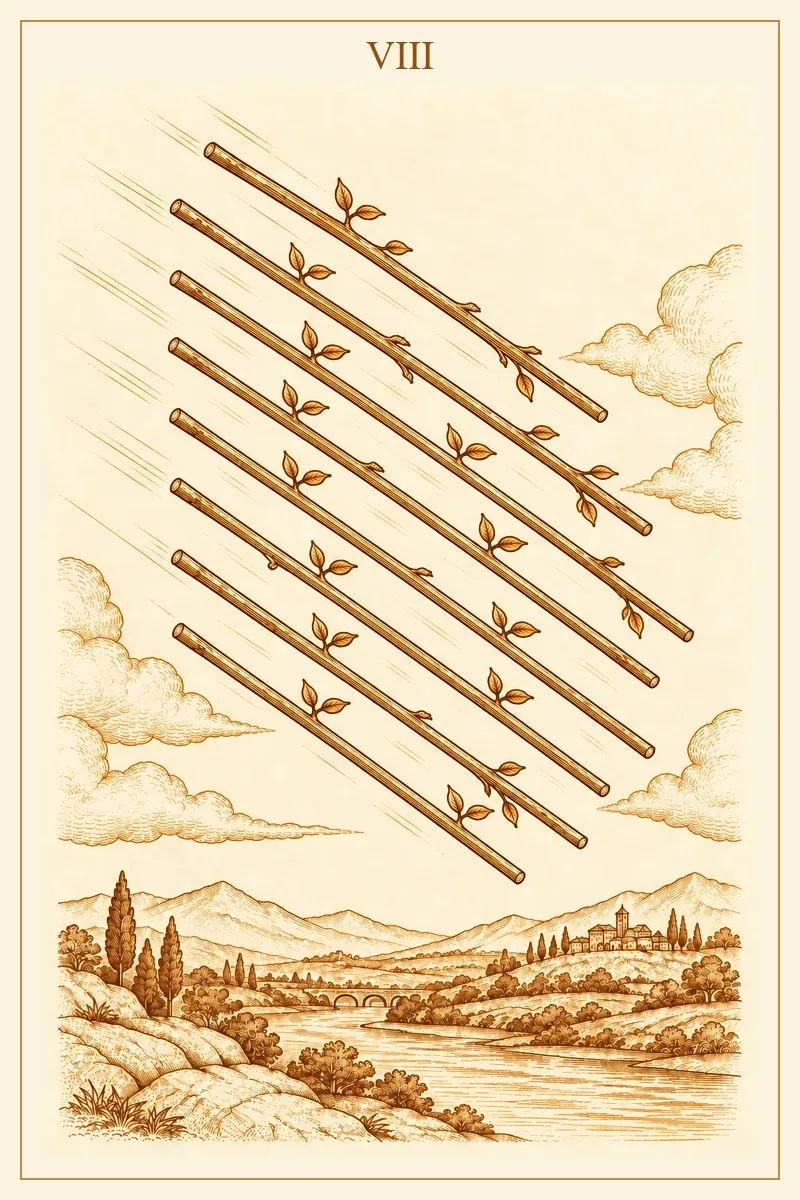
Eight leafy staffs streak diagonally across an open sky, speed lines trailing behind them, above a river valley and a small hill town. Nobody holds them: they are already thrown and still in flight, which makes this the plainest "soon" in the deck.
Upright in a timing position, it suggests days to a couple of weeks, with messages, replies, travel plans and decisions picking up speed together. In love it can describe a sudden run of contact after a quiet stretch; at work, an application moving faster than you expected. Reversed, the staffs have not landed yet: a delay in communication, crossed wires, or haste that pushes you to act before the facts arrive. Our Eight of Wands tarot meaning covers its other readings.
Wheel of Fortune: a turn you do not steer
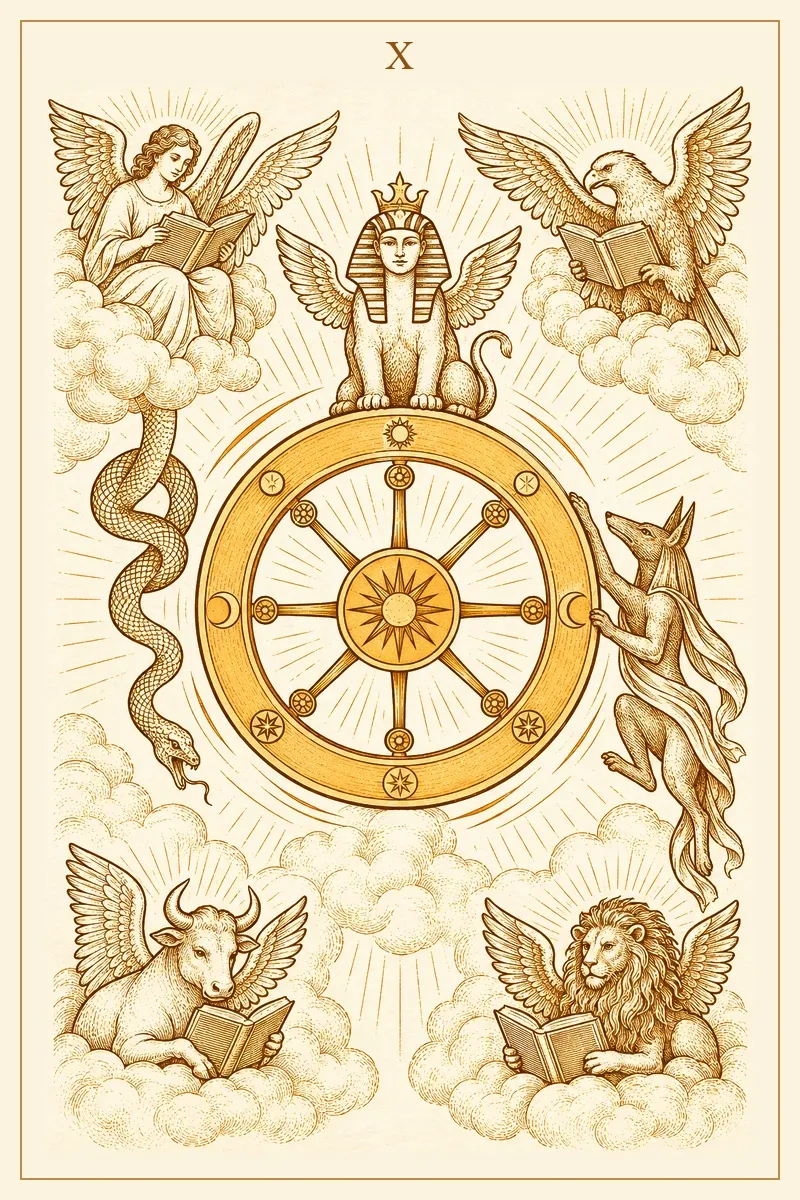
A golden eight-spoked wheel hangs among clouds with a crowned, winged sphinx seated on top. A serpent winds down its left side and a jackal-headed figure climbs its right, while four winged creatures, an angel, an eagle, an ox and a lion, read open books in the corners. Everything in the picture is moving except the sphinx.
As a timing card, the Wheel points to a change that arrives from outside your plans: a reorganization at work, a chance meeting, a door that opens because another closed. The Golden Dawn gives it Jupiter, which spends about a year in each sign, so readers of that system take it as a change due somewhere in the coming twelve months. Reversed, it describes a loop that has to run out first, or a change you are resisting. The Wheel of Fortune tarot meaning goes deeper into its symbols.
Seven of Pentacles: a long season of tending
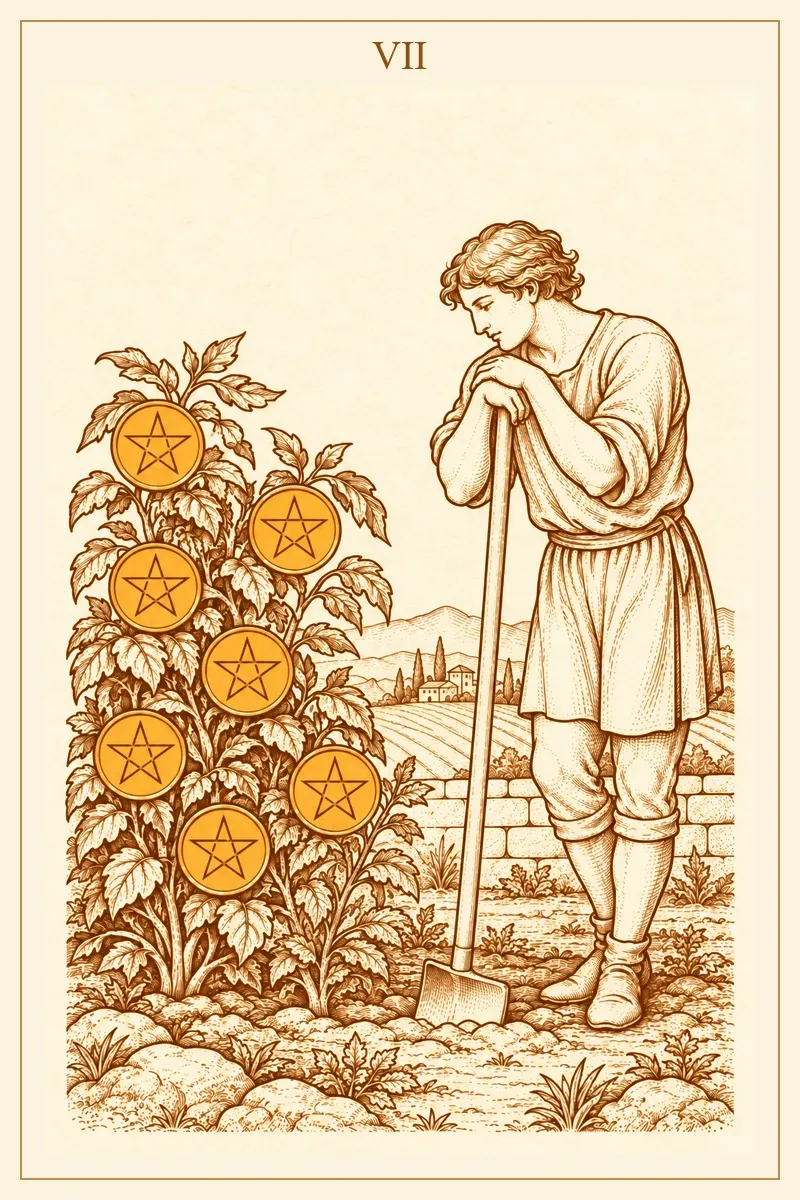
A young man in a belted tunic rests his chin on his hands, which are folded over the handle of his spade. Beside him, seven gold pentacles hang among the leaves of a thriving bush; behind him lie a low stone wall, plowed fields and a farmhouse among cypress trees. The digging is done for now. What remains is waiting.
This card is the deck's honest "not quickly." Upright, it points to months rather than weeks, and to results that depend on effort already invested: savings, training, a relationship built with care, a business that needs another season. Reversed, it can mean impatience that pulls up the crop to check the roots, or effort spent on something that will not pay back, in which case changing the plan matters more than waiting longer. Our Seven of Pentacles tarot meaning looks closely at its work and money readings.
The Hanged Man: not yet, on purpose
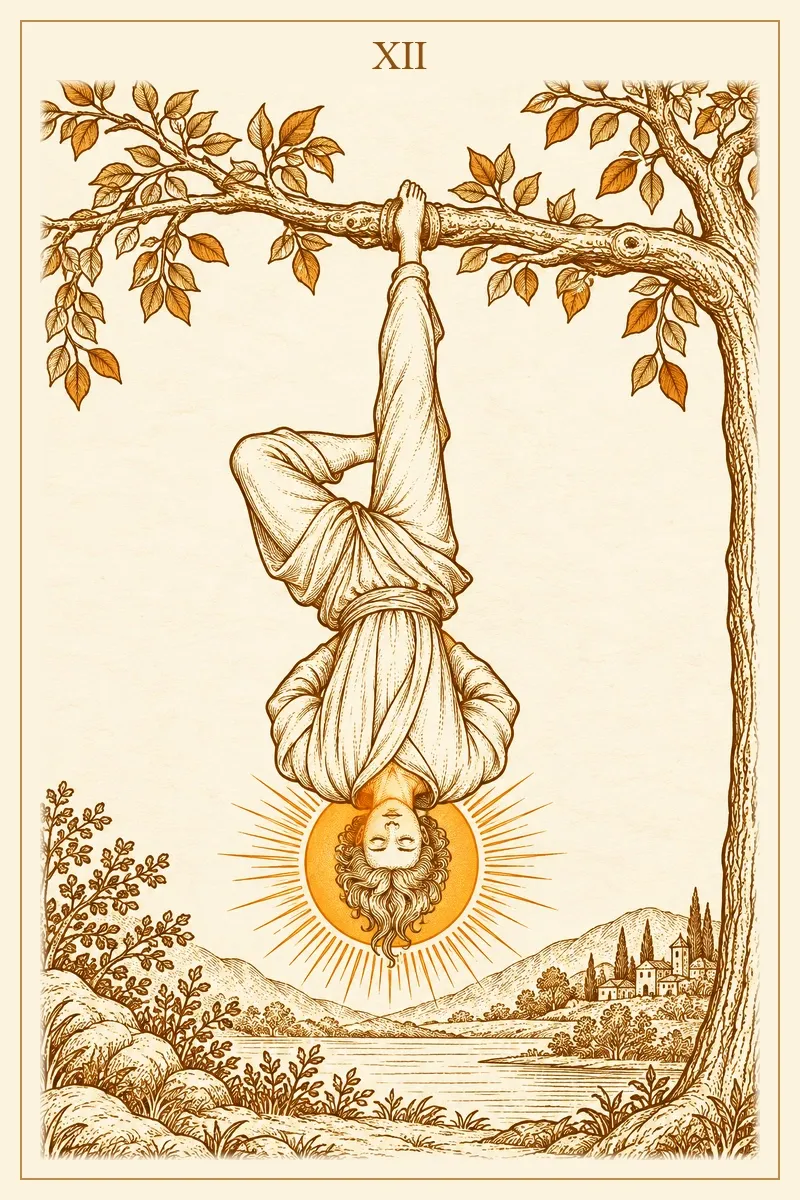
A figure hangs upside down from a leafy branch by one foot, the other leg bent behind the knee and the arms tucked behind the back. The face is calm, eyes closed, framed by a golden sunburst, with a lake and a quiet town below. Nothing about the picture says hurry.
In a timing question, this is the clearest "not yet" in the Major Arcana: a pause the situation needs, while information arrives, another person works through their process, or your own view shifts. The Golden Dawn gives it the element of water rather than a sign, so it offers no calendar window at all. Upright, the pause pays off if you use it to see the question from another angle. Reversed, it can describe stalling: waiting that has become a habit, or a sacrifice you keep making while nothing moves. The Hanged Man tarot meaning explores the card in full.
Four of Swords: rest comes first
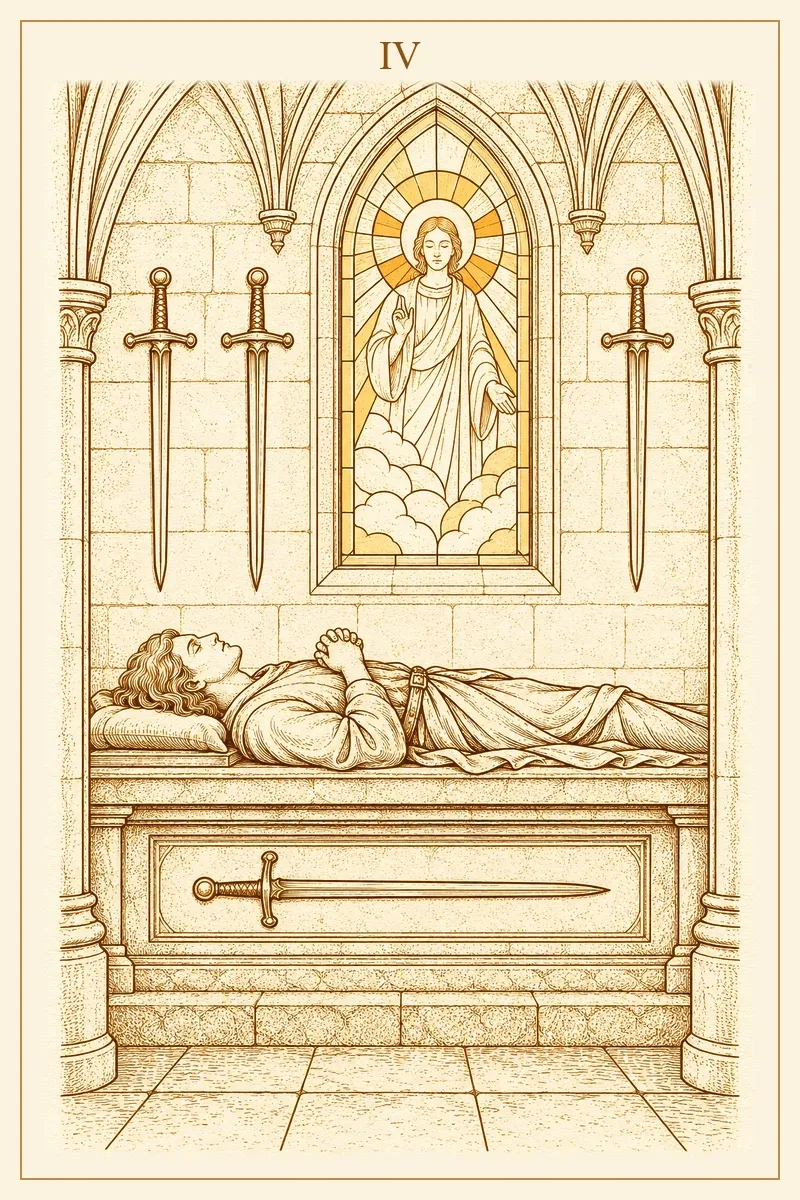
In a vaulted stone chapel, a figure lies on a carved tomb with hands joined on the chest. Three swords hang point-down on the wall, a fourth is carved along the side of the tomb, and a stained-glass window glows above. It is the stillest card in the Swords suit.
As a timing card it says recovery comes before progress. Upright, expect a quiet stretch, a few weeks by suit speed or about four by the number count, in which the best move is rest, review or simply not deciding yet. In questions about burnout or health, it supports a real break before any new deadline, alongside whatever care a professional advises. Reversed, it can mean restlessness that cuts the rest short, or a return to full activity before you are ready. You can read more in our Four of Swords tarot meaning.
The World: when the circle closes
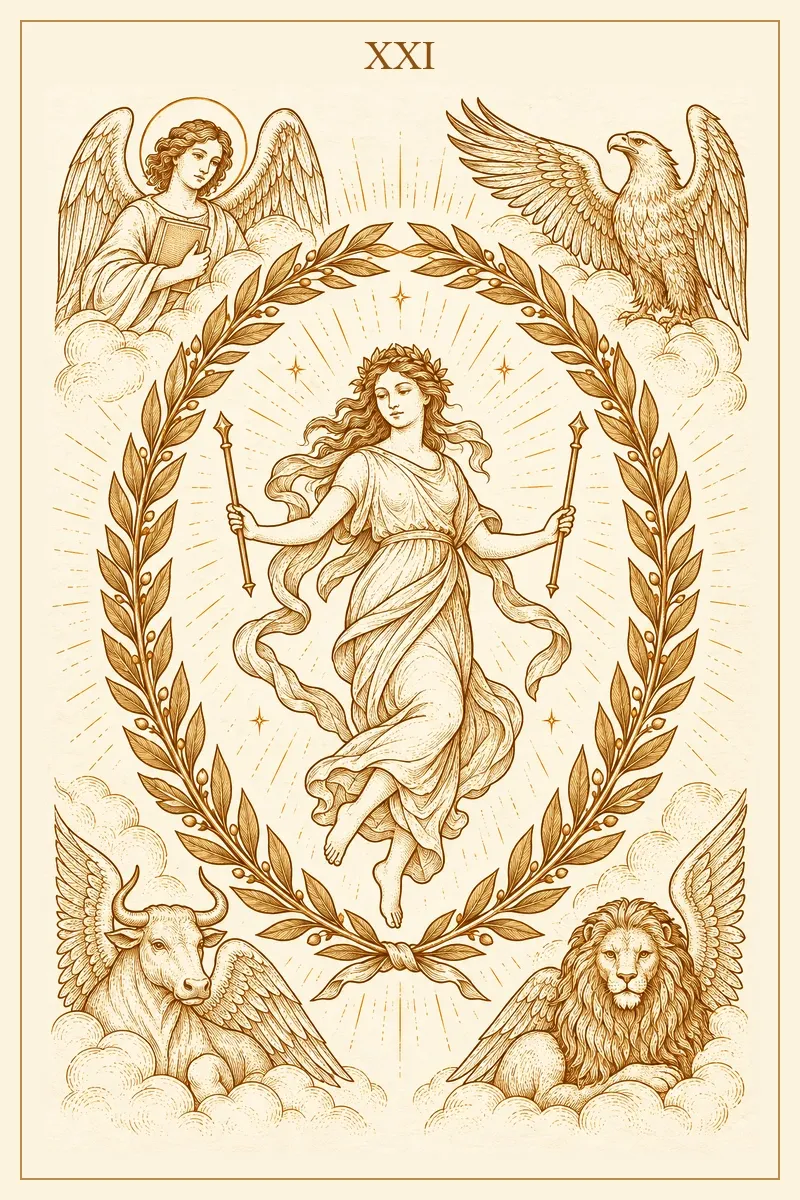
A dancer wrapped in flowing cloth floats inside an oval laurel wreath tied at the bottom with a ribbon, a slim wand in each hand and a laurel crown in her hair. The same four winged creatures that surround the Wheel watch from the corners: angel, eagle, ox and lion.
The World points to completion: the end of a course, a contract, a move or a long chapter in a relationship. As timing, it says that what you ask about arrives when the current cycle is finished, which can be close when the other cards agree. The Golden Dawn gives it Saturn, the slowest of the classical planets, so in that system its window can be long. Reversed, it describes a loose end: one last task, form, conversation or goodbye that holds the ending back. The World tarot meaning covers the card's other sides.
More cards with a sense of timing
Each of these also has a recognizable pace in a timing position.
- The Aces: the Ace of Wands is a spark you can act on now; the Ace of Cups is an emotional opening that needs time to fill; the Ace of Swords is a moment of clarity that can arrive suddenly; the Ace of Pentacles is a seed that grows over months.
- Death: change that comes when the old situation has run its course, not on a date you can circle.
- The Star: hope and recovery that return gradually after a hard stretch.
- Temperance: things coming together slowly, in measured steps, through patience and adjustment.
- The Hermit: a solitary season first; time alone with the question before anything outside you changes.
- The Chariot: momentum you create yourself through focus and effort.
- Two of Swords: a stalemate that lasts until someone makes a choice.
Asking a timing question the cards can answer
"When will he call?" gives a spread almost nothing to work with. These reframes keep your interest in timing but ask about the parts of the situation that cards can describe.
- "What has to happen before this can move?" turns a date into a sequence of steps.
- "What will the next three months look like for this?" sets a horizon the cards can read within.
- "Is now a good time for me to act on this?" is a yes-or-no about your own move, not someone else's.
- "What is slowing this down, and what part of that is mine to change?" turns waiting into something you can work on.
Setting a horizon matters for every system above. If you decide before shuffling that you are reading the next six months, a Pentacles card points to the far end of that window and a Wands card to the near end. Our guide on how to ask effective tarot questions has more ways to shape the wording.
The Hourglass spread for "when" questions
This six-card spread puts the timing card in context, so a window never stands on its own. Lay the cards in two rows of three.
- Where things stand: the current pace of the situation.
- What has to happen first: the step or change that comes before anything else.
- What could speed it up: a help, an action or an opening.
- What could slow it down: a delay, a doubt or an obligation.
- The window: read with the system you chose before shuffling.
- Your part: what you can do while you wait.
Read position 5 last, once you know what comes first and what helps or hinders. If position 2 holds a slow card such as a Pentacle, treat it as the real timeline and the window as the moment after it. If positions 3 and 4 are both strong, the timing is open in both directions and your own choices carry extra weight.
Worked example: the interview that went quiet
Take a sample question, asked in late October: "When am I likely to hear back about the job I interviewed for, and what can I do in the meantime?" Before shuffling, the reader chose suit speed plus number as the system and set a three-month horizon. The Hourglass spread gave these cards:
- Where things stand: Four of Swords, upright.
- What has to happen first: Page of Pentacles, upright.
- What could speed it up: Knight of Wands, upright.
- What could slow it down: Two of Swords, reversed.
- The window: Eight of Wands, upright.
- Your part: Seven of Pentacles, upright.
The Four of Swords says the process has gone quiet, which matches the feeling after an interview: nothing visible is happening. The Page of Pentacles in the "first" position points to practical steps on the employer's side, such as references, a budget approval or a skills check, and that careful work has to finish before any news can travel.
The Knight of Wands suggests a direct, friendly follow-up could move things along, while the reversed Two of Swords names the risk: someone on the other side has not made up their mind. The window card is the Eight of Wands. Within a three-month horizon the reader takes the Wands unit as weeks, so the Eight reads as news within about eight weeks, arriving as a burst of contact once the decision unsticks.
The Seven of Pentacles in "your part" asks for patience with effort attached: keep applying and keep building the skills the role needs. A grounded summary: send one polite follow-up in the next week or two, keep other applications alive, and expect news before the end of the year, with no certainty that the answer will be yes.
Timing questions in love, work and money
Love and relationships
Love timing questions are the hardest, because they depend on another person's choices. Read the cards for your side of it: when you will be ready, what brings connection closer, and which pattern you may need to set down. A Two of Cups in the window position can describe a mutual bond forming, but it speaks to the season you are entering more than to anyone else's schedule.
Career and work
Work questions suit timing systems better, since workplaces run on calendars: review cycles, fiscal quarters, hiring rounds and deadlines. Pair the suit speed with what you know about your field. A Three of Pentacles might point to about three months, with collaboration as what gets the result over the line.
Money and big purchases
In money questions, Pentacles set the tone and slow is normal. The Four of Pentacles can describe a period of holding and saving, while the Ace of Pentacles marks the start of something that grows over months. Treat any timing card as a prompt for your own planning, never as a reason for a financial move you would not make otherwise, and talk to a qualified advisor before decisions with real stakes.
What to do while the window is open
- Write down the window and the method. Note the dates and the system, set a reminder for when the window closes, and keep the reading in a tarot journal to see over time which method suits you.
- Act on the "first" card. Whatever the spread says has to happen first is something you can start on today.
- Do not redraw the same question the same day. A second spread laid out of impatience muddies the first.
- Check back when the window closes, not before. If nothing has moved, ask what has changed rather than asking "when" again.
- Keep living around the question. Keep your other plans, friendships and work moving, so the answer finds you busy rather than stuck.
Frequently asked questions
Can tarot tell me the exact date something will happen?
No. No card can confirm that an event will happen, let alone on a set day, because people's choices and circumstances keep shifting. A spread offers a window, a sequence and a sense of pace. For a wider look, read whether tarot can predict the future.
Which timing system is the most accurate?
None has been shown to beat the others. What helps is consistency: use one method for a few months, record your windows and compare them with what happened. That record tells you more about your own practice than any rule book.
Can I do a month-by-month timing spread?
Yes. Lay twelve cards in a circle, one for each month, with a thirteenth in the center for the year's theme, as in the birthday tarot spread. Look for the month whose card speaks most clearly to your question. It gives a range of months rather than a day.
Why do different readers give different time frames for the same card?
Because they follow different conventions. One reader uses suit speed, another the Golden Dawn decans, another a seasonal scheme or pure intuition. None of these is universal, which is exactly why it helps to name your system before you draw.
What does it mean when the cards keep saying "not yet"?
"Not yet" means the conditions are not in place, not that the thing will never happen. Look at what the spread says has to happen first and work on that. If The Hanged Man or the Four of Swords keeps appearing, the pause itself may be part of the answer.
Is timing more precise if I add astrology?
It is more specific, which is not the same as more certain. In the Golden Dawn system Death points to Scorpio season and Temperance to Sagittarius season (about November 22 to December 21), so a reading can name a month or even a ten-day stretch. That narrows the window, but it still describes a time to watch, not an appointment.
How do I read a reversed card in the timing position?
Choose your rule before you read. Some readers take a reversed timing card as a delay to the next occurrence of that window; others read it as an inner block to clear first. Either works if you apply it consistently.
Letting the answer arrive in its own time
A "when" question can hide a deeper one: what can I do while I wait? If you read for yourself, our guide to reading tarot for yourself helps you stay steady with that question. When you are ready to look at your own situation, you can lay out a calm Veil Soul reading and see what comes first.