
Loading your view
The page is gathering the latest information.
The page is gathering the latest information.
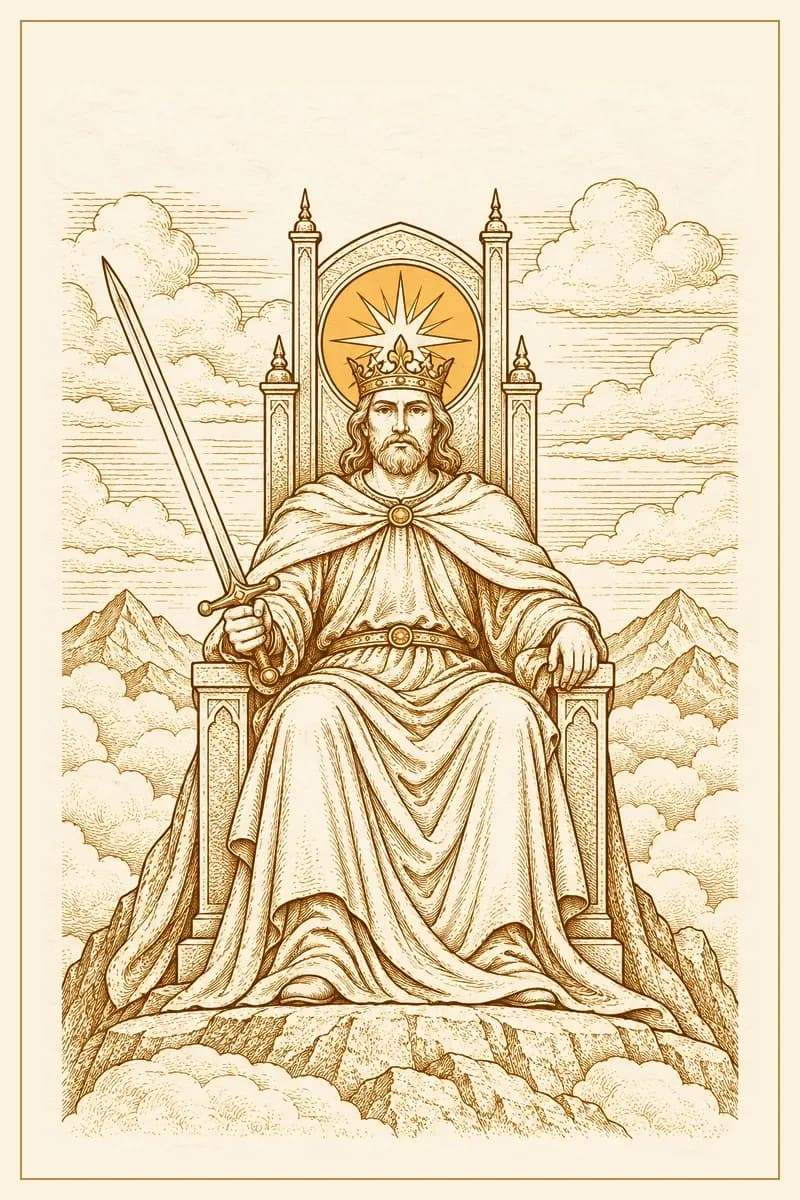
The card shown is VeilSoul's own engraved drawing of the 1909 Waite–Smith card. The scene and symbols described on this page follow the 1909 card, so a few details are drawn differently in our deck.
The King of Swords sits on his high throne facing forward, sword in his right hand pointing slightly to the left — the side of the subconscious, suggesting that his authority integrates both rational analysis and intuitive understanding. His expression is stern but not cruel: this is the face of someone who has accepted the weight of judgment and carries it with discipline and moral seriousness.
When the King of Swords appears upright, you are being called to make decisions with the authority of someone who has mastered the art of clear thinking. This is not a time for emotional reasoning or wishful interpretation. The King demands that you assess the situation with complete objectivity, weigh the evidence, and deliver a judgment that is fair — even if it is not popular.
This card represents the highest expression of intellectual power: not intelligence for its own sake, but intelligence in service of justice, truth, and ethical responsibility. The King of Swords does not abuse his authority. He does not use his mental sharpness to manipulate or dominate. He uses it to create order, establish fairness, and make the difficult decisions that others avoid.
When this card appears, it often signals involvement with systems of authority — legal matters, institutional decisions, professional hierarchies, or ethical frameworks. Someone in a position of power may influence your situation, or you may be called to step into that role yourself. Either way, the standard is the same: think clearly, decide fairly, and stand behind your judgment.
The sword is held perfectly vertical — tilted toward neither mercy nor punishment. True intellectual authority means letting the evidence decide, even when the verdict is personally inconvenient.
Either intellect becomes a weapon of control — logic twisted to serve predetermined conclusions — or the throne sits empty, the King paralyzed by knowing every judgment risks being wrong.
Detailed Interpretations
The King of Swords in love represents a mature, intellectually grounded approach to relationships. If single, this card suggests that your next significant connection will be with someone who values honest communication, mutual respect, and intellectual partnership over dramatic passion. The King does not fall in love — he chooses love, deliberately and with full awareness.
In a relationship, this card calls for the application of fairness and clear thinking to a romantic issue. Perhaps a decision needs to be made that affects both partners — the King asks you to make it based on what is right rather than what is easy. He also represents the commitment to treating your partner with consistent respect and ethical consideration.
The King of Swords in love is not cold — he is steady. He is the partner who shows love through reliability, honesty, and the willingness to have difficult conversations rather than avoid them. His love is not poetic, but it is dependable.
In love reversed, the King of Swords indicates a controlling or emotionally detached partner — someone who uses intellectual superiority to dominate the relationship dynamic. Communication becomes more like cross-examination than conversation. Decisions are made unilaterally rather than collaboratively. The reversed King treats the relationship as a system to be managed rather than a bond to be nurtured, applying the same analytical detachment to his partner's feelings that he would apply to a quarterly report — efficient, perhaps, but devastating to anyone who needs to feel loved rather than merely assessed.
If single, this card warns against seeking a partner who impresses your mind while neglecting your heart. Intelligence without warmth is a cold foundation for love. The reversed King of Swords is the person who wins every argument but loses every relationship, who can articulate exactly why their partner is wrong but cannot articulate why their partner matters. Watch for the pattern: if someone makes you feel intellectually stimulated but emotionally diminished, if you leave conversations feeling defeated rather than understood, if their version of honesty consistently leaves you in tears — that is not a partnership of equals. That is an intellectual monarchy, and you are the subject, not the sovereign.
Professionally, the King of Swords represents the pinnacle of intellectual authority and professional mastery. This card appears when strategic, high-level thinking is required — executive decisions, legal analysis, policy creation, or any situation where clear judgment has significant consequences. The King does not guess, does not rely on gut feelings, and does not make decisions based on who will be most pleased by the outcome. He examines the evidence, applies his principles, and acts on what is true rather than what is comfortable.
The King favors careers in law, governance, management consulting, medicine, academia, and any field where the ability to analyze complex information and make fair, decisive judgments is the primary skill. If you are preparing for an important professional decision — a negotiation, a presentation, a contract review — the King says you are ready. Trust your analysis and deliver your conclusion with authority. Your preparation has been thorough, your reasoning is sound, and the time for second-guessing has passed.
This card can also represent a mentor, supervisor, or authority figure who communicates with intellectual precision and expects the same from you. They may seem demanding, but their standards will sharpen your own thinking. Learn from their rigor. The King of Swords in career ultimately represents the professional who has earned the right to speak with authority because they have done the work — years of study, practice, and disciplined thinking that give weight to every word they deliver.
Career-wise, the reversed King of Swords suggests abuse of professional authority — a supervisor who leads through fear, a decision made without ethical consideration, or a professional environment where rules are applied unfairly. If you are in a position of power, examine whether your authority serves your team or only your ego.
This reversal can also indicate analysis paralysis at a leadership level — an important decision that keeps being deferred because no analysis feels comprehensive enough. At some point, the King must rule. Indecision is its own kind of tyranny.
The King of Swords in health encourages you to take an authoritative, well-informed approach to your wellness. This is the time for second opinions, research, and evidence-based decision making about your health. Do not accept a diagnosis or treatment plan passively — ask questions, understand the reasoning, and participate actively in your healthcare decisions.
Mentally, the King represents mastery over the mind — the ability to direct your thoughts rather than being directed by them. If you struggle with anxiety, rumination, or decision fatigue, the King's medicine is structure: create frameworks for your thinking, establish priorities, and stop trying to hold everything in your head at once.
The King can also indicate the need for professional mental health support — specifically, someone who brings intellectual rigor to the therapeutic process. Cognitive behavioral therapy and similar structured approaches align with this card's energy.
Use this as a reflective prompt, not medical advice or a diagnosis. For health concerns, seek guidance from a qualified healthcare professional.
The King of Swords reversed reveals authority corrupted by ego, intellect weaponized for personal gain, or judgment so rigid that it has lost touch with human reality. The reversed King may be technically right about everything — and completely wrong about what matters.
This reversal can indicate an authority figure who abuses power through manipulation, intimidation, or the cold application of rules without regard for context or compassion. In organizations, this is the leader who demands compliance but offers no understanding — the one who sees people as variables in an equation rather than human beings with complex lives.
If the reversed King represents you, it may be warning that your intellectual confidence has become intellectual arrogance. You may be making decisions based on how things should work in theory while ignoring how they actually work in practice. Or you may be using your analytical ability to justify a conclusion you had already reached emotionally.
The deepest shadow of the reversed King is the tyrant who genuinely believes he is serving justice. Check your motives. Power that is not regularly questioned by the one who wields it is power that has already begun to corrupt.
The reversed King of Swords teaches that authority without accountability is tyranny, and intellect without empathy is merely clever cruelty. The lesson is that the highest form of intellectual mastery is knowing when to set the sword down — when to lead with fairness rather than force, and when to listen rather than judge. The King who rules only through the sharpness of his mind, without the tempering influence of compassion, creates a kingdom where everyone obeys but no one trusts, where order is maintained through intimidation rather than respect, and where the truth everyone speaks is the truth the King wants to hear rather than the truth that would actually serve the realm.
This reversal also teaches the profound difference between authority and authoritarianism. True authority is earned through consistent fairness, transparent reasoning, and the willingness to be held to the same standards you impose on others. Authoritarianism is the counterfeit — control maintained through intellectual dominance, emotional manipulation disguised as rationality, and the systematic dismantling of any voice that challenges the king's conclusions. The reversed King's path back to wisdom begins with a question he rarely asks: what if I am wrong?
Make one decision today that is fair rather than convenient. Let your judgment stand on principle, not on what is easiest or most popular. The King of Swords asks you to embody intellectual integrity — to examine a situation with clear eyes, to weigh the evidence without letting personal bias tip the scales, and to deliver your conclusion with the quiet authority of someone who has thought carefully and arrived at the truth. Do not soften your analysis to avoid discomfort, but do not sharpen it to inflict it either. The king's sword is for justice, not for punishment. Today, be the person in the room who says what is true, fairly and without flinching, and trusts that clarity — delivered with respect — is always ultimately kinder than comfortable silence.
“I wield my intellect with fairness and moral courage. My authority serves truth, not ego, and my judgment is tempered by compassion.”
The card shown is VeilSoul's own engraved drawing of the 1909 Waite–Smith card. The scene and symbols described on this page follow the 1909 card, so a few details are drawn differently in our deck.
The King sits on a throne decorated with butterflies, angels, and crescent moons — symbols of transformation, divine message, and the receptive subconscious. These decorative elements soften the martial energy of his sword, reminding us that true intellectual authority integrates mercy and intuition alongside logic.
His sword is held in his right hand but points slightly to the left — the side traditionally associated with the unconscious and receptive mind. This subtle detail distinguishes the King from the Knight: the Knight charges straight ahead, but the King incorporates all dimensions of knowing into his judgment.
His purple robe represents spiritual authority and wisdom, while his blue tunic underneath symbolizes clarity of thought and truth. The crown on his head marks sovereignty — not over others, but over his own mind.
The two birds in the sky behind him connect to the Queen's single bird — where she had one perspective, he has two: the ability to see both sides of any argument before rendering judgment. The clouds are present but lower than his position, indicating that he sits above confusion while remaining aware of it.
Kings represent the air element within their suit — the commanding, governing intelligence that masters the suit's energy. The King of Swords is air of air: intellectual mastery expressed through decisive authority, ethical judgment, and the power to establish order through clear thinking.
Keep or share this card reference
✦ From meaning to reflection ✦
Bring what this card stirred into a reading shaped around what you are facing now.
Read with this insight