Loading your view
The page is gathering the latest information.
The page is gathering the latest information.
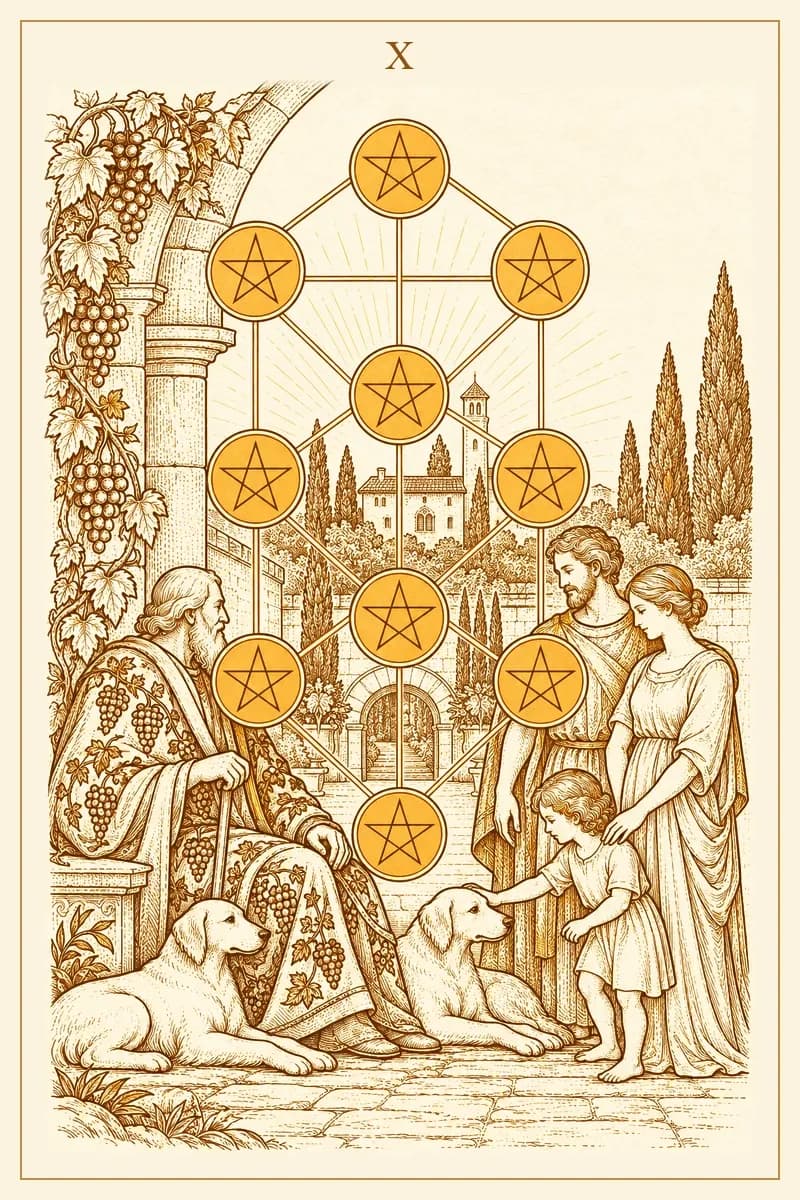
The card shown is VeilSoul's own engraved drawing of the 1909 Waite–Smith card. The scene and symbols described on this page follow the 1909 card, so a few details are drawn differently in our deck.
The Ten of Pentacles presents a multi-generational family scene within the courtyard of a grand estate. An elderly patriarch sits near the entrance, draped in a richly embroidered robe decorated with grape vines and symbols of abundance, while two white dogs rest at his feet. A younger couple stands nearby — perhaps his son and daughter-in-law — and a small child reaches toward one of the dogs. Ten pentacles are arranged in the pattern of the Kabbalistic Tree of Life, overlaying the entire scene and connecting every figure within its sacred geometry.
When the Ten of Pentacles appears upright, you have arrived at a place of enduring material success — wealth that extends beyond your individual lifetime to benefit your family, community, and future generations. This is not merely personal prosperity but legacy: the structures, values, resources, and traditions that you create and pass forward.
This card represents the highest material achievement in the Pentacles suit — not just having enough for yourself, but having built something that sustains others. The estate, the family, the accumulated wisdom, the financial security that allows future generations to begin their journeys from a position of strength rather than struggle. This is what responsible stewardship produces over time.
The Ten of Pentacles also speaks to the importance of roots, traditions, and belonging. The family in the card is not just wealthy — they are connected. Three generations share a space, a history, and a set of values. In a world that often prioritizes individual achievement, this card reminds you that the deepest form of success is one that strengthens the bonds between people and endures across time.
An elderly patriarch sits among dogs at an archway while family gathers, ten pentacles in the Tree of Life pattern overhead. Wealth has matured beyond individual achievement into legacy.
Inheritance poisons relationships when family fights over assets, or the weight of legacy becomes a cage that prevents the next generation from forging their own path.
Detailed Interpretations
The Ten of Pentacles in love represents the deepest, most enduring level of committed partnership — a relationship that has matured beyond the intoxication of early romance into something far more substantial: a shared home, a family, a legacy being built together brick by brick and year by year. This is love that has survived the tests of time and emerged not merely intact but enriched, its roots now so deep that the partnership has become a living institution — a source of stability and belonging not just for the couple but for the children, relatives, and community members who orbit their shared life.
When this card appears, it often signals a relationship milestone connected to family and material security — an engagement, a home purchase, a decision to start a family, or the simple but profound recognition that you and your partner have built something genuinely lasting. The Ten celebrates the beauty of domestic partnership in its fullest expression: not just romantic love but the intertwined financial partnership, shared values, family traditions, and mutual commitment to building something that will outlast both of you.
For singles, the Ten of Pentacles suggests that the next significant relationship is likely to carry long-term potential from the very beginning. You may meet someone through family connections, within your cultural community, or in a context where shared values and compatible life goals are immediately apparent. The Ten does not promise whirlwind romance — it promises something rarer and more valuable: a partner with whom you can build a life of genuine substance, someone whose vision of the future aligns with yours deeply enough that building together feels natural rather than negotiated.
In love reversed, the Ten of Pentacles warns of family interference disrupting an otherwise healthy relationship — parents who disapprove of your partner, inheritance disputes that create tension between siblings and their spouses, or the weight of family expectations that constrains your freedom to build the kind of partnership you genuinely want. The legacy that should be a blessing has become a burden, and family loyalty is being weaponized against personal happiness.
This reversal also indicates a relationship that presents a facade of stability while crumbling beneath the surface. From the outside, everything looks enviable — the home, the family photos, the holiday gatherings — but privately, the partnership is hollow, sustained by obligation, shared assets, and social expectations rather than genuine love and mutual respect. The reversed Ten asks whether you are maintaining a legacy or maintaining an illusion, and whether the cost of preserving appearances has become greater than the cost of honest change.
Additionally, the reversed Ten can signal disputes over shared finances, property, or inheritance within a partnership — disagreements about how money should be managed, whose family should receive priority, or how assets should be divided if the relationship ends. These material conflicts often mask deeper emotional issues about trust, fairness, and the power dynamics embedded in financial dependence.
Professionally, the Ten of Pentacles represents the pinnacle of long-term career success — a business that has matured into an institution, a professional legacy that creates opportunities for others, or financial achievements that provide security not just for you but for your family and potentially for generations to come. If you have built a company, this card suggests it has reached the stage where it could continue to thrive beyond your personal involvement. If you have pursued a career in an established organization, the Ten indicates that your contributions have become foundational — part of the institutional knowledge and culture that sustains the organization's excellence.
This card frequently appears for business owners planning succession, professionals establishing retirement funds and estate plans, or anyone who is thinking strategically about the long-term financial legacy they will leave behind. The Ten validates the decades of work that made this security possible while encouraging you to think about wealth not merely as personal accumulation but as a resource that flows through generations — funding education for grandchildren, endowing charitable foundations, or simply providing the financial stability that allows your descendants to pursue their ambitions without the survival anxiety that may have driven your own early career.
The Ten of Pentacles also speaks to the value of institutional knowledge and mentorship. The elderly patriarch in the card does not merely sit on his wealth — his presence within the family scene suggests that his wisdom, experience, and guidance are as valuable as his material resources. In professional terms, this translates to the importance of mentoring the next generation, documenting institutional knowledge before it is lost to retirement, and building organizational cultures that sustain excellence long after the founders have departed.
Career-wise, the reversed Ten of Pentacles suggests a family business in serious trouble — internal conflicts, mismanagement, generational disagreements about direction, or the painful realization that the enterprise built by previous generations is not sustainable in its current form. Succession planning may have been neglected, leaving the business vulnerable to leadership gaps, or family politics may be poisoning the professional environment in ways that drive away talented non-family employees.
This reversal also indicates professional legacies being squandered — retirement savings depleted by poor investment decisions, institutional knowledge lost because no one documented it before key personnel departed, or organizations that have become so attached to tradition that they cannot adapt to changing market conditions. The reversed Ten asks whether you are preserving a legacy or embalming one, and whether the structures you inherited still serve their original purpose or have become monuments to a past that no longer exists.
On a personal financial level, the reversed Ten warns of estate planning failures — inadequate wills, poorly structured trusts, tax liabilities that could significantly erode the wealth you intend to pass forward, or simply the absence of any plan at all for what happens to your assets and responsibilities after you are gone. If you have been postponing these conversations and decisions, the reversed Ten urges you to address them now, while you have the clarity and capacity to do so thoughtfully.
The Ten of Pentacles in health speaks to the profound importance of generational wellness — the understanding that your health choices ripple forward through time, affecting not just your own body but the habits, beliefs, and genetic expression of your children and their children after them. Healthy patterns passed down through families — regular physical activity, nutritious cooking traditions, open conversations about mental health, preventive medical care — create a legacy of wellbeing that compounds across generations just as financial wealth does.
This card encourages you to think about health in terms of inheritance. What physical habits are you modeling for the younger members of your family? What is your family's medical history, and how does awareness of genetic predispositions inform your preventive care decisions? The Ten of Pentacles asks you to become a conscious steward of your family's health legacy — not just managing your own wellness but actively creating conditions that support the health of those who will come after you.
On a practical level, the Ten may indicate a period of robust health supported by strong family and community networks. The patriarch in the card is elderly but present, active, and engaged — suggesting that longevity is not merely about physical survival but about maintaining the vitality and purpose that make a long life meaningful. If you are caring for aging family members, this card honors that work while reminding you that the quality of elder care you provide today establishes the standard your own children will follow when your turn comes. Health as legacy means caring for yourself with the same devotion you would want your grandchildren to show toward their own bodies and minds.
Use this as a reflective prompt, not medical advice or a diagnosis. For health concerns, seek guidance from a qualified healthcare professional.
The Ten of Pentacles reversed can indicate family conflict over money, inheritance disputes, an unstable financial foundation, or the dissolution of structures that were supposed to endure. The legacy has cracks — perhaps due to mismanagement, broken trust, family dysfunction, or a failure to plan for the future while there was still time.
This reversal may also signal a rejection of traditional values or family expectations. You may feel trapped by the legacy you have inherited — bound by family obligations, weighed down by tradition, or pressured to maintain a lifestyle or career that does not align with your authentic self. Not every inheritance is a gift; some are cages.
Alternatively, the reversed Ten can indicate financial instability in later life — retirement funds that are insufficient, property values that have declined, or a realization that long-term financial planning was neglected during the years when it mattered most.
The reversed Ten of Pentacles teaches that legacy is never guaranteed — it must be actively maintained, wisely managed, and consciously transmitted from one generation to the next with both love and practical competence. Wealth without wisdom creates conflict rather than security; traditions without genuine love behind them become obligations that breed resentment rather than belonging. The deepest lesson is that what you build matters less than how you pass it forward — a modest inheritance shared with clarity, fairness, and affection sustains a family far better than a vast fortune contested in court by siblings who never learned to trust each other.
This card also teaches that the most valuable things you can leave behind are not material — they are the values, the emotional intelligence, the capacity for love and honest communication that enable your descendants to build their own prosperity rather than merely spending yours. A legacy of character outlasts a legacy of currency every time, and the reversed Ten asks you to invest in both with equal seriousness.
Think beyond yourself today. Consider how your choices — financial, relational, professional, personal — affect not just your own immediate future but the people who depend on you, the family who looks to you for stability, and those who will inherit the consequences of what you build or neglect to build. Legacy is not constructed in grand gestures; it is assembled in the daily decisions that compound over years into something lasting. Make one choice today that your future self — or your grandchildren — will thank you for. Build something that endures.
“I build a legacy of abundance, wisdom, and love that blesses my family and community for generations. My prosperity serves not just myself but all who come after me.”
The card shown is VeilSoul's own engraved drawing of the 1909 Waite–Smith card. The scene and symbols described on this page follow the 1909 card, so a few details are drawn differently in our deck.
The ten pentacles arranged in the Tree of Life pattern is the card's most significant symbol — sacred geometry overlaying a domestic scene, suggesting that family wealth and spiritual completeness are connected. The Tree of Life maps the journey from divine source to material manifestation, and its presence here indicates that the family's prosperity is aligned with a deeper cosmic order.
The elderly patriarch represents accumulated wisdom, tradition, and the responsibility of stewardship. His richly decorated robe — covered in grapevines and mystical symbols — marks him as someone who has not merely accumulated wealth but has understood its deeper meaning. The two dogs at his feet represent loyalty, protection, and the domesticated instincts that guard what has been built.
The three generations — elder, adult couple, and child — represent the continuity of legacy. The archway of the estate frames them all, suggesting that the structures we build (physical, financial, cultural) shelter those who come after us. The child reaching for the dog is the most human detail in the card: a small, innocent gesture that reminds us why we build legacies in the first place.
Ten represents completion, fulfillment, and the culmination of a cycle. In the Pentacles suit, it manifests as the full realization of material abundance — wealth that has matured into legacy, prosperity that has become tradition, and success that endures across generations.
Keep or share this card reference
✦ From meaning to reflection ✦
Bring what this card stirred into a reading shaped around what you are facing now.
Read with this insight