
Loading your view
The page is gathering the latest information.
The page is gathering the latest information.
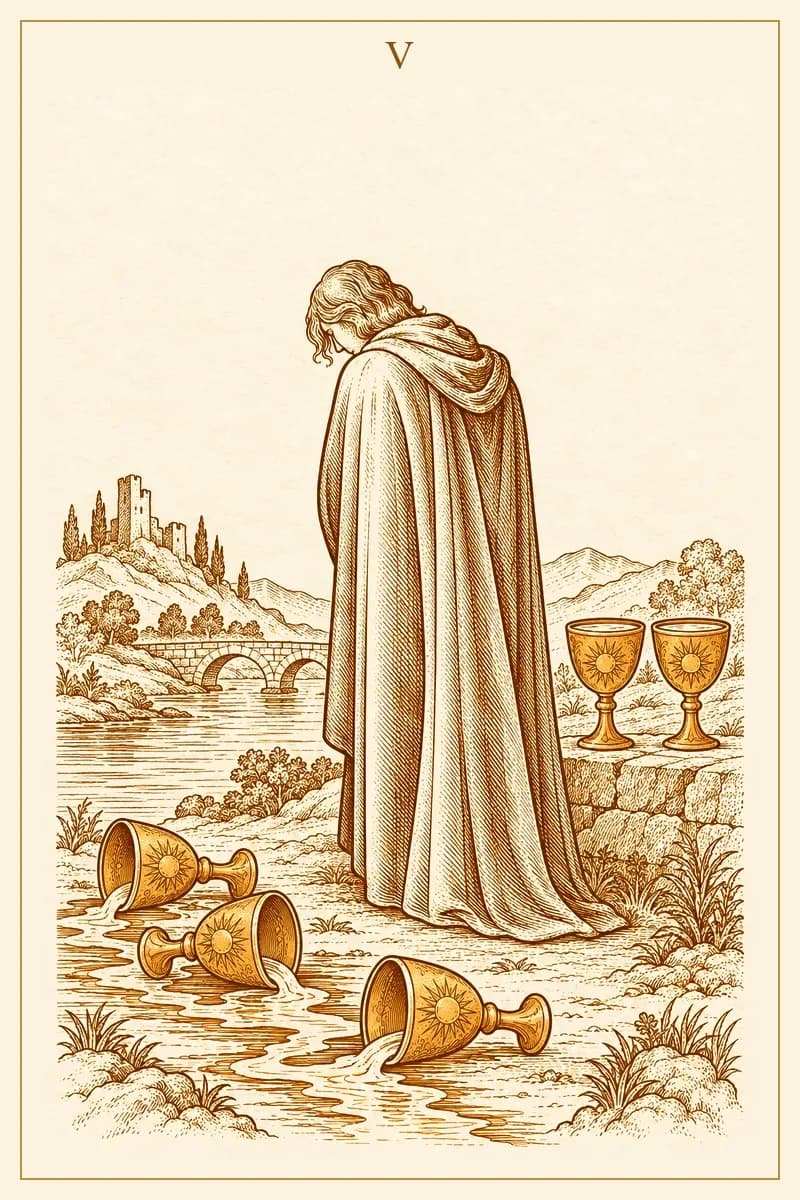
The card shown is VeilSoul's own engraved drawing of the 1909 Waite–Smith card. The scene and symbols described on this page follow the 1909 card, so a few details are drawn differently in our deck.
The Five of Cups is one of the most emotionally evocative cards in the tarot. A cloaked figure stands before three spilled cups, their contents lost to the ground. The figure's head is bowed in grief, shoulders heavy with sorrow. Behind the figure — unseen because of the downcast gaze — two cups remain standing, still full. In the distance, a bridge leads across a river to a home or castle, symbolizing the path forward that exists even in the darkest moments of loss.
When the Five of Cups appears upright, you are experiencing loss, grief, disappointment, or regret. Something has not turned out as you hoped. A relationship has ended, a dream has fallen apart, a betrayal has shaken your trust, or a failure has wounded your self-worth. The pain is real, and this card does not minimize it.
But the Five of Cups contains a crucial teaching hidden within its sorrow: you are so focused on what has been lost that you cannot see what remains. The three spilled cups demand your attention with their dramatic loss, but the two standing cups — perhaps representing relationships, abilities, resources, or opportunities that are still intact — are right behind you. You have not lost everything.
The bridge in the background is equally important. There is a way forward. There is a path home. But you cannot walk it while staring at the ground. At some point, the Five of Cups asks you to honor your grief fully — and then turn around.
Three cups spilled, two still standing behind — but the cloaked figure stares only at the loss. Grief narrows vision until what remains becomes invisible, and the bridge home stands uncrossed.
The figure begins to turn — grief loosening its grip enough to notice the two standing cups (recovery), or mourning has become identity itself, the cloak worn so long it fused to skin (excess).
Detailed Interpretations
The Five of Cups in love typically signals heartbreak, a breakup, or deep disappointment in a romantic relationship. If you are going through a separation, this card validates your grief — you are allowed to mourn what was lost. Do not rush the healing process. Feel what needs to be felt. The figure in this card stands with their back to the two remaining cups because grief narrows vision — when loss is fresh, it is almost impossible to see anything except what has been taken from you. The spilled cups command all your attention, and the love that still exists in your life becomes invisible behind the wall of pain.
However, the card also gently reminds you that this loss is not the end of your love story. The two standing cups represent the love that still exists in your life — from friends, family, or the love you hold for yourself. When you are ready, a new chapter awaits. The bridge is there when you choose to cross it. For those still in a relationship, the Five of Cups may indicate a betrayal, a broken promise, or a deep disappointment that has changed how you see your partner. Something has been spilled that cannot be poured back into the cup — trust, perhaps, or the innocent belief that this person would never hurt you. The question now is not whether the spill happened but whether the two cups that remain are enough to sustain the relationship through its rebuilding, and whether both partners are willing to do the difficult, unglamorous work that rebuilding requires.
In love reversed, the Five of Cups signals a turning toward recovery after loss — the moment when grief begins to lift enough to notice what remains, or the conscious decision to stop looking only at what was lost and to begin attending to what is still present and potentially good.
This may indicate moving on from a significant heartbreak: the gradual, non-linear process of healing that does not erase the grief but restores enough balance for genuine engagement with present possibilities. The reversed Five does not rush this process — it simply acknowledges that it has begun.
For those still deeply in grief, this card holds the hope that the turn toward the remaining cups is coming, without demanding that it happen before it is genuinely ready. Healing has its own timetable, and respecting that timeline is an act of self-compassion.
Professionally, the Five of Cups represents career disappointment — a lost job, a failed project, a rejected proposal, or a professional setback that has shaken your confidence. The sting of failure is acute, and you may be questioning your abilities or your chosen path. The Five of Cups professional moment is the evening after the rejection email, the morning after the layoff notification, the quiet drive home after the presentation that fell flat — the raw, private moments when professional disappointment bypasses your rational defenses and lands directly in the emotional center where it actually hurts.
But this card reminds you that career setbacks are not career endings. The two standing cups represent skills, experiences, and connections that remain valuable regardless of this particular loss. The bridge ahead represents new opportunities that become visible once you shift your focus from what went wrong to what is still possible. The most successful people in any field are not those who avoided failure but those who failed, grieved appropriately, extracted the lesson, and then turned around to face the remaining cups with the willingness to try again.
Allow yourself to feel the disappointment without letting it define your professional identity. Every successful career includes chapters of failure. The question is never whether you will experience setbacks — it is whether you will let the spilled cups convince you that you have nothing left, when two perfectly good cups are standing right behind you, waiting for you to turn around and notice that the story is not over.
Professionally, the reversed Five of Cups suggests recovery from a significant professional setback — a failed project, a difficult departure, a rejection — and the beginning of reassessment about what remains valuable and what new directions are genuinely available.
This reversal often marks the point at which professional grief becomes professional resilience: when the loss has been genuinely processed rather than suppressed, and the energy that was consumed by regret becomes available again for forward movement and creative engagement.
The reversed Five also invites reframing: not every professional loss is a defeat. Some endings free you for directions that the continued presence of what you lost would have prevented. Look at the remaining cups with fresh eyes.
The Five of Cups in health points to the physical toll of grief and emotional pain. Prolonged sadness can manifest as fatigue, weakened immunity, disrupted sleep, loss of appetite, or chronic tension. This card validates that emotional suffering is not separate from physical health — they are deeply intertwined. The body keeps the score of every emotional loss, and the Five of Cups acknowledges that your physical symptoms may be the body's way of processing a grief that your mind has not yet fully addressed. The heaviness in your chest, the knot in your stomach, the exhaustion that no amount of sleep resolves — these are not imaginary complaints but the somatic language of a heart that is carrying more than it was designed to hold.
Be gentle with yourself during this time. Seek support from a therapist or counselor. Allow the body to grieve alongside the heart, and trust that the healing process, while slow, is working even when you cannot feel it. The Five of Cups in health also cautions against self-medicating grief with substances, overwork, or reckless behavior — the temptation to numb the pain rather than feel it is understandable but ultimately extends the suffering rather than ending it. The two standing cups are your remaining health resources — the routines that still function, the relationships that still support you, the baseline of physical wellness that persists beneath the grief. Protect those cups. They are what you will rebuild from when the mourning finally begins to lift.
Use this as a reflective prompt, not medical advice or a diagnosis. For health concerns, seek guidance from a qualified healthcare professional.
The Five of Cups reversed signals the beginning of emotional recovery — the moment when you finally lift your head, see the two standing cups, and feel the first stirrings of hope. Grief is not gone, but it is no longer all-consuming. You are starting to accept what happened and to re-engage with the life that continues around you.
This reversal can also indicate forgiveness — of yourself or others. Releasing the grip of regret and blame does not mean what happened was acceptable; it means you are choosing to stop letting it control your present and future.
In some cases, the reversed Five of Cups warns against premature recovery — pushing grief underground before it has been fully processed. True healing requires feeling the loss, not just intellectualizing it.
The reversed Five of Cups teaches the liberating truth that grief does not have to be permanent residence — that mourning what was lost is appropriate and necessary, but that at some point, continuing to face the spilled cups rather than the standing ones becomes a choice rather than an inevitability.
This card invites the nuanced work of integrating loss without being defined by it: acknowledging the real significance of what was lost, allowing the grief to move through fully, and then turning with gentle intention toward what remains — the relationships, possibilities, and inner resources that the loss did not take.
The deepest lesson: you can honor what was lost and still choose what is still available. These are not in opposition. The reversed Five is the card of the person who has cried enough, who has sat with the grief long enough, and who is now — slowly, imperfectly, without betraying what was lost — choosing to live forward.
If you are carrying grief today, honor it — and also, gently, turn your attention for one moment toward what is still standing. The Five of Cups reversed is the moment of the first small shift: not forced positivity, not premature recovery, but the quiet acknowledgment that there is still something here worth orienting toward. What is one thing, however small, that has not been taken away?
“I honor my grief without letting it consume me. I turn to see what remains, and I trust that a path forward exists even when I cannot see it yet.”
The card shown is VeilSoul's own engraved drawing of the 1909 Waite–Smith card. The scene and symbols described on this page follow the 1909 card, so a few details are drawn differently in our deck.
The black cloak draped over the figure represents the all-consuming nature of grief — it covers the entire person, blocking out light and warmth. The three spilled cups in the foreground symbolize loss that commands immediate attention: their dramatic toppling draws the eye just as loss dominates the mind.
The two standing cups behind the figure are deliberately placed out of the figure's line of sight — not because they are hidden, but because grief naturally narrows our vision. They represent what survives loss: the relationships, strengths, and possibilities that endure even when something precious is gone.
The bridge in the background is a universal symbol of transition and hope. It crosses a flowing river — the water of emotions that must be navigated, not avoided. The house or castle on the other side represents safety, home, and the future that waits beyond grief. The entire composition teaches that loss and hope coexist in the same landscape.
Five is the number of conflict, disruption, and necessary change. In the Cups suit, it represents the painful emotional upheaval that forces growth — the loss that cracks the heart open so it can eventually hold more.
Keep or share this card reference
✦ From meaning to reflection ✦
Bring what this card stirred into a reading shaped around what you are facing now.
Read with this insight