Loading your view
The page is gathering the latest information.
The page is gathering the latest information.
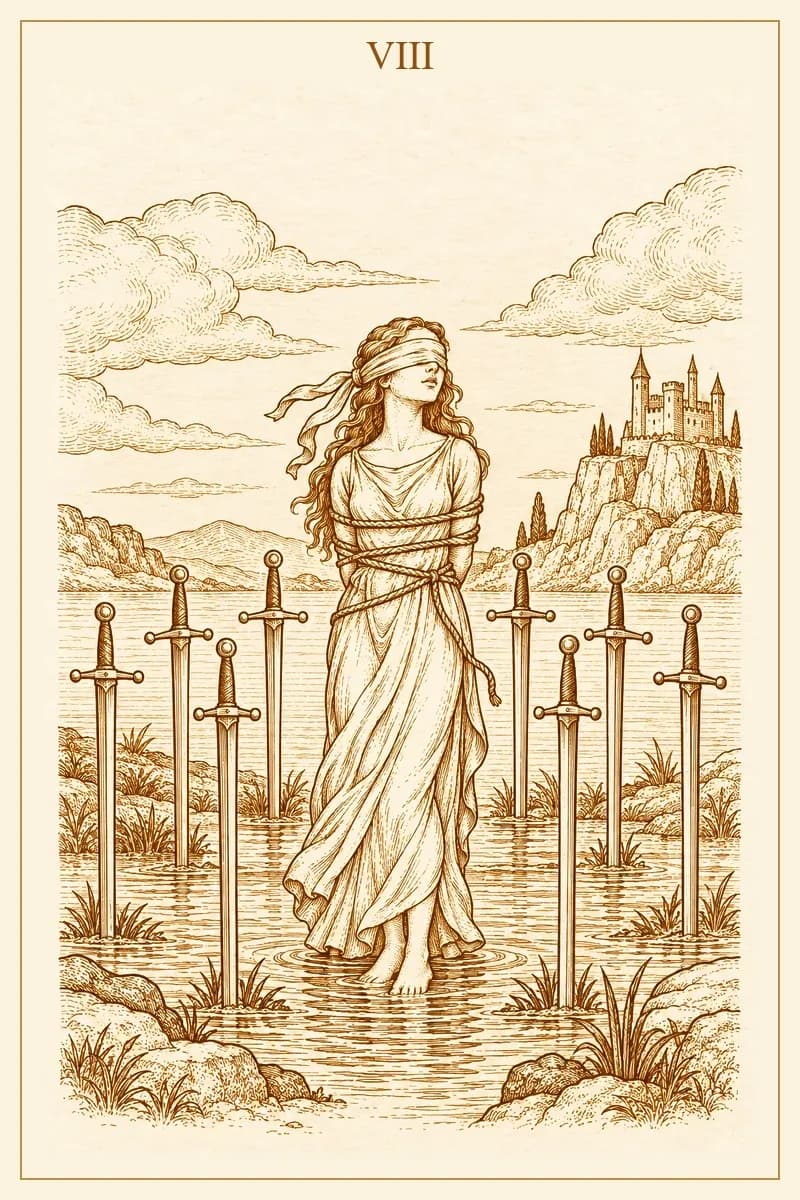
The card shown is VeilSoul's own engraved drawing of the 1909 Waite–Smith card. The scene and symbols described on this page follow the 1909 card, so a few details are drawn differently in our deck.
The Eight of Swords shows a blindfolded and loosely bound woman standing in a shallow pool of water, surrounded by eight swords planted in the ground around her. A castle looms in the distant background. She appears trapped — but look carefully. The ropes are loose. The swords form a fence, not a cage. Her feet are not bound. The ground beneath her is flat and navigable. The imprisonment is real in her mind but not in her circumstances.
When the Eight of Swords appears upright, you feel trapped, powerless, or unable to see a way out of your current situation — but the card's crucial message is that the restrictions are largely self-imposed. Fear, negative self-talk, overthinking, and the belief that you have no options are creating a mental prison that does not correspond to external reality. You have more freedom and more power than you currently believe.
This is one of the most important cards in the tarot for understanding how the mind creates its own suffering. The woman's blindfold represents the refusal or inability to see the situation clearly. The swords around her represent the thoughts, beliefs, and fears that she has accepted as barriers. But they are planted in soft ground — they can be pulled out. She can remove the blindfold herself.
The Eight of Swords does not dismiss your feelings. Feeling trapped is genuinely distressing, and the card acknowledges that. But it insists — gently, firmly — that the path to freedom begins with recognizing that you are the one who put the blindfold on, and you are the one who can take it off.
The woman stands bound and blindfolded among eight swords — yet the bindings are loose, the swords form a cage with gaps. The prison is mental, maintained by the belief that escape is impossible.
Liberation becomes terrifying — freedom's vastness overwhelms more than the cage did (excess) — or a return to captivity because familiar restriction feels safer than openness (deficiency).
Detailed Interpretations
The Eight of Swords in love reveals a relationship dynamic where one or both partners feel profoundly stuck — unable to leave despite knowing the relationship is unhealthy, unable to speak up about needs that go chronically unmet, unable to change the patterns that are slowly suffocating the connection. Fear of being alone, fear of confrontation, fear of the unknown, fear of financial instability after separation — these fears form the swords that surround you, and the blindfold is the narrative you have constructed to justify staying in a situation that you know, deep down, is not serving your growth or happiness.
This card often appears when someone has convinced themselves that they have no options in love — that this relationship, however painful, is the best they can do, that they are too old to start over, that no one else would want them, or that leaving would cause too much collateral damage to be worth the freedom. These beliefs feel like iron bars, but the Eight of Swords insists they are mental constructions, not physical realities. The bindings are loose, the gaps between the swords are wide enough to walk through, and the only thing keeping you imprisoned is the conviction that escape is impossible.
For singles, the Eight of Swords indicates self-imposed limitations in your romantic life — beliefs about your own attractiveness, worthiness, or capacity for love that are preventing you from pursuing connections that are genuinely available. You may be replaying old rejections as evidence that future attempts will fail, or using past heartbreak as justification for building walls so high that no one — including potential partners who would treat you well — can reach you.
In love reversed, the Eight of Swords signals liberation from a relationship pattern that kept you feeling imprisoned — the moment when the blindfold slips and you suddenly see that the cage was never as solid as you believed. You are recognizing your worth, finding your voice, seeing through the fear-based narratives that kept you paralyzed, and beginning to take the practical steps toward freedom that terror previously prevented.
This reversal often marks the turning point in situations of emotional or psychological control — the moment when the person who felt trapped realizes that leaving is not only possible but necessary, and that the consequences they feared are manageable and far less devastating than the continued cost of staying. The swords do not disappear — the practical challenges of leaving are real — but you can now see the gaps between them and are willing to navigate through rather than standing motionless in perceived helplessness.
For those emerging from a toxic relationship, the reversed Eight validates both the difficulty of what you endured and the courage of what you are choosing. Leaving is not a single dramatic moment but a series of small decisions — each one terrifying, each one slightly easier than the last — that gradually carry you from the marsh of captivity to solid ground. For singles, this reversal indicates breaking free from self-limiting beliefs about love and opening yourself to possibilities you previously dismissed as unavailable to someone like you.
Professionally, the Eight of Swords represents the feeling of being stuck in a job, a project, or a career path with no visible exit. You may believe that you cannot leave your current position because of financial obligations, lack of qualifications, age, market conditions, or a hundred other reasons that feel insurmountable. The card acknowledges these concerns but challenges their absoluteness.
The Eight of Swords in career readings often reveals that the biggest barrier to professional change is not the external obstacle but the internal narrative. You have more options than you think. Your skills are more transferable than you believe. The market may be more receptive than you fear.
This card advises starting small. You do not have to remove all the swords at once — just remove one. Update your resume. Have one networking conversation. Research one alternative. Each small action loosens the ropes and reveals that the cage was never as solid as it appeared.
Career-wise, the reversed Eight of Swords signals a breakthrough in professional thinking — the empowering moment when you see through the mental barriers that kept you feeling trapped in a job, a career path, or a professional identity that no longer fits. Options that previously seemed impossible now become visible: you can retrain, you can relocate, you can start the business, you can negotiate different terms, you can leave the position that has been slowly diminishing you. The cage was constructed from your own assumptions, and the reversed Eight is the moment those assumptions finally crack.
This reversal frequently appears when imposter syndrome loosens its grip — when you begin to believe, perhaps for the first time, that your skills and experience genuinely qualify you for opportunities you previously considered above your station. The blindfold of self-doubt comes off, and the professional landscape that appeared so limited and confining now reveals paths, possibilities, and exits you could not see while you were busy convincing yourself that you were stuck.
However, the reversed Eight also cautions that seeing freedom and seizing it are different actions. The mental breakthrough must be followed by practical steps — updating the resume, making the phone call, having the difficult conversation with your manager, filing the paperwork. Liberation from a mental prison is only complete when it translates into changed behavior in the physical world.
The Eight of Swords in health highlights the powerful and clinically documented connection between mental state and physical well-being. Feeling trapped, helpless, or hopeless creates measurable physiological effects — chronic stress hormones flooding the system, immune function suppressed by sustained anxiety, sleep disrupted by the relentless mental loop of perceived helplessness, and muscular tension held so habitually in the body that it has become invisible to the person carrying it. The prison of the mind becomes a prison of the body with remarkable speed and thoroughness.
This card frequently appears for people whose health challenges are significantly worsened by the mental narrative they carry about those challenges. The difference between someone who views a diagnosis as a problem to be managed and someone who views it as a life sentence is not medical — it is psychological, and it profoundly affects treatment outcomes, recovery timelines, and quality of life. The Eight of Swords asks whether your beliefs about your health are helping you heal or keeping you sick.
The card also addresses the specific health impact of feeling trapped in circumstances that generate chronic stress — a toxic job you believe you cannot leave, a caregiving role that allows no rest, a relationship that damages your wellbeing but feels impossible to exit. The swords surrounding the figure are the stressors, and the blindfold is the belief that endurance without change is the only available response. Until you begin to question that narrative, your body will continue to absorb the full cost of circumstances your mind has declared inescapable. Removing the blindfold — seeing options, seeking help, questioning assumptions about what is and is not possible — is itself a health intervention of the first order.
Use this as a reflective prompt, not medical advice or a diagnosis. For health concerns, seek guidance from a qualified healthcare professional.
The Eight of Swords reversed is one of the most empowering reversals in the tarot — it signals the moment when you see through your own mental prison and begin to free yourself. The blindfold is coming off. The ropes are being loosened. You are recognizing that the restrictions you accepted as permanent were always more fragile than they appeared.
This reversal brings a surge of mental clarity and personal agency. You may suddenly see a solution that was always there but invisible to you. A limiting belief crumbles. A fear that paralyzed you loses its power. The swords have not moved — but your perception of them has completely changed.
Alternatively, the reversed Eight can indicate that the process of self-liberation is beginning but not yet complete. You have identified the mental trap, but you have not yet walked out of it. The awareness is present; now the action is needed.
The reversed Eight of Swords teaches that freedom begins in the mind — that external circumstances change when internal narratives change, and that you were never as trapped as you believed. The most profound prison is not the one built by others but the one you construct for yourself from fear, self-doubt, and the unexamined assumption that your current limitations are permanent and absolute. The reversed Eight proves that they are not — that the moment you question the story of your captivity, the swords begin to wobble, the blindfold begins to slip, and the path out becomes visible.
This reversal also teaches the difference between genuine constraints and perceived ones. Some limitations are real — physical disabilities, legal obligations, financial realities that cannot be wished away. But many of the barriers we accept as immovable are actually mental constructions that would dissolve under honest scrutiny. The reversed Eight asks you to examine each sword individually: which are real obstacles requiring practical solutions, and which are projections of fear that vanish the moment you walk toward them instead of standing still?
Question the story that says you are stuck. Look at your situation with fresh eyes today and ask: what if the cage is not as solid as I have been telling myself? What if the limitations I accepted as permanent are actually assumptions I have never tested? Choose one perceived barrier and examine it honestly — is it a real wall or a projected fear? One small step toward it today can begin to prove that you have more freedom than the blindfold allowed you to see. The swords surround you, but the gaps between them have been there all along.
“I see through the illusion of my limitations. The barriers I accepted as permanent are dissolving, and I am free to move in any direction I choose.”
The card shown is VeilSoul's own engraved drawing of the 1909 Waite–Smith card. The scene and symbols described on this page follow the 1909 card, so a few details are drawn differently in our deck.
The blindfolded woman stands in water — emotion — surrounded by eight swords planted in marshy ground. The swords form a loose perimeter, not a sealed cage. Crucially, there are gaps between the swords large enough to walk through. The imprisonment is perceptual, not physical.
Her bindings are loose around her upper body, and her feet are completely free. She could walk away at any time — but she cannot see this because of the blindfold. The blindfold represents the beliefs, fears, and cognitive distortions that prevent clear perception of available options.
The distant castle represents the help, safety, or resources that exist but feel unreachable from the woman's current perspective. The overcast sky suggests mental cloudiness and the absence of illuminating insight. The flat, muddy ground indicates that while the situation is uncomfortable, it is not dangerous — the footing is stable enough to walk on if she chooses to move.
Eights represent power, mastery, and the consequences of past choices. The Eight of Swords reveals the power that the mind holds over perception — and the mastery available when you reclaim that power from fear and self-limiting beliefs.
Keep or share this card reference
✦ From meaning to reflection ✦
Bring what this card stirred into a reading shaped around what you are facing now.
Read with this insight