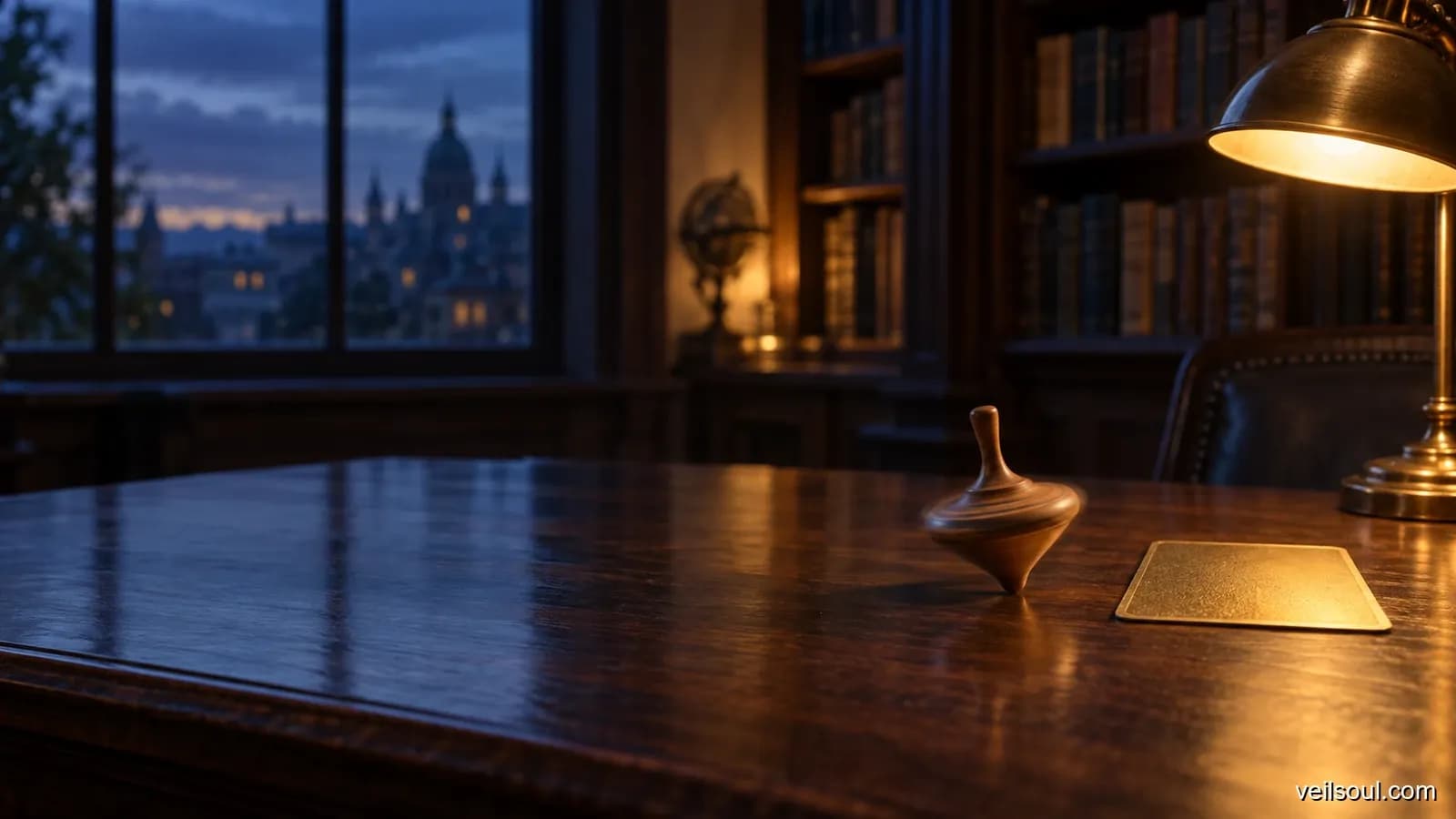
Change arriving on its own schedule is the heart of the Wheel of Fortune meaning: circumstances shift, a cycle moves into its next phase, and part of what happens next is timing rather than effort. Upright, the turn tends to run in your favor, bringing momentum after a stall, a lucky opening or a chapter that finally begins. Reversed, the same wheel feels stuck or set against you: delays, plans that slip, or a pattern you keep repeating because you are gripping the old position. In love, the card points to a change of season in a relationship or a meeting that seems to arrive by chance.
What the card cannot do is fix the future in place. It will not promise a lucky break, name the day it arrives or reveal what another person will choose. Read it as a mirror for the moment you are in: what is already moving, what is passing out of reach, and which small part of the turn is still yours to steer.
- Upright keywords: a turning point, momentum, good timing, luck that meets preparation, a new cycle.
- Reversed keywords: delay, bad timing, a run of setbacks, resisting change, repeating an old loop.
- Yes or no: upright, a hopeful yes that often moves sooner than expected; reversed, "not yet."
- Number and place: card X (ten) of the Major Arcana, between The Hermit and Justice.
- Astrology and element: Jupiter; often read with Fire for its sense of expansion.
- Love in one line: a new chapter, a chance meeting or a relationship cycle turning.
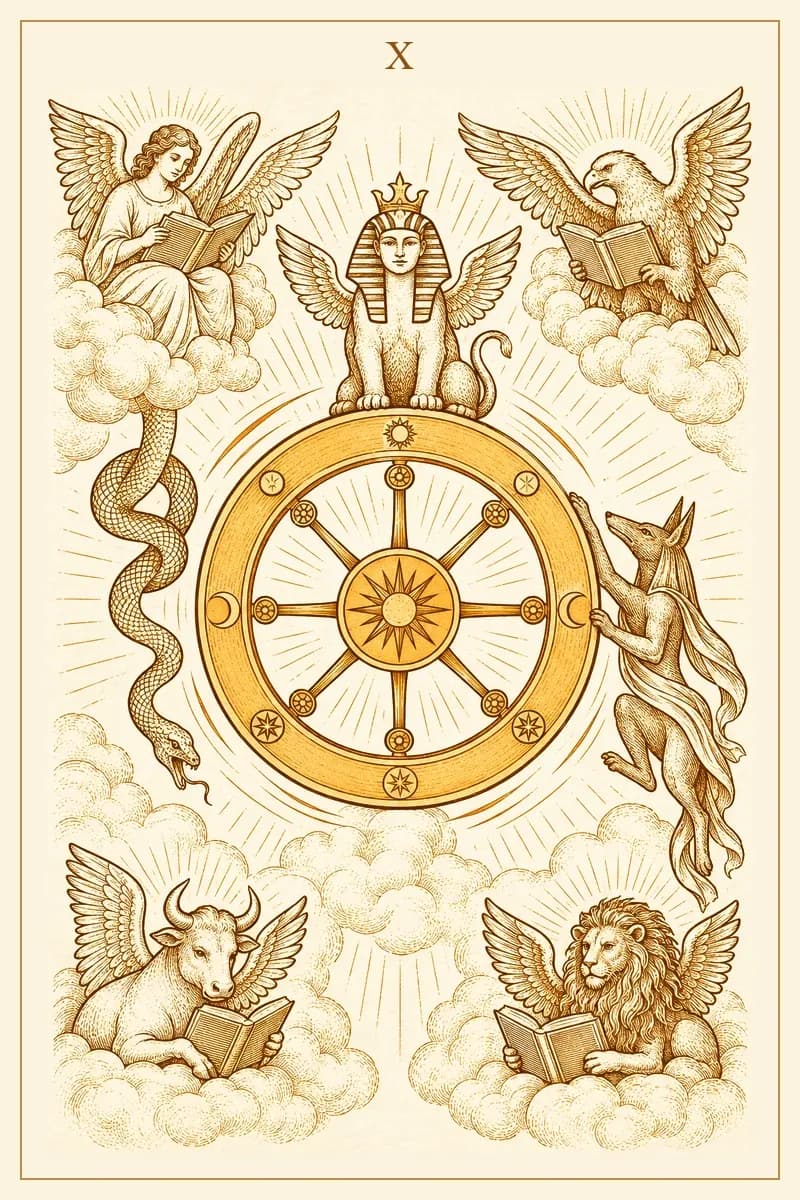
A golden wheel in the clouds: reading the picture
The wheel and its sun-and-moon rim
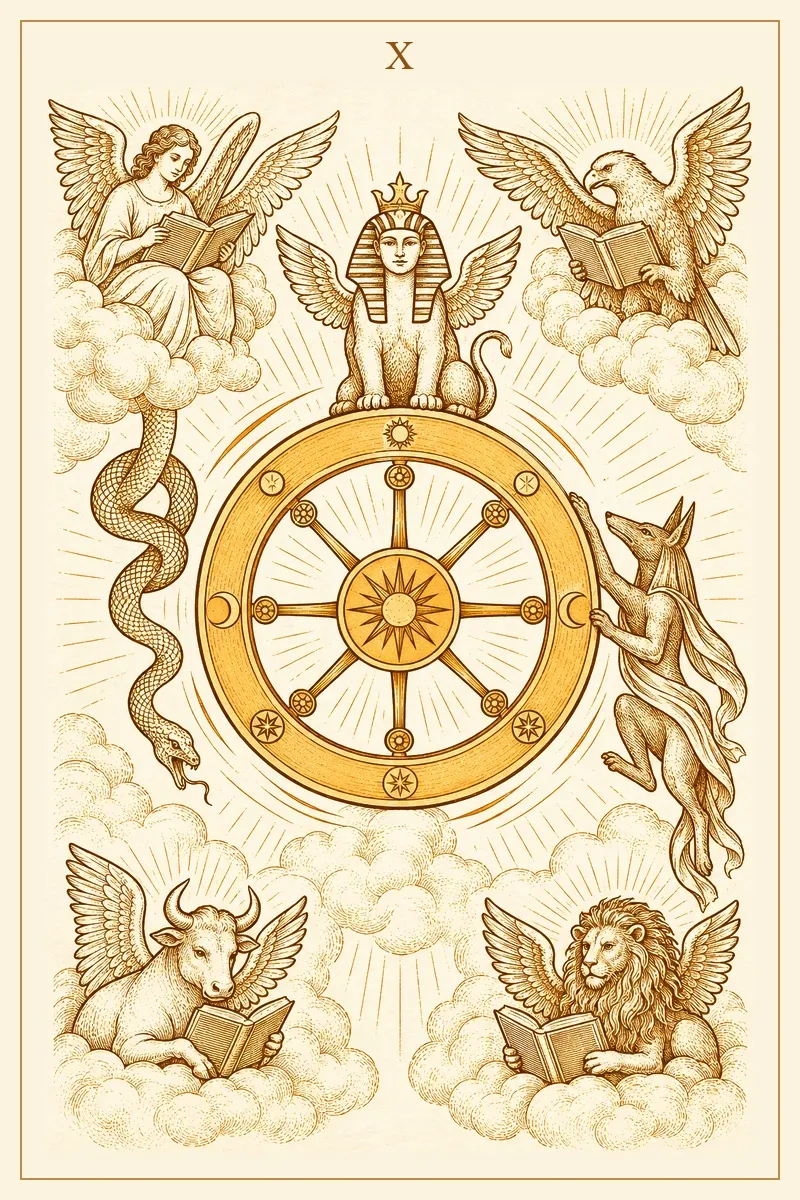
A great gold wheel hangs in an open sky, ringed by clouds, with fine rays fanning out behind it. Eight spokes run from a hub drawn as a many-pointed star. The rim carries a small sun at the top, a crescent moon at the left and right edges, and eight-pointed stars around the lower half, tying the card to days, months and seasons that keep coming around. Curved strokes around the outside show the wheel in motion, yet the hub barely moves. That is the card's first lesson: whatever happens at the edge of your life, there is a still center where you can stand while the rim turns.
The sphinx above, the serpent and the jackal on either side
On top sits a winged sphinx in a striped headdress with a small crown, its paws resting on the rim. It neither rises nor falls with the turning. Traditionally it stands for the riddle of the whole process and the balance that understands it, so the card asks you to take that seat and observe the turn before reacting.
On the left a long serpent winds down the outside of the wheel, head lowered toward the clouds. On the right a jackal-headed figure with a trailing cloth climbs the rim with both hands. Older commentary names them Typhon and Anubis. One descends while the other rises, which makes the card's most practical point: being low on the wheel is a position, not an identity, and being high is only a position too.
Four winged readers in the corners
In each corner a winged creature rests on a cloud with an open book: an angel at the upper left, an eagle at the upper right, a bull at the lower left and a lion at the lower right. They are usually linked to the four fixed signs (Aquarius, Scorpio, Taurus and Leo). Each is reading rather than watching the wheel: while fortune moves, steady study goes on. The same four return around the dancer of The World, card XXI, where the journey the Wheel sets turning comes to completion.
Ten, Jupiter and the palm of the hand: the card's correspondences
The Wheel is card X. Ten closes the first run of single digits and, in many number traditions, reduces back to one, so the card carries a sense of a cycle finishing and another starting from the same place. It sits after The Hermit, who withdraws to find his own light, and before Justice, who weighs what has been done: reflection, then a turn of events, then accountability for what you do with it. If Justice keeps appearing beside the Wheel, read the Justice tarot meaning next.
In the Golden Dawn system, which many modern decks follow, the card belongs to Jupiter and carries the title Lord of the Forces of Life. Jupiter, the planet of growth and wider horizons, rules Sagittarius and Pisces, which is why some readers connect the Wheel with those signs; the guide to Jupiter in tarot follows the planet through the other cards it touches. Its Hebrew letter is Kaph, the palm of the hand, a fitting image for what you are handed and what you can grasp. Many readers add Fire as its element, though books differ.
Upright: the turn that works in your favor
Upright, the Wheel says that something is moving: parked plans start to roll, or a door opens that you did not knock on. Its main force comes from outside you. You did not build the turn, but you are standing where it lands.
Momentum after a long stall
The card often speaks to the end of a period of waiting: applications without answers, a relationship in a holding pattern, a project that never got its green light. The upright Wheel suggests the stall is ending and events may pick up speed. Ask what you would need ready if things moved this month: an updated resume, savings for a deposit, or a conversation you have been postponing.
Luck that meets preparation
The Wheel is a luck card, but the luck it describes tends to land on people who are already on the path. A chance introduction helps the person who has kept practicing; an unexpected vacancy helps the one whose portfolio is current. Read it as good timing more than a gift from nowhere. It points at the opening and leaves the stepping through to you.
A chapter that closes so another can start
Not every upright Wheel feels lucky at first. Sometimes the turn is an ending: a team reorganized, a close friend moving away. Upright, the card frames that change as part of a larger cycle rather than a failure; the next position has room the old one lacked, and such moments can look, in hindsight, like the hinges of a story.
Reversed: when the wheel sticks or turns the hard way
Reversed, the Wheel still means change and cycles, but the experience is rougher. Either the turn is going against you for now, or something, often you, is holding the wheel in place. Neither is a sentence of bad luck; the reversal describes a phase, and phases end.
Delays, missed timing and a run of setbacks
The simplest reading is a downturn: a contract slips, a trip falls through, money that was expected arrives late, and effort does not seem to connect with results. The advice here is to avoid making permanent decisions from a temporary low. Protect what you have, keep the routines that steady you and wait for clearer information before you sign, quit or commit.
Gripping the rim
Look again at the jackal figure, holding the rim while the wheel carries it upward. Reversed, the card can show the opposite grip, a hand trying to stop the wheel: holding on to a role, a relationship or a picture of yourself that has run its course. The effort of keeping it in place is what makes the turn painful. Ask what you are refusing to let change, and what loosening your hold a little would really cost.
Going around the same loop
A reversed Wheel can also point to repetition: the same argument with a new partner, the same money crunch every quarter. A returning pattern is not random; something in the way you meet it has not changed yet. Writing down the last three times it happened, and what you did each time, often shows the missing lever.
Wheel of Fortune in love readings
In love, the Wheel rarely describes a person; it describes the season a relationship is in, or the moment a new one starts. Keep the question specific, because it is an easy card to over-read.
Single: meetings that feel arranged
Upright, the card often describes a meeting that seems to happen by chance: a party you nearly skipped, a delayed train, a match you had forgotten about. It can also end a dry spell because a move, a new job or a new circle puts you in front of new people. Say yes to the invitations that suit you and let the timing do part of the work.
Together: the relationship's next season
For a couple, an upright Wheel signals a new phase: moving in together, a long-distance stretch ending, a decision about marriage or children, or closeness returning after a flat period. Relationships pass through seasons of excitement, routine, strain and repair, and the card says the current one is shifting. Talk about what each of you wants next instead of assuming the change will sort itself out.
An ex coming back around
Because the wheel carries things back to the top, it is a natural card to read for questions about an ex. Upright, it can show that a second chance is possible, usually because circumstances have changed, but it does not decide whether returning is wise. Ask whether the old reasons for the breakup have been resolved; a cycle that repeats unchanged belongs to the reversed Wheel.
What it says about their feelings
As a feelings card, the upright Wheel describes interest that feels sudden or fated to the other person, a sense that meeting you was good timing. Reversed, it describes feelings in flux, warm one week and distant the next, or held back because the timing in their own life feels wrong. Either way, the card shows how things look from your side; their words and actions over the coming weeks will tell you more.
Reversed in a love reading
Reversed, the Wheel can describe a rough patch, a couple stuck in the same argument, or an ending that felt unavoidable. Sometimes it shows clinging to a connection that has finished its cycle, or, for singles, meeting the same type of person again and again. Its question is kind but direct: which part of this pattern is yours to change?
Career and money when the ground shifts
A job market that suddenly moves
Upright in a career reading, the Wheel points to change arriving from outside: a restructure that creates a new role, a recruiter's message, a client who appears through a lucky referral, an industry shift that suddenly favors your skills. If you have been considering a change of direction, update your materials and tell the right people what you are looking for.
A role that stalls or a promotion that slips
Reversed, the Wheel describes setbacks that have more to do with timing than talent: a hiring freeze, a canceled project, a promotion delayed by a budget cycle. It warns against quitting in a panic. Keep your skills current, document what you have delivered and find one move within your control, such as a course or a talk with a mentor.
Money that comes in waves
Financially, the upright card can show an improvement: extra work, a refund, a raise or a season in which income runs ahead of costs. Good seasons end, so use the upswing to build a cushion and pay down debt rather than raise fixed costs. Reversed, it points to a tighter stretch with unexpected expenses, a time for a simple budget rather than speculative risks. For decisions about debt or investments, a qualified advisor is the right next step.
Body, rhythm and meaning: health and spiritual readings
In health questions the Wheel speaks about rhythm, not diagnosis. Upright, it can reflect energy returning, routines settling or a frustrating phase starting to ease. Reversed, it may mirror a cycle that keeps returning, such as stress that flares around the same deadlines each month. Use it to notice patterns and bring them to a doctor or another qualified professional; the card says nothing reliable about a condition or how it will develop.
Spiritually, the Wheel is the tarot's clearest card about impermanence: hold good times lightly and bad times patiently, as the sphinx keeps its seat while the serpent and the jackal ride the rim. To explore that observer's position, the practices in tarot for self-discovery pair well with this card. Readers who link the Wheel with karma usually mean it gently: the choices you make now shape the next turn.
Yes, no and when: the Wheel as a timing card
For a yes-or-no question, the upright Wheel is a yes, often with movement sooner than you expected. Reversed, it is closer to "not yet": the timing is off, or something needs to shift before the answer can change.
Timing questions suit the card even better. It shows that change is close, but it does not name a date. Because Jupiter spends about a year in each sign, some readers treat the card as a turn that unfolds over months rather than days; that is a convention, not a rule. The article on reading timing in tarot cards explains the common methods and their limits. A more useful question is often "What will tell me the wheel has turned?" Decide on that sign, then watch for it instead of the calendar.
Cards that steer the Wheel
Neighboring cards show which way the turn is likely to go. Next to The Tower, the change is sudden and shakes what seemed solid, though it clears ground for something sturdier. Next to The Sun, the turn is bright and generous. Three more deserve a closer look.
With The Magician: luck you can use
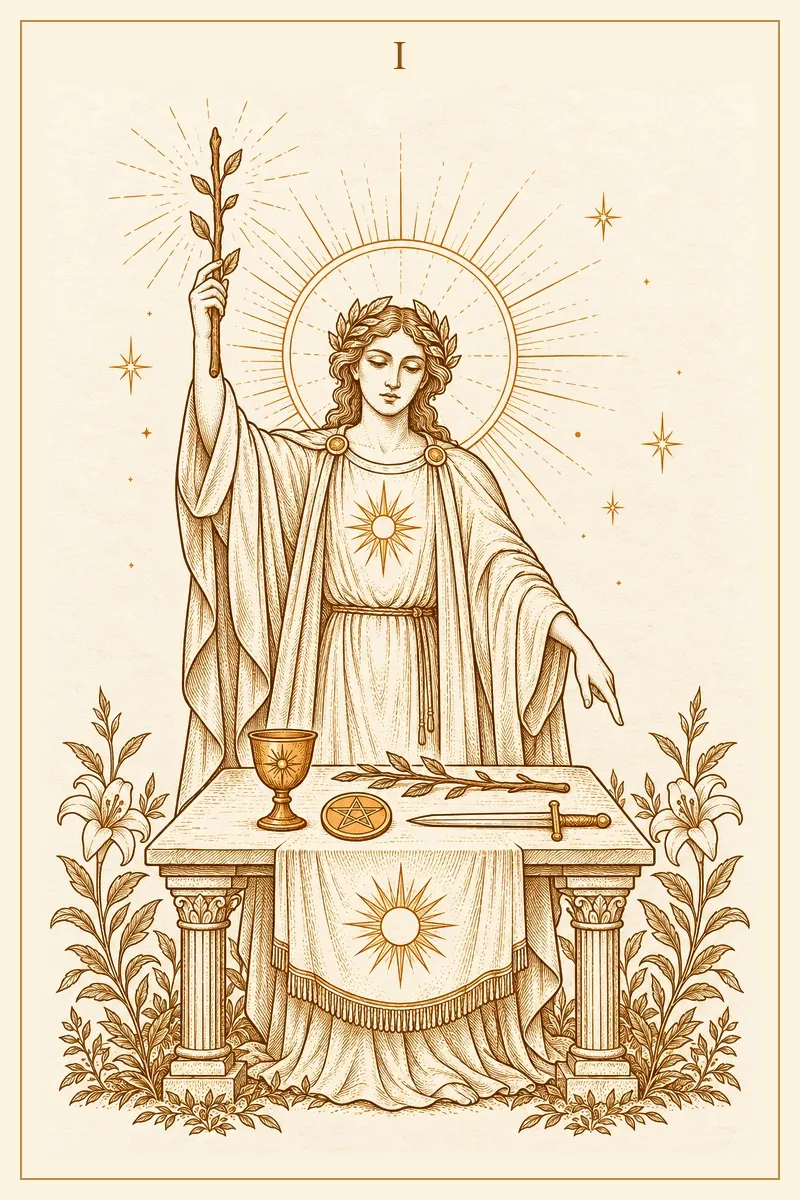
The Magician has every tool on the table, and the Wheel brings the moment to use them. Together they describe an opportunity that matches your skills almost exactly: the opening is timing, the result is what you do. Act while the window is open. The Magician tarot meaning covers the reversed side, which turns this pairing into a warning about scattered effort or overpromising.
With The Hermit: a turn that begins inside
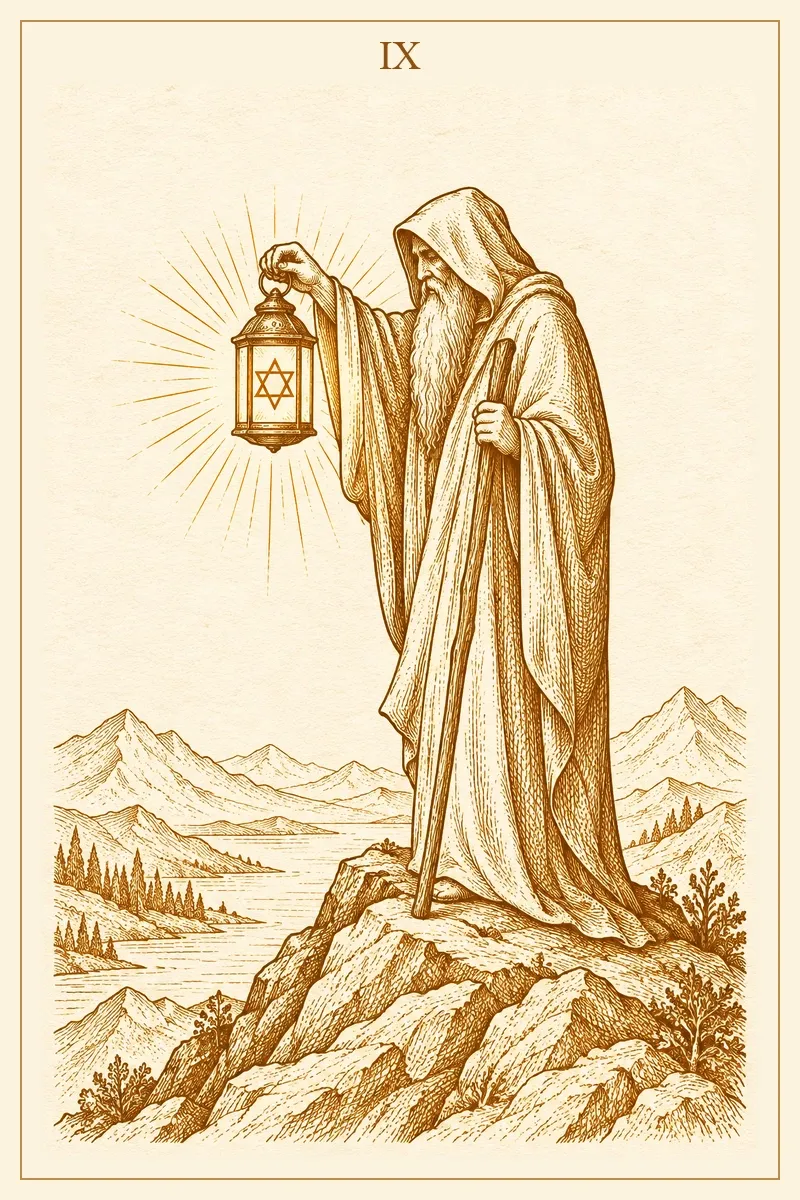
The Hermit comes just before the Wheel, and together they describe a change that starts with time alone: a realization during a quiet stretch that reshapes your plans. The Hermit tarot meaning explains the lantern and the solitude this pairing draws on.
With The Lovers: a meeting at the right moment
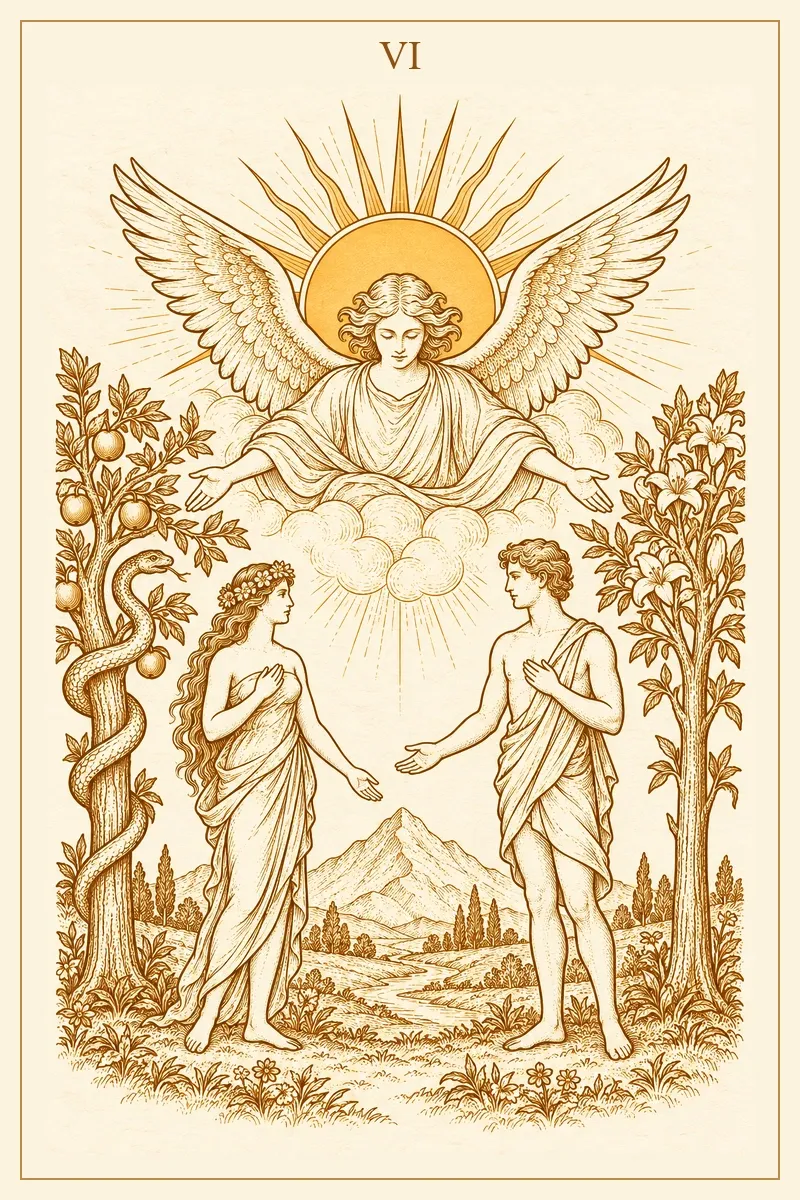
The Lovers beside the Wheel is the classic sign of a connection that feels fated: someone who appears at a turning point and becomes part of the next chapter. It can also show a values-based choice that new circumstances force you to make. Either way, as the Lovers tarot meaning describes, the card asks for a decision, not only a feeling.
The hub and the rim: a four-card spread for a turning point
This spread follows the picture on the card. Lay the first card in the center, then place the others around it as if on a rim: rising on the right, falling on the left and the last at the top.
- The hub: what stays steady in you while things change.
- The rising side: what is coming up and gaining strength.
- The falling side: what is passing and can be released.
- The hand on the rim: the part of the turn you can influence this month.
Read the hub first, then rising and falling as a pair, since what leaves often makes room for what arrives. Turn the hand on the rim into one concrete action.
Reading it through: a lease ending and an interview in another city
Suppose someone asks: "My lease ends in three months, and a company in another city has invited me to interview. What is turning, and what is mine to steer?" The hub-and-rim spread gives these cards:
- The hub: Four of Pentacles
- The rising side: Wheel of Fortune, upright
- The falling side: Six of Swords
- The hand on the rim: Page of Pentacles
The Four of Pentacles at the hub shows a strong need for security, which keeps this person from leaping without a plan but may also make them refuse any uncertain change. The Wheel on the rising side confirms that the invitation is part of a real turn in circumstances; the timing is good, and it arrived without being chased.
The Six of Swords on the falling side describes a transition already underway: part of them has been preparing to leave for a while. The Page of Pentacles makes the practical step clear: study the details. Research rents and commute times, ask the company concrete questions and sketch a budget for both choices.
Together, the cards do not say "move." They say the door is open, the old setup is ending anyway, and the need for security is best met with information rather than refusal. If the numbers hold up, the move becomes a grounded choice; if not, the lease ending is still a chance to find a better home nearby.
Steering what you can after drawing the Wheel
- Name the turn. Write one sentence about what is changing, even if you only half see it.
- Separate what you control from what you do not. Two short lists are enough; stop spending energy on the second.
- Choose one move for the rising side. A message, an application or a conversation.
- Release one thing on the falling side. A habit, an expectation or a plan that no longer fits.
- Check back in a month, not every hour. Note what actually moved; a journal shows the cycle more clearly than memory does.
Two questions are worth carrying with you: which cycle in my life is finishing, and which one is starting? And can I accept that neither the high point nor the low point is permanent?
Frequently asked questions
Is the Wheel of Fortune a good or bad card?
Mostly good. Upright it points to momentum and good timing; reversed it describes a difficult phase that will pass, not a disaster. Its deeper message is neutral: every position on the wheel is temporary.
What does the Wheel of Fortune mean in love?
Upright, a change of season: a chance meeting, a relationship moving to a new stage or a second chance made possible by new circumstances. Reversed, a rough patch, a repeated pattern or a connection that has completed its cycle. As a feelings card it shows interest that feels sudden or changeable.
Is the Wheel of Fortune reversed a yes or a no?
Usually "not yet" rather than a firm no. The timing is off, or something needs to change first, often your own grip on the old situation. Ask again after something real has changed, not the next day.
Can the Wheel of Fortune predict when something will happen?
It suggests that change is near and may move quickly, but no card can give a reliable date or guarantee an outcome. Tarot works best as a reflection on what is already in motion and what you can do about it, so let real-world signals confirm any timing.
How is the Wheel of Fortune different from The Tower?
Both describe change you did not fully choose. The Wheel is a turn within a cycle, lucky or merely inconvenient; The Tower is a sudden break in something already unstable. One says the season is changing, the other that a structure has to come down.
Bring your own turning point to the cards
If you are new to the deck, the beginner's introduction to tarot shows how a card like this one fits into a full reading. When a change is already in motion, you can start a reading with Veil Soul and ask what is turning and where your hand belongs on the rim.