Self-made comfort is what the Nine of Pentacles means: a life, an income or an inner steadiness you built with your own patience, and the freedom to enjoy it without asking anyone's permission. Reversed, it shows that same comfort under strain, kept going through over-work, paid for at a cost you have not counted, or resting on someone else's support in a way that makes you feel smaller.
Tarot works here as a mirror rather than a forecast. It cannot say what your savings will look like next year, whether a partner will stay, or what someone else privately thinks of you. What this card can do is show where your sense of security really comes from, and whether the ease you have is resting on something solid.
In short:
- Upright: independence, earned comfort, self-discipline that has paid off, good taste, time to enjoy what you grew.
- Reversed: over-work to keep a lifestyle afloat, comfort that costs more than it gives, financial or emotional dependence, a polished surface over a shaky base.
- Love: being whole on your own and choosing company rather than needing it; reversed, independence that has hardened into a wall.
- Their feelings: respect for how composed you are, sometimes mixed with doubt about whether there is room for them.
- Career and money: expertise that buys freedom, savings, self-employment, a raise you earned.
- Yes or no: upright, a calm yes; reversed, a yes that asks what it will cost.
A vineyard of her own: the falcon, the grapes and the snail
What the card shows
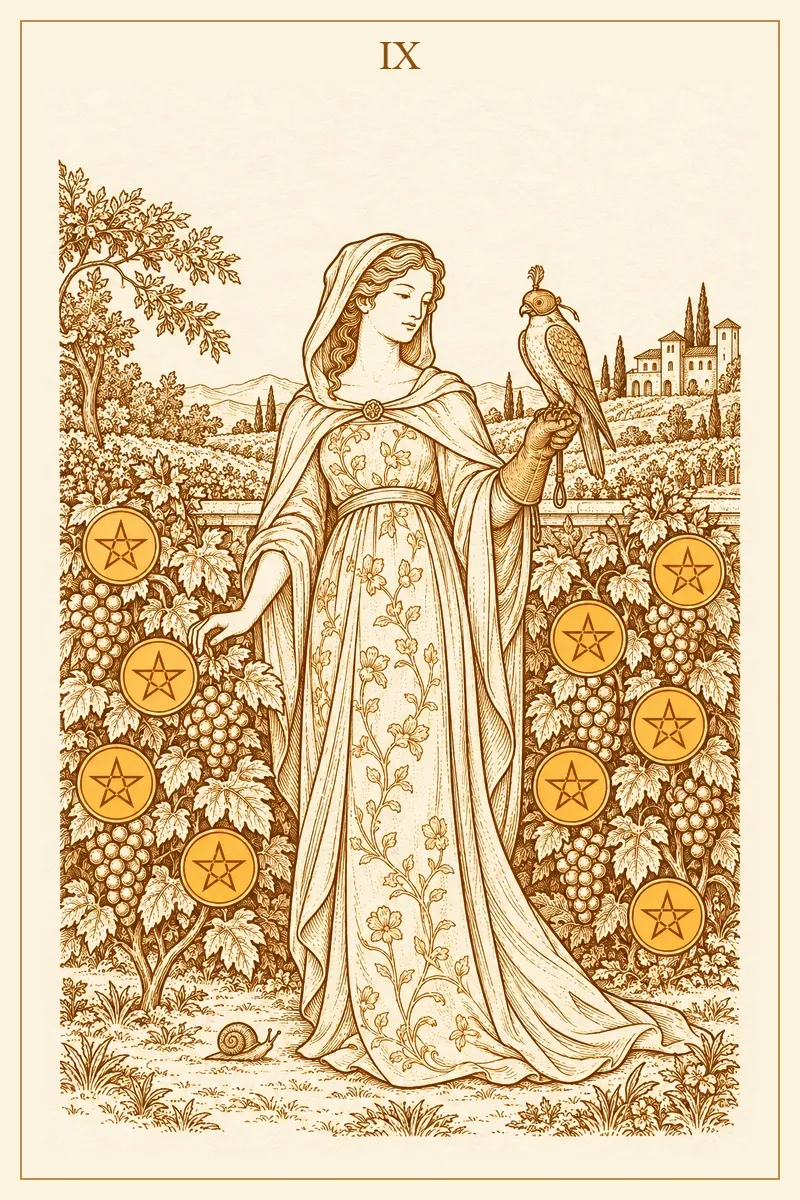
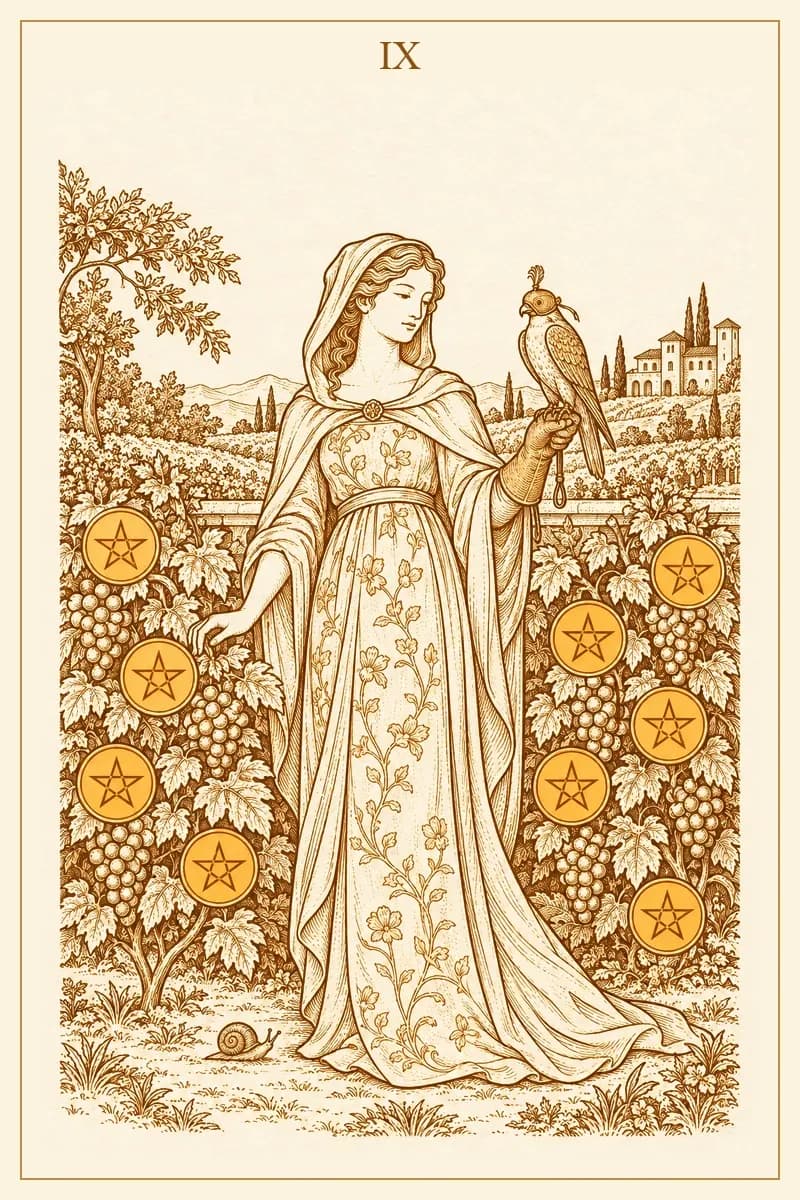
A woman stands alone in a vineyard. A hooded cloak, fastened with a round brooch at her throat, falls over a long gown belted at the waist and embroidered from hem to collar with flowering vines. On her raised, gloved hand sits a falcon wearing a small hood topped with a plume, and a short tether hangs from the glove. Her other hand rests lightly on a cluster of grapes. Vines crowd in on both sides of her, and nine gold pentacles hang among the leaves: four on the left of the picture, five on the right.
Behind her runs a low stone wall. Beyond it, on a hill at the upper right, stands a villa with tall cypresses around it, and at the upper left a leafy tree leans into the frame. Down by the hem of her gown, at the lower left, a small snail is crossing the ground. Nobody else is in the picture. She is not working or waiting for anyone; she is standing in something she has grown.
- The hooded falcon: a hunting bird is wild by nature, and it sits calmly here only because of long, patient training. That is the quiet point of the card: the ease you see was made by discipline you do not see.
- The hand on the grapes: she touches the harvest instead of guarding it. Enjoyment belongs to the meaning; it is not a reward postponed to some later date.
- The snail: slow, self-contained, carrying its home on its back. Abundance of this kind grows at its own pace, and being self-sufficient has nothing to do with being fast.
- The wall and the far villa: her world has edges. The wall keeps the vineyard safe; read reversed, it can also keep people out.
Lord of Material Gain: Venus in Virgo
In the Golden Dawn system, which shaped the Waite-Smith deck that most modern tarot grows from, this card is titled the Lord of Material Gain and is assigned to Venus in Virgo, the second ten-degree section (decan) of the sign. Virgo is an earth sign of care, method and useful work; Venus is the planet of pleasure, beauty and what we value. Together they describe pleasure that comes from careful tending: a garden that is lovely because someone weeded it every week. The sign's other tarot links are laid out in Virgo and tarot.
The three Virgo decans form a small story inside the suit. The first, the Sun in Virgo, is the Eight (the Lord of Prudence); the second is this Nine; the third, Mercury in Virgo, is the Ten (the Lord of Wealth). Every Nine also sits on Yesod, the "foundation" on the Tree of Life, which suits a card about a life resting on solid ground. A. E. Waite, who wrote the meanings for that deck, listed prudence, safety, success, accomplishment and discernment for this card upright, and for the reversed card wrote of deception, bad faith and plans that come to nothing.
Nine of Pentacles upright: comfort you built yourself
Upright, the card says you are standing in the results of your own steady effort, or very close to it. That can be concrete: savings that finally cover a few months, a home furnished piece by piece, a freelance practice that now pays the bills, a skill people seek you out for. It can also be quieter: the ability to spend an evening alone and enjoy it, or to make a decision without checking it with five people first.
The card asks two things. The first is simply to notice. People who build something slowly often never feel that they have arrived, because the habit of effort keeps running after the need for it has eased. The second is to keep the discipline that made this possible without letting it run your life.
The upright meaning fits best when:
- your own income, skill or routine has reached the point where it supports you;
- you feel a new, slightly unfamiliar ease and are not sure you are allowed to enjoy it;
- you are deciding how much of your independence to keep as your life changes.
Nine of Pentacles reversed: over-work, borrowed ease, a fence
Reversed, the vineyard is still there, but something about the way it is kept has gone wrong. In readings this tends to show up in three forms.
Over-work. You may have the life the upright card describes and still never get to stand in it, because every free hour goes to maintaining the standard: one more project, one more client, one more upgrade. The reversed card asks whether the effort is still building something or only defending an image.
Comfort bought at a cost. Sometimes the ease is real but paid for in a currency that is harder to see: debt, health, sleep, a relationship that gets only your leftover energy. Waite's reversed words, bad faith and plans that come to nothing, can describe a promise to yourself that is not being kept, such as "I will rest once I have enough", where enough keeps moving further away.
Dependence. The reversed Nine can also point to security that rests on someone else (a partner's salary, a parent's help, a single employer) in a way that leaves you feeling you have no say. Receiving help is not a failure; the card looks at how the arrangement feels from the inside. If being supported has quietly turned into being unable to choose, it suggests one small step back toward ground of your own.
Between the workbench and the family table: the Nine's place in the suit
The Nine makes most sense beside the cards on either side of it: before it comes a card of practice, after it a card of sharing. It also helps to set it against the Five of Pentacles, where two ragged figures trudge through snow past a lit window: the Five is about standing outside the shelter, the Nine about having built a shelter of your own.
Eight of Pentacles: the hours that came first
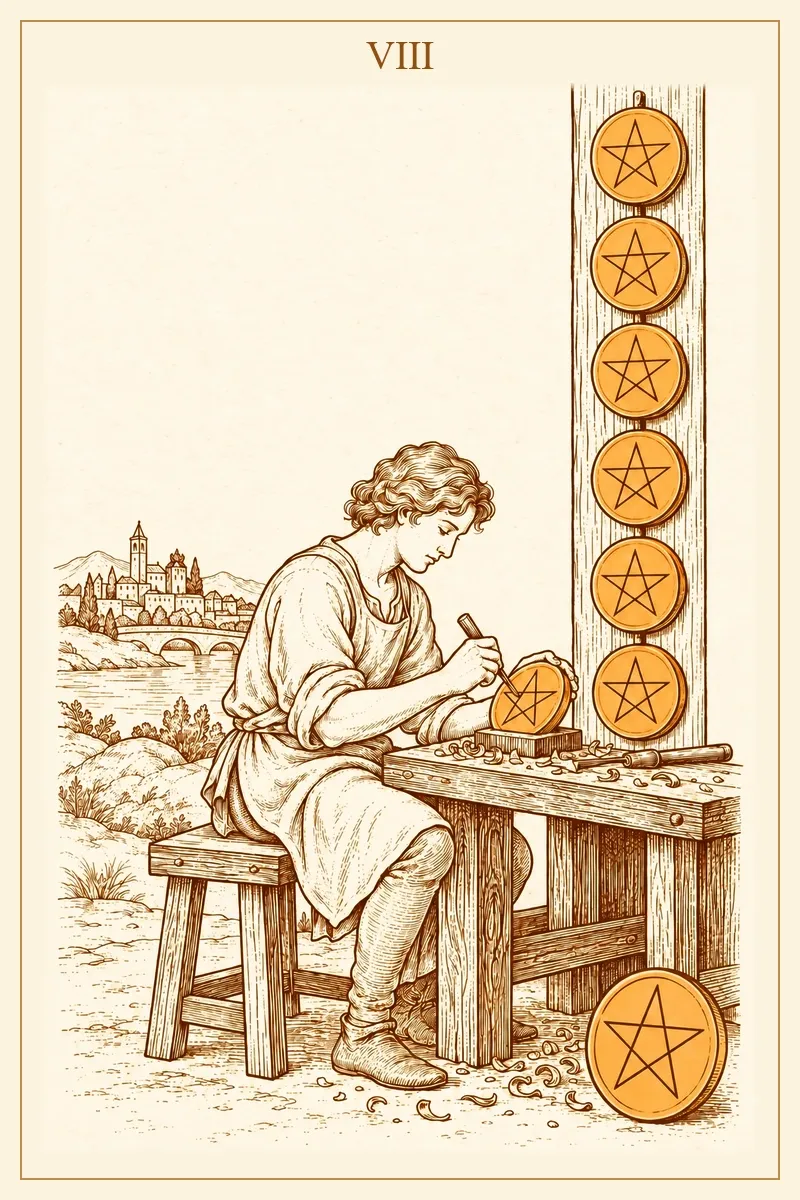
The Eight of Pentacles shows a young craftsman on a stool, carving a star into one coin while six finished ones hang on the post beside him. It is the unglamorous part: repetition and getting slightly better each week. The Nine is what that repetition looks like years later. When the Eight appears near the Nine, it reminds you that your ease is not luck, and that practice is worth keeping even when you no longer need to prove anything. The Eight of Pentacles meaning covers that card in full.
Ten of Pentacles: when the garden is shared
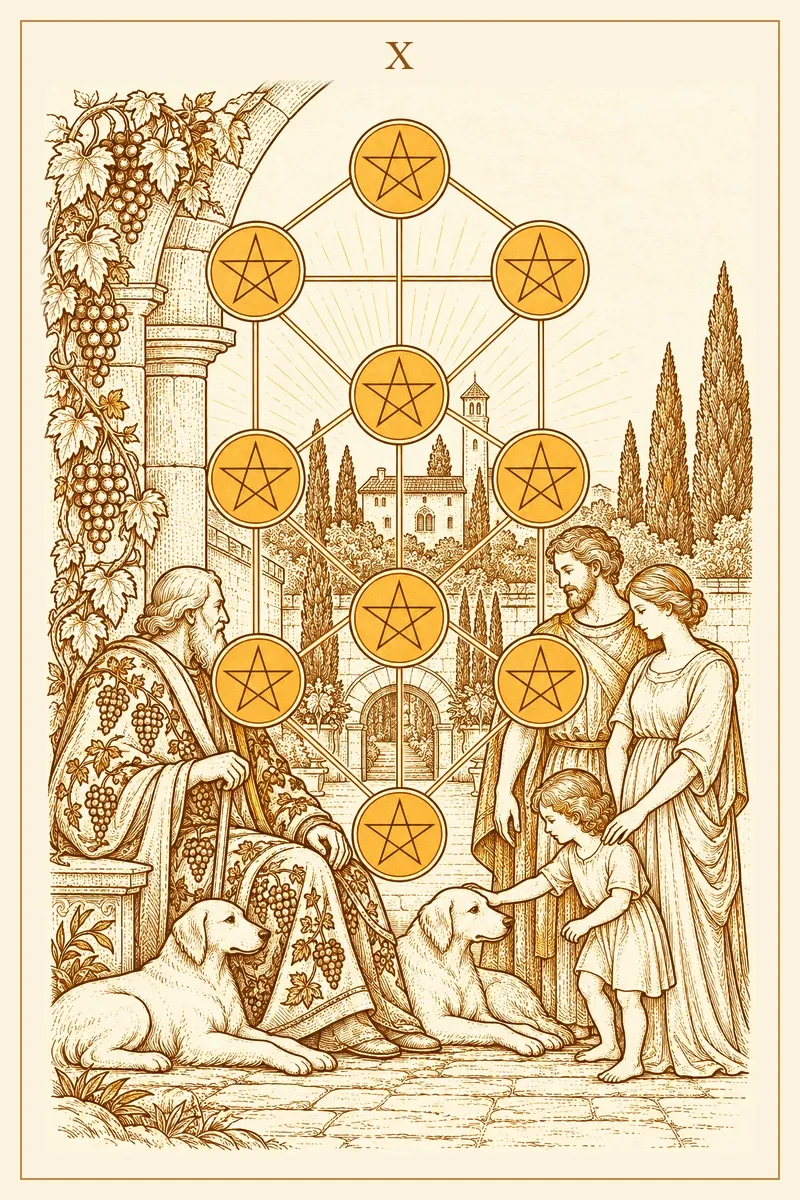
In the Ten of Pentacles, an old man in a robe patterned with grapes sits under a vine-covered arch with two dogs at his feet, while a younger couple and a child stand nearby, the child reaching out to pat one of the dogs. A villa among cypresses appears in the background again, but now the whole household is in the frame. The Nine is what one person can build and enjoy; the Ten is that security becoming a home for others. Drawn together, they ask how much of your private comfort you want to share. The Ten of Pentacles meaning follows that thread further.
Nine of Pentacles in love: enough on your own, open to company
In a relationship, single, or hoping
In love, the Nine of Pentacles describes someone who does not need a partner to feel complete. If you are single, your life is full in its own right: home, work, friends and evenings already please you. That changes the way you date. You are less likely to hold onto someone who treats you carelessly, because being alone is not what you fear most. If you are hoping for one person in particular, the card suggests keeping your own days steady rather than letting their replies set your mood.
In a relationship, the card points to two people who each keep a life of their own: separate interests, a say over their own money, time apart that does not feel like a threat. Reversed, that balance has tipped. Either independence has become distance, or one partner depends on the other so completely that they no longer feel like an equal. For a single reader, the reversed card can show self-sufficiency used as armor: high standards that are really a way of never risking disappointment. More love situations are gathered in the Nine of Pentacles in a love reading.
Nine of Pentacles as feelings: how they see you, upright and reversed
As an answer to "how does this person feel about me?", the upright Nine of Pentacles usually reflects respect and admiration. They see you as composed, capable and complete; they may like the life you have built and enjoy being near it. There can also be a hesitation inside that admiration: someone so self-sufficient can look hard to approach, and they may wonder whether you have room, or need, for them at all. The feeling is warm but careful, more "I admire you" than "I can't live without you".
Reversed, the feelings get tangled with security. They may value the comfort you provide (stability, a calm home, practical support) more than the closeness itself, or feel they cannot measure up to your standard and pull back to protect their pride. Whichever fits, the useful step is the same: say plainly what you want from the relationship rather than proving again how well you manage alone.
Getting back together: the Nine of Pentacles upright and reversed
Upright in a reconciliation question, the Nine often reflects that you have already rebuilt your life since the break, which matters more than any yes or no. If a reunion happens, it can only work as a meeting of two whole people, and you are now able to choose it rather than need it. It may also show that the wish to return is fading on its own; both are honest outcomes.
Reversed, look at the motive. Wanting someone back for the comfort they provided, the shared rent, the familiar routine, the fear of starting over, is not the same as wanting them. The reversed Nine can also point to an old pattern of dependence that would return with the person. Before you reach out, ask what in your own life you could steady first. Signs of reconciliation in tarot sets this card beside the others readers look for in that question.
Work and money with the Nine of Pentacles
Career: skill that buys its own freedom
At work, the upright Nine points to a stage where your expertise gives you room to choose. That may mean freelancing or running a small business that now sustains you, a role where you are trusted to work without close supervision, or a reputation that brings offers to you. It also describes the satisfaction of doing a job well for its own sake. If you are weighing a move toward more independence, the card supports the direction, provided the groundwork (savings, clients, skills) is in place rather than imagined.
Reversed, the independence may be thinner than it looks: one client pays most of your bills, or a job title hides long, unpaid hours while you keep up a successful image. The answer is rarely a dramatic change. More often it is one practical repair, such as a second income source, a no to a project that only feeds the image, or the leave you keep postponing.
Money: enough to stop counting, not enough to stop caring
Upright, the Nine of Pentacles reflects financial steadiness built over time: a cushion of savings, spending that fits your income, the ability to buy something of real quality and enjoy it without guilt. It is not a card of sudden windfalls but of money that behaves well because you have looked after it.
Reversed, it can describe a lifestyle running ahead of its income, or spending used to soothe stress or signal success. It is a prompt to check the gap between how your finances look and how they actually are.
Yes or no: a settled yes, if the ease is real
Upright, the Nine of Pentacles leans toward yes, particularly for questions about stability, independence, a purchase you have saved for, or a step that relies on your own skill. It is a calm yes rather than an exciting one. Reversed, the answer is qualified: what you want may be possible, but the card asks what it will cost in time, health or freedom, and whether you are relying on support that may not last.
The Empress, The Hermit, the Four of Pentacles and two more beside the Nine
The Empress: abundance that wants to be shared
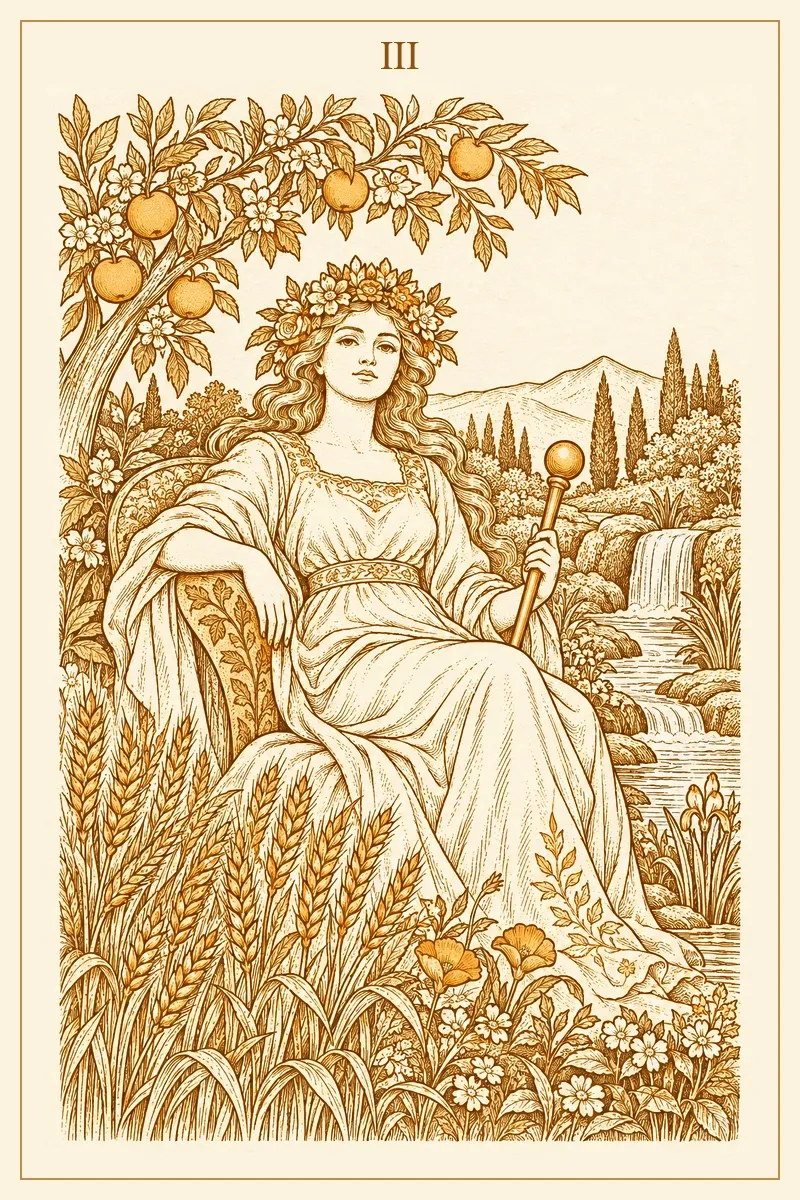
The Empress sits among ripening wheat and flowers, a waterfall behind her and an apple tree above. Next to the Nine, she softens its self-reliance into generosity: comfort that nourishes others, a home people want to visit. In love this pair reflects two people who both feel well cared for. The Empress meaning explains her own range.
The Hermit: solitude by choice
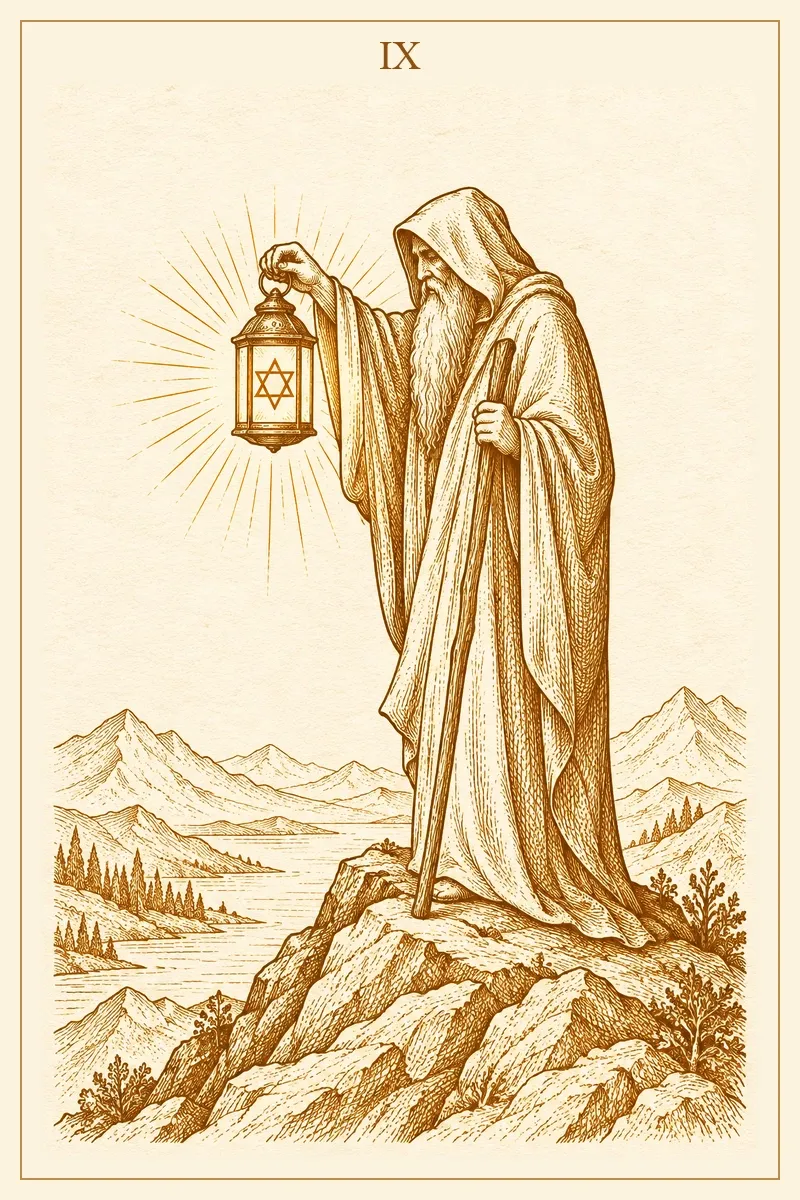
The Hermit stands on a rocky peak holding a lantern with a six-pointed star inside it. With the Nine, the picture is of a person who has chosen a quiet life on purpose and finds it rich. If either card is reversed, ask whether solitude is still a choice or has become a habit that keeps people away. The Hermit meaning looks at the line between the two.
Four of Pentacles: comfort held in a tight grip
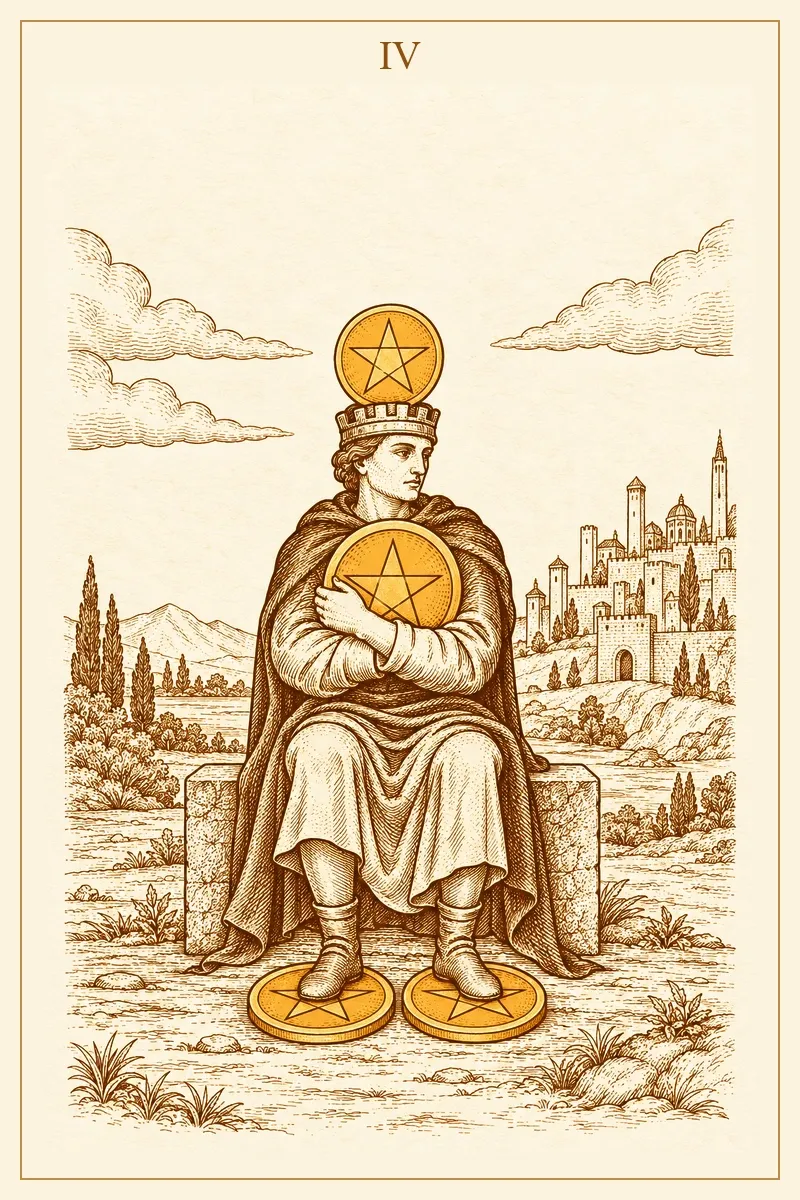
The Four of Pentacles shows a crowned man on a stone bench clutching one coin to his chest, another balanced on his crown and two pinned under his feet. The Nine holds her harvest lightly; the Four holds his so tightly that his hands are good for nothing else. Together they ask whether your security is something you live in or something you guard. The Four of Pentacles meaning covers that card's grip in detail.
Two of Cups and The Devil
With the Two of Cups, the Nine describes a partnership between two people who are each whole: attraction, mutual respect and enough personal space for both. With The Devil, it shows the shadow side of comfort, where a lifestyle, a habit of spending or a financial arrangement has become a chain. The Devil does not cancel the achievement; it asks what the achievement now demands of you.
The falcon spread: four cards, with an invented example
This four-card layout uses the details of the Nine of Pentacles picture as its positions. It works well when life has become more comfortable and you are unsure what to do with that comfort.
- The glove: the discipline that brought you here.
- The grapes: what is ripe and ready to be enjoyed now.
- The snail: what is slow and does not need hurrying.
- The wall: where your comfort may be turning into a fence.
Here is an invented example to show how the positions talk to each other. A freelance illustrator in her fourth year of self-employment asks, "Is it time to stop taking every job that comes in?"
- The glove: Knight of Pentacles. Her discipline has been steady, almost stubborn: meeting deadlines, saying yes, doing the dull jobs well. That reliability is the foundation; it does not need to be thrown away, only redirected.
- The grapes: Six of Pentacles. What is ripe is the ability to set fair terms. She is now in a position to choose which clients to give her time to and to charge in proportion.
- The snail: Four of Cups. She is tired of the same requests, and the card shows that restlessness clearly. The snail position says it can be noticed slowly; she does not have to drop everything this month.
- The wall: Three of Cups. The surprise is here. Her independence has kept other illustrators and friends at a distance. The fence is not around her money but around her company.
Read together, the spread does not say "quit" or "stay". It points toward a modest plan: raise rates for new clients, turn down one type of job she has outgrown, and spend some of the time she wins back with peers.
If you want help putting your own question into words before you lay out the cards, the question library has ready-made phrasings for money, work and love.
Living the Nine of Pentacles: four small practices
- Name what you paid for. Write down three things that exist because of your own effort: not only purchases, but skills, routines, a calmer way of handling conflict.
- Use something good without waiting for a reason. The good pen, the afternoon off.
- Check the cost once a week. Hours worked, sleep, money owed, how you feel on Sunday evening. If the comfort costs more each week, the reversed card has something to say.
- Open the gate once. Share a meal at home, ask a colleague for advice, accept help you would normally refuse. Independence keeps its warmth when it has a door.
Frequently asked questions
Is the Nine of Pentacles a good card?
Upright, it is one of the most reassuring cards in the Pentacles suit, because it describes stability you made yourself. Reversed, it is not a bad omen; it points to strain around comfort, money or independence that is worth looking at honestly.
Does the Nine of Pentacles mean I will stay single?
No. It describes how complete you are, not whether someone will join you. It fits happy single periods and strong relationships where both people keep their own lives alike, and asks that any partner add to a life that already works.
What does the falcon on the Nine of Pentacles mean?
It stands for instincts and ambitions that have been trained rather than suppressed. The hood adds calm restraint: knowing when not to chase.
What is the difference between the Nine of Pentacles and the Nine of Cups?
The Nine of Cups is the wish card: emotional satisfaction, a desire fulfilled, pleasure in the moment. The Nine of Pentacles is slower and more material. Its contentment comes from something built over time, and it emphasizes self-reliance rather than a wish granted.
What does the Nine of Pentacles mean as advice or in a future position?
As advice, it suggests protecting your independence, keeping your standards and allowing yourself to enjoy what you have. In a future position, it reflects where your present habits are heading if you keep tending them, a settled, self-supported comfort, rather than a fixed outcome.
Can the Nine of Pentacles tell me whether I will be financially secure?
No card can promise financial security or predict a specific sum, date or outcome, and tarot cannot see another person's mind either. The Nine can help you reflect on your habits, your sense of safety and the choices in front of you. For decisions about money, combine that reflection with real numbers and, where needed, a qualified adviser.
Back among the vines
The Nine of Pentacles keeps returning to one picture: a person at ease in a place they made. Upright, it invites you to stand there and enjoy it; reversed, it asks what the standing is costing you. If you would like to see how the Nine sits beside the other cards in the suit, the full card library is a good place to wander. And when you have a question of your own about comfort, work or love, a calm three-card reading on your own question is there whenever you are ready.