
Loading your view
The page is gathering the latest information.
The page is gathering the latest information.
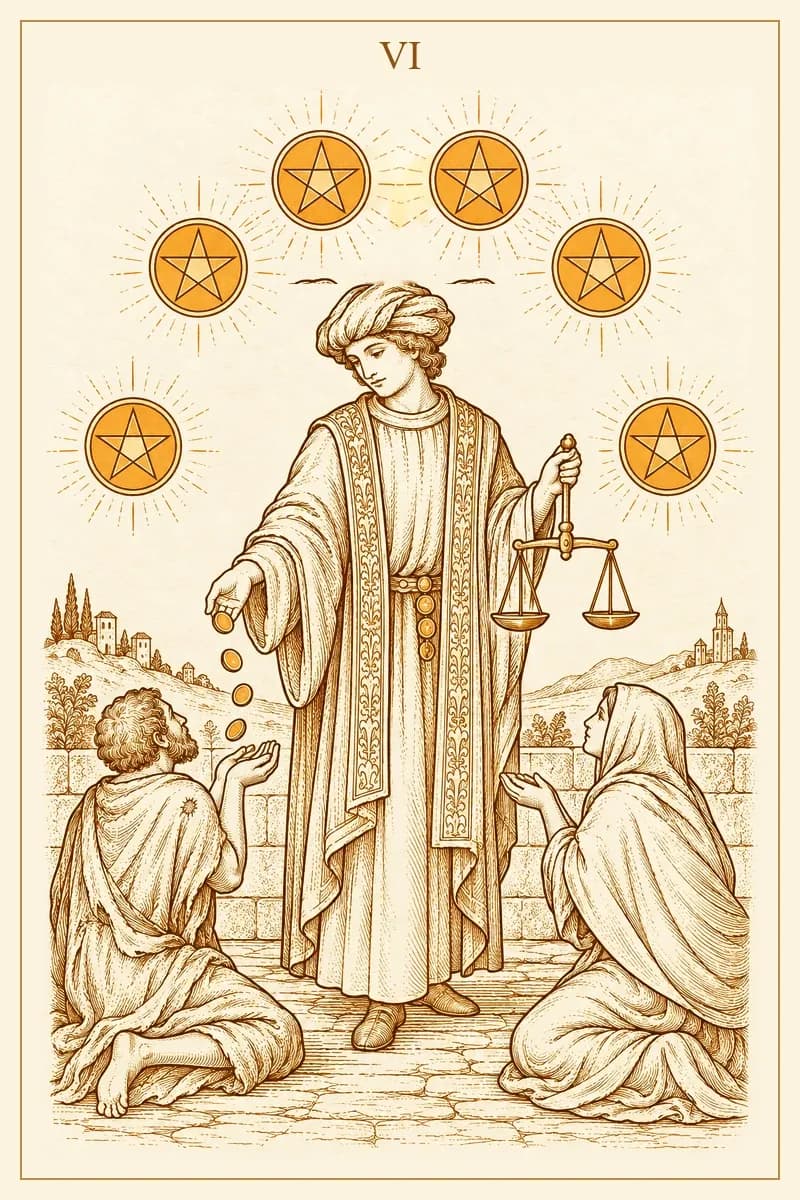
The card shown is VeilSoul's own engraved drawing of the 1909 Waite–Smith card. The scene and symbols described on this page follow the 1909 card, so a few details are drawn differently in our deck.
The Six of Pentacles shows a wealthy merchant standing between two kneeling figures, dispensing coins from one hand while holding a balanced scale in the other. The scale represents fairness and measured generosity — giving that is thoughtful rather than random. Six pentacles float in the air around the scene, suggesting that wealth is in circulation rather than hoarded.
When the Six of Pentacles appears upright, the theme is the flow of resources between those who have and those who need. You may be in the position of the giver — sharing your wealth, knowledge, time, or expertise with someone who benefits from your generosity. Or you may be in the position of the receiver — humbly accepting help that you genuinely need without shame or reluctance.
This card carries a nuanced message about power. The act of giving creates a power dynamic: the giver stands while the receivers kneel. Generosity can be genuine and loving, but it can also be a subtle form of control. The Six of Pentacles asks you to examine the dynamics of giving and receiving in your life. Are you giving freely, or are there strings attached? Are you receiving with gratitude, or with resentment?
The balanced scale confirms that true generosity is measured, fair, and sustainable. Give what you can afford to give without depleting yourself. Receive what you genuinely need without allowing dependency to become a permanent state. The Six of Pentacles celebrates the circulation of abundance — the understanding that wealth flows best when it moves rather than stagnates.
A wealthy figure holds balanced scales in one hand while distributing coins to kneeling beggars with the other. Generosity and power are inseparable here — every gift defines a hierarchy.
Charity becomes control — strings attached to every gift — or receiving feels so shameful that needed help is refused out of misplaced pride.
Detailed Interpretations
The Six of Pentacles in love speaks to the fundamental balance of giving and receiving within a relationship — a balance that, when healthy, creates a partnership where both people feel valued, supported, and reciprocally nourished. Are both partners contributing equally — emotionally, financially, practically — or has the relationship tilted into an imbalance where one person consistently gives while the other consistently takes without awareness or gratitude?
When this card appears upright, it often highlights generosity as a love language. One partner may be particularly giving — offering emotional support during a difficult time, contributing more financially during a period of unequal income, or simply showing up with consistent acts of care that demonstrate devotion through action rather than words alone. In its healthiest expression, the Six reflects a relationship where generosity flows naturally in both directions, each partner instinctively offering what the other needs most.
However, the Six also carries a subtle warning even in its upright position: examine the power dynamics embedded in giving. Does the more generous partner ever use their giving as leverage — expecting gratitude, keeping score, or subtly reminding the other of their dependence? Does the receiving partner feel diminished by always being on the receiving end, or are they contributing in ways that are equally valuable but less visible? True partnership requires that both people can give and receive with equal comfort, and that generosity never becomes a tool of control disguised as love.
For singles, the Six of Pentacles may indicate meeting someone through charitable work, community involvement, or a situation where one person helps the other — and the connection that grows from that initial generosity develops into something deeper and more reciprocal.
In love reversed, the Six of Pentacles exposes an unhealthy power imbalance disguised as generosity. One partner may use financial control — managing all the money, dispensing an allowance, tracking every purchase — to maintain dominance within the relationship. Alternatively, gifts and favors may come with invisible strings attached: every act of generosity is recorded in an unspoken ledger, to be called upon when compliance is needed.
This reversal also warns of one-sided relationships where one partner gives endlessly while the other takes without reciprocation or gratitude. The giving partner may enable this dynamic by deriving their sense of identity from being needed, while the receiving partner may have grown so accustomed to the arrangement that they no longer recognize its unfairness. The reversed Six asks both partners to examine honestly: is your generosity genuine, or is it a currency you spend to purchase control, loyalty, or emotional security? And if you are the one always receiving, are you truly unable to contribute, or have you simply stopped trying?
Professionally, the Six of Pentacles often signals a favorable flow of financial resources in your direction — a well-deserved raise, a meaningful bonus, a timely loan or investment, or a mentor who generously shares valuable knowledge, connections, and opportunities that accelerate your career in ways you could not have achieved alone. If you have been working diligently and wondering when recognition would arrive, the Six suggests that reward is approaching and that your contributions have not gone unnoticed.
If you are in a position of authority or relative abundance, this card encourages you to share your resources, expertise, and opportunities with those who are still building their careers. The most impactful leaders are not those who hoard knowledge and connections but those who actively develop the people around them. Mentoring a junior colleague, recommending someone for an opportunity, or sharing credit for collaborative work are all expressions of the Six of Pentacles in professional life. This generosity is not selfless sacrifice — it creates networks of loyalty, competence, and mutual support that ultimately strengthen your own position.
The Six also addresses the ethics of compensation and fairness in the workplace. Are people being paid equitably for their contributions? Is wealth being distributed in a way that reflects actual value created, or is the system structured to concentrate resources at the top while those doing essential work receive disproportionately little? Whether you are an employer setting salaries, a freelancer negotiating rates, or an employee evaluating whether your compensation reflects your worth, the Six asks you to apply the merchant's balanced scale to every financial arrangement.
Career-wise, the reversed Six of Pentacles warns of workplace dynamics where fairness has been replaced by favoritism, exploitation, or manipulation through financial leverage. A manager may distribute opportunities, raises, or recognition based on personal loyalty rather than merit. A mentor relationship that once felt genuinely supportive may have evolved into something exploitative — where the mentor's guidance comes with expectations of obedience, unpaid labor, or personal favors that cross professional boundaries.
This reversal also addresses the experience of being systematically undercompensated — working significantly harder or producing more value than your compensation reflects, while watching others receive disproportionate rewards for less meaningful contributions. If you feel you are giving more than you are getting, the reversed Six validates that perception and encourages you to reassess the arrangement. Fairness is not something you should have to beg for, and a workplace that consistently undervalues your contributions is not one that deserves your loyalty.
On the giving side, the reversed Six warns against charitable or generous acts in your professional life that are motivated by ego, tax strategy, or reputation management rather than genuine desire to help. Philanthropy that serves primarily as self-promotion ultimately corrodes trust and creates cynicism rather than goodwill.
The Six of Pentacles in health suggests receiving good medical care, meaningful support from health professionals, or the assistance of caregivers, family members, or a devoted partner who helps you navigate a recovery process with patience and practical help. If you have been managing a health issue alone — shouldering the burden of appointments, medications, lifestyle changes, and emotional weight without asking anyone to share the load — this card encourages you to accept the help that is available and to recognize that receiving care is not a weakness but a natural part of being human.
This card also addresses the reciprocal nature of health support. Perhaps you are the caregiver rather than the patient — supporting a loved one through illness, managing their appointments, providing emotional stability during their most vulnerable moments. The Six honors this generosity while reminding you that sustainable caregiving requires that you also receive support, rest, and care for yourself. The merchant holds the scale in balance; the caregiver who gives everything and receives nothing will eventually collapse under the weight of their own generosity.
On a broader level, the Six of Pentacles in health can represent access to healthcare resources — insurance coverage, community health programs, charitable organizations that provide medical assistance, or workplace wellness benefits that you may not have fully utilized. If you need help, it may be more accessible than you realize. The Six encourages you to investigate what support systems exist and to use them without shame.
Use this as a reflective prompt, not medical advice or a diagnosis. For health concerns, seek guidance from a qualified healthcare professional.
The Six of Pentacles reversed exposes the shadow side of giving and receiving — strings-attached generosity, charity used as control, or an unfair distribution of resources. Someone may be giving in order to create obligation, or withholding help to maintain power over those in need.
This reversal can also indicate that you are on the losing end of an unequal exchange — giving far more than you receive, or receiving help that comes with conditions that compromise your autonomy. The scale has tipped, and the imbalance needs to be addressed.
Alternatively, the reversed Six may signal self-sabotage around money — refusing help when you need it, giving away resources you cannot afford to lose, or using financial generosity to avoid addressing deeper emotional issues.
The reversed Six of Pentacles teaches that generosity without genuine fairness is not generosity at all — it is manipulation wearing a charitable mask. The deepest lesson of this reversal is that every exchange of resources — whether money, time, energy, or emotional support — carries an implicit power dynamic, and only conscious awareness of that dynamic prevents generosity from becoming a tool of control.
This card also teaches the crucial distinction between enabling and empowering. True generosity empowers the recipient toward independence — sharing knowledge so they can fish for themselves, offering a hand up rather than creating dependence on handouts. When giving consistently creates obligation rather than growth, when receiving always requires submission rather than gratitude, the circulation of abundance has been corrupted into a mechanism of control. The balanced scale must be held honestly — and both giver and receiver bear responsibility for keeping it level.
Give something today — your time, your knowledge, your attention, your money — and notice how it feels to release resources rather than clutch them. If someone offers you help, receive it with genuine grace rather than deflecting with false self-sufficiency. But also pay attention to the balance: are you giving from abundance or from obligation? Are you receiving with gratitude or with entitlement? The circulation of generosity is how abundance stays alive, but only when the scale is held honestly by both hands. Today, be both a generous giver and a gracious receiver, and let the flow of exchange nourish everyone it touches.
“I give generously from a place of abundance and receive gratefully without shame. My wealth flows in fair circulation, enriching both myself and those I touch.”
The card shown is VeilSoul's own engraved drawing of the 1909 Waite–Smith card. The scene and symbols described on this page follow the 1909 card, so a few details are drawn differently in our deck.
The merchant's balanced scale is the card's defining symbol — generosity guided by fairness, not impulse. He gives a measured amount to one kneeling figure while the other still waits, suggesting that true generosity is thoughtful and sustainable rather than performative or reckless. The scale also represents karma: what you give comes back to you in kind.
The two kneeling figures represent those in need — humble, grateful, and willing to receive. Their posture is one of acceptance rather than demand. The power dynamic is visible but not necessarily negative; the merchant is fulfilling a social responsibility, and the receivers are accepting legitimate help.
The six pentacles floating in the air suggest that wealth is in motion — circulating through the scene rather than being held by any single person. This is the tarot's vision of healthy economic flow: resources moving from where they accumulate to where they are needed, sustaining the whole community.
Six represents harmony, balance, and reciprocity. In the Pentacles suit, it manifests as the healthy flow of material resources between giver and receiver — the understanding that wealth serves its highest purpose when it circulates rather than accumulates.
Keep or share this card reference
✦ From meaning to reflection ✦
Bring what this card stirred into a reading shaped around what you are facing now.
Read with this insight