Lasting security that reaches past one lifetime: that is the Ten of Pentacles tarot card meaning in a sentence. Upright, the card describes money, a home or a set of values built steadily enough to be shared with family and handed on, whether that family is the one you were born into or one you gathered yourself. Reversed, it shows the same foundation under strain, through money disputes, inheritance tangles, family pressure or choices that trade long-term stability for short-term relief.
As for when, the honest answer is that no card can name a date. Readers who want a time frame often use the Golden Dawn convention that places this card in the last ten days of Virgo, roughly September 12 to 22, or they read the slow Pentacles suit in months rather than days. Those are conventions, not promises, and the same limit applies throughout: a reading cannot guarantee an inheritance, confirm what a relative intends or settle an outcome. It can show what you are building and what deserves protecting.
The card at a glance:
- Upright: legacy, family wealth, a settled home, long-term security, belonging across generations.
- Reversed: family conflict over money or property, a contested inheritance, pressure to follow the family script, short-term thinking.
- Astrology: Mercury in Virgo, the third decan of Virgo; the Golden Dawn title is Lord of Wealth.
- Yes or no: yes, strongest for home, family and long-range plans; reversed, a yes that waits until the money talk has happened.
- Timing: slow and cumulative; by convention, mid-to-late September or a span of months.
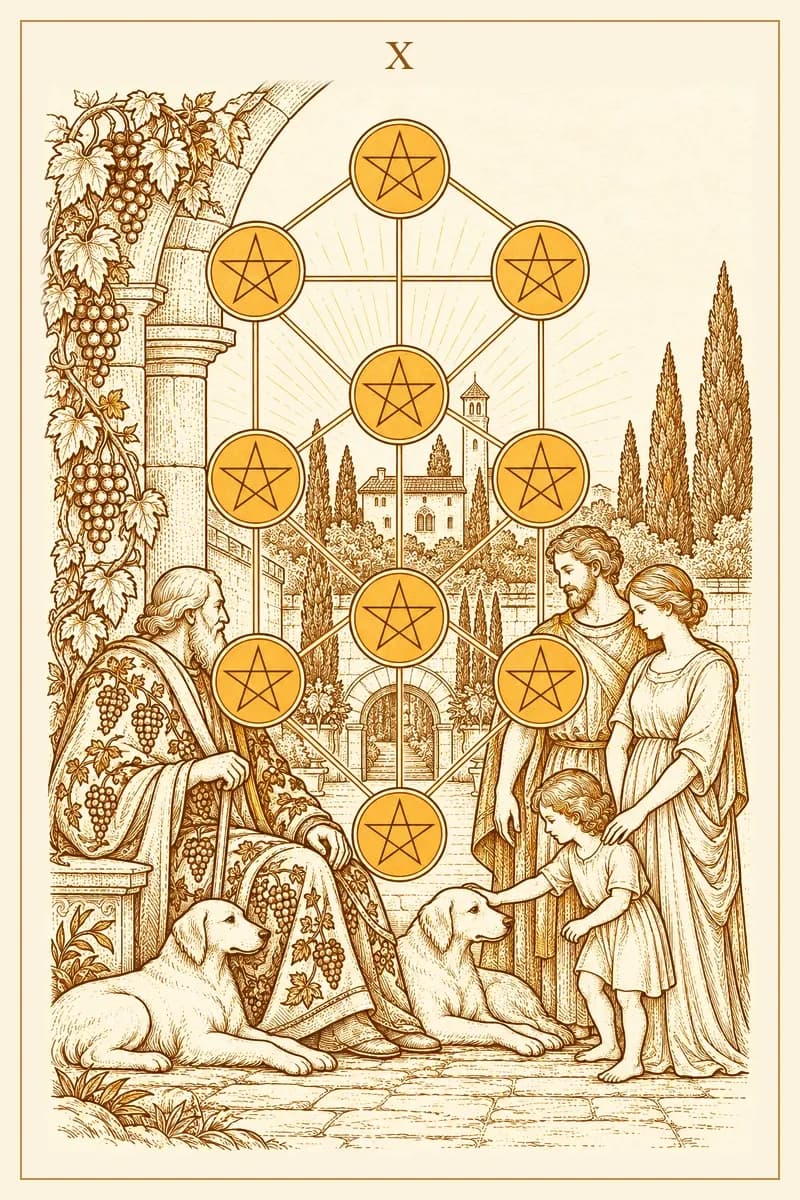
Three generations under a vine-covered arch
The grandfather in the grape-patterned robe
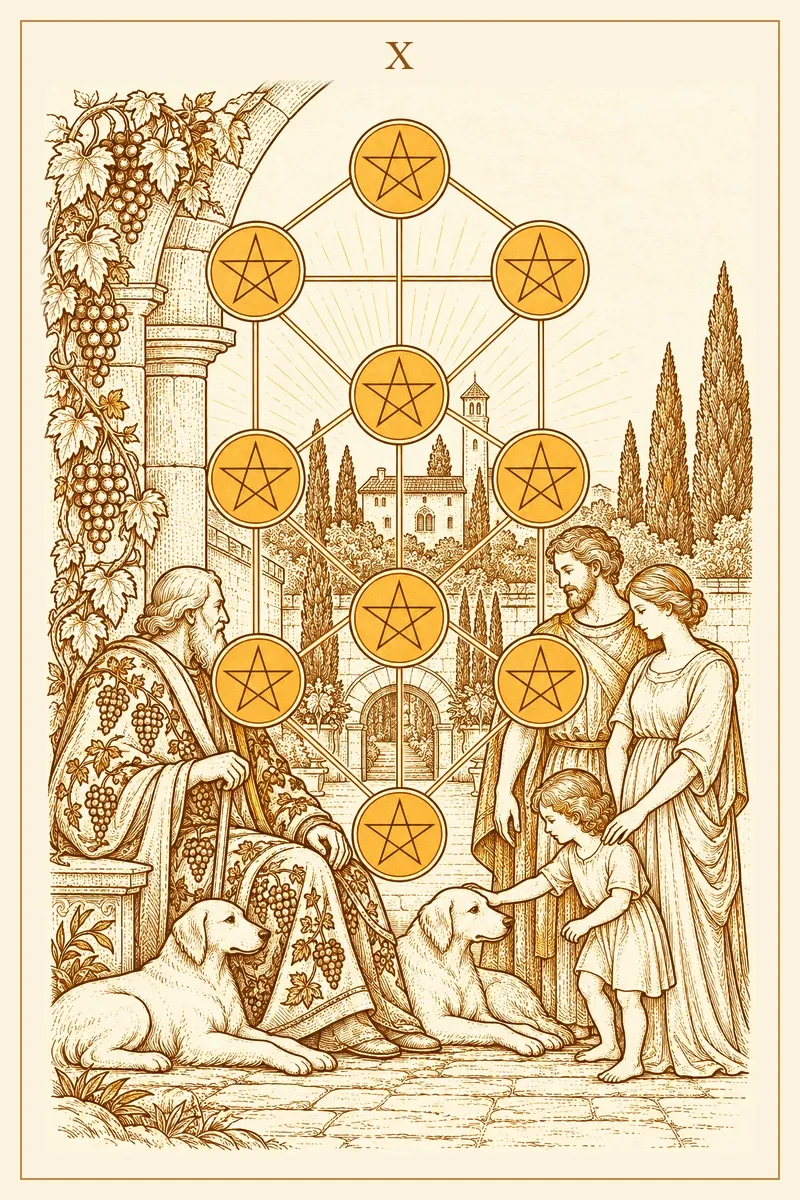
On the left, an old man with a long white beard sits on a carved stone bench beneath a stone archway, one hand on a walking staff. His heavy robe is patterned all over with bunches of grapes, echoing the real vine that climbs the arch beside him. He has finished building and is watching the people who will live with what he built. A vine takes years to establish and then fruits season after season, which is a fair summary of the wealth this card describes: slow to plant, generous once rooted.
Two pale dogs and a child's reaching hand
Two pale, long-eared dogs lie on the flagstones, and a barefoot child reaches out to stroke one of them while a younger couple stands behind, the woman's hand on the child's shoulder. The dogs usually stand for loyalty and continuity. The child's gesture matters just as much, because legacy here is not a formal handover of deeds. It is a small hand learning that this place is safe and these people will be here tomorrow.
Ten coins arranged as the Tree of Life
Above the family, ten gold pentacles are joined by fine lines: one at the top, then pairs and single center coins alternating downward to a last coin just above the paving. This is the Kabbalistic Tree of Life, ten spheres running from the most abstract at the crown to Malkuth, the physical world, at the base. Pentacles is the suit of earth and ten is the final number, so the card lands exactly on Malkuth: spirit worked all the way down into bricks, bread and the people around a table. Nobody in the family looks up at the coins, which is how inherited security feels from inside: you rarely notice a foundation until it is gone.
A villa, cypresses and an open garden gate
Through the arch you can see a house with a small bell tower, tall cypresses, stone walls and a second archway opening onto steps and a garden. That gate stands open, and a lasting home, the picture suggests, is one people can walk in and out of.
Mercury in Virgo, the Lord of Wealth and the tenth sphere
In the Golden Dawn system that most modern decks follow, this card belongs to earth and to the third decan of Virgo, ruled by Mercury, and carries the title Lord of Wealth. Virgo is the sign of care, maintenance and detail; Mercury rules contracts, records and conversation. Together, at the very end of the sign, they describe the unglamorous side of wealth: the will that was actually written, the family recipe someone bothered to copy out, accounts kept straight for decades. The Virgo and tarot guide gathers the other cards that share this sign.
Ten also closes the suit's long cycle, from a single coin offered out of a cloud to a household that has lasted. Next in line is the Page of Pentacles, a young student holding one coin up to the light, and the Page of Pentacles meaning picks up the story where this card sets it down.
Ten of Pentacles upright: what keeps standing after you
Security that has been shared out
Upright, the Ten of Pentacles describes material life stable enough to support more than one person: a paid-off family home, a business entering its second generation, savings that can absorb a bad year, a household where bills and care are reliably covered. This is not a windfall but years of ordinary decisions pointing the same way, and the card speaks to the moment someone realizes their own stability has quietly become part of other people's lives.
Roots, rituals and the family you build
Not every legacy is money. The card also covers inheritances with no price: a language spoken at home, a holiday dish cooked the same way for forty years, a trade learned at a parent's elbow. Upright, these feel like resources rather than obligations. The family in the picture can be a chosen one, too, such as friends you spend every holiday with.
Thinking in decades
As advice, the upright Ten asks you to choose with a longer horizon. Would this decision still make sense in ten years, and who would inherit its consequences? Recording an elder's stories while they can still tell them is as much in the spirit of the card as any savings plan.
Ten of Pentacles reversed: when the foundation shifts
Money, property and inheritance under strain
Reversed, the card usually describes conflict over shared resources: siblings who disagree about a parent's house, a will that surprised someone, a family business with no agreed successor, a couple who never talked openly about money and now must. The card rarely says who is right; it points to where clarity is missing.
A family script that no longer fits
The reversal can also describe pressure from the past rather than its loss: being expected to take over the business, marry well, stay in the hometown or keep a tradition that has turned into a weight. It is not necessarily a warning against breaking with tradition. Sometimes the healthiest thing a person can do for the next generation is decide which inheritance stops with them.
Trading the long view for quick relief
The reversed Ten can also point to choices that eat into future security, such as borrowing against a home for something temporary, or to the opposite imbalance: someone so focused on the estate and the look of success that the actual family is neglected. Either way, the correction is to bring the long view and the people back into one room.
Love, marriage and the household under the arch
In a committed relationship
In a love reading, the upright Ten points to a partnership turning into a shared life with real structure: moving in, marrying, buying a home, combining finances. It favors steady, practical love over drama. If you asked whether the relationship has a future, the card describes the kind of future it could have, built on reliability and shared plans, without promising a particular outcome.
If you are single
For someone single, the card can describe meeting a partner through family or a familiar community, or simply what you are looking for: someone whose idea of a good life fits yours over decades rather than weekends.
Reversed: in-laws, money and appearances
Reversed, the card tends to bring relatives into the picture: disapproving in-laws, disagreements about where to live or how to raise children, unequal earnings nobody discusses, or a couple who look settled from outside while privately drifting apart. The practical step is a clear conversation about money and family expectations, ideally before a major commitment rather than after one.
Family business, property and long-term money
Work you stay in for the long haul
At work, the upright card favors established institutions, family firms, long tenure and fields that deal with property, records, inheritance or heritage. It can mark the moment you choose a place to put down roots, or start passing on what you know. Reversed, it may show a succession fight, a family business that refuses to modernize, or a workplace whose stability rests on one aging founder.
Property, savings and estate questions
With money, the Ten is the card of slow accumulation: property, retirement savings, a home paid down over many years. Upright, the long-term plan looks sound. Reversed, something needs attention, perhaps an outdated will or a vague arrangement with relatives. A reading will not replace an accountant or an estate lawyer; what it can do is name the conversation you have been postponing.
Body, ancestry and belonging
In well-being questions, the card turns attention to what runs in the family, including a health history relatives know but may never have mentioned; asking about it and sharing it with your doctor is a practical way to honor the card. Spiritually, the Tree of Life drawn over a courtyard says the sacred lives in ordinary things. Reversed, it can describe rootlessness, which often eases when you learn where you come from or start traditions of your own.
Ten of Pentacles timing: what a time frame can and cannot mean
When will the house, the wedding or the settlement come through? The conventions below are handy for setting a check-in point, but they disagree with one another and none of them is a forecast.
The decan convention: the last days of Virgo
In the Golden Dawn system each numbered Minor card from two to ten rules a ten-degree slice of the zodiac. The Ten of Pentacles takes Mercury's slice at the end of Virgo, which the Sun crosses roughly from September 12 to 22, shifting by a day or so between years. Readers who use this method treat an upright Ten as pointing to the next such window. The guide to tarot timing with astrology lists the window for every decan card.
Suit and number conventions
A simpler method reads the suit as a speed. Pentacles, the earth suit, moves slowest, so many readers translate it into months or seasons; some also count the number and read the Ten as about ten months, or simply as the close of a long cycle. That fits the picture, since nothing in the scene was built quickly. The overview of how to read timing in tarot cards sets this beside other methods.
What a reversal or a neighbor changes
Reversed, most readers take the Ten as a delay rather than a refusal: the window passes or stretches while a family, legal or financial matter is settled. A fast card beside it, such as the Eight of Wands, can pull the timing forward, while slow cards like the Four of Pentacles or The Hermit push it out. If a date really matters, try asking "What needs to be in place before this can happen?" The Ten answers that far more reliably.
Yes or no: a slow, solid yes
Upright, the Ten of Pentacles is a clear yes, strongest for questions about home, family, property and long-term commitments, and better suited to "Will this hold?" than to "Will this happen this week?" Reversed, read it as "yes, once the shared arrangement is sorted out": an honest conversation, a written agreement or a repaired relationship comes first.
Cards that change the Ten of Pentacles
With the Nine of Pentacles: from one garden to a whole courtyard
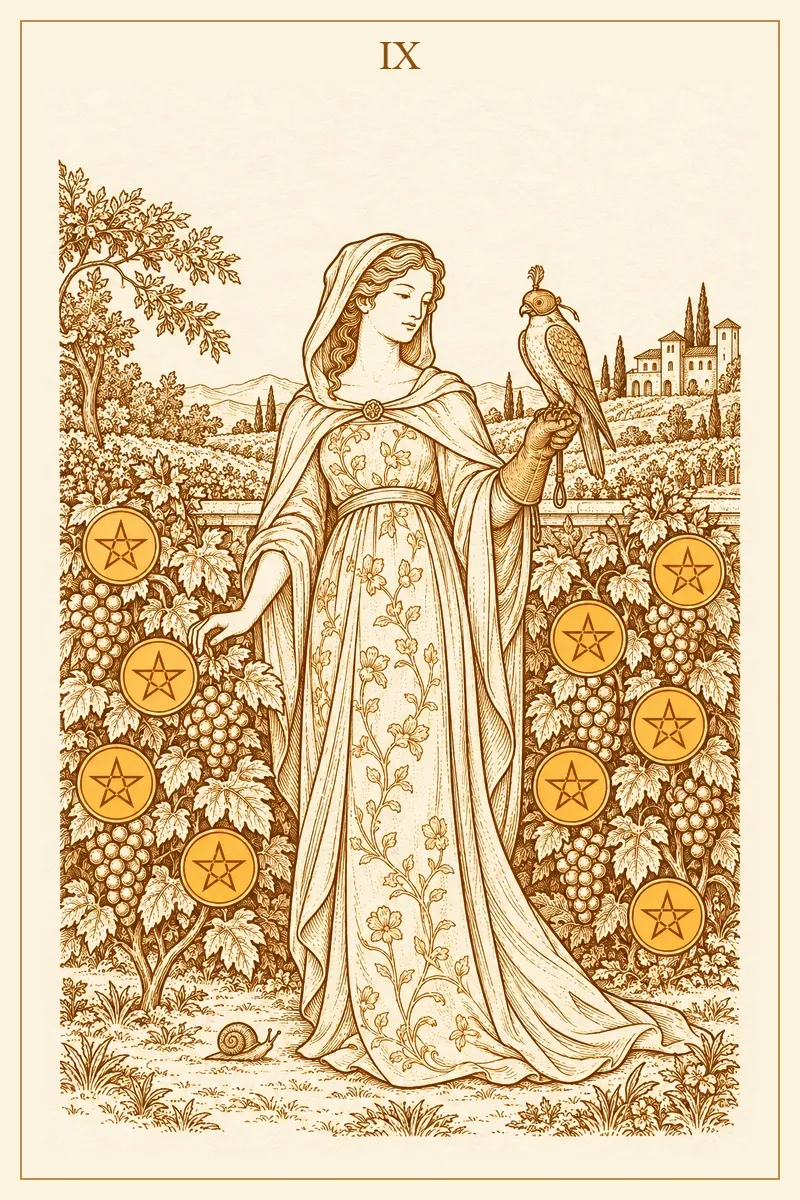
The Nine of Pentacles shows a woman in a long flowered gown standing alone among grapevines heavy with fruit and coins, a hooded falcon on her gloved hand and a small snail near her feet. Beside the Ten, that self-made comfort grows into shared security: someone who built something alone is deciding whom to bring into it. The full Nine of Pentacles meaning explores the self-reliance the Ten builds on.
With the Ten of Cups: a sound roof over a happy room
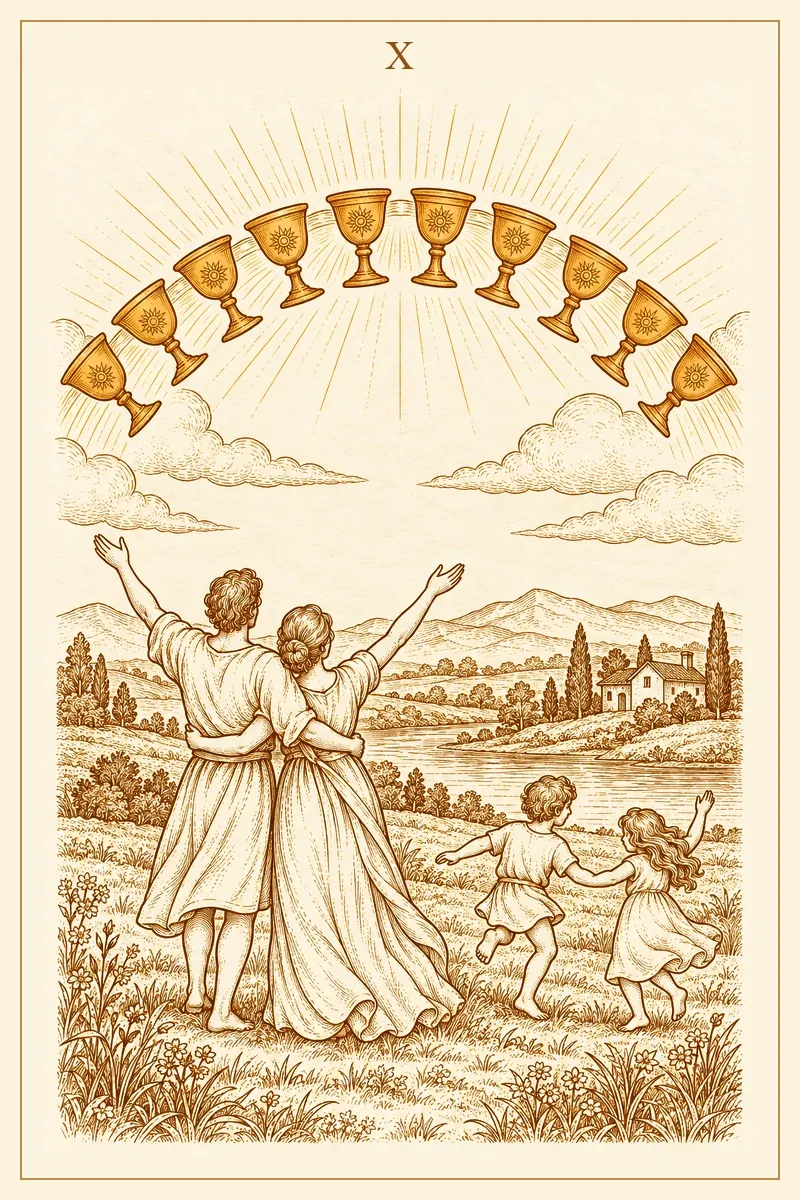
The Ten of Cups shows a couple, arms around each other, raising their free hands toward an arc of ten cups while two children dance nearby. Where the Ten of Pentacles is the estate, this card is the feeling of being home. A reversed Cups card beside an upright Pentacles one often describes a comfortable house that has stopped feeling warm; the other way around, love that is strong while the money is not. The Ten of Cups meaning covers the emotional side.
With The Hierophant: vows, ceremonies and traditions
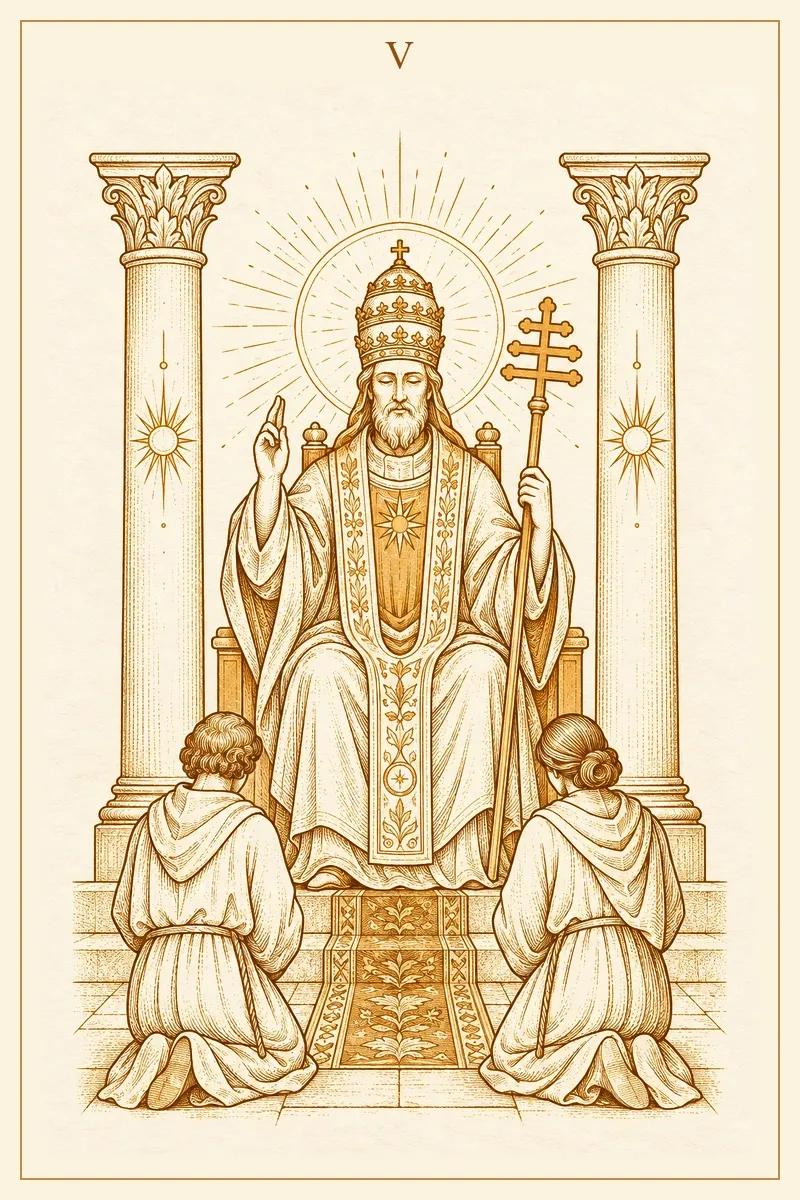
The Hierophant sits enthroned between two tall columns in a triple crown, one hand raised in blessing and the other holding a triple cross, while two figures kneel on the steps below. With the Ten of Pentacles it often points to a wedding or a family custom taking on formal weight; with either card reversed, to tension between what the family expects and what you believe. The Hierophant card meaning goes further into tradition and teaching.
With The Tower: the old house shakes
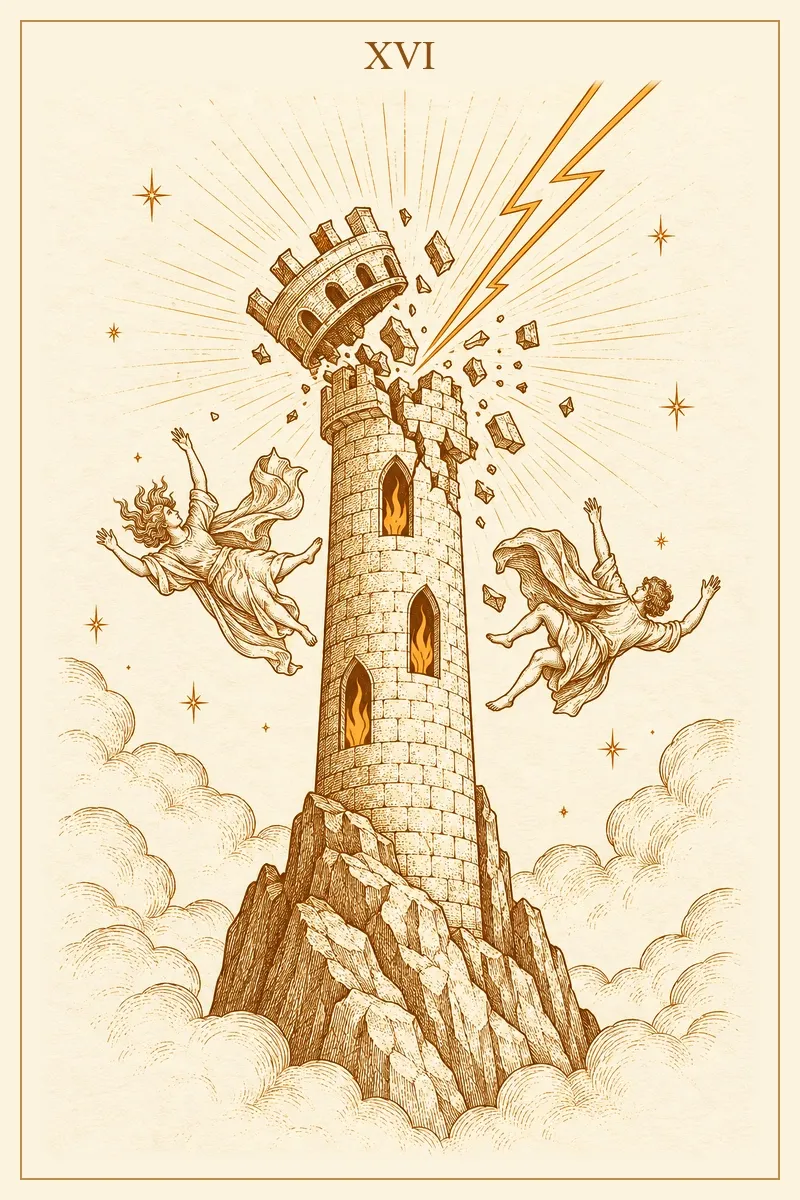
The Tower shows a stone tower on a rocky peak above the clouds, its crowned top blown off by lightning, flames at the windows and two figures falling. Beside the Ten of Pentacles, it describes sudden disruption to something that looked permanent, such as a family business closing or a house being sold. More often than total loss, it means a structure that depended on silence has to be rebuilt more honestly. The Tower card meaning looks at what tends to grow back afterward.
Three more pairings worth knowing
- With The Emperor: authority and order around family wealth, such as a family company with clear rules; the Emperor card meaning covers both the steady and the rigid sides of that authority.
- With the Ace of Pentacles: the first and last cards of the suit together, a new opportunity that could grow into lasting security or a new generation starting on someone else's foundation; the Ace of Pentacles meaning tells the seed end of this story.
- With The World: a long chapter completed, such as a mortgage closed or a family milestone reached; the World card meaning describes that sense of a cycle closing well.
The Inheritance Spread: five positions for what you carry forward
This layout borrows the card's three generations as its frame. Hold a question about family, home or money while you shuffle, then lay five cards in a row.
- The foundation: what you were given, in money, habits or values.
- The keepsake: what is worth carrying forward.
- The crack: what needs repair or a clear conversation.
- The handiwork: what you are adding now with your own hands.
- The open gate: how this could look for whoever comes after you.
Read the first two positions together before the rest. Most family questions hide a tension between what you were handed and what you actually want to keep, and the third card usually shows where it surfaces.
A worked example: buying a house with aging parents
This example is invented to show the spread at work. A woman in her late thirties asks: "What should I weigh before my partner and I buy a two-unit house with my parents?" She draws five cards for the Inheritance Spread.
- The foundation: Four of Pentacles, upright. Her parents handle money carefully to the point of tight control; in that household, security has always meant holding on.
- The keepsake: Ten of Pentacles, upright. The wish beneath the plan is real: children growing up near their grandparents, help flowing both ways, a home that stays in the family.
- The crack: Justice, upright. The weak point is not affection but terms: who owns which share, who pays for the roof, what happens if someone needs to move out or into care.
- The handiwork: Eight of Pentacles, upright. Her part is steady and unglamorous: research, numbers and many small, repeated contributions.
- The open gate: Three of Pentacles, upright. The plan works best as a joint project with clear roles and outside expertise.
Read together, the cards support the idea but not the vagueness around it. The Ten says the family vision is worth protecting, and Justice says the way to protect it is to write the arrangement down while everyone is on good terms. Sensible next steps would be a meeting with all four adults, advice from an independent lawyer and a financial advisor before any offer, and a written plan for one parent needing full-time care. Asked when to move, the cards give no date; the useful timing comes from Justice: once the agreement is signed, not before.
Small ways to build something that lasts
- Write a one-page list of what you own, owe and depend on, and tell one trusted person where it is kept.
- If you share property or money with family, schedule the conversation you have been avoiding and put the outcome in writing.
- Choose one tradition to keep on purpose and one to let go, and ask yourself what you would like to stop with you.
Frequently asked questions
Is the Ten of Pentacles a good card?
Yes. It is one of the most reassuring cards in the Minor Arcana, describing stability that lasts and is shared. Reversed, it is not a disaster card either; it shows where a shared foundation needs attention.
What is the Ten of Pentacles time frame?
No card can tell you a date, and this one is no exception. Tarot can describe what is developing and what may help, but not when an event will happen, what another person will decide or how something will turn out. If you like conventions, the Golden Dawn decan points to roughly September 12 to 22, and the suit convention reads Pentacles in months or seasons. Treat either as a check-in point rather than a deadline.
Does the Ten of Pentacles mean marriage?
It is closely linked with marriage, moving in together and starting a family, because it describes building a shared, lasting household. It does not guarantee a wedding, and reversed it may point to family or money questions to settle before a commitment.
Does the Ten of Pentacles mean I will inherit money?
It can, but more often it describes the wider idea of what is passed down, from property to values to skills. If an inheritance is in question, read the card as a prompt to get clear information and sound advice, not as a forecast.
Can the Ten of Pentacles represent a person?
Yes: a grandparent or older relative who holds a family together, or someone established and generous with their stability. Reversed, it may describe someone whose sense of duty to family has become heavy.
I am new to tarot. How should I study this card?
Lay out the Ace through the Ten of Pentacles in order and watch the story move from one coin to a whole household. If tarot itself is new to you, the beginner's introduction to tarot explains how the suits and numbers fit together.
The gate left open
The Ten of Pentacles does not ask you to be rich. It asks what you are building, whom it will hold and whether the people inside it feel at home there. When you want to look at your own foundations, a quiet Veil Soul reading is a good place to start.