Court cards in tarot are the sixteen figure cards of the Minor Arcana: a Page, a Knight, a Queen and a King in each of the four suits. Each is built from two parts. The rank shows how the energy moves, from the Page who is still learning to the King who carries it with responsibility, and the suit shows what that energy moves through: Wands for drive and creative fire, Cups for feeling, Swords for thought and speech, Pentacles for work, money and the body.
In a reading, a court card can describe another person, a side of you, or an attitude the situation is asking for. The question, the position and the neighboring cards help you choose. What a court card cannot do is name a specific person, reveal what someone privately thinks, or tell you what they will do next; your own knowledge of the people in your life fills that gap far better than any card.
The courts belong to the Minor Arcana, so if the deck's structure is still new to you, the overview of how the Major and Minor Arcana differ is useful background. Here are the eight building blocks:
- Page: the beginner and the messenger; curiosity, study, news, a first attempt.
- Knight: the suit in motion; pursuit, travel, and a habit of going too far.
- Queen: the suit held inwardly; care, steadiness, influence without force.
- King: the suit carried outward; direction, decisions, responsibility for others.
- Wands: fire; ambition, energy, creativity and courage.
- Cups: water; emotion, relationships, intuition and imagination.
- Swords: air; ideas, words, conflict, truth and decisions.
- Pentacles: earth; work, money, skill, health and home.
How rank and suit build each court card
Think of a court card as a short sentence. The suit is the subject: what the card is about. The rank is the verb: what is happening to that subject right now. The Page of Swords is someone exploring ideas, asking questions and testing what they have heard. The King of Swords is someone using ideas to judge and decide on behalf of others. Same element, very different stage.
The numbered cards of each suit tell a story in ten steps, which the guide to number symbolism in the Minor Arcana walks through. The courts step outside that sequence and show the suit as a personality. On the cards, posture gives the rank away before you read the title: Pages stand on foot, Knights ride, and Queens and Kings sit on thrones.
Pages: learning and first messages
A Page meets its suit for the first time. Upright, it brings curiosity, a willingness to try, a piece of news or an invitation, and a beginner's mind. At work it can point to a course or a skill you are only starting to build; in love, a hesitant first message.
Reversed, a Page tends to show the beginner's weak spots: a plan that stays in the notebook, a message delayed or misread, immaturity, or the fear of looking foolish that keeps someone from starting at all. As a person, a Page can be a young person, but just as easily anyone new to a role, at any age.
Knights: the suit in motion
A Knight has left the classroom and is riding toward something. Upright, it is movement, pursuit and commitment to a direction: travel, a new push at work, an offer that arrives quickly, a person who acts the moment they feel or think something. Knights show the suit with nothing holding it back, which makes them exciting and sometimes exhausting.
Reversed, a Knight's momentum turns sideways. It can be haste that skips steps, a pursuit that stalls, a promise that is not kept, or the opposite of motion: a rider who never leaves the stable. When a Knight stands for someone, ask what they are chasing and whether they stay once they arrive.
Queens: holding the suit from within
A Queen has absorbed her suit so fully that she has nothing to prove. Upright, she brings maturity expressed through presence, care and inner authority: the friend whose calm settles a room, or the part of you that already knows what you need. Her power works through influence and example rather than command.
Reversed, a Queen's gifts either turn against her or spill outward without limits. Care becomes self-sacrifice, intuition becomes worry, clarity becomes coldness, generosity becomes control.
Kings: carrying the suit outward
A King has mastered his suit and now uses it for others. Upright, he means leadership, expertise, decisions and responsibility: a manager, a mentor, an advisor, or the moment when you are the one who has to choose and live with the result.
Reversed, a King's authority can harden or wobble. Think rigid rules, power misused, or a boss who avoids deciding. When a King lands in an advice position, the question is usually what you are willing to take responsibility for.
Four courts read closely
The four cards below were chosen so that each rank and each suit appears once. Side by side, they show how one structure produces four very different characters.
Page of Cups: a feeling that surprises you
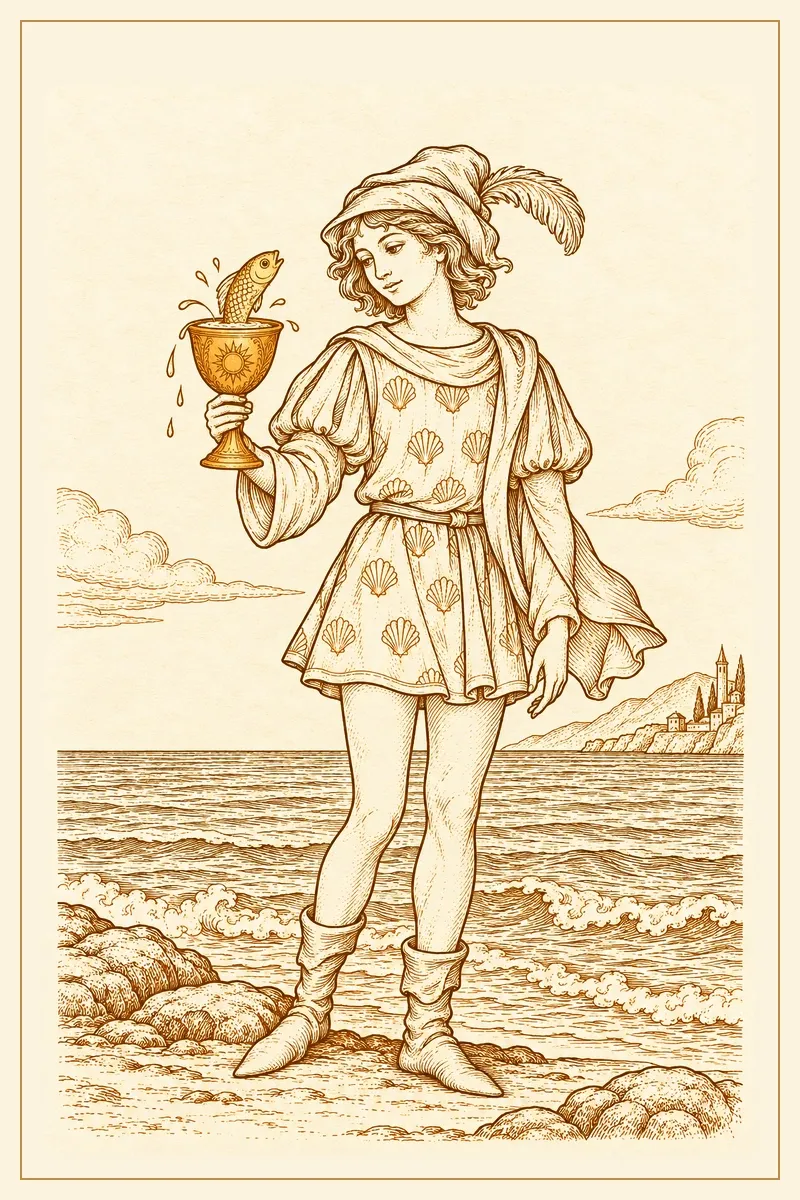
On the Page of Cups, a young figure in a feathered cap and a shell-patterned tunic stands at the shoreline while a small fish leaps out of the cup in their hand. Upright, this Page is an emotion or idea that arrives unexpectedly and asks to be taken seriously: a crush, a creative impulse, a tender message, an apology you did not expect. In love it can describe affection that is sweet and shy; at work, an idea worth sketching or a role where imagination matters.
Reversed, the surprise lands badly. Feelings get hurt over small things, creative ideas are dismissed before they have a chance, or someone hides in daydreams instead of saying what they feel. As advice, the card asks you to give the unexpected feeling a little room before deciding what it means. The full Page of Cups meaning covers its combinations and yes-or-no reading in more depth.
Knight of Wands: a fast start that needs a plan
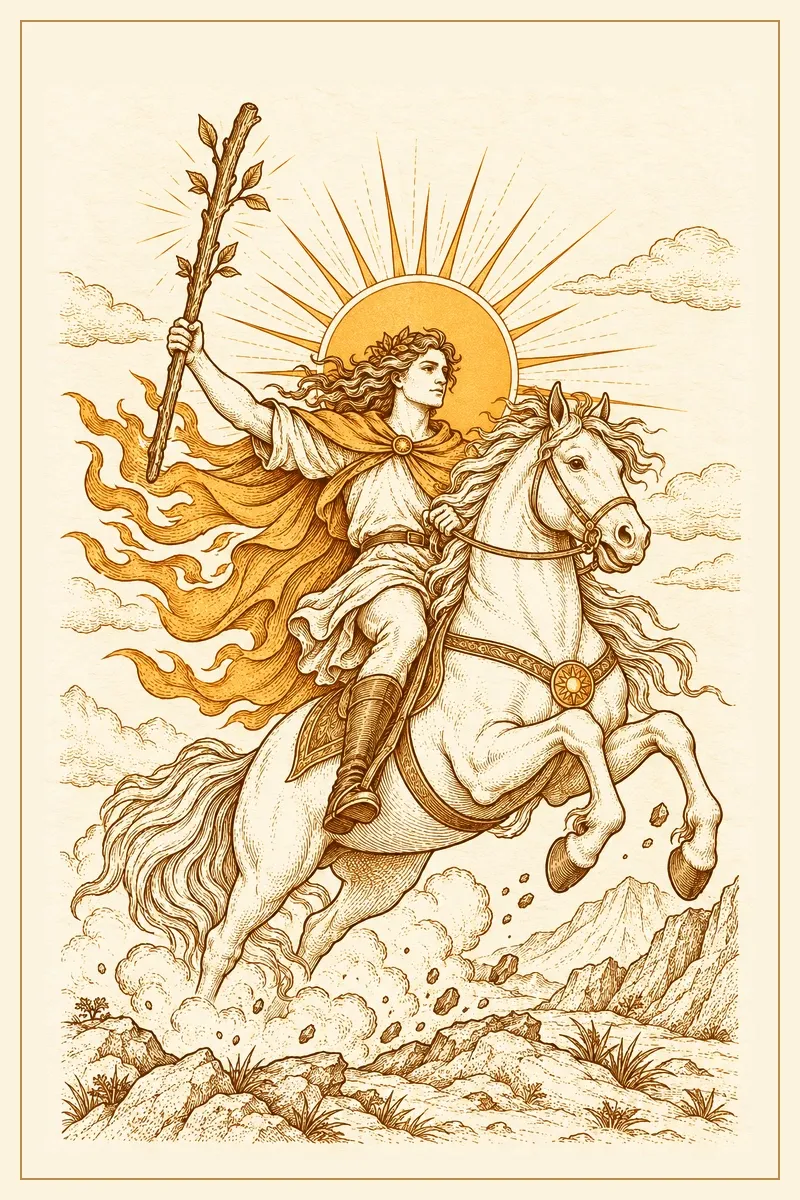
The Knight of Wands rides a rearing white horse, a sprouting wand raised overhead, while flames stream back from his cloak and the sun blazes behind him. Upright, he is the bold start: a launch, a move, a trip booked on short notice, a pitch made with conviction. In love he can be thrilling attraction that moves quickly; in career, a burst of energy that gets a stalled project moving again.
Reversed, the fire scatters. Plans get abandoned halfway, frustration turns into short temper, delays feel unbearable, or several projects are started and none finished. As advice, the card asks you to keep the enthusiasm and add one practical step that makes it last. The Knight of Wands tarot meaning goes further into how he behaves in love and money readings.
Queen of Swords: clarity with an open hand
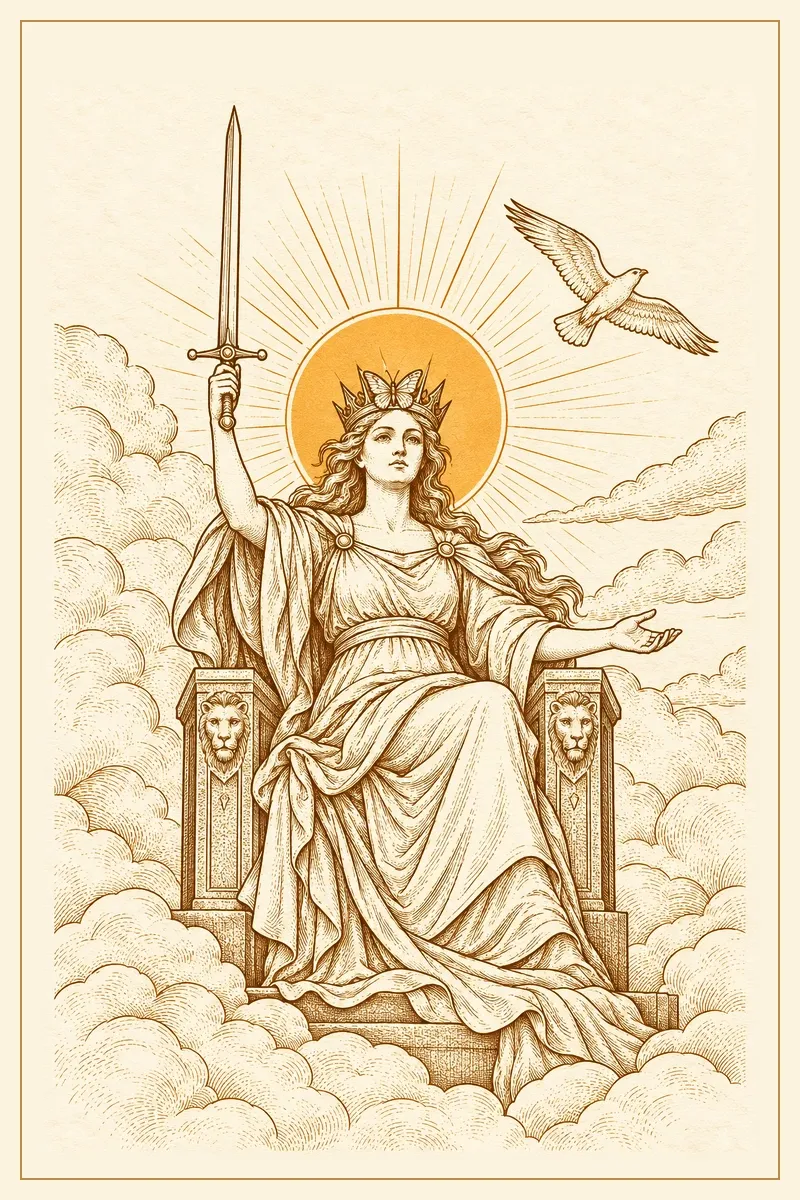
The Queen of Swords sits on a throne among clouds, her sword held straight up in one hand while the other hand is open and extended, and a bird flies overhead. A clear boundary and a willingness to listen: that pairing is the whole card. Upright, she is honest perception, independent thinking and judgment shaped by experience, including painful experience. In love she says what she wants and expects honesty back; at work she is the editor or analyst who asks the question nobody else will.
Reversed, the sword cuts without the open hand. Honesty turns into harshness, past hurt hardens into bitterness, or someone isolates themselves to avoid being let down again. As advice, she asks you to say the plain thing, kindly and without apology. The Queen of Swords meaning looks more closely at her reversed side and her pairings.
King of Pentacles: building something that lasts
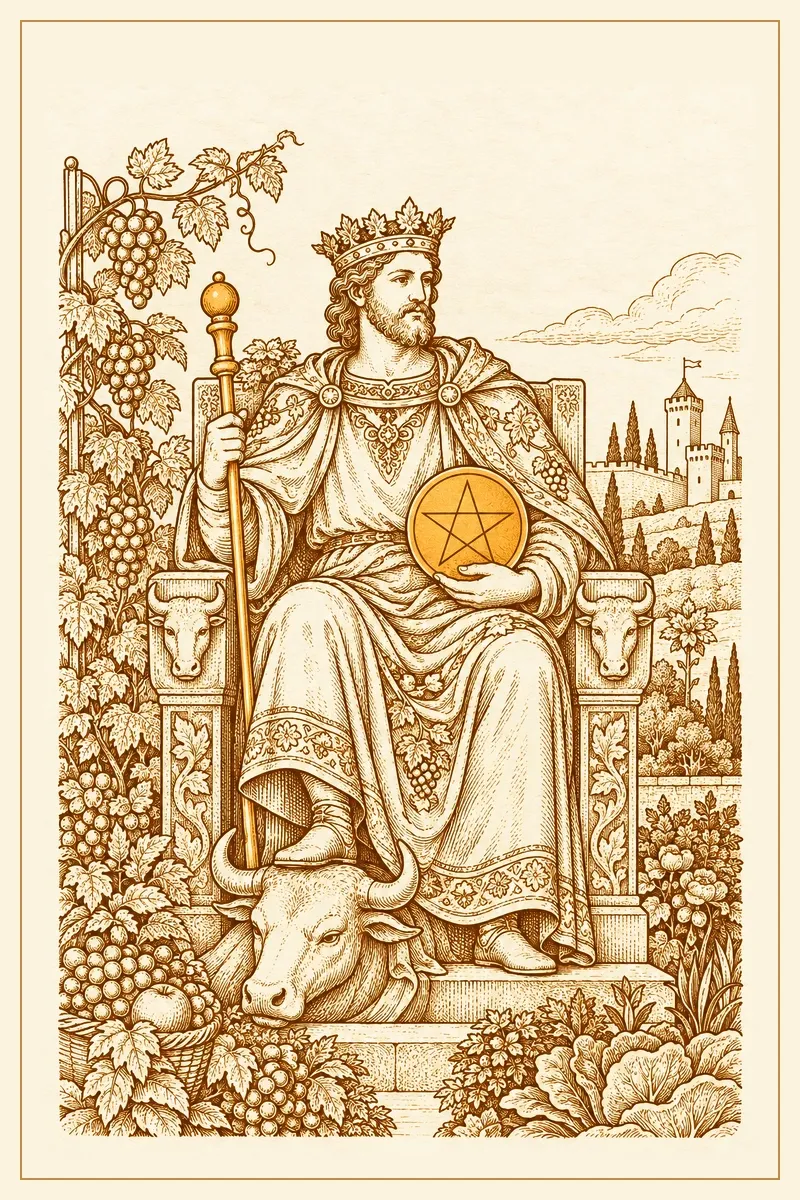
The King of Pentacles sits on a throne carved with bull heads, surrounded by grapevines, a golden pentacle resting on his knee and a castle on the hill behind him. Upright, he means security, business sense, reliability and generosity backed by real resources. In love he shows care through practical acts. In money and career he points to long-term planning, an established business, or a seasoned mentor.
Reversed, the same strengths turn heavy: stubbornness, materialism, using money to control, or working so hard that the vineyard is never enjoyed. As advice, he asks what you are building and who shares in it. More on his upright and reversed meanings is in the King of Pentacles tarot meaning.
All sixteen court cards in brief
Each line gives the upright core first and then the reversed shadow.
Wands court: fire as a personality
- Page of Wands: a young figure on a rocky plain studies a sprouting wand; excitement about a new idea, exploration, good news about a plan. Reversed: false starts, plans that stay talk, discouragement.
- Knight of Wands: bold action, adventure, passion, a sudden move. Reversed: recklessness, impatience, burnout.
- Queen of Wands: sunflowers at her side and a black cat at her feet; confidence, warmth, courage to be seen. Reversed: self-doubt, jealousy, spreading herself too thin.
- King of Wands: vision, leadership, the entrepreneur who sets the direction. Reversed: domineering, impulsive decisions, impatience with slower people.
Cups court: water as a personality
- Page of Cups: surprise feelings, creative ideas, a gentle message. Reversed: hurt feelings, emotional immaturity, escapism.
- Knight of Cups: a rider in a winged helmet offering a cup; romance, an invitation, following the heart. Reversed: moodiness, promises without follow-through.
- Queen of Cups: compassion, intuition, emotional steadiness that holds others. Reversed: absorbing everyone's feelings, weak boundaries, martyrdom.
- King of Cups: enthroned on a rock while waves break around him; calm under emotional pressure, wise counsel. Reversed: suppressed feeling, moodiness, emotional manipulation.
Swords court: air as a personality
- Page of Swords: curiosity, questions, vigilance, a sharp new idea. Reversed: gossip, defensiveness, all talk.
- Knight of Swords: fast, direct pursuit; arguing a case; cutting through delay. Reversed: rash words, aggression, scattered thinking.
- Queen of Swords: clear boundaries, honest perception, independence. Reversed: coldness, bitterness, harsh judgment.
- King of Swords: fair judgment, expertise, decisions made on principle. Reversed: rigidity, authority misused, logic used to win rather than to understand.
Pentacles court: earth as a personality
- Page of Pentacles: a youth in a field holds up a pentacle and studies it; study, a practical opportunity, a new skill. Reversed: procrastination, unfinished courses, unrealistic plans.
- Knight of Pentacles: a knight on a dark horse standing still beside plowed fields; routine, reliability, slow and steady work. Reversed: feeling stuck, boredom, perfectionism.
- Queen of Pentacles: a rabbit at her feet in a garden; practical care, a comfortable home, generosity with time and resources. Reversed: overgiving, neglecting herself, insecurity about money.
- King of Pentacles: security, business sense, a dependable provider. Reversed: materialism, stubbornness, control through money.
Person, self or attitude: deciding what a court card means
The difficulty with court cards is not that their meanings are vague. It is that each one has several reasonable jobs it can do in a spread. Asking four questions in order usually settles it.
Is it someone else?
If the question involves another person, or the position is labeled for someone else, a court card may describe how that person is showing up. The suit hints at temperament: a Cups person leads with feeling, a Swords person with reasoning. Some readers also match suits to the element of a person's sun sign, Wands for a fire sign and so on. Rank describes experience in the matter at hand, not age or gender. A retiree learning to paint can be a Page, a twenty-five-year-old running a team can be a King, and a Queen can describe a man as easily as a woman. When you read for a friend, let them say who the card brings to mind; the guide to reading tarot for other people has more on asking instead of telling.
Is it you?
In a self-reading, or in positions such as "where I stand" or "how I am approaching this," a court card is best read as a portrait of you in this particular situation. You may be a confident Queen of Wands at work and an uncertain Page of Cups in a new relationship, and both can be true in the same week.
Is it an attitude to borrow?
In an advice position, a court card rarely means "find this person." It means "approach this the way this figure would." The Queen of Swords as advice says to state the facts plainly. The Knight of Pentacles says to slow down and do the next small task. This is usually the most useful reading for personal questions.
Is it a stage you are passing through?
The four ranks also work as a ladder of growth in any area of life: the Page discovers, the Knight pursues, the Queen absorbs, and the King applies and teaches. A court card can show where you stand on that ladder, which helps when you feel impatient with yourself.
Reading reversed court cards
A reversed court card is not a bad person. It is the same character with its energy blocked, overdone or turned inward. Take the Knight of Cups reversed. Undeveloped, he is the person who admires from a distance and never makes the offer. Overdone, he is all mood and grand gesture with nothing behind it. Turned inward, he is a romantic plan kept entirely private.
The surrounding cards and the question tell you which of the three fits. Without reversals, you can still read a court's shadow side when the position asks about an obstacle.
When several courts share a spread
A spread with three or more court cards tends to be about people: roles, negotiations, family dynamics, a team, or the different parts of yourself pulling in different directions. Look at what they have in common. Several Pages point to learning, beginnings or news on the way. Several Knights suggest a fast-moving situation with many moving parts. Several Queens put the weight on care and influence; several Kings on authority and who decides.
Shared suits matter too. A Cups court beside a Pentacles court can describe one person who needs to talk and another who shows love by doing. Beside a Major Arcana card, read the court as the person or attitude meeting that larger theme.
Princes, Princesses and the Golden Dawn names
Not every deck uses Page, Knight, Queen and King. The Hermetic Order of the Golden Dawn, whose papers shaped many modern decks, called the four figures King, Queen, Prince and Princess, and its King was the mounted figure. The Golden Dawn King corresponds to the modern Knight, the Golden Dawn Prince corresponds to the modern King, the Princess corresponds to the Page, and the Queen stays a Queen. Thoth-style decks use Knight, Queen, Prince and Princess, so there the Knight matches the Waite-Smith Knight, the Prince matches the Waite-Smith King, and the Princess matches the Page.
The same history explains why books disagree on the element of each rank. Following the Golden Dawn figures, the mounted rider is fire, the Queen water, the Prince air and the Princess earth, which in Waite-Smith names gives Knights fire and Kings air. Many modern books instead give Kings fire and Knights air, matching the King's commanding role. Both systems keep Queens as water and Pages as earth. Neither is wrong; pick one and use it consistently, so that the King of Cups reads as either the air of water or the fire of water every time.
A four-position spread built on the ranks
This layout uses the court ladder as its positions. Shuffle the whole deck and lay four cards in a row; any card can land in any position.
- Page position: what I am still learning in this situation.
- Knight position: where my energy is going, or rushing.
- Queen position: what I need to tend quietly, in myself or in others.
- King position: the decision or responsibility that is mine to carry.
When a court card lands in its own rank's position, the theme is doubled, so give it extra weight. When it lands in a different rank's position, read the gap: a King in the Page position is an experienced person who still has something to learn here, and a Page in the King position suggests you are being asked to decide before you feel ready.
Worked example: a new manager and a string of rewrites
Here is an illustrative reading, not a real client's. The question: "How can I work well with my new manager, who keeps rewriting my reports?" The four cards drawn in the rank spread are the Page of Pentacles, the Knight of Swords, the Queen of Cups and the Eight of Pentacles.
Page position, Page of Pentacles. A court card in its own position, so the learning theme is strong. Both people are new to each other's standards. Rather than guessing, ask for one report the manager considers a good example and study it.
Knight position, Knight of Swords. This could be a manager who edits at speed without explaining. Thinking honestly, though, the querent sees their own habit of firing back defensive replies within minutes. Read as self, the card becomes something they can change: wait an hour, then ask a question instead of defending.
Queen position, Queen of Cups. Having your work rewritten stings, and that feeling deserves attention rather than suppression. The Queen of Cups suggests acknowledging the hurt privately first, so it does not leak into the next meeting; the manager may be under pressure too.
King position, Eight of Pentacles. No court card lands here, which is a message in itself: the responsibility lies in the craft, not the relationship, so practice the new format until it is routine. Next step: book twenty minutes, bring one report, and ask which three changes matter most to them.
Practicing until the courts feel familiar
Court cards become easier through handling them rather than memorizing lists. Lay all sixteen out in a four-by-four grid, ranks across and suits down, and read along each row and column. You can also cast the courts with characters from novels rather than people you know, which builds instinct without labeling anyone.
A short morning practice helps too. Pull one court card as part of your one-card daily draw and ask, "Which of this figure's strengths would help me today?" In the evening, note where you saw that energy, in yourself or in someone else.
Frequently asked questions
How many court cards are in a tarot deck?
Sixteen: a Page, a Knight, a Queen and a King in each of the four suits. They are part of the fifty-six Minor Arcana cards.
Does a court card always mean another person?
No. It can describe someone else, you, an attitude to adopt, or a stage of growth. The question and the position decide which reading fits best, and an advice position is best read as an attitude.
Does a Queen mean a woman, or a King an older man?
Not necessarily. Rank describes how the energy is used, not gender or age. Read a Queen as inward mastery and a King as outward responsibility, whoever carries them.
Can a court card tell me who someone is or what they feel about me?
No. Tarot cannot identify a person, read their private thoughts, or predict what they will choose. A court card can help you reflect on how someone shows up and how you respond; only their words and actions tell you what they think.
Should I use a court card as a significator?
You can. Some readers pick a court card to represent the querent and set it in the middle of the spread before drawing. Choose by temperament rather than appearance, or skip it and leave every card free to fall.
Meeting the court one card at a time
You do not need to master all sixteen at once. Start with the rank and suit, ask which of the four jobs the card is doing, and let your sense of each figure grow through practice. When you are ready to see which court card shows up for your own question, begin a reading and take your time with the people in the picture.