
Loading your view
The page is gathering the latest information.
The page is gathering the latest information.
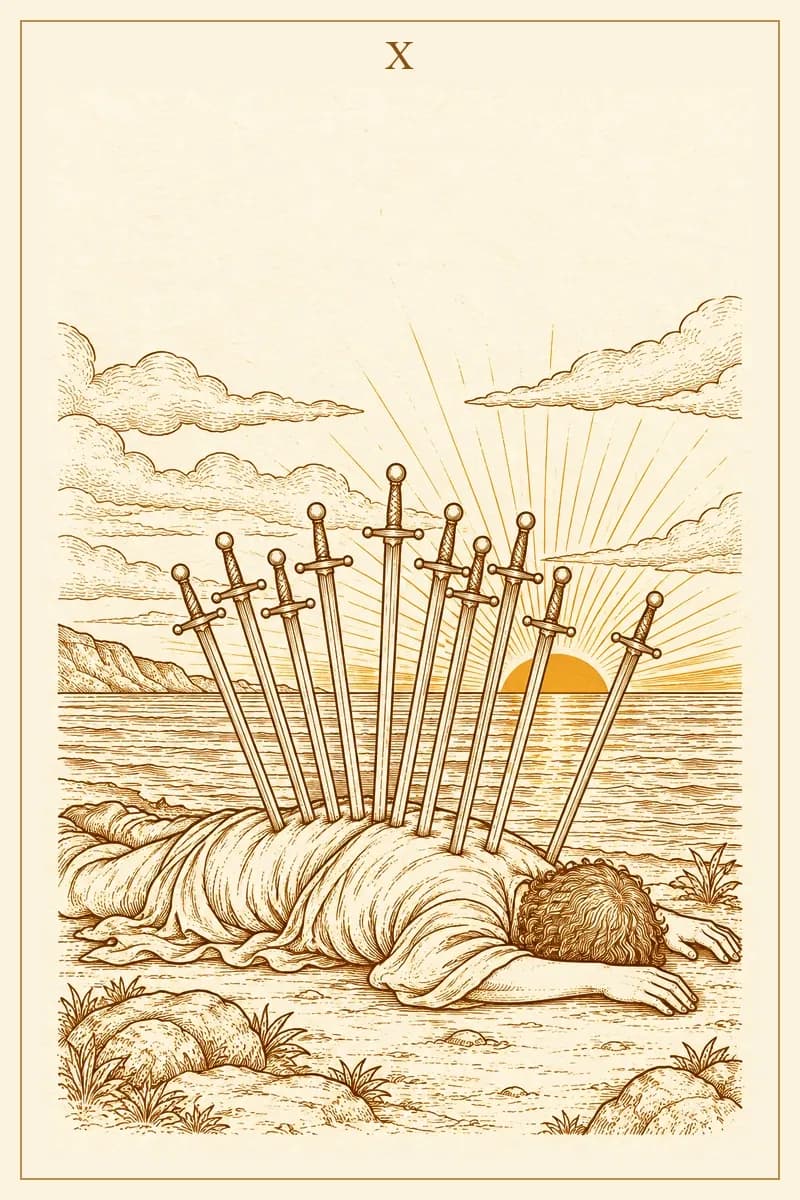
The card shown is VeilSoul's own engraved drawing of the 1909 Waite–Smith card. The scene and symbols described on this page follow the 1909 card, so a few details are drawn differently in our deck.
The Ten of Swords is one of the most dramatic images in the Rider-Waite-Smith deck: a figure lies face down on the ground, ten swords driven into his back, while a golden dawn breaks on the horizon over a calm sea. The image is deliberately excessive — even theatrical — because the Ten of Swords often represents the moment when things cannot possibly get worse. And when things cannot get worse, they can only get better.
When the Ten of Swords appears upright, you have hit rock bottom in some area of your life. A betrayal has been complete. A situation has ended in the worst possible way. A chapter has closed with finality and pain. The ten swords in the back suggest that this ending was not gentle — it was decisive, thorough, and left no room for ambiguity. Whatever has ended is truly over.
However — and this is the card's most important message — the dawn on the horizon is real. The golden light breaking through the darkness is not a cruel joke; it is a genuine promise. The Ten of Swords marks the absolute end of a painful cycle, which means the beginning of a new one. You cannot fall any further. The only direction from here is up.
The card invites surrender — not defeat, but the conscious decision to stop fighting an ending that has already occurred. Acceptance is not weakness; it is the prerequisite for renewal. Lay down the struggle. Acknowledge what is over. And then — when you are ready — turn your face toward the light that is already appearing on the horizon.
Ten swords in the back — far more than necessary for a single ending. The overkill is the message: this collapse is theatrical, final, and strangely liberating because nothing worse remains.
The ending replays on loop — refusing to let the figure die, prolonging dramatic suffering (excess) — or gets minimized as a setback when complete surrender and restart are required (deficiency).
Detailed Interpretations
The Ten of Swords in love represents the definitive, unmistakable end of a relationship — a breakup that is absolute and final, a betrayal so complete that forgiveness is no longer a relevant question, or the painful but liberating acceptance that a love you desperately hoped would last has run its full course and there is nothing left to save. This is not a rough patch or a temporary separation — this is the moment when the last thread of hope snaps and you are left face down in the emotional wreckage, wondering how something that once felt so alive could be so completely dead.
The ten swords in the figure's back represent the excessive, almost theatrical nature of some romantic endings — the breakup that comes with public humiliation, the betrayal that arrives through multiple simultaneous discoveries, the relationship that does not merely end but collapses in a cascade of revelations that leave you questioning everything you thought you knew about your partner and about yourself. The Ten acknowledges the overwhelming nature of this pain while pointing to a critical detail: the golden dawn on the horizon. Even in the card's most devastating imagery, the sky is brightening. This ending, however brutal, is also a beginning.
For singles who have already endured this kind of ending, the Ten of Swords may appear as a reminder that you have already survived the worst, and that the dramatic finality of what happened — however agonizing — has at least given you the clarity that ambiguous, slowly dying relationships never provide. There is strange mercy in an ending so complete that no part of you can pretend it might be reversed. The door is closed, locked, and demolished — and that demolition, eventually, becomes the foundation on which something new can be built.
In love reversed, the Ten of Swords indicates the slow, tentative process of recovery from a devastating romantic ending. You are beginning to lift your face from the ground, beginning to believe — cautiously, with the wariness of someone who has been profoundly hurt — that love might be possible again someday. The swords are being removed one at a time, and each removal hurts in its own way, but the lightening of the burden is unmistakable. You are not healed, but you are healing, and the distinction matters.
This reversal often marks the moment when the narrative shifts from what was lost to what might yet be gained. The obsessive replaying of the ending begins to fade, replaced by tentative curiosity about what the future might hold. You catch yourself imagining a life beyond the wreckage — not yet building it, but no longer believing it is impossible. That shift in belief, fragile as it is, represents genuine progress.
Alternatively, the reversed Ten can indicate a relationship that refuses to end cleanly — a breakup followed by attempts at reconciliation, an on-again-off-again dynamic that re-inflicts the pain of ending without ever completing it, or a situation where one person has moved on while the other continues to suffer. In these cases, the reversed Ten asks whether incomplete endings are prolonging your suffering unnecessarily, and whether a cleaner, more decisive conclusion — however painful — would serve your healing better than the limbo of perpetual almost-endings.
Professionally, the Ten of Swords represents a complete career collapse — a business failure, a devastating termination, the end of a professional partnership, or the failure of a project you invested everything in. The defeat is total and unmistakable. There is no spinning this into a positive — it is, unambiguously, an ending.
But the card's wisdom is in the sunrise. Every career reinvention begins with the death of what came before. The entrepreneurs who built the most successful companies often did so after a spectacular failure. The professionals who found their true calling often did so after being forced out of a path that was wrong for them.
The Ten of Swords advises you to stop trying to resuscitate what has clearly ended. Accept the loss. Grieve it. And then begin to notice the light on the horizon — the new possibilities that only become visible when the old path is irrevocably closed.
Career-wise, the reversed Ten of Swords signals the beginning of professional recovery after a devastating setback — the first tentative steps toward rebuilding after a business collapse, a career-ending failure, or a professional crisis that left you questioning whether you had any future in your field. You are picking up the pieces, extracting lessons from the wreckage, and beginning to see possibilities that were invisible while you were face down in the aftermath.
This reversal frequently appears for people who have experienced the most extreme forms of career failure — bankruptcy, public professional humiliation, termination under difficult circumstances — and who are now at the point where the shock has subsided enough to allow forward planning. The reversed Ten does not promise that recovery will be quick or easy, but it does suggest that it has begun, and that the person who emerges from this level of professional adversity can come away with a resilience, humility, and practical wisdom that no amount of comfortable success could have provided.
The reversed Ten also carries a warning against repeating the patterns that led to the collapse. If the career crisis was caused by overextension, poor judgment, ethical shortcuts, or the refusal to heed warning signs, recovery requires not just rebuilding but redesigning — creating professional structures and habits that are more sustainable, more honest, and more resilient than the ones that failed. Rising from the Ten of Swords without learning its lessons simply sets the stage for a future collapse that may be even more devastating than the first.
The Ten of Swords in health can represent the culmination of a health crisis — the point where an illness reaches its most acute phase, where a mental health breakdown forces the intervention that should have come sooner, where the body finally collapses under the accumulated weight of neglect, overwork, or chronic stress that you pushed through for far too long. This is rock bottom in health terms — the hospitalization, the diagnosis that can no longer be denied, the moment when your body delivers its final ultimatum and demands that you listen or face consequences that cannot be reversed.
However, like all Ten of Swords expressions, the health dimension carries the paradoxical promise of the golden dawn. Rock bottom, while terrifying and painful, is also the point where genuine recovery begins — because you can no longer ignore, minimize, or rationalize away the crisis. The denial is over, the swords are in your back, and the only direction available is up. Many people who experience severe health crises report that the collapse, while devastating, was ultimately the event that forced them to make the lifestyle changes, seek the treatment, or accept the help that they had been resisting for years.
This card also addresses the mental health dimension with particular gravity. The Ten of Swords can represent suicidal ideation, severe depressive episodes, or the feeling that psychological pain has become unbearable. If this applies to you, the card's message is urgent and specific: the dawn on the horizon is real, recovery is possible, but you must reach out for help now. Crisis hotlines, emergency services, trusted friends, mental health professionals — the swords can be removed from your back, but not by you alone. This is the moment to accept help without shame or hesitation.
Use this as a reflective prompt, not medical advice or a diagnosis. For health concerns, seek guidance from a qualified healthcare professional.
The Ten of Swords reversed signals that the very worst is over — you are beginning to stand up after being knocked completely down. Recovery is not complete, and scars remain, but the process of rising from rock bottom has begun. The swords are being pulled from your back one by one.
Alternatively, this reversal can indicate resistance to an inevitable ending — refusing to accept that something is over, desperately trying to revive what has clearly died, or clinging to a situation that has already run its course. The Ten of Swords reversed asks: are you recovering, or are you refusing to let go?
In some cases, the reversed Ten suggests that you narrowly avoided a disaster — the ending was less severe than feared, or a crisis was averted at the last moment. The swords grazed but did not kill. Count the near-miss as a warning and a blessing.
The reversed Ten of Swords teaches that even the most devastating endings are followed by new beginnings — that rock bottom is not a permanent address but a turning point, and that the very completeness of the destruction contains within it the seeds of genuine renewal. The lesson is that survival itself is an achievement worthy of respect, and that the person who stands up after being knocked flat by ten swords possesses a strength that no comfortable life could have built.
This reversal also teaches that the dawn on the horizon is not conditional — it arrives regardless of whether you feel ready for it, regardless of whether you believe you deserve it, regardless of how complete the devastation feels. The light returns because that is what light does. Your only task is to lift your head enough to see it, and to allow the warmth of new possibility to reach the wounds that the ending inflicted. Recovery from rock bottom is not about returning to who you were before — that person and that life are gone. It is about discovering who you become in the aftermath, and trusting that the version of yourself forged in this fire will be stronger, wiser, and more compassionate than the one who existed before the swords fell.
If you are at rock bottom today — or somewhere near it — lift your head just enough to see the horizon. The golden dawn breaking behind the darkness is not a metaphor or a platitude — it is the fundamental truth that endings and beginnings are the same moment viewed from different angles. You have survived the worst that this particular chapter had to offer. The swords are in your back, and they hurt, and nothing about this moment feels hopeful. But the light is arriving whether you feel ready for it or not, and your only task right now is to let it reach you. You do not need to stand up yet. You just need to look toward the dawn.
“I accept what has ended. I release what is over. And I turn toward the dawn with trust that what comes next will be born from the wisdom of what I survived.”
The card shown is VeilSoul's own engraved drawing of the 1909 Waite–Smith card. The scene and symbols described on this page follow the 1909 card, so a few details are drawn differently in our deck.
A figure lies face down — completely prostrate — with ten swords driven into his back from shoulders to lower spine. The image is deliberately excessive; ten swords is overkill, suggesting that the ending was more dramatic than strictly necessary. This theatrical quality hints at the card's hidden wisdom: some endings feel worse than they actually are.
The figure's right hand makes a gesture of blessing or peace — even in total defeat, grace is present. The red cloak draped over the lower body represents the passion and vitality that survives even catastrophic endings. The black sky dominates the upper portion of the image, but the golden dawn breaking along the horizon is the card's true focal point.
The calm, still water behind the figure confirms that beneath the drama of the ending, peace exists. The mountains in the far distance represent the challenges and achievements of a future that becomes possible only after this ending is fully accepted. The Ten of Swords is the darkest card — but it contains the most light.
Tens represent completion, the end of a cycle, and the transition to a new beginning. The Ten of Swords is the ultimate completion of the mental journey — the final and most painful lesson of the intellect before the cycle resets and a new understanding begins.
Keep or share this card reference
✦ From meaning to reflection ✦
Bring what this card stirred into a reading shaped around what you are facing now.
Read with this insight