A tarot deck has 78 cards, and they follow a set order. First come the 22 Major Arcana, numbered 0 to XXI; then the 56 Minor Arcana, split into four suits of 14 cards. Each suit runs Ace, Two, Three and on through Ten, then Page, Knight, Queen and King, and the suits are usually laid out as Wands, Cups, Swords and Pentacles.
That order is the skeleton of the whole system: once you know where a card sits, you already know a good part of what it is about. One honest limit before you start: knowing the structure makes tarot easier to read as a mirror for reflection, but no card, in any position, can confirm what another person thinks, name a date or guarantee an outcome.
The deck at a glance:
- Total: 78 cards, 22 Major and 56 Minor.
- Major Arcana: named archetypes numbered 0 to XXI, read as one long story.
- Minor Arcana: four suits tied to the four elements and to areas of daily life.
- Number cards: 40 in all, Ace through Ten in each suit.
- Court cards: 16 in all, Page, Knight, Queen and King in each suit.
- Usual suit order: Wands, Cups, Swords, Pentacles, though some decks and books start with another suit.
The complete tarot card list in deck order
Here is every card in sorting order, with a short working theme beside each; the card pages add full upright and reversed meanings. Checking a deck for missing cards? The Majors end with their twenty-second card, The World, and each suit closes at its fourteenth card, the King.
Major Arcana: 0 to XXI
- 0 — The Fool: new beginnings, innocence, a leap of faith
- I — The Magician: manifestation, skill, willpower
- II — The High Priestess: intuition, mystery, inner knowledge
- III — The Empress: abundance, nurturing, creativity
- IV — The Emperor: structure, authority, stability
- V — The Hierophant: tradition, spiritual guidance, shared values
- VI — The Lovers: love, choices, alignment of values
- VII — The Chariot: determination, momentum, victory through will
- VIII — Strength: courage, patience, inner strength
- IX — The Hermit: solitude, reflection, inner guidance
- X — Wheel of Fortune: cycles, fate, turning points
- XI — Justice: fairness, truth, cause and effect
- XII — The Hanged Man: surrender, a new perspective, a pause
- XIII — Death: transformation, endings, renewal
- XIV — Temperance: balance, patience, moderation
- XV — The Devil: shadow, attachment, temptation
- XVI — The Tower: sudden change, upheaval, revelation
- XVII — The Star: hope, healing, inspiration
- XVIII — The Moon: illusion, fear, the subconscious
- XIX — The Sun: joy, success, vitality
- XX — Judgement: rebirth, a calling, reckoning
- XXI — The World: completion, integration, achievement
Wands (Fire): Ace to King
- Ace of Wands: a spark of inspiration, a new venture
- Two of Wands: planning, looking beyond where you stand
- Three of Wands: expansion, early results, looking ahead
- Four of Wands: celebration, a stable milestone, homecoming
- Five of Wands: competition, clashing ideas
- Six of Wands: recognition, public success
- Seven of Wands: defending your position
- Eight of Wands: speed, news, sudden movement
- Nine of Wands: resilience, the last stretch
- Ten of Wands: burden, carrying too much
- Page of Wands: enthusiasm for a new idea
- Knight of Wands: bold action, impatience
- Queen of Wands: confidence, warmth, magnetism
- King of Wands: visionary leadership
Cups (Water): Ace to King
- Ace of Cups: a new feeling, an open heart
- Two of Cups: mutual attraction, partnership
- Three of Cups: friendship, celebration
- Four of Cups: apathy, contemplation, an overlooked offer
- Five of Cups: grief, focusing on what was lost
- Six of Cups: nostalgia, childhood memories, simple kindness
- Seven of Cups: many options, wishful thinking
- Eight of Cups: walking away to seek something deeper
- Nine of Cups: contentment, a wish granted
- Ten of Cups: family harmony, emotional fulfillment
- Page of Cups: a tender message, creative intuition
- Knight of Cups: romance, following the heart, an offer
- Queen of Cups: compassion, emotional wisdom
- King of Cups: emotional balance, calm under pressure
Swords (Air): Ace to King
- Ace of Swords: clarity, a breakthrough idea, truth
- Two of Swords: stalemate, putting off a choice
- Three of Swords: heartbreak, a painful truth
- Four of Swords: rest, recovery
- Five of Swords: conflict, a hollow win
- Six of Swords: transition, moving toward calmer water
- Seven of Swords: strategy, secrecy
- Eight of Swords: feeling trapped, self-imposed limits
- Nine of Swords: anxiety, sleepless worry
- Ten of Swords: a painful ending, rock bottom
- Page of Swords: curiosity, vigilance, new ideas
- Knight of Swords: charging ahead, haste
- Queen of Swords: clear perception, honest boundaries
- King of Swords: intellectual authority, fair judgment
Pentacles (Earth): Ace to King
- Ace of Pentacles: a new material opportunity
- Two of Pentacles: juggling priorities, adaptability
- Three of Pentacles: teamwork, skilled collaboration
- Four of Pentacles: holding on, security, control
- Five of Pentacles: hardship, feeling left out in the cold
- Six of Pentacles: generosity, giving and receiving
- Seven of Pentacles: patience, assessing long-term growth
- Eight of Pentacles: diligent practice, craftsmanship
- Nine of Pentacles: self-sufficiency, earned comfort
- Ten of Pentacles: legacy, family wealth, lasting security
- Page of Pentacles: study, a practical new start
- Knight of Pentacles: steady, reliable work
- Queen of Pentacles: nurturing practicality, resourcefulness
- King of Pentacles: material mastery, dependable support
Some books list Pentacles or Cups first, which changes no card's meaning. What stays fixed is the order inside each suit and the numbering of the Majors, with one well-known exception explained next.
Where the sequence came from
The earliest tarot cards that survive were painted in fifteenth-century northern Italy for a card game, later known as tarocchi, in which a fifth set of picture cards acted as trumps. Those trumps are the ancestors of the Major Arcana, and the four ordinary suits of the time, cups, coins, swords and batons, became the Minor Arcana. Early decks did not always print numbers on the trumps, and their order shifted from city to city.
In the late eighteenth century French writers began treating the cards as a symbolic system, and nineteenth-century occult societies linked each card to an element or an astrological sign. The deck that shaped English-language tarot most was published in 1909, drawn by the artist Pamela Colman Smith under the direction of Arthur Edward Waite. Smith gave every number card a full scene instead of a plain pattern of suit symbols, which is why beginners today can read a Minor card from its picture.
Because The Fool carries the number 0, or no number at all, some readers place it at the start of the Majors and others at the end, after The World. Either way, the structure underneath stays the same.
Strength: VIII in many modern decks, XI in older ones
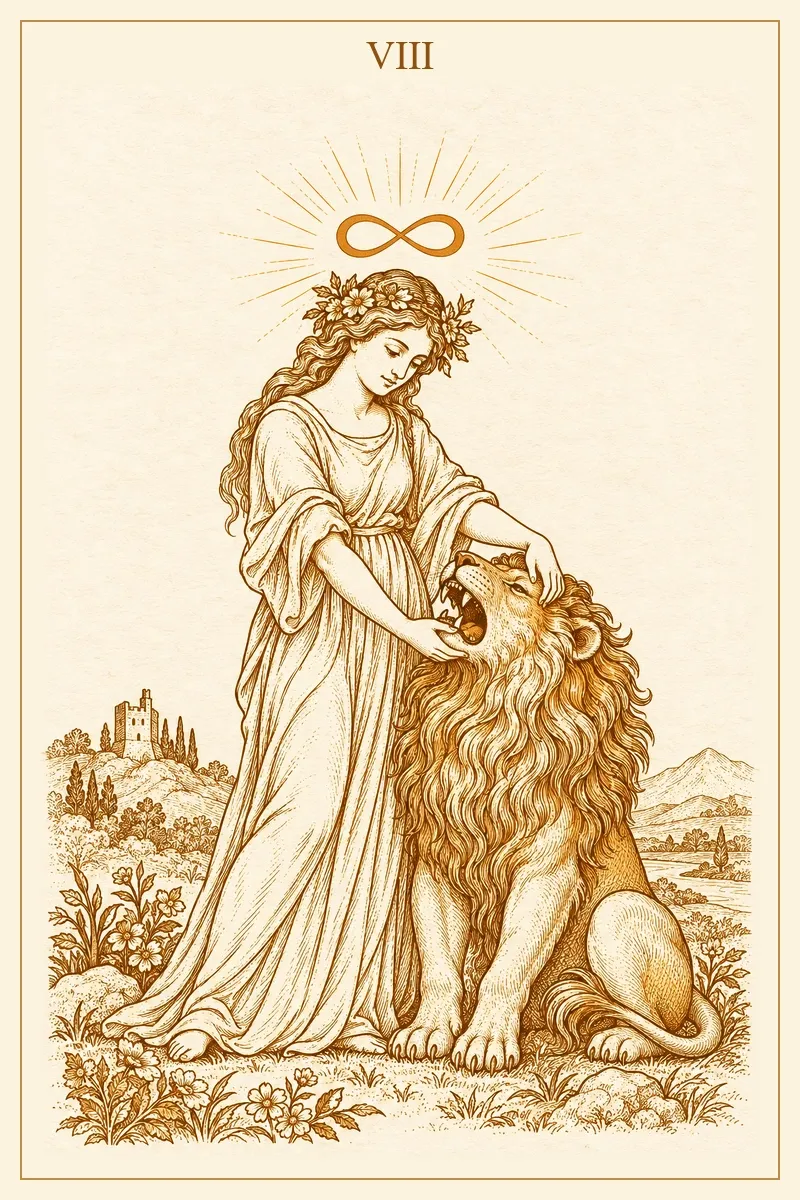
If you compare two decks and find the eighth card different, nothing is missing. In Marseille-pattern decks, Justice is VIII and Strength is XI. The Hermetic Order of the Golden Dawn swapped them so the sequence would match its astrological links, with Strength tied to Leo and Justice to Libra; the 1909 deck adopted that order, and many decks drawn since then follow it. Some modern decks keep the older order instead.
The swap matters only when you count. Strength still means patient courage, the calm hand on the lion rather than a fist, and Justice still means fairness and honest consequence. Reversed, Strength can point to self-doubt or a temper running ahead of you. When you study from a book, check which numbering it uses so card VIII on the page matches card VIII in your hands.
The Major Arcana as one continuous story
The 22 Majors describe the large themes of a life: beginnings, authority, love, loss, change and completion. Read in order, they form what readers call the Fool's Journey, a traveler meeting one teacher or trial after another. The story is a teaching device, not a doctrine, but it is far easier to remember than a column of keywords. The guide to Major and Minor Arcana differences compares the two halves in weight and scope.
To hold all 22 in mind, group what the traveler meets along the road:
- Teachers and guides: The Magician, The High Priestess, The Hierophant.
- Relationships and choices: The Empress, The Emperor, The Lovers.
- Challenges and growth: The Chariot, Strength, The Hermit.
- Tests of balance and honesty: Wheel of Fortune, Justice, The Hanged Man, Temperance, The Devil, The Moon.
- Transformation: Death, The Tower, Judgement.
- Illumination: The Star, The Sun, The World.
Several Majors in one spread suggest the question touches something structural rather than a passing mood; the page on readings full of Major Arcana explores that situation in depth.
The Fool: card 0, the traveler
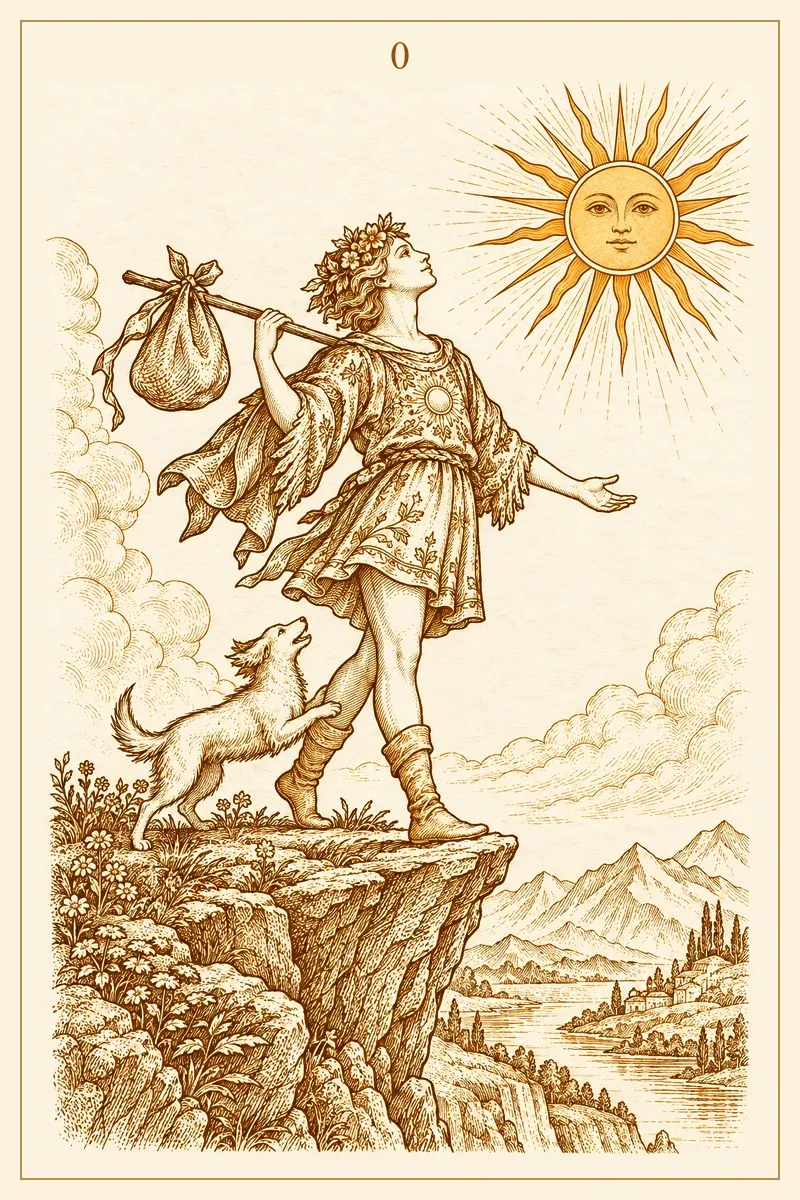
The Fool opens the sequence because it has not started anything yet. Upright, it stands for curiosity, a fresh start and the willingness to step forward without a full map. Reversed, it can describe recklessness, a leap taken to avoid thinking, or the opposite: a fear of beginning at all. As the zero card it belongs to every stage, and each new chapter of the Majors can be pictured as The Fool arriving somewhere new. The full Fool tarot meaning covers love, work and reversed readings in more depth.
The World: XXI, where the circle closes
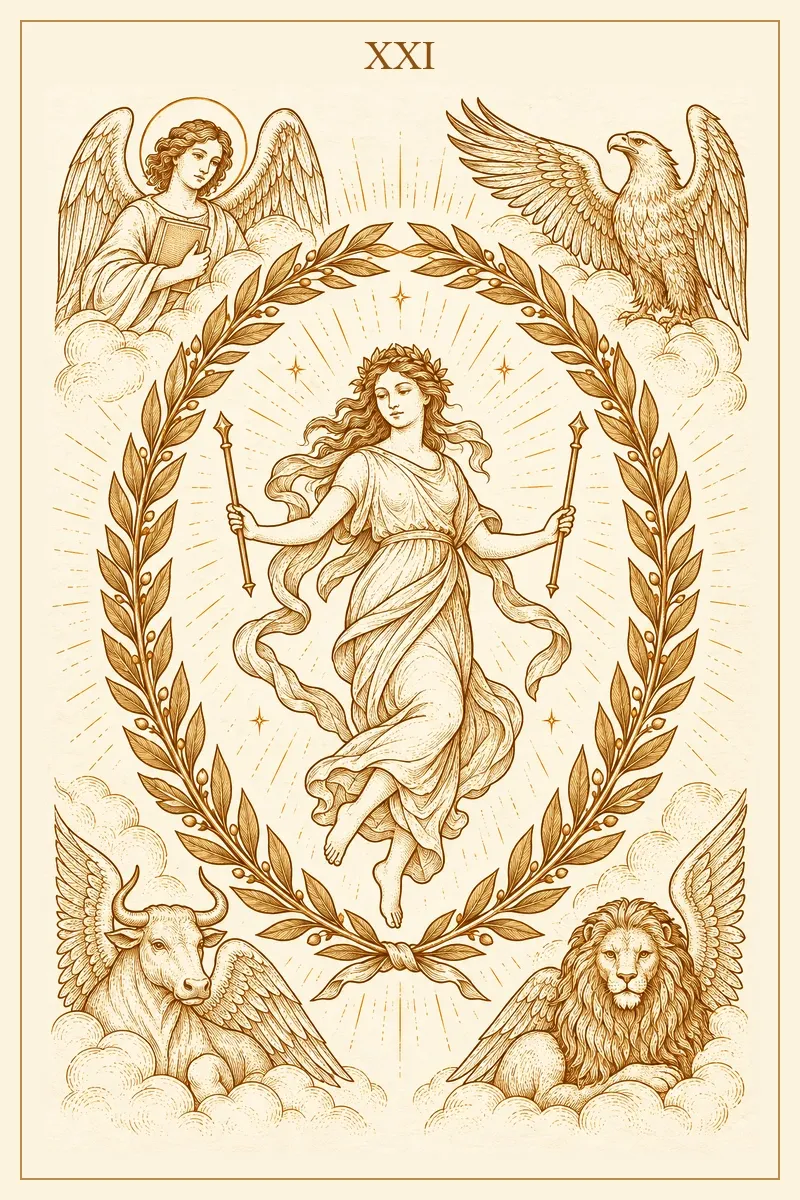
The World ends the Majors with integration: a cycle completed, lessons absorbed, a sense of belonging in your own life. Upright, it can mark a graduation, a finished project or a move that feels earned. Reversed, it points to loose ends, a goal left almost finished, or a reluctance to close one chapter so the next can begin.
Side by side, The Fool and The World read like one traveler at the two ends of a road, which is why learning the Majors as a sequence pays off: a card's number tells you how far along the journey it sits.
Four suits, four elements, four areas of life
The 56 Minor Arcana carry the daily texture of a life. Each suit is tied to an element and to one field of experience, and once you know those four pairings you can make a first read of any spread from its mix of suits, before interpreting a single card.
- Wands, Fire: drive, creativity, ambition, the projects that make you want to get out of bed.
- Cups, Water: feelings, relationships, intuition, the inner weather of love and grief.
- Swords, Air: thought, speech, decisions and conflict, the work of seeing clearly.
- Pentacles, Earth: money, work, the body, home and the material world.
Suit balance is a quick clue. A spread heavy in Cups is about feelings, even when the question sounded practical. Several Swords suggest the mind is doing the heavy lifting through worry, debate or a decision. Wands bring momentum and impatience; Pentacles slow things down to what can be built, saved or touched. A suit that is missing can say as much as one that dominates: a career question with no Pentacles may be more about meaning than about money.
Some systems pair Wands with Air and Swords with Fire; this page keeps Wands with Fire and Swords with Air. Either works if you use it consistently.
How numbers and court ranks work inside a suit
Inside every suit the cards climb the same two ladders: the numbers from Ace to Ten, and the four court ranks. Learn each ladder once and you can apply it four times, which turns 56 separate meanings into a handful of patterns. The deeper guide to number symbolism in the Minor Arcana walks through each number with examples from all four suits.
Ace to Ten: one arc in four settings
- Ace: the seed of the suit, its energy in pure form.
- Two: a pairing, or a first choice between options.
- Three: growth, a first result, the situation widening.
- Four: stability and foundations, which can harden into standing still.
- Five: friction, loss or conflict that forces change.
- Six: recovery and exchange after the trouble of the Five.
- Seven: complexity and testing, the point where simple answers stop working.
- Eight: movement, practice and effort, the work that builds skill.
- Nine: near completion, the suit's experience at full intensity.
- Ten: the end of the cycle, the suit at its fullest or at the end of its rope.
Put suit and number together and a card starts to explain itself. The Five of Pentacles is material friction: hardship, money worries, feeling shut out. The Three of Cups is emotional growth shared with others, hence friendship and celebration. The Ten of Swords is a mental cycle run to its end, painful but finished. Since each Ace holds the seed of a whole suit, the guide to the four Aces in tarot is a good place to look more closely.
Page, Knight, Queen, King: four ways to handle a suit
The 16 court cards can stand for someone in your life, a side of yourself, or an approach the situation calls for. Ask "what way of handling this suit is shown here?" before asking "who is this?"
- Page: the student, curious and new to the suit's territory; messages and first lessons.
- Knight: the pursuer, all motion and focus, and sometimes too much of the suit's energy.
- Queen: mastery held inwardly; emotional intelligence, steadiness, care.
- King: mastery expressed outwardly; responsibility, authority, leadership.
Combined with a suit, the rank becomes specific. The Queen of Cups is emotional maturity turned inward; the King of Pentacles is material skill put to work for others; the Knight of Swords chases clarity so hard that it can forget tact; the Page of Wands is the first spark of interest in something new. The guide to tarot court cards offers ways to tell when a court card means a person and when it means a mood.
Reading a card from its address in the deck
Every card has an address: Major or Minor, suit, number or rank. Add the position it lands in and the cards around it, and you have most of an interpretation before opening a book. A handy working formula is suit + number + position + neighbors = reading.
A Major's address is its place in the Fool's Journey, so it marks a chapter-level theme, while the Minors around it show where and how that theme plays out. Repeated numbers are another clue: two or three Fives point to friction across several areas, while a pair of Aces suggests a fresh start that is still more potential than plan.
Five of Cups in two different positions
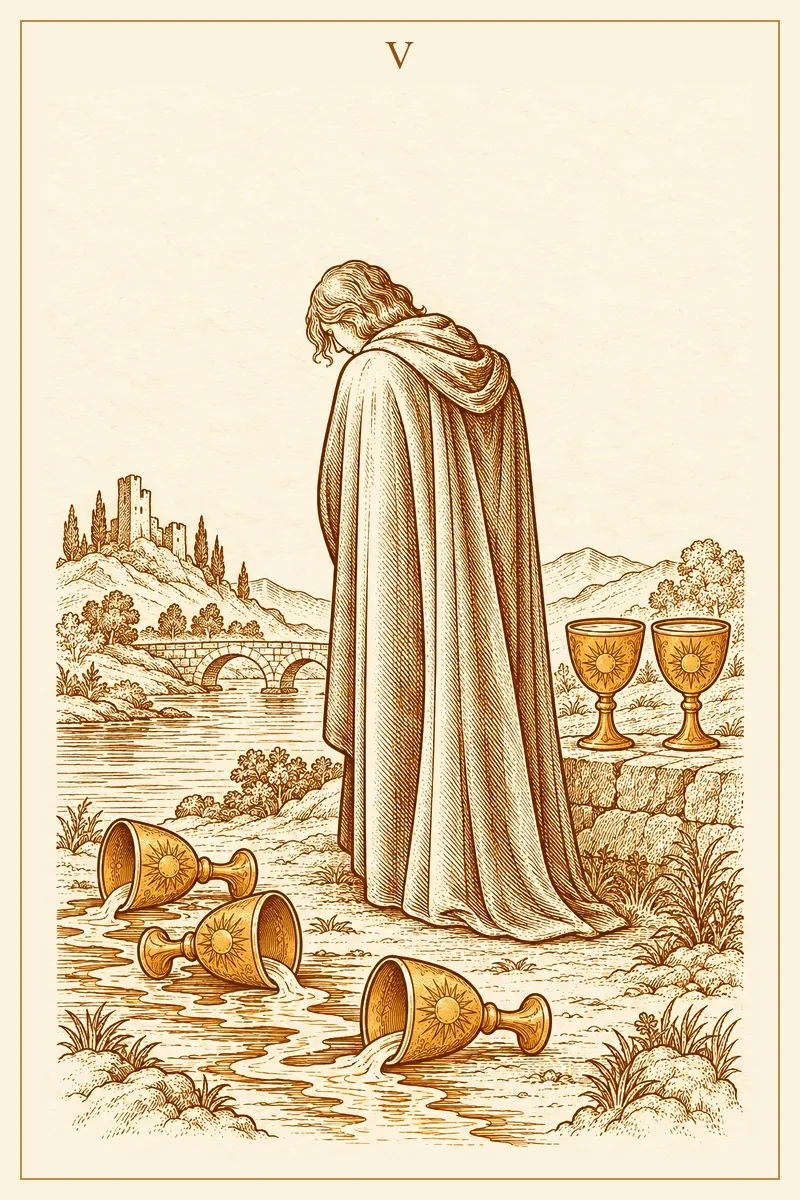
Take the Five of Cups: Water, the suit of feeling, at the number of friction and loss. In the "where things stand" position of a relationship spread, it describes disappointment that is active right now, attention fixed on what spilled rather than on what is still standing. In the "advice" position of a career spread, the same card asks you to grieve something, perhaps a role you did not get or a plan that ended, before you push on. Same card, two readings, both reached from its address. Reversed, it can mark the moment you look up from the loss and notice the two cups still standing behind you. For the full range of meanings, see the Five of Cups tarot meaning.
Worked example: three cards read by structure alone
Suppose someone asks, "What should I weigh before accepting a promotion I feel unsure about?" They use a three-card spread with named positions: 1. What the role asks of me, 2. What it could cost, 3. What would help me decide. The cards drawn are the Queen of Pentacles, the Three of Swords and The Hermit.
Position 1, the Queen of Pentacles. Earth suit, Queen rank: practical mastery held inwardly. The role asks for someone steady, resourceful and caring toward the people and budgets in their charge. It describes the version of the person the job would draw out, not a verdict on whether they can become it.
Position 2, the Three of Swords. Air suit, number three: thought and speech growing into something larger, and in this suit that growth stings. In the cost position it suggests a painful truth or a strained conversation, perhaps with a colleague passed over or someone at home who would see less of them.
Position 3, The Hermit. Major Arcana IX: time apart, reflection, an inner lamp. A Major in the advice position signals that this decision is bigger than a schedule change. The suggestion is to step back from other people's opinions for a few days and decide in quiet.
Read together, the spread leans toward resources and thought: one Earth card, one Air card, one Major and no Cups. Feelings arrive only through the Three of Swords, as worry rather than open emotion, which is worth noticing. A grounded next step: name who the Three of Swords might involve, talk with them directly, and set a date to decide after some time alone. The cards framed the questions; the choice stays with the person.
Learning the 78 cards in the order they are built
Memorizing 78 meanings before drawing a single card is a reliable way to feel stuck; the structure offers a gentler path, one layer at a time. If you have not picked a deck yet, the guide on choosing your first tarot deck can help you find one whose images feel easy to read.
- Separate the two halves. Pull out the 22 Majors and set the 56 Minors aside.
- Lay the Majors in a line from 0 to XXI. Read them as a story, saying one sentence about how each card moves the traveler on.
- Sort the Minors into four suits. Notice how the images of each suit differ, and say its element and area of life aloud.
- Lay out one suit from Ace to King. Look for the arc from seed to completion, then for the shift from number cards to people.
- Learn the ten numbers once. Apply them across the four suits, and forty number cards become ten patterns.
- Learn the four ranks as approaches. Page, Knight, Queen and King, combined with each suit, cover all 16 courts.
- Draw one card a day. Write one sentence in the morning about what it might mean and one in the evening about how it showed up.
Visual learners can add one step: pick three cards whose images draw you in, write what each seems to be about before looking anything up, then compare with the card pages. That habit of reading from pictures is what the guide to reading tarot intuitively builds on.
Frequently Asked Questions
How many cards are in a tarot deck, and do all decks share the same structure?
A standard tarot deck has 78 cards: 22 Major Arcana and 56 Minor Arcana. Nearly every tarot deck keeps that framework even when the art and names change. The Thoth deck, for example, renames some Majors, calling Strength "Lust" and Temperance "Art," and uses Princess, Prince, Queen and Knight for its courts. Oracle decks are a different tool with no fixed number or order.
Which cards should I learn first?
Start with the 22 Majors as a story, then move on to the four suit elements and the ten number patterns. The court cards can come last, because they are far easier to read once you know what each suit and each rank means on its own.
Why do some decks rename the suits?
Older and regional decks used names like Batons, Coins or Disks, and modern decks sometimes pick names that suit their artwork, so Wands may become Rods or Staves and Pentacles may become Coins. The element and meaning stay the same.
Does the order of the cards matter when I shuffle?
No. Sorting the deck into order helps you check for missing cards and study, but a reading uses whatever order the shuffle produces. Ordering the deck before storing it is a personal ritual, not a rule.
Are reversed cards extra cards?
No. A reversed card is the same card turned upside down, read as that energy blocked, turned inward or still developing. The deck stays at 78. Reading reversals is optional: you can begin with upright meanings only and add reversals once the upright ones feel familiar.
Can knowing the structure tell me what will happen?
Not in a literal sense. The structure helps you read the cards as a language for reflection, showing which part of life a question touches and how a situation might be moving. It cannot confirm another person's intentions, give a date or promise a result, so make decisions with the people and facts involved.
Putting the deck back in order
Twenty-two Majors from The Fool to The World, then four suits of fourteen, each climbing from Ace to King: that is the whole architecture. Majors give a reading its chapters, suits name the area of life, numbers mark how far things have developed, and courts show the people or attitudes involved. With that frame in place, each new meaning has somewhere to live.
When you would like to see how the structure works with your own question, you can draw a reading with Veil Soul and notice which suits, numbers and Majors appear.