Choose a standard 78-card deck in the Waite-Smith style, with a full illustrated scene on every card, art you enjoy looking at, and cards that sit comfortably in your hands. A deck like that is the best tarot deck for beginners because you can learn it from free guides, from books, and from the card pages here without first translating a different symbol system. Everything else, from color palette to theme, is personal taste.
A deck is a tool for reflection, not a source of power. No deck makes a reading more accurate, reveals what another person is thinking, or fixes a date for an event. What a good first deck does is make you want to sit with the cards, notice details, and come back tomorrow. That is how reading skill grows.
Before you shop, here is the short version of what to check:
- 78 cards: 22 Major Arcana and 56 Minor Arcana in four suits, so standard learning material applies.
- Scenes on the numbered cards: the Three of Cups shows people doing something, not only three cups in a row.
- Waite-Smith symbolism: the easiest family to study first; Thoth and Marseille reward later study.
- Readable art: you can tell what is happening in each card within a few seconds.
- Hand feel: a size you can shuffle and a cardstock that bends without creasing.
- A guidebook: helpful as a starting point, never a replacement for looking at the card.
The 78 cards every standard deck shares
Whatever the artwork, a standard tarot deck follows one structure, and knowing it makes product descriptions much easier to judge. There are 22 Major Arcana, numbered from 0 (The Fool) to 21 (The World), which carry the large themes of a life: beginnings, choices, endings, renewal. Then come 56 Minor Arcana split into four suits of fourteen cards. Each suit runs from Ace to Ten and adds four court cards, usually called Page, Knight, Queen and King. A fuller walk through how these groups fit together is in our guide to the structure of a tarot deck.
The suits carry their own areas of life. Wands speak about energy, drive and creative work. Cups are feelings and relationships. Swords are thoughts, words and conflict. Pentacles are money, the body, work and the physical world. Some decks rename them, so you may see Staffs or Rods for Wands, Coins or Disks for Pentacles, and Princes or Princesses among the courts. A renamed suit is fine as long as the four-suit, 78-card frame is intact.
Check that frame carefully when a deck is called an oracle deck. Oracle decks are a separate kind of tool: each one sets its own number of cards, its own titles and its own meanings. They can be lovely for journaling, but they will not teach you tarot, and a tarot guide will not match them. If the box does not say 78 cards with Major and Minor Arcana, read the description again before buying.
Three deck families and how they read
Tarot art comes in a huge range of styles, but the useful question for a beginner is which tradition a deck belongs to. Three families cover the decks you are likely to meet. They share the 78-card frame but differ in what the numbered cards show and in some names and numbers, and that difference decides how easily you can learn from general material.
Waite-Smith style decks
The Waite-Smith deck was first published in 1909, drawn by the artist Pamela Colman Smith to a plan by the writer Arthur Edward Waite. Its key feature for a learner is that every numbered card has a scene. The Five of Cups shows a cloaked figure looking down at spilled cups while two upright cups stand behind them; the Six of Swords shows a boat crossing calmer water. You can read the story in the picture before you know the textbook meaning.
Modern decks in this family redraw these scenes in a new style while keeping the figures, gestures and objects in the same places. When a product page says a deck follows Waite-Smith symbolism, it means the meanings you learn from general guides will transfer. In this family Strength is card 8 and Justice is card 11, which is worth knowing because the other two families swap them.
Thoth decks
The Thoth deck was designed by Aleister Crowley and painted by Frieda Harris, and it was first published in 1969. Its art is dense with astrological, alchemical and Kabbalistic symbols. Several names differ: Strength becomes Lust, Temperance becomes Art, Judgement becomes The Aeon, Justice becomes Adjustment, and Pentacles become Disks. The numbered Minor Arcana carry a one-word title, such as Ruin for the Ten of Swords, and show arranged suit symbols in color fields rather than people in a scene.
It is a rich system to grow into. As a first deck it asks you to study its own book alongside the cards, because general beginner material will not line up with every title and image.
Marseille decks
The Tarot de Marseille is a pattern of French woodcut-style decks that goes back several centuries, with a bold, limited palette. Its Major Arcana are illustrated, but its numbered cards are pips: the Seven of Swords is seven swords arranged on the card, with decorative foliage, and no scene. Readers of this family work from number, suit and pattern, which is a precise and elegant method. Justice is card 8 and Strength is card 11 here.
If you already enjoy numerology or have studied playing-card reading, a Marseille deck can be a good fit. If you are starting from nothing, the pips can feel blank, and you may find yourself memorizing forty cards without a picture to hold the meaning.
Practical checks before you buy
Once you know which family you want, the remaining choice is about how the deck feels to use every day. These checks matter more than any review score.
Art you can actually read
Beautiful art and readable art are not the same thing. Look at sample images and ask: can I tell who the figures are, what they are doing and how they feel? Heavy abstraction, very dark palettes or crowded collage can be striking yet slow you down while you learn. Pay attention to who appears in the cards too. A deck where you can recognize yourself and people you know is easier to talk to.
Size and how it feels to shuffle
Tarot cards are larger than playing cards, roughly 7 by 12 centimeters (about 2.75 by 4.75 inches) for a standard deck. Oversized decks show more detail but can be awkward if your hands are small; pocket decks travel well but hide the small symbols you are trying to learn. If you can, hold a deck before buying, or compare the listed card size with a card you already own. Our guide on how to shuffle tarot cards shows several methods that work for different hand sizes.
Cardstock and finish
A first deck is handled constantly, so the card itself matters. Good stock bends slightly and springs back without creasing. A matte or lightly textured finish slides more evenly than a high-gloss one, and gloss can show fingerprints. Gilded or colored edges look beautiful, and it helps to know they can make new cards cling together until they have been shuffled for a while.
Card backs and reversals
Look at the back design. If it is fully symmetrical, you cannot tell which cards are upside down until you turn them over, which matters if you plan to read reversed cards. A back with a clear top and bottom gives the orientation away while the deck is still face-down. Neither is wrong; just choose knowingly. If you are unsure whether to use reversals at all, our guide to reading reversed cards covers both approaches.
The guidebook in the box
A deck may come with a small booklet, sometimes called the little white book, that lists a few keywords per card. A thicker companion book is a bonus, especially for decks outside the Waite-Smith family. Use whatever comes in the box as a first prompt, then look back at the picture and ask what you see. That habit is the core of building intuition for tarot, and it keeps you from reading a definition aloud while missing the card in front of you.
Four cards to look at in any deck you are considering
A product page may show only the prettiest Major Arcana. A better test is to look up a few specific cards in a flip-through video or sample gallery, because these four reveal how a deck will feel when you actually read with it. The figures below give you one version of each card to compare against.
The Fool: does the deck invite you in?
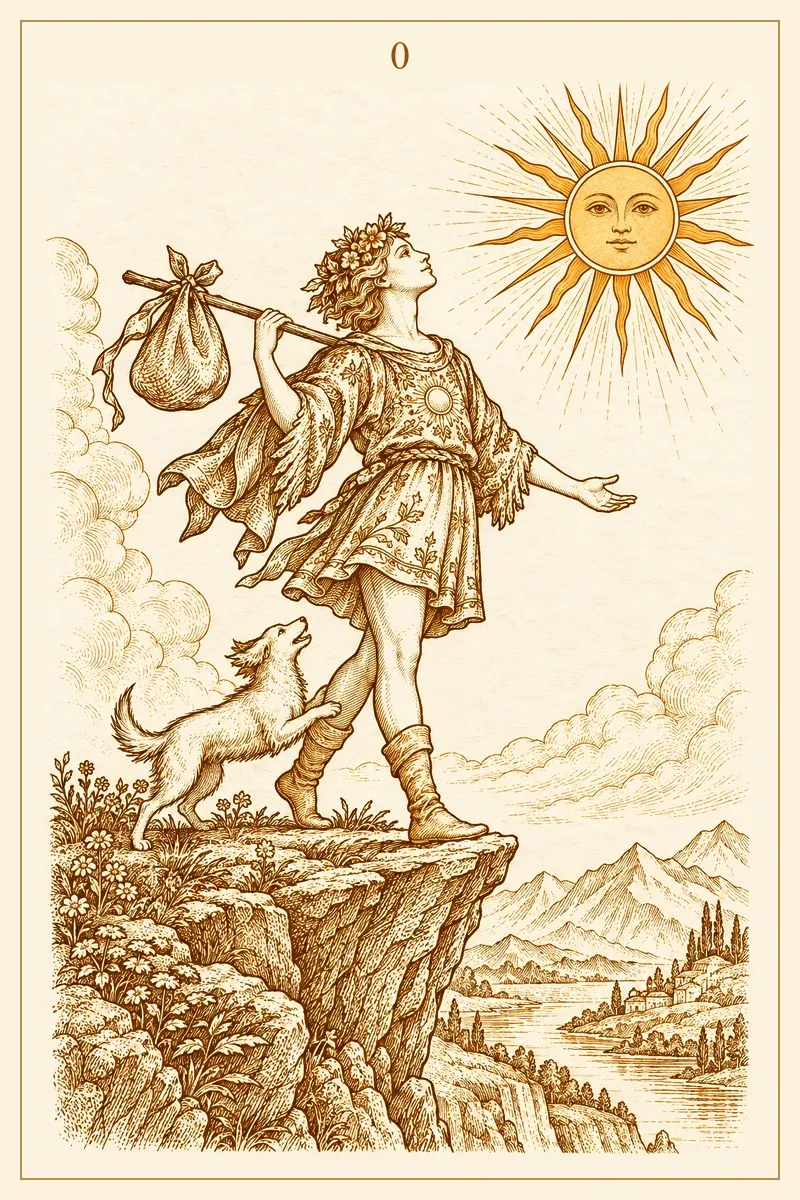
The Fool is card 0, the traveler setting out with a light bag and an open face. Upright it speaks about beginnings, trust and a step into the unknown; reversed it can point to hesitation or a leap taken without looking. When you look at a deck's Fool, notice your first reaction. Do you feel curious, amused, eager? That response is a fair preview of how you will feel shuffling this deck on an ordinary evening. The full range of the card is in The Fool tarot meaning.
The Fool also tells you about the artist's attitude to the whole deck. A Fool drawn with care and humor suggests the rest of the Major Arcana will feel alive rather than decorative. If this card leaves you flat, keep looking.
Three of Cups: scene or pattern?
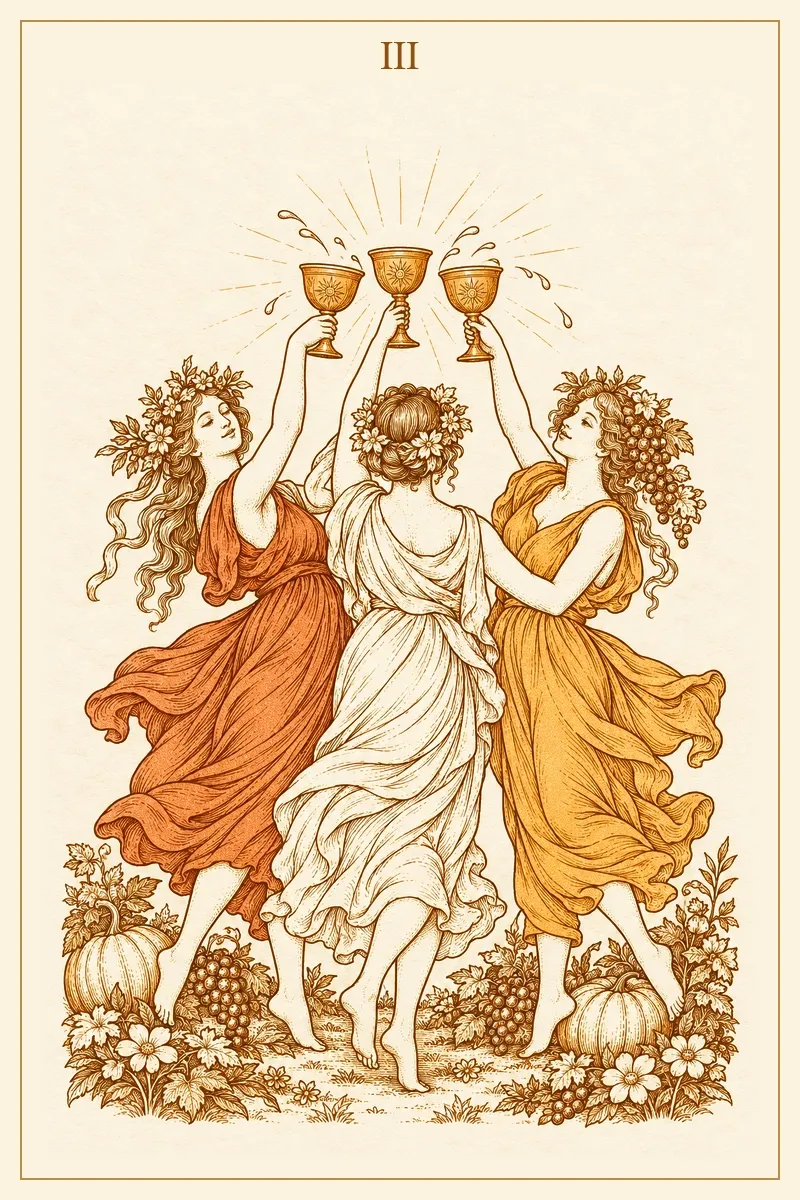
The Three of Cups is the quickest way to see whether a deck has illustrated pips. In the Waite-Smith tradition it shows three friends raising their cups together; upright it means celebration, friendship and shared joy, and reversed it can suggest overindulgence, a friend group that has drifted, or a celebration that excludes someone. If the deck you are looking at shows only three cups and some ornament, you are holding a pip deck, and you will need to learn its numbered cards from number and suit. For the card's other angles, see the Three of Cups tarot card meaning.
Five of Pentacles: can you sit with a hard card?
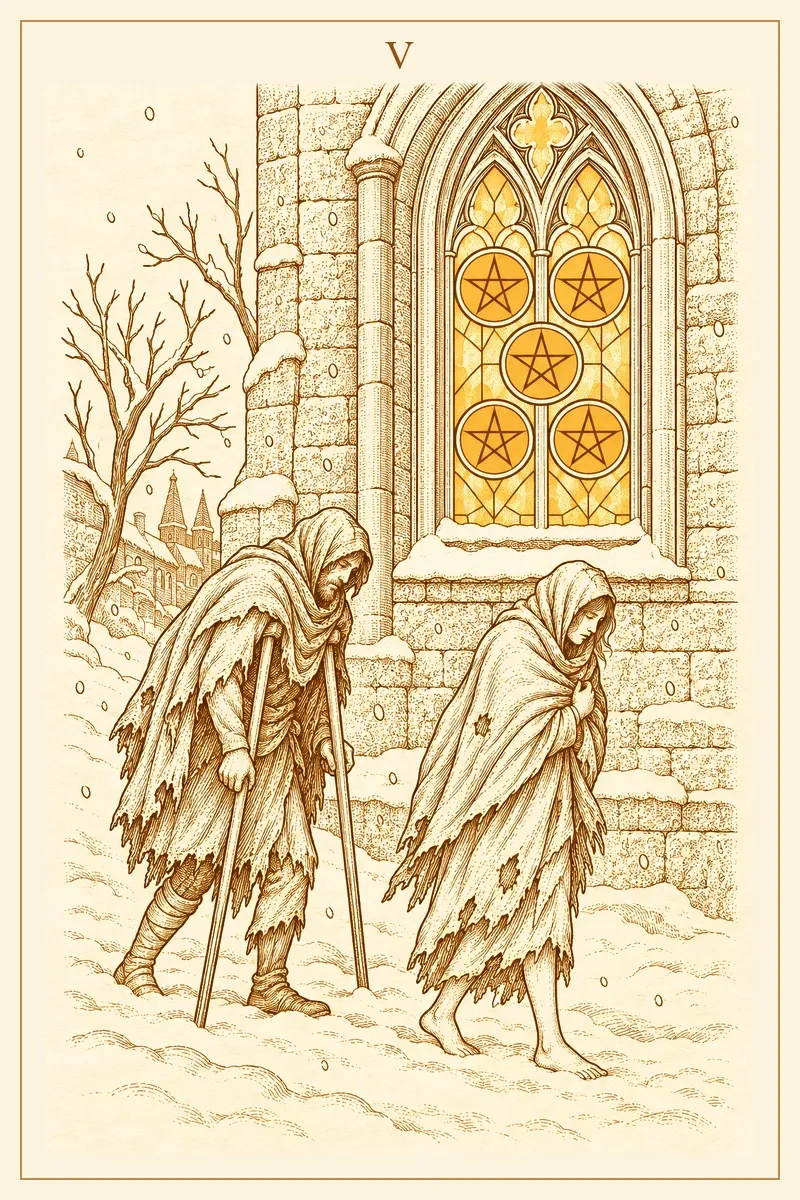
Every deck has difficult cards, and you will draw them. The Five of Pentacles traditionally shows two figures walking through snow past a lit window. Upright it speaks about hardship, feeling left out in the cold and the help that may be closer than it looks; reversed it can describe recovery, or asking for support at last. Look at how a deck draws it. Some artists keep the scene gentle, others make it bleak. If a deck's hard cards frighten you rather than make you think, it may not be the right partner while you are learning. Our guide to the Five of Pentacles tarot card meaning explores the card's upright and reversed readings in more depth.
Queen of Swords: can you tell the court cards apart?
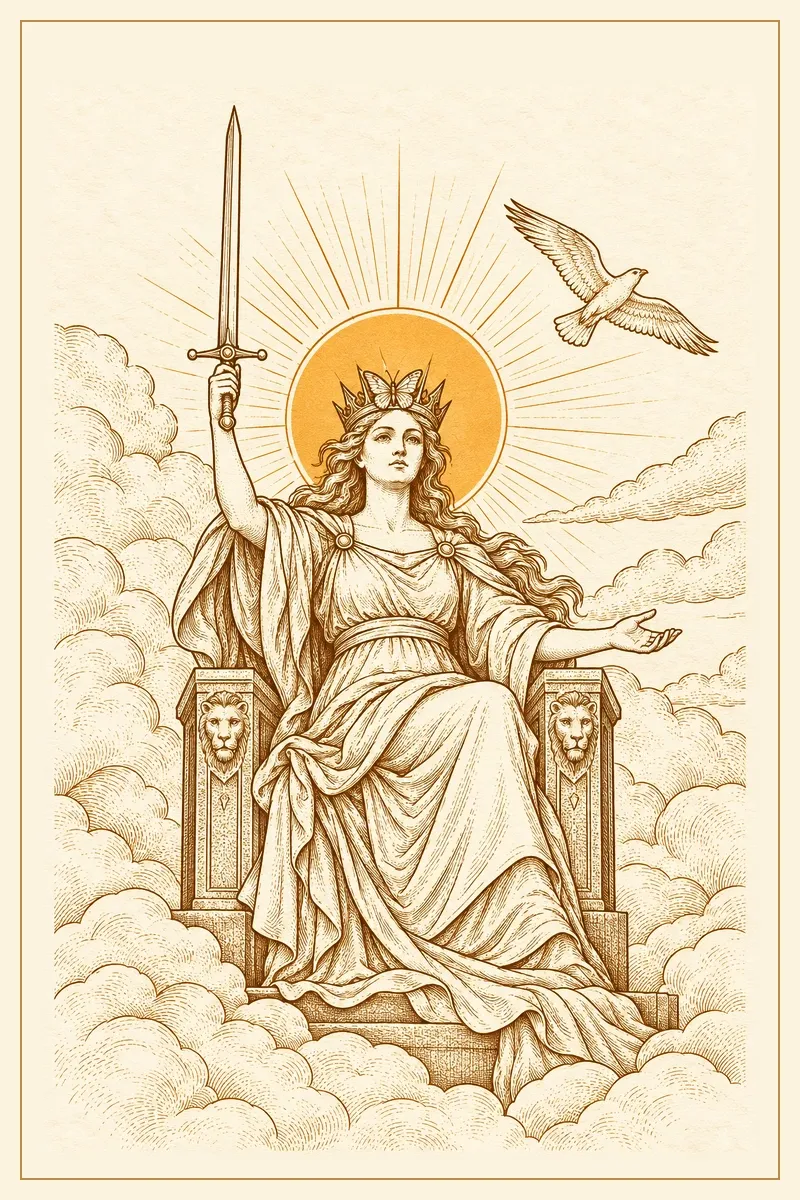
The sixteen court cards can be the trickiest part of a deck to learn, so check them before you buy. The Queen of Swords sits upright with a raised sword and an open hand: clear thinking, honest words, independence. Reversed she can turn cold, harsh or overly guarded. Compare her with the deck's Queen of Cups and Queen of Pentacles. If the three queens look interchangeable apart from the object they hold, you will spend your first months confusing them. A deck where posture, setting and expression change from court to court gives you far more to read. The Queen of Swords tarot card meaning goes deeper into her reversed side.
Buying your own deck, and where to see one first
You may have heard that your first deck has to be a gift. It is one of several tarot myths worth setting aside; there is no rule in tarot practice that says so. Buying your own deck is a perfectly good start, and choosing it yourself means it already reflects your taste.
Where you look affects what you can check. In a physical shop that keeps open sample decks, you can feel the cardstock and the size. Online, search for flip-through videos of the exact deck and edition, which let you see all 78 cards before you decide. Publisher and artist pages sometimes post sample images; check that they include numbered cards and court cards, not only the Majors. Independent and crowdfunded decks can be wonderful, but read the card list to confirm they have the full tarot structure and look for comments on card stock. A secondhand deck is fine too; count the cards when it arrives.
If you are not ready to buy anything, you can still begin. Reading with digital cards lets you learn the images and meanings first, so that when you choose a physical deck you already know what you are looking for.
A first conversation with your new deck
When the deck arrives, a short getting-to-know-you spread turns the unboxing into your first real reading. Shuffle in whatever way feels comfortable, then lay out five cards in a row and read each position as a question about how you and this deck will work together.
- What this deck shows clearly: its strongest voice.
- Where I may find it hard to read: the kind of message you might resist or misread.
- What it can teach me first: a theme for your early practice.
- How to work with it: an attitude or habit that helps.
- My next step as a learner: one concrete thing to do this month.
A sample reading with this spread
Imagine a new reader who has just opened a Waite-Smith style deck with soft watercolor art. She draws these five cards.
In the first position, the Page of Pentacles appears upright: a young figure studying a coin with total attention. This deck's strength is patient study. It rewards looking closely, and its details are worth learning one at a time. In the second position comes the Seven of Cups, a card of many tempting options and some illusion. She may find the soft, dreamy art easy to project wishes onto, reading what she hopes rather than what is there.
The third card is The High Priestess, upright. The first lesson is quiet attention: notice what she sees before she reaches for the booklet. In the fourth position, the Two of Cups arrives reversed. A partnership feels slightly out of balance; she has been letting the guidebook do all the talking, and the reversal suggests giving her own observations equal weight. The last card, the Eight of Pentacles, is a craftsperson working on one coin after another. Her next step is steady repetition, one card at a time, with notes.
Read together, the spread gives her a clear plan: slow, careful practice, a habit of describing the image before the meaning, and awareness that wishful reading is her blind spot with this deck. None of it predicts anything. It simply turns a new object into a working relationship.
The first two weeks with your deck
A new deck becomes familiar through handling and attention, not through memorizing a list. These steps keep the start light.
- Look through all 78 cards without reading meanings. Sort them into three loose piles: cards you like, cards that make you uneasy, and cards that confuse you. Write the piles down; they are a snapshot of where you start.
- Draw a single card each day. Describe the picture in two sentences, then read the booklet or a card page, then note what matched. Our guide to the one-card daily draw shows how to keep this short.
- Learn one suit at a time. Lay out the Ace to Ten of a single suit and look at how the story moves from card to card before you add the courts.
- Keep the deck somewhere you will see it. A deck on a shelf you pass every day gets used; a deck in a drawer gets forgotten.
- Try a three-card reading after a week or two. Past, present and next step is enough. Add more positions only when the single cards feel familiar.
Whatever you notice, write it down. A deck you have handled for two weeks will already feel different from the one you unwrapped.
Frequently asked questions
Is there one deck every beginner should buy?
No single deck is right for everyone. The safest category for a first deck is a 78-card deck that follows Waite-Smith symbolism with illustrated scenes on every card. Within that category, choose the art you most enjoy looking at, since you will be looking at it a lot.
Can I start with a Thoth or Marseille deck?
Yes. Expect to rely on the deck's own book, and for a Marseille deck, to learn the numbered cards from number and suit. If you find yourself stuck, a Waite-Smith style deck alongside it can help you cross-reference.
Does a more expensive deck give better readings?
No. Price reflects printing, cardstock, packaging and the artist's work, not insight. A deck you enjoy handling will get more use, and that use is what builds skill.
Do I need to cleanse or bless a new deck before using it?
It is not required. You may enjoy a small opening ritual, such as shuffling through the whole deck once or spending a few minutes with each suit, because it marks the start. If that appeals to you, our guide on how to cleanse a tarot deck offers simple options.
Can a deck make my readings more accurate?
A deck cannot make tarot predict events, confirm what someone else feels, or guarantee an outcome. Clear art can make it easier to notice what a card is saying about your situation and your own choices, which is the honest work tarot does.
When should I buy a second deck?
Whenever your curiosity wants one. A second deck in a different style or family can show you new sides of cards you already know. There is no need to rush; one familiar deck is enough to keep learning for a long time.
Your first deck is a starting point
A first deck does not have to be your forever deck. It has to follow the standard structure, make the cards readable, and feel good to pick up. Choose the one that makes you curious, give it a few weeks of attention, and let your preferences sharpen as you go.
If you would like to meet the cards before your deck arrives, start a reading and spend a few quiet minutes with what you draw.