Tarot, at its simplest, is a deck of 78 illustrated cards and the practice of shuffling them, laying a few out and reading their pictures as prompts about a question you care about. It works less like a forecast and more like a structured conversation: each card carries a traditional theme, each place in the layout asks something specific, and the meaning comes from putting the two together with what you know about your own life. Tarot for beginners asks for no special gift, no ritual and no particular belief, only a question and some patience.
It helps to know the limits from day one. A card cannot reveal what another person privately thinks, name a date, or settle an outcome that still depends on choices, yours and other people's. What it can do is slow you down, show an angle you skipped, and help you put words to something you already half-sensed. Everything below is built on that understanding.
Here is tarot at a glance, before the detail:
- The deck: 78 cards, split into 22 Major Arcana and 56 Minor Arcana.
- The Major Arcana: big life themes, in cards numbered from 0 to 21.
- The Minor Arcana: everyday situations in four suits, Cups, Pentacles, Swords and Wands, each with ten number cards and four court cards.
- A reading: a question, a shuffle, a layout called a spread, and an interpretation of each card in its position.
- Upright and reversed: a card that lands upside down can be read as the same theme blocked, turned inward or out of balance.
- What it is for: reflection, perspective and planning, not certainty about the future.
How does tarot work? The four parts of every reading
Strip away the candles and the movie scenes, and a tarot reading has four moving parts.
- A question. The question sets the frame for everything else. Open questions give the cards room to say something: “What do I need to understand about the tension with my manager?” leads somewhere, while “Will I get fired?” leaves you hunting for a yes or a no. Write the question down before you shuffle so you cannot quietly change it after you see the cards.
- A shuffle. Any method works: an overhand shuffle, mixing the cards face-down on a table, or cutting the deck into piles. The point is that you do not choose which card appears, so you meet a picture you would not have picked for yourself.
- A spread. A spread is a layout in which every position has a name, such as “what is here now” or “what I can lean on.” The position tells you which part of the question a card answers.
- An interpretation. You read the card’s traditional theme, its position and your real circumstances together. The same card can mean encouragement in one spot and a caution in another, which is why a reading is more than a list of definitions.
You are not decoding a secret message in that last step. You are asking, “If this picture were a comment on my question, what would it be pointing at?” and then checking the answer against what you actually know.
Why a random card can feel so personal
If the shuffle is random, why can a card feel as if it was chosen for you? There are two broad answers, and you do not need to pick one before you start.
The first is spiritual. Some readers see the cards as a channel for intuition, guidance or meaningful coincidence, and they treat the draw itself as part of the message.
The second is psychological. A picture with an open meaning invites you to project onto it, the way you might see a face in a cloud. The detail you notice first, whether it is the figure’s posture, the weather in the background or a dropped object, is the detail that connects to what is on your mind. Seen this way, the card is a mirror held at an unusual angle: it does not know your situation, but it gives you a fresh place to look at it from.
Both views lead to the same practical habits. Read the card in its position, say honestly what fits and what does not, and be careful with the parts you want to hear. If prediction is the part you are most curious about, the article on whether tarot can predict the future separates what a reading can describe from what stays open.
The 78 cards: Major Arcana, Minor Arcana and court cards
Every standard tarot deck shares the same skeleton, even when the art looks nothing alike.
The Major Arcana are 22 cards numbered from 0 to 21. They point to large themes: a turning point, a lesson, a shift in how you see yourself. When one appears, it suggests the question touches something bigger than the week ahead.
The Minor Arcana are 56 cards in four suits. Each suit covers one area of daily life:
- Cups: feelings, relationships, intuition and the inner life.
- Pentacles: money, work, the body, home and anything you can hold.
- Swords: thoughts, words, decisions and conflict.
- Wands: drive, creativity, ambition and the energy to start.
Inside each suit, the number cards run from Ace to Ten like a short story: the Ace is a seed, the middle numbers bring effort, strain and adjustment, and the Ten shows a cycle complete or overloaded. The four court cards, Page, Knight, Queen and King, can stand for people in your life, roles you play, or ways of handling the suit’s energy, from curious beginner to steady authority. For a fuller map of how the suits and numbers fit together, the structure of a tarot deck goes through each part in order.
Four cards to meet first
Each of these four teaches a different part of the system: a Major Arcana card, the card with the worst reputation, a number card and a court card. Spend a minute with the picture before you read each section.
The Fool: where the Major Arcana begins
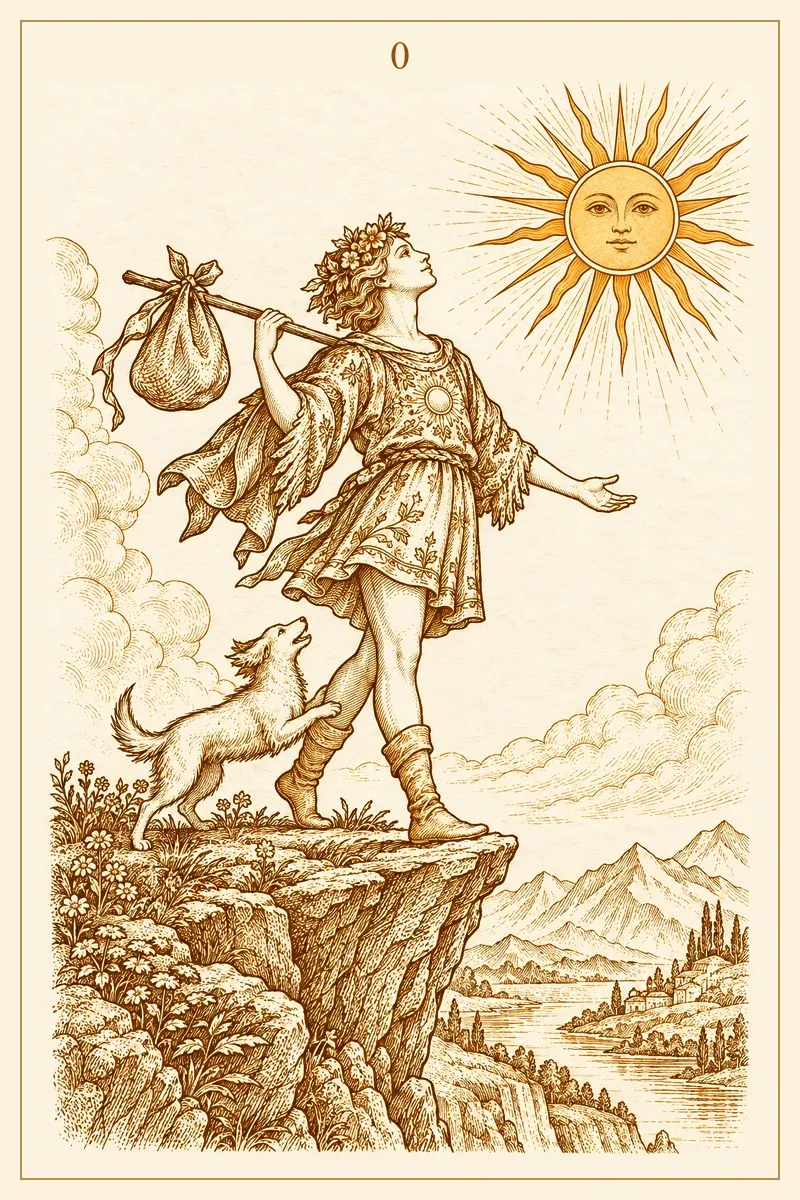
The Fool carries the number 0, so it sits before the journey of the other Major Arcana cards rather than inside it. The picture shows a young traveler with a flower crown and a small bundle tied to a stick, looking up at a bright sun while one foot steps toward the edge of a cliff. A little dog leaps at his leg, and a river town lies far below. Nothing in the scene says he is about to fall; it says he is paying more attention to the sky than to the ground.
Upright, The Fool describes a beginning taken on trust: a new job, a move, a first date, a hobby you have wanted to try for years. In love it can point to openness and play; at work, to a fresh start where you will learn as you go. Reversed, the same energy turns into one of two problems: a leap without any look at the ground, or so much hesitation that the moment passes. The question it asks is simple: what would a first step look like, and what do you need to check before you take it? The full meaning of The Fool in love, work and reversals goes further into both sides.
Death: the card beginners fear, and what it describes
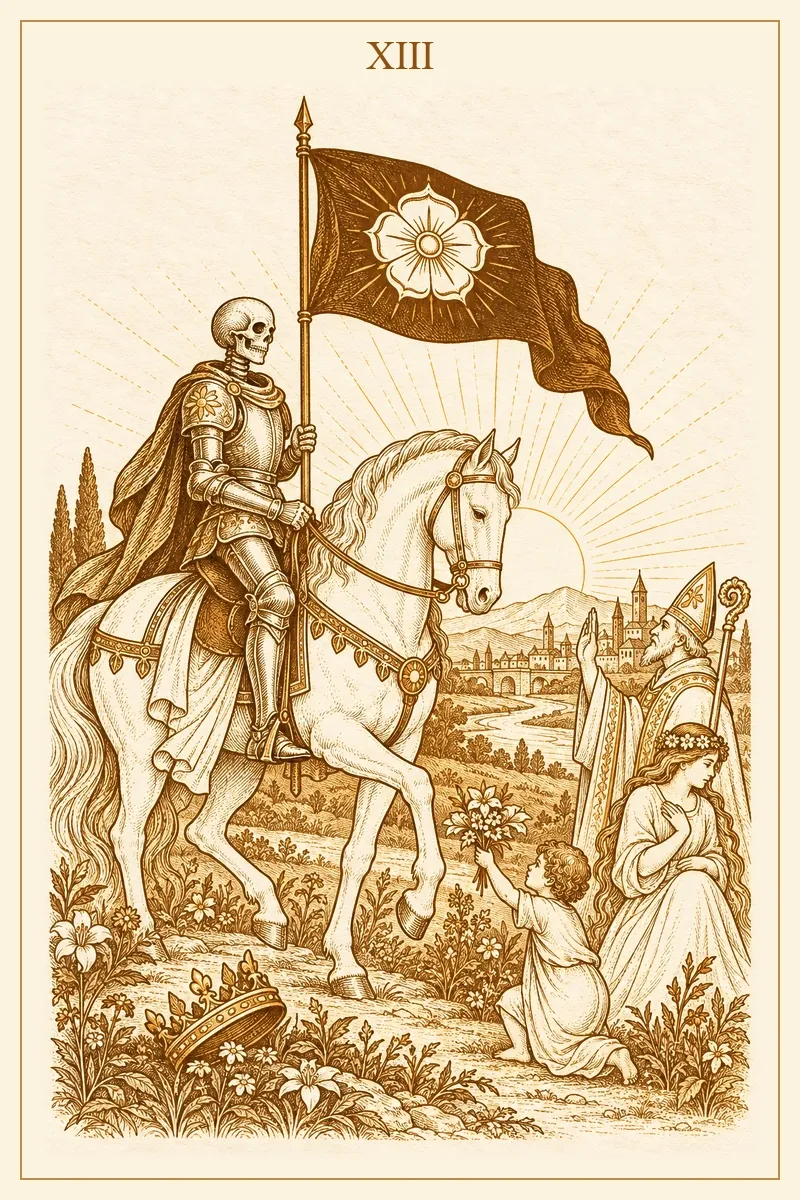
Death is card XIII, and in tarot it does not predict anyone’s physical death. The picture shows an armored skeleton riding a white horse and carrying a dark banner marked with a white rose. In front of him a fallen crown lies among the flowers, a child holds out a small bouquet, a kneeling woman bows her head, and a bishop in a tall miter raises his hand. Behind them, a sun rests on the horizon beside a walled town.
Upright, Death marks the close of a chapter: a role you have outgrown, a habit that no longer fits, a relationship that has already changed shape. It asks you to let the ending be real so that something new has space. Reversed, it describes resistance: holding onto what has finished, or dragging a transition out because the next stage feels uncertain. In a career reading it might point to a restructure or a role that is winding down; in love, to a pattern that has to end for the relationship to continue, or for you to move on. The article on Death as transformation rather than loss explains why the card becomes one of the most useful in the deck once the fear wears off.
Ace of Cups: how a number card works
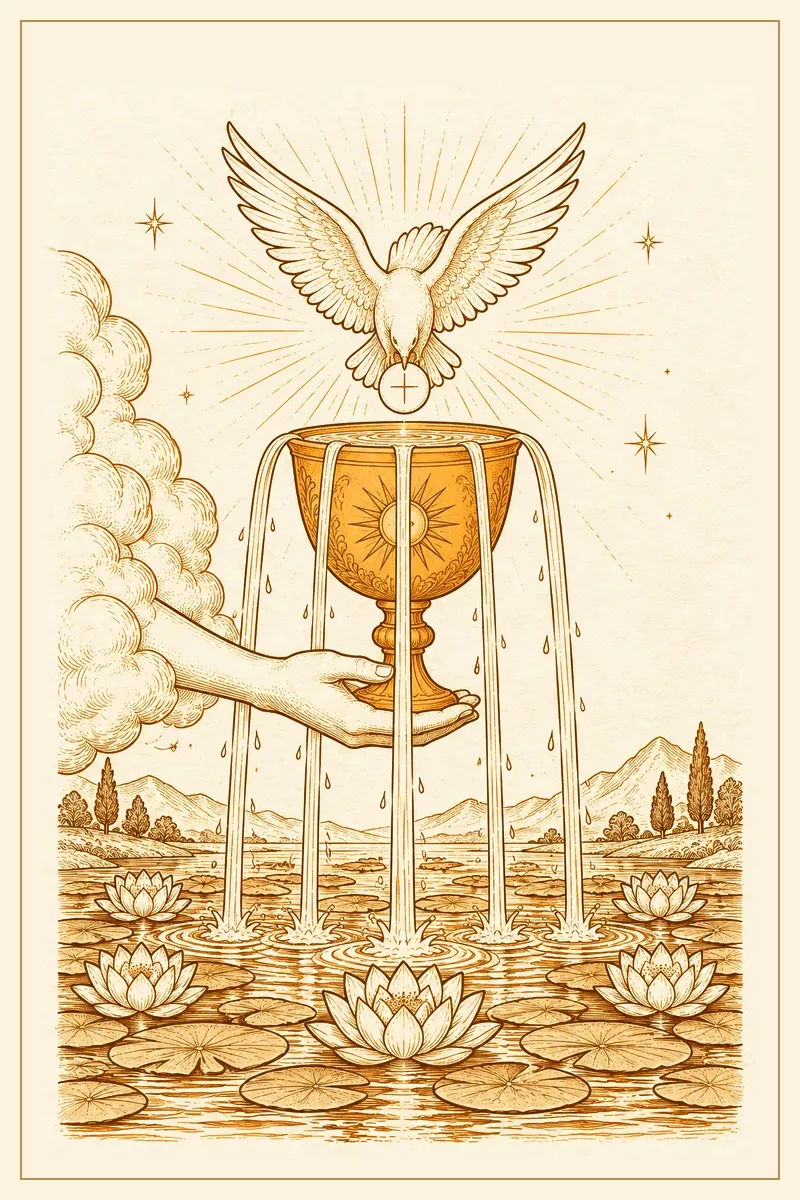
The Ace of Cups shows how the Minor Arcana combine a number with a suit. A hand reaches out of a cloud holding a golden cup; streams of water spill over its rim into a pond full of lotus flowers, and a dove descends from above with a small wafer in its beak. Ace means seed and Cups means feeling, so the card reads as the first stirring of an emotion: new affection, a creative idea that moves you, or compassion that finally includes yourself.
Upright, it can point to a relationship beginning, a softening between two people, or simply a day when your heart feels open again. Reversed, the water has nowhere to go: feelings held back, a cup emptied by giving without refilling, or a hope you are afraid to name. Its question is gentle: what feeling is asking for room right now? The longer guide to the Ace of Cups in love, creativity and emotional renewal goes deeper into its upright and reversed forms.
Queen of Pentacles: how a court card works
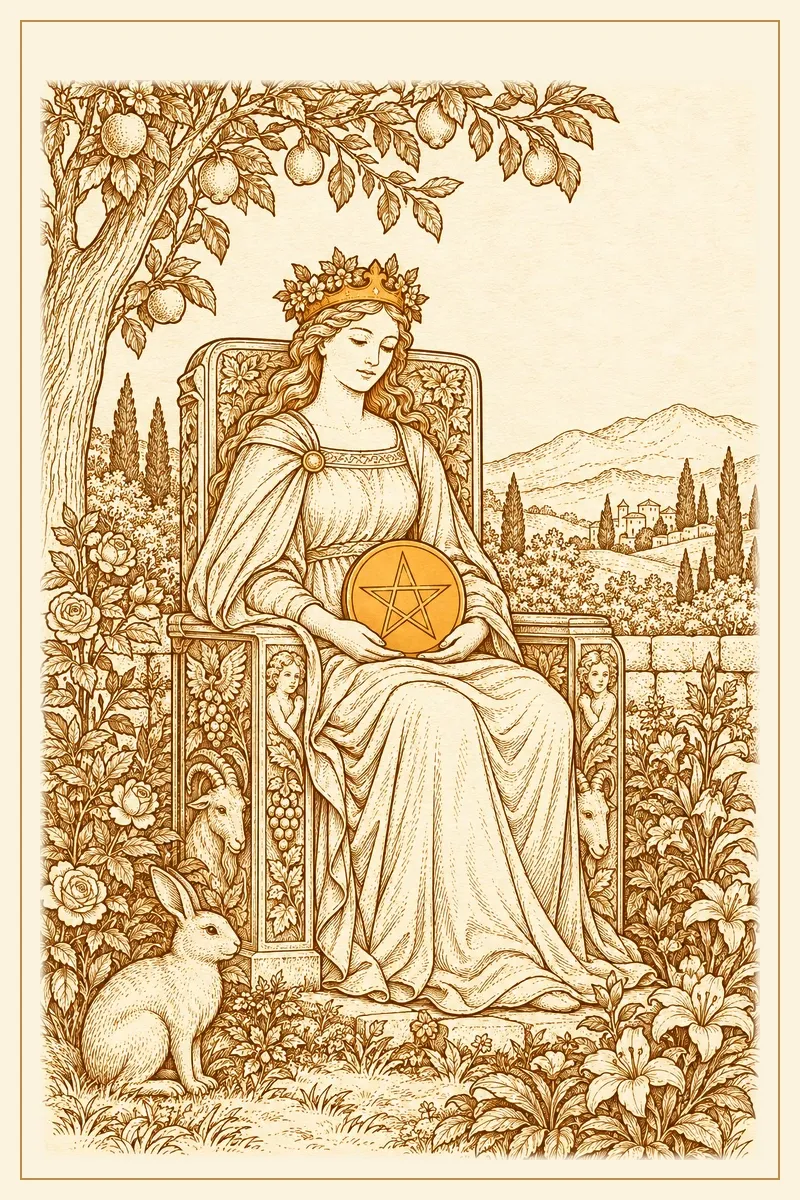
The Queen of Pentacles sits on a carved stone throne in a garden, holding a large golden pentacle in her lap and looking down at it with quiet attention. Fruit hangs from the tree above her, roses and lilies grow at her feet, and a rabbit rests close by. Everything in the picture is tended and growing, which is exactly what the card is about.
Court cards can be read three ways, and this Queen shows all three. She can be a person: someone warm and practical who makes others feel looked after. She can be a role you are playing: the one who keeps the household running, the budget balanced, the team fed. Or she can describe a style: meeting the question with steady, hands-on care. Upright, she suggests resourcefulness and a home or workplace made comfortable by attention. Reversed, the care tips out of balance: giving to everyone but yourself, money worries crowding out rest, or work and home pulling in different directions. The full guide to the Queen of Pentacles and practical care covers her in love, money and career readings.
Upright and reversed cards
When you shuffle, some cards will turn upside down. Readers handle this in two ways. Some read every card upright and let the position and the neighboring cards supply the nuance. Others read a reversal as a variation on the card’s theme. Both approaches are valid; the only rule is to decide before you shuffle, not after you see a card you dislike.
If you do read reversals, avoid treating them as the card’s opposite or as bad news. Three readings cover a reversed card well:
- Blocked or delayed: the theme is present but cannot move yet. A reversed Ace of Cups might be love you feel but have not expressed.
- Turned inward: the theme is happening inside you rather than in events. A reversed Fool can describe a private wish for a fresh start that nobody else has heard about.
- Too much or too little: the theme is out of balance. A reversed Queen of Pentacles might be caring for everyone so thoroughly that nothing is left for you.
Try each of the three on the card and keep the one that matches your situation. If none fits, read the card upright and take the reversal as a reminder to go slowly.
Where tarot came from
Tarot began as a card game. Decks that added a set of picture trumps to the four ordinary suits appear in northern Italy in the fifteenth century, where the game was known as tarocchi. Versions of that game are still played in parts of Europe today, and for roughly three centuries there is little evidence that anyone used the cards to read questions about life.
That changed in 1781, when the French writer Antoine Court de Gébelin claimed the trumps held ancient Egyptian wisdom. There is no evidence for the Egyptian story, but it gave the cards a new reputation, and decks soon appeared that were designed for cartomancy, the reading of cards. In the nineteenth century, occultists in France and England linked the Major Arcana to astrology, the four elements and Hebrew letters. In 1909, a deck drawn by the artist Pamela Colman Smith under the direction of Arthur Edward Waite gave every Minor Arcana number card its own illustrated scene, and that choice still shapes how modern decks look.
The practical point is that tarot is a human-made symbol system that has changed over time. No single deck is the correct one, and your own reading of a picture belongs to that long tradition.
Myths that keep beginners away
A few old ideas stop people from ever picking up a deck. None of them holds up.
- “You need psychic ability.” Reading tarot is a skill: knowing the symbols, listening to the question and being honest about what fits. Intuition grows with practice, the way an ear for music does.
- “Your first deck has to be a gift.” This is a superstition with no basis. Buy a deck whose pictures you enjoy looking at; the guide on how to choose your first tarot deck walks through what to look for in the art, the card size and the guidebook.
- “Tarot is dangerous.” The cards are printed pictures. What matters is how you use them: keep them for reflection and keep important decisions in your own hands.
Your first week with tarot
You do not need to learn 78 meanings before your first reading. A week of small, regular contact teaches more than an evening of memorizing. Here is one way to spend it.
- Day one: sort the deck. Lay the cards face-up in five groups: the Major Arcana in number order, then each suit from Ace to King. Notice which pictures draw you in and which you would rather skip.
- Days two to six: one card each morning. Shuffle, draw a single card, and describe the picture in three plain sentences before you look anything up. Then read a meaning and write one line on where the theme might show up today.
- Each evening: close the loop. Add a sentence on what actually happened. On some days the card will connect clearly and on others it will not, and both results teach you how the symbols behave.
- Day seven: read your notes. Look for repeated suits, repeated feelings, or a card you misread on day two and understand better now.
When you feel ready for more than one card, your first tarot reading, step by step shows how to open and close a full session. If you would rather learn in a set order, the tarot lessons on Veil Soul walk through the cards first and the spreads after them, and you can browse all 78 card meanings whenever a picture puzzles you.
A first spread: three cards with named positions
Three cards are enough for a real reading and few enough to hold in your head. This layout keeps the focus on what you can do rather than on what might happen to you:
- What is here now: the heart of the situation as it stands today.
- What I can lean on: a strength, resource or support already within reach.
- One step for this week: a small, concrete action worth trying.
Write the three position names on paper before you shuffle. Draw the cards one at a time, place them left to right, and read each card only in its own position before you look at the three together.
Worked example: settling into a new job
The question: “How can I feel more settled in the job I started last month?”
What is here now: Page of Cups. A young figure stands at the shoreline holding a golden cup, and a fish leaps out of it. The surprise on the card mirrors the situation: everything is still new, feelings sit close to the surface, and the person feels like a beginner again. That is not a problem to fix but a stage to accept.
What I can lean on: Eight of Pentacles. A craftsman sits at a workbench carving a pentacle, with six finished ones hung on a post beside him and another resting at its foot. The resource here is practice. The person already knows how to get better at something through repetition, and that habit can carry them through the awkward first months.
One step for this week: The Star. A woman kneels by a pool under a large star, pouring water from one jug into the pool and from the other onto the land. The step is about replenishing rather than pushing: one restful evening protected in the calendar, or one honest conversation with a colleague about how the first weeks have felt.
Read together, the cards do not say whether the job will work out. They describe someone who is new, capable of steady improvement, and in need of refilling as much as effort. The practical result is a plan: write down three skills to practice, and keep one evening a week free of work. That is what a good beginner reading looks like: a clearer picture and a next step, not a verdict.
Frequently asked questions
Do I need to be spiritual to use tarot?
No. Some readers treat tarot as a spiritual practice and others use it purely for structured reflection, and the question, the spread and the card-by-card reading in this article work the same way for both. What matters more than belief is the willingness to sit with a picture for a moment and notice what it brings up.
Can tarot predict the future?
Tarot can describe the current direction of a situation and the forces at work in it, but it cannot guarantee events, confirm another person’s feelings, or give reliable dates. Choices, yours and other people’s, keep the future open. For health, legal or money decisions, a qualified professional is the right source, and a reading can sit alongside that advice as reflection.
Is it okay to read tarot for myself?
Yes. Reading for yourself is a natural way to learn, since you know the background of every question. The one trap is wishful reading: if you catch yourself bending a card toward the answer you hoped for, write down the plain meaning first and your hopeful version second.
How long does it take to learn the 78 cards?
You can give a meaningful three-card reading within your first week if you work from the pictures and the positions. Knowing every card without a reference comes gradually with regular practice, and there is no deadline.
Should I memorize meanings or use my intuition?
Both, with the balance shifting over time. Start with traditional meanings as a shared vocabulary, then let the picture and your situation adjust them. When a detail in the image catches your attention and connects to your question, follow it; when nothing comes, the traditional meaning is a reliable place to start.
Is it okay to ask the same question twice?
Give the first answer time to play out before you ask again. Shuffling the same question until a card you like appears teaches you to ignore the first answer, which defeats the purpose. Asking again weeks later, once the situation has actually moved, is a fresh reading and perfectly reasonable.
Where to go from here
Tarot brings a deck of pictures, a set of named positions and your own honest attention together around one question. When you have a question of your own, you can try a three-card reading on your question and read each card in its place, the same way the example above did.