Your first tarot reading can happen tonight with nothing more than a deck, one written question and about half an hour. Write the question in a single sentence, shuffle while you hold it in mind, lay out three cards in named positions, describe what you see before you look up any meaning, then read the three cards together and write down one step you will take. Tarot will not tell you what is going to happen or what someone else is thinking; it gives you pictures to think with, and the thinking is the part that helps.
The sections below take each step slowly, then follow an invented example reading from question to closing note.
At a glance, a first reading runs like this:
- Set up: a deck, a flat surface, a notebook and twenty to thirty quiet minutes.
- Question: one open sentence about your own situation, written down.
- Shuffle: any method your hands can repeat calmly, until it feels done.
- Lay out: three cards for Situation, Obstacle and Next step, left to right.
- Look: describe each picture in plain words before opening a book or a card page.
- Read: join the three cards into one short story that answers your question.
- Close: write down the cards, your story and one action, then put the deck away.
What to have ready before the first card
You need less than the photographs online suggest: a deck, a clear table or patch of floor, and a pen with a notebook or a notes file. Candles, cloths and crystals are optional. Use them if they help you settle, and skip them if they feel like a costume.
Time matters more than objects. Pick twenty to thirty minutes when nobody will need you, with your phone on silent in another room. A first reading runs slower than later ones because you will stop to look things up and to write; squeezed into a five-minute gap, it turns into a quiz you feel you failed.
Leaf through the deck face-up for a minute first. Notice which pictures you like, which feel strange and which you would rather not draw. You are not memorizing anything, only letting the deck stop being a stranger. If it is new, take out any title or advertisement card the publisher included so it does not slip into your spread.
Then sit with both feet on the floor, take three slow breaths and let your shoulders drop. And remember that you cannot do your first reading wrong. Awkwardness, a misread card or feeling nothing at all are part of learning, so treat this sitting as practice rather than a verdict.
Step 1: Put your question into one sentence
A clear question gives the three cards something to answer. A vague one, such as "What about my life?", leaves you fitting every meaning onto everything at once, which is tiring and gives you little to hold.
For a first reading, choose a question that is about you, about something current, and open enough to have more than one answer. These shapes work well:
- "What do I need to understand about ... right now?"
- "What is getting in the way of ...?"
- "What could help me with ... this month?"
- "What am I not seeing about ...?"
Some questions are better saved for later. Yes-or-no questions squeeze three cards into one word, and "When will..." questions pull the reading toward a calendar instead of toward you. Questions about what another person thinks turn the reading into guesswork about them, so turn them toward yourself: instead of "Does she still care?", try "What do I need to understand about how I feel in this friendship?"
Write the question down exactly as you will use it. On paper, a second question hiding inside the first is easier to spot, and afterward you can check whether the reading answered what you actually asked. If nothing comes to mind, "What do I most need to pay attention to this week?" is a fair start. For help with wording, there is a fuller guide to asking tarot questions that lead to clear answers, and the library of ready-made tarot questions lets you browse by topic when you are unsure what to ask at all.
Step 2: Shuffle while the question settles
There is no official way to shuffle tarot cards. Any method that mixes the deck and that your hands can repeat without strain is fine:
- Overhand: drop small packets from one hand into the other, over and over.
- Table wash: spread the cards face-down, swirl them with both hands and gather them up. This is the gentlest choice for large cards.
- Cut and restack: split the deck into three piles and stack them in a new order, a few times over.
Shuffle until it feels finished, whether that takes thirty seconds or a few minutes. While you do, keep the question lightly in mind, the way you might hum a tune without thinking about the words.
Decide one thing before you begin: what to do with cards that come out upside down. For a first reading, the simplest choice is to turn every card upright and read its usual meaning. If a card jumps out while you shuffle, set it aside to glance at later or slide it back in; neither is a rule.
Step 3: Lay out three cards with named positions
Three cards suit a first reading. One can feel thin while you are learning to connect ideas, and ten bring more meanings than a beginner can hold at once. Three give you a starting point, a tension and a direction.
Name the positions before you draw and write them in your notebook. This layout asks three practical questions that fit nearly any first question:
- Situation (left): what is here now, as it stands.
- Obstacle (center): what is in the way, or what you are struggling with.
- Next step (right): one thing you could do, try or pay attention to.
Past, present and future is another well-known set of labels, but a "future" seat can feel like a verdict to a nervous beginner; a Next step seat keeps the reading pointed at something you can act on.
Place the shuffled deck face-down. Take the top three cards, or fan the deck and pick three you feel drawn to; both are fine. Lay them face-down from left to right in the order you drew them, then turn them over one at a time, like pages. Leave them on the table while you read, and save any urge to add a "clarifying" fourth card until you have finished with these three.
Step 4: Look before you look anything up
It is tempting to reach for a book the moment the cards are face-up. Wait a minute or two; this is the step that makes the reading yours.
For each card, say or write what you see, as if describing the picture to a friend on the phone. Who is in the scene, what are they doing, where are they looking, and what is the light like? Add one line on how it makes you feel, then look across the row: which card caught your eye first, and do any two share a color, a gesture or an object?
Only then open a reference. The card library gives each card's traditional upright and reversed meanings. Set each meaning next to what you noticed and ask whether it matches, adds something or pulls against your first impression. Each of those answers is useful.
Three of Cups: when your first look and the book disagree
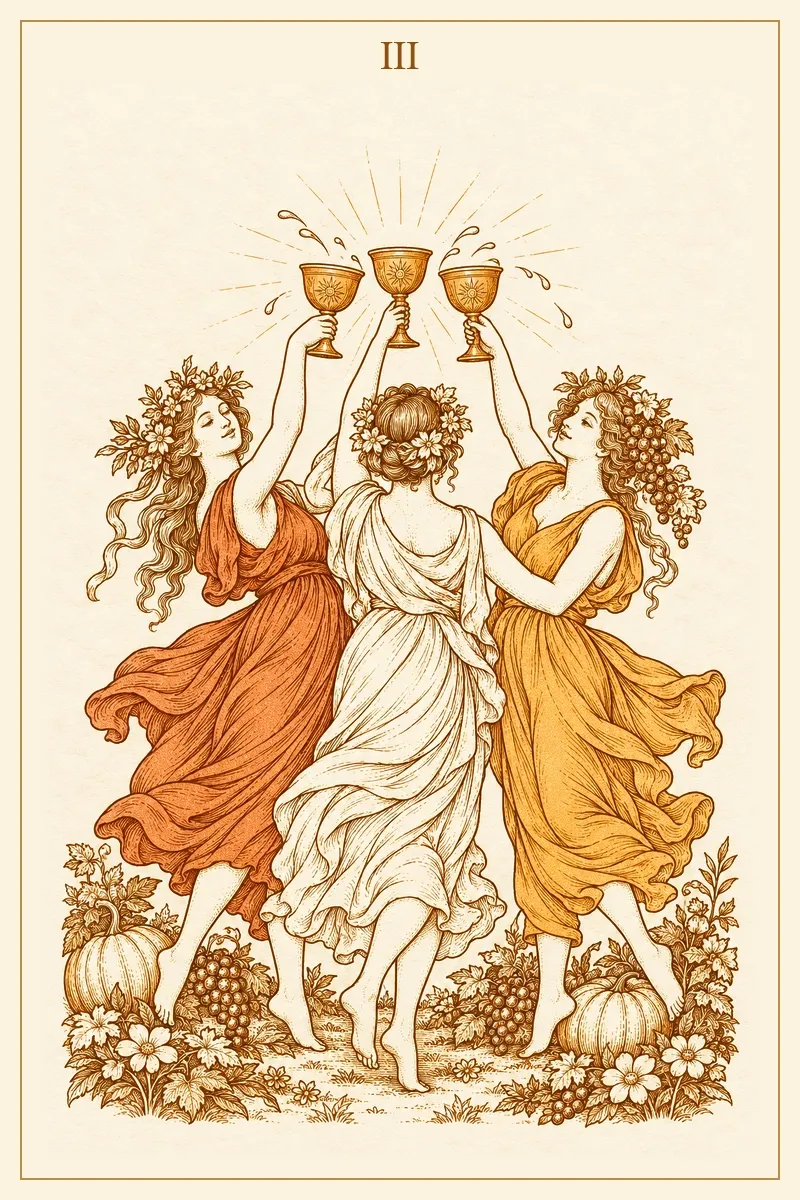
Here is that comparison with a single card. The Three of Cups shows three women dancing in a ring, each lifting a golden cup so high that drops splash over the rims. They wear flower crowns and loose dresses in rust, white and gold, with grapes, pumpkins and blossoms at their bare feet. The traditional reading is celebration, friendship and shared good news.
Now imagine you draw it in the Obstacle seat for a question about a lonely few months. Your first reaction might be to feel shut out of the circle, watching a party nobody invited you to. That reaction is not a mistake for the book to correct. It may be exactly what the card shows about your question: the obstacle is not a lack of fun but the feeling of standing outside a group you want to join. The full Three of Cups tarot meaning covers its reversed side and its place in love and work readings.
Step 5: Read the three cards as one story
Single meanings are only raw material. A reading forms when the three positions start answering your question together. A simple way in is a sentence frame:
"Right now, [Situation card] describes where I stand. What gets in the way is [Obstacle card]. A step I could take is [Next step card]."
Your first version will sound stiff. Rewrite it until it sounds like something you would say to a friend: two or three sentences that answer the question from Step 1, not a list of nine keywords.
If two cards seem to contradict each other, keep both. A bright card beside a troubled one can describe a real tension, such as wanting something and fearing it at once, and putting that tension into one sentence can give you the most useful line in the reading. And if one card makes no sense at all, write down what you see in it and leave a gap. A reading does not need every card resolved to be worth having.
Step 6: Write it down and close the reading
Writing turns one evening with the cards into a practice. A short entry is enough:
- the date and your question, word for word;
- the three cards, in their positions;
- your first impressions, before any book;
- the meanings you looked up, in a few words each;
- your story sentence;
- one concrete action, and by when.
The action line matters most. "Be more confident" is a wish; "send the email on Thursday morning" is a step you can check. If the reading gave you nothing to act on, write down one question you now want to ask yourself.
Then close the sitting on purpose: gather the cards, shuffle them back and put the deck away. Ending the reading clearly stops you from drawing "just one more" card until the answer changes. For a fuller template and a monthly look back, the guide to keeping a tarot journal of your readings goes further.
An invented example: a first reading about an evening class
The reading below is an invented example, written to show the six steps in order. The person, the question and the cards were all made up for this guide.
Mai, in her thirties, has wanted to learn Spanish for years. A community center near her office runs an evening class, and its sign-up page has been open on her laptop for two weeks. At her kitchen table, with a deck she bought last month and twenty-five minutes set aside, she writes: "What do I need to understand about signing up for the Spanish class?" She shuffles with a table wash, takes the top three cards and lays them out as Situation, Obstacle and Next step.
Situation: Two of Wands
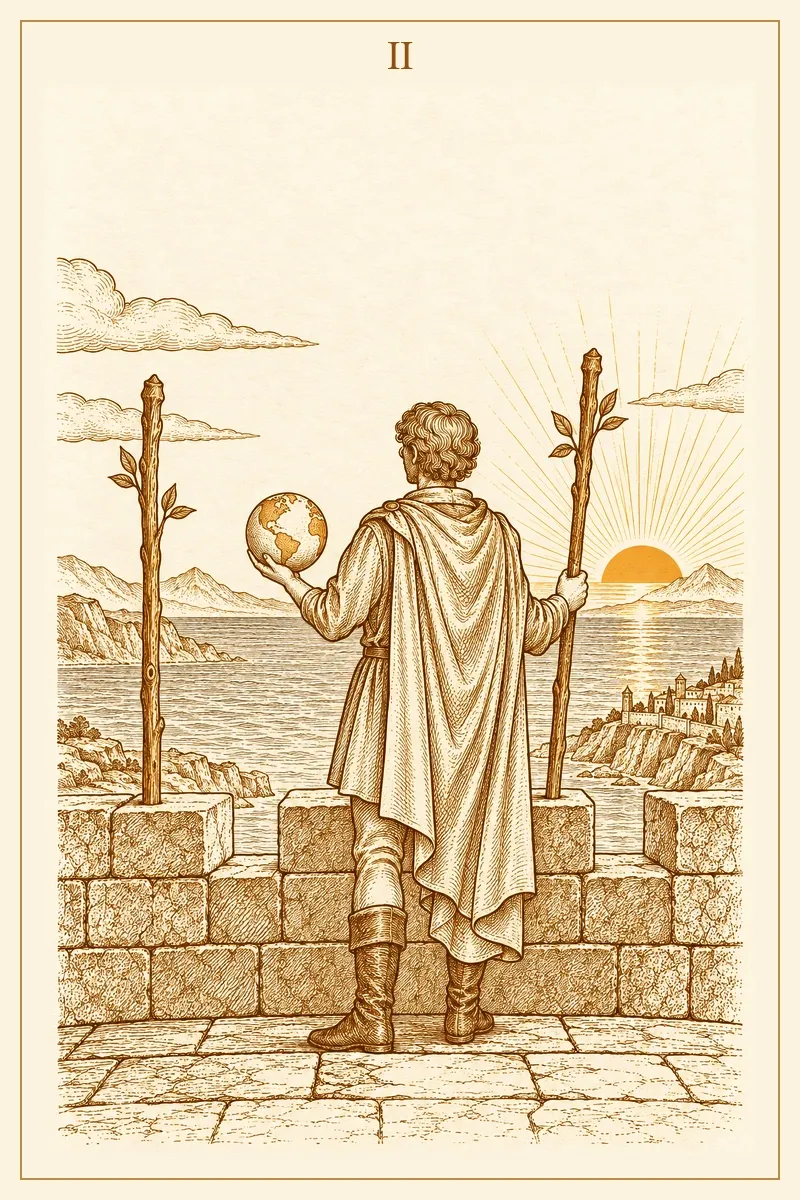
The first card is the Two of Wands. Before checking anything, Mai describes it: a man in a long cloak stands on a stone terrace with his back to her, looking over a low wall toward the sea, a town on the cliffs and a sun resting on the horizon. He holds a small globe in one hand and a leafy staff in the other, and a second staff stands fixed in the stone beside him. Her note reads: "He can see everywhere he could go, and he's still standing behind the wall."
The traditional meaning is planning and weighing a wider world from a safe place, which the Two of Wands tarot meaning explores in depth. In the Situation seat, it describes where she is: the plan is real and already in her hand, but she is still looking rather than going.
Obstacle: Nine of Swords
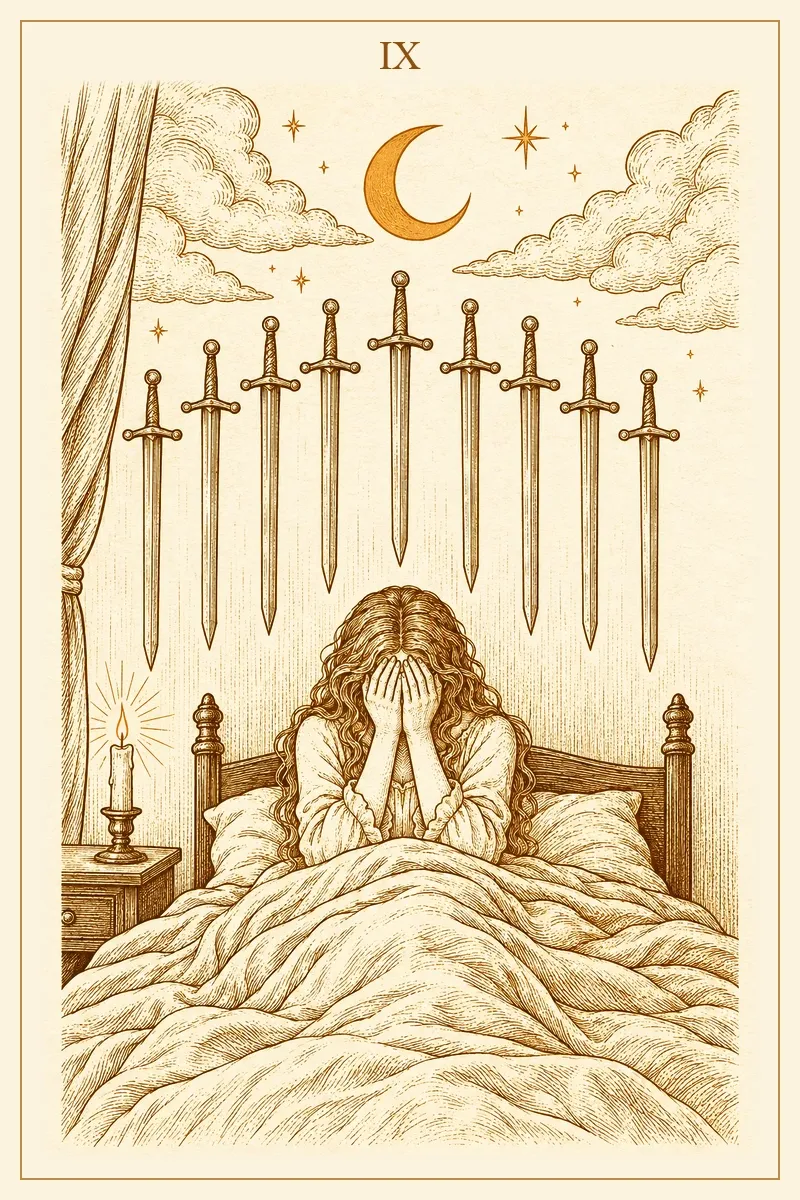
The center card is the Nine of Swords, and Mai feels her stomach tighten. A woman sits up in bed at night with her face in her hands. Nine swords hang in the air above her in a shallow arc, points down, under a crescent moon, and a candle burns on the bedside table. Not one blade reaches her. Mai writes: "Everything is over her head. Nothing is actually in the bed with her."
The card's traditional meaning is worry, sleeplessness and fears that grow larger in the dark; the Nine of Swords tarot meaning covers its reversed side. In the Obstacle seat, Mai reads it as her late-night thoughts about the class: she will be the oldest student, she will freeze when asked to speak, she will waste the fee. Her note about the blades becomes the key line. The worries are vivid, but they are thoughts, not events.
Next step: Knight of Pentacles
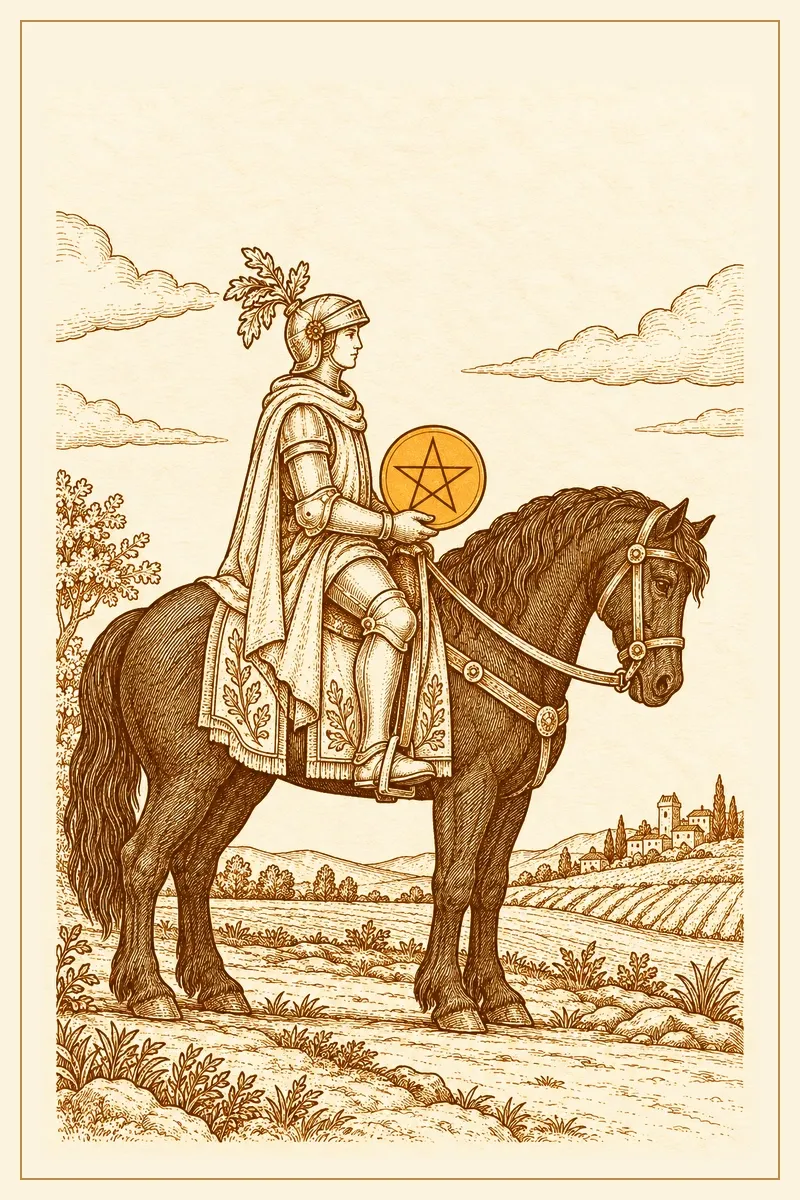
The last card is the Knight of Pentacles. An armored rider with oak leaves on his helmet sits on a dark horse that stands quite still beside plowed fields, a village on the hill behind. He holds a golden pentacle in front of him and looks steadily ahead, past it. Mai writes: "He isn't racing anywhere. He looks ready to set off at a walk."
Tradition reads this knight as patience, routine and practical progress, and the Knight of Pentacles tarot meaning covers him in more detail. In the Next step seat, he does not suggest a dramatic leap, only one plain action that can be repeated.
Mai's story and her next step
Mai fills the sentence frame, then rewrites it in her own voice: "I've had this plan in my hand for a long time and I'm still standing behind the wall. What stops me is mostly what I picture at night, not anything that has happened. The next step is small and steady: go once, at a walking pace." Her action line reads: "Ask the community center on Monday whether I can sit in on one class before I pay."
The reading gave her a clearer picture of where she was stuck and one step small enough to take this week, which is what a first reading can reasonably offer.
If the first reading feels confusing or uncomfortable
A first reading does not always go smoothly. Knowing three bumps in advance keeps them from throwing you.
The story won't come together
If the cards seem unrelated to your question, go back to your Step 4 notes rather than to the book. Pick one detail from each card and ask how it could relate to the question, however loosely. If that still gives you nothing, look at the question itself: one that holds two questions, such as "Should I change jobs or move cities?", can produce cards that each answer a different half. Record the reading as it is and try again another day with a narrower question.
A card frightens you
Some cards look alarming before you know them. Death shows an armored skeleton on a white horse with a dark banner bearing a white rose, a fallen crown in the flowers and a small child holding out a bouquet. The Tower shows lightning blasting the battlemented top off a tower on a rocky peak above the clouds while two figures fall through the air. Neither card is about physical death or disaster. Death describes an ending that clears the way for something else, such as a chapter closing or a role you have outgrown. The Tower describes a sudden shake-up of something already unstable, and the relief that can follow once a false structure falls.
If one of these lands in your first reading, slow down, describe the picture as you did the others, then read the card in its position. In the Obstacle seat, Death might point to something you are holding past its time; as a Next step, The Tower might suggest saying the honest thing you have been avoiding. Hard cards ask for attention, not alarm.
You want to draw again
Wanting a second opinion after an unclear or heavy reading is natural. Drawing again on the same question straight away leaves you a pile of mixed messages to sort through, though, and teaches you to shuffle until you see what you hoped for. Let the first reading stand for at least a day. If you are still unsure, write a narrower question that grows out of it, such as "What is the smallest part of this I could deal with first?", and draw for that instead.
The week after your first reading
One reading is a start, not yet a skill. The skill grows from a little regular practice in the days that follow; a big spread every night is not required.
The easiest habit to begin with is a single card in the morning: shuffle, turn over one card, describe it in a sentence and carry it through your day, then write one evening line about where it showed up. The one-card daily draw explains that practice step by step, and it trains the same look-first habit from Step 4 in five minutes a day.
Midweek, reread your first entry; on the weekend, try the three-card layout with a new question. When you feel ready for more than three cards, these simple tarot spreads for beginners add one layout at a time, each with named positions like the ones you used here. Leave the deck where you will pass it each day; practice fades quietly once the box goes into a drawer.
Frequently asked questions
Can tarot tell me what will happen?
No. Tarot cannot confirm what another person thinks, give a date or fix an outcome. What it can do is offer pictures and positions that help you see your situation from a new angle, notice what you already sense and choose a next step. Read the cards as reflection, and take decisions about health, money or the law to people qualified to help.
Should I read reversed cards in my first reading?
You do not have to. Reading every card upright keeps early sittings simpler while you learn the core meanings. Once the upright cards feel familiar, let reversals stand and read each one as its theme being blocked, turned inward or fading rather than as its opposite.
Do I have to be given my first tarot deck?
No. The idea that a first deck must be a gift is a superstition, and buying your own changes nothing about how it reads. Choose pictures you enjoy looking at, ideally a Waite-Smith style deck where every card shows a full scene; that makes Step 4 much easier.
Is it all right to do my first reading for myself?
Yes. Reading for yourself is a natural place to begin, because you know the question from the inside. The one thing to watch is leaning toward the meaning you hoped for, and writing your first impressions before you look anything up is a good check on that.
Can my first reading be a digital one?
Yes. A digital reading follows the same structure: a question, a shuffle, cards in named positions and your own reflection. It can be a gentle way to start because the meanings sit right beside the cards. Describe each picture in your own words before you read the interpretation, and the steps here still apply.
Sit down with three cards tonight
Your first reading does not need to be profound. It needs a question, three cards, a few honest minutes of looking and one line in a notebook. Everything you learn afterward builds on this sitting.
When you want an interpretation beside you, you can start a tarot reading on your own question at Veil Soul. Look at each card first, then compare what you noticed with what the interpretation says.