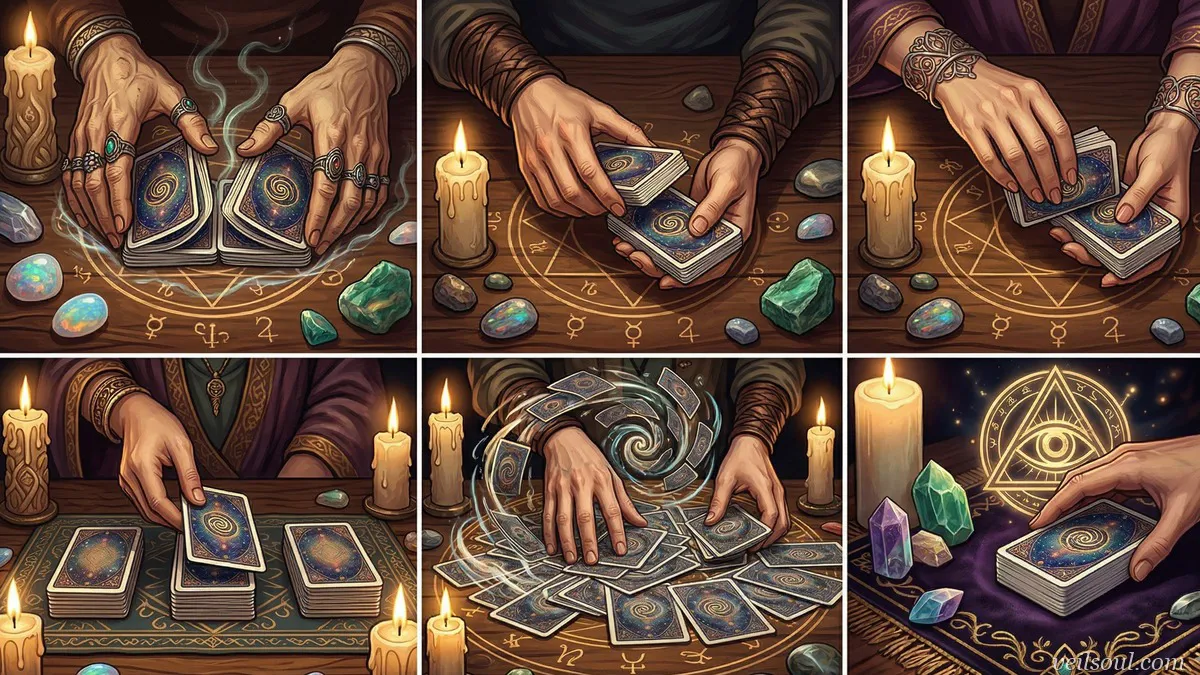
A one-card daily draw is exactly what it sounds like: once a day you shuffle, turn over a single tarot card, and treat it as the theme you carry through the next few hours. To read that one card well, look at the picture before you look up a meaning, write down the first word it gives you, tie it to one real thing on today's calendar, and check back in the evening to see where it showed up. Five minutes in the morning and two at night are enough.
One card cannot tell you what will happen at work, what someone else is thinking, or how a choice will turn out, and this practice does not ask it to. What it can do is give your attention a single image to hold, so that an ordinary day has something specific to notice. Repeated over weeks, that small daily look becomes a steady way to get to know a deck card by card.
The one-card draw at a glance:
- Time: one moment a day you can protect, morning or evening.
- Question: short and open, about you and the day ahead.
- Reading: three layers: first word, picture, your day.
- Book meaning: after your own read, as a second opinion.
- Record: date, card, first word, one evening sentence.
- Review: a month-end look back at what the cards showed you.
Why a single card is enough
Spreads with ten positions have their place, but they ask you to juggle many meanings and the links between them all at once. A single card removes that load. Instead of skimming seventy-eight definitions, you spend a whole day with one picture: you meet it at breakfast, notice it in a conversation after lunch, and think it over before bed. Weeks later, that card is no longer a keyword you memorized. It is a Tuesday you remember.
The small stakes help too. Nothing major rides on a daily card, so you can look at it calmly, even when it is one you find uncomfortable. That calm looking is the ground for building tarot intuition: little by little you start to trust what you notice in an image before anyone tells you what it should mean.
A one-card draw is also forgiving: it fits on a kitchen counter, takes less time than making coffee, and survives busy weeks. Beginners get to learn without the pressure of a large spread, and longtime readers keep their eye fresh on cards they think they already know.
Setting up your one-card draw
Pick a time you can protect
A morning draw sets a focus for the hours ahead. An evening draw looks back on a day you have already lived, while the evidence is fresh. A lunchtime draw works as a midday check-in. No hour is more accurate than another; the right one is the time you can keep on an ordinary weekday, then guard like a short appointment.
A two-minute ritual
Ceremony is optional, but a short, repeated sequence helps your mind change gears from autopilot to attention:
- Pause. Take three slow breaths and let your shoulders drop.
- Shuffle. Use any method that feels natural; the guide on how to shuffle tarot cards compares a few. Stop when your hands want to stop.
- Ask. Hold one short question in mind (examples below).
- Draw. Take the top card, cut the deck, or fan it out and pick the one your hand goes to. Any of these works; keep the same one for a few weeks so your draws stay comparable.
- Look. Give the image thirty quiet seconds before you read anything about it.
Questions that suit a single card
One card answers an open question better than a narrow one. It cannot weigh a yes against a no, and it cannot read another person's mind, so phrase the question about your own part in the day:
- "What is worth my attention today?"
- "What do I need to be aware of?"
- "What lesson is available to me today?"
- "Where can I be a little braver today?"
- Or simply: "Show me what I need to see."
If your question keeps coming out vague, the article on how to ask effective tarot questions shows how to turn "Will today go well?" into "How can I meet today's deadline with a clear head?"
Reading one card in three layers
The point of the daily draw is to practice reading, not to practice looking things up. These three short layers keep your own observations first and the guidebook second.
Layer 1: the first word (five seconds)
Turn the card and notice the first word or phrase that arrives. Do not edit it, even if it seems off-topic: "tired," "finally," "too many," "wait." Write it down before you can talk yourself out of it. By evening you will be able to see whether that first word fit the day, and over a month you will learn how far your quick impressions can be trusted.
Layer 2: the picture as a story (thirty seconds)
Now look at the card as if you had never seen it. Four questions open almost any image:
- What is the figure doing? Action points to energy.
- What might the figure be feeling? Posture points to mood.
- What is in the background? Setting points to context.
- Which colors or shapes stand out? They set the tone.
If the card has no human figure, ask the same questions of the objects: what is held, what has fallen, what is waiting. Then tell yourself the story in one or two plain sentences.
Layer 3: where it touches your day (one minute)
Bring yourself into the picture. Is there a meeting, a conversation, a chore or a decision today where this story could show up? Pick one concrete place and write it next to your first word. That single link is what turns a nice image into something you can test: by evening you will know whether the card spoke to that moment, to a different one, or to nothing you noticed.
Then open the book
Only now read a traditional meaning, from a guidebook or a card page, and treat it as a second opinion. Where it agrees with your read, the lesson sticks. Where it adds a point you missed, note it. Where it disagrees, keep both versions and let the evening decide.
Five cards and how they read as one daily card
Any card can turn up, and each works best when you shrink its meaning to the size of one day. The five below come from different parts of the deck, one of them alarming at first glance. Each has upright and reversed notes and a line for your journal.
The Magician: use what is already on the table
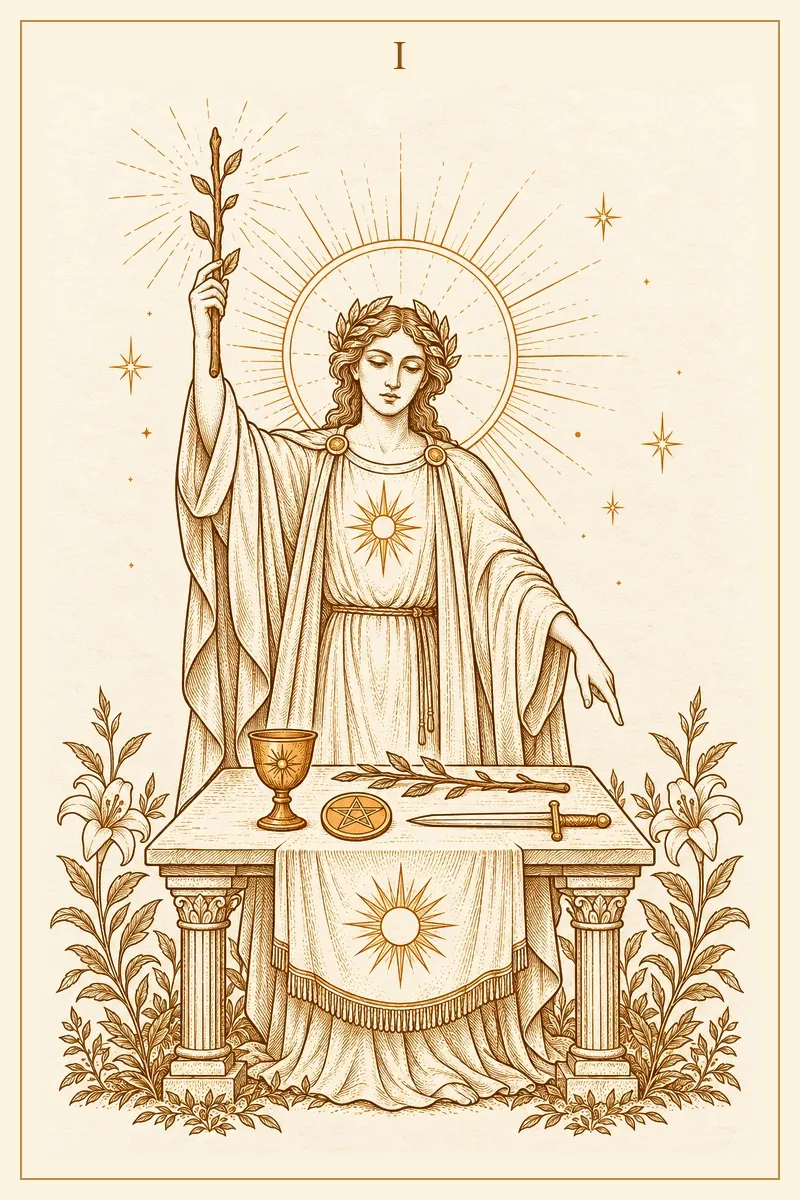
The Magician stands behind a stone table, one hand raising a leafy branch toward the sky and the other pointing down to the ground. On the table lie a cup, a coin marked with a star, a second branch and a sword, the four suits laid out side by side, with white lilies growing at both ends. Layer 2 almost reads itself: everything needed is already within reach.
Upright as a daily card, it suggests a day for starting rather than planning: send the first email, make the call you have been rehearsing. Reversed, it can point to scattered effort, or to talking about a plan more than acting on it; pick one tool from the table and use only that. The Magician tarot meaning covers its love and career readings in more depth.
A line to write: "What can I start today with what I already have?"
Eight of Pentacles: one more careful pass
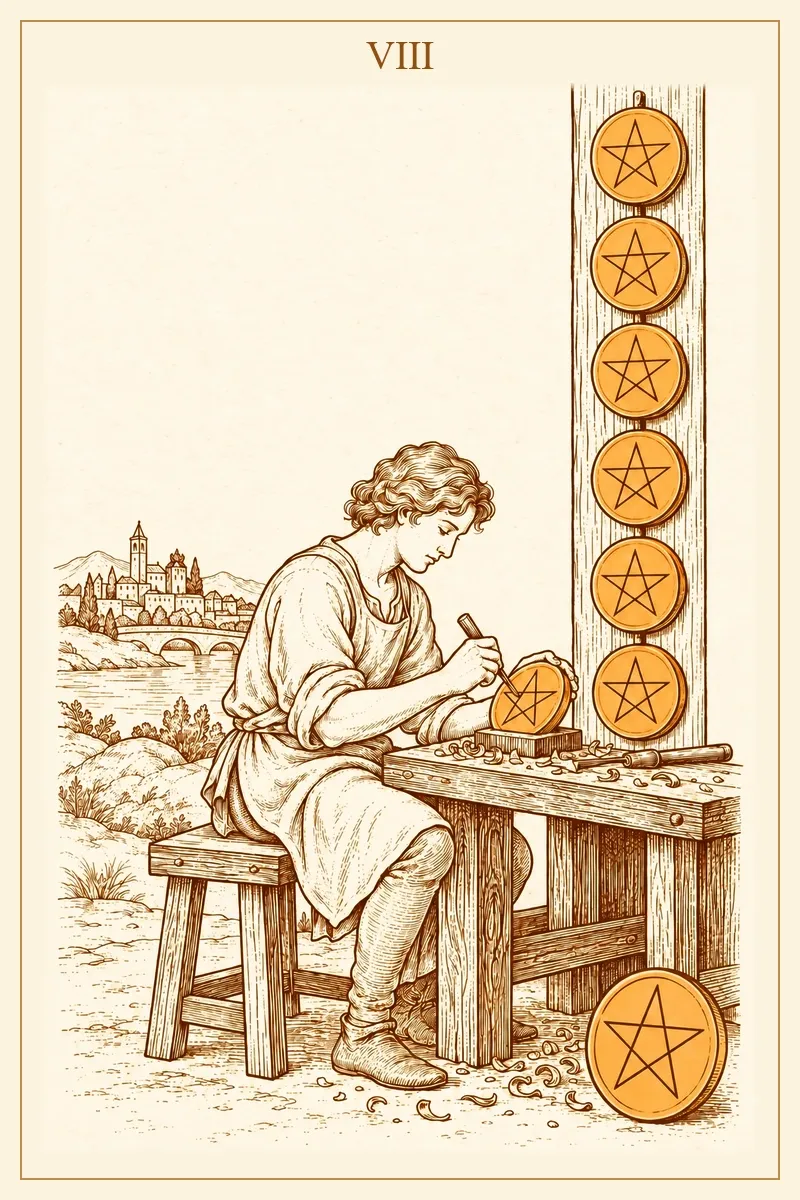
The Eight of Pentacles shows a young worker in an apron bent over a wooden bench, chisel in hand, cutting a star into a fresh coin. Six finished coins hang one above another on a tall post beside him, another leans against the bench leg, and wood shavings cover the ground. A town with an arched bridge sits far behind him, outside his attention.
Upright, this is a card of steady, repeated effort: a day to practice, revise, or put real care into a task nobody will praise. It also mirrors the daily draw itself, one careful card at a time. Reversed, it can describe work done on autopilot, or perfectionism that keeps anything from being finished; aim for one task done well, then let it go. The Eight of Pentacles tarot card meaning goes further into its work and study themes.
A line to write: "Which one task deserves my full attention today?"
Four of Cups: the offer you have not looked up for
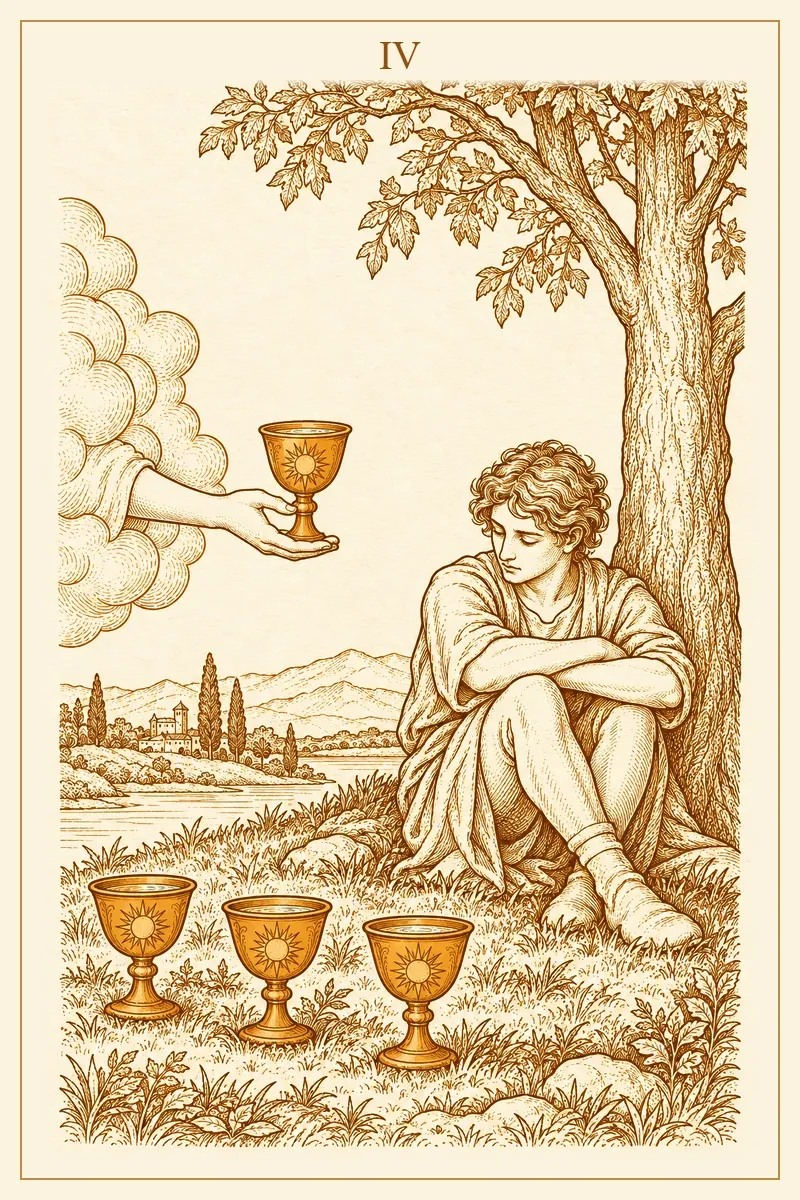
The Four of Cups shows a young person sitting under a tree, arms folded over raised knees, eyes lowered. Three cups stand in a row on the grass in front of them, and from a cloud on the left a hand holds out a fourth. The figure has not turned to see it.
Upright as a daily card, it points to boredom, withdrawal, or a mood that makes everything on offer look flat. It does not scold you for resting; it asks whether something worth accepting is being held out while you look elsewhere. Reversed, it can mark the moment you lift your head: saying yes to an invitation, or noticing a chance you had dismissed.
A line to write: "What is being offered to me that I have not looked at?"
Three of Wands: watching what you sent out
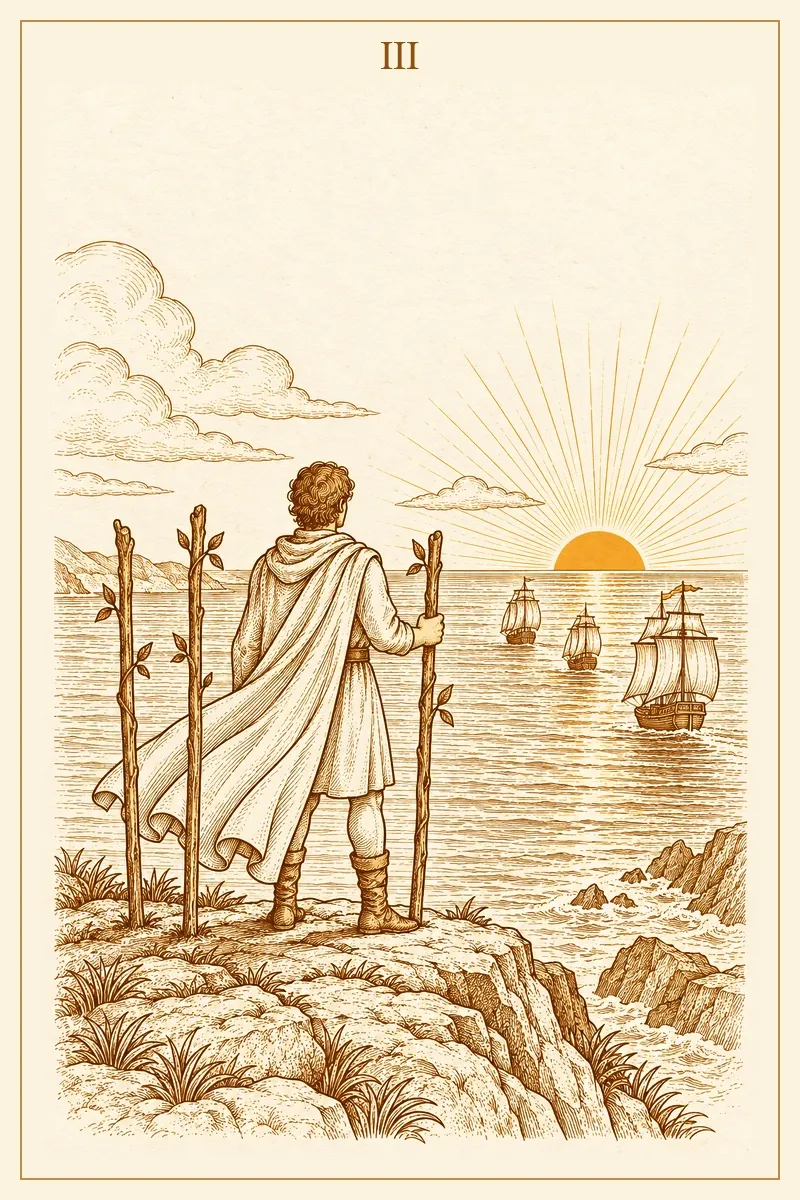
In the Three of Wands, a figure in a long cloak stands on a rocky cliff, seen from behind, one hand on a tall staff while two more are planted in the ground beside him. Below, three sailing ships cross a calm sea toward a low sun on the horizon. He is not rowing; he is watching what he has already set in motion.
Upright, the card suits a day of follow-up and patience: replies to wait for, plans already launched, a wider view of where things are heading. It can also nudge you to think one step past today. Reversed, it may reflect frustration that results are slow, or a plan that needs adjusting before more effort goes into it.
A line to write: "What have I already started that only needs my patience today?"
Ten of Swords: the end of a heavy story
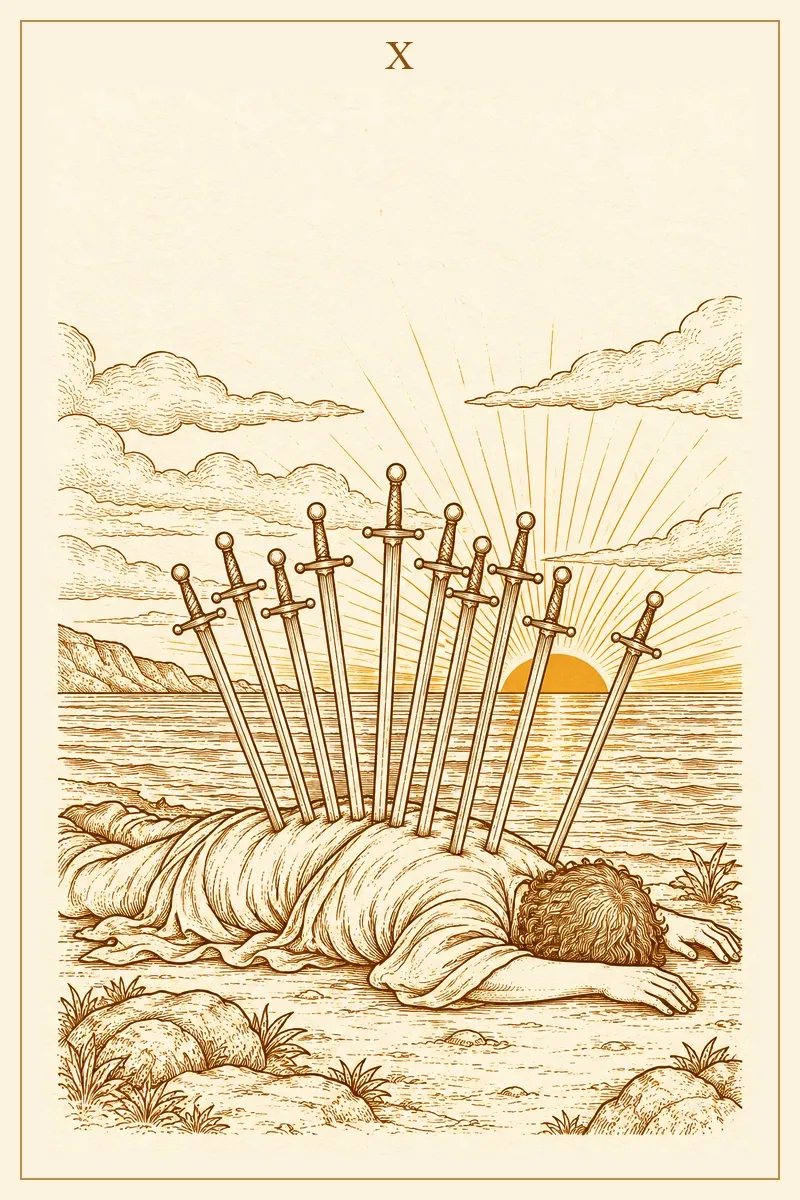
The Ten of Swords can look alarming over breakfast. A figure lies face down on a quiet shore under a draped cloth, ten swords standing upright in their back. Yet behind them the sea is calm, and a sun sits on the horizon with its rays spreading across the sky.
As a daily card it does not predict harm. Upright, it can name an exhausting story you have been telling yourself, a worry that has reached its worst point, or a situation that is ready to be called finished. The sun in the picture is part of the message: once something is over, the next part can begin. Reversed, it can describe getting back up slowly, or holding on to a pain that already belongs to the past. The Ten of Swords tarot card meaning treats it gently and in detail.
A line to write: "What am I ready to call finished today?"
A worked example: one card on an ordinary Thursday
This example is invented to show the method. Imagine someone with a routine Thursday ahead: a team meeting at ten, a report to finish, and an invitation from a coworker to join a new project group that they have been ignoring for a week. At 7:30, coffee in hand, they shuffle with "What is worth my attention today?" and turn over one card.
The card: Four of Cups, upright.
Layer 1, first word: "Sulking." They write it down and wince a little.
Layer 2, the picture: "Someone sitting with their arms folded, staring at three cups they already have, while a hand from a cloud holds out a new one they will not look at."
Layer 3, today: The new cup lines up uncomfortably well with the unanswered invitation. They write: "Meeting at ten: listen to the project pitch properly instead of checking out."
The book: The traditional meaning, apathy, inward focus and an overlooked offer, agrees with their read. It adds a point they missed: the card also allows for rest, so the answer does not have to be yes, only an honest look.
Midday: In the meeting they catch themselves folding their arms when the project comes up, and almost laugh at the match. They ask two questions about it instead of staying quiet.
Evening: Their journal line reads: "Four of Cups. Sulking. Turns out I was bored with my own work, not with the project. Said I'd join for a month and see." The card did not decide anything for them. It gave the morning a picture that made a habit of avoidance easier to catch.
Carrying the card through the day
The draw takes a few minutes; the card keeps working for hours if you let it stay in view.
- Photograph it and keep it as your lock screen, or in your camera roll for a quick look later.
- Leave it out on your desk, nightstand or kitchen shelf where your eyes will land on it.
- Check in at midday. Has the card's theme shown up yet? In what form? Some days the link is obvious; on others it is faint, and that is information too.
- Reflect at night. Look at the card once more. Where did it fit? What surprised you? What do you know about this card tonight that you did not know this morning?
The evening look is where the learning settles in, because it sets your morning guess beside what actually happened. A day when the card seemed to miss is still a useful entry: it shows a side of the card the book left out, or a question that was too broad.
Keeping a record and reading your first month back
Writing your draws down turns a pleasant habit into a teacher. A plain notebook, a note on your phone, a spreadsheet or a dedicated tarot journal all work. Each day needs only four lines:
- Date
- Card, and upright or reversed if you read reversals
- First word from Layer 1
- Evening sentence about how it showed up, or did not
After about thirty entries, set aside twenty minutes for a month-end look-back. Instead of shuffling, take the cards you recorded out of your deck and lay four of them in these positions:
- The card that came back. The one that appeared most in the month. What was going on each time?
- The card that surprised you. The draw whose evening note differed most from your morning guess.
- The card you understood late. One that made no sense at breakfast and clicked hours or days afterward.
- The card to meet again. One you still feel unsure about; make it next month's study card and read its full meaning.
Read the four together as a short story of your month. You may notice cards that turn up around the same kind of day, cards that have taken on a personal meaning, and cards that once confused you and now feel familiar. If one card dominates the list, the article on when the same tarot card keeps appearing helps you decide how much weight to give it.
Making the habit stick
Interpretation gets easier with practice. Turning up on day nineteen, when nothing feels new, is the real work, and a few small arrangements carry you past that point.
- Attach it to something you already do. Draw right after the kettle boils, after you brush your teeth, or as you sit down at your desk. The existing habit does the remembering.
- Keep the deck in sight. A deck buried in a drawer is easy to forget. Leave it, with a pen, where your chosen moment happens.
- Start with seven days. Commit to one week, not forever. At the end, read the seven entries together and decide whether to continue.
- Forgive missed days. You will skip some. Do not let one missed day turn into a missed month; draw again the next morning. The deck keeps no score.
For ideas on timing the draw across a whole day, from a morning focus card to an evening gratitude pull, daily tarot rituals sets out a complete routine built around the same single card.
A thirty-day intention: one card a day for a month, three layers each time, one sentence each night. At the end you will hold a set of cards you have met in your own life rather than on a page, and a notebook that shows how your reading has changed.
Frequently asked questions
I pulled a hard card. Does that mean my day will go badly?
No. A card like The Tower or Death in a daily draw is an invitation to pay attention, not a forecast of disaster. The Tower might show up as a plan that changes at short notice, and Death as the close of one phase of a project. Both cards are explained calmly in The Tower tarot meaning and the Death tarot meaning. Treat every card as guidance for how to meet the day, not as a verdict on it.
Can one card tell me what will happen today?
No. A card cannot fix an event in advance, guarantee an outcome, or reveal what another person thinks or plans. It offers a theme to notice and an attitude to try; the day itself is shaped by circumstances, other people and your own choices. That is also why the evening check matters: it keeps the practice honest.
I keep pulling the same card. What does that mean?
Read it as a theme that has not finished with you yet, not as a fault in your shuffling. Instead of getting frustrated, get curious: note what was happening each time it appeared, and on the next draw ask a more specific question about it, such as "What part of this card am I not seeing?"
What if the card makes no sense to me?
Keep it anyway. Write your first word, however thin, and carry the puzzle through the day. A daily card can click only in hindsight, in the evening or even a few days later. If it still feels blank at night, write that down; a run of blank days can mean your question has drifted and needs sharpening.
Should I read reversals in a daily draw?
That is your call. Reading reversed cards adds nuance, such as the blocked, inward or overdone side of a card's theme, but it also adds a layer to learn. Starting upright-only and adding reversals once the base meanings feel familiar is a perfectly good path, and so is reading them from day one. Choose one approach and keep it for a few weeks so your entries can be compared.
Can I draw a second card if I don't like the first?
Stay with the first. A replacement drawn because the first felt uncomfortable mostly tells you what you hoped to see. If the card is unclear rather than unwelcome, you may add one clarifying card with the question "How can I work with this today?" and read the two side by side.
Do I need to know all 78 meanings before I start?
No. The three layers are built for someone who knows nothing yet: your first word and the picture come before any meaning. Each daily card you look up teaches you one more card in the setting of a real day, which is far easier to remember than a list.
One card, starting tomorrow
Tonight, put your deck and a pen where tomorrow's chosen moment will happen. In the morning, breathe, shuffle with one open question, turn a single card, and give it a first word, a picture story and one link to your day before you read anything about it. When a bigger question needs more than one card, you can start a reading on Veil Soul in any quiet moment.