Five simple tarot spreads cover nearly everything a beginner wants to ask: a one-card draw for a quick focus, a three-card spread for one clear question, a four-card day-ahead spread, a five-card decision spread for choosing between two options, and a six-card self-check-in for the week. Each layout gives every card a named position, so you read what a card means in that one place instead of trying to hold the whole deck in your head. If you are brand new, start with one card or three and add the larger layouts once three cards side by side feel manageable.
A spread is a structure for reflection, not a forecast. It can show how you currently see a situation and suggest a next step worth trying; it cannot tell you what another person is thinking, name a date, or promise how things turn out. If you want the basics of the deck itself before you start laying cards, the introduction to what tarot is and how it works covers the 78 cards and the two arcana.
Here are the five easy tarot spreads at a glance:
- One-card draw (1 card): a single focus for the day, read in a couple of minutes.
- Three-card spread (3 cards): one question, read left to right as a short story.
- Day-ahead spread (4 cards): a theme, likely friction, overlooked support and an evening question.
- Decision spread (5 cards): the heart of a choice plus the surface and depth of each option.
- Self-check-in spread (6 cards): mind, heart, action, what feeds you, what drains you, and guidance for the week.
Why named positions make a spread easy to read
It is easy to freeze in front of a spread when every card seems to say ten things at once. A named position solves that. When a card full of rest and stillness lands in a slot called "what to lean on," you stop asking what the card means in general and ask what rest could look like as support right now.
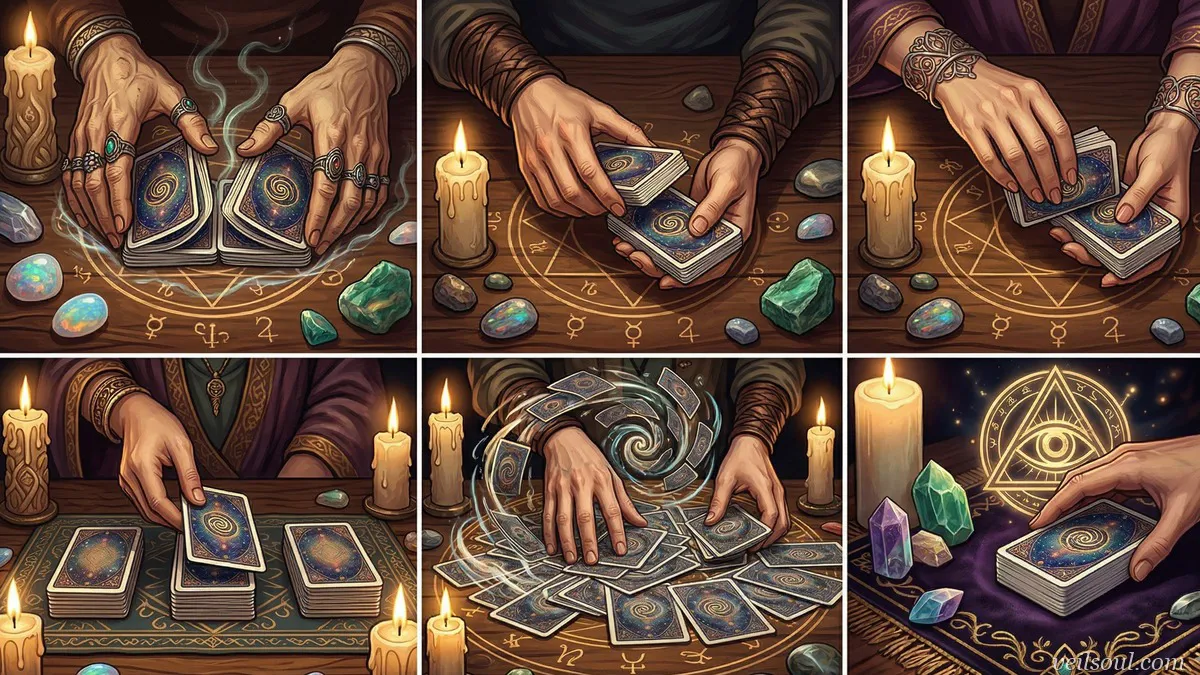
Three habits make any of the spreads below easier. First, write your question before you shuffle, starting with "what" or "how" rather than "will." "What would help me settle into this job?" gives the cards room to answer; "Will I like this job?" asks for a verdict they cannot give. Second, decide the positions before you draw. Changing a position after you see the card is the quickest way to read only what you hoped for. Third, describe what you see on the card before you reach for a book: the figures, their posture, the setting, the mood. That first plain description can be the most honest part of the reading.
The one-card draw: a single focus for today
Position: 1. Today's focus, meaning the theme, attitude or small task worth your attention.
When to use it: on busy mornings, while you are learning the cards one by one, or when a bigger spread feels like too much. There is nothing to combine: one card, one idea, one day.
Shuffle while holding a short question such as "What do I need to pay attention to today?" and turn over the top card. Before you look up its meaning, spend half a minute with the picture and write one line about what it shows you. Then read a short meaning and write a second line linking it to something you expect today, such as a meeting or a conversation. At night, glance back and note whether the theme appeared, even in a small way. The guide to the one-card daily draw goes deeper into building that habit.
Short example: you ask what you need on a Monday that already feels crowded, and draw the Four of Swords. The card shows a figure lying on a stone bed with hands folded, three swords hanging on the wall above and a fourth carved into the side of the bed. Read as today's focus, it suggests building a deliberate pause into the day: lunch away from your desk, ten quiet minutes before the evening, or one task moved to tomorrow so the rest gets your full attention. It does not say the day will be restful. It says rest is the thing to protect.
The three-card spread: one question, three positions
Positions (default set): 1. Situation, 2. Obstacle, 3. Next step. Lay them left to right and read them as a sentence: "Here is where things stand, here is what is in the way, here is something to try."
When to use it: for any single, specific question when you want more than one card but less than a full layout. Three cards is where you start reading relationships between cards, the skill every larger spread builds on. If you want a single 3-card tarot spread for beginners to practice with every week, this is it.
The same three slots can carry different labels depending on the question. Choose one set before you shuffle:
- Past, present, next: for a situation with a history, such as a friendship that has cooled.
- Strength, weak spot, guidance: for a personal goal, a study plan or a creative project.
- You, the other person, the space between you: for a relationship, read as your view of each rather than a window into their mind.
- Option A, option B, what to weigh: for a quick either-or choice that does not need the full decision spread.
- Challenge, root, way through: for a problem that keeps repeating.
Read the cards one at a time first, then ask how they talk to each other. Does the mood get lighter or heavier from left to right? Do two cards share a suit? Cups lean toward feelings and relationships, Pentacles toward work, money and the body, Swords toward thoughts and conversations, and Wands toward energy and drive. For a full tour of position sets and how three cards interact, the three-card spread mastery guide is the natural next read.
Short example (strength, weak spot, guidance): you are preparing for a certification exam and ask, "How can I study better over the next month?" You draw the Eight of Pentacles, then the Seven of Cups and finally the Ace of Swords. Your strength is steady, repetitive practice. The weak spot is scattered attention, with too many courses, apps and plans competing for the same evening. The guidance card asks for one clear decision: choose a single study method and drop the rest. Together, the three cards say the effort is there but needs one direction.
The day-ahead spread: four cards for a full day
Positions:
- Theme of the day: the overall tone or lesson to keep in mind.
- Likely friction: what may test your patience or need extra care.
- Overlooked support: a strength, person or resource you might forget to use.
- Evening question: something to reflect on before bed.
When to use it: on the morning of an important or crowded day, such as a presentation, a move, a family event or a day with several deadlines. Lay the four cards left to right; reading them takes about five minutes.
Give the third position a slow look. The friction card feels like news, but the support card is the one that changes how you meet the friction: a colleague, a habit, a skill you have stopped noticing. The evening card is not a prediction of how you will feel; it is a question to sit with once the day is done.
Short example: on a morning with two deadlines and a school pickup, you draw the Two of Pentacles as the theme, the Knight of Swords as friction, the Queen of Pentacles as overlooked support and the Six of Cups as the evening question. The day is about juggling, not perfection. The friction is speed: replying too fast, cutting people off, sending something half-checked. The support is practical care, like eating a proper lunch or asking someone steady to help with logistics. In the evening, the Six of Cups invites a simple comfort, such as calling someone from home, and the question of what made today feel kind.
The decision spread: a fork with five cards
Positions: place card 1 at the top center, then two columns below it, A on the left and B on the right.
- The core: what this decision is really about for you.
- Path A, surface: how option A looks and feels from where you stand now.
- Path B, surface: how option B looks and feels from where you stand now.
- Path A, depth: what option A may ask of you once the first impression fades.
- Path B, depth: what option B may ask of you once the first impression fades.
When to use it: when you are torn between two concrete options, such as two jobs, staying or moving, or two courses. Name both options in writing before you shuffle, and keep them specific: "stay in my current apartment" and "move to a place near work" read far more clearly than "change or not." If there are three or more options, narrow them to the two you are really weighing, or give each its own three-card spread.
Read card 1 first, since it can explain why the choice feels hard. Then compare the two surface cards, and then the two depth cards. A path that looks easy on the surface can carry a heavier depth card, and the opposite happens too. The cards lay out what you already sense about each option; the choosing stays with you. For a longer two-path layout with extra positions, see the decision-making tarot spread guide.
Short example: you ask, "Should I stay in my current apartment or move closer to work?" The core card is the Two of Swords: you have been holding off the decision by refusing to look properly at either option. Path A, staying, shows the Four of Pentacles on the surface, the security of a known rent and a place you control, and the Four of Cups in depth, a slow boredom and offers you keep ignoring. Path B, moving, shows the Six of Swords on the surface, a transition toward calmer days without the long commute, and the Ten of Wands in depth, the real weight of packing, setup costs and a hectic first month. Staying is safe but may grow stale; moving brings relief at the price of a heavy few weeks. The next step is practical: price the move honestly, then decide whether that load feels worth carrying.
The self-check-in spread: six cards for the week
Positions: two rows of three, with cards 1 to 3 on top and 4 to 6 below.
- 1. Mind: the thought or worry taking up the most room.
- 2. Heart: how you are feeling underneath the to-do list.
- 3. Action: where your time and energy are actually going.
- 4. What nourishes you: something to lean into for support.
- 5. What drains you: something to notice, reduce or set down.
- 6. Guidance for the week: one theme to carry through the coming days.
When to use it: on a Sunday evening or a Monday morning, or any time you feel busy but cannot say what is wrong. It is a snapshot of where you are this week. On Friday, look again and ask which card felt most true in hindsight. The "drains you" card may point at something you enjoy but have been overdoing, like late-night scrolling; treat it as information, not a verdict.
Short example: the top row shows the Eight of Swords in mind, the Two of Cups in heart and the Eight of Wands in action. Your thinking feels boxed in, your feelings center on one close connection, and your days are full of fast messages and quick moves. The bottom row shows The Star as what nourishes you, the Seven of Wands as what drains you and The Hermit as guidance. Quiet hope and open time restore you; constantly defending your choices to other people wears you down. The guidance is to take some solitude this week, even a single hour, so the trapped feeling in the mind card has room to loosen.
Matching a beginner spread to your question
- "What should I focus on today?": the one-card draw.
- A specific question about one situation: the three-card spread, with the position set that fits.
- A busy or important day ahead: the day-ahead spread.
- Two clear options and a deadline: the decision spread.
- A general sense of being off balance: the self-check-in spread.
If two spreads seem to fit, choose the smaller one. Fewer cards means fewer threads to hold, and a clear three-card reading teaches you more than a confused six-card one. Larger layouts such as the ten-card Celtic Cross make more sense later, once you can see how positions interact.
A full worked reading with three cards
Here is one complete reading, from question to next step, so you can see how the pieces fit. It is an illustrative example, not a real person's reading. Imagine someone three weeks into a new job who feels unsure and a little defensive. They write the question "What would help me settle into this new role?", choose the default positions (situation, obstacle, next step), shuffle, and lay three cards from left to right. All three come up upright.
Situation: Page of Pentacles
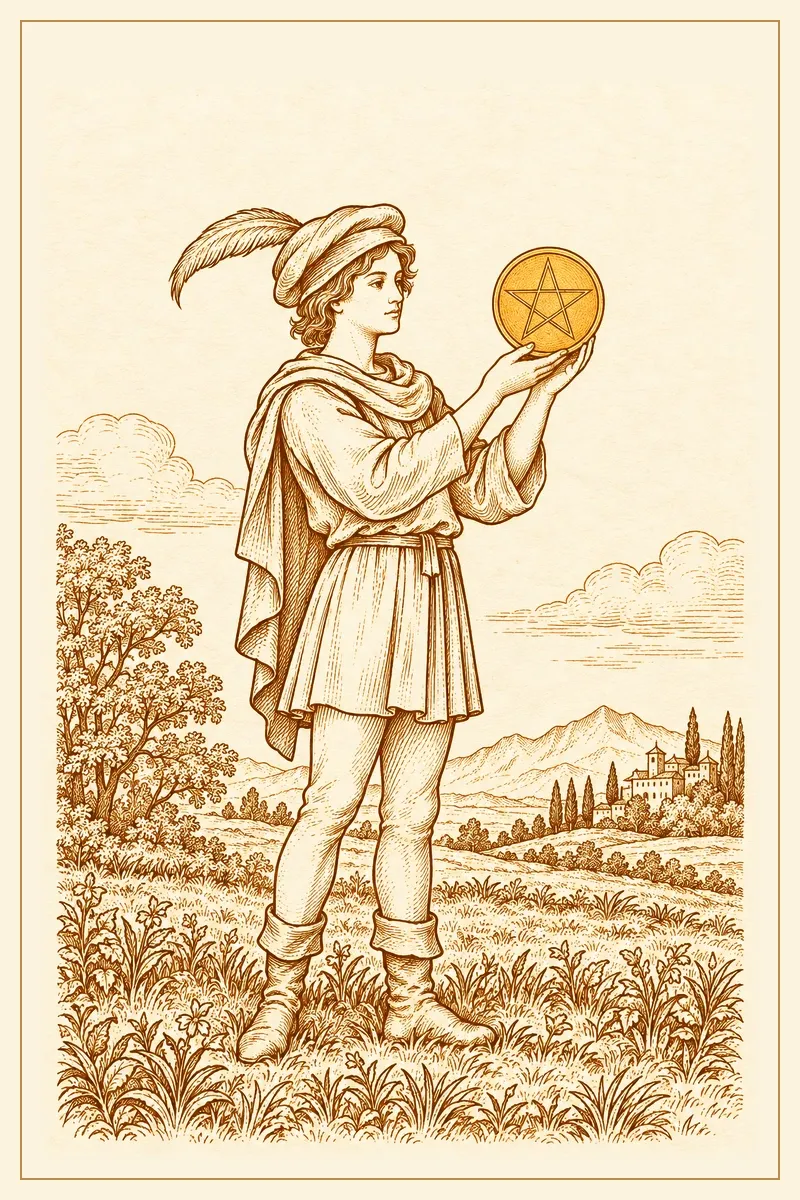
The Page of Pentacles shows a young man in a feathered cap standing in a flowering field, holding a gold pentacle up in both hands and studying it closely, with a hilltop town far behind him. As the situation card, it describes a learner: someone at the start of something practical, curious and willing, but still turning the new thing over to understand it. Being new is not a problem to fix; it is simply the stage this person is in. The full Page of Pentacles meaning adds the card's ties to study, apprenticeship and patient first steps.
Obstacle: Nine of Wands
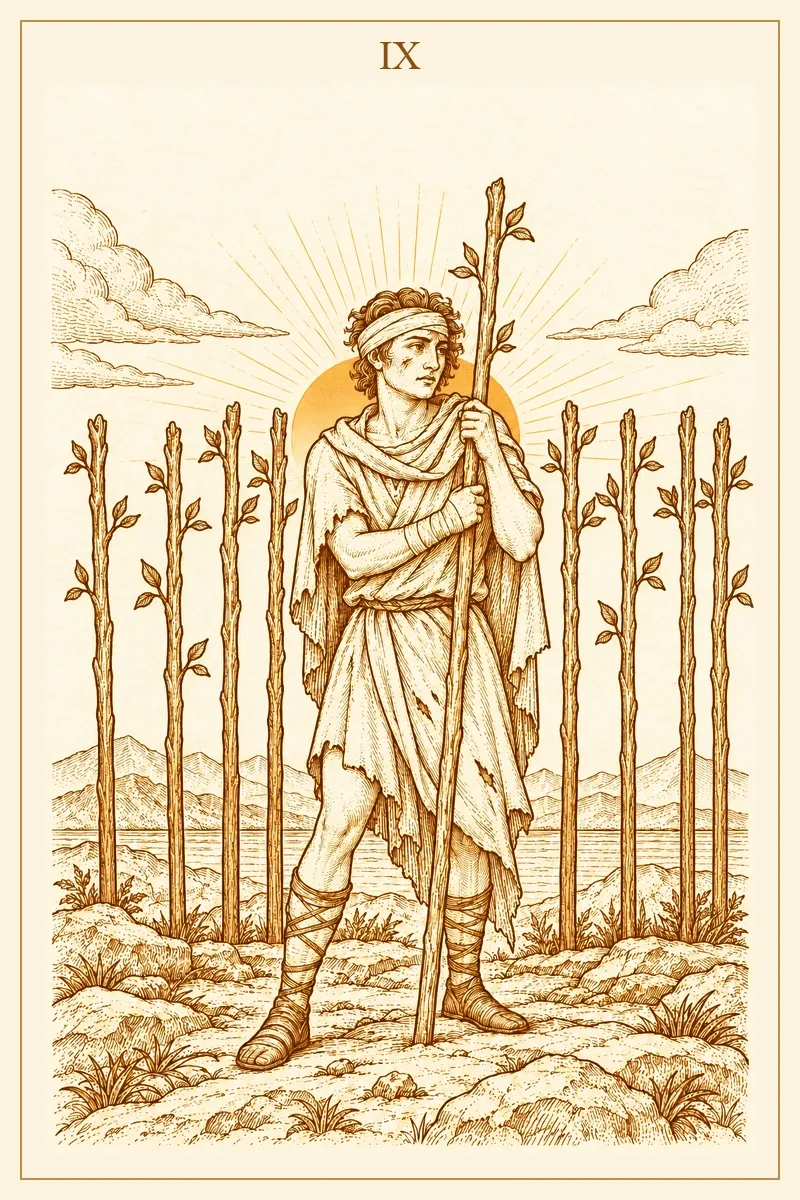
The Nine of Wands shows a tired man with a bandaged head and a torn tunic, gripping one staff while eight more stand in a row behind him, glancing sideways as if expecting the next challenge. In the obstacle position, it points to guardedness. This person may be bracing for criticism, treating every question from a colleague as a test, and spending energy on defense that could go into learning. The card also carries real resilience, since they have made it through a hard start. The obstacle is not weakness but staying on guard longer than the situation needs. The Nine of Wands meaning guide covers both sides of that persistence.
Next step: Three of Pentacles
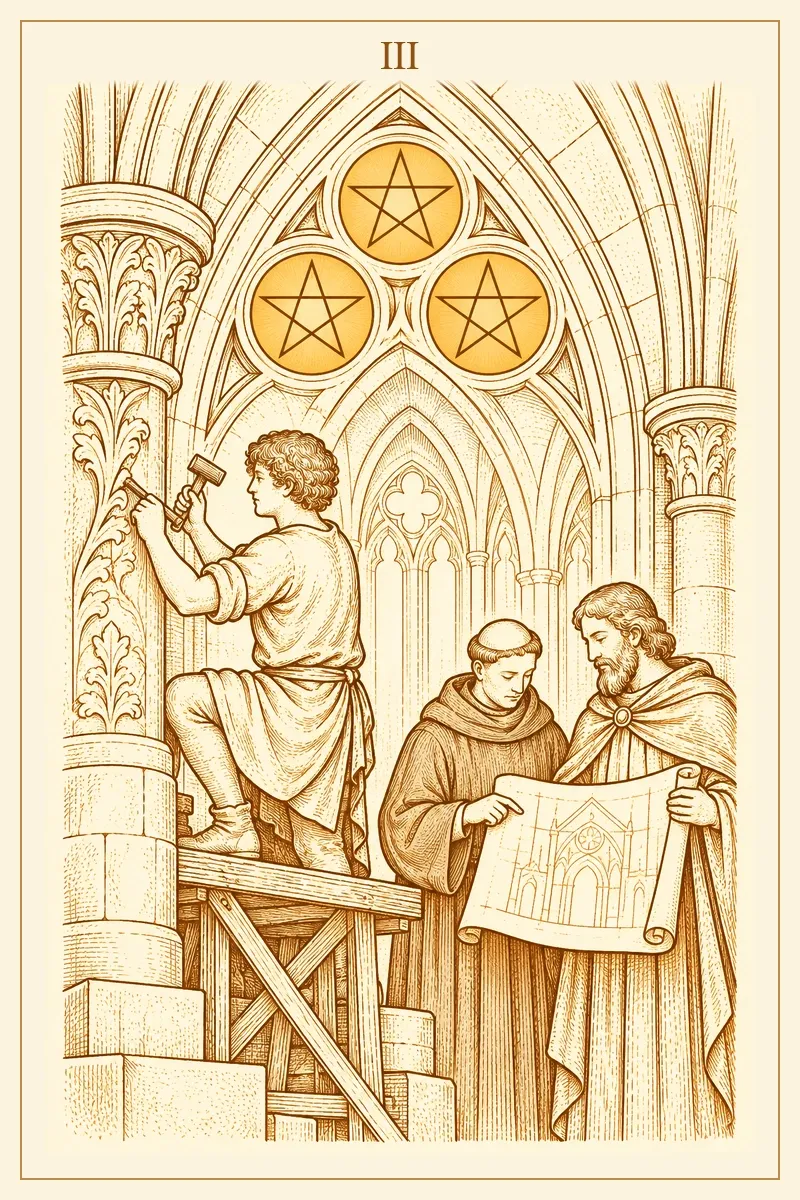
The Three of Pentacles shows a carver on a wooden scaffold working on a stone pillar, while two figures below hold the plan of the building between them and talk it through. As the next step, it suggests collaboration and feedback: ask a teammate to review your work, watch how others solve a problem, share a draft before it is perfect. The card turns the obstacle around. Instead of guarding the work alone, bring it into a shared plan. The Three of Pentacles meaning explores the teamwork and craft side of the card in more depth.
Read as one sentence, the spread says: "You are a learner, you are holding yourself on guard, and the way forward is to let others see your work." Notice the suit pattern as well. Two Pentacles cards place the reading firmly in practical work, while the single Wands card sits exactly where the tension is, in energy spent on defense. A concrete next step might be booking a short check-in with a manager this week and asking, "What does good work look like here in the first three months?" The reading says nothing about whether the job will last; it offers one action to test, which is enough.
A five-day plan to try every spread
If you want to learn all five without overload, give each spread one day of a working week:
- Monday, one-card draw: set a single focus and check it at night.
- Tuesday, three-card spread: pick one question that has been on your mind and choose a position set for it.
- Wednesday, day-ahead spread: lay it in the morning before the day gets going and read the support card twice.
- Thursday, decision spread: use it on a choice you have been putting off, even a small one.
- Friday, self-check-in spread: look back at the week as a whole.
Keep a few lines from each reading. By the weekend you can compare five readings and make the layout that felt most natural your default for now. An ordinary notebook is enough, and the guide to keeping a tarot journal shows how to set one up so past readings are easy to review.
Frequently asked questions
Which spread should a complete beginner start with?
Start with the one-card draw for a week or two, then move to the three-card spread. One card teaches you the images; three cards teach you to read cards together. Add the day-ahead and decision spreads once three cards feel comfortable, and the six-card check-in when combining two rows no longer feels like a stretch. You do not need to memorize meanings first: keep a reference nearby and use it without guilt.
Can I create my own spread?
Yes. Write down what you want to know, break it into two to six smaller questions, and give each one a position. Decide the order before you draw and keep the labels short. A good custom spread has positions that each ask something different; if two positions overlap, merge them.
What if a card does not seem to fit its position?
Stay with it for a moment before moving on. Ask what the card would mean if it were true in that position, and write down the first idea that comes. If it still feels unclear, make a note and come back later; a card that seems wrong in the morning sometimes makes sense after a conversation. Avoid drawing extra cards to "fix" one you dislike.
Should I read reversed cards in these spreads?
It is your choice. Reading upright cards only at first and adding reversals later is a sound approach. If you do read them, treat a reversed card as the same theme blocked, delayed, turned inward or overdone, and read it in light of its position rather than as a separate, darker meaning.
Can a spread tell me what will happen?
No spread can confirm another person's feelings, a date or a fixed outcome. What it can do is reflect how you see a situation right now and suggest something worth trying. Treat any "future" or "outcome" card as the direction things may take if nothing changes, and remember that your choices still shape what happens.
How often should I do a reading?
A daily one-card draw works well as a habit. For the larger spreads, ask each question once and give the situation time to move before you ask again. If a reading feels unclear, note what confused you and return to it in a day or two rather than reshuffling until a card you like appears.
Pick one spread and lay it today
You do not need all five at once. Choose the layout that matches what is on your mind today, write the positions down before you shuffle, and read the cards as one short story. When you would like a guided layout to try it with, you can start a calm reading on Veil Soul whenever you are ready.