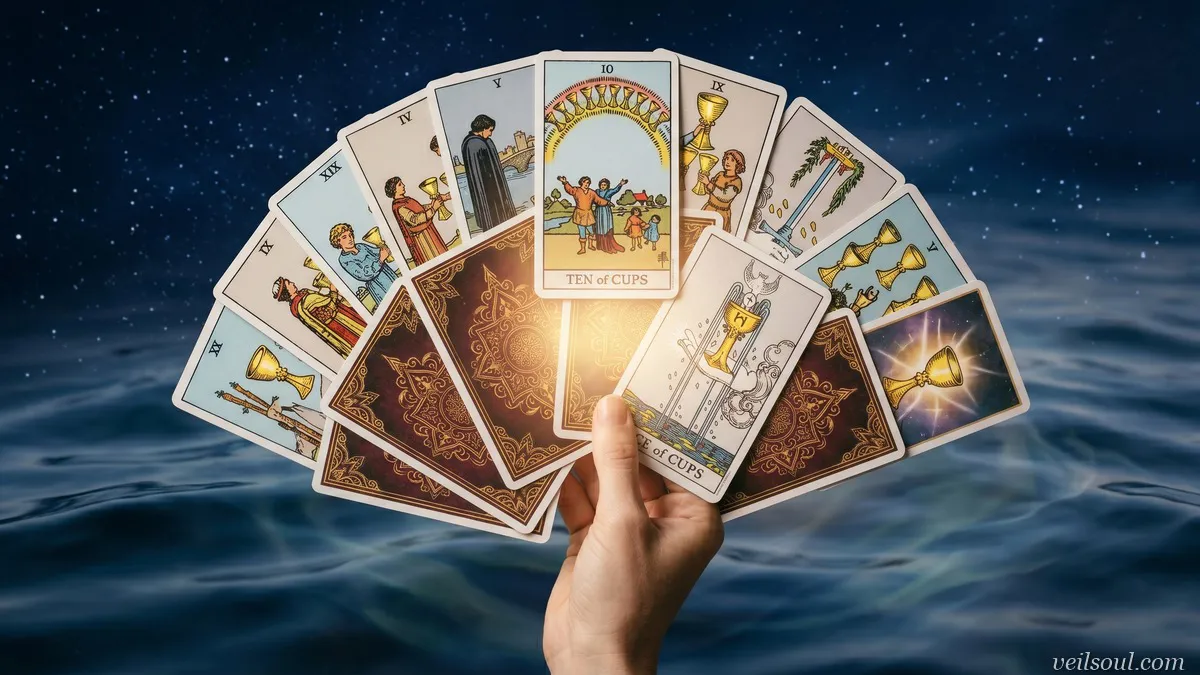
You read tarot intuitively by describing the picture before you name the card. Say who is in the scene, what they are doing, what they are looking at and how the image lands on you, and you have already produced a reading. A deck that illustrates every card was drawn to be used this way, so a beginner gets something useful from a draw on day one and lets the seventy-eight definitions arrive slowly in the background. One honest limit first: a card cannot confirm what another person is thinking, name a date or settle an outcome. It hands you a picture to think with.
What follows is the method rather than the argument for it: how to read the image, how to use your first response, the small framework that replaces memorizing, how to test a read against the traditional meaning, and what to try when a card says nothing. A spread and a worked example run it end to end.
Intuitive reading is not the opposite of study. Readers who seem to pull meaning out of the air have usually sat with the same card a few hundred times. Nothing here asks you to throw the book away, only to change the order: look, then look it up.
At a glance, an intuitive read is five moves made in this order:
- Describe before you define: name what is literally in the frame before any keyword.
- Catch the first response: what arrives in the first second is information; write it down before the editor reaches it.
- Find yourself in the scene: decide which figure or object in the picture is yours today.
- Lean on a small framework: four suits, a one-to-ten arc and four court roles cover fifty-six cards.
- Check, do not obey: compare what you saw with the traditional meaning and treat any disagreement as the interesting part.
What changes when you stop reciting
There is a particular flatness to a reading built from remembered definitions. Each card gets its label, the labels are set side by side, and the listener nods politely at a string of abstract nouns. A described reading is anchored instead to one picture and one situation: this figure has their back to two cups that are still standing, and you have been doing something similar since February.
The shift is small and it changes everything downstream. A definition answers "what does this card mean?", a question about the deck; a description answers "what is happening here, and where does it touch my life?", a question about you. If you are still deciding whether any of this is learnable, our honest look at whether anyone can learn tarot says yes.
Read the picture before you read the meaning
Treat the card as a photograph handed to you with no caption. These five questions work on every card, major or minor, and take about ninety seconds.
- What is literally here? Figures, objects, weather, time of day, background, foreground.
- What just happened, and what happens next? A card is one frame of a longer scene; say what the frames on either side would show.
- Where is the attention? Who is looking at what, who is looking away, and what nobody in the picture is looking at.
- Where am I standing in this? Pick the figure or object that is yours this week, and say why.
- What does the scene want? If the picture could ask you for one thing, name it in a short sentence.
Answer those and you have four or five sentences about your own life, which is more than a keyword entry would give you. Say them aloud or write them down; kept in your head they stay vague.
Five of Cups: a picture that reads itself
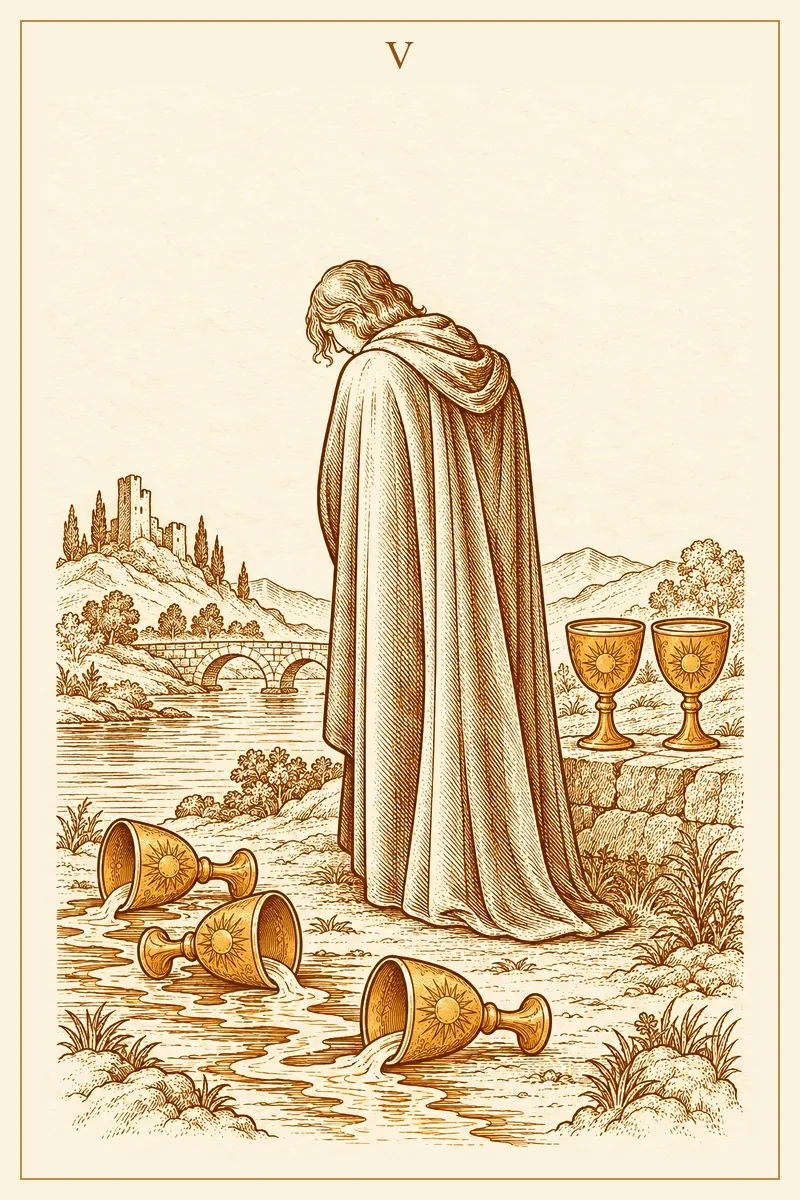
Work the questions on the Five of Cups. A cloaked figure stands on a riverbank, head bowed, three cups tipped over at their feet and spilling into the water, two cups still upright on a low wall behind them, an arched bridge crossing the river. Nobody is looking at the two that survived, or at the bridge.
That is the reading, derived from a picture. Upright, this is grief that has narrowed the field of view: the losses sit in front of the eyes and what remains sits behind the back. The bridge is the quiet detail, a way across that exists and is not being used yet. Reversed, the figure has usually started to turn, or is being pushed to turn too early. The guide to the Five of Cups meaning adds the traditional associations once you have formed your own.
Catching your first response
Something arrives in the first second after a card lands, and it is rarely a sentence. More often it is a temperature, a tightening, a word that makes no obvious sense, a pull toward one corner of the image. It is assembled faster than you can narrate it, and the second thought talks over it within about three seconds.
So give it somewhere to land. Keep a line free in your notebook and, the moment the card is face up, write two words: one for what you felt, one for what you noticed. Not a sentence, not the card name. "Cold. The door." "Relieved. Her hands." Then do the slow described reading. Afterward those two words either organize everything you wrote or sit there plainly wrong, and both outcomes teach you something.
Telling a true impression from a projection is the discipline that matters, and the trick is to name your own state before you shuffle: tired, hopeful, braced for bad news. If your first response matches that line exactly, hold it lightly; if it cuts against your mood, take it seriously. This quiet assembly is most of what people point at when they call a reader psychic, and our piece on whether you need psychic ability to read tarot looks at what is really happening.
The small framework that replaces seventy-eight definitions
Memorizing seventy-eight entries is a bad deal because the entries are not independent. Fifty-six cards are built from two ingredients that combine; the other twenty-two are learned one at a time, through their pictures. Three short lists, and the minor arcana stops being a vocabulary test. If the shape of the deck is still new, start with what tarot is and how a deck is put together.
Four suits, four questions
A suit is not a topic label to stamp on a reading; it is the question the card asks you.
- Cups ask what this does to the heart: mood, attachment, what you want and who with.
- Swords ask what is being thought, said or decided: clarity, argument, the truth somebody is avoiding.
- Wands ask what is being started or pushed: energy, appetite, the risk you keep eyeing.
- Pentacles ask what this costs and what it builds: money, body, hours, skill, the slow things.
One to ten, read as a story
The numbers run a single arc, and the same arc plays out in all four suits.
- Ace: the seed, offered and not yet planted.
- Two: a pair, a choice, two things held at once.
- Three: the first real result, and other people in the picture.
- Four: a structure holding still, shelter or stagnation.
- Five: that structure under strain, loss or conflict.
- Six: a repair, a crossing, help given or received.
- Seven: holding your position alone while it is tested.
- Eight: the long stretch of effort, or the decision to walk out of it.
- Nine: nearly there, carrying the cost of the journey.
- Ten: the thing complete and full, for better or worse.
Each step holds more than one line can carry, and the number symbolism in the minor arcana rewards a slow read once the arc is familiar.
Ten of Wands: suit, number and picture together
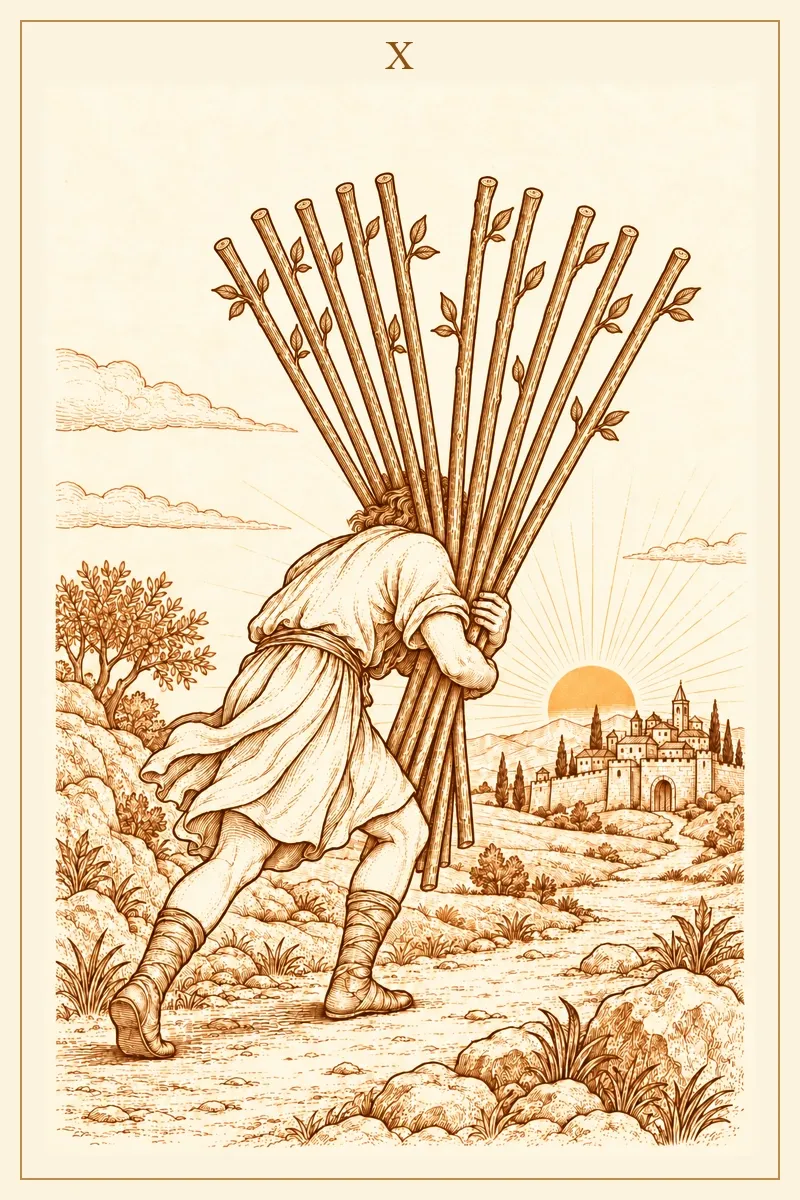
Try deriving one. The Ten of Wands is Wands, so the question is about drive and what you have taken on, and a ten, so it is complete and full. You have "a full load of the work you chose" before any book is open.
Now look. A figure walks bent almost double, arms wrapped around ten leafy staves in a bundle that rises high enough to cover the face, a walled town ahead on a rise. The picture adds what the formula could not: the load blocks the view of the destination, and nobody in the frame handed those staves over. Wands are what we pick up ourselves, so this is volunteered effort reaching its limit rather than unfair treatment. Upright, it is the final stretch with everything still in your arms; reversed, part of the load is set down at last, or stubbornly not. The Ten of Wands meaning follows it into work and health questions.
Page of Cups: court cards are roles, not ranks
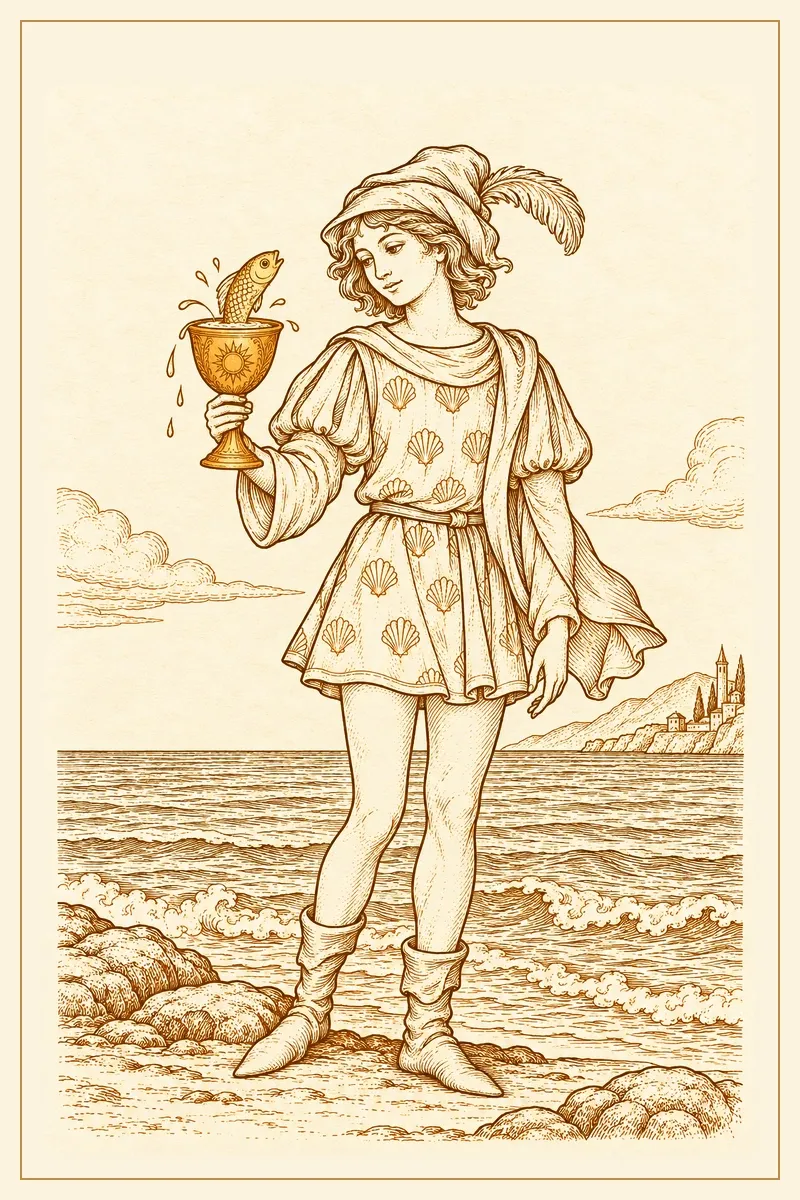
Court cards trip up a lot of beginners, usually because they are taught as a hierarchy of people. Read them as four stances toward the suit's element instead. A Page is new to it and receiving it; a Knight chases it at speed; a Queen holds it from the inside; a King arranges it from the outside. That is sixteen cards from one short list, and the overview of the court cards in tarot adds the variations.
So the Page of Cups should be someone new to feeling, receiving something they did not arrange. Check it against the picture: a young figure at the shore in a tunic patterned with shells, a cup raised, a fish putting its head out of the cup and looking back at them. The expression is amused rather than alarmed, and the cup has not been dropped. Upright, that is a tender idea, a message or a first creative stirring, all needing more holding and less analysis. Reversed, it tends toward the dropped cup: a feeling dismissed as silly, or sulking in place of asking. Our longer Page of Cups meaning takes it into love questions.
Checking your read against the traditional meaning
Looking first does not mean never looking. The compare step is where intuitive reading becomes reliable instead of merely enjoyable, and it costs three lines: what you saw, what the traditional meaning says in your own words, and where the two disagree and why.
That third line usually has one of three answers. You noticed a detail the keyword compresses away, which is a real addition. The question bent the meaning, which it is allowed to do. Or you painted your own mood onto the picture. Do this for a few months and you end up knowing the traditional meanings anyway, attached to cards you have looked at and situations you have lived, which is why they stick when flashcards never did.
Five of Pentacles: when your eyes and the book disagree
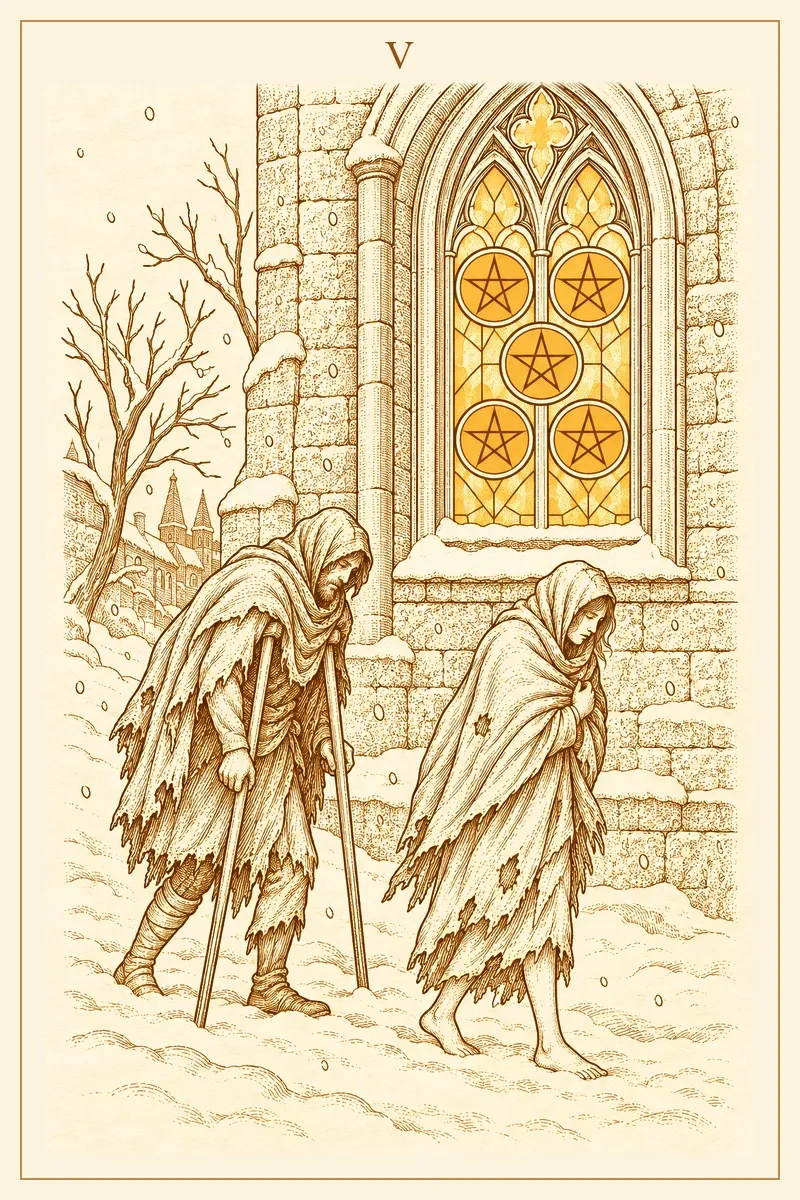
Describe the Five of Pentacles first. Two figures move through deep snow along the wall of a large stone building; one leans on a pair of crutches, the other is barefoot in a tattered cloak. Beside them a tall window glows with warm light, five pentacles set into its glass. A common first response is some version of "this is the worst one in the deck".
Now compare. The traditional reading is hardship and the feeling of being shut out, and it leans on a detail your eye probably skated over: the lit window is a few steps away and neither figure looks up at it. Help exists within reach and goes unasked for, often because asking feels worse than the cold. Your eye was accurate about the hardship, the tradition noticed the window, and the gap is the lesson. Upright, read material difficulty plus the isolation that travels with it; reversed, it often marks the turn, with support finally accepted. The Five of Pentacles meaning belongs beside your own notes.
When nothing comes
Some days a card is just a rectangle of ink. This happens to everyone, and the fix is never to stare harder. Try these in order.
- Count instead of interpret. Name three things in the frame and one thing you expected that is missing.
- Change the distance. Hold the card at arm's length and look only at shape, light and where the dark areas sit.
- Read it as a place. Forget the event; ask whether you would want to stand in this landscape.
- Ask what it is not. Nobody here is celebrating, nobody is leaving, nobody is speaking. Absence is as readable as presence.
- Leave it on the table. Write the card down with the date and no interpretation, and come back in two days.
Keep one more possibility in view: the blank may be the reading. Some cards are about stillness or suspension, and a mind hunting for an event finds nothing, because there is no event in the picture.
Four of Swords: when the picture looks like nothing is happening
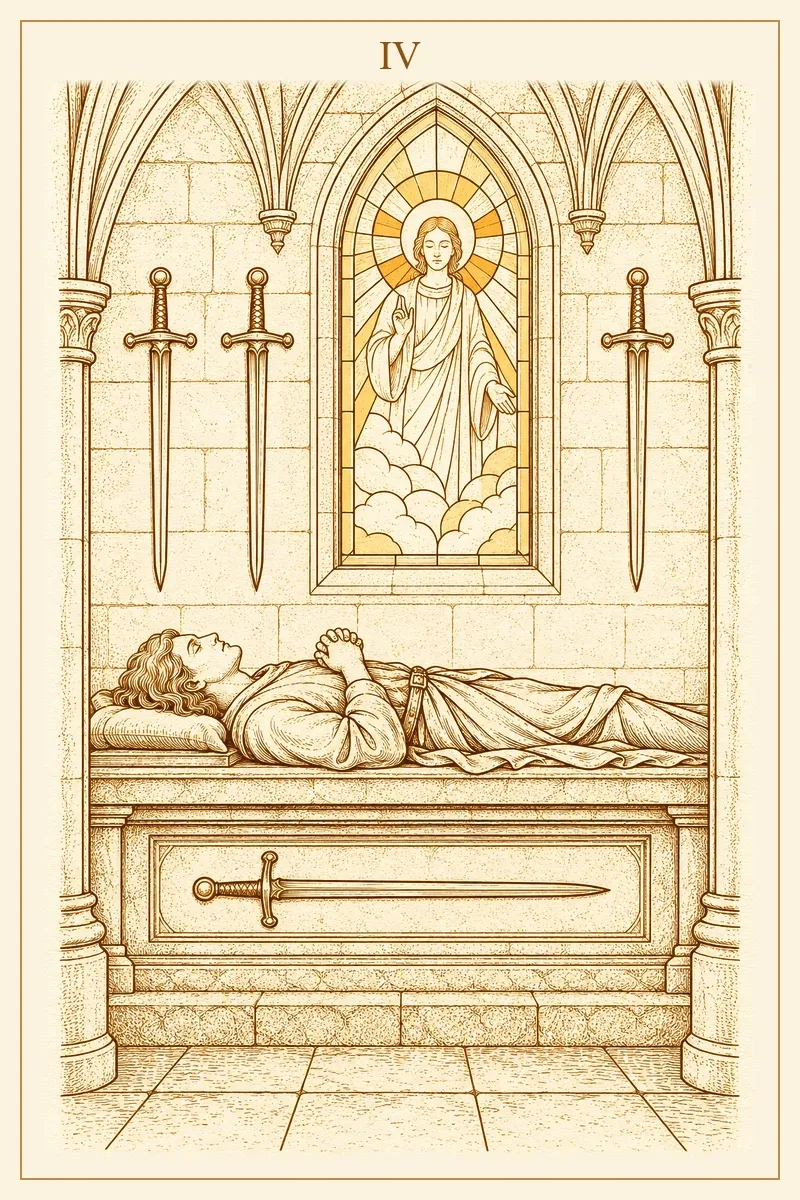
The Four of Swords is the classic blank. Inside a stone chapel a figure lies full length on a raised tomb, hands joined on the chest. Three swords hang point-down on the wall above, and a fourth is carved along the side of the tomb. Nothing moves and there is no drama to narrate, which is why beginners come up empty.
Work the detail instead. Three of the swords are on the wall, not on the sleeper. In a suit that stands for thought, that is the whole message: the thinking has been set down deliberately, and the fourth stays within reach underneath. Add the number four, a structure holding still, and you get rest with a shape to it rather than collapse. Upright, recovery that has been chosen; reversed, rest overdue and refused, or stillness that has outlasted its usefulness. The Four of Swords meaning covers work and health questions.
The first-look spread
This four-card layout rehearses the method on a real question rather than forecasting anything. Write the positions down before you shuffle, because the urge to rename one to suit a card you liked is strong and it ruins the exercise.
- 1. What I can see. Read this card literally and describe the scene only: no meanings, no conclusions.
- 2. What I feel first. Turn it, write your two words within three seconds, then stop and let them sit.
- 3. What the tradition adds. Read this one with a source open on purpose, and note where the book and your eye part company.
- 4. What I do this week. Pull the card down to one small action you could finish in an afternoon.
Lay the four in a row and read them in order without jumping ahead; the positions are deliberately uneven, and the point is to feel the difference between them. Date the entry and reread it two weeks later. If wording the question stalls you, borrow one from the question library.
A worked example: four cards about a friendship that went quiet
Here is the spread run end to end with the thinking left visible. The question: "My oldest friend and I have barely spoken in three months. Nothing happened between us and nobody fell out. What is going on, and what can I do about it?"
Position one, what I can see: Four of Cups. A figure sits under a tree with arms and legs folded, looking down at three cups on the grass. A hand reaching out of a cloud beside them holds out a fourth cup, and they are not reaching for it. Described and nothing more: three cups already there, one offered, attention on the three.
Position two, what I feel first: Six of Cups. The two words written inside three seconds were "warm" and "long ago". Children in a walled garden, a cup of white flowers passed from one to the other. The warmth was real and immediate, and it pointed firmly backward: the feeling about this friendship is intact and lives in the past tense.
Position three, what the tradition adds: Eight of Wands. Eight staves fly in parallel across an open sky above a river. The gut response was "nothing is happening", almost the opposite of the traditional reading of speed, messages and things arriving quickly. Sitting with the gap produced the insight: that sky is empty of obstacles, not of possibility. Nothing is blocked between these two people; the channel is unused because neither has sent anything down it.
Position four, what I do this week: Knight of Cups. A rider moves at a walk rather than a gallop, holding a cup out level in front of him. The action is in the posture: go first, slowly, carrying something offered rather than a demand. In practice that meant one short message with a specific memory in it and no requirement that anyone explain the silence.
What the reading did was narrow: it separated a real warmth from an unused channel and produced one action small enough to take.
Ten minutes a day
One card, three lines, then the book. Draw a card, write three sentences of pure description and one about what is happening in your week, and only then check a meaning. Add a fourth line recording whether they agreed; that record is the part that compounds.
The two-card conversation. Lay two cards side by side and turn them so the figures face each other. Rather than reading each in turn, ask what the first is saying to the second and what the second would answer. Cards that look unrelated often turn out to be arguing about something you recognize.
The silent story. Draw three cards and narrate a beginning, a middle and an end using only what is painted on them, with no card names and no keywords. This is the exercise that teaches a spread to behave like a sentence rather than a list. Once a week, reread your notes and underline any line that turned out to be about something real; those underlines are your own vocabulary forming. A longer program for the same skill is set out in our guide to building tarot intuition.
Frequently asked questions
Will I read less accurately if I never memorize the meanings?
Not in the way you fear. You will miss some traditional associations early on, and the compare step is how you pick them up without flashcards. What you gain at once is flexibility: a recited definition gives everybody the same reading, while a described one is already attached to a particular life.
Some cards go blank for me every single time. What then?
A card that is reliably blank is usually one you have quietly decided is boring, or one whose subject you would rather not think about. Stand it on your desk for a week and write one line whenever you notice something new. Persistent blankness is more often a shut door than an empty room.
Should I use a pip deck such as a Marseille deck for intuitive reading?
Not while you are learning this method, because it runs on scenes. In Marseille and other pip decks the numbered cards show arrangements of suit symbols rather than people doing things, a legitimate and very old way to read that leans on number and suit knowledge instead of the picture.
Can I mix intuitive reading with the traditional meanings?
You should, and the order matters more than the mix. Look, describe, record your first response, and only then bring in what the card traditionally carries. That way the tradition acts as a second opinion and catches your projections; the other way around, the definition quietly rewrites what you would have seen.
Can I read this way for other people, or only for myself?
It works better with other people, as long as you narrate as you go. Describe the picture aloud, say what you noticed first, and ask whether any of it connects before you commit. The commentary stops you announcing conclusions, and the person opposite will correct your aim better than a book can.
What if my first impression turns out to be wrong?
Then you have learned something specific about your own reading, which is why it gets written down. Go back and ask what produced it: a detail you over-weighted, your mood that morning, a hope you had already settled on. Wrong first impressions reviewed honestly are the fastest route to a trustworthy one.
What can an intuitive reading not tell me?
The same things no reading can tell you, however experienced the reader. It cannot report another person's private thoughts, fix a date, or settle a medical, legal or financial question, and a vivid gut response does not change that. Treat what you see as a mirror for your own next step, and take the rest to someone qualified.
Look first, look it up second
The method fits in one line and the rest is refinement: look at the card, say what you see, write what you felt, then check. You already know how to read a picture; you have been doing it since you were small, narrating an illustration without anybody handing you a glossary first. When you want a quiet place to practice, begin a reading with Veil Soul and write your first line before you look anything up.