Card 0 of the Major Arcana, The Fool, means a beginning you cannot fully plan: a new road, a fresh start, or a leap you take on trust while curiosity does the work that certainty usually does. Upright, it says the step is worth taking and that you are freer to begin than you feel. Reversed, its keywords turn to hesitation, recklessness and naivety, so you either freeze at the edge or jump without looking.
Like any card, it cannot tell you how the leap will turn out, read another person's mind, or pick a date. What it does well is show you how you are standing at the threshold, and whether fear or impatience is doing the steering.
At a glance:
- Upright keywords: new beginnings, innocence, spontaneity, trust, curiosity, freedom.
- Reversed keywords: hesitation, fear of the unknown, recklessness, naivety, a false start, delay.
- Number: 0, set outside the count and placed before card I.
- Element and planet: Air; in modern astrology, Uranus.
- Hebrew letter: Aleph, the first letter.
- Yes or no: yes upright, not yet reversed.
- Advice: travel light, keep your eyes open, take the first step.
A flower crown and a leaping dog: what card 0 shows
The traveler with an open palm
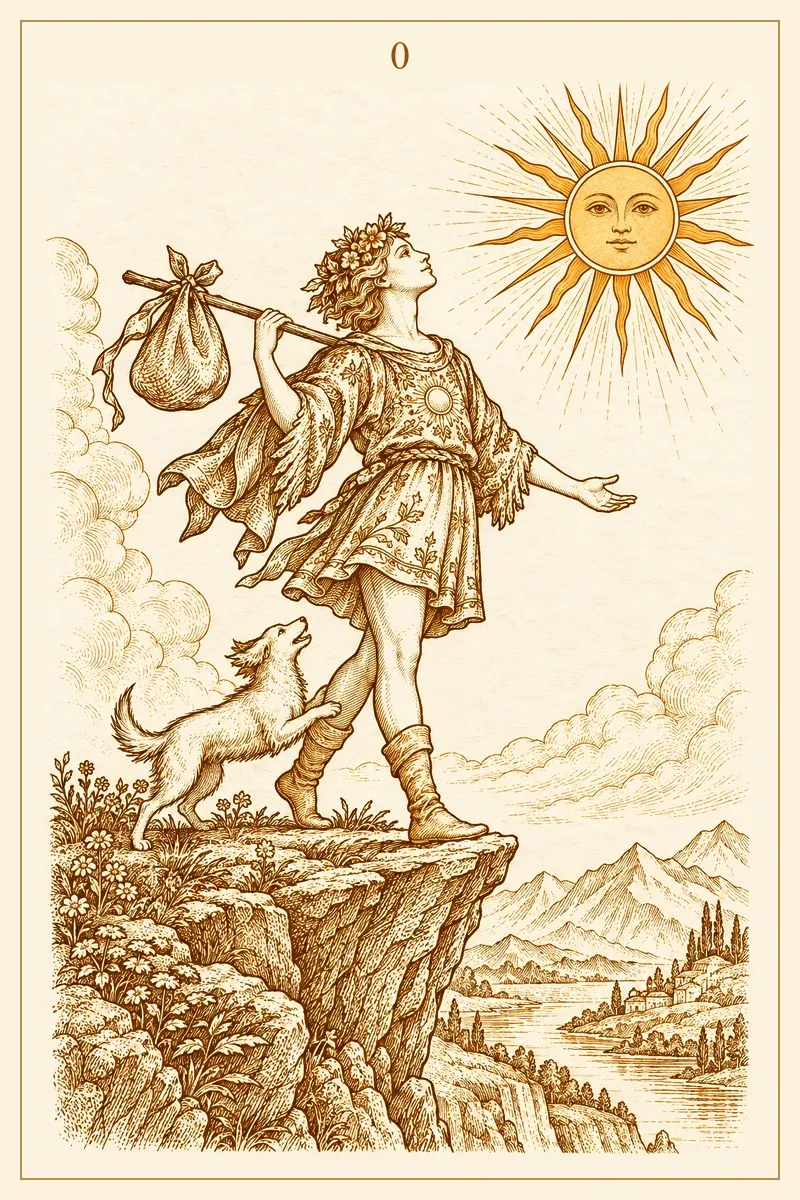
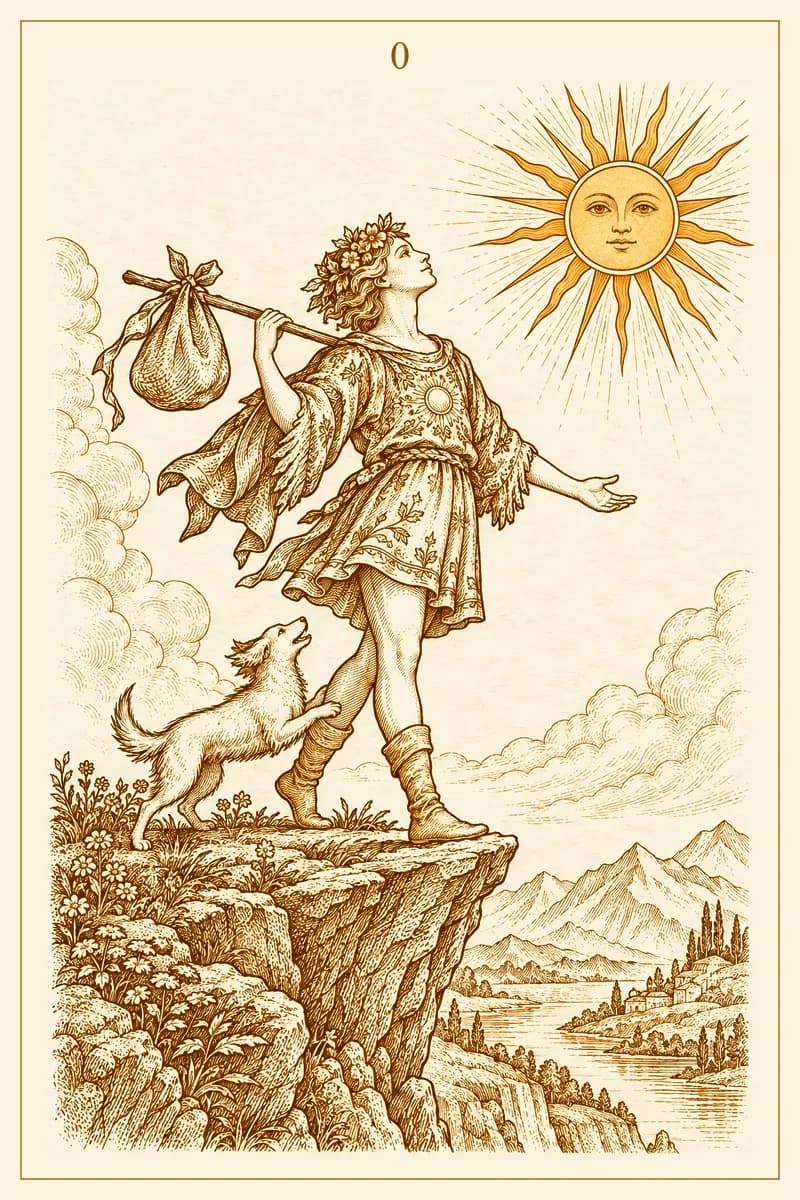
A young traveler walks toward the lip of a rocky cliff with his face tipped up to the sky. A crown of flowers sits in his curly hair, and he wears a loose tunic embroidered with leaves, a small sun-shaped disc on the chest, a rope belt and soft boots folded at the calf. One arm swings out with the palm open and empty. Nothing in that hand is gripped or guarded, which is the card's first lesson: he is receiving the day rather than bracing against it.
Over his shoulder rests a staff with a cloth bundle knotted to its end. The bundle is small. Whatever he owns fits inside it, and readers take that as a picture of what you actually need to start: a little experience, a few tools, and not much else. A beginning usually weighs less than the planning makes it look.
A dog at his leg, a sun with a face
A small pale dog leaps up behind him, front paws pressed against his leg, muzzle raised. It may be barking a warning about the drop or jumping for joy at the walk; the drawing never settles which, and that ambiguity is useful. The dog is instinct. When The Fool turns up, ask what your own gut is doing right now: tugging you back, or urging you on?
In the upper right, a sun with a calm human face spreads long rays across the sky. Clouds bank around the edges of the scene, and wildflowers grow right up to the rock where he is about to step. The mood is daylight and open air, not danger.
The village and river below
Down in the valley on the right, a river winds past a hillside village with tall cypress trees, and mountains rise behind it. That is the settled world: houses, roads, routine. The traveler has climbed above it and is now looking somewhere else entirely. The card does not say the village was wrong. It says you have outgrown the view from inside it, at least for now, and the next stretch of road is one only you can walk.
Zero, Air and Aleph: what The Fool means in the Major Arcana
Asking what the Fool arcana means is really asking why a card numbered zero leads the twenty-two trumps. The Major Arcana describe big themes and turning points, while the fifty-six Minor Arcana describe everyday situations; the difference is laid out in Major Arcana vs Minor Arcana. The Fool is the only Major with no rank at all. Some older writers slotted the unnumbered card near the end of the trumps, but most modern decks print a 0 and set it at the front, ahead of The Magician at I.
Zero works as both nothing and everything. It is the empty page before the first word, and it is also the circle that holds every number still to come. That is why many readers treat the Major Arcana as the Fool's Journey: the same traveler meets each later card as a teacher or a test, all the way to The World at XXI, and then sets out again.
- Element: Air, the element of breath, ideas and movement.
- Hebrew letter: Aleph, the first letter of the alphabet, silent on its own and often linked with breath.
- Planet: Uranus in modern astrology, the planet of surprise, independence and broken patterns.
- Older title: the Spirit of Aethyr, the name some esoteric orders gave the card.
Air explains why The Fool rarely feels heavy. It is the card of an idea arriving, a door opening in your head before your feet move. Uranus adds a sudden, slightly unconventional quality: beginnings under this card can come from a direction you were not watching.
The Fool upright: trust before the evidence arrives
Upright, The Fool marks the start of something: a job, a move, a relationship, a course of study, a creative project, a new way of living with yourself. The detail that matters is that the start comes before the proof. You will not know whether it works until you are already in it, and the card is comfortable with that.
Beginner's mind as an advantage
There is real value in not knowing yet. Someone new to a field asks the obvious questions experts stopped asking, tries the approach nobody told them was impossible, and enjoys small wins that experienced people barely notice. Upright, the card treats your inexperience as an asset as long as you stay teachable. Being new is not the same as being careless.
In practice, the upright Fool fits the moment when you have been circling an idea for a while and the readiness is finally there. The money might not be perfect and the plan might have gaps, but the curiosity is alive and the window is open. It suggests acting while that energy is fresh rather than waiting for a feeling of total certainty that may never come.
Freedom with a light bundle
Look again at the bundle. The upright Fool asks what you can leave behind: an old role, a story about who you are supposed to be, a habit of asking permission. Spontaneity here does not mean chaos. It means responding to what is in front of you instead of to a script written years ago. It also suits the moment right after a door has closed, when there is suddenly room to choose.
The Fool reversed: keywords and three ways the step goes wrong
The reversed Fool's card keywords are hesitation, fear of the unknown, recklessness, naivety, a false start and delay. They look contradictory, because some describe too little movement and some describe too much. Both come from the same place: a beginning that has lost touch with clear sight. A reversal is not a curse here. It points at the specific way your fresh start is snagging.
Frozen at the edge
The first reversed reading is the leap you keep not taking. The course is bookmarked, the application is half filled in, the conversation is rehearsed, and still nothing moves. Fear of looking foolish is often the real block, which is ironic for this card. Ask what the smallest visible step would be, and whether the risk is really as large as it feels at two in the morning.
Leaping without looking
The opposite version is the dog barking and the traveler ignoring it. Reversed, The Fool can describe a decision made to escape something rather than to reach something: quitting on a bad day, signing up for a scheme because it promised quick results, trusting someone you have only just met with something important. Innocence is lovely; naivety about obvious risk is expensive. Check the details you would rather skip.
Starting again, and again
A third reversed pattern is the restart loop. Every new project is thrilling for three weeks, then dropped once it becomes ordinary work. Each beginning feels like freedom, but taken together they keep you exactly where you were. Here the reversed card asks for one beginning carried past the dull middle, which is where most of the reward lives.
The Fool in love: the essentials
In love readings, The Fool is about openness more than outcome. It favors new attraction, playful energy and the willingness to be seen, and it is wary of anything that needs a fixed plan to feel safe. What follows is a summary; for a particular situation, a full layout such as those in Tarot Spreads for Love and Relationships gives the card more context to work with.
Upright in love
Single, the upright card points to meeting someone unexpected, perhaps outside your usual type or routine, and to enjoying the early stage without rushing to define it. In a relationship, it suggests fresh air: a trip, a new shared interest, or simply looking at your partner with the curiosity you had at the start. It is a good card for renewal and a weaker one for questions about long-term security.
Reversed in love
Reversed, watch for two opposite habits. One is fear of commitment or of being emotionally exposed, keeping things light because depth feels risky. The other is diving into something new so fast that you never check whether the other person wants the same thing. Either way, the card asks for honesty about what you are actually looking for.
The Fool as feelings
When you ask how someone feels about you and draw the upright Fool, read it as curiosity and attraction without a plan: they enjoy your company and feel free around you, but may not be thinking about what comes next. Reversed, the feelings may be interested yet hesitant, or restless and unwilling to be pinned down. Use the card to shape a direct conversation rather than to replace one.
Work, money and wellbeing with The Fool
Career
Upright, The Fool backs a new job, a career change, a first business or a return to study, especially when the move feels slightly unconventional. It favors learning on the job over waiting until you feel fully qualified. Reversed, it describes either staying in a role you have outgrown because the unknown feels worse, or hopping between opportunities before any of them can grow.
Money
With money, the upright card supports a new income stream or a fresh approach to budgeting, and asks you to keep a basic safety margin while you experiment. Reversed, it flags impulse spending and offers that sound too easy. Tarot gives no financial advice; read the card as a prompt to check the numbers yourself or with a qualified adviser.
Health and wellbeing
In wellbeing questions, the upright Fool suits starting a new routine gently, such as a walking habit, a beginner's class or a different way of resting. Reversed, it can point to ignoring a signal from your body or overdoing a new regime. Nothing here replaces care from a qualified professional; let the card help you decide what to ask them.
Is The Fool a yes or no card?
Upright and reversed answers
Upright, The Fool is a yes, the kind that comes with a grin: go, try it, find out. It is especially clear for questions about starting something. Reversed, read it as not yet rather than a firm no. Something needs preparing first, or the question itself is coming from a restless mood. For ways to phrase a question so that a single card can answer it, see How to Do a Yes or No Tarot Reading.
Timing
Where readers assign timing to The Fool, it points to soon and suddenly: once the first step is taken, things can move faster than expected, within days or weeks. Some link the card to the Aquarius season through Uranus, the sign's modern ruler, which runs roughly from late January to mid-February. Treat that as a loose association, not a calendar.
The Fool and The Magician: the idea finds its tools
What The Magician adds
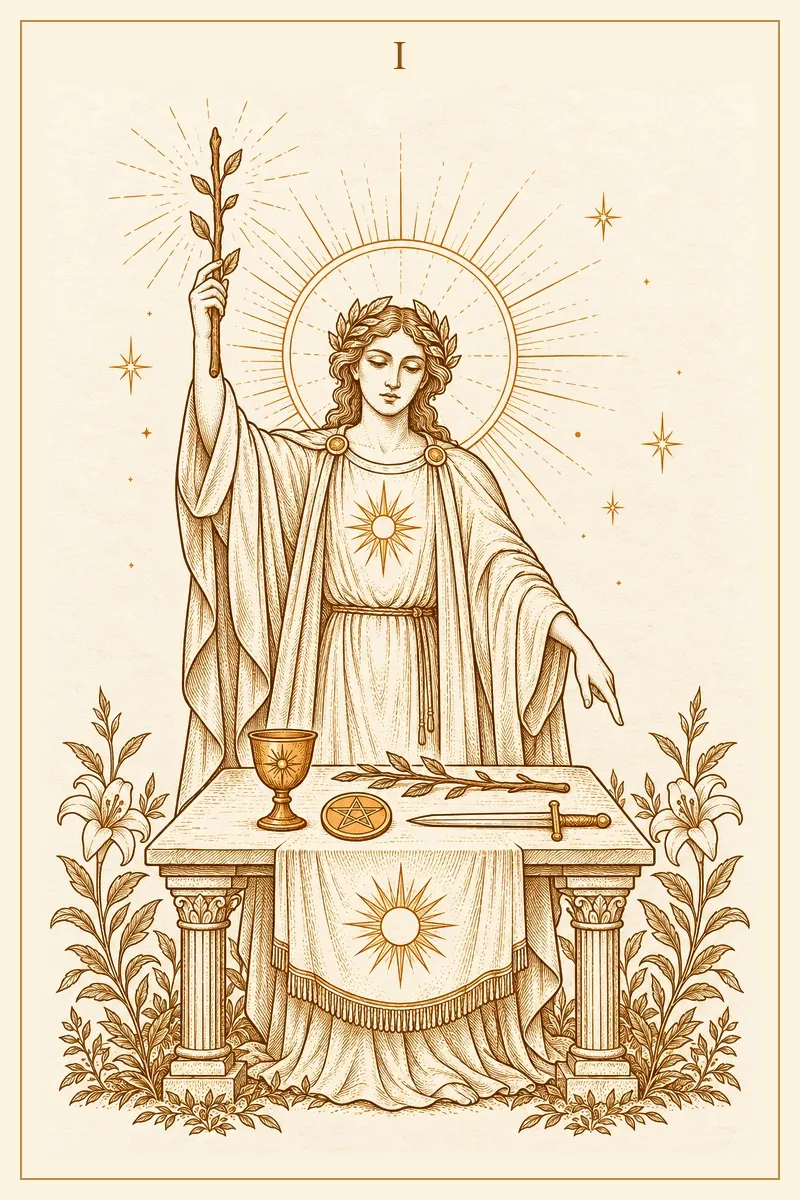
Card I shows a figure behind a table that holds a cup, a coin marked with a star, a leafy branch and a sword: one tool for each suit. One hand lifts a budding wand toward the sky and the other points down at the ground, the familiar gesture of turning an idea into something real. Where The Fool carries only a small bundle, The Magician has the whole kit laid out. The Magician tarot meaning explores that skill and focus in depth.
Reading the pair
Together, the two cards describe a beginning that is both inspired and equipped: you want to start and you already have what you need. Upright, this is one of the strongest pairings for launching something. If The Fool is reversed beside an upright Magician, the skills exist but fear is stopping you from using them. If The Magician is the reversed one, the enthusiasm is real but the method is missing, so learn the basics before you leap.
The Fool and The World: zero meets twenty-one
What The World adds
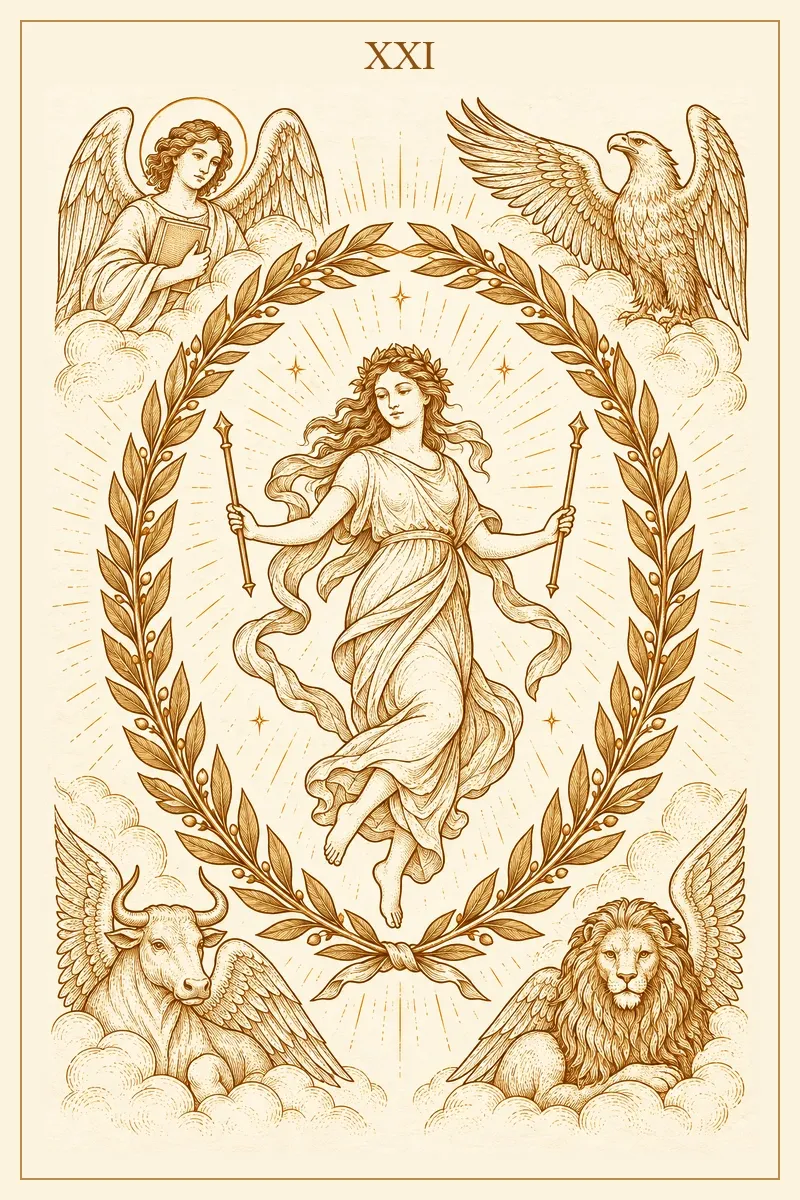
The final trump shows a dancer floating inside a laurel wreath tied with a ribbon, a slender wand in each hand, with an angel, an eagle, a bull and a lion at the four corners. It is the card of completion: a cycle finished and fully lived. The World tarot meaning covers it upright and reversed.
Reading the loop
When the first and last Majors appear together, one chapter is closing and the next is opening almost at once, such as finishing a degree and starting a job abroad, or ending a long project and immediately feeling drawn to a new one. Upright, the handover is smooth. If either card is reversed, something is unfinished: a goodbye not said, a lesson not absorbed. Tie off the loose thread before stepping onto the new road.
Other cards that change The Fool's step
Beyond those two pairings, these neighbors shift the meaning in clear ways:
- The Lovers: a new relationship or a choice of values; love asks you to be brave and honest about what you want.
- The Tower: a sudden collapse clears the ground for an unplanned beginning, and the Tower tarot meaning explains why the lightning is not the end of the story.
- Ace of Wands: a hand reaches from a cloud holding a budding branch; beside The Fool, that burst of creative energy says start the project now.
- Ten of Swords: an ending you dreaded becomes the way out, and the sun on the horizon behind the fallen figure hints at a new day.
- The Hermit: pause and prepare before you go; the leap still happens, but after reflection.
The Packed Bundle spread: four positions before you set out
This short layout borrows the card's own picture. Shuffle while thinking about the beginning you are weighing, then lay four cards in a row.
- The edge: where you stand right now, and how ready you really are.
- The bundle: what you already carry that will help, whether skills, people or lessons.
- The dog: what your instinct is saying, a warning or a push.
- The first step: the smallest action that makes the beginning real this week.
Start by pairing the edge with the dog. If the edge looks frozen and the dog looks anxious, the issue is fear; if the edge looks eager and the dog is barking, the issue is haste. Then let the bundle remind you what you can rely on, and treat the last card as an instruction small enough to carry out.
A worked example: the woodworking class she kept postponing
Here is an invented reading to show the spread in use. A woman in her thirties has talked about learning furniture making for years. Her question: what do I need to see about finally starting? She draws four cards.
The edge: The Fool reversed
The card of beginnings, upside down, in the position of where she stands. That is almost too literal: the start is right there and she is not taking it. She admits she has bought tools she has never unpacked. The reversal points at hesitation, not at a bad idea.
The bundle: Eight of Pentacles
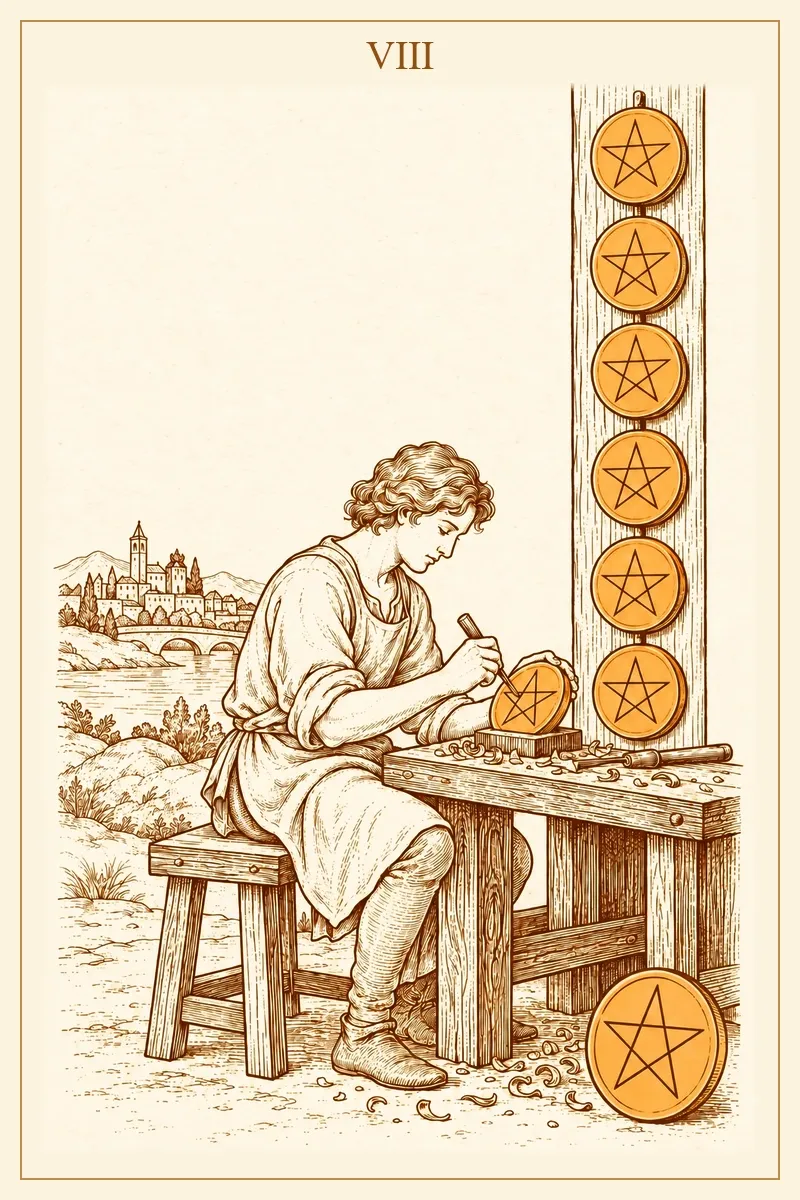
On the Eight of Pentacles, an apprentice bent over a workbench carves a coin while six finished ones hang on a post beside him and a town with a bridge sits in the distance. In the bundle position, this says she already has the most important trait for the craft: patience with repetitive, careful work. Her day job in accounts has trained exactly that.
The dog: Seven of Cups
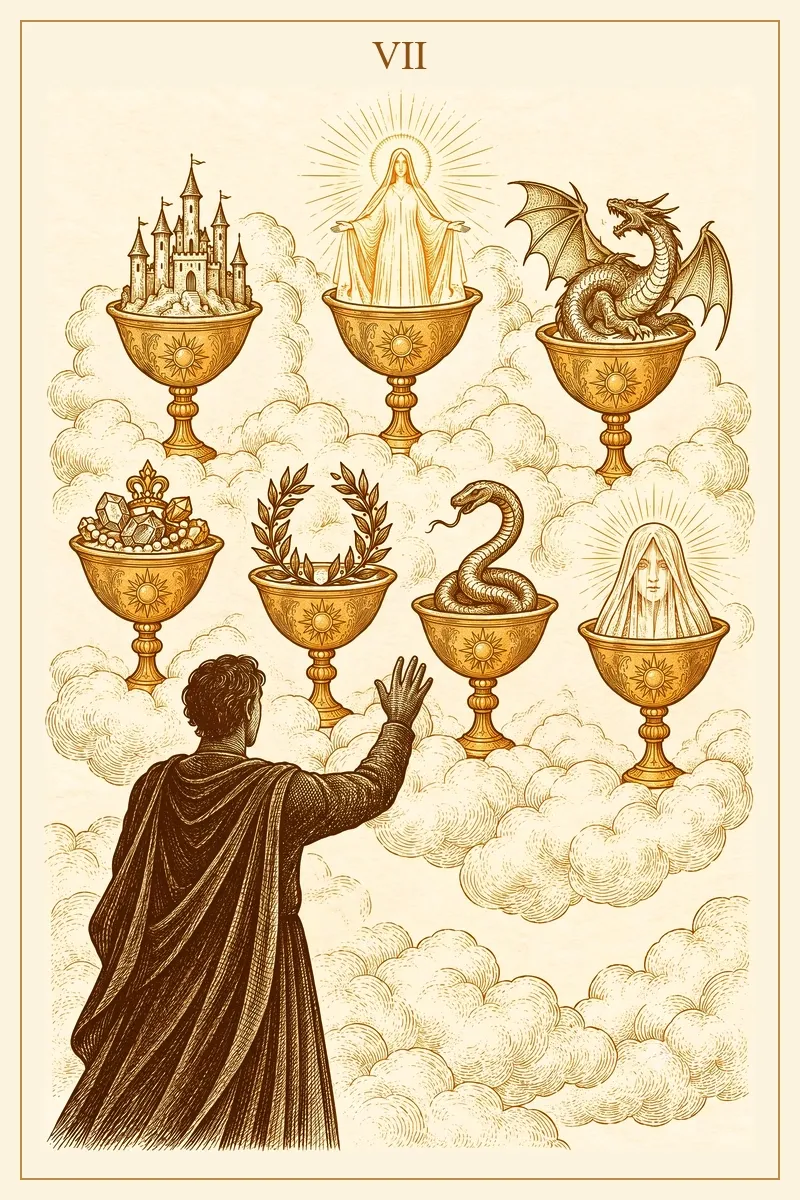
The Seven of Cups shows a figure facing seven golden cups on the clouds, each holding a different vision: a castle, a dragon, a laurel wreath, a crown with jewels, a snake, a radiant robed figure and a veiled face. Her instinct is not warning her about danger. It is warning her about daydreams. She has been picturing the workshop, the market stall and a waiting list of customers instead of the first wobbly stool.
The first step: Page of Pentacles
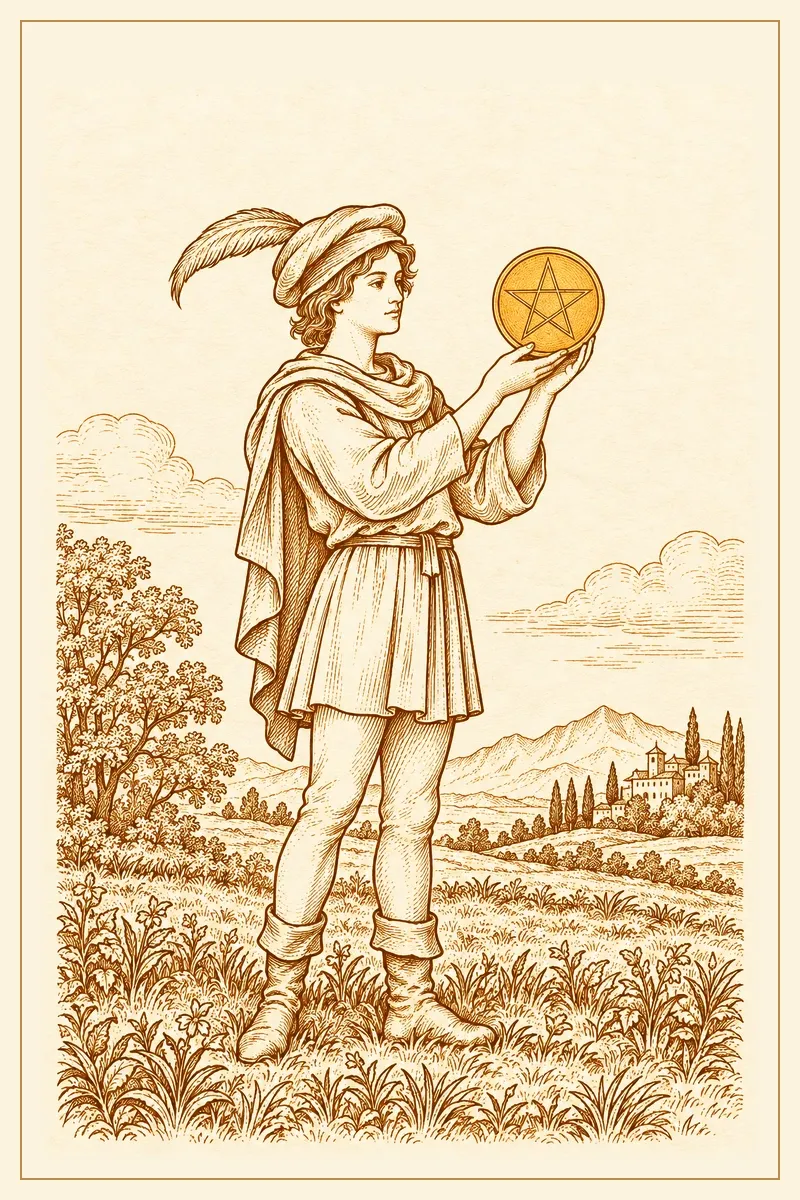
On the Page of Pentacles, a young student in a feathered cap stands in a meadow, holding a single coin up at eye level and studying it closely. One coin, one subject, one beginner's course. The card suggests booking an introductory weekend class rather than planning the whole business.
Reading the four together
Read as a sequence, the spread moves from a reversed Fool to an upright Page, two cards about being new. The story is that she does not need more confidence before she begins; she needs a smaller beginning. A six-week evening class would be a natural next move, and whether she loves it or not, the reversal at the edge has done its job by being named. The cards did not predict success. They showed her which part of the hesitation was hers to change.
Frequently asked questions
What does The Fool mean in one sentence?
Upright, it means a fresh start taken on trust and curiosity; reversed, it means a beginning blocked by fear or spoiled by carelessness.
What are the reversed Fool's keywords?
Hesitation, fear of the unknown, recklessness, naivety, a false start, delay and escapism. Which ones apply depends on whether your situation shows too little movement or too much.
Is The Fool a good card to draw?
Mostly, yes. It is one of the more hopeful Majors because it opens possibilities. Its warning is a gentle one: keep your eyes open while you step.
Does The Fool represent a person?
Sometimes. It can describe someone young at heart, new to a situation, adventurous or a little unreliable. It can also describe the energy of the moment, including your own.
Why is The Fool numbered zero?
Zero sits outside the sequence, so the Fool can be read as the traveler who passes through every other Major card. To see how the twenty-two trumps fit among all seventy-eight cards, Understanding the Structure of a Tarot Deck maps the whole deck.
Can The Fool tell me if my new start will succeed?
No card can promise a result, read someone else's thoughts or fix a date. The Fool shows the attitude you bring to a beginning, and that attitude is something you can change.
Before you step off the edge
When The Fool appears, three questions deserve a few minutes with a notebook. What beginning keeps returning to my mind? What could I leave out of the bundle? What is the smallest step I could take before the week ends? If you are new to reading the cards yourself, What is Tarot? is a gentle place to start.
Whenever you want to ask about your own threshold, you can draw a reading with Veil Soul and see which card meets you at the edge.