Twenty-two cards in a 78-card tarot deck form the Major Arcana: named, numbered archetypes running from The Fool (0) to The World (21), and they speak to the larger chapters of a life, such as a beginning, a reckoning, a loss, or a homecoming. The other 56 cards are the Minor Arcana, four suits of Wands, Cups, Swords, and Pentacles, and they describe the events, moods, conversations, and choices that fill those chapters day by day. Put simply, a Major card tells you what a situation is about underneath; a Minor card shows how it is unfolding and where you can act.
That distinction is a reading aid, not a ranking. Neither group can confirm what another person thinks, fix a date, or promise an outcome. What both can do is give you a clearer frame for looking at your own situation and deciding what to do next.
At a glance, here is how the two groups compare:
- Number of cards: 22 Major Arcana; 56 Minor Arcana.
- How they are organized: the Majors form one numbered sequence; the Minors fall into four suits of fourteen cards each.
- What they describe: Majors name a life theme or turning point; Minors name a specific event, feeling, or task.
- Time scale: Majors point to a season of life or longer; Minors to days, weeks, or a single situation.
- Room to act: Majors describe what you are meeting; Minors describe what you can do about it.
- People: the sixteen court cards, which belong to the Minor Arcana, are the cards traditionally read as people or roles.
- Reading order: notice the Majors first for the theme, then let the Minors fill in the detail.
Inside the Major Arcana: twenty-two chapters
The word arcana is Latin for secrets. The Major Arcana were once called trumps, the cards that outranked the suits in the card games tarot was first made for in Renaissance Italy. In reading, they hold the big archetypes: a mother, a ruler, a teacher, a hermit, a choice between lovers, a wheel that turns, a sudden fall, a quiet star after the storm. Each has a name as well as a number, and that name tells you its scale. A card called Justice or Death is not about a single afternoon.
Read in order, the sequence is taught as a journey, sometimes called the Fool's Journey: the traveler at card 0 meets each figure in turn, gains skill and self-knowledge, faces loss and illusion, and arrives at completion in card 21. One teaching frame splits cards 1 to 21 into three rows of seven. Cards 1 to 7 deal with the outer world of will, learning, and relationships; 8 to 14 turn inward toward patience, solitude, and acceptance; 15 to 21 move through shadow, upheaval, and renewal toward wholeness. Not every reader uses that frame, but it shows why The Magician and The Moon feel so different.
Two numbering notes help beginners. Some decks put Strength at 8 and Justice at 11, older ones reverse them, and the meanings stay the same either way. The Fool's zero, meanwhile, places it outside the count, so it can be read as the start of the journey or as a free spirit wandering through all of it.
The Fool: the zero before the journey
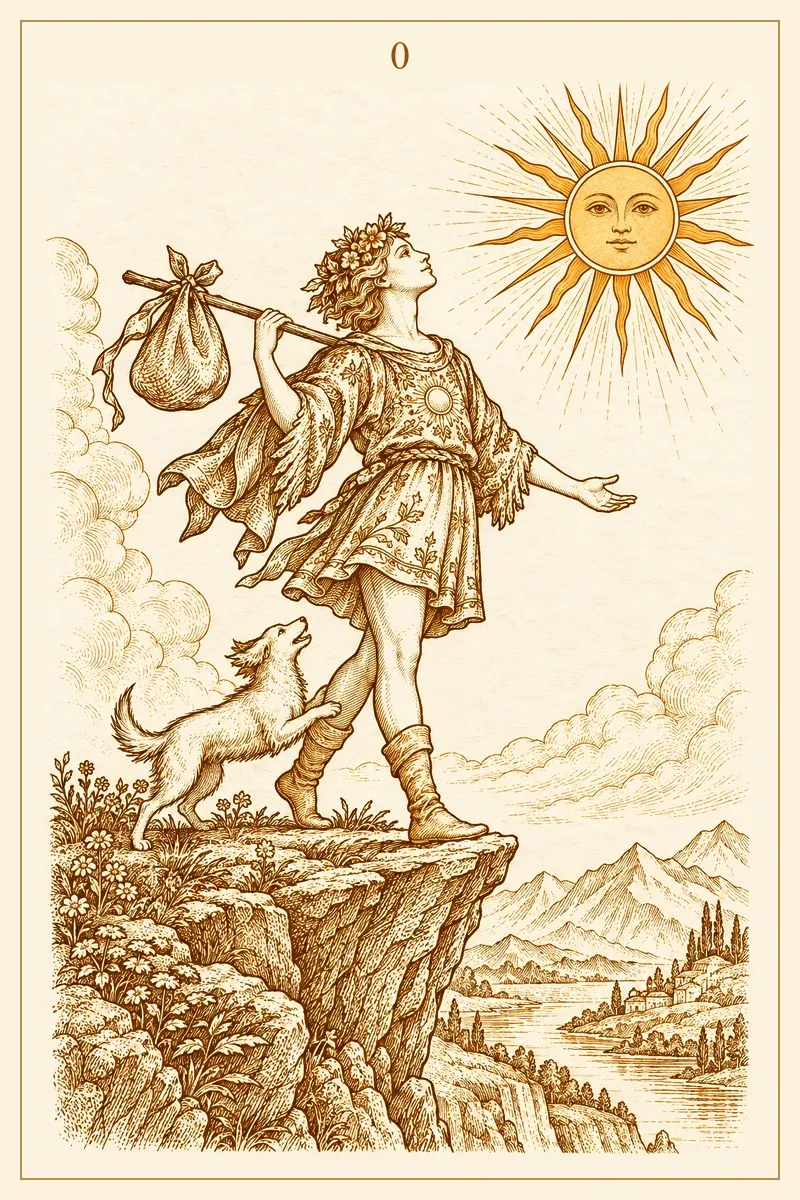
On this card, The Fool is a young traveler with a wreath of flowers in his hair and a bundle tied to a stick over one shoulder. He looks up at a bright sun with a calm human face while a small dog leaps at his leg, and he stands one step from the edge of a cliff, with mountains and a river valley far below. Upright, he stands for a fresh start taken on trust: curiosity, a leap before every detail is known, the beginner's mind. Reversed, the same openness can tip into carelessness, or into a hesitation that never leaves the cliff top. The full Fool tarot meaning covers love and career angles in more depth.
A Minor card such as the Ace of Wands can also announce a beginning, but it points to a single project or spark. When The Fool appears, the beginning is a whole new chapter: a move, a change of path, a version of yourself you have not tried yet.
The World: the circle that closes it
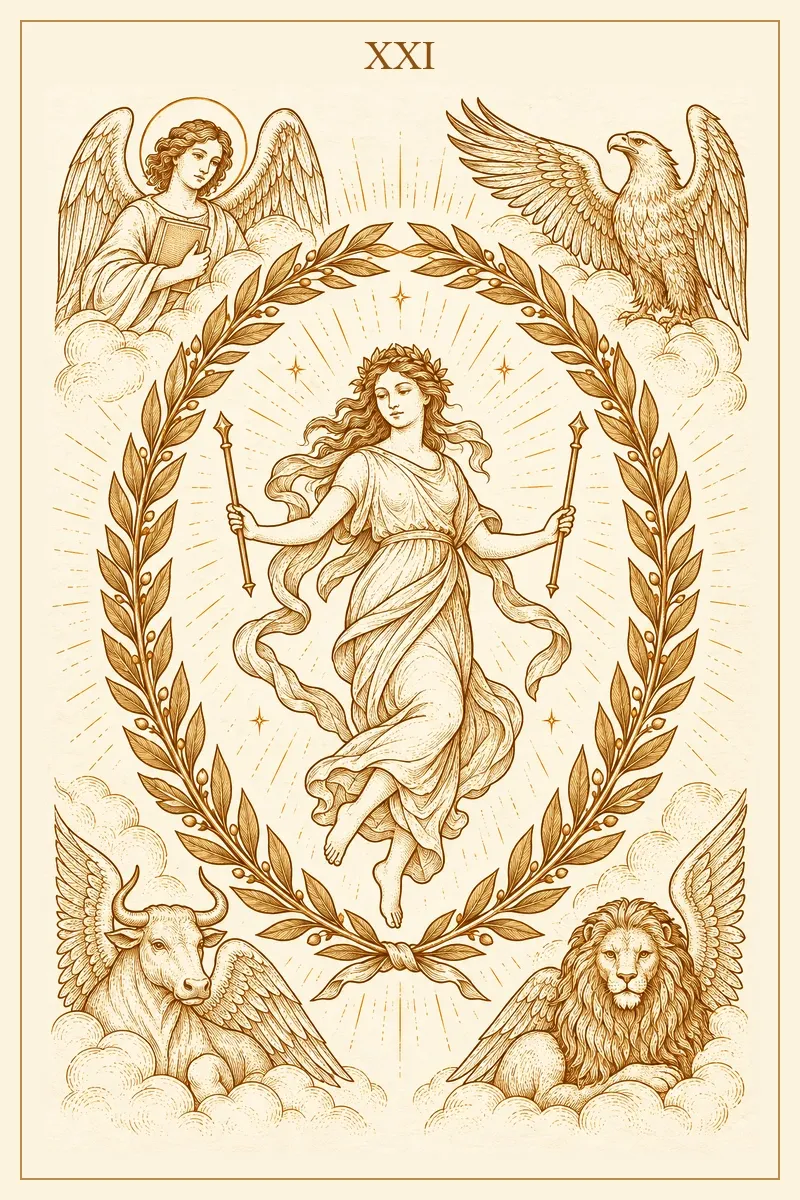
The World ends the sequence at 21. A dancer floats inside an oval laurel wreath tied with a ribbon at its base, holding a slim wand in each hand, while four winged figures watch from the corners: an angel holding a book, an eagle, a bull, and a lion. Upright, the card speaks of completion and integration, a cycle that has done its work, and a sense of belonging in your own life. Reversed, it can describe an ending you keep postponing, a loose thread that stops you from closing the chapter, or success that feels strangely flat. You can read more in the World tarot meaning.
Each suit's Ten also marks a finish line, but with a smaller scope. The Ten of Cups completes an emotional story within a family or relationship; The World completes a stage of who you are.
Inside the Minor Arcana: four suits for ordinary days
The Minor Arcana descend from the four-suited playing cards of late medieval Europe, and they still resemble a card deck: each suit runs from Ace to Ten and then adds four court cards, and in illustrated decks each of them carries its own scene. The Minors are where the texture of a reading lives: the argument on Tuesday, the offer in your inbox, the night you could not sleep.
Each suit is tied to an element and an area of life:
- Wands (fire): drive, ambition, creative work, the energy to start something.
- Cups (water): feelings, love, friendship, intuition, what the heart wants.
- Swords (air): thought, speech, conflict, decisions, the truth you are wrestling with.
- Pentacles (earth): money, work, the body, home, the slow building of something real.
A few traditions swap the elements of Wands and Swords. Pick one system and stay with it; consistency matters more than the pairing.
Number cards: Ace to Ten as a short story
Within each suit, the numbers trace an arc. The Ace is the seed of the suit's energy, the Twos and Threes bring choice and early growth, the Fours pause to steady things, the Fives bring friction, the Sixes restore some balance, the Sevens test you, the Eights bring movement or focused effort, the Nines carry the suit almost to its peak, and the Tens show the full result, for better or for worse. Once you know this rhythm, an unfamiliar card is less of a mystery: a Five of any suit is likely to involve some kind of strain, and a Ten describes a story that has reached its end. The guide to number symbolism in the Minor Arcana walks through each number across all four suits.
Court cards: sixteen people and roles
Each suit has a Page, a Knight, a Queen, and a King. They can describe people in your life, sides of your own personality, or an approach a situation asks of you. A simple way in is to treat the ranks as stages of maturity. The Page is the curious student, new to the suit; the Knight is the one in motion who sometimes overdoes it; the Queen holds the suit's energy from the inside; and the King directs it outward with responsibility. The Queen of Cups, for example, can be a caring friend who listens well, or a reminder to treat your own feelings with the same care. If the court cards feel slippery, the overview of the court cards goes through each rank and suit with examples.
Weight versus detail: how each group behaves in a spread
The group a card belongs to gives you a first read of a spread before you recall a single meaning. A Major lifts the matter onto a larger stage; a Minor keeps it close to the ground, where things can change within a week.
When Majors fill the spread
A spread crowded with Majors suggests that the question touches something larger than the situation you named. A question about a single job interview that draws Judgement, The Hermit, and The Star may really be asking about calling, solitude, and hope. That does not mean events are out of your hands. It means the stakes are personal and the change may take longer than one decision. Slow down, read the Majors as a sequence, and ask what chapter they describe. The guide to a reading made entirely of Major Arcana looks at that case closely.
When Minors fill the spread
A spread of suit cards alone points to the practical layer: what is happening, how you feel about it, and what you could do this week. That is not a lesser reading. Minor situations respond to action, so the spread doubles as a to-do list. Look at which suit dominates. Several Swords suggest the problem lives in thought and conversation; several Pentacles put it in money, health routines, or work; a run of Cups puts it in the heart; and Wands point to motivation and momentum.
When one Major sits among Minors
A single Major in a spread of Minors works like a headline. Read it first, because it names the theme the other cards are serving. If Temperance appears in the middle of three busy Wands cards, the reading may be saying that the pace itself is the issue, and that the lesson underneath the workload is balance rather than more effort.
The same split in love, work, and money questions
Love. The Lovers is a Major card about choice and alignment: who you are when you commit, and whether a relationship fits your values. The Two of Cups describes one specific connection, such as mutual attraction or a conversation that brings two people closer. Ask about a new partner and draw The Lovers, and the reading may be less about this person than about what you are choosing in love.
Work. The Chariot speaks of willpower steering a whole phase of your career. The Eight of Pentacles describes the steady practice of a craft: the training course, the hours spent getting better. One names the drive behind a career stage; the other names the work on your desk.
Money. The Wheel of Fortune points to a turn in circumstances you did not fully choose, and asks you to adapt. The Six of Pentacles stays practical: giving and receiving, a fair share, help asked for and offered. Neither card is a financial forecast; together they separate the tide from the decisions you make in it.
In each pair, the Major asks what this means for your life, and the Minor asks what you will do on Monday.
When a suit card lands like a Major
Some suit cards hit with real force. Knowing how their weight differs from a Major's keeps a heavy card from frightening you more than it should.
Ten of Swords: a hard ending at human scale
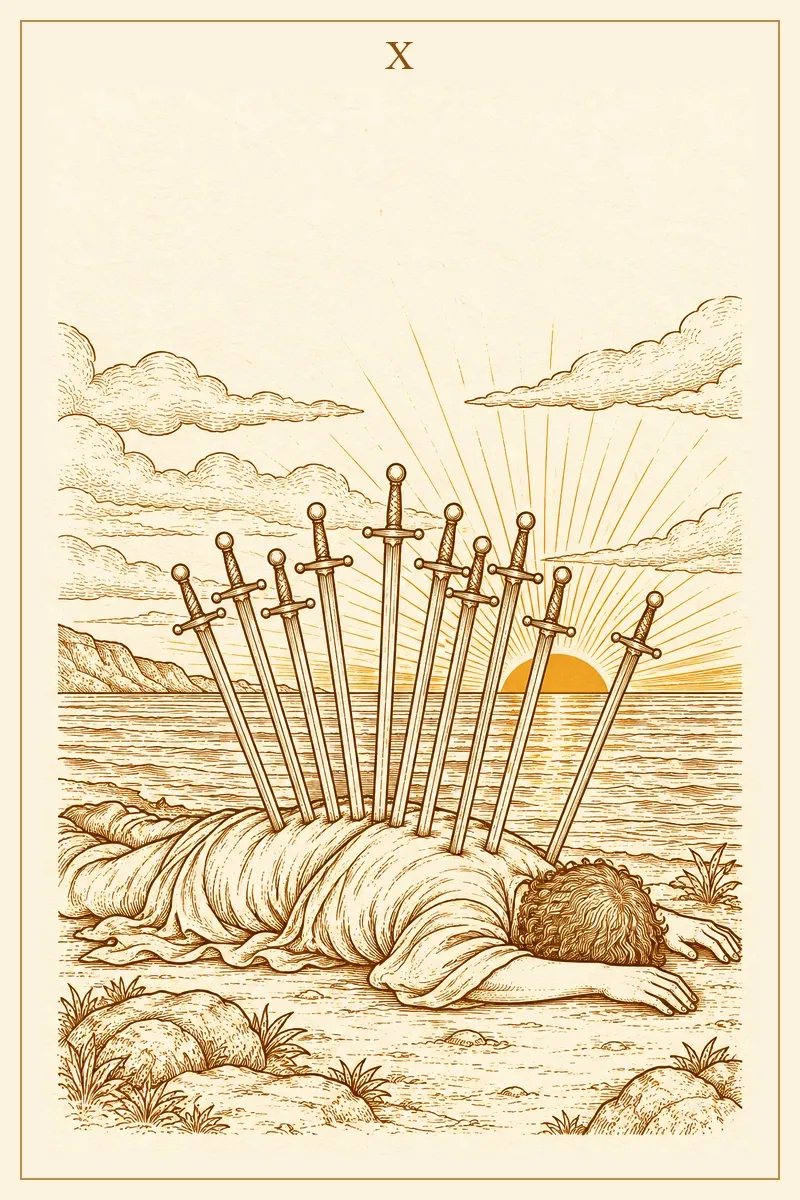
On the Ten of Swords, a figure lies face down on a shore with ten swords standing in their back, while the sun sits low over a calm sea. Upright, it marks a painful ending: a betrayal, a defeat, or exhaustion so complete that there is nowhere further down to go. That last point is also its comfort, since the low sun and the still water hint that the worst is over. Reversed, it can describe slowly getting back up, or refusing to let something already finished be finished. The Ten of Swords tarot meaning looks at both sides.
Set it beside The Tower and the difference becomes clear. The Tower shakes the foundations of a whole chapter: a belief, a plan, a structure you built your life around. The Ten of Swords belongs to the suit of thought, so the ending it shows is a mental one, the story you keep telling yourself about one particular loss. Both hurt. The Tower asks you to rebuild on new ground; the Ten of Swords asks you to stop replaying the moment and stand up. The Three of Swords, with its heartache, can feel as heavy as any Major for the same reason: the pain is real, and it belongs to one wound rather than to a whole era.
One question, three cards: a worked reading
To see the two groups share the work, imagine someone asks: "My role disappeared in a restructuring last month. What do I need to understand, and where do I go from here?" They draw three cards into three named positions: what happened, where I stand now, and what I can begin.
The Tower in "what happened"
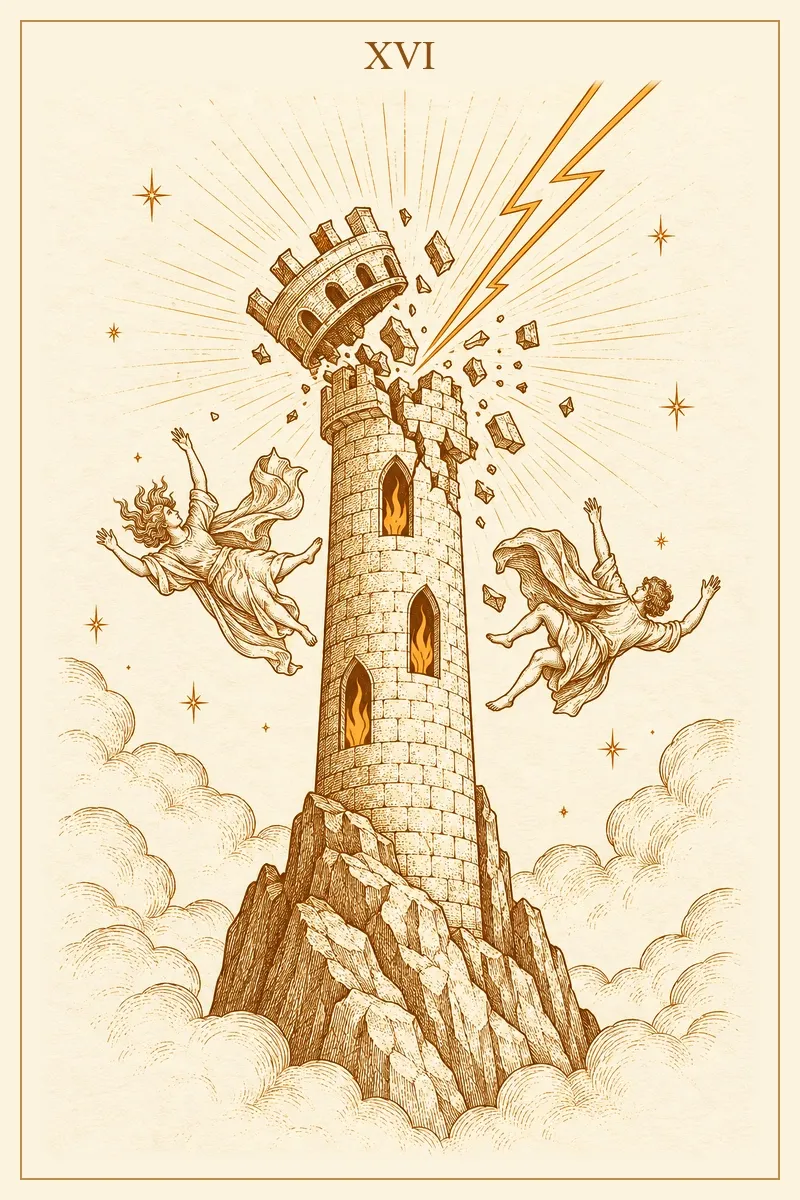
The Tower shows a stone tower on a rocky peak above the clouds. Lightning knocks the crown from its top, flames show in the windows, and two figures fall through the air. Upright, it marks the sudden collapse of something that looked solid, followed by a clearer view of what was never stable. In this position it says the restructuring was not a small setback but a change of foundations: the plan this person had built their working life around is gone. Reversed, it can describe a collapse resisted or delayed, or an upheaval that is happening inside rather than outside. The Tower tarot meaning explores those angles. As a Major, The Tower here asks what the person believed about security, and what they want to believe now.
Five of Cups in "where I stand now"
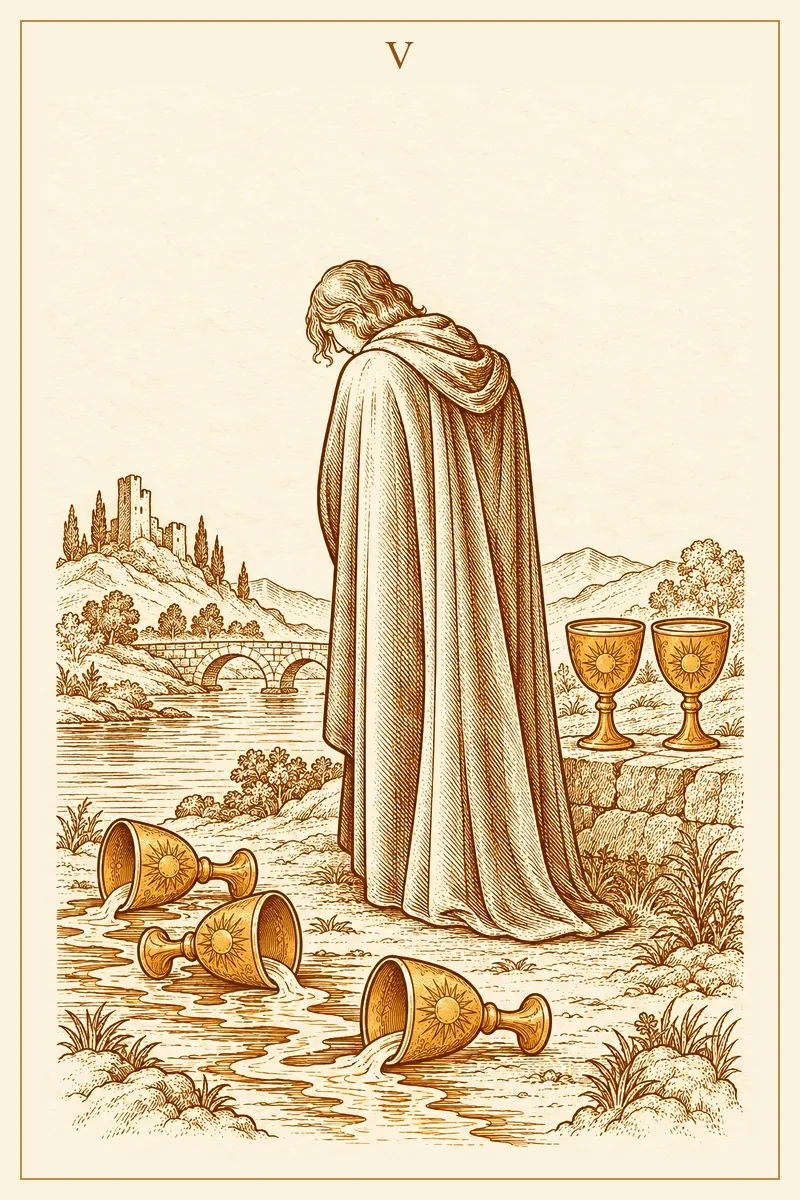
On the Five of Cups, a figure in a long cloak stands with head bowed over three overturned cups spilling into the ground, while two cups stand upright on a stone ledge behind them; across the river, a bridge leads toward a castle on the hill. Upright, the card is grief and regret, attention fixed on what spilled. Reversed, it marks the moment you begin to turn around and notice what remains. In this spread it describes the present state: mourning the job, the team, maybe a piece of identity. As a Minor card, it says the grief is real and specific, and that it is a stage rather than a permanent condition. The two standing cups are worth naming aloud: savings, skills, a few colleagues who still call. The Five of Cups tarot meaning has more on working through it.
Ace of Wands in "what I can begin"
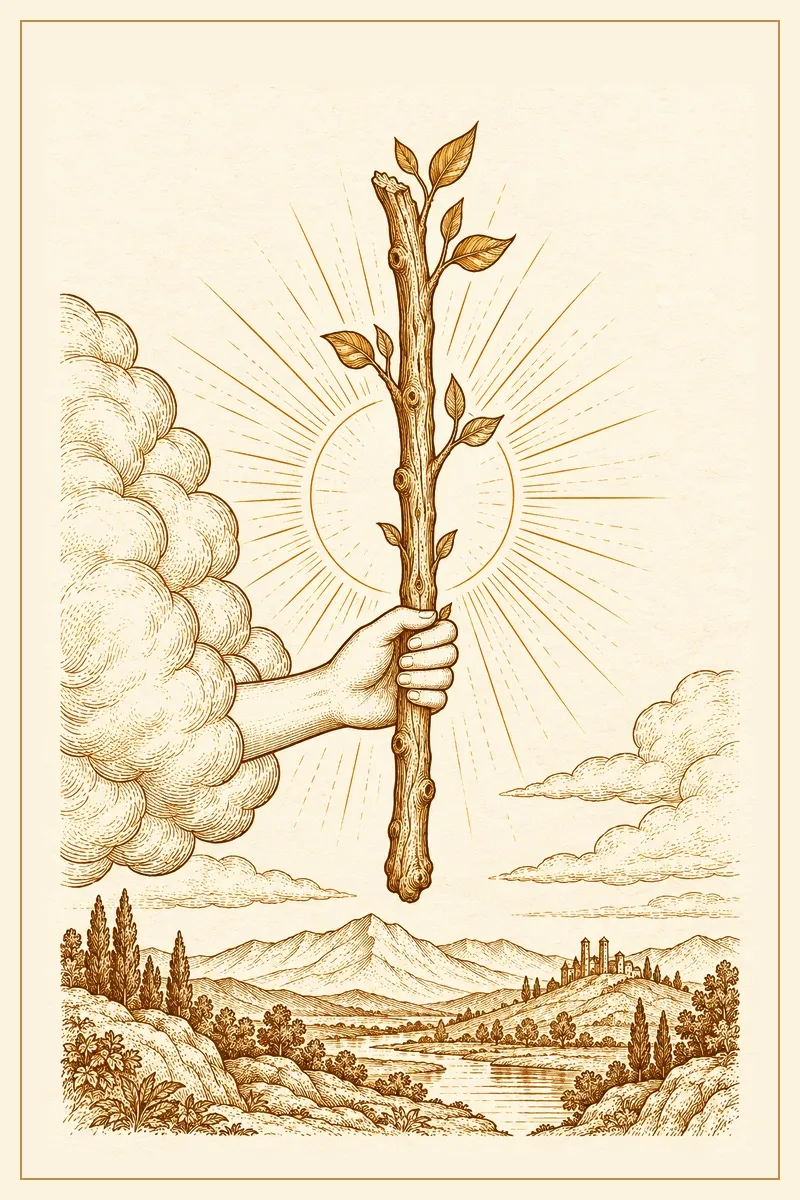
The Ace of Wands shows a hand reaching out of a cloud and holding a rough staff that is sprouting fresh leaves, framed by a ring of light above a valley with mountains, a river, and a distant castle. Upright, it is a spark: an idea, an urge to make something, the first burst of energy for a new direction. Reversed, the spark is there but delayed, scattered, or waiting for a permission you have not given yourself. In the third position it suggests that the next step is this person's to take, whether a project, a pitch, a course, or a conversation that starts something. Because it is a Minor card, it points to an action that can be taken this month, not a destiny that arrives on its own. The Ace of Wands tarot meaning covers it in love and career too.
Read together, the cards divide the work cleanly. The Major names the scale of what happened. The two Minors show where the person is and what is within reach. With The Tower in the last place instead, the same cards would advise building on firm ground before acting.
The two-pile spread: separate the layers on purpose
Once you can tell the groups apart, you can use the split as a tool. Before shuffling, sort your deck into two piles, the 22 Majors and the 56 Minors. Shuffle each pile separately, then draw one card from the Major pile and three from the Minor pile into these positions:
- The chapter (Major pile): the larger theme this question belongs to.
- The ground (Minor pile): what is actually happening right now.
- The inner weather (Minor pile): how you feel and think about it.
- The step (Minor pile): one action within your reach.
The layout guarantees exactly one Major, so the reading always has a headline with three practical lines beneath it. Read the chapter card first and write it down in one sentence. Then read the ground and the inner weather together. If they disagree, for example a calm Pentacles card on the ground and an anxious Swords card in the inner weather, the gap between the situation and your reaction is worth noticing. Finish with the step, and make it small enough to do within a week.
Which group to learn first
There is no rule, but one well-worn path starts with the 22 Majors: they are fewer, each has a strong story, and learning them in order gives you the Fool's Journey as a memory aid. Then learn the Minors suit by suit, using the number pattern and the court ranks as shortcuts instead of memorizing 56 separate meanings. Starting with the one suit closest to your questions, such as Cups for relationships, works just as well.
A quick exercise ties the two groups together. Shuffle the full deck and draw five cards face down while holding a question in mind. Turn them up and sort them, Majors to the left and Minors to the right. Before reading any single meaning, say what the ratio suggests: a big chapter, a practical week, or a headline with details. Then read the cards and see whether that first impression held. If you have never laid out a spread before, start with your first tarot reading and come back to this exercise afterward.
Frequently asked questions
Are Major Arcana cards more important than Minor Arcana cards?
They carry more weight in the sense of scale, not in the sense of value. A Major says the theme reaches into a bigger part of your life; a Minor says something specific is happening that you can respond to. A reading without a single Major can be one of the most useful you do, because it hands you clear practical steps.
What does it mean if I draw only Minor Arcana cards?
It points to a situation grounded in everyday events, decisions, and feelings. That is not a lighter reading. It is a hint that your choices are the main lever, and that the picture can change as you act.
Can a Minor card be as intense as a Major?
Yes. The Ten of Swords or the Three of Swords can feel as heavy as The Tower. The difference lies in reach: a Minor card's intensity belongs to one situation, while a Major colors a longer stretch of your life.
Are court cards part of the Major Arcana?
No. The Pages, Knights, Queens, and Kings belong to the Minor Arcana, one set of four in each suit. Majors with human figures, such as The Empress or The Emperor, describe archetypes, though in context they can point to someone who plays that role in your life.
Do reversed cards work the same way in both groups?
The logic is the same: a reversal can show a theme that is blocked, delayed, turned inward, or overdone. A reversed Major suggests a large lesson you are resisting or meeting privately; a reversed Minor describes a specific situation that is stuck or easing.
Can a Major card tell me when a big change will happen?
No card can fix a date or guarantee an event. Tarot works best as a mirror for how you see a situation and what you might do next. A Major card can tell you that a theme is large and worth your attention; the timing and the outcome still depend on circumstances and on choices, yours and other people's.
Reading the headline and the details together
The difference between the Major and Minor Arcana comes down to scale. The 22 Majors name the chapters, the 56 Minors write the pages, and a good reading lets each do its own job. Next time you lay out cards, notice which group shows up before you reach for a meaning. When you want to try it with a question of your own, draw a reading with Veil Soul and start with the headline card.