Number symbolism in the Minor Arcana gives each number from Ace to Ten one stage of a story, and every suit tells that story in its own area of life. Aces open a cycle, Fives shake it and Tens close it, while the suit shows whether the cycle concerns drive (Wands), feeling (Cups), thought (Swords) or work, money and the body (Pentacles). An Ace in any suit is a beginning that is offered rather than earned, and several Aces in one spread point to more than one opening at once, which turns the reading into a question of where your energy goes first.
Knowing the numbers means a card you have never studied is never blank. The Seven of Pentacles, read as "Seven" plus "Pentacles," becomes a pause to check whether slow, practical work is paying off, which sits close to its traditional meaning. The shortcut has limits, and so does tarot: a card can help you see a situation more clearly, but it cannot confirm what another person intends, give you a date, or decide an outcome on your behalf.
The ten numbers at a glance:
- Ace (1): a seed, an opening, raw potential handed to you.
- Two: a pair, a choice, balance between two pulls.
- Three: first growth, shared effort, something others can see.
- Four: structure, rest, security that can harden.
- Five: friction, loss, the shake-up that forces change.
- Six: repair, generosity, calmer ground after the storm.
- Seven: assessment, strategy, testing what is real.
- Eight: movement, effort, momentum or a felt trap.
- Nine: intensity near the end, the last stretch.
- Ten: a cycle at full size, ready to close and restart.
How a number and a suit build one card
Every numbered card answers two questions at once. The number says where a situation stands in its cycle; the suit says which part of life that cycle is happening in.
- Wands (fire): drive, creative projects, ambition, the urge to act.
- Cups (water): emotions, relationships, intuition.
- Swords (air): thoughts, words, decisions, conflict and clarity.
- Pentacles (earth): money, work, health, home and slow practical results.
Name the stage, name the area, then join them into one sentence. The Five of Pentacles becomes "disruption in the material world": a lean month, a job worry, a feeling of being shut out of comfort. The Three of Cups becomes "first growth in feeling," which is friendship and celebration. The image, the position and your question then refine that sentence. This stage-by-stage logic is also what separates the forty numbered cards from the twenty-two trumps, as the difference between the Major and Minor Arcana explains.
Ace through Ten, stage by stage
Each number below has a theme, its four suit versions and a note on its reversed tone. A reversal here means the number's energy is blocked, delayed, turned inward or easing; it does not flip a card into its opposite.
Ace (1): the seed
One is unity and initiation. An Ace is the purest form of its suit: not yet a result, only an opening. The four Aces have their own section after this one.
Two: the choice
Two brings in a second element, and with it cooperation or tension. Where One says "I," Two says "I and you," or "this or that."
- Wands: planning, weighing a wider horizon against home ground.
- Cups: mutual attraction, a partnership of equals.
- Swords: stalemate, a decision avoided by closing your eyes to it.
- Pentacles: juggling two demands as they shift.
Reversed, a Two tilts: one partner carries more, a plan stays on paper, or a postponed choice starts making itself.
Three: the first result
Three is synthesis, the first point where effort shows up in the world and other people can see it.
- Wands: expansion, looking ahead as early plans start to travel.
- Cups: celebration, friendship, joy shared in a group.
- Swords: heartbreak, a painful truth entering the picture.
- Pentacles: teamwork, skill improved by other people's input.
Reversed, a Three points to growth that stalls or a group that loses its rhythm.
Four: the foundation
Four is the square: four walls and a floor you can stand on. It consolidates what Three produced, giving rest at its best and clinging at its worst.
- Wands: a milestone celebrated, a homecoming.
- Cups: withdrawal, boredom, missing what is being offered.
- Swords: rest and recovery, a deliberate pause for the mind.
- Pentacles: saving, guarding, holding resources tightly.
Reversed, a Four loosens its walls, which can feel like relief from rigidity or like a routine shifting beneath you.
Five: the disruption
Five sits mid-sequence and breaks the stability Four built. It is the hardest stage in each suit and the one that forces the most learning, because nobody rethinks a routine that still works.
- Wands: competition, clashing egos, energetic friction.
- Cups: grief, attention fixed on what spilled rather than what remains.
- Swords: a fight won at too high a price.
- Pentacles: hardship, worry about money or health, feeling left out in the cold.
Reversed, a Five can mark the worst passing: the argument cools, grief softens, help becomes easier to accept.
Six: the repair
Six restores balance after the upheaval, a calm reached by working through the lesson rather than avoiding it.
- Wands: victory and public recognition.
- Cups: nostalgia, childhood memories, simple kindness.
- Swords: transition toward calmer water.
- Pentacles: giving and receiving, support that flows both ways.
Reversed, a Six shows a repair still unfinished: help with strings attached, a planned move not yet made, or the past pulling you from the present.
Seven: the test
Seven turns inward and asks whether the gain was real and whether this path is still yours. Sevens are strategic, sometimes slippery, and seldom simple.
- Wands: holding your ground under pressure.
- Cups: too many options, fantasy, wishful thinking.
- Swords: strategy, evasion, someone taking a shortcut.
- Pentacles: patience with slow growth, checking whether effort pays off.
Reversed, a Seven may show the strategy giving way: confidence slipping, a secret coming out, or an honest decision to stop investing in what will not grow.
Eight: the momentum
Eight turns reflection into action, sometimes fast, sometimes repeated until it becomes skill. Some numerological systems also read it as power and cause and effect.
- Wands: speed, news, events moving faster than expected.
- Cups: walking away from what no longer feeds you.
- Swords: feeling trapped by your own thoughts, a cage with an open side.
- Pentacles: diligent practice, mastery by repetition.
Reversed, an Eight brakes: plans stall or practice turns into busywork, though a mental trap may also loosen.
Nine: the last stretch
Nine is the last single digit and carries the weight of everything before it, showing a suit at its most intense and private.
- Wands: resilience, guarding what you built while tired.
- Cups: a wish fulfilled, contentment.
- Swords: anxiety, sleepless worry, fear at its loudest.
- Pentacles: self-sufficiency, comfort earned by long work.
Reversed, a Nine turns that intensity inward: doubting a success, running out of reserves, or finally sharing a worry kept private.
Ten: the full cycle
Ten is a suit at full size. Reduced (1 + 0), it returns to One, so every Ten also points toward the next Ace; how differently each suit closes is the subject of the four Tens read card by card.
- Wands: burden, carrying more than one person can.
- Cups: emotional fulfillment, family and belonging.
- Swords: a painful ending that has already landed.
- Pentacles: legacy, family wealth, security that lasts.
Reversed, a Ten suggests a cycle that will not close cleanly: a load you could put down, or an ending still being replayed.
What the Aces mean in tarot
An Ace is the number one of its suit: the whole element in its rawest form. In the traditional imagery a hand reaches out of a cloud holding a wand, a cup, a sword or a coin, and that gesture is the key. An Ace is offered, not earned; the door opens, and walking through is up to you. Upright, it is a fresh start in its suit's area of life. Reversed, the start is delayed, blocked or turned inward. For their imagery and place in the deck, see the overview of Aces in tarot.
Ace of Wands: a spark asking for a first move
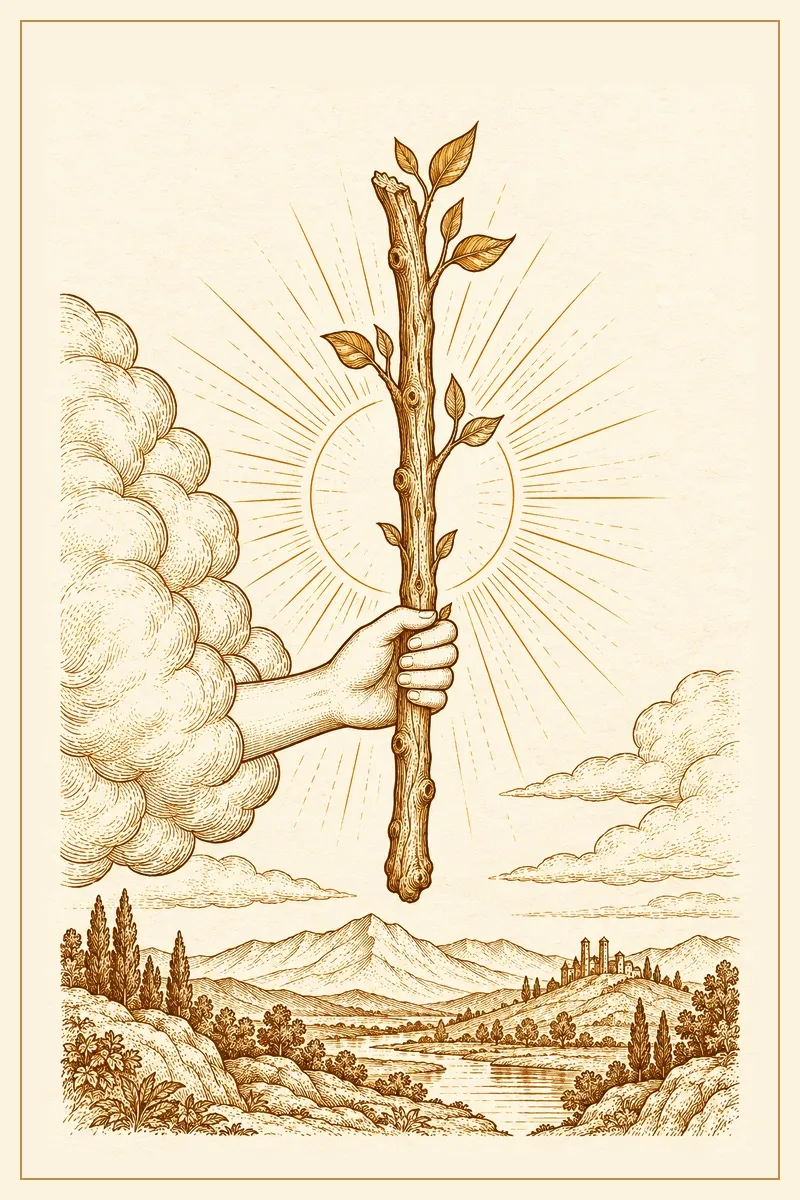
Upright, the Ace of Wands is fresh energy: an idea you cannot stop thinking about, a burst of motivation, the courage to start. At work it can be a new project that excites you; in love, attraction with real heat behind it. It asks for a first concrete action while the fire is hot, and the full Ace of Wands tarot meaning covers its other positions.
Reversed, the spark sputters: the urge to create without the energy to act, or many starts and no finishes. Ask what is draining your fuel before looking for another idea.
Ace of Cups: a feeling that overflows
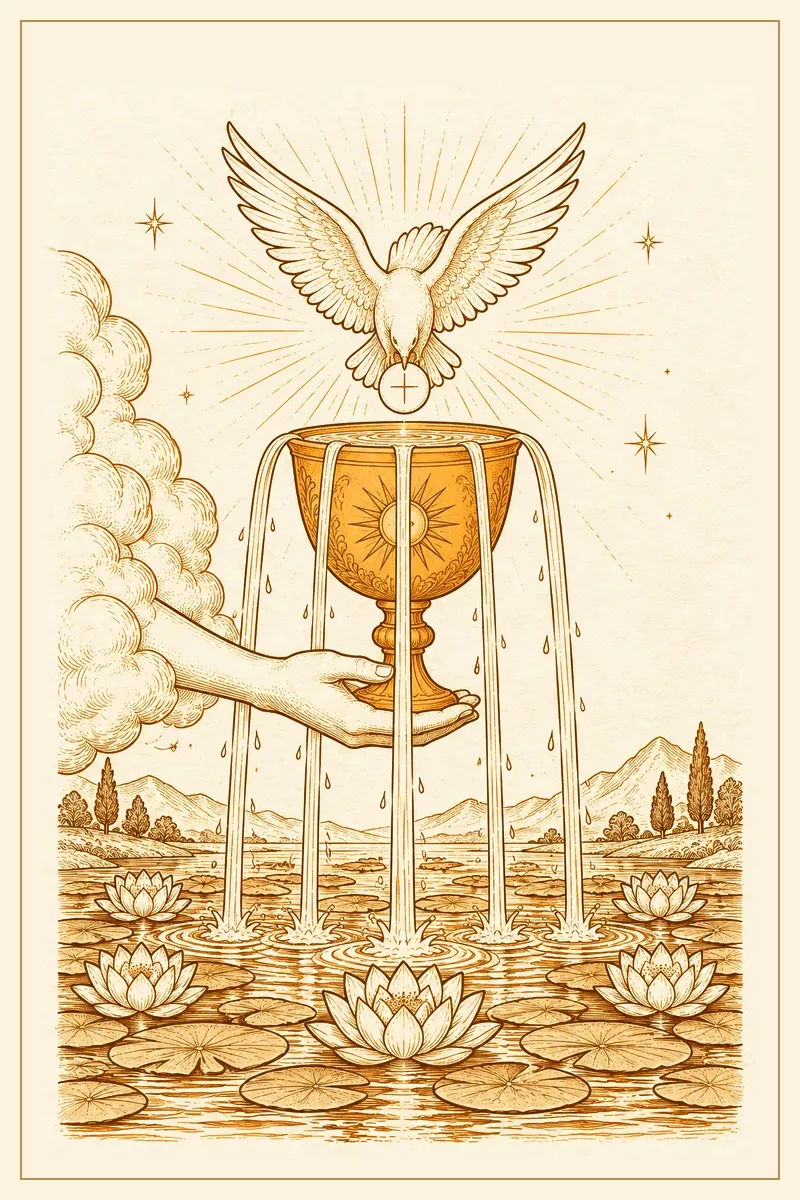
Upright, the Ace of Cups is an opening of the heart: new love, renewed affection, compassion, a creative or spiritual feeling that fills you up. In a love reading it describes emotional availability more than a guaranteed romance. There is more on its love and spiritual sides in the Ace of Cups tarot meaning.
Reversed, the cup is tipped or held shut. Feelings may be blocked, poured out to everyone but yourself, or kept back for fear of being hurt.
Ace of Swords: clarity that cuts through
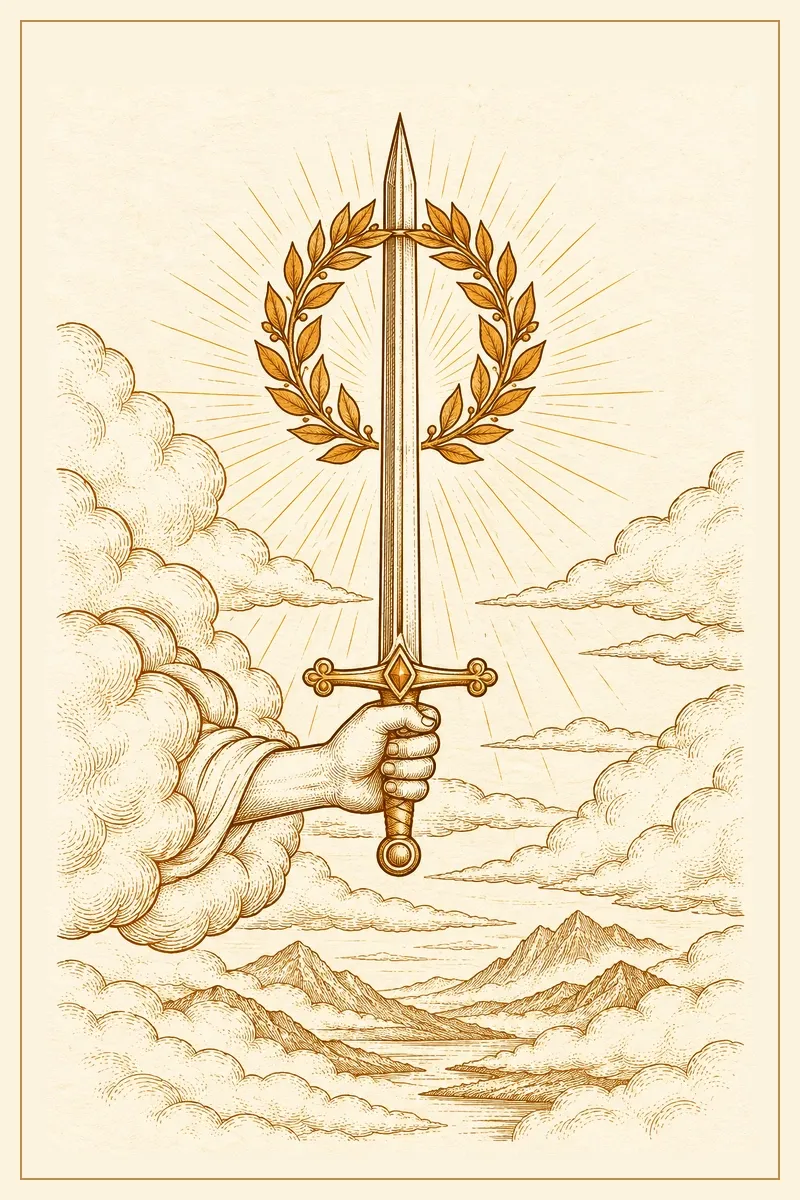
Upright, the Ace of Swords is a breakthrough in thought: the truth becoming obvious, a decision snapping into focus. At work it favors a clear proposal or a negotiation; in relationships it asks for an honest conversation. The Ace of Swords tarot meaning follows the card through more situations.
Reversed, the blade is dull or swinging wildly: confusion, misunderstanding, or sharp words that hurt more than they clarify. Gather facts and say the important thing once, calmly.
Ace of Pentacles: a seed you can hold
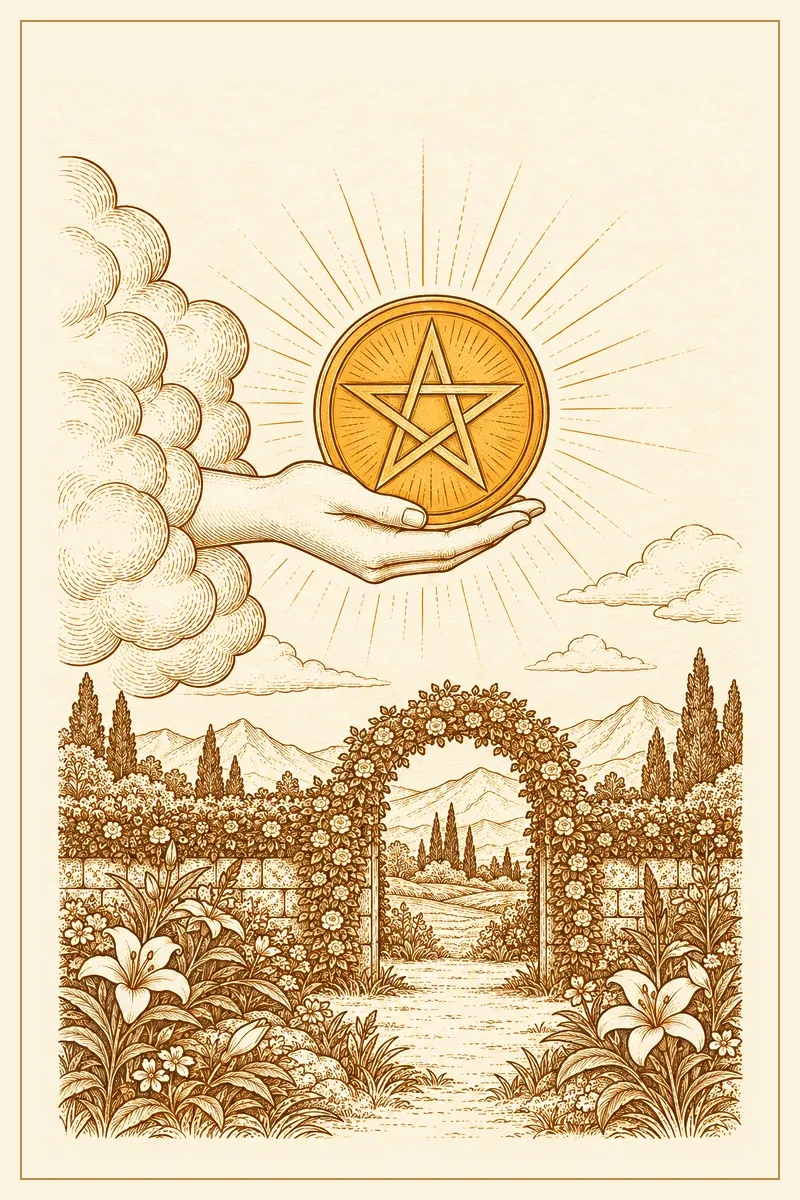
Upright, the Ace of Pentacles is a tangible opening: a job offer, new income, a home, a fresh commitment to your health. It is the most practical of the four, a seed that grows only if you plant and tend it. Its money and career sides are explored in the Ace of Pentacles tarot meaning.
Reversed, the opportunity may be delayed, smaller than hoped, or not yet backed by a plan. Check the terms and timing before committing.
Multiple Aces in one tarot reading
Several Aces in one spread mean several beginnings are on the table at once. That can be good news, but beginnings take energy, and the reading asks where yours should go first. Look at the suits, the positions and any reversals.
Two Aces: two doors at once
Two Aces describe two openings that either support or compete with each other:
- Wands and Pentacles: an idea and the means to build it.
- Cups and Wands: a romance or creative passion with momentum.
- Swords and Cups: head and heart both speaking; a clear truth about a feeling.
- Swords and Pentacles: a sound decision about money, work or health.
- Wands and Swords: an idea sharpened by a plan.
- Cups and Pentacles: a relationship or home taking a concrete form.
Three or four Aces
Three Aces suggest fresh starts across most of your life, and the missing suit can be telling: with no Ace of Cups among them, the new chapter may be busy without yet being nourishing. All four Aces describe a full reset. Treat it as an invitation to choose rather than to say yes to everything; each beginning needs its own first step, and not all of them this month.
Reversed Aces and Aces beside Tens
A reversed Ace beside an upright one can show which of two options is ready and which needs more time. An Ace next to the Ten of its suit links an ending with a fresh start: the Ten of Swords beside the Ace of Swords reads as a painful chapter of thought closing so a clearer one can begin.
Repeated numbers beyond the Aces
Any number that repeats across suits becomes the headline of the reading, and the suits show where that stage is playing out.
- Twos: decisions and partnerships.
- Threes: collaboration and visible progress.
- Fours: a need for rest, or standing still too long.
- Fives: friction in several areas; change pushed rather than chosen.
- Sixes: recovery and give-and-take.
- Sevens: reassessing and holding steady.
- Eights: fast movement or disciplined effort.
- Nines: the last stretch; reserves matter.
- Tens: cycles closing, a major transition.
The four suits as ten-chapter stories
Read one suit in order and it becomes a short story about how one part of life develops, which helps you place any single card in its arc.
Wands: from spark to burden
A spark (Ace) becomes a plan (Two), a venture (Three) and a milestone (Four). Competition (Five) leads to recognition (Six) and a position to defend (Seven); events speed up (Eight), stamina is tested (Nine), and the project becomes a load carried alone (Ten).
Cups: from an open heart to a shared home
A new feeling (Ace) meets another person (Two), widens into friendship (Three) and dulls into boredom (Four). Loss (Five), memory (Six) and fantasy (Seven) lead to a deeper search (Eight), contentment (Nine) and belonging (Ten).
Swords: from clarity to the end of a thought pattern
A breakthrough (Ace) hardens into stalemate (Two), a hurtful truth (Three) and rest (Four). A bitter win (Five), a departure (Six), evasion (Seven), a self-made trap (Eight) and night worry (Nine) end where there is nowhere further to fall (Ten).
Pentacles: from a seed to a legacy
An opportunity (Ace) brings juggling (Two), teamwork (Three) and saving (Four). Hardship (Five) gives way to generosity (Six), patience (Seven) and practice (Eight), then self-made comfort (Nine) and security that outlasts its builder (Ten).
No Ten is purely good or bad. The Ten of Cups can hide a family picture kept up for appearances, the Ten of Pentacles can carry heavy expectation, the Ten of Swords is the point where the fall stops, and the Ten of Wands also proves how much you built.
Patterns the numbers make on the table
The three acts of one to ten
One to Three opens the story, Four to Six develops it through structure, crisis and repair, Seven to Nine deepens it, and Ten hands it back to One. Mostly low numbers mean a young situation; mostly high numbers mean finishing well matters more than starting fresh.
Neighboring numbers in different suits
Consecutive numbers side by side read as movement from one stage to the next. The Five of Cups beside the Six of Swords describes grief beginning to move toward calmer ground. A lower number before a higher one suggests progress; the reverse can show a slide back.
When one suit dominates
Three or more cards of one suit reveal where the real question lives. A career question full of Cups is partly about how the work feels; a love question full of Pentacles may be about money or living arrangements.
Major cards beside numbered cards
The trump names the theme and the numbered card shows how it plays out day to day. Death beside the Eight of Pentacles can describe a change in how you work; The Tower next to the Ten of Swords suggests the collapse of a way of thinking that was already exhausted.
Court cards and the number sequence
Pages, Knights, Queens and Kings follow rank rather than stage: the Page learns, the Knight pursues, the Queen holds the suit within, the King directs it outward. Some readers number them 11 to 14 and reduce them (11 becomes 2, 12 becomes 3), so the Page echoes Two and the Knight echoes Three. That layer is optional, and the overview of the court cards explains them on their own terms.
A five-card spread built on the numbers
This layout borrows the number sequence for any situation in motion, such as a project, a relationship or a change you are weighing. Hold the situation in mind while you mix the deck, then place five cards left to right.
- The seed: what started this, or what is trying to start.
- The choice: the decision or balance you are holding now.
- What is growing: the result beginning to show.
- The friction: what is testing the situation, the job of every Five.
- What completing it asks: what a healthy finish would require from you.
Read each card by its position first, then notice its number. A high number in the seed position may mean the start is older than you think.
Worked example: two Aces and a heavy load
The question: "I have been offered freelance design work while keeping my full-time job. Where should my energy go?" The cards:
- The seed: Ace of Wands, upright.
- The choice: Two of Pentacles, upright.
- What is growing: Ace of Pentacles, upright.
- The friction: Five of Wands, upright.
- What completing it asks: Ten of Wands, reversed.
Two Aces open the reading with two beginnings, a creative spark and a material opportunity; together they describe an idea with a way to earn from it, which matches the offer. The Two of Pentacles names the real task: juggling two commitments and staying flexible.
The Five of Wands brings friction, perhaps clients and an employer wanting the same evenings. The Ten of Wands reversed is a load that could be set down, so finishing well means not carrying everything at once. The numbers tell the story plainly: two Aces of opportunity, a Two of balancing, a Five of strain, and a Ten warning of overload before it arrives.
A grounded takeaway: accept a defined amount of freelance work, cap evening hours, and review after a month whether the Ace of Pentacles is growing or the weight is creeping back. The cards do not decide whether to leave the job; they show how to keep two beginnings from becoming one burden.
Learning the forty numbered cards by number
Learn the ten numbers first as a story, one line each in your own words. Then take one suit a week, lay it out from Ace to Ten and read it as the chapters above. By the fourth week the forty cards stop feeling like separate facts.
After that, pull three cards each morning, name each card's stage and suit before checking a reference, and compare your sentence with the traditional meaning. Where they disagree, the gap shows which card needs more study. When a card confuses you, set it beside its neighbors one number above and below.
Frequently asked questions
What do the numbers mean in the Minor Arcana?
Each number names a stage of a cycle: One begins, Two chooses, Three grows, Four stabilizes, Five disrupts, Six repairs, Seven tests, Eight moves, Nine intensifies and Ten completes. The suit shows which area of life the stage belongs to.
What do the Aces mean in tarot?
Aces are beginnings offered in the area of their suit: drive for Wands, feeling for Cups, clarity for Swords and tangible opportunity for Pentacles. Reversed, the opening is delayed, blocked or turned inward.
What does it mean to get multiple Aces in a reading?
Several beginnings are available at once. Two Aces may support or compete with each other; three or four describe a wider reset. The useful question is which opening deserves your first step.
Do the numbers mean the same thing in every tradition?
The broad arc holds across the main traditions. The Thoth deck ties each number to Kabbalistic correspondences and retitles some cards, and Marseille-style decks show numbered cards as arrangements of suit symbols, so readers lean on number and suit even more. The illustrated scenes of the Waite-Smith deck of 1909 add a picture to each number but keep the same stages.
Why do the Fives feel so difficult?
Five is the midpoint, where the stability of Four breaks, so conflict, loss and scarcity are its themes in every suit. They describe a stage, not a verdict, and the Six that follows shows the disruption is a passage.
Can the numbers tell me when something will happen?
No. Some readers use numbers as loose timing symbols, but a card cannot give a reliable date, confirm someone else's intentions or fix an outcome. Treat the number as a picture of where things stand now.
Counting your way through a reading
Once the ten stages feel familiar, every numbered card tells you at a glance how far along a situation is and which part of life it touches. The Aces open, the Fives shake, the Tens close, and the story starts again.
When you want to try it on a question of your own, draw a reading and name each card's number before anything else.