Shadow work with tarot means using the cards as a mirror for the parts of yourself you would rather not see: the reaction that feels too big for the moment, the trait you judge sharply in other people, the wish you learned to hide. You draw a card, notice what it stirs, and write about it with curiosity instead of a verdict. The cards do not expose a secret self; they give you an image to think with, so a hard feeling becomes something you can look at.
A reading cannot diagnose you, recover a forgotten memory as fact, or explain why another person treated you as they did. It can slow you down long enough to ask a better question about your own patterns. Below are twelve cards suited to that question, followed by three spreads, a worked example, prompts and aftercare.
At a glance, here is what each card brings to a shadow reading:
- The Moon: fears and half-seen feelings that grow larger in the dark.
- The Devil: habits, cravings and the shame that keeps them secret.
- The Hermit: the honest, solitary look inward.
- The Tower: a self-image that cracks once the truth gets in.
- Death: an old role or identity that is ready to end.
- Eight of Swords: beliefs that hold you in place more firmly than the facts do.
- Five of Pentacles: a lit window you walk past because you decided it was not for you.
- Nine of Swords: the harsh inner voice that wakes you at three in the morning.
- Ten of Swords: an ending you kept postponing, and the relief underneath it.
- Eight of Cups: leaving something that looks complete because it never felt like yours.
- Seven of Swords: the small stories you tell to avoid a hard conversation.
- Four of Pentacles: money, affection or time held tight from fear of running out.
- The High Priestess: what you already know but have not said aloud.
- Five of Cups: sorrow fixed on the spilled cups that misses the two still standing.
What Jung meant by the shadow
The word comes from the Swiss psychiatrist Carl Jung, who used "shadow" for the aspects of a personality that the conscious self does not identify with. Some of that material is uncomfortable: anger you were told was ugly, envy, neediness, a hunger for attention. Some of it is surprisingly positive, such as ambition, tenderness or a playful streak that never felt safe to show. Later writers sometimes call those disowned strengths the "golden shadow." Either way, the shadow is not an evil second self; it is the material that did not fit the picture you learned to keep of yourself.
Jung also wrote about projection, the habit of seeing in other people what we have not recognized in ourselves. That idea is central to shadow work today: the coworker whose confidence irritates you, or the friend whose neediness you cannot stand, may be pointing at something you have not let yourself feel. Jung did not invent a tarot method; pairing his ideas with the cards is a modern choice, and a gentle one, because the cards approach the subject sideways.
Shadow work is not reliving painful experiences on purpose, wallowing in a low mood, or fixing yourself as if you were broken, and it is not a project you finish. It looks more like this:
- Noticing patterns: reactions that feel out of proportion, situations you steer around, people who get under your skin.
- Owning projections: asking whether the quality you criticize in someone else also lives, unacknowledged, in you.
- Integrating rather than removing: the hidden part does not disappear; it becomes a known, accepted piece of who you are.
- Going at your own pace: small, honest steps, with rest in between.
Why a tarot card makes a good mirror
Asking yourself "What am I ashamed of?" can make the mind slam shut. Asking "What does this figure holding a chain remind me of?" is easier, because you start with an image outside yourself and let the meaning come back to you. You can describe the howling dog on The Moon or the blindfold on the Eight of Swords before you are ready to describe your own fear, and the description may turn out to be about you anyway.
Your reaction to a card is part of the reading. If you feel a jolt of resistance, a sudden urge to reshuffle, or a quick "that's not me," write it down before you interpret anything. Those reactions point to where the hidden material lives. The card you would most like to put back in the deck deserves the most patient attention.
Two more things the deck does well. It refuses vagueness: "I should work on my anger" rarely goes anywhere, while "this card shows where I dodge a hard conversation with my sister" is something you can act on by Friday. And it holds both poles at once. The cards of relief and reward travel in the same box as the cards of fear and loss, so you never work with a deck that shows only your best side.
A simple order keeps the reading honest: describe the picture in plain words, note the feeling it brings up without judging it, and only then ask where that feeling lives in your life now. Leave the guidebook meaning for last, so you do not borrow an interpretation that lets you off the hook.
Six cards that open shadow work, upright and reversed
Any card can carry a shadow message, yet these six speak directly to hidden feelings, attachments and self-images. Look at each picture first, then read its angles and answer the journal question. Reversals are optional; if you use them, read a reversed card as its theme turned inward or resisted, and decide before you shuffle.
The Moon: fears that grow in the dark
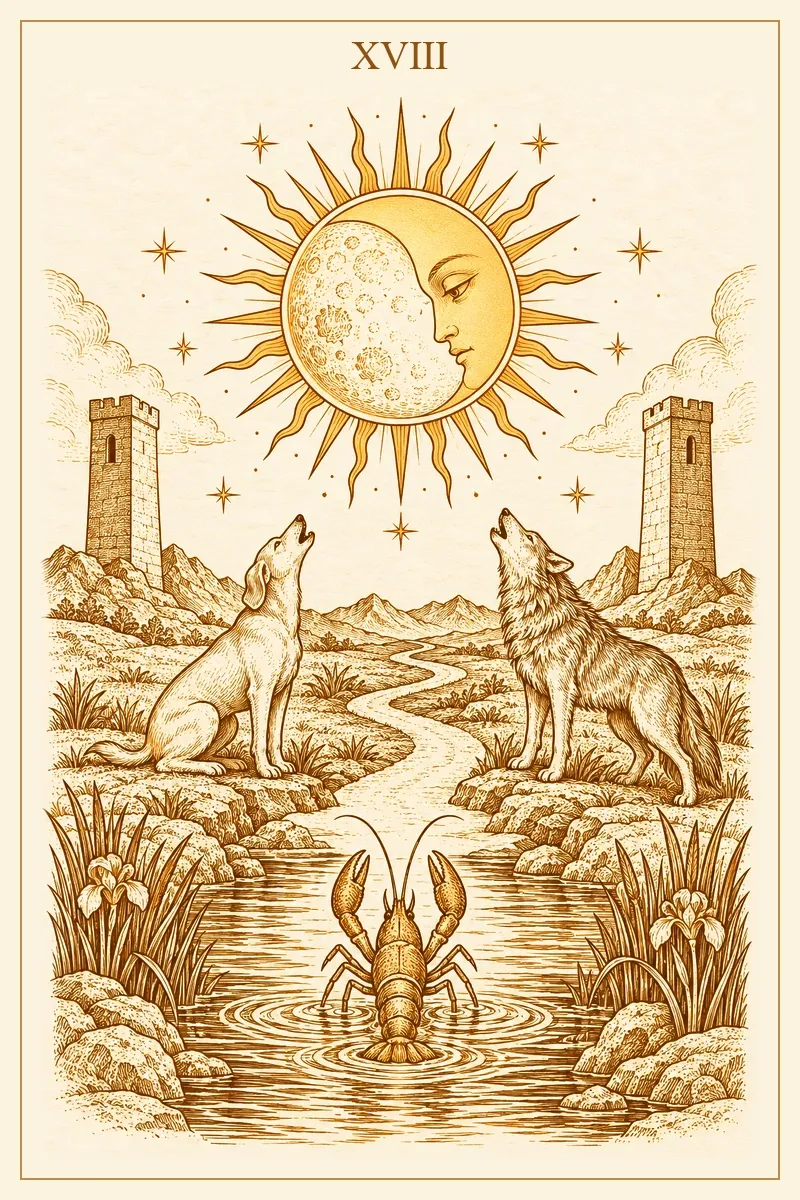
On this card a crescent face sits inside a radiant disk, two towers stand at the edges of the land, and a dog and a wolf howl on either side of a winding path. Below them a crayfish climbs out of a pool. In shadow work The Moon shows feelings rising from somewhere deep, the tame and wild sides of you facing each other, and a path you walk one step at a time. The full Moon tarot meaning covers its other contexts.
Upright, the card invites you to name a fear that has been shaping your choices without your consent. Anxiety in a relationship, a sense that you are about to be found out at work: The Moon asks what you believe in the dark that you would question in daylight. Reversed, it can describe confusion beginning to lift, or a fear you pretended not to feel finally surfacing. Both are progress.
Journal: What am I afraid is true about me, and what evidence do I actually have?
The Devil: what holds you, and why you stay
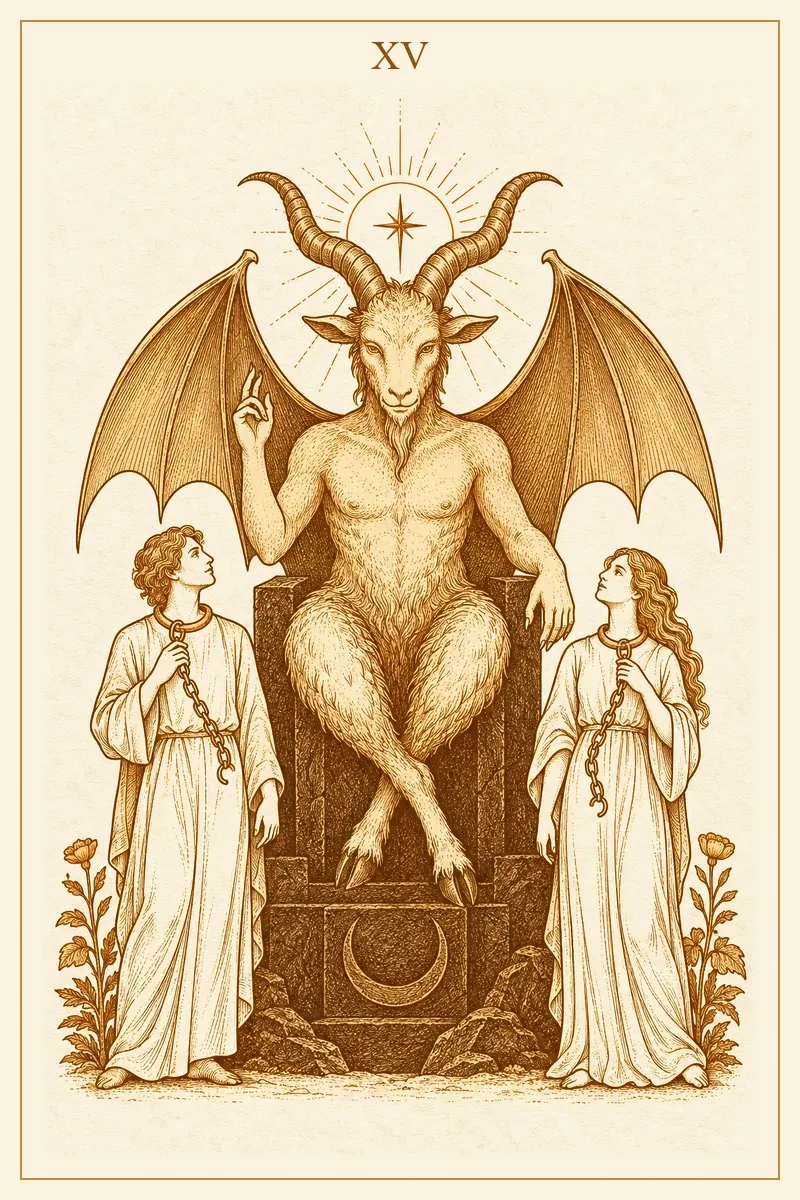
A goat-headed figure with bat wings sits on a dark throne marked with a crescent, one hand raised. Two robed figures stand beside the throne, each holding a length of chain in their own hands. The Devil names attachments, cravings and the shame that keeps them hidden, and that detail hints the grip is not as total as it feels. See the Devil tarot meaning for love and career readings of the card.
Upright, the card points to a pattern you keep repeating even though it costs you: scrolling late into the night, choosing partners who make you chase them, overworking so no one can call you lazy. The useful question is not "How do I get rid of this?" but "What does this give me that I am afraid to go without?" Reversed, The Devil can show the first loosening: you see the pattern, talk about it, or catch the moment before you reach for it. Shame has less power over something you have said out loud, even if only to the page.
Journal: Which habit do I hide, and what need is it trying to meet?
The Hermit: holding up your own lantern
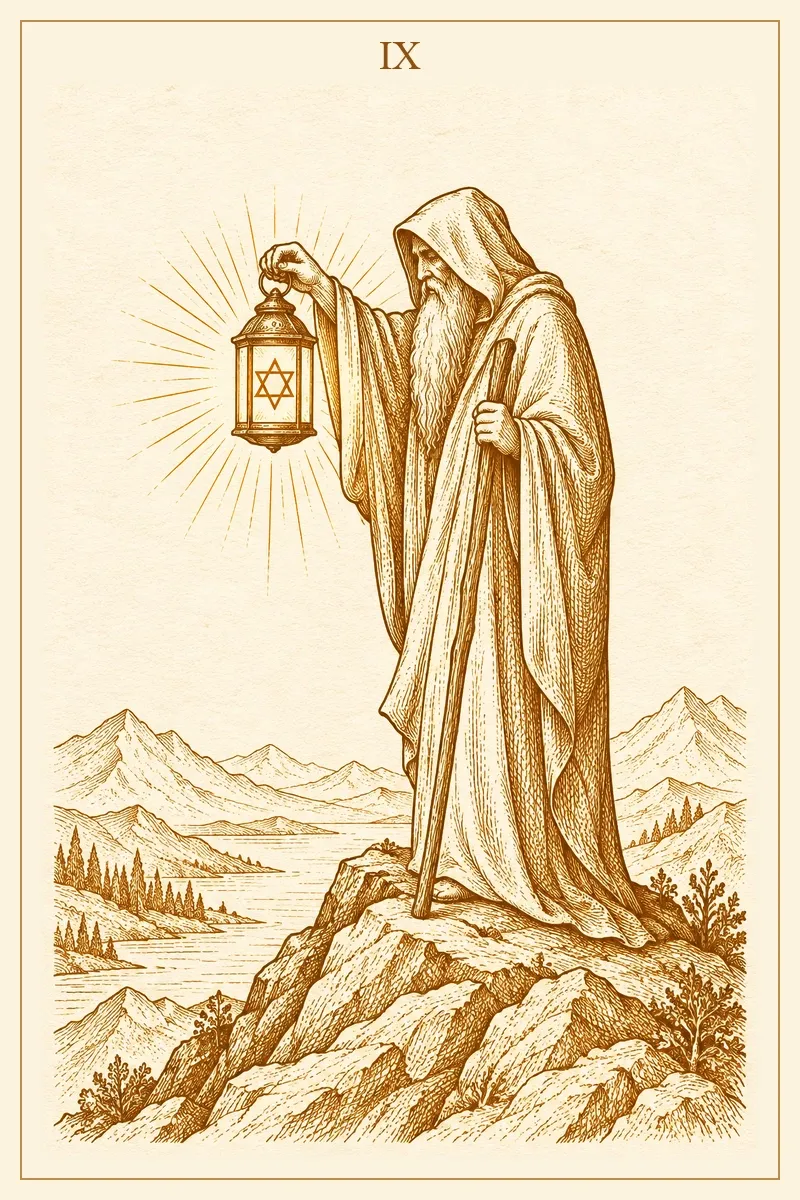
A hooded, bearded figure stands on a rocky peak above a lake and a ring of mountains, leaning on a staff and holding out a lantern with a six-pointed star inside. The light is small but shows the next stretch of ground. In shadow work The Hermit stands for an honest, unhurried look inward, away from other people's opinions. Its full meaning is in the Hermit tarot guide.
Upright, this is a card of permission: you may step back, keep a quiet evening for your journal, and look at something without explaining it to anyone yet. The lantern is held by you, not by the cards; the insight comes from your own attention. Reversed, The Hermit can warn of two opposite shadows: isolation that has become a way of hiding, or avoiding solitude because silence brings up feelings you would rather not meet.
Journal: What do I notice about myself when no one else is watching?
The Tower: when the mask cracks
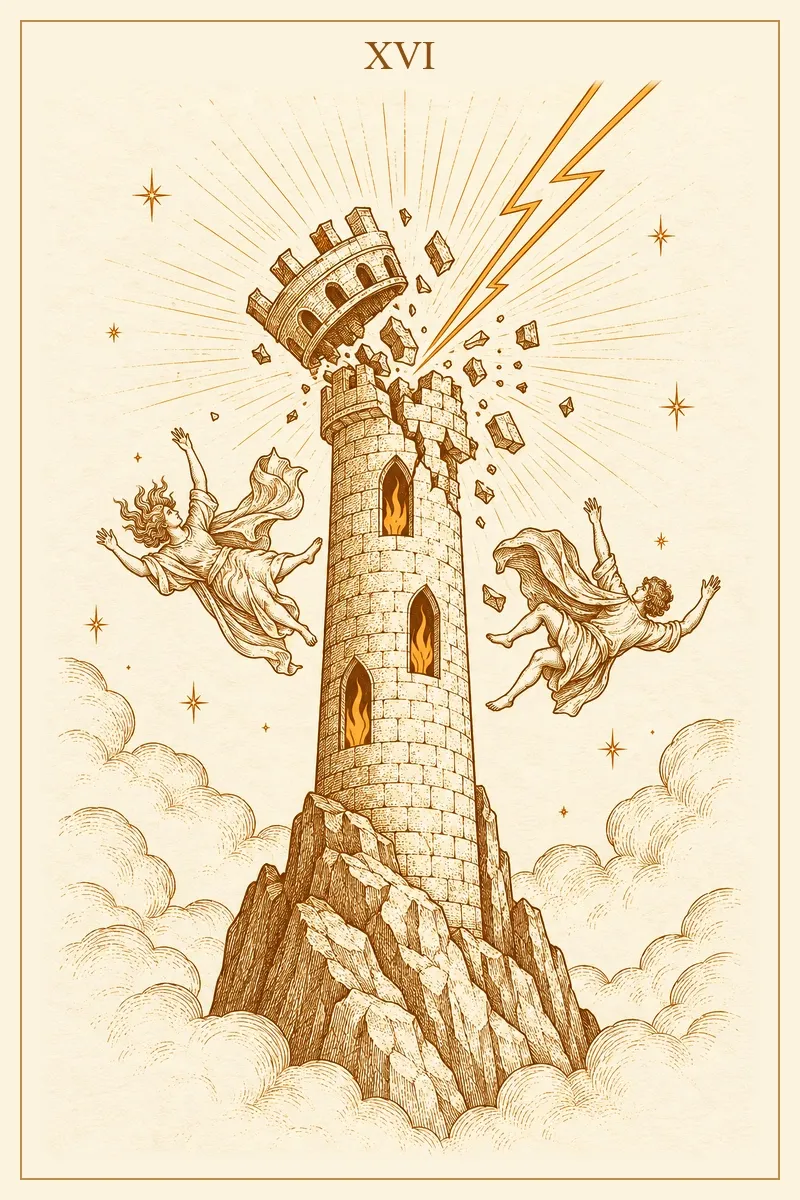
Lightning strikes a tall stone tower on a crag above the clouds. Its crowned top bursts apart, flames show in the windows, and two figures fall through the air. The Tower is the moment a carefully built self-image meets a truth it cannot hold. You might learn that the "easygoing" role you play has been covering resentment, or that a relationship rested on a story you told yourself. For the card's broader reading, see the Tower tarot meaning.
Upright, the card does not predict disaster. In a shadow reading it describes a structure inside you that was too rigid, and the relief that can arrive with the upheaval once it falls. Reversed, The Tower can show a collapse you are holding off by force: you sense the old story is false but keep repairing it, or the change happens privately, as a quiet inner shift instead of a public event. Either way, ask what you have been spending energy to protect.
Journal: Which belief about myself would I most hate to lose, and why?
Death: letting an old self finish
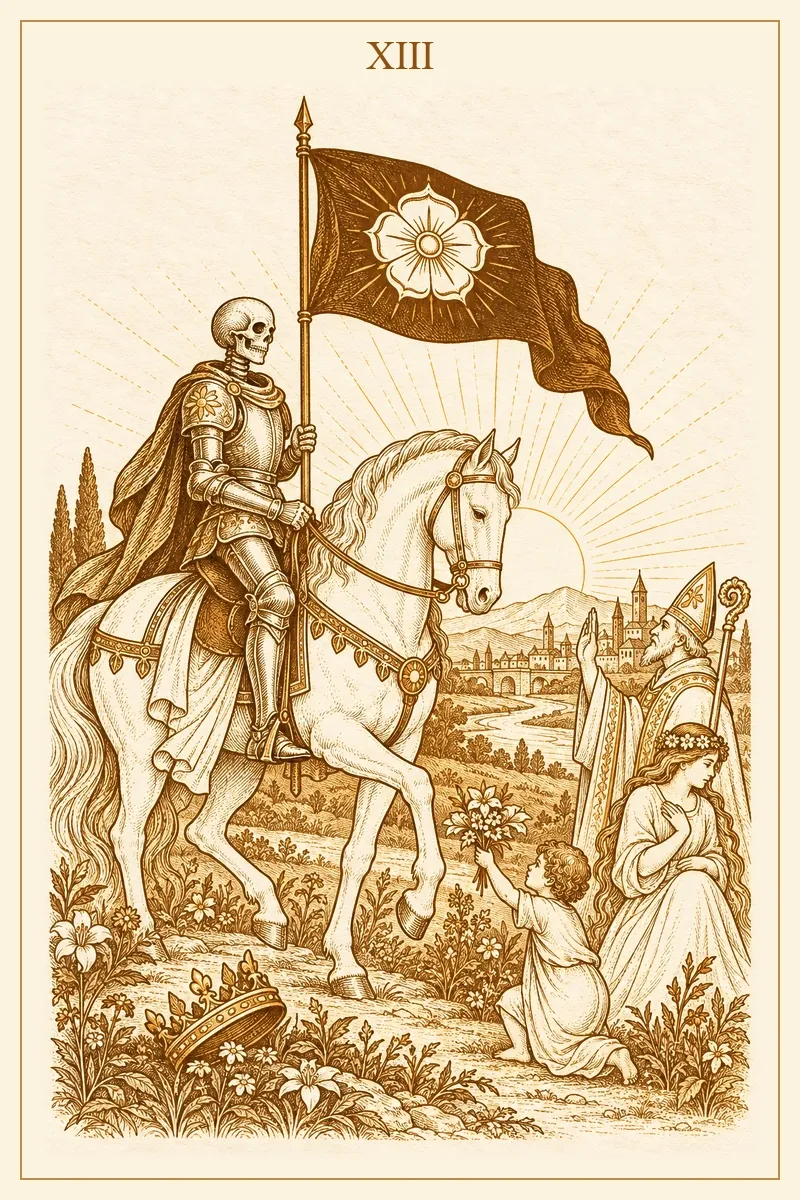
A skeleton in armor rides a white horse and carries a black banner marked with a white rose. A crown lies fallen in the grass, a child holds out flowers, a woman kneels, and a churchman stands with his staff, while the sun sits low behind a distant town. In a reading Death is a card of endings and transition, not a literal death; in shadow work it marks the end of a role you have outgrown. The full Death tarot meaning covers its link to change.
Upright, the card asks what you are ready to stop being: the peacemaker who never disagrees, the one who always copes, the person you were in a relationship that ended long ago. Ending that identity leaves room for qualities you hid to keep it intact. Reversed, Death can describe clinging: you know a chapter is over but keep acting it out, from loyalty or fear of the blank page. Grief belongs here too; an old self deserves a proper goodbye.
Journal: Which role am I still playing that no longer fits who I am?
Eight of Swords: the blindfold you can lift
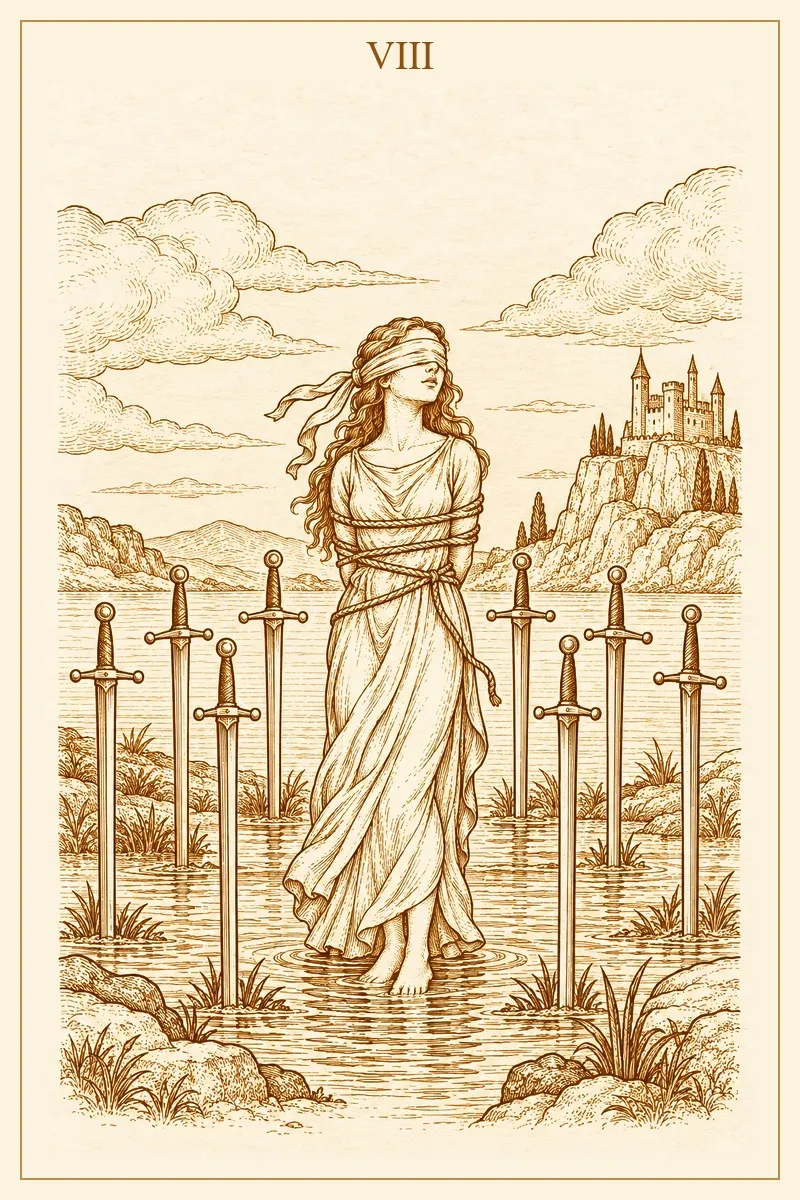
A woman stands barefoot in shallow water, blindfolded, with rope looped loosely around her arms. Eight swords stand upright around her, and a castle rises on a cliff behind. The swords do not quite close her in, and the rope looks slack. That is the card's shadow message: much of the trap is made of belief. The Eight of Swords tarot meaning covers it in more detail.
Upright, the card shows thoughts that have hardened into rules: "I can't ask for help," "If I speak up, I'll be rejected," "People like me don't get that job." In love, it can describe staying silent about a need because you have already decided the answer is no. Reversed, the blindfold starts to slip: you question one of those rules, test it with a small action, or notice the way out was there all along. Move gently; a freed mind can still need time before the body trusts it.
Journal: What rule do I live by that I have never actually tested?
Six more cards for the harder seasons, upright and reversed
If the first six cards open the door to hidden feelings and self-images, these six tend to appear in the harder seasons: feeling locked out, the night-time critic, the ending you cannot allow, the wish you are not supposed to have, the small evasions, the clenched hand. Read them the same way, picture first, then the angles, then the question.
Five of Pentacles: the lit window you walk past
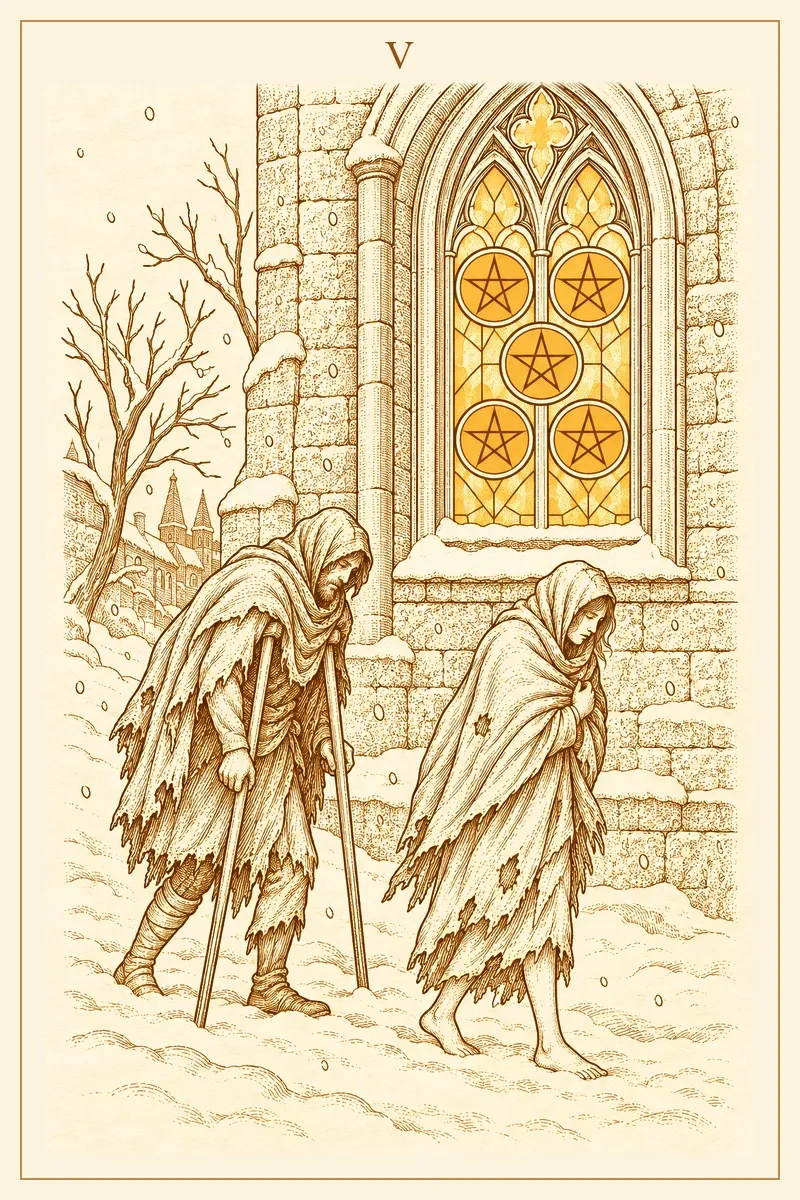
Two figures move through falling snow beside a stone wall, one on crutches, the other wrapped in a shawl, while a stained-glass window above them glows with five coins. Neither looks up at it. In shadow work the Five of Pentacles shows the places where you lock yourself out: help, warmth or belonging that is close by and that you have decided is not meant for you. The Five of Pentacles tarot meaning covers its money and health readings.
Upright, the card asks which door you walk past without trying it: the friend you do not call when things get hard, the support you refuse because accepting it would mean admitting a need. Under that habit often sits a belief about worth, the sense that you must earn what other people are simply given. Reversed, the figures turn toward the window: you accept help, let someone see you struggling, or notice that the cold was partly a choice.
Journal: Which kind of help do I refuse, and what would accepting it say about me?
Nine of Swords: whose voice speaks at three in the morning
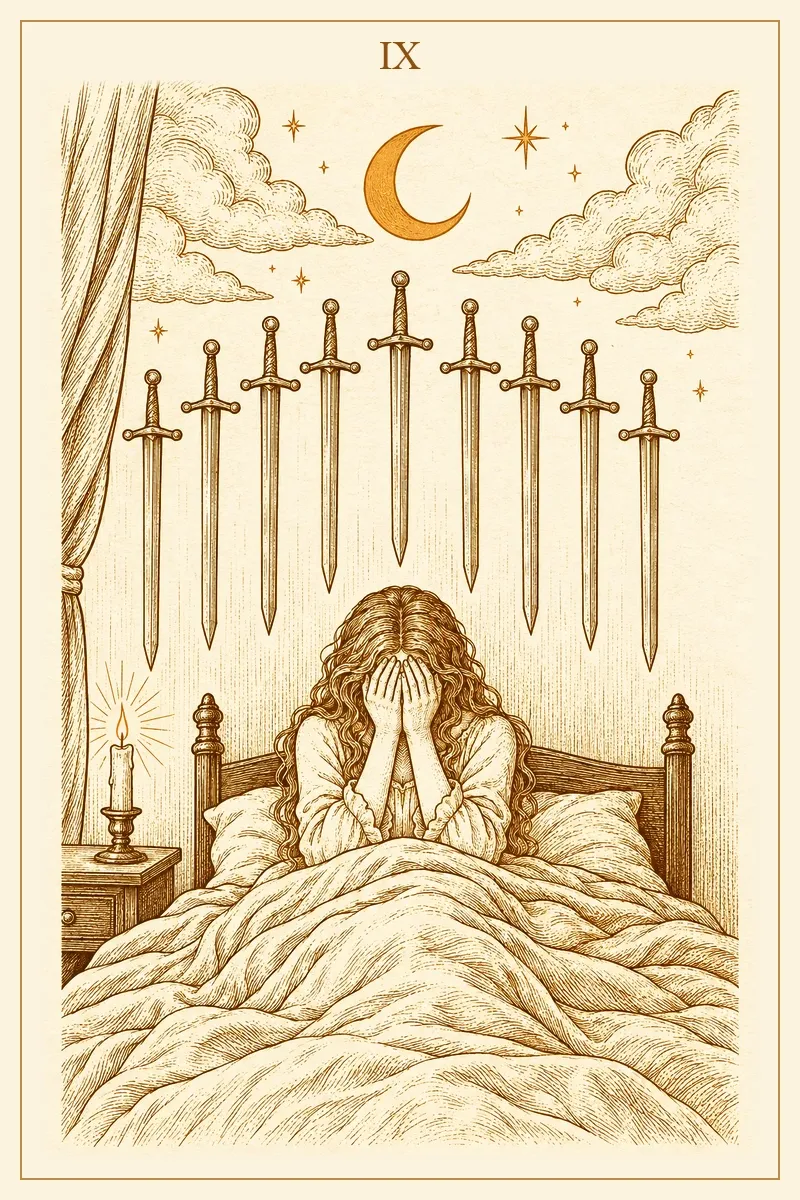
A figure sits up in bed with both hands over the face, a candle burning on the nightstand, while nine swords hang point down in the night sky above, under a crescent moon. None of them falls; the swords stay where they are. In shadow work the Nine of Swords is the voice of self-criticism that runs loudest when no one else is awake. Its wider meaning is in the Nine of Swords tarot meaning.
Upright, the card invites you to listen to that voice as if it belonged to a stranger: what does it say, in what tone, and whose words are those originally? Often the harshest line is one you heard long ago from a parent, a teacher or an early partner and have been repeating in their place. Reversed, the night begins to end: the worry loses some of its grip, you say the thought aloud and hear how extreme it sounds, or you ask for the reassurance you kept refusing.
Journal: What does my inner critic say most often, and who said it first?
Ten of Swords: the ending you kept postponing
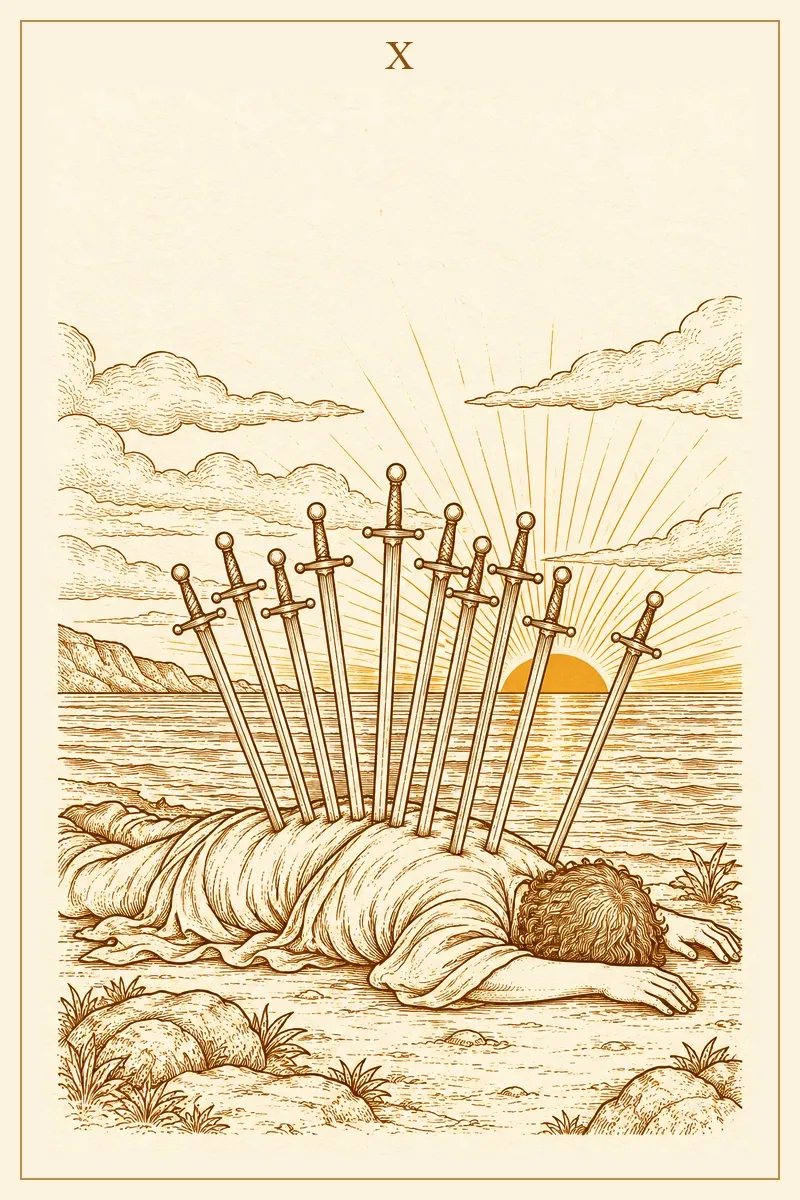
A figure lies face down at the edge of still water with ten swords in the back and a cloth draped across the body, while the sun rises over the sea and spreads its rays across the sky. The scene looks like the worst moment, and the horizon says it is also the last one. In shadow work the Ten of Swords marks something you kept alive long past its end, and the odd relief that follows when it finally stops. See the Ten of Swords tarot meaning for its other readings.
Upright, the card asks what you have been propping up: a friendship held together by obligation, a plan you no longer believe in, a version of events you defend because admitting defeat feels unbearable. The hidden part here is often the pride or fear that made collapse seem worse than a slow bleed. Reversed, you may be getting up: the worst has passed, you see how much the fight cost, and you let the dawn mean what it means.
Journal: What am I keeping alive that has already ended, and what would I feel if I let it stop?
Eight of Cups: walking away from what looks complete
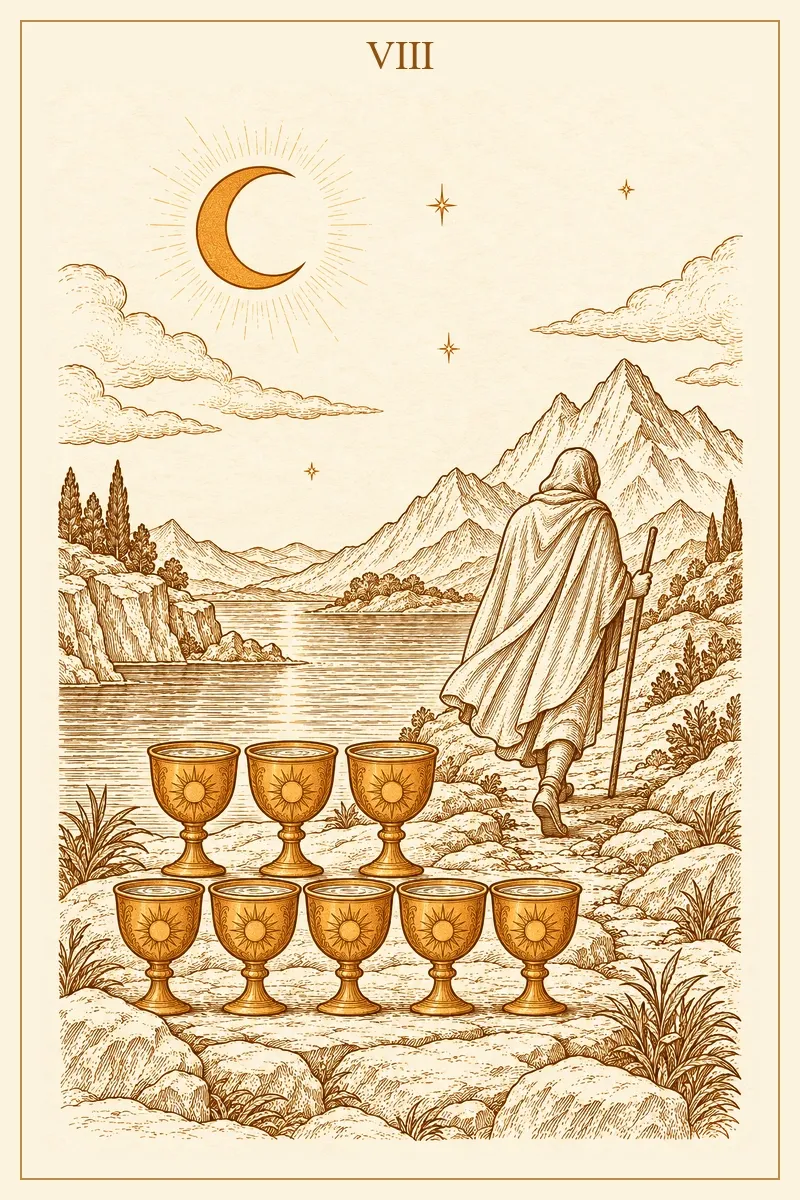
Under a crescent moon, a hooded figure in a long cloak walks away from eight cups standing in two neat rows in the foreground, heading with a staff along the shore toward the mountains. The cups are full; the figure leaves anyway. In shadow work the Eight of Cups surfaces the things you are supposed to want and quietly do not. The Eight of Cups tarot meaning looks at it in love and career.
Upright, the card points to a life that passes every test except the one that matters: the job that looks good from outside, the relationship that ticks each box and still feels wrong, the goal you set so long ago that you forgot it was never yours. Admitting that you do not want it can feel ungrateful, which is why the wish stays hidden. Reversed, the card can show the opposite shadow: leaving before you have let yourself grieve, or staying because you are afraid of the empty space that walking away would open.
Journal: What am I supposed to want that I do not, and who would I disappoint by saying so?
Seven of Swords: the small stories you tell
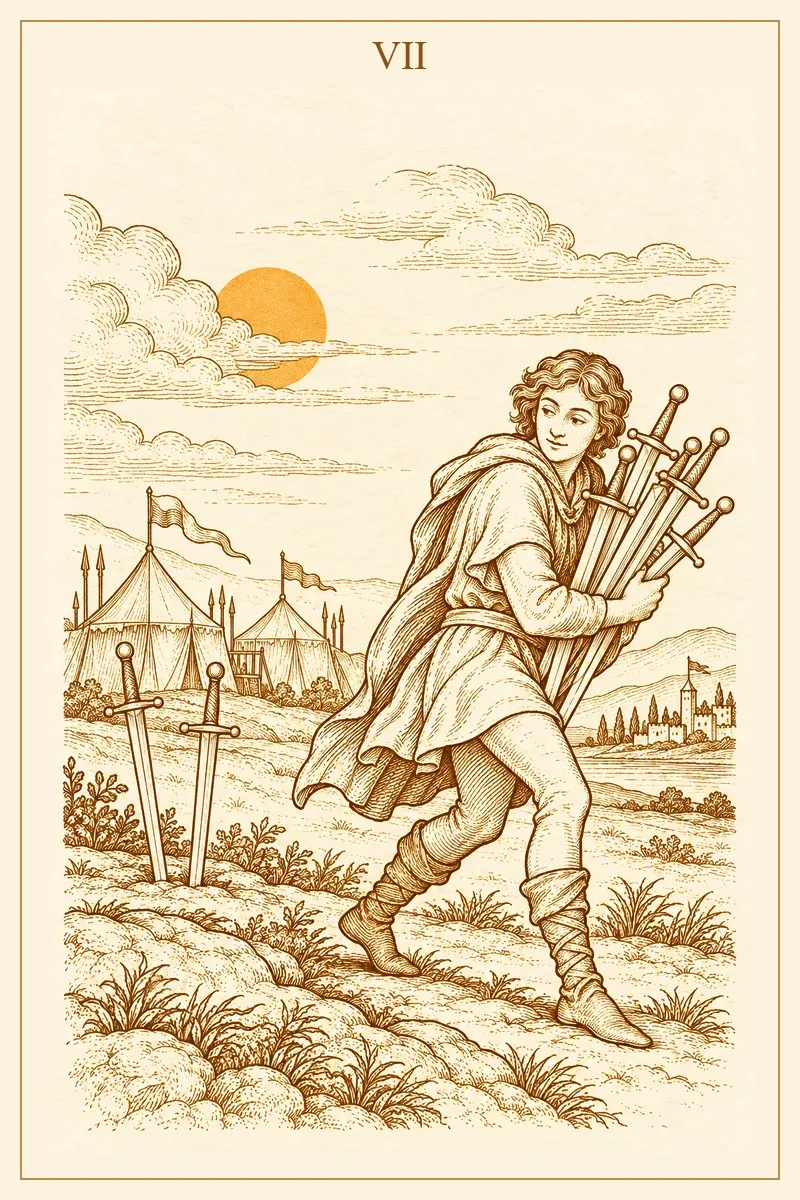
A figure tiptoes away from a camp of bright tents with five swords in both arms, glancing back over one shoulder, two swords left standing in the ground behind. In shadow work the Seven of Swords is less about deceiving other people than about where you deceive yourself: the version of a story you polish before telling it, the conversation you avoid by being busy. The Seven of Swords tarot meaning covers its warnings in other contexts.
Upright, the card asks where you dodge. You may overstate how well things are going to a parent, skip the detail that would make you look less generous, or keep a small plan to yourself so no one can object. Reversed, the figure turns back: you own the omission, tell the plainer version, or decide to have the conversation you have been stepping around.
Journal: Which story do I tidy up before I tell it, and what is in the part I leave out?
Four of Pentacles: what you are afraid to put down
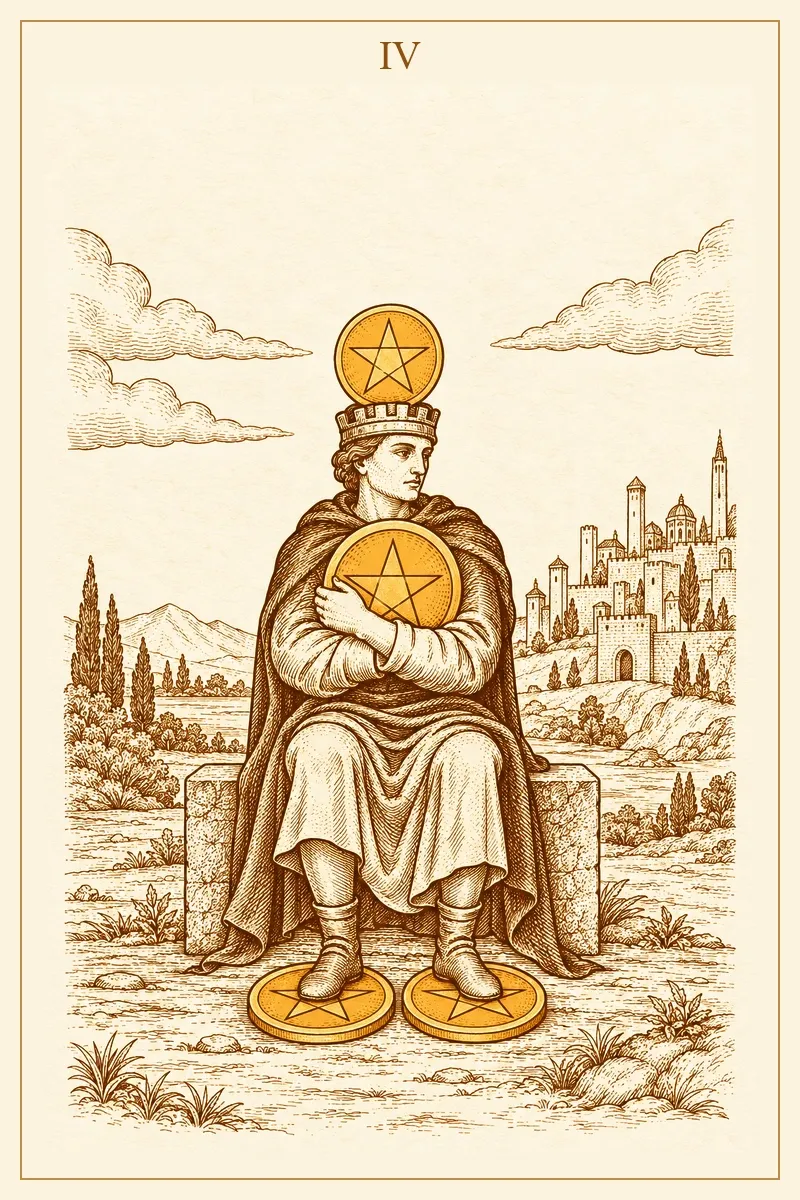
A crowned figure sits on a stone bench with a coin clasped against the chest, one coin balanced on the crown and one under each foot, a city in the distance behind. Every limb is busy holding. In shadow work the Four of Pentacles reveals the fear underneath control: money you cannot spend, affection you cannot show, time you cannot share even when there is enough. The Four of Pentacles tarot meaning looks at its financial side.
Upright, the card asks what you believe would disappear if you opened your hands. The answer is rarely about the thing itself; it is about an old experience of scarcity, or of being taken from. Reversed, the grip loosens, by choice or because life pries one finger off at a time: you spend, give, delegate or say yes to being helped, and discover that nothing collapses.
Journal: What do I hold most tightly, and what do I fear would happen if I loosened my grip?
Two more cards are worth knowing. The High Priestess, seated between a dark and a light pillar with a closed book in her lap, points to something you know but have not admitted. The Five of Cups, a cloaked figure bowed over three spilled cups while two still stand behind, shows regret that holds your attention on the loss. If either appears, ask what you have been unwilling to see, or what is still standing.
The mask spread: five positions for shadow work
This spread moves from the self you show to the part you hide and back toward integration. Lay five cards in a row, left to right, and read them in order. Name each position on a slip of paper before you shuffle.
Positions of the mask spread
- The mask: the version of me I present to others, the face that feels safe.
- What the mask guards: the feeling, wish or quality I keep out of sight.
- Where I learned to hide it: the old message, fear or experience that taught me this part was not welcome.
- What hiding costs me now: the pattern, conflict or self-sabotage the hiding creates.
- A first step toward owning it: one small, safe way to acknowledge this part.
Treat position three with care. The card there offers a theme to reflect on, not a reconstruction of your past. If it brings up a memory, explore only what you choose to explore, and leave anything you are not ready for alone.
A three-card spread for a strong reaction
Use this after someone or something triggers a reaction that surprises you with its size:
- What set me off: the surface event or behavior.
- What it mirrors in me: the hidden part the moment touched.
- What it can teach me: the growth available inside the discomfort.
A three-card projection spread
The trigger spread above starts from an event. This one starts from a person and uses the projection idea directly: the trait you cannot stand in someone else may be one you have not allowed in yourself. Choose the person who has been bothering you out of all proportion lately and lay three cards:
- How I see this person: the figure they cut in my mind right now.
- The quality in them I react to: the specific trait, not the whole person.
- The same quality in me, unowned: my own version of that trait, which may look different on me.
The third card does not always echo the second. Someone's loudness may point to your silence; their carelessness, to a carefulness that is wearing you out. Read the pair together and ask what your reaction has been protecting.
A four-card integration spread
Save this one for a quiet afternoon a few times a year. It goes further than the others, so give it an hour, write afterward and sleep before you decide anything. The insight often arrives a few days later rather than in the session itself.
- The part of me I have been trying to exile: the feeling, wish or trait I keep pushing out of the picture.
- What it protects me from: the hurt or fear it formed in answer to.
- What it needs: the acknowledgment, boundary or rest it is asking for.
- How to give it that without letting it steer: a way to make room for this part that does not hand it the wheel.
A one-card check-in
When you want a lighter touch, shuffle and ask, "Which hidden part of me is asking for attention right now?" Draw one card and write a few lines about it. Kept in a tarot journal, these single draws add up to a map of the themes that return to you over time.
A worked example of the mask spread
The reading below is an illustration, not a real client. Imagine a woman we will call Dana, calm with almost everyone, who feels a fury out of all proportion whenever a colleague talks up his own work in meetings. She asks, "What is this reaction showing me about myself?" and lays out the mask spread.
- The mask: Queen of Pentacles
- What the mask guards: Six of Wands, reversed
- Where I learned to hide it: The Hierophant
- What hiding costs me now: Four of Cups
- A first step toward owning it: Three of Pentacles
The Queen of Pentacles, seated in a fruitful garden with a coin in her lap, fits the mask well: Dana is the dependable one who keeps everything running and never makes a fuss. In the second position, the Six of Wands shows a rider lifting a laurel wreath while a crowd walks beside him. Reversed, it suggests a wish for recognition that Dana keeps hidden, even from herself. Her colleague openly does what part of her longs to do.
The Hierophant in the third position points to inherited rules. Dana might remember a family saying that good work speaks for itself and that people who praise themselves are vain. The card does not prove where the pattern began; it gives her a thread to pull. The Four of Cups shows the cost: a young man sits under a tree with folded arms, ignoring the cup a hand offers from a cloud. Dana realizes she turns down chances to present her own projects, then resents the people who say yes.
The last card, the Three of Pentacles, shows a craftsman at work in a church while two others study the plans. It suggests a practical step: asking to present her part of the next project with the team, so her work is seen without a performance. Her journal question afterward is "What would it feel like to want credit and not be ashamed of it?" The colleague has not changed, but her reaction to him has become information instead of a problem.
Notice who did the interpreting: the cards offered images to think with, and Dana decided which ones rang true and what to do next.
Journaling prompts to pair with your cards
Write by hand if you can, and stop after ten or fifteen minutes even if you feel there is more. These prompts work with any card, and several connect to the cards above.
- Which emotion do I judge most harshly in myself? What would change if I let it exist?
- Which compliment do I always brush off? What would it mean to take it in?
- When I criticize someone, which quality in myself might I be seeing?
- What is the story about myself I would never tell anyone? Can I tell it to this page?
- If the hidden part of me could write me a letter, what would it ask for?
- Which card did I want to put back in the deck today, and what did it remind me of?
- What strength have I hidden because it once felt unsafe or "too much"?
Read old entries now and then. Patterns that were invisible in a single reading can be obvious across a stack of them, and spotting one gives you something concrete to work with.
Four habits that stall shadow work
Four habits tend to stall this practice.
- Doing it too often. Daily shadow draws turn into noise, because what a card stirs needs days to settle. A workable rhythm is one check-in a week, the trigger or projection spread about once a month, and the integration spread a few times a year.
- Skipping the writing. A card without a journal entry is a photograph never developed. The writing is where the hidden part gets its name; if you will not write, choose a different practice for now.
- Treating the shadow as an opponent. The envy, anger or neediness you meet is not trying to ruin you; it formed to protect something. Ask what it guards before you try to change it.
- Working in the middle of a crisis. Shadow work suits a steady season. In the first weeks of a breakup, a bereavement or a burnout, use the cards for comfort if at all, and return to this practice when the ground under you is solid.
Aftercare: closing a session gently
What a session opens does not close the moment you put the cards away, so build in a short ending.
- Keep sessions short. One card or one spread and one journal entry is enough.
- Return to your body. Stand up, stretch, drink a glass of water, or step outside for a few minutes; something physical marks the end of the session.
- Close the spread on purpose. Gather the cards, shuffle them back into the deck, and say or write one sentence of thanks to the part of you that showed up.
- Use a short meditation. A few minutes of slow breathing, or one of these tarot meditation techniques, helps you settle before you go back to your day.
- Offer yourself kindness. The parts you hid formed for a reason, perhaps to protect you. They deserve curiosity, not punishment. If self-judgment shows up, the practice of tarot for forgiveness can help you turn some of that kindness inward.
- Know when to pause. If a session leaves you shaken for days, or touches memories you are not ready to hold, put the deck away for a while and talk with someone you trust.
Integration is quiet. You might catch yourself mid-reaction and recognize the pattern, or say a need aloud that you once swallowed. Those small moments are the work paying off, and they deserve to be noticed.
Frequently asked questions
Which tarot card is best for shadow work?
No single card owns the theme. The Moon, The Devil and the Eight of Swords speak most directly to fear, attachment and limiting beliefs, while The Hermit supports the reflective mood the practice needs. The card that matters most in your reading is the one that provokes the strongest reaction in you.
Can a beginner do shadow work with tarot?
Yes, and you do not need to know every card by heart. Start with the one-card check-in above, look at the image, and write what it brings up before you read any meaning. Learning the cards and learning about yourself can happen in the same notebook.
Can tarot shadow work replace therapy?
No. Tarot is a tool for reflection; it cannot diagnose anything, confirm what happened in your past, or tell you what another person feels. It does not replace a therapist or counselor, and the two can sit side by side. If you are working through trauma, grief or anything that feels too heavy to hold alone, a trained professional is the right support.
What if a reading leaves me feeling worse?
Stop for the day and use the aftercare steps above. Discomfort does not mean you did anything wrong; it may mean you touched something that matters. Come back when you feel steady, choose a lighter question, and remember that you decide how deep to go.
Did Jung use tarot for shadow work?
Jung did not create a tarot practice. He wrote about the shadow, projection and the symbolic images that run through myths and dreams, and later readers saw parallels with tarot imagery. Treat tarot shadow work as your own reflective tool built on those ideas, not as Jung's method.
What if the card I draw does not feel like a shadow card?
Stay with it longer. A Three of Cups can point to friendships you let lapse; a Six of Wands, as in Dana's reading, can show ambition you disowned. The question is never whether the card looks dark, but what its picture is asking you to notice.
How often should I do shadow work, and when does it change anything?
A weekly draw with a short entry is enough; the heavier spreads belong to months and seasons, not days. Insights can arrive fast, but integration is slow, and durable shifts tend to show over months of steady practice rather than after one strong session.
Should I share my shadow readings with other people?
Mostly no. This work stays honest when it stays private; a trusted friend or a therapist is a safe container, a social feed is not. Once a reading is performed for an audience, the part of you that was ready to speak tends to go quiet again.
Does the deck I use matter for shadow work?
Less than the habit does, but choose a deck whose difficult cards are still difficult. Decks that soften The Devil or the Ten of Swords into pretty scenes remove the friction the practice depends on. Fully illustrated scenes help too, because you can describe a figure before you describe yourself.
Welcoming the hidden parts home
Your shadow is not an enemy waiting to be defeated. It holds the parts of you that learned to hide, and some of what it holds is strength. Each time you stay with a card that makes you uncomfortable instead of reshuffling, you make a little more room for all of yourself.
When you are ready for a quiet session, start a reading with one of the spreads above and give whatever appears a patient, kind look.