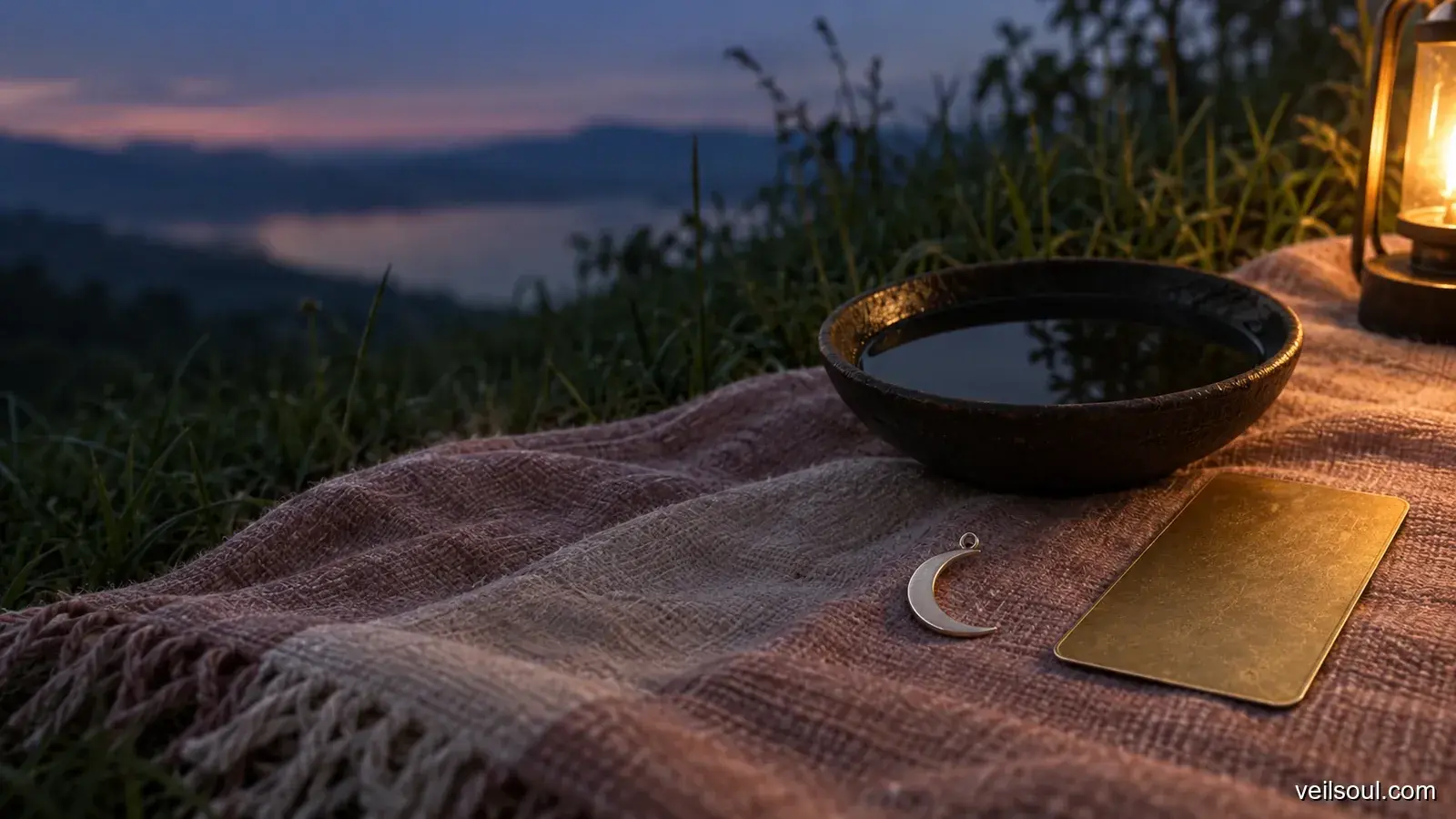
The Moon tarot card (XVIII) means you are walking through a stretch of uncertainty: something is not yet fully visible, so fear, wishful thinking and genuine intuition all speak at once and sound alike. Upright, the card asks you to slow down, check facts before you act and listen to dreams and gut feelings without treating them as proof. Reversed, the fog usually begins to thin as hidden information surfaces and an old fear loses its grip, though it can also mean you are pushing your instincts away.
On timing, this card rarely says "now." It points to a slow, cyclical stretch, often a few weeks of watching rather than deciding, and as a yes-or-no card it reads as "not yet." Like any card, it cannot reveal what another person is thinking, name a date or guarantee an outcome; it can help you sort what you know from what you are filling in with worry or hope.
Key facts for card XVIII:
- Number and place: XVIII in the Major Arcana, between The Star (XVII) and The Sun (XIX).
- Astrology: Pisces, the mutable water sign; the planet Moon belongs to The High Priestess instead.
- Element: water.
- Upright keywords: uncertainty, illusion, anxiety, dreams, intuition, the unconscious.
- Reversed keywords: clarity returning, truth surfacing, fear easing, or intuition ignored.
- Yes or no: not yet; wait for firmer information.
- Timing: slow and cyclical, often read as one lunar month or the Pisces season.
Reading the night landscape on card XVIII
Most of this card's meaning lives in its picture, so it pays to look before memorizing keywords.
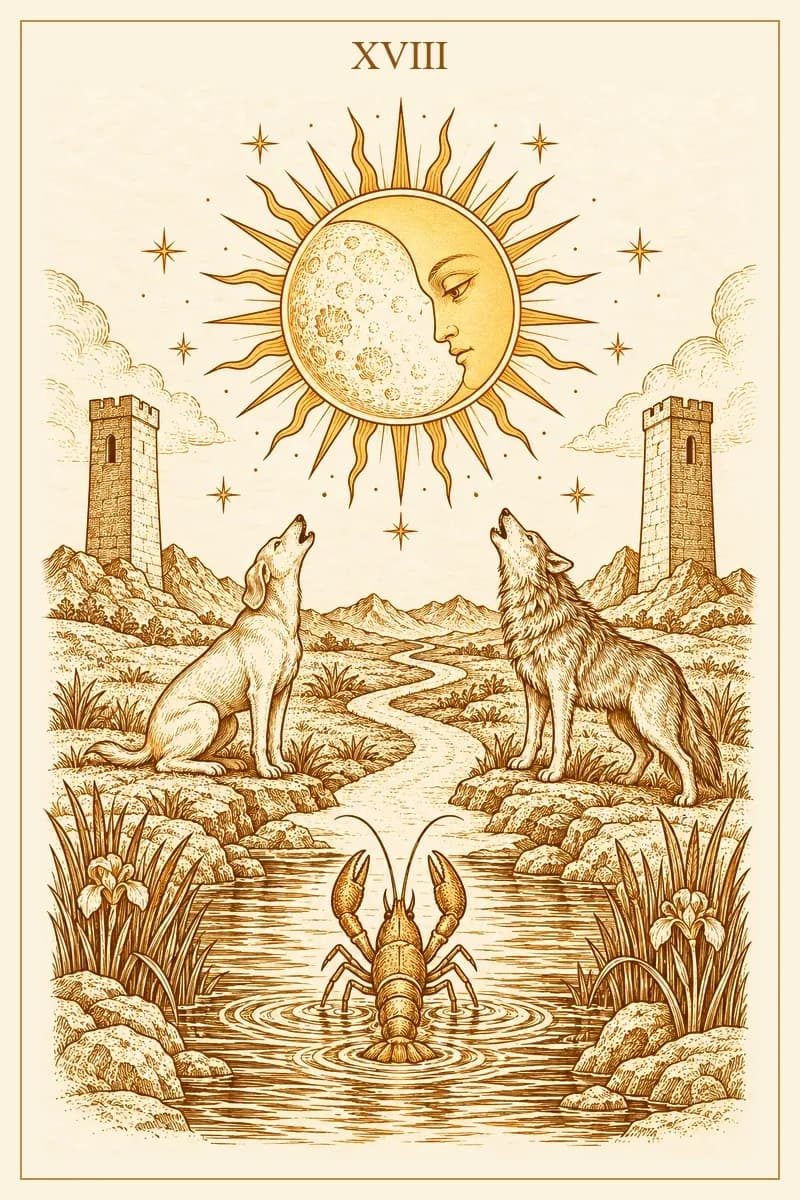
A moon wrapped in sun rays
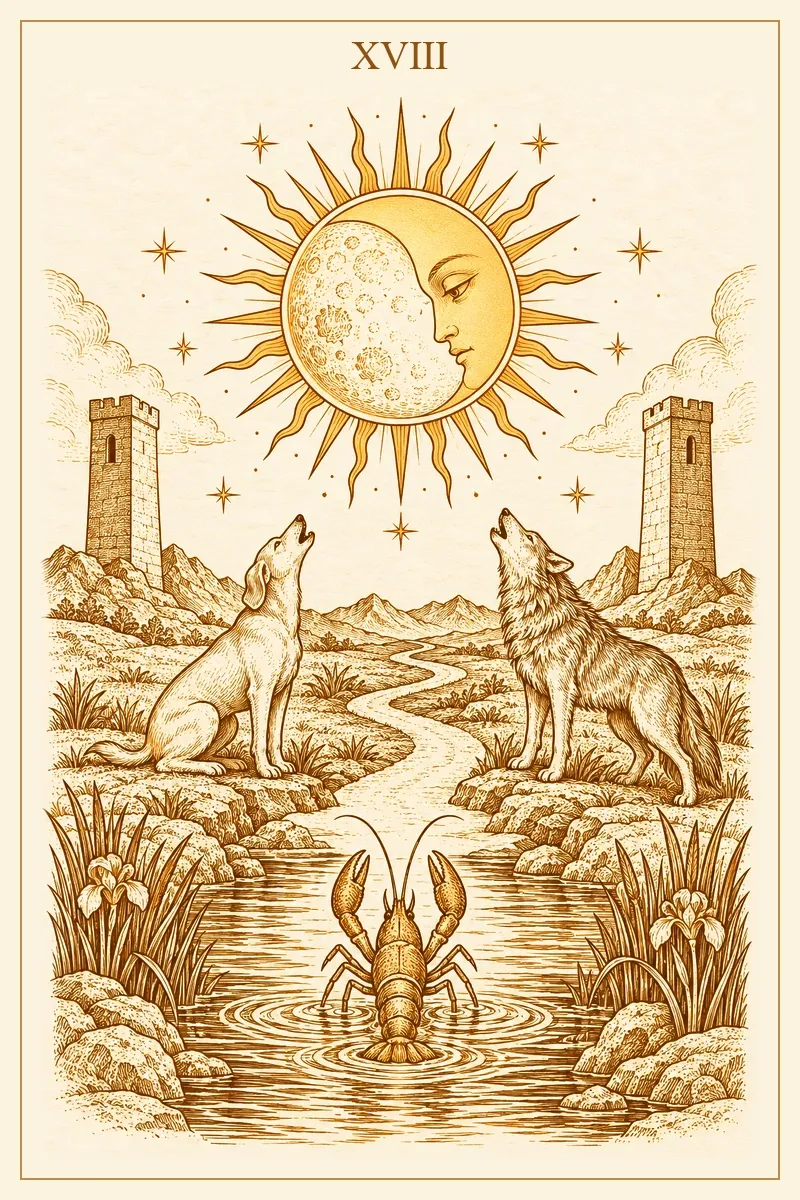
At the top hangs a disk that is two things at once. Its left side is a full moon pitted with craters; its right side is a slim crescent holding a calm face in profile, eyes lowered as if half asleep. The disk sits inside a ring of long, flame-like rays, and small four-pointed stars glitter around it. Those rays are a quiet reminder that moonlight is borrowed sunlight: what you see at night is real, but it reaches you secondhand, softened and partial. That is the heart of the card. You are not blind; you are seeing by reflected light.
The dog and the wolf
Below, a pale dog sits on the left bank with its head thrown back, and a shaggy wolf stands on the right, both howling up at the sky. The dog is the tamed, trained part of you, the one that learned the house rules; the wolf is raw instinct. Under this light neither can settle. Reacting is not wrong, but neither animal is calm, which is why the card speaks to moments when your nerves are louder than your information.
The crayfish in the pool
In the foreground a crayfish climbs halfway out of a rippling pool, claws raised, long antennae arching up. Irises and reeds crowd the banks on both sides. The pool stands for the deep layer of the mind, and the crayfish is whatever is rising from it: an old memory, a dream image, a feeling you have not named. It looks primitive and a little unsettling because it has only just surfaced. It is asking to be noticed, not obeyed.
Two towers and a winding path
Two square stone towers, each with one small window, stand on the hills at the far left and right edges, with clouds banked behind them. Between them a narrow path leaves the water's edge, winds between the dog and the wolf and disappears toward a line of distant mountains. The towers mark the border between familiar ground and wilderness. The path is the only way through, and it bends so often that you can never see more than the next stretch. That is how this card asks you to move: one visible step at a time.
Upright: when the road is lit but not clear
Upright, the card describes a period when the facts are incomplete and your mind is filling the gaps. Messages are ambiguous, plans keep shifting, or someone's behavior does not add up. Because the picture is partial, imagination steps in, and it tends to draw either the worst case or the dream case. Neither is a reliable map.
That is why the upright card is best read as advice about pace. This is a poor moment for irreversible decisions made on a hunch or a fright. It is a good moment for gathering information, asking one more question, sleeping on things and noticing what keeps returning in dreams or quiet moments.
The card also speaks of the unconscious becoming active. Dreams may be vivid, moods may swing without an obvious cause, and memories you thought were settled can resurface. Treat this as material to look at rather than a verdict. Sometimes a dream simply sorts through the day; sometimes it points at something you have avoided naming.
Fear or intuition? Three questions to tell them apart
The real test of this card is telling instinct apart from anxiety, because in the dark the two are hard to separate. These questions help:
- Is it about now or about then? Fear often borrows its script from an older situation. If the feeling is strongly familiar, check whether it fits the present facts.
- Does it get louder or quieter when I gather facts? Anxiety tends to swell the further it drifts from information; intuition usually sharpens when you look closer.
- Does it ask me to act at once, or to wait and check? Panic demands an immediate move. Quiet knowing is patient and survives a day's delay.
None of these is a perfect filter, but they turn a blur of feeling into something you can examine, which is the most useful work to do while this card is in play.
Reversed: the fog thins, or the instincts go quiet
Reversed, The Moon often marks the end of a confusing stretch. Information arrives, a misunderstanding is cleared up, or you realize the scenario you dreaded was built on guesswork. The tension of the upright card loosens, and you can see the shape of the path again. This reversal tends to bring relief.
Truth surfacing
In a question about a secret or a half-explained situation, the reversed card can describe the moment things come into the open. That is not always comfortable; a fact can be disappointing. Still, solid ground under your feet usually feels better than the endless guessing that came before.
Fear losing its grip
Sometimes the change is internal. A worry that ran every evening gets smaller, sleep returns, or you realize a fear belonged to an earlier chapter of your life. The reversed card can describe the morning after a bad dream, when the room looks ordinary again.
Intuition pushed aside
The less comfortable reading: you may be overriding your instincts with pure logic, dismissing a recurring dream, or refusing to admit an uneasy feeling because it is inconvenient. If the reversal arrives with a nagging sense that something is off, take the nagging seriously enough to check. Clarity that comes from ignoring a feeling is not really clarity.
Love, work, money and rest under moonlight
Love: the person or the projection?
Upright in a love reading, The Moon asks whether you are seeing your partner or the story you have built around them. Early dating is especially prone to this: a few messages, a long silence, and suddenly you are interpreting every emoji. In an established relationship, it can point to things left unsaid, mixed signals, or your own past hurts coloring the present. It does not, by itself, accuse anyone of lying. More often it shows that both people are guessing.
Reversed in love, secrets and misunderstandings tend to come out, and the relationship can be seen as it is. Sometimes that confirms the bond is steadier than your fear suggested; sometimes it shows a pattern you no longer want. Either way, the reversed card favors a direct, calm conversation over another round of reading between the lines.
Work: vague briefs and ideas that come at night
At work, the upright card warns about unclear expectations: a job offer whose terms keep moving, a role nobody can quite describe, office rumors filling an information gap. Ask for details in writing and do not sign anything you do not understand. On the brighter side, The Moon favors imaginative work. Writers, designers, musicians, counselors and anyone who works with dreams, images or feelings can do deep work under this card. Reversed, the brief finally makes sense, a rumor is corrected or you see where you fit.
Money: read the small print twice
Financially, the upright card points to missing information: hidden fees, a deal that sounds too good, figures you have not checked. It is a cue to slow down and verify, not to panic. Reversed, the numbers become clearer and you can make an informed choice. For anything with real stakes, a qualified adviser is a better guide than any card.
Rest, sleep and the worried mind
In a reading about rest, The Moon can point to light sleep and a mind that gets busy at night. Read it as a nudge toward rest and gentler evenings rather than a diagnosis. If worry or low mood is persistent or heavy, a doctor or counselor is the right next step; tarot can sit beside that support, not replace it. Reversed, the card can mirror sleep and calm returning.
A spiritual night walk
On a spiritual path, The Moon describes the stretch where old certainties dissolve and new ones have not formed yet. It values dreamwork, meditation and creative practice, ways of knowing that do not run through logic. It also asks for discernment: not every vision is wisdom, and not every confident teacher deserves trust. Test inner experiences against ordinary life and against the people who know you well.
The Moon tarot timing: slow, cyclical and not yet
When the question is "when," The Moon rarely gives a quick answer. Its pace is the pace of a lunar cycle: things wax, wane and come back around. Readers who assign time frames to the Major Arcana tend to read it in one of three ways.
- A lunar month: roughly four weeks, or until the next full or new moon. Treat this as a window for watching, not a deadline.
- Pisces season: about February 19 to March 20, if you use astrological timing.
- After clarification: the most practical reading. Events move once the missing information arrives, so the useful question becomes "what do I still need to know?"
Reversed, the timing usually speeds up a little, because the confusion that was holding things back is lifting. If you want a fuller method, our guide to reading timing in tarot cards compares the main systems and shows how to pick one before you shuffle.
Yes, no or not yet
As a yes-or-no card, the upright Moon reads as "not yet": there is too much you cannot see to commit. If you must answer, it leans toward no for anything you would have to decide blind. Reversed, it leans toward a cautious yes, once you have confirmed the details that just came to light.
The Moon and The High Priestess: two lunar cards
These two are easy to confuse. Both carry moon imagery and both deal with what lies beneath the surface. Yet they describe different kinds of knowing.
The High Priestess
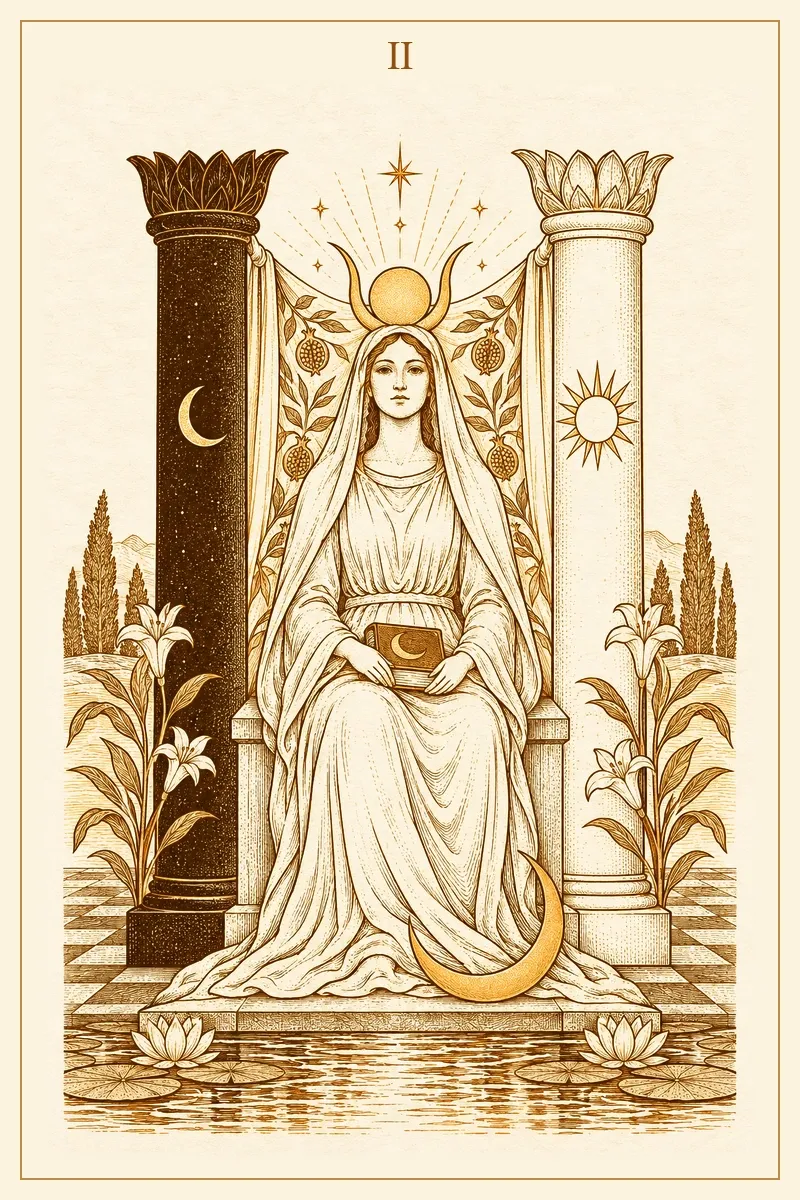
She is seated, perfectly still, between two columns: a black one bearing a crescent and a white one bearing a sun. She wears a veil and a crown of curved horns around a disk, rests a closed book on her lap, and a large crescent lies at her feet above calm water with lotus leaves. In the Golden Dawn system she carries the planet Moon itself, while card XVIII carries Pisces. If the astrology interests you, the article on the planet Moon in tarot explains how that split came about.
The difference is simple to remember. The High Priestess knows quietly and waits; The Moon wanders through the night and feels everything. Her knowing is still water; the night card's is a rippling pool with something climbing out of it. When The High Priestess appears, your inner voice is likely trustworthy and simply needs patience. When The Moon appears, your inner voice is mixed with fear and imagination and needs sorting. The High Priestess tarot meaning covers her own upright, reversed and love readings.
When both lunar cards appear together
Drawn together, the two make a strong case for paying attention to dreams, hunches and what is not being said. The pairing suits journaling, a slower decision and listening more than speaking. Its risk is self-deception dressed up as insight: the more convinced you feel, the more worthwhile it is to check a fact or two. If The High Priestess is reversed beside The Moon, the message is often that a clear inner signal is being drowned out by worry.
Between hope and daylight: The Star before, The Sun after
This card makes more sense when you see its neighbors. The Major Arcana places it between a card of healing and a card of full daylight, so it is a middle passage, not an ending.
The Star
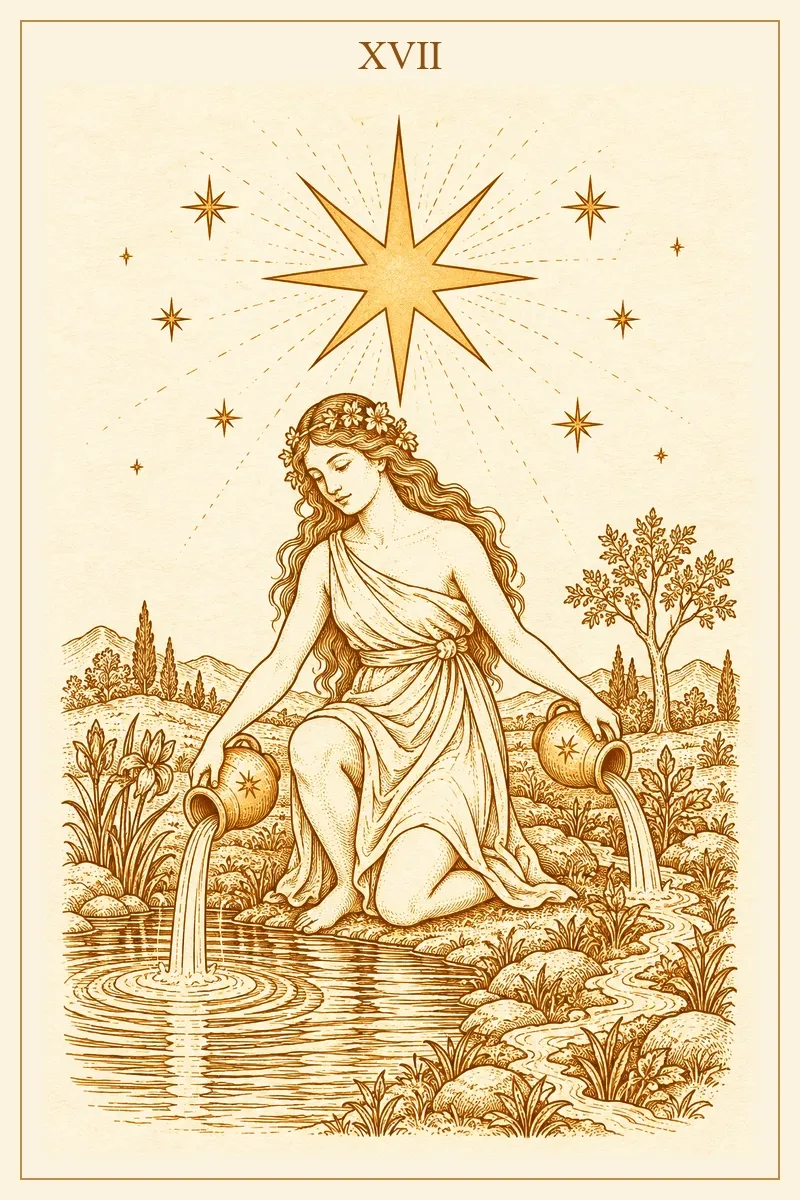
On card XVII, a woman with a crown of flowers kneels by a pool under a large eight-pointed star, pouring water from one jug into the pool and from another onto the ground, where it runs off as a stream. After the shock of The Tower, The Star restores hope. The Moon follows it because hope, once restored, still has to walk through the dark and meet the fears it has not resolved. Together, The Star and The Moon say: keep faith, but keep checking the path. More on card XVII is in The Star tarot meaning.
The Sun
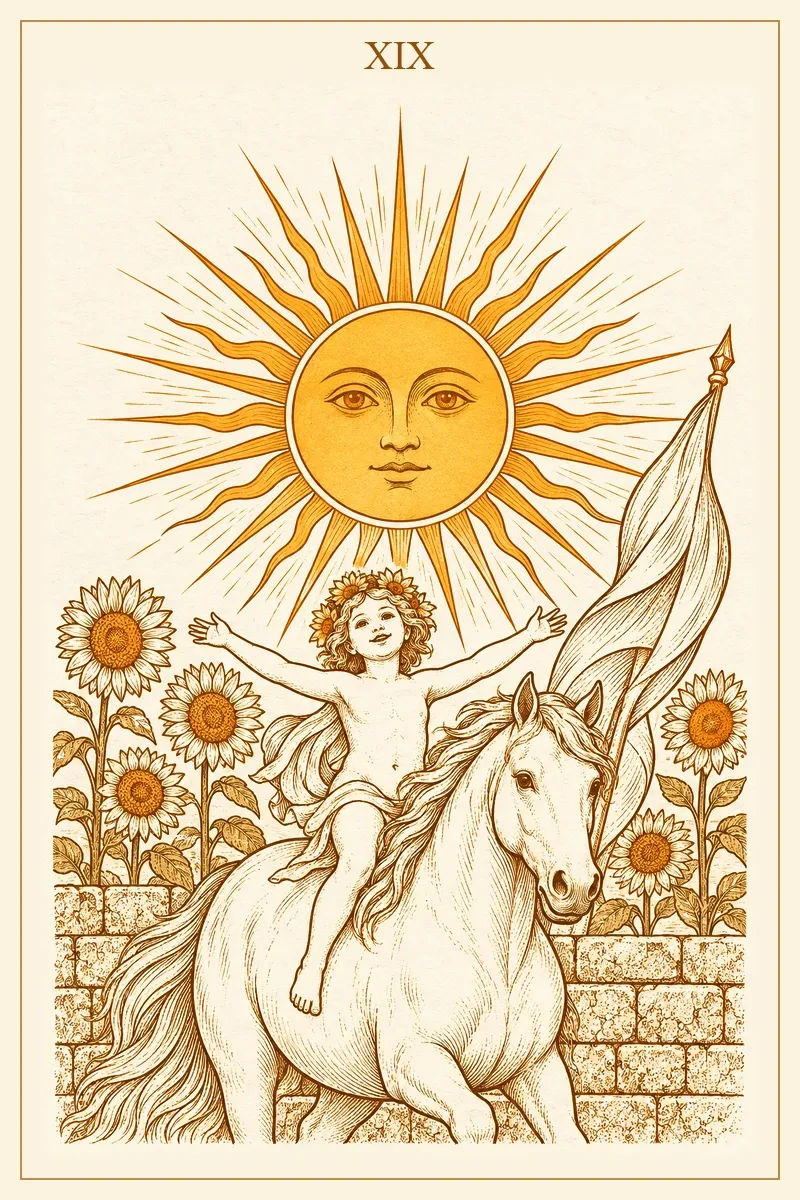
Card XIX answers the night with full light: a broad sun with a calm, open face, a child in a flower wreath riding a white horse with arms spread wide, a large pale banner and sunflowers above a brick wall. Where The Moon shows things half-lit, The Sun shows them plainly. Paired, the two describe confusion that resolves into clarity, often with relief and a lighter mood. Read the Sun tarot meaning for what that daylight looks like in love and work.
Pairings that darken the night: The Tower and The Devil
Some neighbors intensify this card's themes rather than easing them. These two deserve a careful read.
The Tower
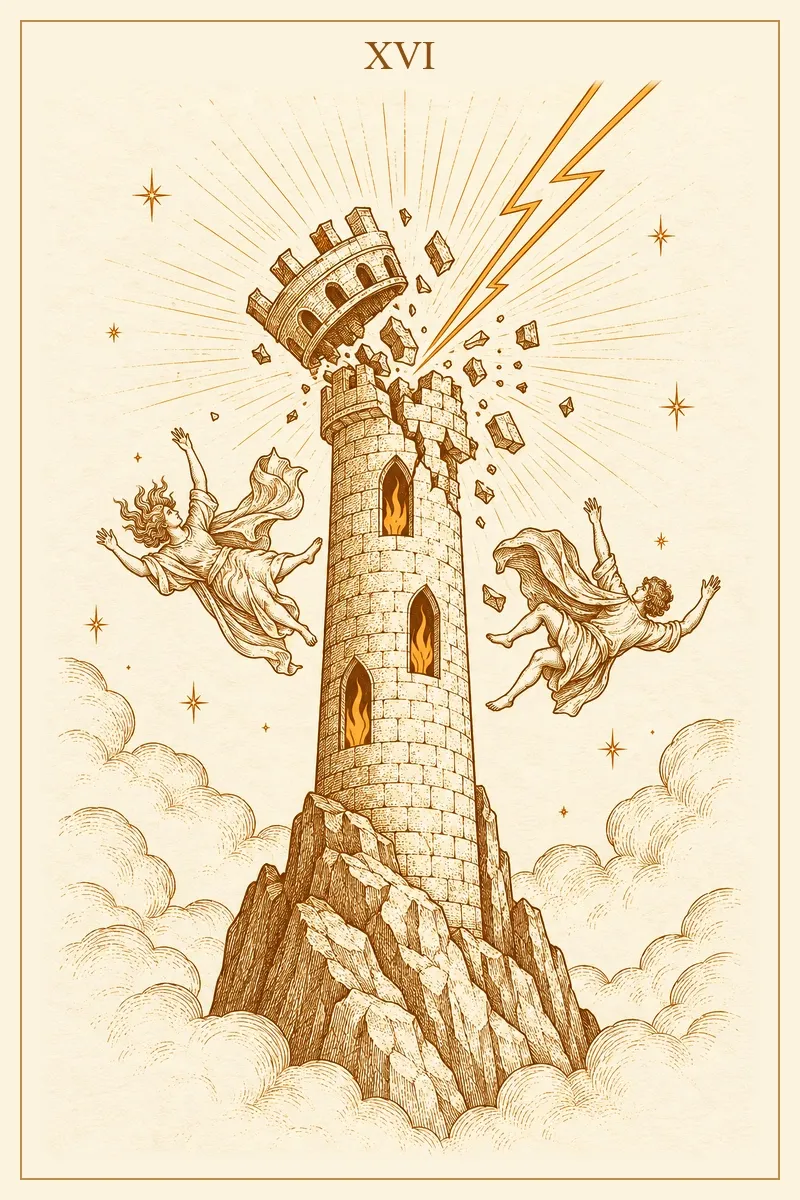
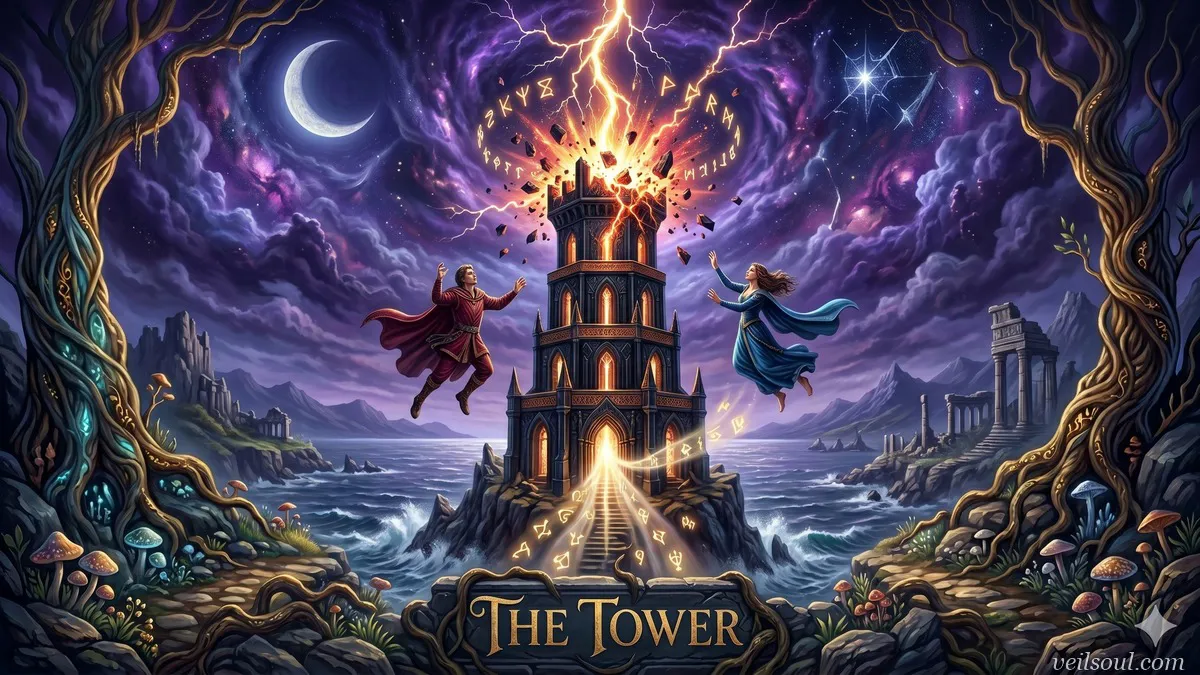
On The Tower, lightning strikes a stone tower on a rocky peak above the clouds; its crown-shaped top breaks away, flames show in its windows and two figures fall through the air amid scattered stones. With The Moon, it suggests an illusion breaking suddenly: a secret coming out all at once, or a shaky arrangement giving way. It is jarring, yet what falls was usually built on a misunderstanding. The Tower tarot meaning explores how to steady yourself after that kind of shake-up.
The Devil
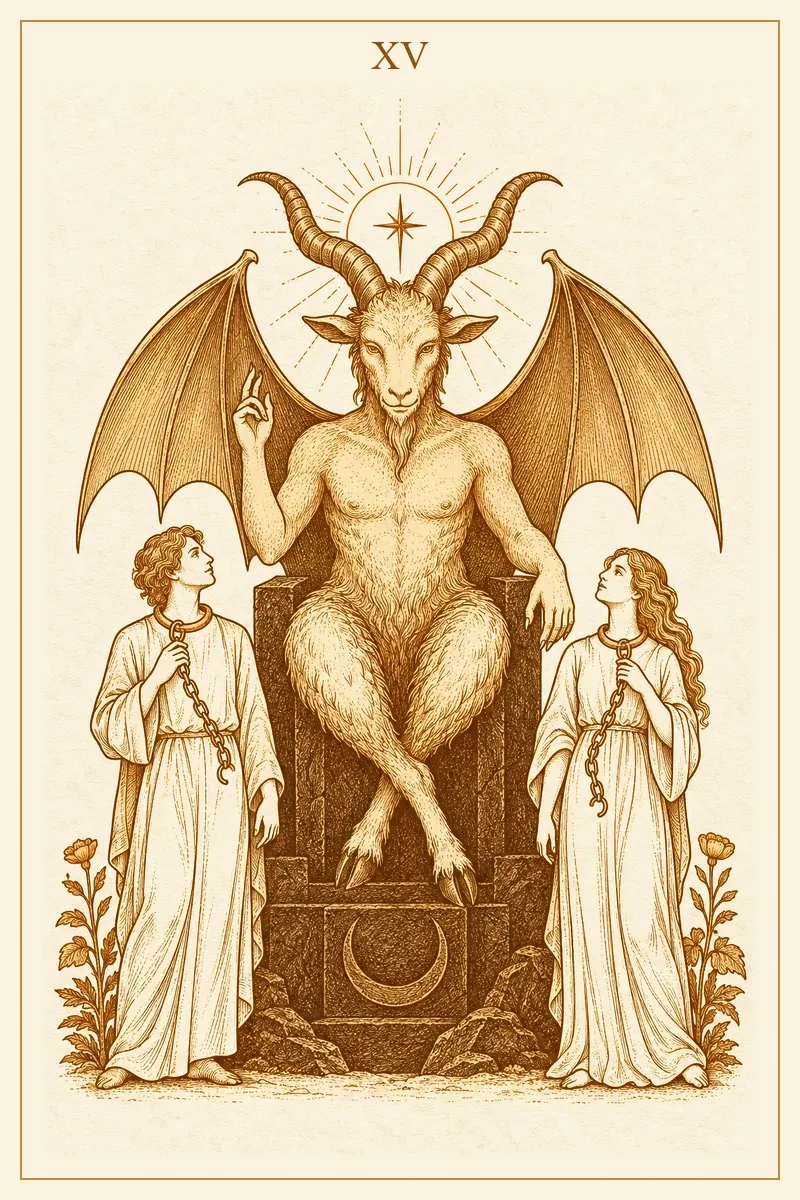
The Devil shows a horned, bat-winged figure seated on a dark stone block carved with a crescent, one hand raised. A man and a woman in long robes stand to either side, each wearing a collar and holding their own chain in hand. That detail matters: the bond is one they could loosen. Next to The Moon, the card points to a pattern that runs in the dark, such as a habit, an attachment or a story you tell yourself because it feels safer than the truth. What helps is honesty and, where needed, support from others. See The Devil tarot meaning for its fuller reading.
Two minor cards also echo The Moon closely:
- Seven of Cups: many tempting options, none of them tested; with The Moon, a firm warning against choosing from fantasy.
- Nine of Swords: worry that peaks at night; with The Moon, a sign that anxiety is magnifying what you see.
The moonlit path spread
This four-card spread borrows its positions from the card's own picture. Use it when a situation feels murky and you want to separate fear from instinct before you choose.
- The pool: what is rising to the surface right now.
- The dog: the familiar, cautious part of you and what it is warning about.
- The wolf: the wild instinct and what it wants to do.
- The path: one step you can take and check in daylight.
Sample reading: a contract role with shifting terms
Imagine someone who has been offered a six-month contract. The recruiter is friendly, but the start date and the pay have already changed twice. The question: "What am I not seeing about this offer?"
The pool: Five of Pentacles. What is surfacing is an old fear of money running out, perhaps the memory of a lean year. It explains the urge to accept anything quickly, and it belongs partly to then, not now.
The dog: Page of Swords. The cautious side wants to ask questions. Its alertness is not paranoia; it is curiosity doing its job.
The wolf: Knight of Wands. The instinctive side wants to leap, say yes and sort out the details later. That energy is useful, but here the fear in the pool is feeding it.
The path: Ace of Swords. The step is a clear, written statement of terms. Ask for the contract in writing before deciding.
Read together, the spread does not say "accept" or "refuse." It says the decision will be easier once the terms stop moving, and that the rush to say yes comes more from an old fear than from the offer itself. That is very much this card's way: not a prediction, but a better question.
Living with The Moon in the days after it appears
- Split facts from guesses. Draw two columns: what you know and what you assume. The second column is usually longer than you expect.
- Keep a dream note. Jot down anything vivid on waking for a week; patterns matter more than one strange night.
- Ask one clarifying question. Choose the person or source that can actually answer it, and ask plainly.
- Delay what can be delayed. If a big decision can wait until the next new or full moon, let it.
- Talk it through. Saying a fear out loud to someone you trust often shrinks it to its real size.
Questions to journal with:
- What am I not seeing clearly, and who could tell me?
- Is this fear about the present situation or an older one?
- What has my intuition said more than once that I keep dismissing?
If The Moon keeps returning in your readings, it may be inviting a longer look inward, and tarot for self-discovery offers gentle practices for that kind of slow work.
Frequently asked questions
Is The Moon a good or bad card?
Neither. It is an uncomfortable card because it describes uncertainty, but it also protects you from deciding too fast and opens the door to imagination and intuition. How it turns out depends on how carefully you move while it is in play.
Does The Moon mean someone is lying to me?
Not necessarily. It shows that something is unclear, and that can come from deception, but just as often from silence, mixed signals or your own fears. Tarot cannot see into another person's mind, confirm a hidden fact, give an exact date or guarantee how things will end. Use the card to notice what you need to ask, then ask the person directly.
What does The Moon reversed mean in love?
Usually that confusion is clearing: a misunderstanding is resolved, an unspoken issue comes out or you stop projecting old hurts onto a new partner. Occasionally it warns that you are looking away from a feeling you would rather not have.
What zodiac sign is The Moon tarot card?
Pisces, the mutable water sign of dreams, empathy and dissolving boundaries. The planet Moon, by contrast, is assigned to The High Priestess in the Golden Dawn tradition behind the Waite-Smith deck.
How is The Moon different from the Seven of Cups?
The Seven of Cups is about too many attractive options and daydreaming among them. The Moon is broader and deeper: it covers fear, dreams and the unconscious, not just tempting choices. The Seven of Cups asks "which of these is real?"; The Moon asks "what is happening beneath what I can see?"
What does The Moon mean as someone's feelings?
In a feelings position, it suggests emotions that are strong but unclear, perhaps attraction mixed with hesitation, or a worry the person has not voiced. It is a cue to ask, not to assume.
A small light for the next bend
The Moon never asks you to see the whole road, only the next bend. When you want to look at a murky situation of your own, a calm reading with Veil Soul can help you lay out what is known and what is still in shadow.