Despite its name, Death almost never points to anyone dying. The Death tarot card means an ending that clears the way: a chapter, role, habit or version of a relationship has run its course, and closing it makes room for what comes next. Upright, it asks you to let that ending finish; reversed, it shows you holding shut a door that is already trying to close, so the change drags on longer than it needs to.
No card can tell you when an ending will arrive, how another person will choose, or what will happen to anyone's health. What Death can do is name what is already finishing, so you can meet it with open eyes instead of bracing against it.
- Upright keywords: endings, transformation, release, transition, clearing.
- Reversed keywords: resisting change, stagnation, a half-finished transition, clinging, delay.
- Love: the old shape of a relationship ends, whether that means a breakup or a deeper way of being together.
- Career: a role or way of working has reached the end of its useful life; restructuring or a move.
- Yes or no: no to keeping things as they are; yes to the change that follows.
- Number and correspondences: XIII; Scorpio, the element of Water and the Hebrew letter Nun.
Why Death so rarely means dying
Death has a frightening name and a skeleton on its face, and films have used it as shorthand for doom, so many people freeze when it lands on the table. Experienced readers see something else: a change of state, where something stops being what it was. A season ends, a lease runs out, a title is handed back, a story you told about yourself stops fitting.
That is also why Death sits in the middle of the Major Arcana rather than at the end. The sequence keeps going after card XIII, through healing, shadow, upheaval and hope to completion, so an ending here works like a hinge, not a full stop. If several cards in one spread unsettle you at once, the guide to scary tarot cards and what they really mean walks through the others with an alarming reputation.
One situation deserves extra care. If you are grieving an actual death and draw this card, it is not a message about the person you lost and not a warning about anyone else. It may simply mirror a loss that is changing your life whether you want it to or not. A gentler practice for that season is described in tarot for grief and loss, and the people around you, or a counselor, matter more than any spread.
The rider beneath the rose banner: what card XIII shows
The skeleton and the white horse
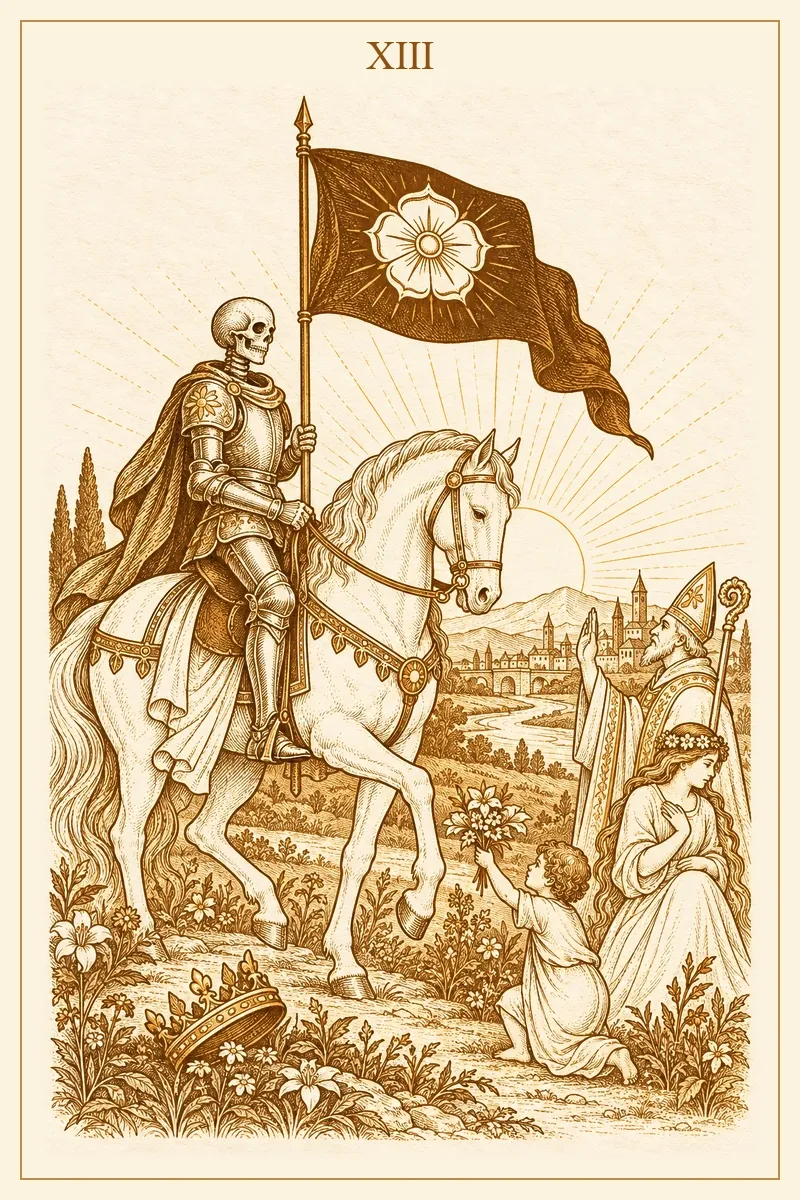
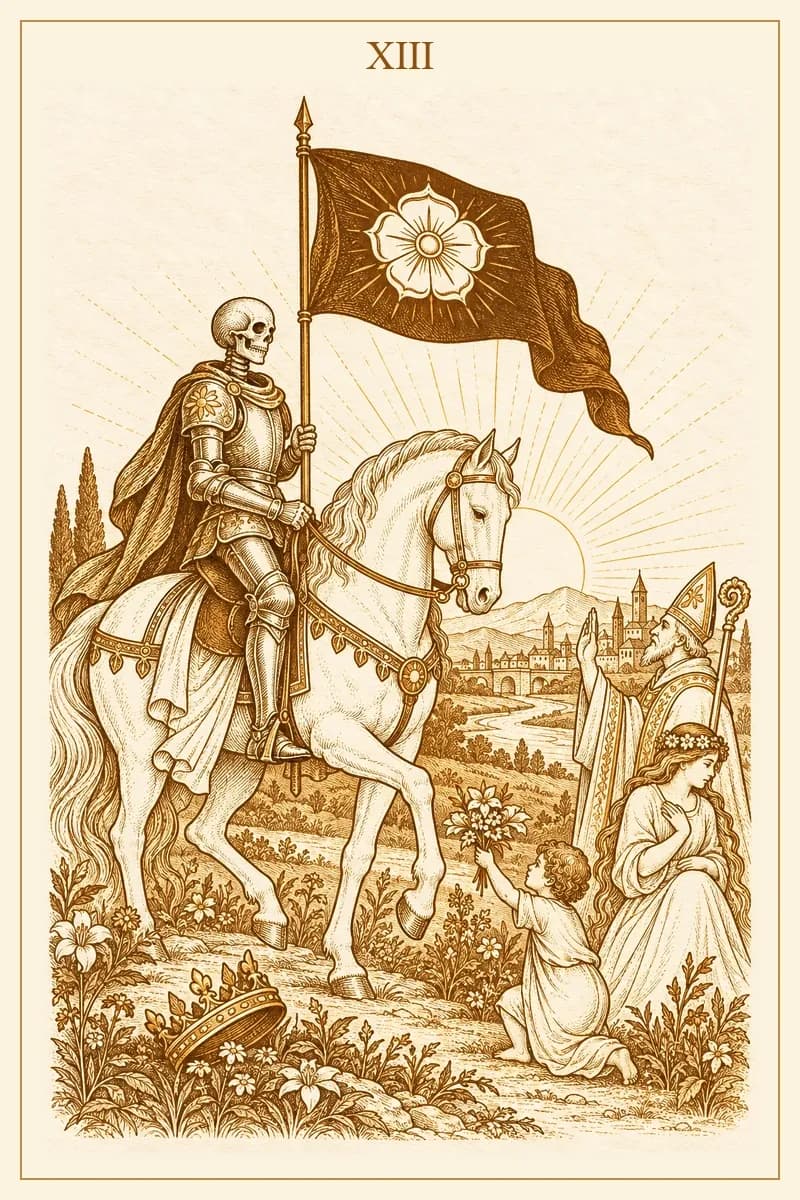
The main figure is a skeleton in plate armor, a heavy cloak falling from its shoulders, riding a pale horse from left to right. It holds a tall lance upright, and from it flies a dark banner marked with a large white rose of five petals, drawn with fine rays around it as if the flower were giving off light.
The skeleton is what remains when everything changeable has gone: no face to read, no expression to bargain with, and armor that cannot be argued away. Yet the horse is calm. Its head is lowered and one foreleg is lifted mid-step. Death in this picture does not charge. It walks, at the steady pace endings usually keep in real life, and the rose on the banner says it carries renewal as much as loss.
A fallen crown, a bishop, a woman and a child
In the foreground, just below the horse's hind hooves, a golden crown lies tipped over in the grass. No king is shown, only the symbol of rank, already on the ground: status, control and the roles we wear are the first things this card takes.
To the right, three figures meet the rider in three different ways. A bishop in a tall miter, holding his crozier, raises a hand toward the skeleton as if to plead or negotiate. A young woman in a wreath of flowers kneels with one hand on her chest and her eyes lowered, neither fleeing nor reaching out. In front of her, a small child kneels on the path and holds up a bunch of lilies to the rider, unafraid.
Together they map how people respond to change: bargaining, quiet grief and simple acceptance. The card scolds none of them. It asks which one you are being right now.
The sun on the horizon and the winding river
Behind the figures, a river winds through fields toward a town with towers, low hills rising behind it, and beyond it the sun sits on the horizon, throwing long rays across the sky. Whether it is rising or setting is left open, and that is the point: the same light can look like an ending or a beginning, depending on where you stand. Lilies and wildflowers fill the ground at the horse's feet, and slim cypress trees, long planted beside graves as a sign of what endures, rise at the left edge.
Death upright: letting a chapter finish
Upright, Death says something in your life has reached its natural end and is ready to close. It might be a job you have outgrown, a relationship that has stopped growing, a home, a friendship that belongs to an earlier version of you, or a belief you no longer act on. The card rarely describes a random blow. More often it names a change that has been coming for a while, one you may already sense.
Its core advice is to cooperate. Endings tend to happen whether or not we agree to them; what we choose is how hard we fight. Letting go deliberately, with a proper goodbye, usually hurts less and finishes sooner than being dragged out of a situation that has long been over.
Clearing, then a quiet space
Death upright often brings an in-between stretch: the old thing is gone and the new one has not arrived. That gap can feel empty, but it is part of the card's meaning, not a sign that something went wrong. Fields lie fallow before they are planted. Grief belongs here too, since even a welcome ending leaves you missing the people and routines attached to it. Use the space to rest, take stock, and notice what you actually want to bring with you.
Death reversed: holding a door that wants to close
Reversed, the ending is still there, but something stands in its way. Usually that something is you, or the part of you that fears the unknown more than it dislikes the present. The relationship is over in everything but name, yet the messages keep going out. The job wears you down, yet you renew the contract because leaving feels like failure.
Clinging to what has already ended
A classic reading of reversed Death is resistance: you can see what needs to change and you are not allowing it. The card is not harsh about this; fear of change is human. It does point out the cost. Kept going past its time, a situation goes flat, the same arguments and the same Sunday-evening dread on repeat, and the energy spent propping it up is unavailable for anything new.
Halfway through the change
Sometimes the reversal shows a change that started and then stalled. You have resigned in your head but not on paper, moved out but not unpacked, ended the relationship but not the hope. The way forward is to finish one concrete step rather than reopen the whole decision.
A narrow escape, or an ending postponed
A gentler reading also exists: an ending that was close has been put off, or a loss you feared did not happen. Treat it as extra time, not as proof that nothing needs to change, and ask what you want to do with the reprieve.
Death in a love reading: the old shape of the relationship
The question most people bring to Death in love is whether it means a breakup. Sometimes it does. Just as often a way of relating is ending while the relationship continues: the first rush giving way to something steadier, a long-distance arrangement ending because you move in together, a couple dropping a habit of avoidance after a hard conversation.
In a relationship
Upright, ask what in your partnership has run its course. It might be an unspoken rule, a role one of you has outgrown, or a story about how the two of you "always" are. If both people are willing, the relationship can come through changed and more honest. If only one is, the card may be describing a real parting, and it asks you to let that be clean and kind rather than drawn out.
Single, or after a breakup
For someone single, Death often points to the end of an old attachment: lingering hope for an ex, a type you keep choosing, a picture of love formed years ago. Clearing that space is not the same as a new person arriving, but it is usually the step that comes first. Fresh from a split, the card says the ending is real; look after yourself while it settles instead of rushing to fill the gap.
What Death says about someone's feelings
When the question is how another person feels, Death suggests their feelings are in transition. They may be closing a chapter of their own, or their view of you may be shifting in ways they have not yet put into words. Reversed, it can describe someone who knows something has ended but has not admitted it, or who is holding on out of habit. Their words and actions will tell you more than any card.
Reversed in love
Reversed in a love reading, Death tends to show one or both people refusing to let a dynamic end: trying to revive something long gone, or freezing a relationship in its early form because change feels like loss. Ask what you are protecting by not letting it change.
Death in a career reading: when a role has run its course
At work, Death is one of the clearest cards for "this chapter is ending." It can describe leaving a job, a team being dissolved, a restructuring, finishing a degree, closing a business, or simply the moment you realize a career no longer fits the person you have become. Upright, it tends to favor the change: the role that ends is often the one that was holding you in place.
Upright at work
Look for what has stopped growing. Are you still learning anything here? Would you apply for this job if you saw it advertised today? Death upright suggests acting on the answer: revising your plans, having the conversation, setting an end date for a project kept alive past its usefulness. If you are weighing a bigger move, the practical guide to reading tarot for a career change lays out spreads for comparing options.
Layoffs and endings you did not choose
Sometimes someone else decides the ending: a department closes, a contract is not renewed. Death here does not say you deserved it or that it is secretly good. It says the old arrangement is truly over and your energy now belongs to the next step, including a short, honest period of grief for a place that mattered.
Reversed at work
Reversed, Death often describes staying in a role that has already ended in spirit. You go through the motions without growth or meaning, but leaving feels too risky. The card does not demand that you quit tomorrow. It asks for one move that stops the drift, such as a talk with a mentor, a course, or a written plan with a date on it.
Money, health and the inner life
Money
Financially, Death upright can describe closing an account, ending a spending habit, paying off a long debt, or rethinking a household budget. Reversed, it warns against holding on, out of pride or habit, to an arrangement that is quietly costing you. Real financial decisions belong with a qualified adviser; the card highlights the attitude you bring to them.
Health and wellbeing
In a health question Death does not foretell illness or death. Read it as a change of habit or approach, such as dropping a routine that no longer works. Reversed, it can point to resisting a change your body or your doctor has already asked for. Medical questions belong with a medical professional, not a deck of cards.
Spiritual growth
Spiritually, Death is the card of shedding an identity. Labels you wore, roles you defended and stories about who you are allowed to be can fall away, leaving something simpler and truer. If this side of the card speaks to you, tarot for self-discovery offers spreads that keep that inner work grounded.
Thirteen in sequence: Scorpio, Nun and the cards on either side
In the Golden Dawn system that shaped most modern decks, Death is linked with Scorpio, a fixed Water sign of depth and regeneration, and with the Hebrew letter Nun, often translated as "fish." Its old title is the Child of the Great Transformers, Lord of the Gate of Death. Modern astrologers give Scorpio to Pluto as well, which is why Pluto often turns up in descriptions of this card. In some historical decks card XIII carried no name at all, as if the word were too heavy to print.
Its neighbors explain it well. Before it comes The Hanged Man, the card of pausing and surrendering control; Death completes what that surrender began, as the full Hanged Man tarot meaning describes. After it comes Temperance, the slow work of blending and healing once the clearing is done, explored in the Temperance tarot meaning guide. Seen as three steps, the story runs: let go, let it end, then rebuild with care.
Yes, no, and how long an ending takes
As a yes-or-no answer, Death upright is a no to keeping things exactly as they are, and often a yes to the change itself. Ask "Will this stay the same?" and the answer is no; ask "Should I move on?" and the card leans yes. Reversed, the outcome stays stuck until someone lets go of the old form.
Timing is harder. Death describes a process, not a date, and processes like this tend to unfold over weeks or months. Treat the card as a sign of where you stand in the cycle, near the start of an ending, in the middle, or close to its end, rather than as a countdown.
Cards that change Death's ending
Nearby cards shape what kind of ending Death describes, and what follows it.
With The Fool: the clean slate
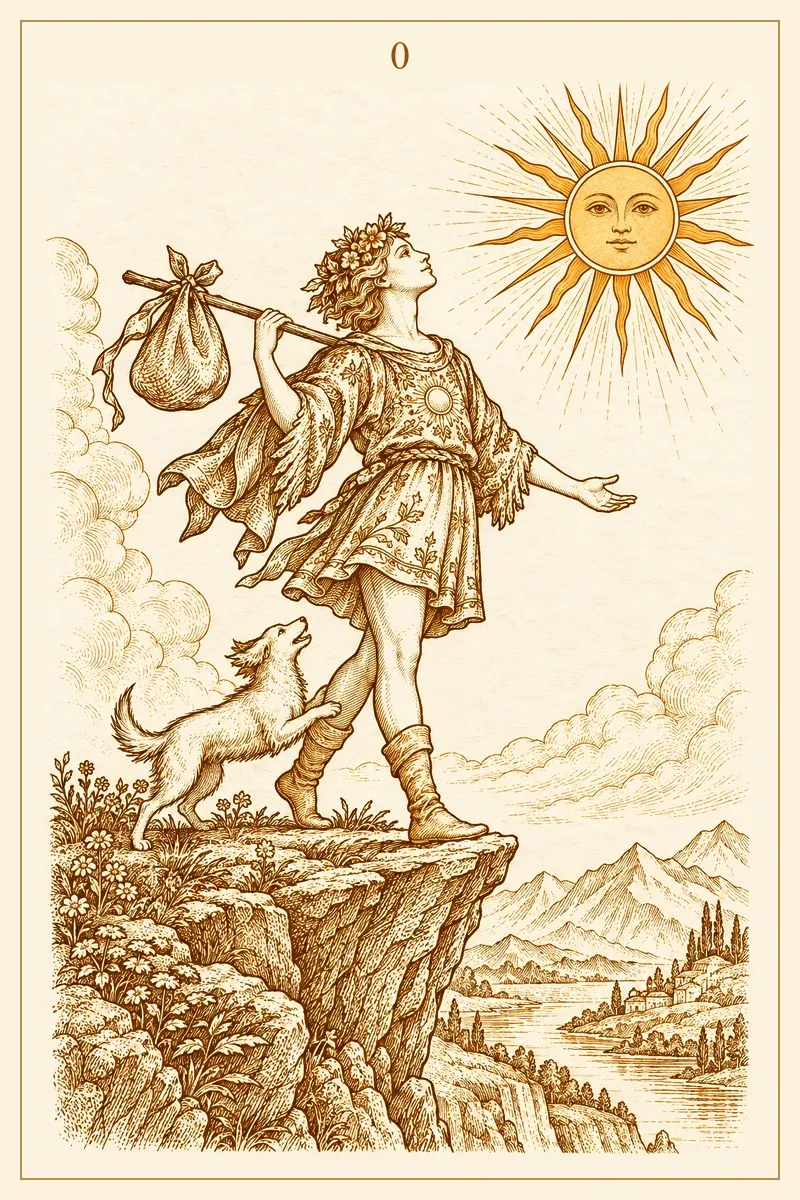
The Fool beside Death shows the whole cycle in two cards: one door closes and a blank road opens. It is a strong pairing for someone leaving a long chapter, such as a move abroad or a career restart, and it favors curiosity over caution once the goodbye is said. The Fool tarot meaning explores that fresh start in depth.
With Strength: the courage to let go
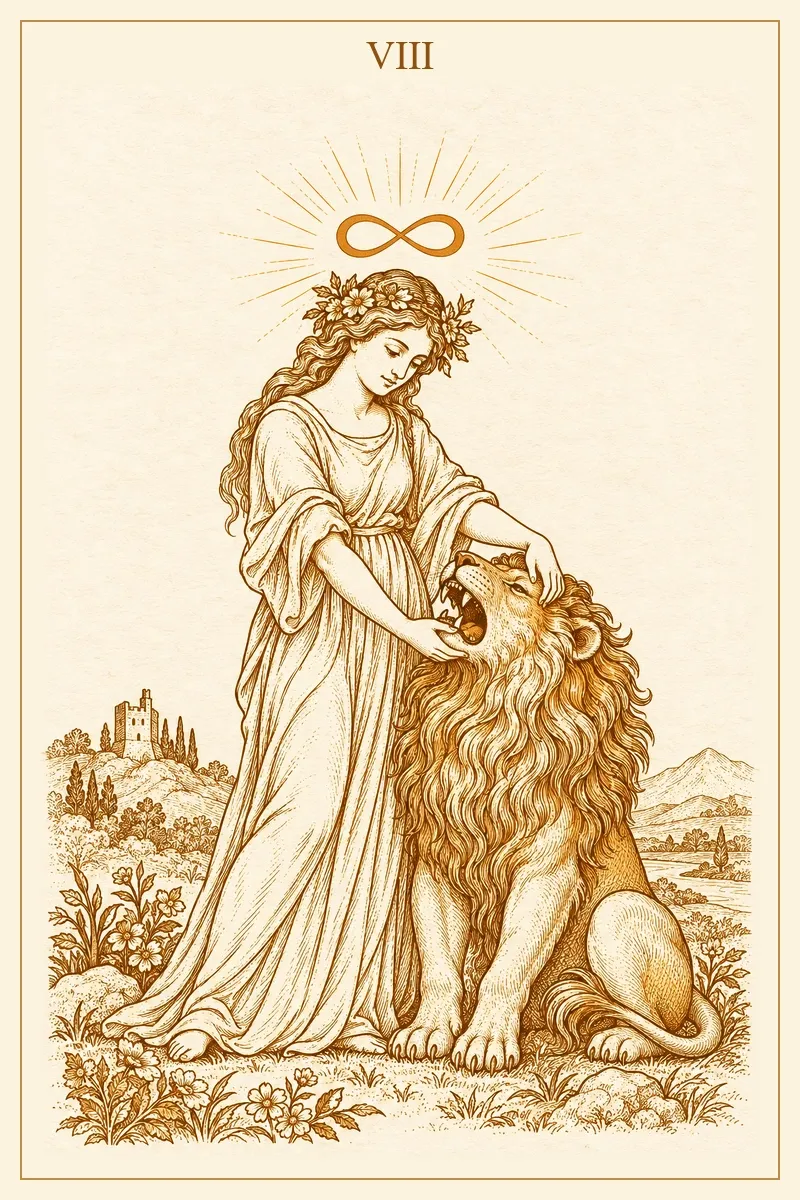
Strength adds the patient courage endings require. Together they suggest you are more able to face this change than you fear, and that gentleness with yourself, not force, carries you through. More on that steadiness appears in the Strength tarot meaning.
With The Sun: warmth after a hard ending
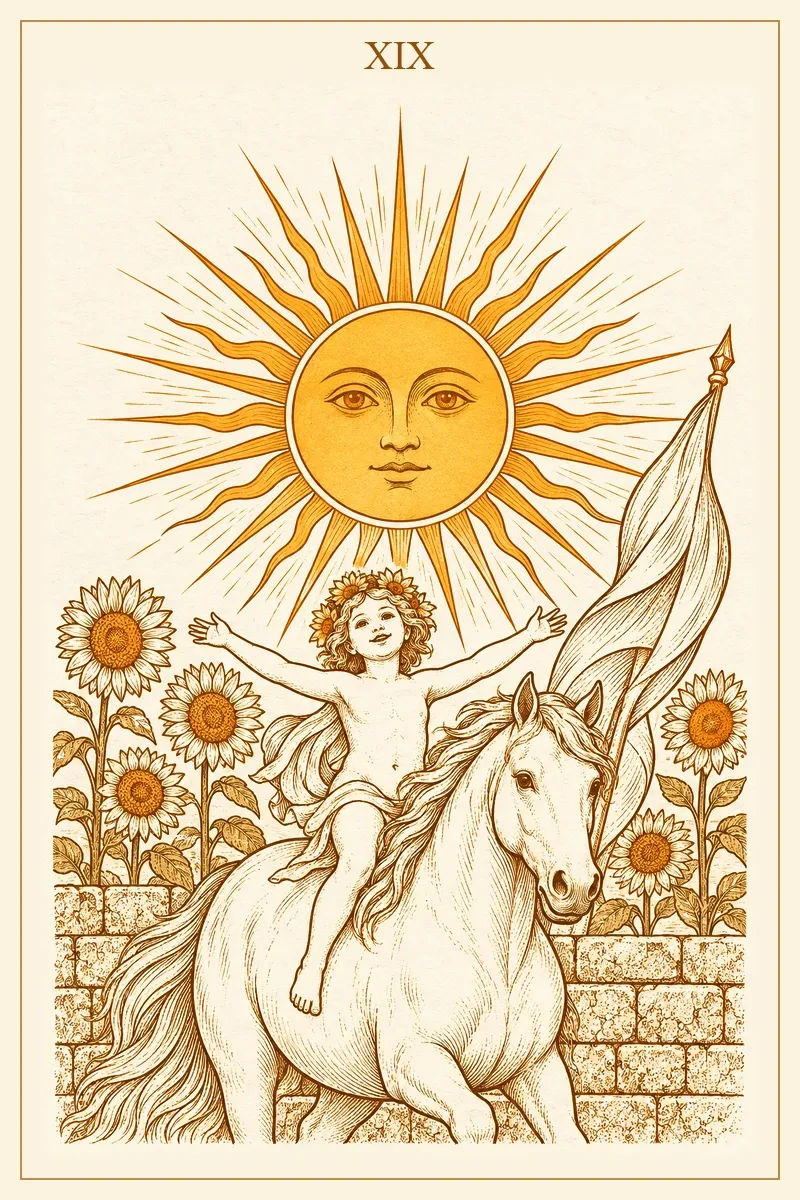
The Sun is one of the most hopeful companions Death can have. The rays on card XIII's horizon become full daylight: a difficult ending leads to relief, clarity and renewed energy. In a love or career reading, this pair often describes being glad, afterward, that something ended.
With The Tower: two kinds of change
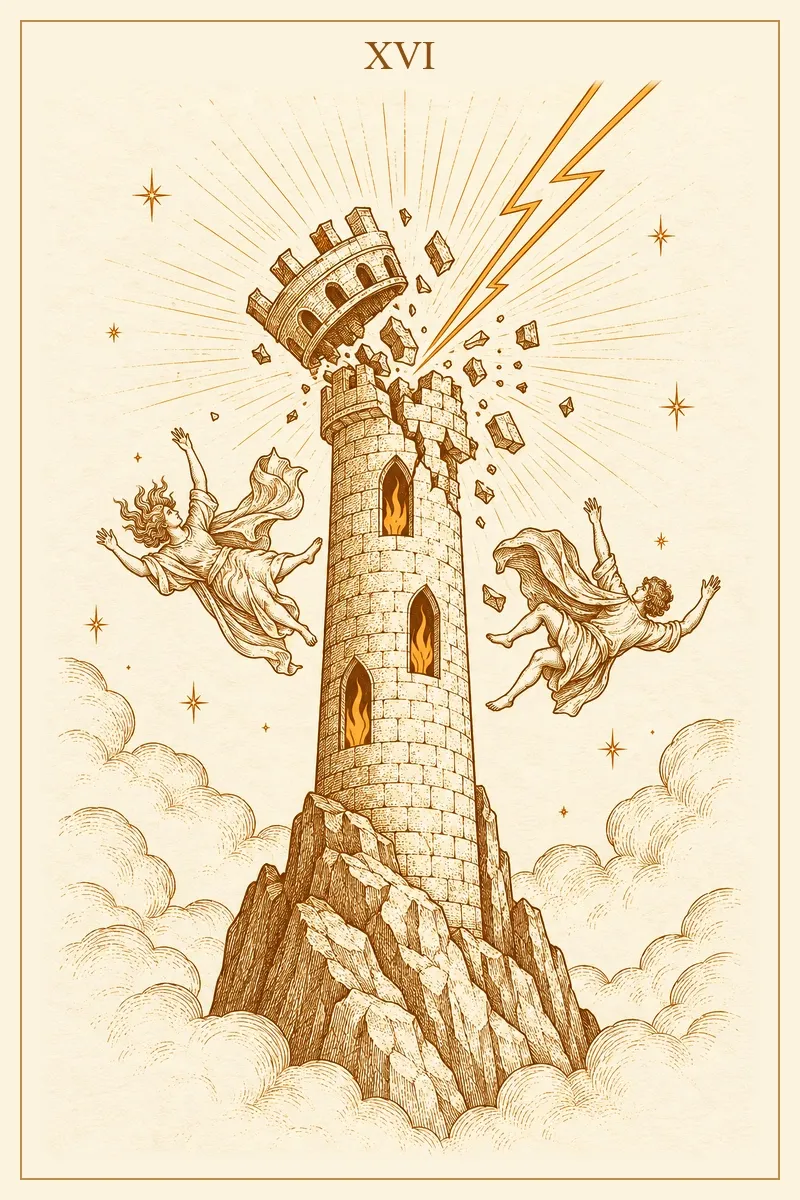
The Tower is often confused with Death. The Tower is sudden and external, a structure collapsing at once; Death is gradual and inevitable, a chapter reaching its natural close. Side by side they describe an upheaval that ends a whole phase, and they ask you to take things one step at a time and lean on steady people.
With an Ace
Any Ace beside Death shows a new beginning growing straight out of the ending: the Ace of Cups for a new emotional start, the Ace of Wands for a fresh project or burst of drive, the Ace of Swords for a clear new idea, and the Ace of Pentacles for a tangible opportunity.
The Banner Spread: four positions taken from the card
This spread follows the figures on card XIII. Shuffle with a situation in mind that feels as if it is ending, then lay four cards in a row.
- The fallen crown: what is already ending, whether or not you have accepted it.
- The bishop's raised hand: what you are still bargaining to keep.
- The child's lilies: what you can accept, or offer, as the change unfolds.
- The sun on the horizon: what this ending makes room for.
Read positions one and two together first: the gap between what is ending and what you want to save often holds the real question. Then let the last two cards show the way through.
A worked example: twelve years in the classroom
This is a hypothetical reading. A high school science teacher with twelve years in the job draws Death as a morning card, feels uneasy, and lays out the Banner Spread with the question "What is ending in my working life, and what comes after it?"
- The fallen crown: Ten of Wands, upright.
- The bishop's raised hand: Four of Pentacles, upright.
- The child's lilies: Six of Cups, upright.
- The sun on the horizon: Three of Wands, upright.
The Ten of Wands shows what is finishing: not teaching itself, but the way this teacher has been carrying it, with extra duties stacked on year after year until the load hides the work they love. The Four of Pentacles in the bargaining position names what they are clutching: the pension, the title, the predictable calendar. Those are real concerns, and the card does not dismiss them, but it shows how tightly they are held.
The Six of Cups is the tender part of the spread, pointing to what can travel: patience, care for young people, the delight of a good question from a student. The Three of Wands on the horizon shows plans beyond the current shore, such as designing a curriculum, training newer teachers, or education work outside a school.
Taken as a whole, the reading is no instruction to resign. It says the overloaded version of the role is ending, and that the teacher can choose how. A practical next step would be to list the duties they could hand back this term, then talk with two people working in the fields the Three of Wands brought to mind before deciding anything larger.
Questions to ask when Death turns up
- What in my life has already ended that I am still trying to keep alive?
- Which figure on the card am I right now: the bishop bargaining, the woman grieving quietly, the child holding out flowers, or the crown in the grass?
- What am I afraid will happen if I let this go?
- What would a clean, kind goodbye look like here?
- What do I want to carry into the next chapter, and what can stay behind?
Frequently asked questions
Does the Death card mean someone is going to die?
No. In readings, Death stands for endings and transformation, not physical death. Tarot cannot predict a death, a diagnosis or any fixed future event; it reflects patterns and choices in the present. If you are worried about your health or someone else's, talk to a doctor.
Is Death a good or a bad card?
Neither. It is a card of necessary change, and many readers are glad to see it because it often marks the end of something that was holding someone back. How it feels depends on how tightly you are holding what is ending.
What does Death mean reversed?
Reversed, Death usually points to resisting a change already under way, a transition stuck halfway, or stagnation from holding on. Occasionally it means an ending has been postponed. Either way, it asks what you are keeping alive out of fear.
What does Death mean in a love reading?
It shows the end of an old form of the relationship: a breakup, or a couple leaving a pattern behind so the bond can deepen. As feelings, it suggests the other person is in transition, though only their actions show where they truly stand.
Is Death a yes or a no?
Upright, it is a no to things staying the same and usually a yes to change. Reversed, it suggests no clear answer until something is released.
Why does Death keep appearing in my readings?
Repeated appearances often point to an ending you have not fully acknowledged. Look for a conversation or decision you keep postponing. Once you face it, the same card tends to read quite differently.
Where the crown fell, flowers grow
Death is the card of one door closing so another can open. Let what has finished be finished, grieve what deserves grieving, and keep what you want to carry forward. When you are ready to look at your own situation, you can start a reading with Veil Soul and see which chapter is closing for you.