Building confidence with tarot works best as a small practice you repeat, not a verdict you wait for. The tarot cards most useful for confidence are Strength and The Sun, along with the four Queens, because each one pictures a different kind of self-trust: steady courage, being seen, bold presence, emotional security, a clear voice and practical competence. Draw one, name the strength it points to in your own life, then do one small thing today that puts that strength to use.
A deck cannot tell you whether you will get the role, how a date will go, or what other people privately think of you. What it can do is slow the inner critic down long enough for you to look at the evidence. If low confidence has settled in for months, or it shapes your sleep, your work or your relationships, a counselor or therapist can help in ways a reading cannot, and the practices below sit comfortably alongside that support.
The sections that follow look at Strength and The Sun, then at the four Queens as four styles of confidence, the cards that only look discouraging, a four-card layout with a worked example, and habits that carry a reading into the rest of your week. If what you are facing feels more like a loud inner critic than a lack of courage, our guide to tarot for self-doubt works on that side of the problem.
Here are the cards to reach for, each in one line:
- Strength: patient courage that does not need to shout.
- The Sun: letting yourself be visible and enjoy it.
- Queen of Wands: bold presence; taking up room.
- Queen of Cups: trusting your feelings without being ruled by them.
- Queen of Swords: a clear, honest voice.
- Queen of Pentacles: quiet competence in daily life.
- The Chariot: momentum that comes from choosing a direction.
- Seven of Wands: holding your ground when someone pushes back.
Why a deck helps self-trust grow
Confidence is less a trait you either own or lack than a relationship with yourself, and relationships change with attention. Tarot offers four kinds of attention that tend to help.
It lets you practice trusting your own read. When you look at a card and say what you notice before checking any book, you are using judgment and then seeing where it holds up. Each time your first impression turns out to be useful, you collect a small, private piece of evidence that your perception works.
It points at strengths you skip over. Many people describe their flaws in detail and their gifts in a mumble. When Strength, The Sun or a Queen turns up, it becomes a prompt: where have I already acted like this?
It treats struggle as normal. Every suit has its Five. Conflict, loss and hardship are part of the deck because they are part of every life, so a hard card describes a stage of growth rather than a personal failing.
It hands the choice back to you. A card shows a possibility and asks what you will do with it. That framing, choice over fate, is the opposite of the helplessness that keeps confidence low.
Strength and The Sun: two anchors for self-belief
These two Major Arcana cards cover the inner and outer sides of confidence. One is about how you hold yourself when nobody is watching; the other is about letting yourself be seen.
Strength: steadiness you can practice
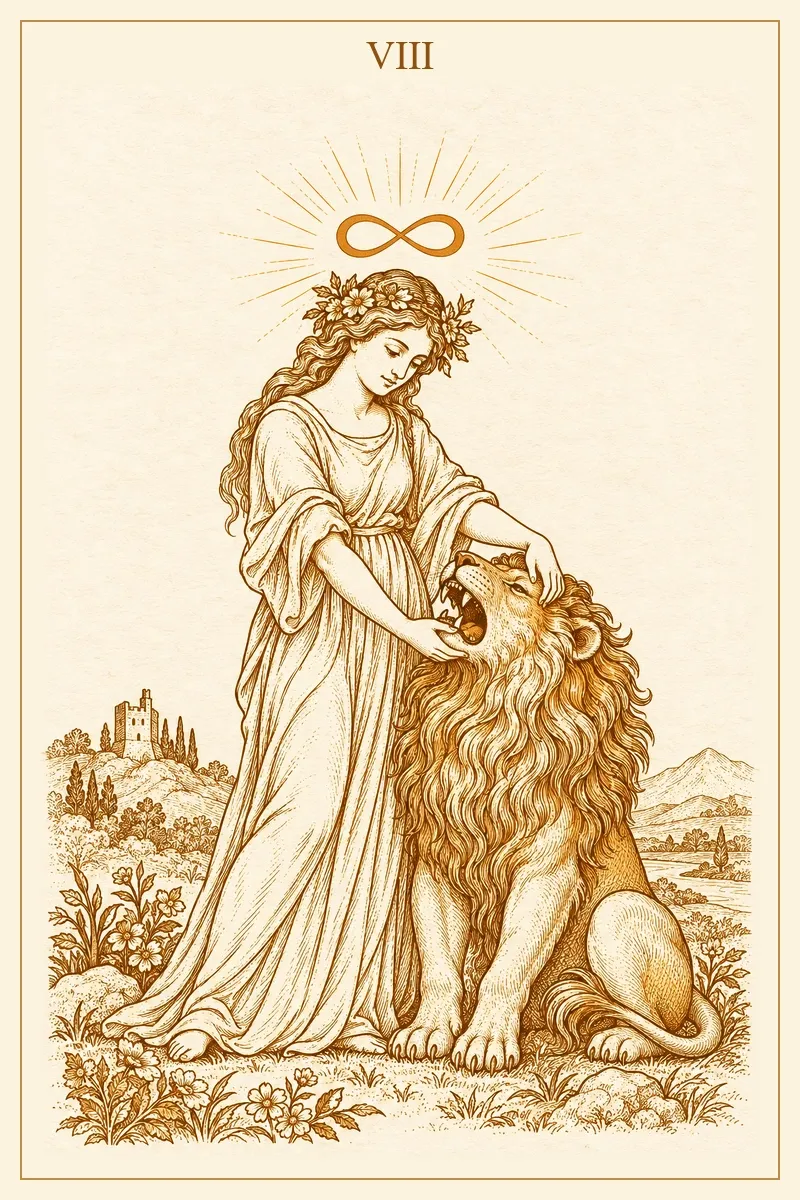
On this card a woman in a loose robe, a wreath of flowers in her hair, rests one hand on a lion's head and the other at its open jaw. The lion sits rather than fights, and an infinity sign glows above her. Nothing about the scene is forceful. The courage it shows is calm attention, the kind that stays near something frightening without either running or attacking.
Upright, Strength in a confidence reading says you already have more composure than you credit yourself with. Think of the last time you stayed kind while a conversation turned tense, or kept going on a project after a setback. That is the quality this card names. In love, it can mean saying what you need gently and without apology; at work, holding a steady tone when a meeting gets heated.
Reversed, Strength often reflects courage that has turned against you: harsh self-talk, or the belief that you must feel fearless before you are allowed to act. Treat it as a reminder that patience applies to yourself too. Our full Strength tarot meaning covers the card's other positions and pairings.
The Sun: letting yourself be seen

A child with a flower wreath rides a white horse with arms flung wide, beneath a calm-faced sun, while tall sunflowers stand behind a stone wall and a pale banner streams out to one side. The child is not performing for anyone. The openness comes from feeling safe enough to be fully visible.
Upright, The Sun asks where you have been hiding something you are good at, whether that is an idea you never share in meetings, a creative project nobody has seen, or simple delight you tone down so as not to seem too much. For money and career questions it can point toward putting your work forward plainly: a portfolio, a pitch, a request for feedback. In love it suggests warmth that does not need to be earned first.
Reversed, the light is still there but dimmed, often by worry about how you will come across. Ask what would happen if you let one person see a little more of you this week. You can read more about the card in our guide to The Sun tarot meaning.
Four Queens, four styles of confidence
The Queens are mature, settled expressions of their suits, which makes them useful models. Wands carry bold confidence, Cups emotional confidence, Swords the confidence of a clear mind, and Pentacles practical confidence. Many people lean on one and neglect another. Notice which Queen feels natural to you and which one you avoid; the second is often where your next growth lies.
Queen of Wands: confidence that takes up room
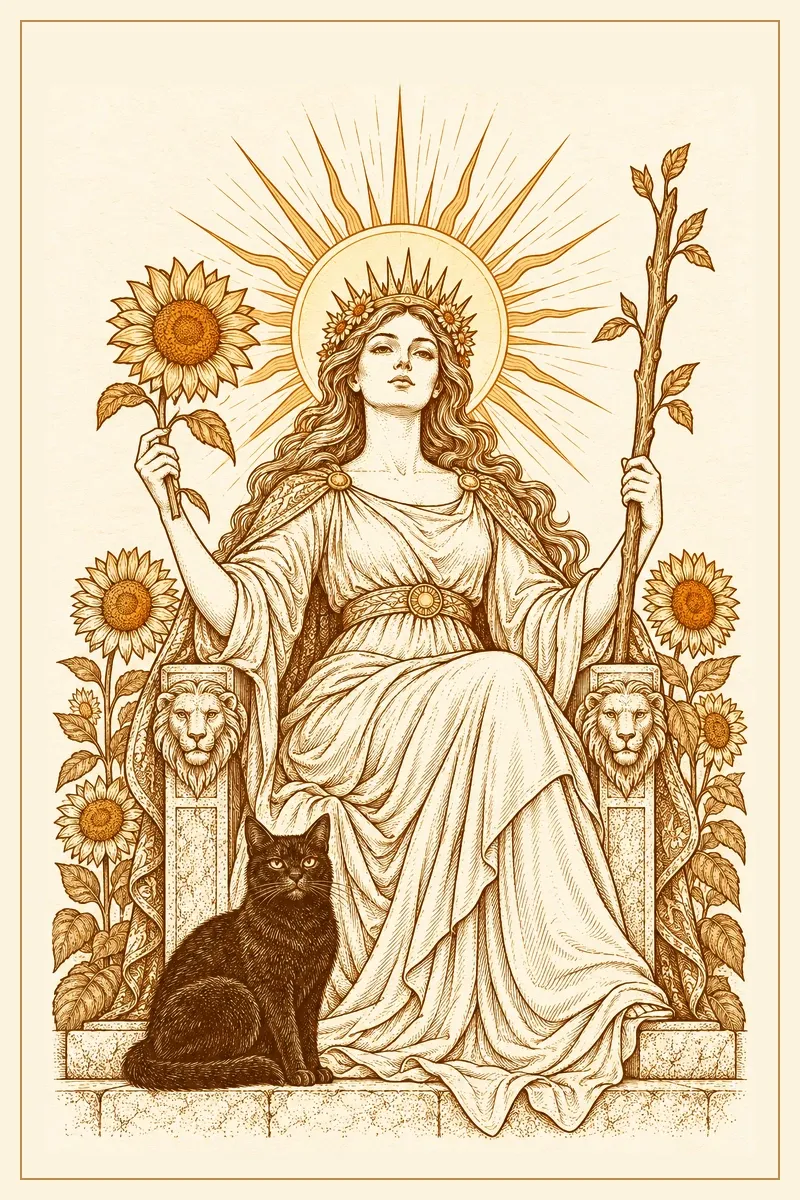
She sits on a throne carved with lion heads, a sunflower in one hand and a budding wand in the other, a sunburst behind her crown and a black cat at her feet. Her gaze goes straight ahead. She is comfortable being looked at and does not shrink to make others comfortable.
Upright, the Queen of Wands invites you to speak first, volunteer, or let your enthusiasm show without apologizing for it. Reversed, she can point to confidence that has turned brittle or performed, or to warmth spent so freely on others that none is left for your own plans. Her full meaning is set out in our Queen of Wands tarot meaning guide.
Queen of Cups: trusting what you feel
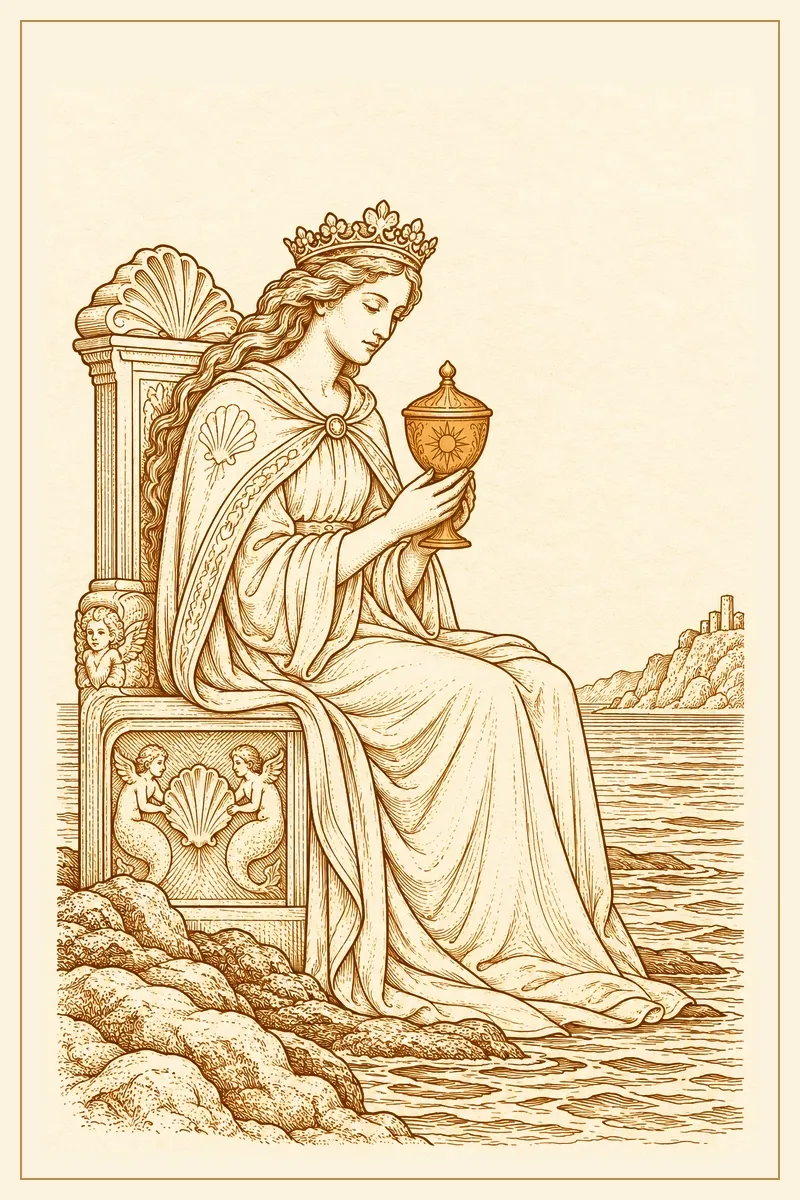
Seated on a shell-backed throne at the edge of the sea, this Queen looks closely into an ornate lidded cup she raises in one hand. Waves reach the rocks at her feet, yet she is not swept away. Her confidence is emotional: she feels deeply and still knows where she stands.
Upright, she asks you to treat your feelings as real information. If something felt wrong in a conversation, you are allowed to say so. Reversed, she may show feelings overflowing into people-pleasing, or numbness that keeps you from knowing what you want. In a love reading she often points to asking for care directly rather than hoping a partner will guess.
Queen of Swords: saying it plainly
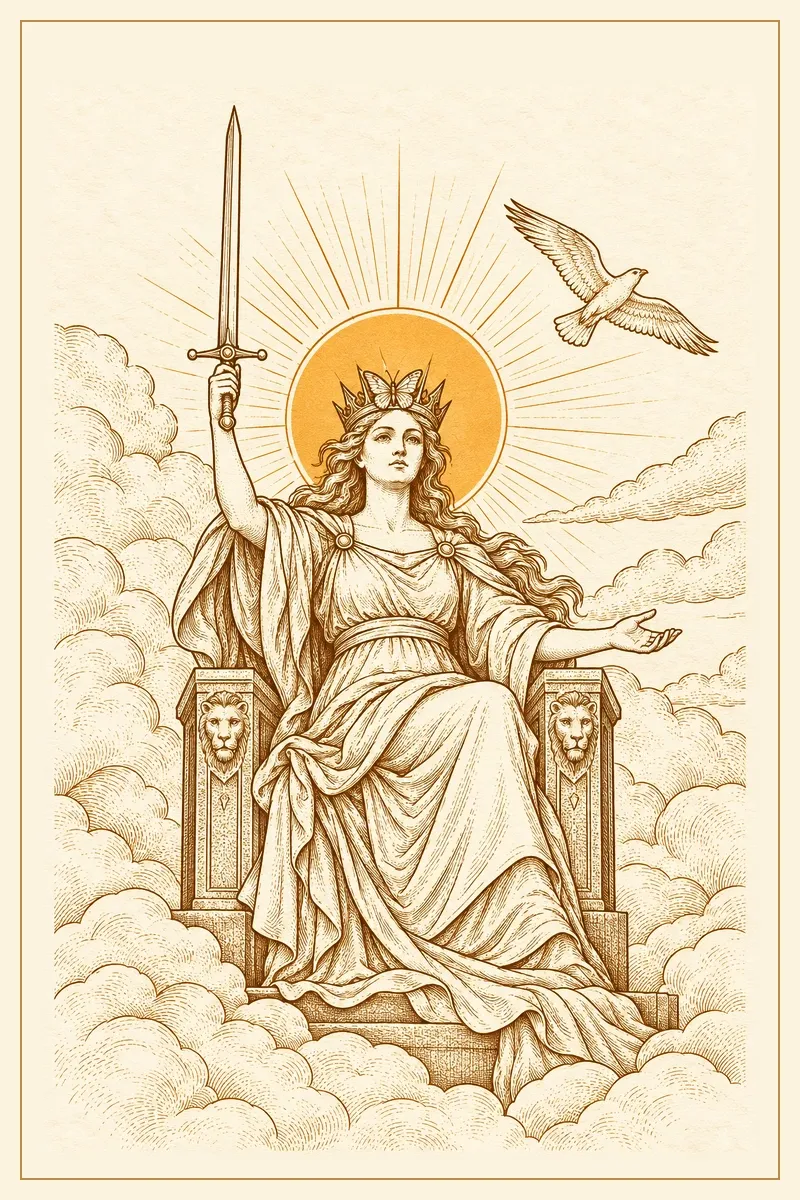
She holds a sword upright in one hand and extends the other, palm open, from a throne set among clouds, with a butterfly on her crown and a bird crossing the sky. The pairing matters: a clear edge and an open hand. Her confidence comes from honesty that is not cruel.
Upright, the Queen of Swords supports setting a boundary, correcting a misunderstanding, or giving your real opinion in a meeting. Reversed, she can warn that clarity has hardened into coldness, or that you are swallowing words you need to say. At work she is a good card to keep in mind before a negotiation or a difficult email.
Queen of Pentacles: competence in everyday life
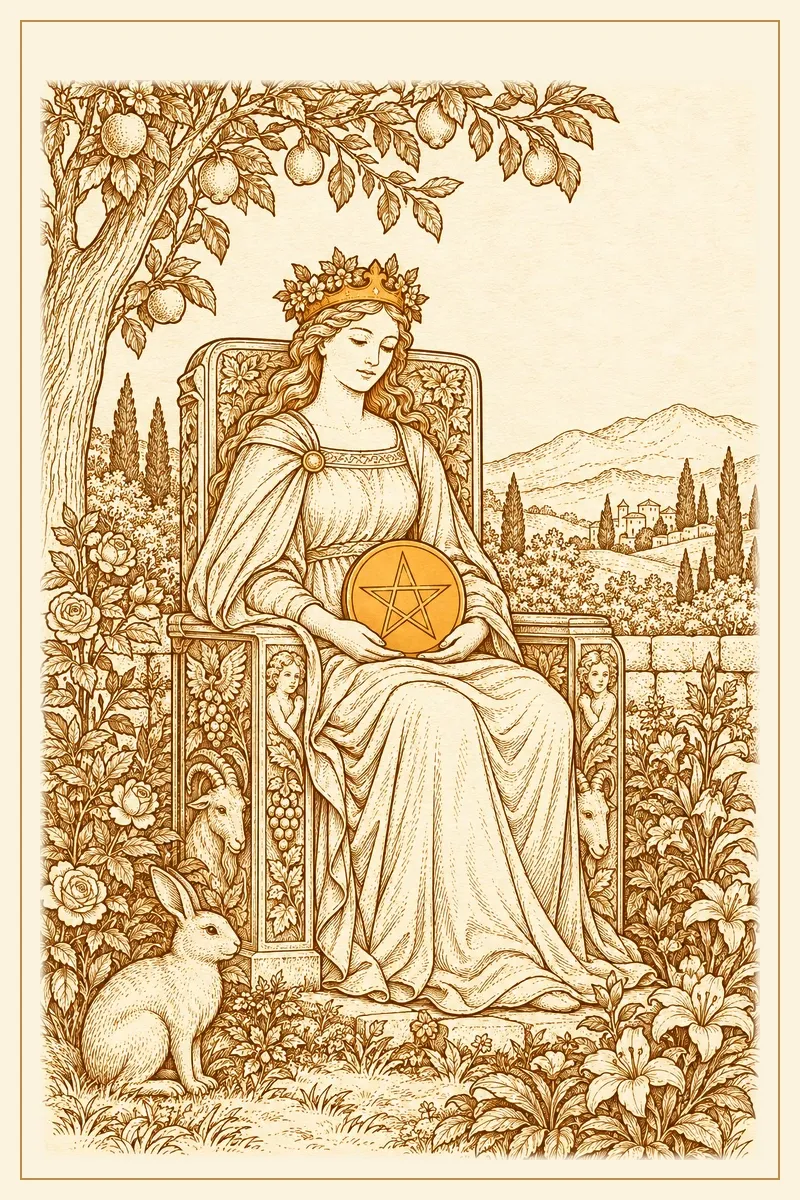
Under a fruit tree in a flowering garden, this Queen holds a golden pentacle in her lap and looks down at it with care, while a rabbit sits near her feet. Her confidence is quiet and practical. She knows how to make things work: a budget, a meal, a home, a team.
Upright, she asks you to count your ordinary competence as real. Running a household, caring for someone, finishing tasks on time: these are skills, and they deserve the same respect as public achievements. Reversed, she can show self-worth tied too tightly to being useful, or practical matters you have been avoiding because they feel overwhelming. For money questions she suggests steady, informed steps rather than a sudden leap.
More cards that show confidence growing
Confidence also turns up in cards beyond the Queens and the two Majors above. The Chariot is momentum that comes from choosing a direction and steering, even when part of you wants to go elsewhere. The Seven of Wands is the stance of someone defending a decision under pressure, a good card for anyone learning to hold a boundary. The Six of Wands is about letting recognition land instead of brushing it off.
The Magician reminds you that you already have the tools for the next step, even if they feel ordinary. The Eight of Pentacles describes confidence built the slow way, through practice and repetition. The Ace of Wands is the first spark of willingness, often enough to begin.
When the cards look discouraging
Ask about confidence and you will sometimes draw cards that seem to confirm your worst fears. Read them as descriptions of what you are moving through, not judgments of who you are.
The Fives, such as the Five of Wands or the Five of Cups, mark the uncomfortable middle of a cycle, where friction and disappointment are expected. The Eight of Swords often shows limits that are more loosely tied than they feel. The Nine of Swords describes worry at its loudest, usually late at night, when it is least reliable.
Even the heaviest cards speak of change. The Tower clears away a shaky structure, perhaps a story about yourself that never fit. The Devil shows chains loose enough to lift off, including habits of comparison or perfectionism. The Ten of Swords is an ending with a dawn behind it. When one of these appears, ask: what is this card asking me to stop carrying?
A four-card layout for rebuilding confidence
This simple layout works well on a morning when you have something to face. Lay the cards in a row, read each position on its own, then look at all four together.
- A strength I am overlooking: a quality you have played down or forgotten.
- The story doubt is telling me: the specific, usually exaggerated claim your inner critic is making.
- Evidence of what I can do: a past achievement or a present skill that contradicts that story.
- One way to act with confidence today: a small, concrete step.
Position two is the one to read slowly. Write the doubt down as a sentence, then compare it with what position three shows you. The point is not to argue the doubt away but to notice that it is one voice among several. Position four should end with something you can actually do before bedtime, such as sending a message, practicing a sentence aloud, or asking a question you have been holding back.
A three-card mirror check
When you suspect you are harder on yourself than the situation warrants, this shorter layout helps.
- How I see myself: your self-image, often harsher than reality.
- How I come across to others: what the people around you actually see when you act.
- What is true at my core: the quality beneath both images.
The useful part is the gap between the first and third cards. If position one shows a struggling card and position three shows a Queen or The Sun, the gap is where your confidence work belongs. Card two is a reflection prompt, not a report on anyone's private thoughts: it asks you to recall real feedback you have received.
Worked example: preparing to ask for a raise
Here is an invented reading to show the four-card layout in use. The question: “What do I need to remember before I ask for a raise at my review next month?”
A strength I am overlooking: Eight of Pentacles. A young craftsman sits at a workbench, chiseling a pentacle, with six finished ones hung on a post beside him. The overlooked strength is consistency. The reader has been doing careful work for a long time and has stopped noticing it because it feels routine.
The story doubt is telling me: Eight of Swords. A blindfolded woman stands in shallow water among planted swords, loosely bound, with open gaps between the blades. The story is “I'm stuck, and asking will make things worse.” The card suggests the trap is mostly made of assumptions that have never been tested.
Evidence of what I can do: Three of Pentacles. A stonemason carves a pillar while two others consult the building plan below. Here the evidence is collaboration: the reader recalls that colleagues already ask for their input on projects, which is a concrete point to bring into the review.
One way to act today: Queen of Swords. Sword upright, hand open. The action is to write three sentences that state the request clearly, with examples, and to practice saying them aloud once.
The reading does not say whether the raise will be approved; that depends on the employer, the budget and the conversation itself. What it gives the reader is a sharper list of evidence and a calmer way to ask. That is often what confidence looks like in practice.
Confidence in love, work and money
The same cards read differently depending on where your confidence is thin.
In love, confidence usually means asking for what you need and trusting that you deserve care. Queen of Cups and Strength are helpful here. A useful question is “What would I say to my partner if I believed my needs were reasonable?” rather than “Do they really like me?”, which the cards cannot answer.
At work, confidence shows as speaking up, sharing work and accepting credit. Queen of Swords, The Sun and the Six of Wands support this. Pull a card before a meeting and choose one contribution you will make, however small.
With money, confidence is less about bold bets and more about looking at the numbers without flinching. The Queen of Pentacles and the Eight of Pentacles suggest steady learning and informed decisions. Use a reading to decide what to research or whom to ask, not what to invest in.
Daily habits that build on a reading
A single reading rarely changes much. Small habits repeated over weeks are where confidence actually grows.
The morning strength card. As part of your daily tarot rituals, draw one card and ask, “What strength do I need to remember today?” Let that card stand in for an affirmation, and look for one moment in the day to use it.
A set of power cards. Go through your deck face-up and set aside every card that makes you feel capable, steady or glad. Keep a few where you will see them, on a desk, a mirror or a bedside table. Choosing cards on purpose is not cheating; it is a way of practicing what you want to notice.
The courage log. Each evening, write down one thing you did that took a little courage: I spoke up, I set a boundary, I tried something new. Keeping a tarot journal alongside this log lets you see over weeks how often you acted despite doubt.
Five minutes with a Queen. Pick the Queen whose style of confidence you want to grow. Sit with her card for five minutes, notice the details, and imagine moving through one part of your day as she would.
Prompts to write about after a draw
- What would I do differently this week if I truly believed I was capable?
- When have I surprised myself with my own strength?
- Which criticism do I carry that is not really mine, and whose voice is it?
- If The Sun showed my best self, what would that version of me do today?
- What is one small risk I can take this week to test my doubt?
Keeping confidence a practice, not a finish line
People who seem confident still feel doubt; they act anyway, and they recover faster when something goes wrong. Tarot helps by showing a bigger picture than the fear does in the moment.
Count small wins. Interpreting a card before checking its meaning is one; so is asking a question you were nervous about. If low confidence seems rooted in parts of yourself you were taught to hide, shadow work with tarot can help you bring them into view gently. And when you feel ready, try reading tarot for others: seeing a friend recognize themselves in your words is one of the quickest ways to trust your own perception.
Frequently asked questions
Which tarot card is best for confidence?
Strength is the classic answer because it shows courage that stays calm. The Sun suits confidence about being seen, and the Queens cover specific styles. The best card is the one whose quality you most need to practice right now.
Can tarot tell me whether I will succeed?
No. A reading cannot confirm an outcome, a date, or what someone else thinks of you. It can help you notice your strengths, name your doubts and choose a next step, which tends to improve how you show up, whatever the result.
What if I keep drawing difficult cards when I ask about confidence?
Look at the question first. “Why am I not good enough?” invites heavy cards. Try “What strength can I lean on this week?” If hard cards still appear, read them as the part of the journey you are in, and ask what each one wants you to set down.
Is it fine to pick a card face-up instead of drawing at random?
Yes. Choosing a card deliberately as a focus, such as a Queen for the day, is a reflection exercise rather than a reading, and it works well for confidence building.
How often should I do a confidence reading?
A short daily draw and a fuller layout once a week or before a big moment is plenty. Repeating the same question many times in one day tends to feed anxiety rather than ease it.
Can tarot replace therapy for low self-esteem?
No. If low confidence is persistent or affects your daily life, a licensed therapist or counselor can address its roots in ways a deck cannot. Tarot can sit alongside that support as a reflective habit.
Seventy-eight cards, and not one says “not enough”
Look through a full deck and you will not find a card that tells you that you are not enough. Even the hardest images describe change, release and a way through. The cards keep assuming you can grow, and a regular practice gives you the chance to start agreeing with them.
When you want a quiet moment to reflect on where your confidence already lives, start a reading and choose one small step to take today.