Stealth and strategy sit at the heart of the Seven of Swords. Upright, this tarot card means acting quietly to gain an advantage: a plan kept secret, a shortcut taken alone, or someone trying to get away with something, whether that someone is another person or you. Reversed, the Seven of Swords usually means the secret is surfacing through a confession, a discovery or a conscience that will not settle, although it can also point to a story someone is now telling themselves.
The card is not an automatic accusation; it also covers discretion and protecting yourself where openness is not safe. What separates those readings is a question the card keeps asking: who pays for this plan, and would it hold up if it were seen? A reading can help you name what feels off, but it cannot prove what another person has done, see into their private intentions or tell you how things will end. Facts, direct conversations and your own judgment do that work.
- Upright: stealth, strategy, secrecy, a shortcut, getting away with something, going it alone.
- Reversed: coming clean, being found out, a restless conscience, returning what was taken, self-deception.
- Suit and element: Swords, the suit of air, which covers thought, words and decisions.
- Astrology: the Moon in Aquarius, the third decan of that sign.
- Love: a secret, mixed signals or split loyalties that call for an honest talk.
- Work: office politics, credit taken, or a strategy you are keeping to yourself.
- Yes or no: usually no as things stand, because something important is still out of view.
Five swords in his arms, two left standing
A young man with a sidelong glance
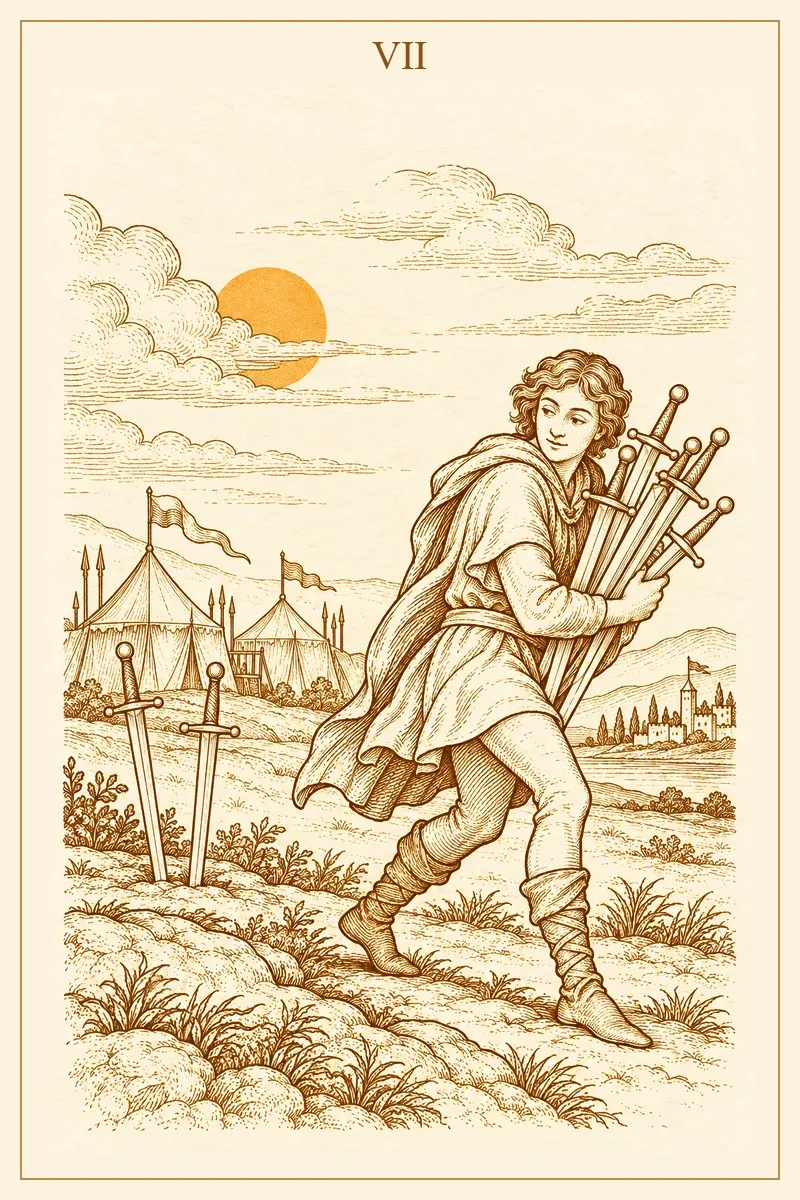
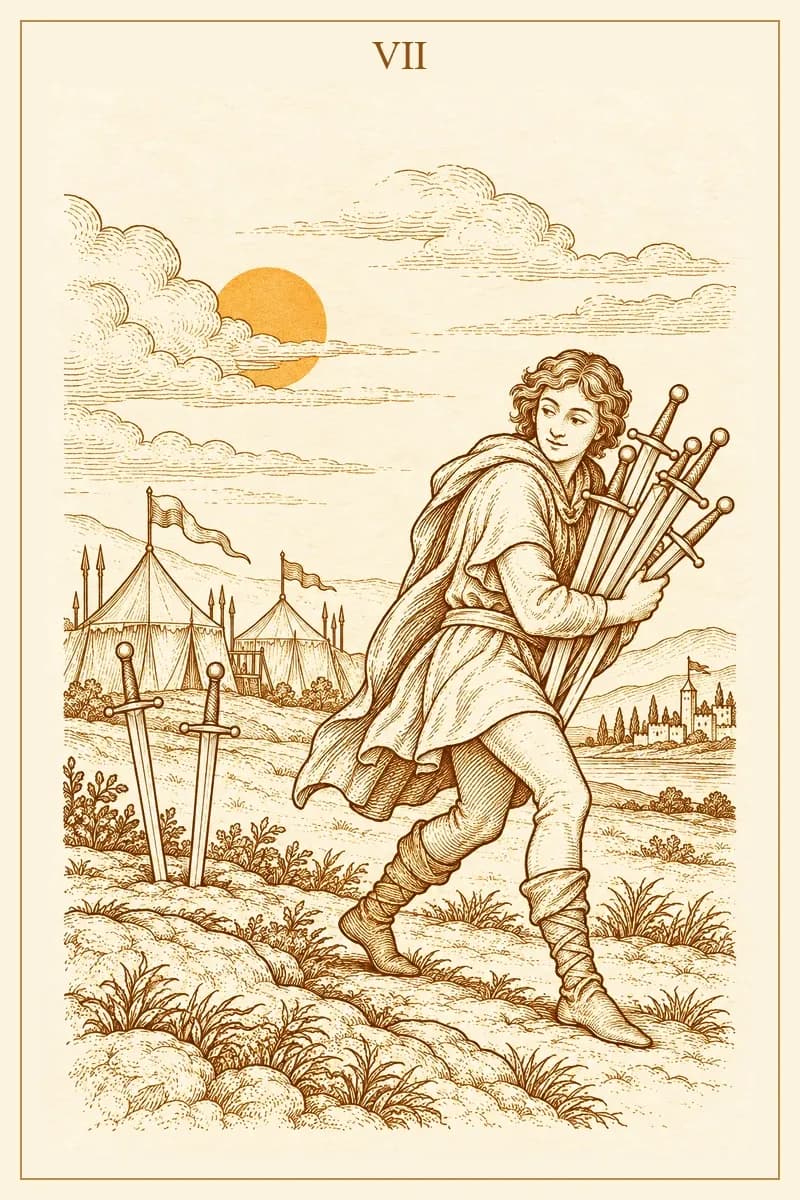
A curly-haired young man in a loose hooded cloak and belted tunic hurries across rough, grassy ground, his boots laced high around his calves. He holds five swords against his chest, hilts up, like an armful of kindling. His body leans toward the right edge of the card, and as he hurries he glances sideways out of the corner of his eye, his expression closer to a private smile than to fear. He looks pleased with himself and is checking whether anyone saw.
That posture is the card in miniature: the feet hurry on while the eyes keep watch. In a reading the figure can stand for the person doing the hiding, or for the uneasy sense that someone near you is moving one way while watching another.
Two blades still in the ground
Behind him, two swords stand upright in the earth where he left them. Readers often treat these two blades as the loose ends of any covert plan: evidence left in place, an unfinished part of the job, the fact that could still give the game away. When the card falls for you, ask what you have left behind that does not fit the story you are telling. Read more generously, the two blades can also be a deliberate limit: he took what he needed and no more, and strategy is not the same as greed.
Tents behind, a walled town ahead, and the sun in an open sky
On the left, a camp of peaked tents flies pennants, with spears planted around it, and nobody there seems to have noticed him. Ahead and to the right, across a stretch of water, a small walled town with towers waits. He is moving from the camp he belonged to toward somewhere he hopes will take him in, which is why the card speaks to divided loyalties, job searches kept quiet and friendships someone is leaving without saying so. Above it all, a gold sun sits half behind clouds. This is no night raid; he is doing it in daylight, a reminder that what feels invisible from the inside may be plain to everyone watching from the camp.
The Lord of Unstable Effort: astrology and the card's place in the suit
In the Golden Dawn tradition the Seven of Swords carries the title Lord of Unstable Effort and is assigned to the Moon in the third decan of Aquarius. Aquarius is the fixed air sign of independence and unconventional thinking; the Moon is changeable and private, tied to moods and to what happens out of sight. Together they describe an inventive but restless mind that works alone, switches tactics halfway and keeps its real aims under the surface. The plan is clever, yet it depends on nobody looking too hard. The effort is real; the footing is not.
The card also makes more sense next to its neighbors. Before it comes the Six of Swords, a quiet passage away from trouble toward calmer water, which the Six of Swords meaning covers step by step. After it comes the Eight of Swords, a bound and blindfolded figure among blades, and the Eight of Swords guide shows how a plan that slips past everyone can end with the planner feeling hemmed in.
Upright: a plan that works only while nobody looks
Upright, the card describes action taken out of view; the reading turns on who is acting and what the secrecy protects.
When someone around you is hiding something
In a question about another person, the upright card often reflects a gap between words and actions: a colleague who agrees in the meeting and does something else afterward, a friend whose account of the weekend keeps shifting, a partner who has grown vague about money or plans. The card does not say what is hidden or how serious it is; a small omission and a real betrayal can both bring it up. Treat it as a prompt to review what you already know: which facts have you noticed and explained away? The card supports paying attention, not snooping, setting traps or treating a hunch as proof.
When the one slipping away is you
The figure could be the person asking, and that possibility is worth checking first. Are you taking a shortcut you would not want described out loud, telling a half-truth to dodge a hard conversation, or quietly working around someone instead of disagreeing with them? Are you accepting credit that partly belongs to someone else? None of this calls for shame; the card simply shows that every secret has to be maintained, and the constant watchfulness is tiring.
Strategy that is not deceit
Not every quiet plan is dishonest. Looking for a new job before telling your manager, keeping a surprise party under wraps, negotiating without showing your whole hand, or protecting yourself from someone who has been unsafe are all forms of discretion this card can describe. Two checks separate discretion from deception: does the plan take something that belongs to someone else, such as their work or their right to make an informed choice, and would a fair witness who saw everything call it reasonable? If both answers favor you, the card may simply be telling you to keep your own counsel for now.
Reversed: the swords come back, or the story gets tighter
Reversed, the card runs in two directions: what was hidden comes into the open, or the hiding turns inward and the person keeping the secret starts to believe it.
Coming clean
The most hopeful reading of the reversal is a decision to put the swords back. Someone admits what they did, returns what was taken or ends a double life before it is discovered. If you have been carrying a secret, the card can reflect the moment when telling the truth starts to feel lighter than keeping it. Confession does not erase consequences, but it puts you back on stable ground.
Found out
The reversal can also describe a secret that is exposed rather than offered: an email forwarded to the wrong person, numbers that no longer add up, a story that collapses under one simple question. If you are learning the truth, slow down before deciding what it means. If you are the one discovered, the card asks for an honest account rather than a new cover story.
The lie you tell yourself
Some readers see the reversed Seven as self-deception: insisting a habit is under control, believing a plan is foolproof, or telling yourself that a partner's behavior does not bother you when it does. The person most affected by the secret is the one keeping it from themselves. To tell this reversal from coming clean, look at the neighboring cards: release, relief or fairness favor confession, while confusion, anxiety or isolation favor self-deception.
Secrets and trust: the Seven of Swords in love
In a committed relationship
Upright in a relationship, the Seven of Swords suggests that something is not being said openly. That can mean infidelity, but it can just as well be something quieter: a hidden worry about money, contact with an ex that one partner has downplayed, or an exit plan someone is quietly forming. It might also be your own resentment, swallowed instead of raised. It is one of the tarot cards that point to cheating or betrayal, yet it never proves an affair on its own. Use it to decide what you want to ask, and ask it plainly.
Dating and new connections
For someone single or newly dating, the upright card advises patience. A charming new person may still hold back something important, such as another relationship or a different idea of commitment. Let what people do over several weeks count for more than what they say on a first date.
What it says about how someone feels
Asked how another person feels, the Seven of Swords often describes guardedness: feelings kept strategic, an interest they are not ready to admit, or attention divided elsewhere. Tarot cannot read another person's mind, so take this as a picture of the dynamic you are living in, not of their private thoughts, and weigh it against what they actually say and do.
Reversed in a love reading
Reversed, secrets surface. A partner may confess, a lie may come to light, or you may decide to stop hiding something yourself. That moment hurts, yet trust cannot be rebuilt on terms one person does not know. The reversed card does not decide whether you stay together; that depends on what is said next and on whether both people want to repair the trust.
Office politics, credit and contracts
Upright at work
At work the upright card can point to someone taking credit for shared work, a decision made in a side conversation, or a colleague who says one thing in the meeting and another in the hallway. It can also reflect your own strategy, such as preparing a move before announcing it. Keep records of your contributions, put important agreements in writing, and choose discretion over cunning.
Reversed at work
Reversed, the maneuvering comes into the open. Someone's shortcut is noticed, credit is corrected, or you decide that your reputation matters more than a short-term edge. It can also describe an impostor feeling, the fear of being "found out" when you have done nothing wrong. In that case the swords you think you stole are simply your own skills.
Money, contracts and fine print
In money questions the upright card asks you to read the fine print. An offer that sounds too good or spending kept from a partner fits here. Verify details and get advice from a qualified professional on anything legal or financial; the card is a prompt to check, not a forecast of loss. Reversed, hidden costs or discrepancies come to light, and the sooner they are faced, the smaller they tend to stay.
Honesty with your body and your beliefs
For well-being, the Seven of Swords can reflect self-deception about habits: putting off appointments, playing down symptoms, or giving a doctor a softer version of the truth. The card cannot assess your health, but it can nudge you to be candid with yourself and with the people who care for you. Spiritually, it asks where practice has become performance, or where spiritual language is covering something you know is not right. Reversed, in both areas, denial stops working and a humbler, more honest approach can begin.
Is the Seven of Swords a yes or a no?
As a single-card answer, the upright Seven of Swords leans toward no, or at least not yet, because a piece is missing: something hidden, an incomplete plan or an agreement that is not what it seems. If the question is about your own plan, the answer may be yes only if the plan would survive being seen. Reversed, it can lean toward a cautious yes, provided honesty comes first.
Five cards that shift the Seven of Swords
With The Moon: layers of uncertainty

On The Moon, a sun-rayed disc with a sleeping crescent profile hangs over a road that runs between twin towers; below it a dog and a wolf bay upward, and a crayfish crawls from the water. Beside the Seven of Swords it deepens the uncertainty: more than one thing may be hidden, or your fears may be filling the gaps, so hold off on conclusions. The Moon tarot meaning explores how this card blurs what you think you see.
With Justice: accountability arrives
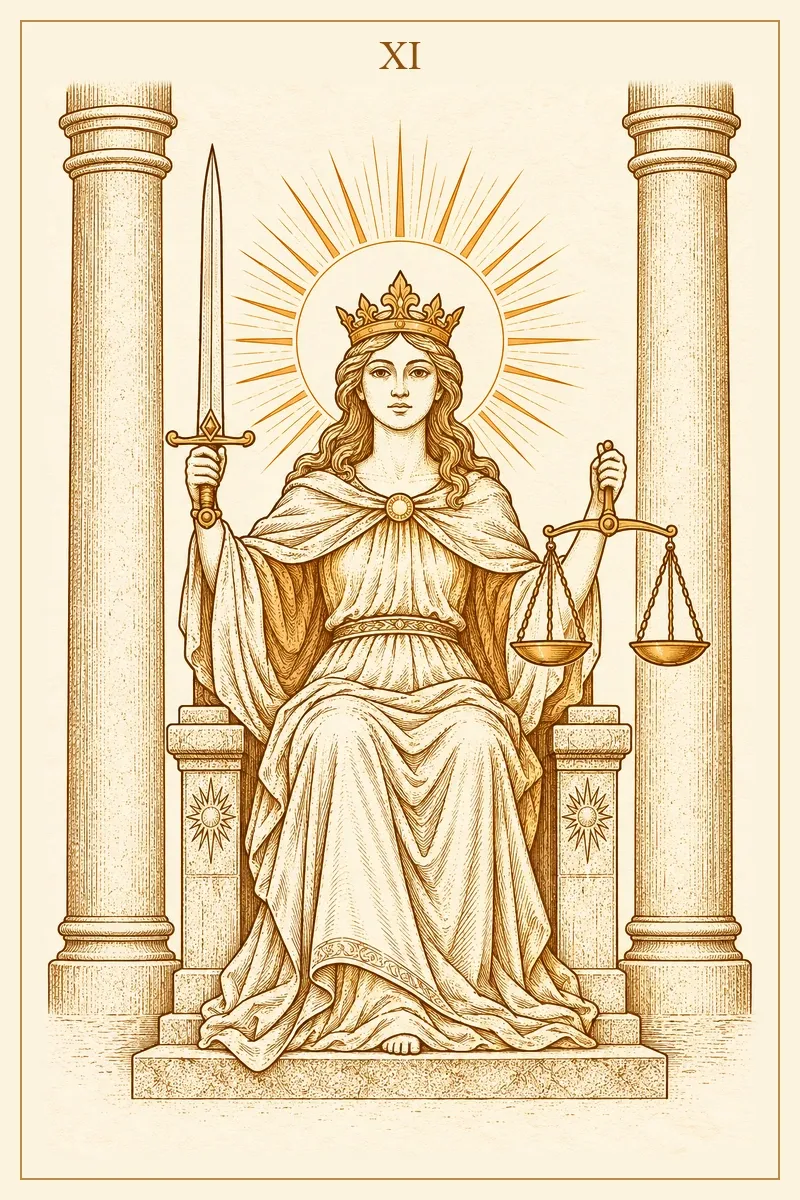
Justice sits crowned between two pillars, holding an upright sword and a pair of scales. With the Seven of Swords, it suggests that what was taken will be weighed fairly. If you were wronged, records and honest testimony matter; if you were cutting corners, now is the moment to set things right. The full Justice card meaning covers fairness and consequences in depth.
With The High Priestess: what you sense before you know
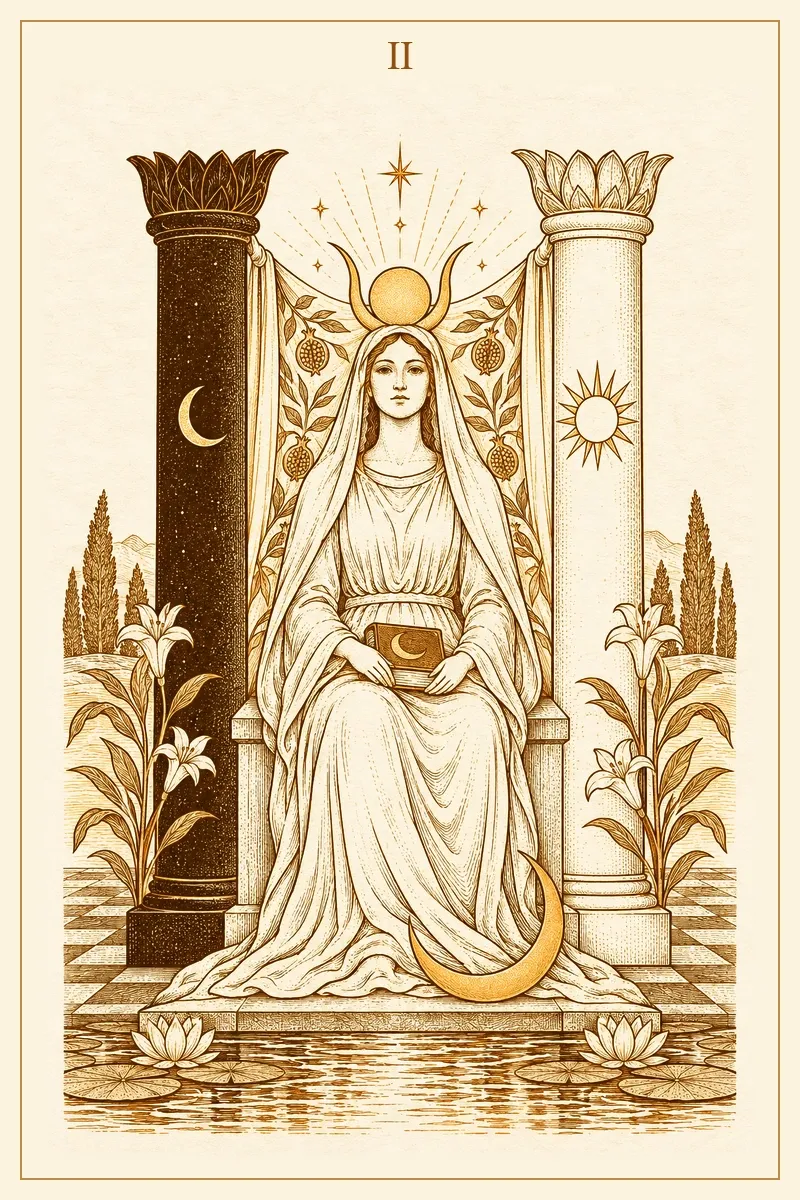
The High Priestess sits veiled between a dark pillar and a pale one, a closed book in her lap and a crescent moon at her feet. With the Seven of Swords, she points to an intuition that something is off before you have proof. Take that feeling seriously enough to watch and listen, but not so seriously that you act on it alone. The High Priestess tarot meaning looks more closely at quiet knowing.
With The Sun: everything in plain view
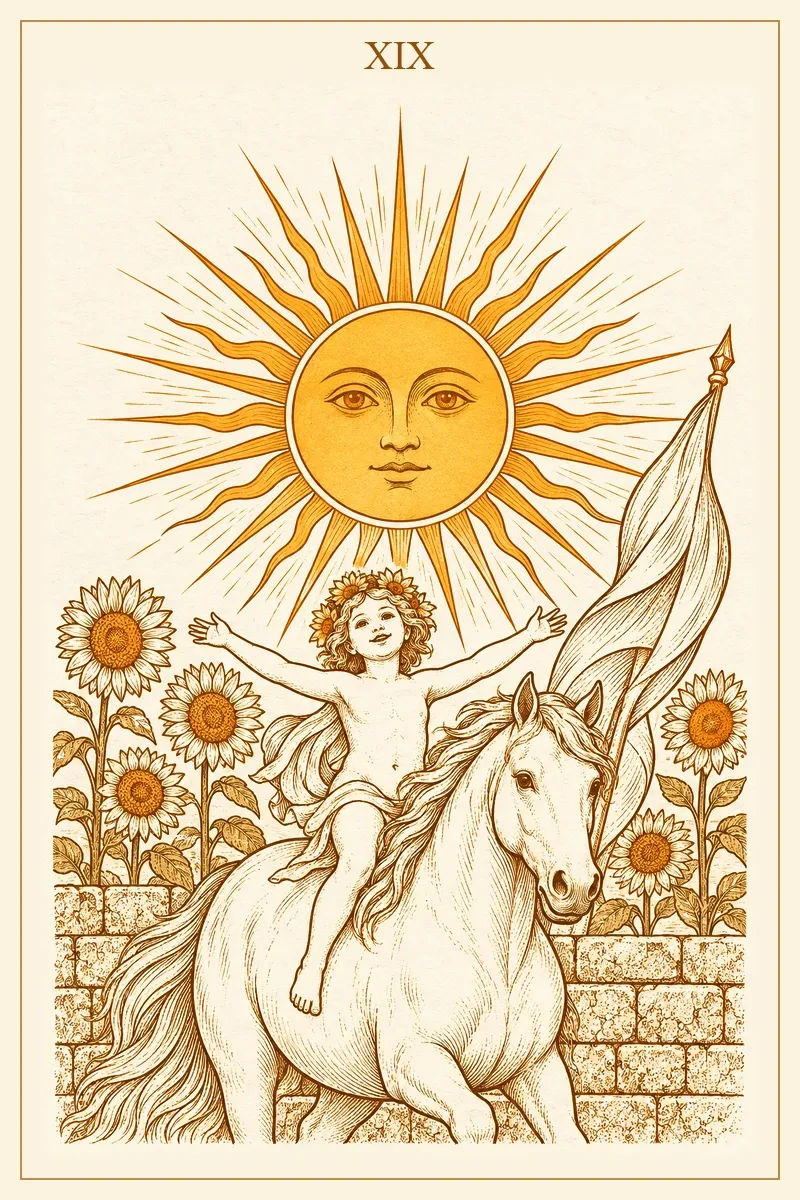
The Sun shows a bright face in the sky above a child riding a white horse past sunflowers and a low brick wall. Next to the Seven of Swords, it brings the hidden into daylight: secrets come out, misunderstandings clear, and honest dealing becomes the easier route. The Sun card meaning describes the clarity it adds to any spread.
With the Five of Swords: a win that costs trust
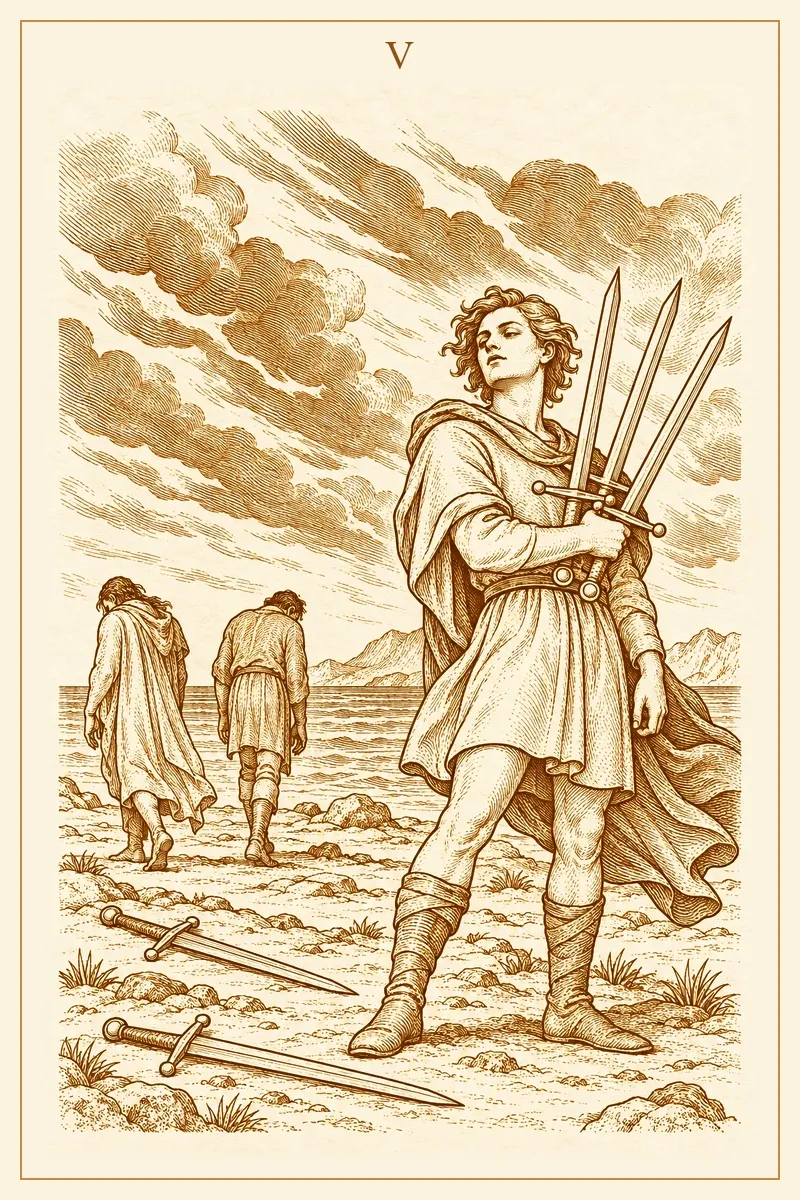
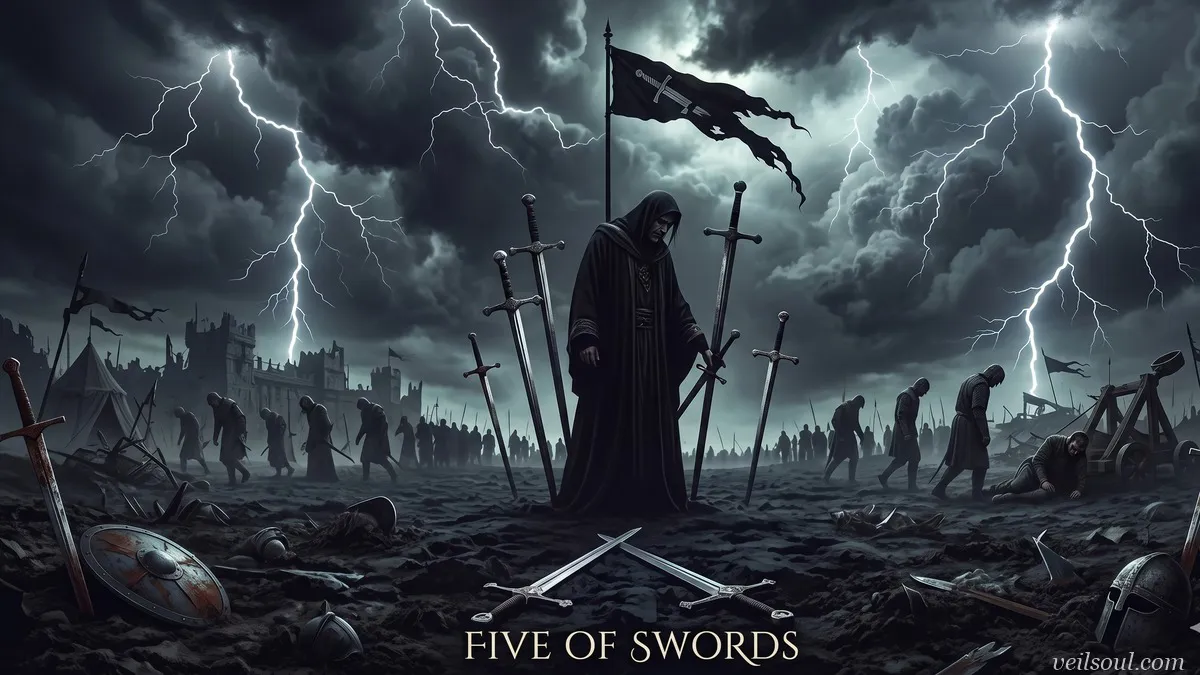
On the Five of Swords, a young man holds three swords while two lie on the ground and two figures walk away toward the sea under a stormy sky. Paired with the Seven, it describes conflict and deception feeding each other: someone fighting unfairly and hiding how they did it. The victory is hollow, and the relationship pays. The Five of Swords meaning covers how to step out of a contest like that.
A five-card layout for a question of trust
When trust is the issue in front of you, this layout follows the card's own picture. Frame the question around yourself: "What do I need to see clearly about this situation?" works better than "Is he lying?"
- The camp: how the situation looks from the outside, or what everyone assumes.
- The five swords: what is being carried off, kept hidden or taken without a word.
- The two standing swords: what is still in place, such as evidence, commitments or facts you can rely on.
- The sidelong glance: the fear, guilt or worry shaping how you see things.
- The open road: the honest next step available to you.
Lay the cards in a row from left to right, following the figure's path from the camp toward the town. If the Seven of Swords itself appears, note its position; that is where the secrecy sits.
A sample reading: shared work and missing credit
A hypothetical example: someone on a small team suspects a coworker has been presenting their shared project as solo work. The question: "What do I need to see about how credit works on this team?"
- The camp: Three of Pentacles. From outside, this looks like a functioning team building something together.
- The five swords: Seven of Swords. The card lands in the position drawn from its own picture, underlining that something is being taken quietly: visibility, since the coworker presents the work without naming everyone who contributed.
- The two standing swords: Eight of Pentacles. The craft is still there. Drafts, version history and the record of who did what remain in place.
- The sidelong glance: Nine of Wands. The asker is guarded and tired, braced for another round of being overlooked, which keeps them quiet.
- The open road: Queen of Swords. A calm, direct statement based on facts.
Read together, the cards suggest an unchallenged habit more than a conspiracy: the evidence of the work exists, and fatigue keeps the asker silent. The Queen of Swords points to a clear, unemotional request: "I'd like our updates to name everyone who worked on each piece. Can we agree on that?" The reading cannot confirm the coworker's intent, but it offers a fair next step that rests on records rather than accusations.
What to do after the Seven of Swords turns up
- Separate fact from suspicion. Write down what you have seen or heard directly, then what you are guessing. Act only on the first list.
- Check your own side. If any part of the secrecy is yours, a quiet correction now is easier than a confession later.
- Ask one direct question. Choose a calm moment and phrase it without accusation; people answer questions more honestly than charges.
- Reflect before you decide. Where am I being less than honest, with others or with myself? Is someone acting in ways that do not match their words? What secret would bring relief if I let it go? Is the shortcut I am considering worth the trust it would cost?
Frequently asked questions
Does the Seven of Swords mean someone is cheating?
Not necessarily. The card points to secrecy or avoidance, which can include infidelity but can equally cover smaller omissions or unspoken feelings. Tarot cannot confirm what another person has done or is thinking, and it should never stand in for evidence or a direct conversation.
Is the Seven of Swords always a negative card?
No. It can describe discretion, strategy and self-protection when openness is not safe. It turns negative when the plan depends on taking something that belongs to someone else or on keeping people uninformed about choices that affect them.
What does the Seven of Swords reversed mean in love?
Usually that a secret is coming out, through confession or discovery, or that you are ready to stop hiding something yourself. It describes a moment of truth, not the outcome of the relationship.
Can the Seven of Swords describe me rather than someone else?
Yes, and it is worth considering first. The card can reflect your own shortcuts, half-truths or private plans, including legitimate ones like a job search. Ask whether your plan takes anything from someone else and whether it would hold up if seen.
How is the Seven of Swords different from the Five of Swords?
The Five of Swords is open conflict: someone wins a fight and loses goodwill in the process. The Seven of Swords is covert: someone avoids the fight by acting quietly.
Setting the swords down in the open
The Seven of Swords asks one plain question: what would change if this were seen? Sometimes the answer is nothing, and your quiet plan is simply wise. Sometimes the answer is everything, and the kindest move, to others and to yourself, is to put the swords back and say what is true. If you want to explore your own situation, you can start a reading with Veil Soul and see which cards sit beside this one.