The Devil tarot card means attachment that has turned into a trap: a habit, a relationship, a debt or a fear that has more say over your choices than you want it to, and that you keep feeding even while it costs you. Upright, it points to compulsion, control, temptation and the parts of yourself you would rather not look at. Reversed, it usually means the grip is loosening because you have finally seen the pattern, although sometimes it describes a habit that has simply moved somewhere less visible.
The Devil does not say anyone is evil, and no card can tell you what another person intends, when a situation will change or how it will end. What this one does well is show you where you feel stuck and what keeps you there. Its most hopeful detail is easy to miss: the chains on this card are not fastened to anything.
The card in brief:
- Upright: attachment, compulsion, temptation, control, materialism, the shadow self, feeling trapped.
- Reversed: release, recognition, reclaiming choice, the hard first stage of change, or a pattern pushed out of sight.
- Number: XV, after Temperance and before The Tower.
- Astrology and element: Capricorn, a cardinal earth sign ruled by Saturn.
- Hebrew letter (Golden Dawn): Ayin, the eye.
- Yes or no: upright, no, or not on these terms; reversed, yes to leaving or changing the arrangement.
Horns, bat wings and a crescent in the stone: what card XV shows
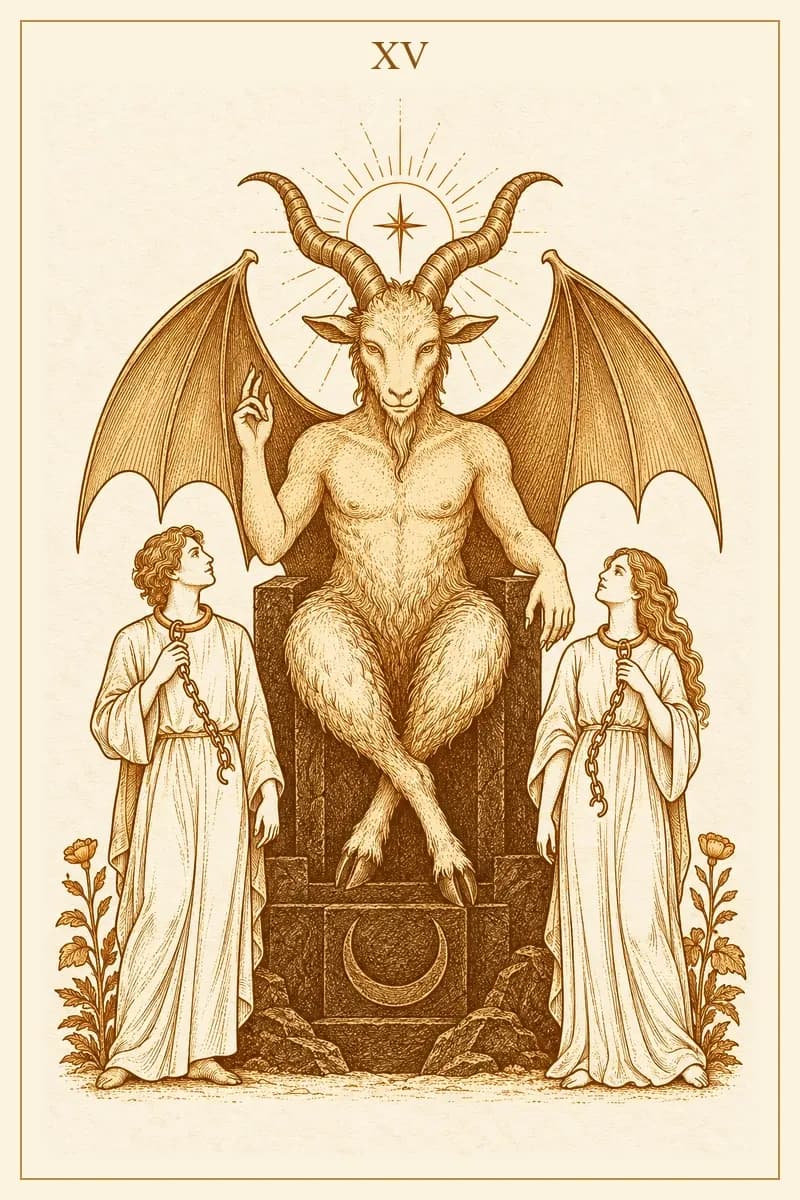
The figure on the dark throne
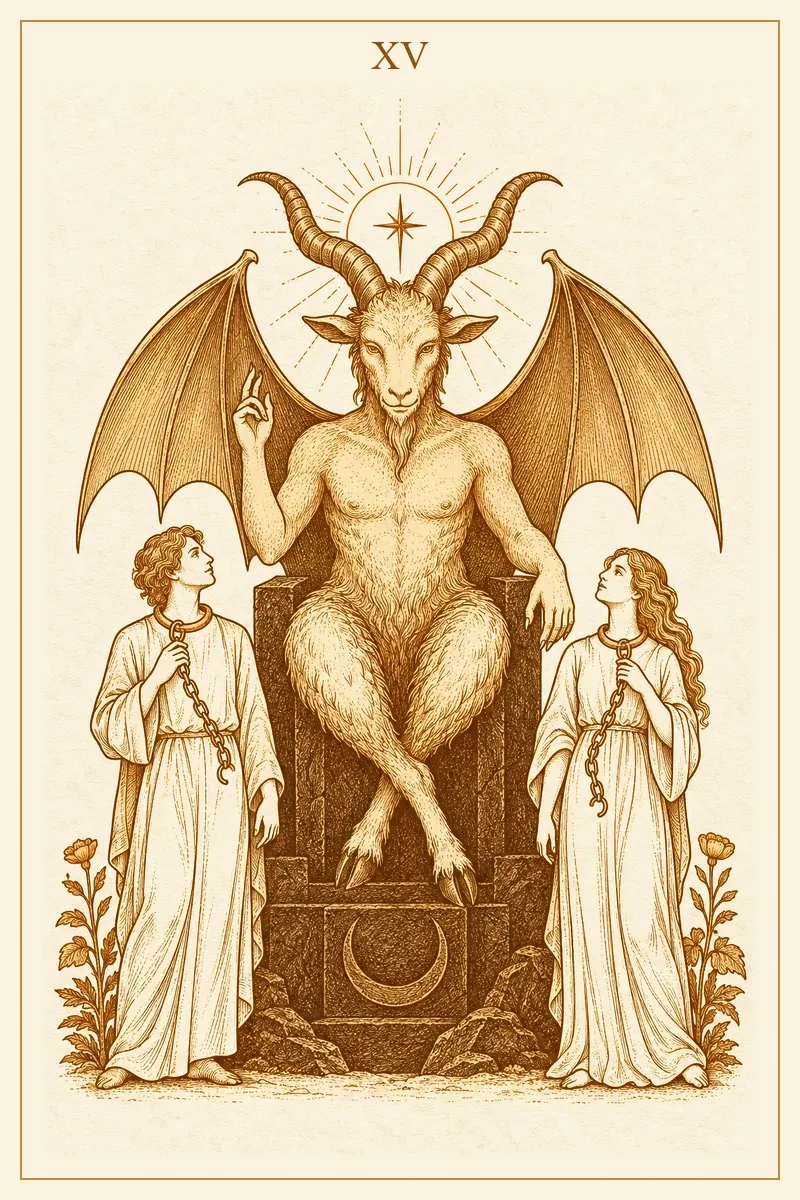
A horned figure sits on a block of rough dark stone. He has a goat's head with long ridged horns, a pointed beard and a calm, almost bored expression, and two wide bat-like wings spread behind him. Below the waist he is shaggy with fur, and his goat legs end in cloven hooves, crossed loosely at the shins.
His right hand is raised with two fingers lifted, echoing the blessing of The Hierophant, card V, who also sits enthroned above two smaller figures. Where The Hierophant hands down a tradition, The Devil hands down a habit; The Hierophant's card meaning shows how closely the two pictures mirror each other. His left hand simply rests on the stone. He holds nothing. He does not need to.
Two people holding their own chains
On either side of the throne stands a young person in a long, plain robe: a curly-haired man on the left, a woman with long wavy hair on the right. Each wears a metal collar with a short chain hanging from it. Follow the chains and they lead into the couple's own hands. Nothing bolts them to the throne. The two of them grip the links themselves and gaze up at him.
That detail carries most of the card's meaning. In many decks the pair are drawn naked, with small horns and tails. Here they look ordinary, which may be more honest: nothing has transformed them. They are simply standing still, holding on to something they could let go of.
A star above, a moon below, flowers at the edges
Between the horns shines a small star in a ring of fine rays, where many decks place an inverted pentagram. Read it as light that survives even here, and as a glimpse of The Star, two cards later. A crescent moon is carved low on the front of the throne, where the figure's weight rests: the pattern sits on something half-seen.
At both outer edges, orange flowers grow on tall stems, only a step from the couple, and neither of them notices. That small piece of life outside the stone is the reversed Devil waiting to happen.
Capricorn, Saturn and Ayin, the eye
The Devil's correspondences come from the Hermetic Order of the Golden Dawn, whose system most modern decks still follow:
- Zodiac sign: Capricorn, the sea-goat, a cardinal earth sign (roughly December 22 to January 19).
- Ruling planet: Saturn, the planet of limits, time and structure.
- Hebrew letter: Ayin, which means eye.
- Golden Dawn title: the Lord of the Gates of Matter, the Child of the Forces of Time.
Capricorn is the sign of ambition, effort and the material world, which is why The Devil is so closely tied to money, status and work. Saturn sets limits, and under this card yours are worth examining, since some were built by circumstance and some by you. The Capricorn tarot guide shows the sign's steadier, disciplined face alongside the one on this card.
Ayin, the eye, may be the most useful key. The Devil's power depends on not being looked at directly. A habit that is named, counted or said out loud to one trusted person is already smaller than it was. The card asks you to look, not to punish yourself.
The Devil upright: what has its hooks in you
Compulsion and the habit that runs the day
Upright, The Devil most often describes something you do more than you choose to: drinking, gambling, shopping, scrolling, overworking, checking a phone for one person's message. The particular form matters less than the shape. It promises relief, delivers a little, then asks for more. If you drew the card and something came to mind instantly, that first thought is usually the reading.
The shadow self: what you would rather not name
The card also points inward, to feelings and wants you have decided are unacceptable: jealousy, resentment, envy, a desire you judge harshly. Pushing those away does not dissolve them. It sends them out of sight, where they steer quietly through sarcasm, sudden withdrawal or a craving with no clear cause. The Devil upright asks you to admit what is there before deciding what to do about it.
Feeling trapped in a room with an open door
The Devil speaks to the feeling of being stuck in a job, a lease, a family role or a relationship. The card takes the feeling seriously and adds an uncomfortable observation: part of what holds you is the comfort of the known. Leaving may cost money, approval or certainty, and those costs are real. Still, a choice is being made each day you stay, and seeing it as a choice is the first loosening of the chain.
The Devil reversed: the collar comes off, or the habit hides
Seeing the pattern for the first time
Reversed, The Devil most often marks recognition. You notice that the relationship runs on the same argument every month, that the overtime is not really about the money, or that you reach for your phone whenever a feeling arrives. It can feel like embarrassment, but it is clarity. Once you can see your own hand on the chain, you also know where the release starts.
The awkward early days of breaking free
The reversed card can also describe the first, wobbly stretch of change: the week after quitting, the cravings, the second-guessing. Freedom rarely feels good straight away. Expect restlessness and some grief for what the old pattern gave you, and treat a slip as information, not proof that you cannot change.
When reversal means a deeper hiding place
Less often, the reversed Devil shows the opposite: a habit pushed underground, kept secret or explained away so convincingly that even you believe it. Look at the surrounding cards. If they are evasive, such as The Moon or Swords cards about deception, the card may be asking whether you have stopped the pattern or only stopped talking about it.
Desire, jealousy and control: The Devil in love
Single readers and the familiar type
For someone single, The Devil upright usually points to attraction to the same kind of person again and again: unavailable, intense, never quite kind. The chemistry is real; so is the pattern. It may also describe a fixation on one person that fills more space than the connection ever did.
Inside a relationship
In a relationship, the card points to dynamics that run on need more than choice: jealousy, possessiveness, control over money or time, or staying together mainly because leaving feels impossible. It can also simply mean strong physical passion, so read it with care and with the other cards. If you feel afraid of a partner, a reading is not the right tool; please reach out to someone you trust or a local support service.
Reversed in love
Reversed, The Devil in love describes loosening: a crush that suddenly loses its pull, a boundary finally set, an on-again, off-again relationship ending for good, or a couple who recognize the old dance and choose to stop it. It does not always mean a breakup. Sometimes the relationship stays and the collar comes off, and the two people meet as equals for the first time.
Golden handcuffs and the pull of more: work and money
Career
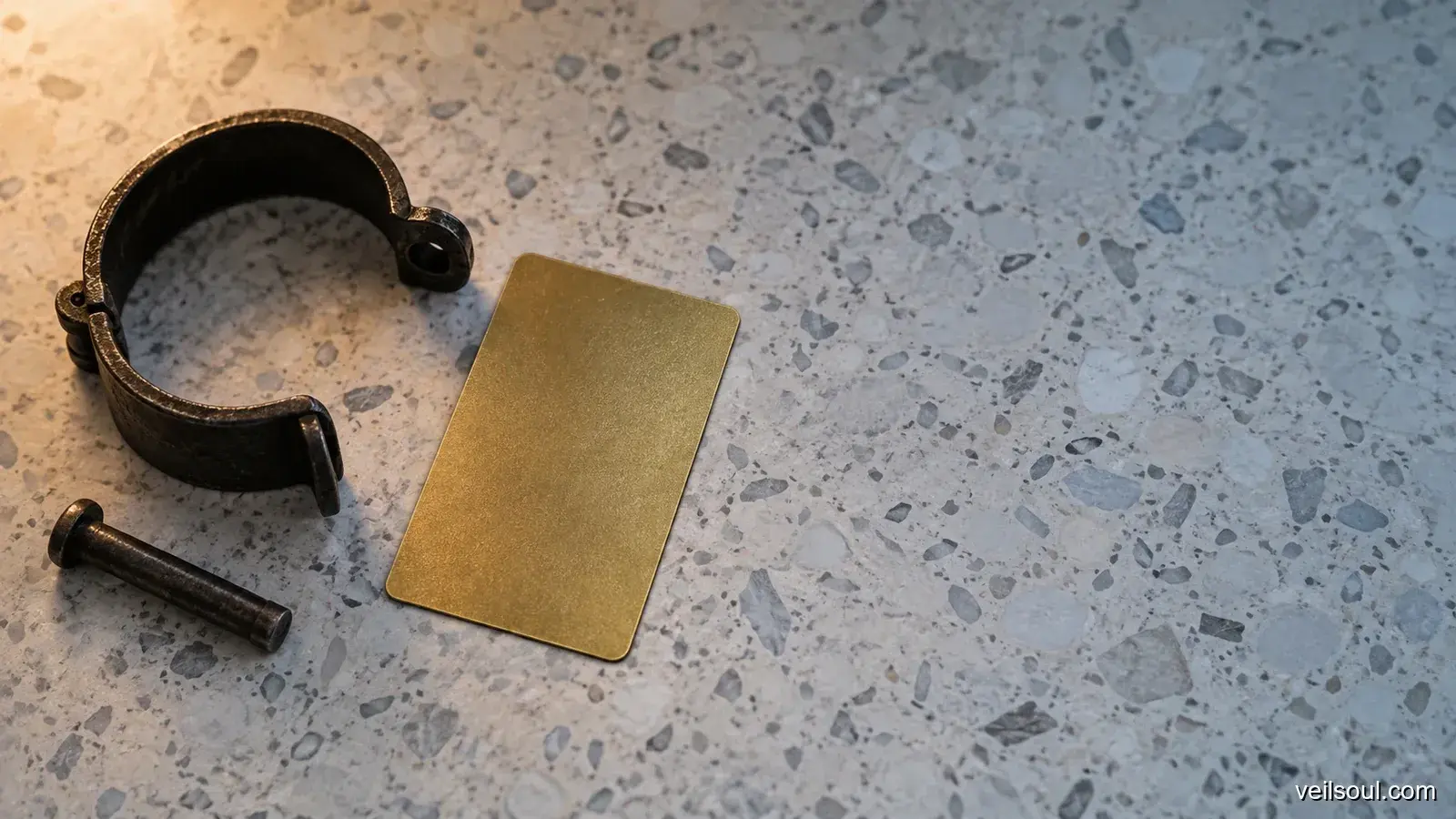
At work, The Devil upright often describes golden handcuffs: a salary, title or set of benefits that makes a draining job hard to leave. It can also point to a culture that runs on fear or constant availability. The card does not tell you to quit tomorrow. It asks you to name what you are trading for the paycheck and whether the trade still makes sense. Reversed, it shows you starting to negotiate, to plan an exit, or simply to log off at six.
Money
Financially, The Devil is the card of debt that dictates your choices, spending to fill an emptiness, or a fixation on piling up more than you need. It is also the card of earning ambition, which is not a fault on its own. Reversed, it suggests the beginning of a different relationship with money: a repayment plan, an honest budget, a spending habit you finally notice. A reading cannot replace a financial adviser; it can help you see the feeling behind the numbers.
Habits, the body and shadow work
Read The Devil in health questions as a card about habits, not a diagnosis. Upright, it can reflect patterns of excess or neglect: too little sleep, too much of something that soothes in the moment. Reversed, it can reflect the point where recovery begins and old routines start to change. If a habit is harming you or feels impossible to stop alone, a doctor or counselor is the right next step, and asking for that help is the reversed Devil in action.
Spiritually, The Devil is the card of shadow work. It warns against using calm practices to avoid what is uncomfortable, often called spiritual bypassing, and invites you to get to know the disowned parts of yourself with some kindness. The prompts in Tarot for Self-Discovery are a gentle place to begin, especially journaling about a reaction bigger than the moment called for.
Does The Devil say no? Yes-or-no and timing
Upright, The Devil is usually a no, or more precisely, not on these terms. If you ask whether to take a deal, return to an ex or accept an offer, the card suggests there is a hook in it worth finding before you agree. Reversed, it reads as yes to leaving, renegotiating or ending a pattern, and no to going back.
The Devil has little to say about dates. Some readers link it to Capricorn season, from late December to mid-January, and as a Saturn card it tends to describe slow, heavy stretches rather than sudden news. Its more useful timing advice is about sequence: release usually begins once you admit the pattern, not once circumstances change by themselves.
Three neighbors that explain card XV
The Devil makes the most sense beside the card it echoes and the two that frame it in the Major Arcana.
The Lovers: the same pair in an open garden
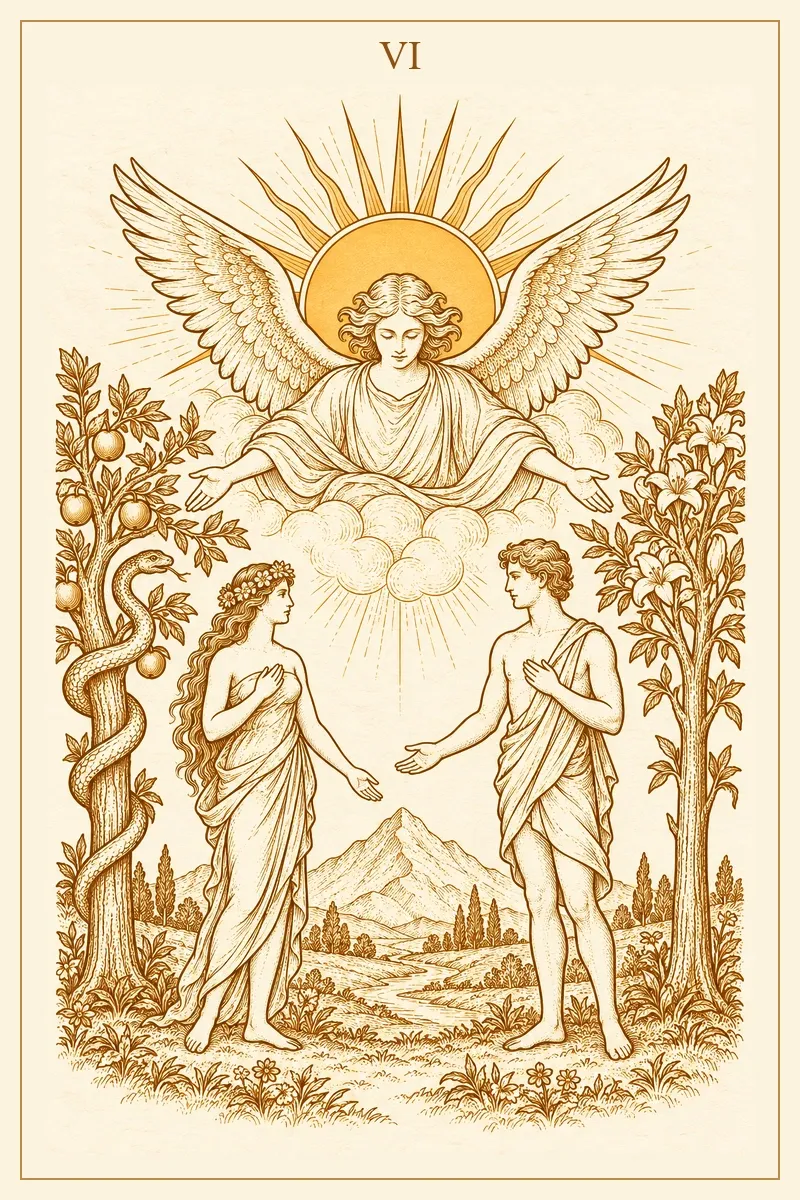
The Lovers, card VI, shows a man and a woman lightly draped in cloth, barefoot in a flowering garden below a mountain. Above them a winged figure spreads its arms in front of a blazing sun, and a serpent winds around the apple tree on the woman's side. The pair reach toward each other with open hands.
Side by side, The Devil looks like The Lovers gone wrong: the same two people and a figure overhead, but the open hands now grip chains. Fifteen also reduces to six (1 + 5). Where The Lovers card meaning is about choosing in line with your values, The Devil is what happens when the choice is handed to a craving. Together, they often ask whether a bond is love or need.
Temperance: the balance just before
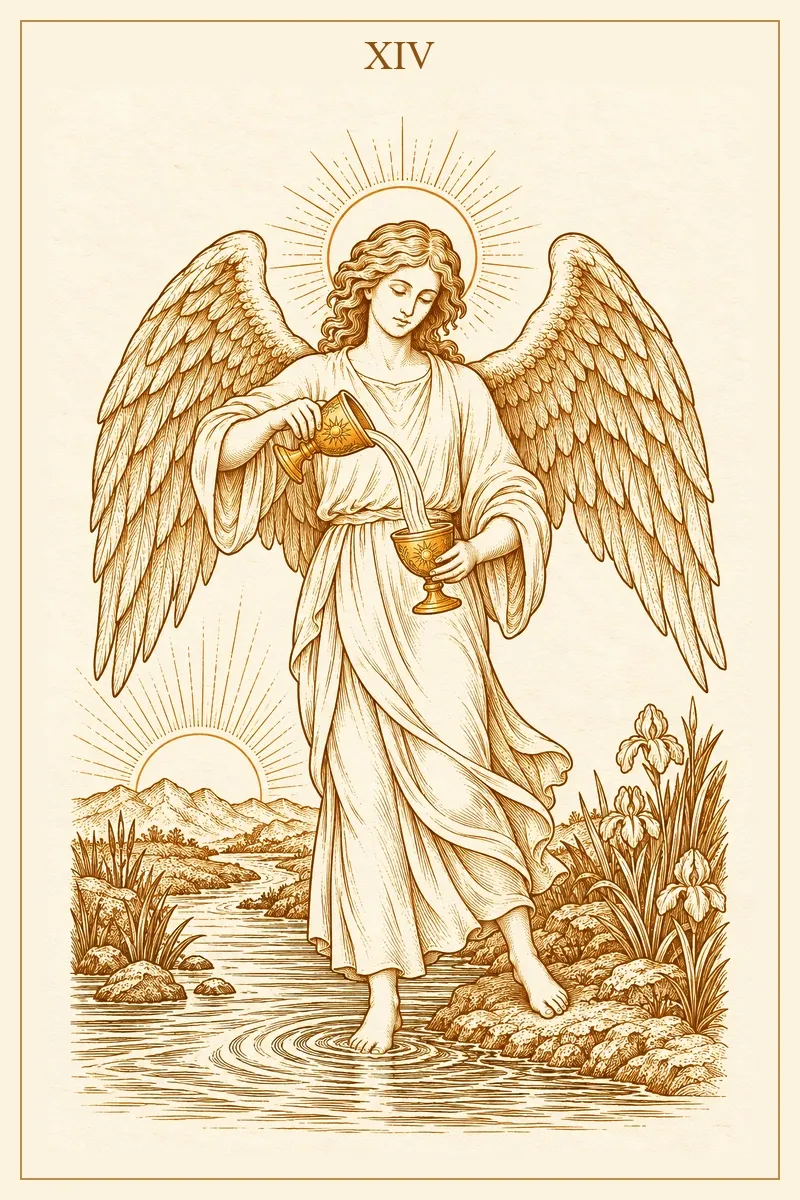
Temperance, card XIV, is a haloed, winged figure with one foot in a stream and one on the bank, pouring water from one golden cup into another without spilling while a sun rises over distant hills. It is the card of moderation and patient blending, described in depth in the Temperance card meaning.
The Devil follows it as its shadow. Temperance knows how much is enough; The Devil wants more. Drawn together, they often show a recovery in progress: the pull of excess and the daily practice that answers it, side by side.
The Tower: the release that comes after
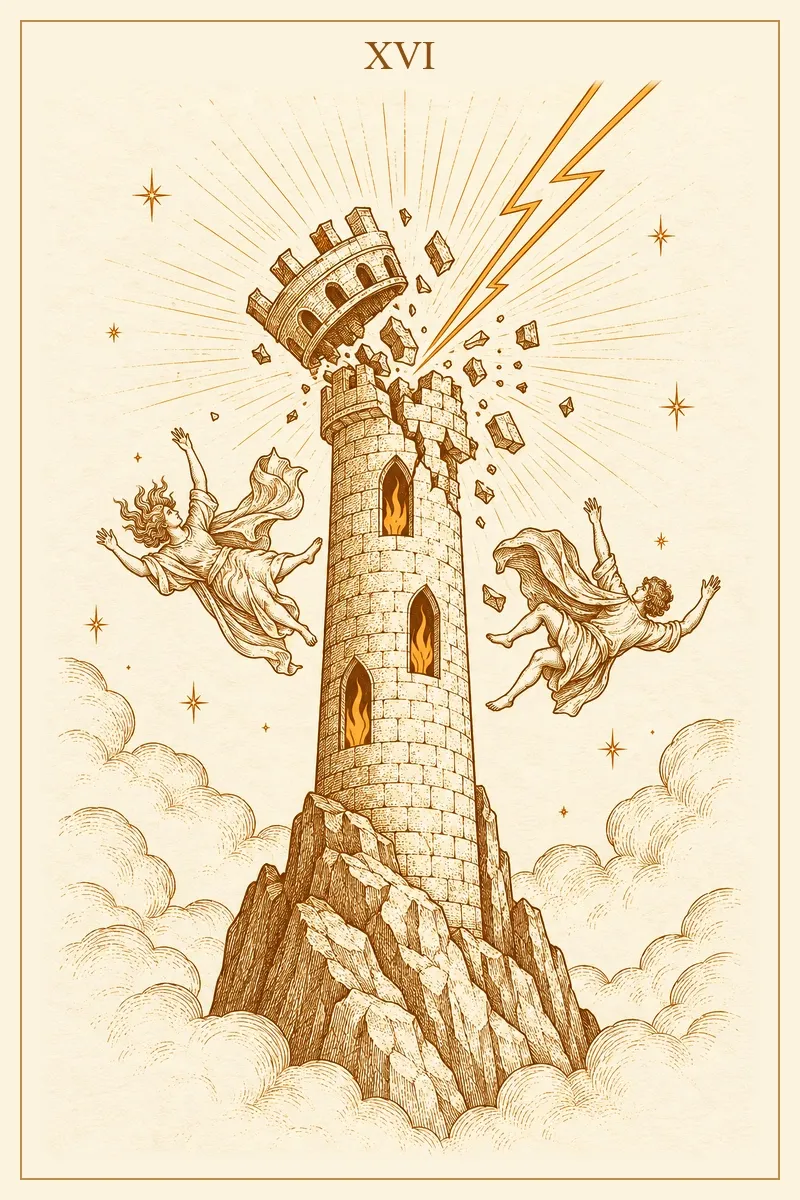
The Tower, card XVI, shows a stone tower on a rocky peak above the clouds. Lightning has knocked off its crowned top, flames burn in the windows, and two figures fall through the air among the stones. It is sudden, and it breaks what was built on something untrue, which The Tower card meaning treats as release as much as loss.
The Tower is what happens to a structure The Devil has kept in place too long. With both in a spread, the reading may be saying that a pattern is ending, and that ending it by choice is gentler than waiting for it to collapse.
Cards that tighten or loosen the chain
- The Devil with Strength: the instinct is still there, but it is handled with patience rather than obeyed. It is an encouraging pairing for anyone working on a habit, and the Strength card meaning describes that gentle kind of control well.
- The Devil with The Moon: a pattern rooted in fear or old confusion, hard to see clearly. Move slowly and check your assumptions with someone you trust.
- The Devil with the Eight of Swords: a double image of a trap that is looser than it looks; the limits live mostly in the story you are telling yourself.
- The Devil with the Six of Cups: a pull toward the past, such as an old flame, a childhood role or a family pattern that still runs the present.
- The Devil with the Ace of Swords: a moment of clear sight that cuts through denial, often the start of real change.
The Loose Chain Spread: five positions taken from the card
Use this spread when The Devil keeps appearing, or when you know something has a hold on you but cannot yet say what. Lay five cards in a row.
- The figure on the throne: what currently holds the power.
- The collar: where you feel it in daily life.
- The hand on the chain: what you do, or get, that keeps it in place.
- The crescent in the stone: the need or fear underneath the pattern.
- The flowers at the edge: a first step toward the life just outside the stone.
Position three is the one to sit with. It usually shows the payoff, the small reward that makes the pattern worth keeping, and it is rarely flattering. Read it kindly; everyone's chains give them something.
Reading it through: a salary that is hard to walk away from
The question: "The Devil has turned up in three readings about work this month. What is it pointing at?"
The cards drawn:
- The figure on the throne: Four of Pentacles
- The collar: Nine of Swords
- The hand on the chain: Ten of Wands
- The crescent in the stone: Five of Pentacles
- The flowers at the edge: Ace of Pentacles
Reading it: The Four of Pentacles on the throne names the hold plainly: the salary and the safety it buys, gripped tightly. The Nine of Swords shows where the collar bites, in Sunday-night dread and poor sleep. The Ten of Wands is the uncomfortable part. The person asking takes on every extra project so nobody can question their place, and that overload leaves no time to plan anything else.
The Five of Pentacles in the crescent position explains why: an old fear of being left out in the cold, perhaps learned in a household where money ran short. The salary is not really the chain; the fear is. The Ace of Pentacles offers a modest first step rather than a dramatic exit, such as a small savings buffer or one evening a week spent exploring other work. With a cushion in place, the grip can loosen, and the decision about the job becomes a choice again.
Questions for the chain you are holding
Carry one or two of these into a journal page or a quiet walk:
- What in my life do I feel controlled by, and what does it give me in return?
- Am I staying in a situation I have the power to leave, and what makes staying feel safer?
- Which feeling in myself am I most reluctant to admit?
- Where might I be confusing need with love, or dependence with security?
- What would one small step away from the throne look like this week?
Then act on them. Count the habit for seven days without trying to change it, since honest numbers are Ayin's eye at work. Tell one person you trust what you have noticed, choose a single specific change, such as no phone in the bedroom, and note how you feel a week later.
Frequently asked questions
Is The Devil a bad card to draw?
It is a challenging card, not a curse. It points to where you have less freedom than you want and shows that some of the hold is in your own hands, which is good news, because it means you can change it. Reversed, it is one of the clearest signs of release in the deck.
Does The Devil mean someone is manipulating me or cheating?
Not by itself. Tarot cannot confirm another person's thoughts, actions or intentions, and The Devil is no exception. In a relationship reading it describes a dynamic of control, secrecy or dependence worth looking at, often including your own part in it. If you have a specific worry, a direct conversation will tell you more than any spread.
What is the difference between The Devil and the Eight of Swords?
Both show people who could free themselves. The Eight of Swords is mainly about fear and limiting thoughts that keep you from acting. The Devil is about desire and attachment, being held by something you want or depend on. One freezes you; the other keeps pulling you back.
Can The Devil ever be a positive sign?
Yes, in the right context. Because it belongs to Capricorn and the element of earth, it also stands for appetite, sensuality and drive. With supportive cards it can mean healthy ambition, strong physical chemistry or enjoying pleasure without guilt. The question is always who is in charge: you, or the want.
Does the card have anything to do with evil or danger?
No. Despite its name and horns, The Devil in tarot is a symbol of human attachment, not a supernatural force, and drawing it does not put you at risk. If you are new to the cards and want to understand where images like this come from, this beginner's introduction to tarot explains how the deck is built.
Setting the chain down
The Devil does not ask you to fight yourself. It asks you to look at what you are holding, notice that your own hand is on the chain, and loosen your grip by one link. The flowers at the edge of the card are not far away. When you want to bring your own question to the cards, a quiet Veil Soul reading can help you see which hold is ready to ease.